
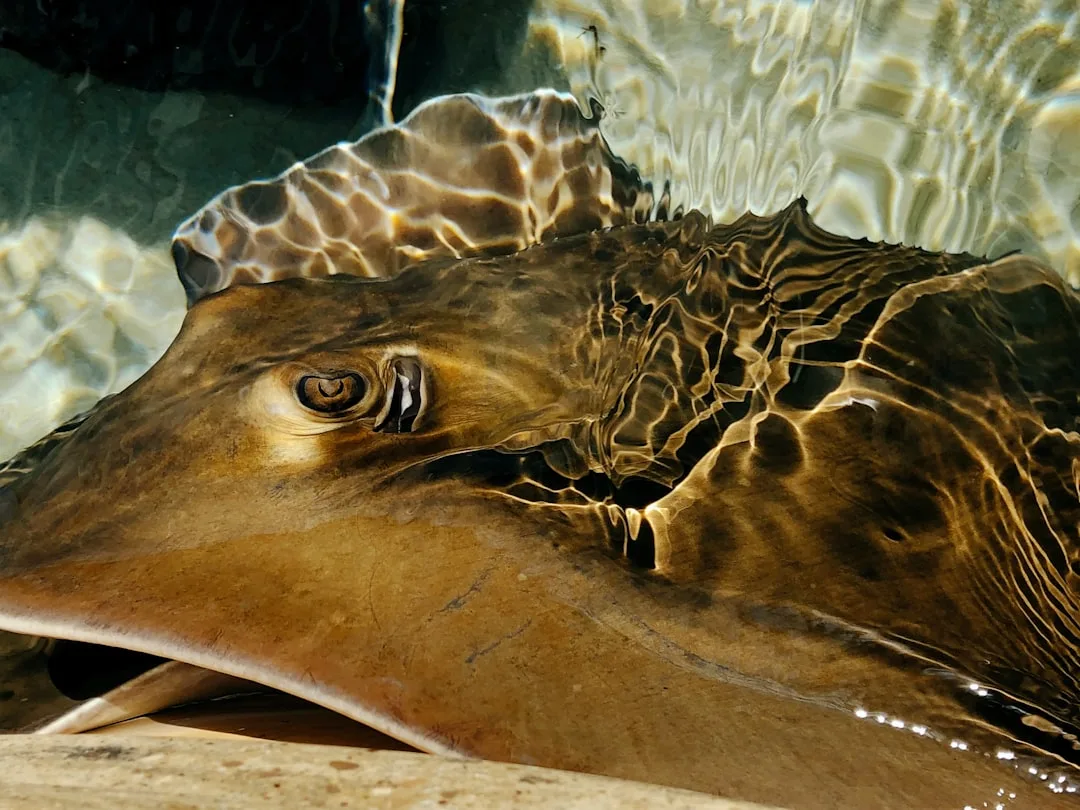
The southern stingray is one of the most recognisable cartilaginous fish on Earth. A broad, diamond-shaped disc glides along sandy Atlantic seabeds, a whip-like tail trails behind, and a pale underside marked with dark gill slits gives the animal a face so expressive that generations of aquarium visitors have sworn a southern stingray smiled at them.
Hypanus americanus is only one of roughly 220 ray species worldwide, but it serves as the public face of the group - familiar from Caribbean tourism, countless nature documentaries, and the unusually frank education that followed the 2006 death of wildlife broadcaster Steve Irwin.
This guide covers the full biology and ecology of the southern stingray and the broader ray lineage it represents: size, body plan, habitat, sensory physiology, diet, reproduction, venom and the tail barb, conservation status, and the complicated relationship between stingrays and humans. It is a reference entry, not a summary - so expect specifics: metres, pups per litter, years of life, venom chemistry, and verified case histories.
Etymology and Classification
The southern stingray was described in 1824 by Hill as Trygon americana and has moved through several genera since. For most of the twentieth century it sat in the genus Dasyatis. In 2016 a molecular revision split the old Dasyatis into several genera, and the southern stingray was moved to Hypanus. The current accepted scientific name is Hypanus americanus.
Many older books, aquarium signs, and field guides still use the older binomial Dasyatis americana, and both names refer to the same animal.
The full taxonomic ladder runs: Animalia - Chordata - Chondrichthyes - Myliobatiformes - Dasyatidae - Hypanus - H. americanus. Every rung in that ladder carries meaningful information. Chondrichthyes means the skeleton is cartilage, not bone - the same skeletal chemistry as a shark.
Myliobatiformes is the stingray order, containing around 220 living species arranged across whiptail rays, eagle rays, manta rays, river rays, butterfly rays, and cownose rays. Dasyatidae is the largest ray family, the whiptail stingrays, distinguished by long flexible tails armed with one or more venomous spines.
Stingrays diverged from sharks roughly 270 million years ago, deep in the Carboniferous. The two groups share a common ancestor but followed very different paths: sharks stayed as active mid-water predators, while rays flattened their bodies and took over the seabed. Today rays collectively outnumber sharks in species count, though sharks retain the larger cultural footprint.
Size and Physical Description
Southern stingrays are mid-sized by ray standards - smaller than a giant oceanic manta, far larger than a freshwater ocellate river ray.
Adults:
- Disc width: up to 1.5 metres; typical 0.8-1.2 metres
- Tail length: up to 2 metres beyond the body
- Total length: commonly 2-3 metres, up to ~3.5 metres
- Weight: up to 135 kg in large females
- Sexual dimorphism: females noticeably larger than males
Newborn pups:
- Disc width: 17-20 centimetres
- Fully formed with a functional barb, teeth, and electroreceptors
- Begin hunting within hours of birth
The body is a flattened disc formed from an enormously expanded pair of pectoral fins fused to the head. The eyes sit on top of the disc, allowing the animal to remain buried in sand with only the eyes and spiracles exposed. The spiracles, a pair of openings just behind the eyes, draw water through the gills when the mouth is pressed against the seabed - a crucial adaptation for a bottom-dwelling predator that cannot use its mouth to breathe while feeding.
The underside carries the mouth, five pairs of gill slits, and the nostrils. The famous 'face' of a stingray is an optical illusion created by the arrangement of these features on the pale belly. The two nostrils sit above the wide horizontal mouth, and the gill slits flare outward like cheek lines, producing a pattern that reads to the human eye as two eyes above a grinning mouth. The real eyes are on the dorsal surface, often hidden under a light dusting of sand.
Skin is covered in tiny tooth-like dermal denticles, the same kind of scales found on sharks. A line of larger thorn-like denticles runs down the midline of the back in adults, and the dorsal surface is typically olive, brown, or grey, sometimes with faint darker blotches, providing effective camouflage against sand and seagrass.
The Tail and the Venomous Barb
No feature of the stingray has drawn more attention, fear, and scientific study than the tail and its venomous spine.
The tail itself is a long, flexible, whip-like extension that can reach 2 metres in large southern stingrays. It is used for steering in open water, for communication during courtship, and - critically - as a defensive weapon. The base of the tail carries one or occasionally two serrated spines known as barbs or stingers.
Anatomy of the barb:
- Origin: modified dermal denticle - essentially a giant, elongated tooth-scale
- Material: vasodentine, a hard cartilage-derived substance
- Length in adults: 10-20 centimetres
- Surface: covered with backward-pointing serrations that tear flesh on withdrawal
- Coating: a thin integumentary sheath loaded with venom-producing glandular cells
The spine is not hollow like a snake fang. Venom sits in the sheath surrounding the spine and in grooves along the spine's sides. When the barb is driven into flesh, the sheath ruptures and venom is smeared deep into the wound. Because the barb is a dermal structure rather than a skeletal one, it can be shed and regrown. A healthy stingray will replace its barb once every six to twelve months, and old barbs are periodically found discarded on the seabed.
Venom composition and effects:
- Protein-based mixture including serotonin, phosphodiesterase, and 5-nucleotidase
- Causes intense local pain, muscle spasms, swelling, and slow healing
- Can trigger cardiovascular effects - bradycardia, hypotension, arrhythmia - at larger doses
- Heat-sensitive: denatures above roughly 45 degrees Celsius
Because the toxin is heat-labile, the standard first-aid treatment worldwide is to immerse the wounded limb in water as hot as the victim can tolerate without scalding (typically 40-45 degrees Celsius) for 30-90 minutes. The heat destroys the venom proteins and dramatically reduces pain. Wounds are then irrigated, inspected for barb fragments, and closely monitored for infection. Tetanus cover and antibiotics are standard.
The tail strike itself is a defensive reflex, not a deliberate hunting behaviour. A stingray that is stepped on, pinned, or cornered flexes its tail forward over its back in a scorpion-like arc and drives the barb into whatever is pressing down on it. Rays do not pursue swimmers, do not ambush humans, and do not use the barb on their prey - they have no reason to, since their food is bivalves and shrimp rather than anything large enough to fight back.
Habitat and Distribution
Southern stingrays live in shallow tropical and subtropical waters of the western Atlantic.
Range:
- Northern limit: New Jersey, USA (summer)
- Southern limit: southern Brazil
- Includes the Gulf of Mexico, Caribbean Sea, Bahamas, and Greater and Lesser Antilles
Preferred habitat:
- Sandy and muddy seabeds
- Seagrass meadows (particularly turtle grass, Thalassia testudinum)
- Edges of coral reefs and patch reefs
- Sheltered lagoons and estuaries
- Typical depth: 0-50 metres, occasionally down to about 70 metres
The species shows clear habitat preferences by life stage. Juveniles are strongly associated with shallow seagrass beds where prey is abundant and large predators are rare. Adults range more widely, using reef edges and open sand flats. During cooler months populations at the northern edge of the range migrate south or drop into deeper water, while tropical populations remain resident year-round.
Across the roughly 220 ray species, habitats span almost every marine environment plus major freshwater systems. River rays of the Amazon basin live hundreds of kilometres from the sea. Deep-water skates hunt at depths beyond 1,500 metres. Giant oceanic mantas migrate across ocean basins. The southern stingray's shallow-coastal lifestyle is the most familiar to humans precisely because it overlaps with beaches, snorkelling sites, and wade fishing grounds.
Sensory Biology - Hunting Under Sand
Stingrays are masterful predators of buried prey, and their success depends on an extraordinary set of senses that reaches beyond what most vertebrates possess.
Sensory toolkit:
| Sense | Structure | Function |
|---|---|---|
| Vision | Large dorsal eyes | Monitor predators, navigate, detect movement |
| Electroreception | Ampullae of Lorenzini (belly and mouth) | Detect electrical fields from hidden prey |
| Olfaction | Nostrils on underside | Track scent plumes drifting along the seabed |
| Mechanoreception | Lateral line | Detect vibration and water movement |
| Taste/touch | Sensory papillae around the mouth | Identify and manipulate food once captured |
The most remarkable of these is electroreception. The ampullae of Lorenzini are jelly-filled pores that open to the skin through tiny canals. Hundreds of them are arranged in dense clusters around the mouth and across the underside of the disc.
Each ampulla responds to the minute electrical fields produced by the muscle and nerve activity of any living animal in the vicinity - including bivalves breathing inside their shells, shrimp twitching beneath the sand, and small fish hiding in seagrass. Sensitivity is extreme: stingrays can detect fields on the order of nanovolts per centimetre.
The practical hunting sequence looks like this:
- The ray cruises slowly along the seabed, a few centimetres off the bottom.
- Jets of water pumped through the nostrils and mouth blow surface sand aside, exposing potential food.
- When a buried animal is detected by electroreception, the ray stops directly above it and presses its disc flat against the sand.
- The prey is pinned, drawn under the body by suction from the mouth, and crushed by flattened grinding teeth.
- Shell fragments and other indigestible matter are expelled through the gill slits.
The southern stingray's menu reflects this hunting style. Bivalves, gastropods, crabs, shrimp, polychaete worms, and small bony fish dominate the diet. Seasonal peaks in particular prey types drive local movements.
Reproduction and Life Cycle
Southern stingrays are ovoviviparous, a reproductive strategy intermediate between egg-laying and true live birth. Eggs develop inside the mother but draw initial nutrition from yolk rather than a placenta.
Reproductive sequence:
- Courtship. Males follow receptive females, sometimes in small groups, often biting the edges of the female's disc. Courtship scars are common on mature females.
- Mating. Internal fertilisation using a pair of claspers - modified pelvic fin structures - on the male. One clasper is inserted into the female's cloaca during mating.
- Gestation. Several months, varying with temperature and individual condition. Initial nutrition comes from yolk; later in pregnancy the mother produces a milky uterine secretion called histotroph that feeds the developing embryos.
- Birth. Eggs hatch internally and 2-10 fully formed live pups are born. Pups emerge with the tail and barb rolled up and the disc folded, then unfurl into a functional adult shape within minutes.
- Independence. No parental care after birth. Pups begin hunting immediately.
Sexual maturity is reached at approximately 4-6 years. Females typically reproduce every 1-2 years under good conditions. Reproductive output is far below that of most bony fish, which makes ray populations particularly vulnerable to overfishing.
Across the roughly 220 ray species reproductive strategies vary. Most stingrays are ovoviviparous. Skates, by contrast, lay leathery egg cases - the 'mermaid's purses' often washed up on beaches. Giant oceanic mantas produce a single pup every 2-3 years, the lowest reproductive output of any ray. River rays in the Amazon produce small live litters similar to southern stingrays.
Lifespan, Growth, and Mortality
Wild southern stingrays live an estimated 15-25 years. Ageing cartilaginous fish is notoriously difficult because their skeletons contain no permanent growth rings comparable to those in bony fish. Biologists estimate age from growth bands in the cartilaginous vertebral centra, validated where possible against tagged and recaptured individuals.
Mortality patterns shift with age:
- Pups and juveniles: Predation is the main cause of death. Large sharks - particularly hammerheads, bull sharks, and tiger sharks - are specialist stingray hunters. Large groupers and the occasional dolphin also prey on juveniles.
- Sub-adults: Fishing pressure begins to matter, particularly in regions with active artisanal fisheries.
- Adults: Main threats are commercial bycatch, targeted fisheries, entanglement, and habitat loss. Natural predation continues at lower rates, mostly from the largest sharks.
Across the ray order lifespans range from 5-10 years in small tropical species to 40 or more in giant oceanic mantas. The southern stingray sits comfortably in the middle of that range.
Conservation Status
The IUCN Red List classifies the southern stingray as Near Threatened. The assessment reflects documented population declines in several parts of its range, particularly in heavily fished regions of the Caribbean and south-western Atlantic, combined with the species' slow reproductive rate.
Principal threats:
- Fisheries. Southern stingrays are caught as bycatch in shrimp trawls, bottom longlines, and gillnets, and are targeted directly in some artisanal fisheries for meat and barbs. Slow reproduction makes population recovery difficult.
- Habitat loss. Seagrass meadows, the critical nursery habitat for juveniles, are declining across the Caribbean due to coastal development, pollution, boat scarring, and disease.
- Pollution. Coastal runoff, plastic debris, and chemical contamination affect shallow-water ecosystems that the species depends on.
- Climate change. Warming and acidification alter the distribution and abundance of bivalve and crustacean prey and can disrupt reproductive timing.
- Tourism pressure. Heavily visited aggregation sites such as Stingray City can suffer elevated injury rates, altered diet, and stress-related health effects if not well managed.
Across the ray order as a whole, conservation pressure is severe. A 2021 global assessment found that more than a third of all chondrichthyan species - including rays and sharks - face an elevated risk of extinction, driven primarily by fishing pressure. Several ray species, particularly sawfishes and some guitarfishes, are now among the most endangered vertebrates on Earth.
National regulations protect southern stingrays in some parts of the range. The Bahamas banned commercial shark and ray fishing in its waters in 2011, one of the strongest protections in the Caribbean. The United States regulates southern stingray fisheries under state authority. Enforcement is inconsistent across the broader range.
Stingrays and Humans
For most of recorded history the relationship between stingrays and humans has been cautious coexistence. Indigenous peoples across the Caribbean and Atlantic have fished stingrays for food for thousands of years and fashioned their barbs into points for arrows, spears, and ceremonial knives. Stingray tooth pavements and barbs appear regularly in archaeological sites from Florida to Brazil.
Modern encounters fall into a small number of well-defined categories.
Beach injuries. The most common human-stingray interaction is an accidental step on a partly buried ray in shallow water. The tail reflex drives the barb into the foot or ankle, producing a deep, jagged, intensely painful wound. Global data are incomplete but annual injury counts in the United States alone are estimated in the hundreds to low thousands.
Prevention is simple and effective: shuffle the feet across the sand while wading, which gives buried rays time to swim away before they are pressed.
Fatal incidents. Deaths from stingray strikes are rare but not unknown. The most famous is the 2006 death of Australian wildlife broadcaster Steve Irwin, who was swimming above a large bull ray off Batt Reef on the Great Barrier Reef when the animal struck upward, driving its barb through his chest and heart.
The case drew global attention to stingray safety and to the basic asymmetry of the interaction - Irwin was reviewing the ray for a documentary; the ray, from its own perspective, was defending itself against what it perceived as a predator hovering overhead. Historical records contain a handful of similar chest and abdominal fatalities spanning centuries and multiple ocean basins.
Tourism. Stingray City on the North Sound of Grand Cayman is the best-known stingray tourism site in the world. Wild southern stingrays have aggregated on the shallow sandbar for decades, originally drawn by fishermen cleaning their catches, now sustained by a well-organised provisioning operation. Visitors stand in waist-deep water while rays glide around them and accept squid from guide-supervised hands.
Similar provisioning sites exist in the Bahamas, Belize, and parts of Antigua. Research on Stingray City has documented effects of provisioning on diet, body condition, reproductive output, and parasite load, and management has been adjusted in response.
Public aquariums. Southern stingrays are among the most common display animals in touch pools and open-topped 'ray bays' in aquariums worldwide. Animals in these exhibits are typically captive-bred and have their barb tip trimmed - a procedure comparable to a fingernail clipping that does not harm the animal - to reduce risk to handlers and visitors.
Food. Stingray meat is eaten in parts of the Caribbean, South America, South-East Asia, and Oceania. Ray fisheries remain largely unregulated in many regions and contribute significantly to the species' declining status.
Rays as a Group
It would be misleading to discuss the southern stingray without setting it against its wider family. Rays are one of the two great lineages of cartilaginous fish, alongside sharks and chimaeras.
Key ray groups:
- Whiptail stingrays (Dasyatidae): ~90 species including the southern stingray. Characterised by long flexible tails and venomous barbs.
- Eagle rays (Myliobatidae): Fast, open-water swimmers with pointed pectoral 'wings' and pronounced snouts; includes the spotted eagle ray.
- Manta and devil rays (Mobulidae): Filter-feeding giants; the giant oceanic manta ray is the largest ray on Earth.
- Cownose rays (Rhinopteridae): Schooling mid-water rays; form spectacular migrations of thousands.
- Butterfly rays (Gymnuridae): Extremely wide, short-tailed rays with reduced barbs.
- River rays (Potamotrygonidae): Freshwater rays of the Amazon basin; among the most colourful and dangerous rays to fishermen.
- Skates (Rajidae and relatives): Lay leathery egg cases; generally lack venomous barbs.
- Electric rays (Torpediniformes): Use modified muscle tissue to produce strong electric shocks for hunting and defence.
- Sawfishes (Pristidae): Toothed rostrum; critically endangered across most of their former range.
- Guitarfishes and wedgefishes: Shark-like intermediate forms; several species critically endangered.
The roughly 220 named ray species collectively inhabit almost every marine and many major freshwater environments, from Arctic skates to Amazon river rays to deep-sea electric rays. They share a common body plan of enormous pectoral fins, ventral gill slits, dermal denticle skin, cartilaginous skeletons, and internal fertilisation - yet diverge radically in size, habitat, hunting style, and reproduction.
Related Reading
- Manta Rays: Gentle Giants of the Ocean
- Giant Oceanic Manta Ray
- Rays and Skates: The Graceful Gliders of the Ocean
References
Relevant peer-reviewed and governmental sources consulted for this entry include the IUCN Red List assessment for Hypanus americanus, the Shark and Ray Specialist Group status reports, published research in Journal of Fish Biology, Environmental Biology of Fishes, Marine Ecology Progress Series, and Toxicon, the Cayman Islands Department of Environment Stingray City monitoring programme, and the peer-reviewed forensic analyses following the 2006 Steve Irwin fatality.
Specific population and range figures reflect the most recent consolidated assessments available.
Frequently Asked Questions
How big are southern stingrays?
Adult southern stingrays (Hypanus americanus) reach a disc width of up to 1.5 metres, with females consistently larger than males. The whip-like tail can extend up to 2 metres beyond the body, giving a total length well over 3 metres in large individuals. Weight reaches around 135 kg in the biggest specimens. Newborn pups emerge at roughly 17-20 cm disc width and begin hunting within hours.
Among the roughly 220 ray species worldwide, the southern stingray is mid-sized - smaller than the giant oceanic manta ray (7+ metre wingspan) but much larger than the freshwater river rays of South America.
Are stingrays dangerous to humans?
Stingrays are not aggressive and do not hunt humans. Virtually every serious injury comes from a swimmer or wader accidentally stepping on a ray resting on the sand, triggering a defensive tail strike. The barb is a serrated, venom-coated spine that can drive through a wetsuit or muscle and leave jagged fragments in the wound. Infections are common and the venom causes intense pain, swelling, and sometimes cardiac or respiratory complications.
Fatalities are rare. The most famous case is the 2006 death of wildlife broadcaster Steve Irwin, killed by a barb strike to the chest off the Great Barrier Reef. Most beach injuries can be prevented by shuffling the feet through the sand - the ‘stingray shuffle’ - which warns buried rays to swim away before they are stepped on.
Where do southern stingrays live?
Southern stingrays inhabit shallow tropical and subtropical waters of the western Atlantic, ranging from New Jersey in the north through the Gulf of Mexico and Caribbean Sea to southern Brazil. They favour sandy and muddy bottoms, seagrass meadows, and the edges of coral reefs, typically at depths of less than 50 metres. They are most abundant in the Bahamas, Florida, the Caribbean islands, and the coastal Gulf.
During cooler months some populations migrate south or move into deeper water, while others aggregate in warm shallow estuaries and lagoons where prey is concentrated.
What do stingrays eat and how do they find food?
Southern stingrays are benthic carnivores. Their diet consists mainly of bivalves, crabs, shrimp, polychaete worms, and small bony fish buried in the sand or hiding in seagrass. The ray cruises just above the seabed and locates prey using two senses that work underground. First, jets of water pumped through the nostrils and mouth blow sand away from potential food.
Second, an array of gel-filled pores called ampullae of Lorenzini, concentrated around the mouth and on the underside of the disc, detects the faint electrical fields produced by the muscle activity of hidden animals. Once located, prey is pinned against the sand, drawn under the ray’s body, and crushed by flattened grinding teeth.
How do stingrays reproduce?
Southern stingrays are ovoviviparous. Eggs are fertilised internally using a pair of claspers on the male’s pelvic fins, and the embryos develop inside the mother in leathery egg capsules. The embryos are first nourished by yolk, then by a milky uterine secretion known as histotroph that the mother produces. After a gestation of several months the eggs hatch inside the mother and she gives birth to 2-10 fully formed live pups.
Newborns are miniature versions of the adults, complete with a functional barb, and receive no further parental care. Females typically reach sexual maturity at 4-6 years.
How long do stingrays live?
Wild southern stingrays are estimated to live 15-25 years, though accurate ageing of cartilaginous fish is difficult and some individuals may live longer. Captive animals in well-run public aquariums have reached the upper end of that range or beyond thanks to reliable food and veterinary care. Lifespan varies widely across the roughly 220 ray species worldwide: some small freshwater species live only 5-10 years, while giant oceanic mantas exceed 40 years.
Mortality in young stingrays is driven mainly by predation from sharks and large groupers, while adults face threats from commercial and recreational fisheries and habitat degradation.
Are stingrays related to sharks?
Yes, very closely. Stingrays and sharks both belong to the class Chondrichthyes, the cartilaginous fishes, which means their skeletons are made of flexible cartilage rather than bone. Both groups share the same general body plan beneath the surface: five to seven pairs of gill slits, skin covered in tooth-like dermal denticles, internal fertilisation via claspers, and the electroreceptive ampullae of Lorenzini.
A stingray is essentially a shark flattened into a disc, with enormously expanded pectoral fins fused to the head. Rays diverged from sharks roughly 270 million years ago, and today the roughly 220 ray species collectively outnumber shark species.
What is Stingray City?
Stingray City is a shallow sandbar on the North Sound of Grand Cayman in the Cayman Islands where wild southern stingrays congregate to be fed squid by snorkellers and divers. The aggregation originated decades ago when local fishermen cleaned their catches in the protected lagoon, attracting rays that learned to associate boats with food.
Today dozens of habituated rays approach visitors in waist-deep water and can be touched and hand-fed under guided supervision. The site is one of the world’s best-known marine wildlife tourism operations and a significant source of income for the Cayman Islands. Researchers monitor the population closely to track effects of provisioning on the animals’ health, behaviour, and reproductive output.