
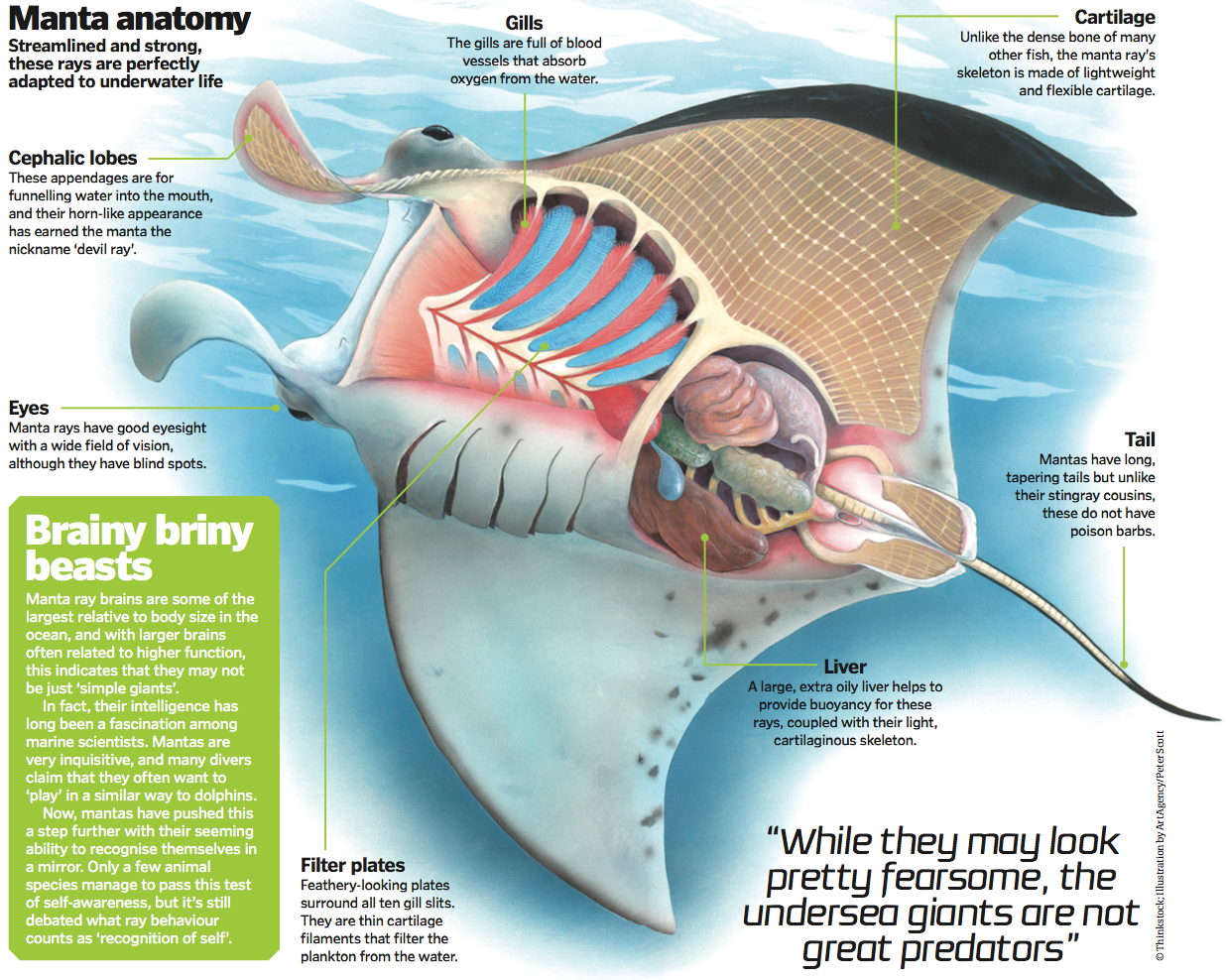
The giant oceanic manta ray is the largest ray species in the world, a circumglobal filter feeder with a wingspan that routinely exceeds five metres and, in extreme cases, passes nine.
It is a plankton eater the size of a small aircraft, with a brain proportionally larger than that of any other fish, cultural loyalty to specific cleaning stations, and a reproductive rate so slow that losing one adult to a fishing net costs the population years of recovery.
Mobula birostris occupies a strange position in marine biology: it is vast, gentle, cognitively sophisticated, and catastrophically vulnerable all at once.
This guide covers every aspect of giant manta biology and ecology: size, taxonomy, feeding, behaviour, cognition, migration, cleaning stations, reproduction, conservation status, and the human pressures that have driven the species from Vulnerable to Endangered within a single generation of research. It is a reference entry, not a summary - expect specifics: metres, kilograms, months of gestation, decades of lifespan, and individual animals tracked across oceans.
Etymology and Classification
The species was first described as Raja birostris by Johann Julius Walbaum in 1792. The genus name Mobula derives from a Portuguese name for devil rays, and birostris refers to the paired cephalic lobes that project forward from the head like a second pair of horns. Older literature places the animal in its own genus, Manta, as Manta birostris.
A 2017 molecular phylogenetic study by White and colleagues demonstrated that the Manta genus was nested inside Mobula and could not stand alone, so the entire genus was collapsed. The correct modern name is Mobula birostris, though Manta birostris persists in older sources and popular writing.
Two species of manta ray are currently recognised:
- Mobula birostris - the giant oceanic manta, pelagic, circumglobal, 5-7 m wingspan
- Mobula alfredi - the reef manta, coastal, Indo-Pacific, typically 3-4 m wingspan
A third candidate species, sometimes informally called the Caribbean manta, is recognised by some researchers based on genetic and morphological differences but has not yet been formally described. All mantas belong to the family Mobulidae, which also contains the nine or so smaller devil ray species.
In European maritime tradition, giant mantas were once called devil fish - not because they were dangerous but because the forward-curling cephalic lobes looked disturbingly like horns. The name survives in the family's common name (devil rays) and in several regional languages. Pacific and Indian Ocean cultures tend to have more neutral or reverent names, and in some Polynesian traditions mantas are guardian spirits.
Taxonomy and Relatives
Mantas are cartilaginous fish, cousins of sharks rather than bony fish, and they sit within the order Myliobatiformes, which contains stingrays and their allies. Despite this shared lineage, mantas look and behave almost nothing like a typical stingray. They are pelagic, not benthic. They filter feed, rather than hunt crustaceans on the sea floor. Their tails carry no functional sting.
Their body form is an aerofoil optimised for powered gliding through open water, while stingrays are flat-bottomed discs adapted to seabed life.
The closest relatives of mantas are the other members of Mobulidae - the smaller devil rays of the genus Mobula (as it stood before 2017) - which share the same filter-feeding mouth architecture and open-ocean lifestyle.
Size and Physical Description
Giant oceanic mantas are the largest rays on Earth. Size differences between the sexes are modest but measurable, with females running slightly larger than males on average.
Adults:
- Wingspan (disc width): 5-7 metres typical
- Largest reliably recorded: 9.1 metres
- Weight: 1,400-2,000 kg
- Disc length (nose to tail base): approximately half the wingspan
Newborn pups:
- Wingspan: 1.4-1.9 metres
- Weight: 9-12 kg
- Emerge rolled like a burrito and unfurl within seconds of birth
The body plan is unmistakable. A broad triangular disc is fringed with two enormous pectoral fins that function as wings. The head is flattened and flanked by the cephalic lobes, which the animal rolls into horn-like tubes when swimming normally and unfurls into paddle shapes during feeding.
The mouth is terminal (at the front, not underneath), which is unusual among rays and reflects the switch to filter feeding in open water. The tail is a slender whip carrying no functional barb in M. birostris, though a small non-venomous spine is present in some individuals.
Coloration is counter-shaded. The dorsal (upper) surface is dark - black, charcoal, or deep navy - and the ventral (lower) surface is white with a constellation of dark spots. Two common colour morphs exist: the typical "chevron" morph with a white ventral surface, and a rare "black" morph in which both sides are dark. The belly spots are the most important feature for researchers, because the pattern is unique to each individual and stable throughout life, serving as a biological fingerprint.
Cephalic Lobes and the Feeding Apparatus
The defining feature of a manta is the pair of cephalic lobes that extend forward from either side of the head. These lobes are modified sections of the pectoral fin that, during embryonic development, separate out and migrate to the head. In cruising swim they are rolled up into neat spirals, which reduces drag. During feeding they unfurl into flat paddles that act as funnels, directing water into the mouth and trapping plankton against the gill rakers.
The gill rakers themselves are delicate plate-like structures lining each of the five gill slits. They form a fine mesh that strains zooplankton out of the water while letting water pass. Unlike baleen in whales, which is keratin, manta gill rakers are cartilaginous and highly vascularised.
It is these gill rakers that are targeted by the traditional Chinese medicine trade, and because an adult manta carries relatively little gill raker tissue by mass, enormous numbers of animals must be killed to supply the market.
Feeding and Diet
Mantas are obligate filter feeders. They cannot hunt individual prey items the way sharks do, and their survival depends on finding water rich enough in plankton to make filtration energetically worthwhile. A single adult filters tens of thousands of litres per hour.
Primary prey:
- Copepods and other small crustaceans
- Krill (euphausiids)
- Mysid shrimps
- Chaetognaths (arrow worms)
- Fish eggs and larvae
- Small schooling fish on occasion
Feeding techniques:
- Straight swimming feed. The manta cruises in a straight line through a dense plankton patch with its mouth open and cephalic lobes unfurled. The simplest and most common method.
- Somersault feeding. When a plankton patch is thick, the animal performs tight backward loops, passing through the same patch repeatedly. Sometimes entire groups somersault in synchrony.
- Chain feeding. Multiple mantas line up nose-to-tail and feed through a corridor, each benefiting from the wake and turbulence created by the one in front.
- Cyclone feeding. In particularly rich conditions dozens of mantas may circle together, creating a vortex of water that concentrates plankton in the middle of the spiral.
- Deep feeding. Tagging studies have shown giant mantas regularly diving to 200-400 metres, and sometimes beyond 1,000 metres, to feed on mesopelagic zooplankton that are invisible from the surface.
The discovery that mantas feed heavily at depth has reshaped scientific understanding of the species. For decades they were considered shallow surface feeders. Modern satellite and acoustic telemetry shows that most of their caloric intake may come from the deep scattering layer, which rises toward the surface at night and sinks by day.
Cognition and the Mirror Test
Manta rays have the largest brain-to-body mass ratio of any fish. The brain is not only large in absolute terms (a giant manta brain is roughly the size of a grapefruit), but enriched specifically in the regions associated with learning, sensory integration, and social behaviour. The cerebellum and telencephalon are particularly developed, which aligns with the animal's complex foraging behaviour, long-distance navigation, and structured social life.
A 2016 study by Csilla Ari and Dominic D'Agostino at the University of South Florida reported that two captive giant mantas presented with a mirror exhibited behaviour consistent with self-recognition: unusual, contingent movements in front of the mirror, and behaviours not directed at the reflection as though it were a conspecific.
If correct, this would make mantas the only fish known to pass the mirror self-recognition test. The result has been disputed, and replications are difficult because of the practical problems of testing such large animals. Even sceptics agree that manta cognition appears to sit well above that of most fish.
Field observations consistently support the idea of a cognitively sophisticated animal. Mantas show long-term site fidelity, recognise and avoid specific boats that have disturbed them previously, approach unfamiliar objects with investigative rather than fleeing behaviour, and form stable associations with particular individuals that can persist across years.
Cleaning Stations and Social Behaviour
Cleaning stations are one of the most important social features of manta life. A cleaning station is a specific location on a reef - typically a coral head or rocky outcrop at 5-25 m depth - where small wrasses and other reef fish perform parasite removal on larger fish that visit. Mantas travel to and queue at these stations, hovering almost motionless above the reef while wrasses enter the gill slits, nip parasites off the skin, and clean the cloaca.
Individual mantas show extraordinary loyalty to specific stations. Photo-identification databases in the Maldives and Mozambique have documented the same animals returning to the same rocks for decades. Station preference is so consistent that researchers can predict which individuals will appear at which station, and in what time window, based on multi-year records.
| Behaviour | Typical duration / distance |
|---|---|
| Cleaning session | 3-30 minutes per visit |
| Cleaning station visits | Near-daily during feeding season |
| Site fidelity | Multi-year, often lifetime |
| Aggregation size | 1-50 animals per station (peak events) |
Mantas also form loose social associations. Stable pairs and small groups are observed at feeding sites. Juvenile mantas gather in nursery areas such as the Gulf of Mexico off Florida, Yucatan waters, and parts of Indonesia. Adults aggregate seasonally to feed and to court, with mating trains in which a female is followed by a chain of up to thirty males forming a distinctive behavioural display.
Reproduction and Life Cycle
Manta reproduction runs on one of the slowest schedules of any large marine vertebrate. Courtship, mating, gestation, and parental investment are all drawn out, and the resulting reproductive rate is so low that population recovery after any significant loss takes decades.
Courtship:
- Mating trains form with one female leading multiple males
- Male chases can last several days
- Courtship ends with the leading male grasping the female's left pectoral fin with his mouth and mating upside down beneath her
Gestation and birth:
- Fertilisation is internal via paired claspers on the male
- Pregnancy lasts approximately 12 months
- Mantas are ovoviviparous: the embryo develops inside a thin egg capsule within the mother's uterus, then hatches internally and is born live
- Litter size is almost always one pup, rarely two
- Females typically reproduce every 2-3 years, sometimes less often
Maturation:
- Males mature at an estimated 6-9 years
- Females mature at 8-10 years or more
- Full adult size may not be reached for 15+ years
A mature female in optimal habitat with no human pressure might produce 10-15 pups over her lifetime. In most real populations the figure is lower. When the baseline reproductive rate is combined with late maturity and high adult mortality from fishing, the mathematics of population growth turn sharply negative very quickly.
Migration, Movement, and Range
Mantas are capable of sustained long-distance travel. Satellite telemetry has documented individuals covering more than 1,100 km between aggregation sites, and some tracked animals move across entire ocean basins over seasons. Migration is driven primarily by plankton productivity, which depends on water temperature, upwelling, and seasonal currents.
| Metric | Value |
|---|---|
| Typical cruising speed | 9-14 km/h |
| Burst speed | ~24 km/h |
| Longest tracked migration | >1,100 km over several months |
| Recorded maximum depth | >1,000 m (rare deep feeding dives) |
| Typical feeding depth range | 0-400 m |
Movement patterns differ between the oceanic (M. birostris) and reef (M. alfredi) mantas. Oceanic mantas spend most of their time offshore and only aggregate predictably at a small set of productive sites such as seamounts, upwelling zones, and island wakes. Reef mantas are more resident, cycling between coastal cleaning stations and nearshore feeding areas within a few hundred kilometres of home.
Populations and Conservation Status
Giant oceanic mantas are globally distributed but nowhere abundant. Population estimates are difficult because the species is pelagic, widely distributed, and difficult to survey, but current global figures suggest tens of thousands of mature individuals - a small number for a circumglobal species. Regional populations have declined by 50-95% at key sites over the past decades.
IUCN status timeline:
- 2011: Listed as Vulnerable
- 2020: Uplifted to Endangered following new assessments
- CITES Appendix II: listed since 2013 to regulate international trade
Primary threats:
- Targeted fishery for gill rakers. Demand from the traditional Chinese medicine market for gill raker products (often sold as "peng yu sai") drove targeted fisheries in Indonesia, Sri Lanka, India, and parts of East Africa. Peak catches at some sites ran to thousands of animals per year.
- Bycatch. Mantas are killed in large numbers as bycatch in tuna purse seine fisheries, gillnets, driftnets, and longlines. Even when released alive, post-release mortality is high.
- Boat strikes. Collisions with tourism vessels and fishing boats at aggregation sites leave characteristic scars on many individuals and kill an unknown but non-trivial fraction.
- Fishing gear entanglement. Mantas frequently trail monofilament line, ropes, and nets that cut into the skin and slowly starve or infect the animal.
- Climate change. Shifts in upwelling patterns and plankton productivity affect the locations and timing of aggregations. Bleaching of coral reefs that support cleaning stations has indirect effects on reef manta populations in particular.
- Tourism disturbance. Mantas are major tourism drawcards at sites such as Kona (Hawaii), Nusa Penida (Indonesia), Hanifaru Bay (Maldives), and Isla de la Plata (Ecuador). Well-managed tourism is broadly positive, but crowding, touching, and poorly controlled boat traffic cause stress and injury.
Conservation measures include CITES listing, national protection laws (Ecuador, Indonesia, Philippines, Mexico, and others have full protection), designated marine protected areas at key aggregation sites, and international efforts under the Convention on Migratory Species. Some of these measures have produced measurable recoveries at site level, particularly where aggregation points have been protected and monitored.
The long-term outlook depends on sustained pressure against the gill raker trade, continued reduction of bycatch in tuna fisheries, and careful management of the tourism industry that now depends on the species.
Mantas and Humans
Human relationships with giant mantas are contradictory. The animal has no defensive weapons, no teeth capable of serious harm, no aggressive behaviour toward swimmers, and a long record of calm, curious encounters with divers. No documented manta attack on a human exists. Despite this gentle reality, European sailors long feared them as "devil fish" capable of capsizing boats, and the name persists in some languages.
Modern non-commercial encounters with mantas are almost universally positive. Divers at sites such as the Kona night-feeding stations, Socorro, and Hanifaru Bay report close, prolonged interactions in which individual mantas circle, hover, and appear to examine the humans in the water. Photo-identification programmes depend heavily on citizen-science contributions from dive tourists, and long-running catalogues now contain tens of thousands of identified individuals.
Commercial pressure tells the opposite story. The targeted gill-raker fishery that devastated Indo-Pacific populations during the 2000s and early 2010s was driven almost entirely by a single urban market in Guangzhou, China. Investigative work by WildAid, the Manta Trust, and others has documented the trade in detail and informed the successful CITES listing in 2013. Ongoing reductions in demand, combined with targeted bycatch mitigation, are the best available levers for population recovery.
Related Reading
- Ocean Giants: Filter Feeders of the Open Sea
- Cartilaginous Fish: Sharks, Rays, and Chimaeras
- Cleaning Stations: The Reef's Invisible Infrastructure
- Reef Manta Ray: The Coastal Cousin
References
Peer-reviewed and governmental sources consulted for this entry include the IUCN Red List assessment for Mobula birostris (2020), the 2017 phylogenetic revision by White and colleagues published in the Zoological Journal of the Linnean Society, cognition research by Ari and D'Agostino (2016) in the Journal of Ethology, migration and deep-diving studies published in Marine Biology and Royal Society Open Science, and status reports from the Manta Trust, WildAid, and the Convention on Migratory Species Sharks MOU.
Population figures and conservation status reflect the most recent consolidated assessments available.
Frequently Asked Questions
How big are giant oceanic manta rays?
Adult giant oceanic mantas (Mobula birostris) typically measure 5-7 m across from wingtip to wingtip and weigh 1,400-2,000 kg. The largest reliably measured specimen spanned 9.1 m, which places the species well ahead of every other ray and among the largest fish in the ocean after whale sharks and basking sharks. Females are slightly larger than males on average.
Newborn pups already emerge with a disc width of around 1.4-1.9 m and weigh roughly 9-12 kg, meaning even a newborn manta is larger than most adult rays of other species.
What do manta rays eat?
Manta rays are obligate filter feeders. They cruise through plankton-rich water with their mouths held open, using a pair of forward-projecting cephalic lobes to funnel seawater into the mouth and out across gill rakers that trap prey. Their diet consists mainly of copepods, krill, mysid shrimp, crab and fish larvae, and occasional small schooling fish. A single adult may filter more than 60 cubic metres of water per hour.
Research in Indonesia and the Maldives has shown mantas also feed on mesopelagic zooplankton at depths of 200-400 m, which shifts previous assumptions about them as purely surface feeders.
Where do manta rays live?
The giant oceanic manta inhabits tropical, subtropical, and temperate oceans worldwide, ranging roughly between 40 degrees north and 40 degrees south latitude. It is genuinely circumglobal, with confirmed records from the Atlantic, Pacific, and Indian Oceans as well as the Red Sea. Important aggregation sites include the waters around Ecuador and the Revillagigedo Islands, the Azores, the Philippines, Indonesia, the Maldives, and Mozambique.
Giant mantas are primarily pelagic and spend most of their time in open water, but they gather predictably at productive coastal sites such as seamounts, reef edges, and upwelling zones. The smaller reef manta (Mobula alfredi) occupies more restricted coastal habitats.
Are manta rays endangered?
Yes. The IUCN Red List uplifted the giant oceanic manta from Vulnerable to Endangered in 2020, and the reef manta is listed as Vulnerable with a decreasing population. The primary threat is targeted and bycatch fishing driven by demand for gill rakers in the traditional Chinese medicine market. Mantas are also killed in gillnets and purse seines set for tuna and other species, struck by boats, and entangled in fishing gear and marine debris.
Their very slow reproductive rate - one pup every two to three years - means any population can take decades to recover from even a few years of heavy fishing pressure.
How long do manta rays live?
Giant oceanic mantas are long-lived fish. Photo-identification studies using individual spot patterns have tracked the same animals for more than 40 years, and current estimates suggest a natural lifespan of at least 40 years and possibly considerably more. Exact maximum ages are hard to determine because ageing cartilaginous fish is difficult and because few individuals have been followed from birth.
Mantas also mature very slowly: females are not believed to reproduce until they are 8-10 years old or more, and males mature a few years earlier.
Are manta rays dangerous to humans?
No. Manta rays have no stinging barb, no teeth capable of harming a person, and no defensive aggression toward divers. Encounters are almost universally calm and often curious, with individual mantas circling, hovering, and returning to watch swimmers. The old ‘devil fish’ reputation comes from the cephalic lobes resembling horns and from the species’ sheer size, not from any real threat.
The opposite is the larger concern: mantas at popular tourism sites can be disturbed, crowded, or injured by poorly managed boat traffic, so most serious dive operators now follow strict codes such as staying below the animal and never touching or chasing it.
What is the difference between manta and stingray?
Manta rays and stingrays belong to the same order (Myliobatiformes) but occupy very different ecological roles. Stingrays are usually smaller, bottom-dwelling, and armed with one or more venomous barbs used for defence. Mantas are pelagic filter feeders, have no functional sting, and are orders of magnitude larger.
Manta rays also have the forward-projecting cephalic lobes that give the head its distinctive horn-like appearance, a structure absent in true stingrays. Genetic analysis in 2017 collapsed the former Manta genus into Mobula, placing mantas with the devil rays rather than with stingrays in the strictest sense.
Why do manta rays breach?
Nobody knows for certain. Giant manta rays routinely launch themselves clear of the water, sometimes two metres or more above the surface, before crashing back down in three characteristic postures (belly flop, back flop, and somersault). Proposed explanations include dislodging parasites or remoras, communicating across long distances through the impact sound, courtship display, coordinating group feeding, or simply play.
Observations of juvenile mantas breaching repeatedly and of entire aggregations breaching together make a single explanation unlikely, and the behaviour probably serves several functions depending on context.