
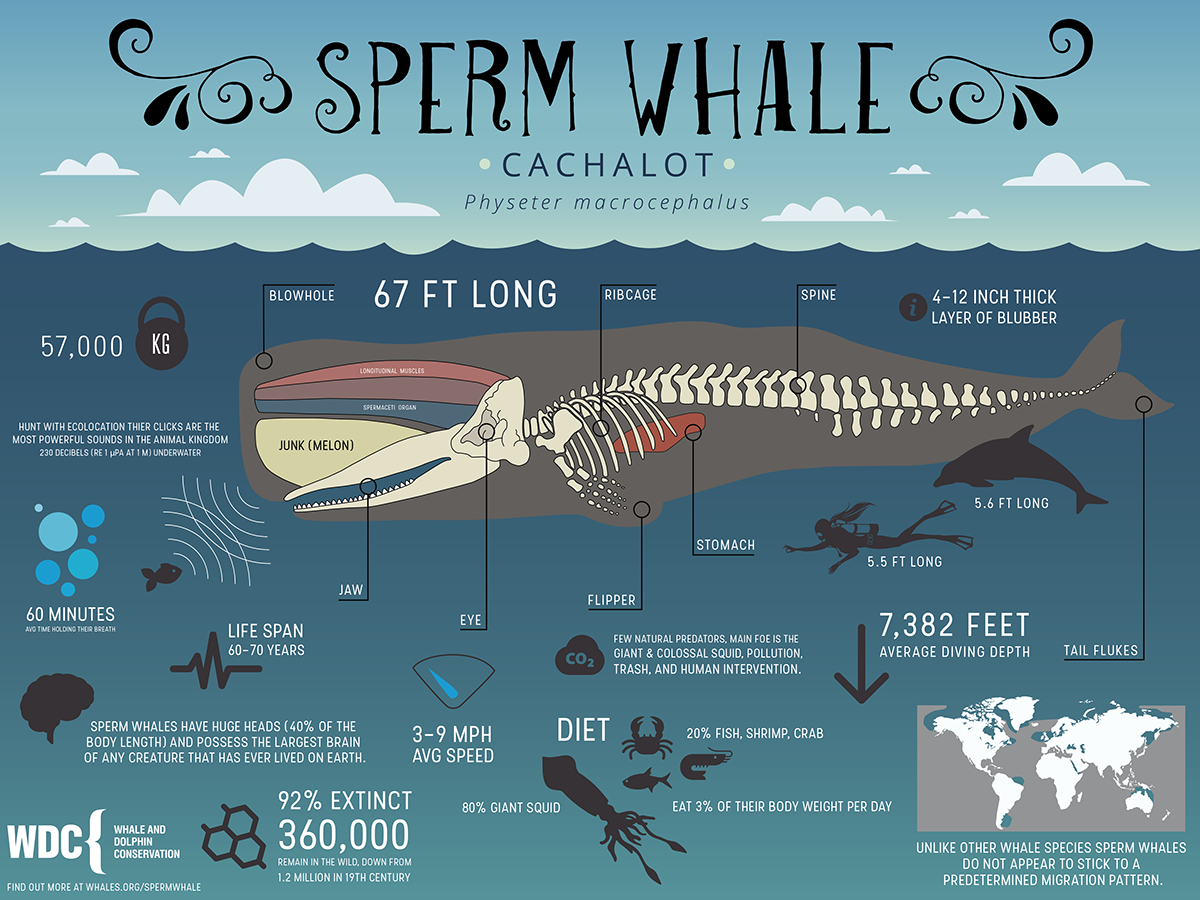
How deep do sperm whales dive?
Sperm whales (Physeter macrocephalus) routinely dive to depths of 1,000-2,000 meters and have been recorded at 2,250 meters - the deepest confirmed dive of any mammal. They hold their breath for 90 minutes during these extreme dives. Their dives are triggered by hunting for giant squid and other deep-sea prey.
The Whale That Hunts in the Abyss
A sperm whale takes one deep breath at the ocean surface, then disappears beneath the waves. Over the next 90 minutes, it descends 2,250 meters - more than 2 kilometers straight down. Down there, in crushing darkness with no sunlight ever reaching the water, it hunts giant squid using one of the most powerful sonars in nature. When the hunt is complete, it returns to the surface with prey it captured in an environment no other air-breathing animal could survive.
This is the sperm whale - the real-world animal that inspired Moby Dick, the deepest diver among mammals, the producer of the loudest sounds in any living creature, and the owner of the largest brain ever evolved.
Size and Structure
Dimensions:
- Male length: up to 20 meters (66 feet)
- Male weight: up to 52 tons
- Female length: up to 12 meters (much smaller than males)
- Lifespan: 60-70 years, some individuals 100+
The massive head:
Sperm whales have the largest heads relative to body size of any animal. The head comprises approximately one-third of total body length. This head contains:
- The brain (largest of any animal at 7-8 kg)
- The spermaceti organ (huge reservoir of waxy oil)
- Complex acoustic machinery for echolocation
- Specialized nasal passages
The head's size is driven primarily by the acoustic and diving equipment rather than the brain itself. The spermaceti organ alone can weigh several tons.
The Deepest Dive
Sperm whales routinely reach depths that no other mammal approaches.
Dive statistics:
- Typical hunting dive: 1,000-2,000 meters
- Record confirmed dive: 2,250 meters
- Duration: up to 90 minutes per dive
- Surface interval: 8-10 minutes between dives
- Daily diving: multiple deep dives throughout active hunting periods
Pressure survival:
At 2,250 meters, water pressure exceeds 225 atmospheres (225 times surface pressure). This pressure would crush any unprotected human instantly. Sperm whales tolerate it through:
Flexible rib cages. Ribs hinge and flex under pressure, allowing lung compression without rupture.
Collapsed lungs. Lungs actively collapse during deep dives, eliminating air that would otherwise compress violently.
Myoglobin-rich muscles. Muscle tissue stores oxygen for use during dives when lungs cannot supply fresh air.
Reduced metabolism. Heart rate drops to 10 beats per minute during deep dives, conserving oxygen.
Blood chemistry. Specialized hemoglobin variants maintain oxygen carrying at extreme pressures.
The Largest Brain
Sperm whale brains exceed all other animal brains in absolute size.
Brain measurements:
- Weight: 7-8 kg (15-18 pounds)
- Volume: approximately 8,000 cubic centimeters (human brain is 1,400 cc)
- Neurons: estimated 200+ billion (humans have 86 billion)
- Complexity: extensive folding similar to other intelligent mammals
Brain-to-body ratio:
Sperm whale brains are absolutely larger than any other, but their brain-to-body ratio is lower than dolphins or humans. This means the brain is enormous but not disproportionately so relative to the body.
Function:
What the brain does is debated. Hypotheses include:
- Complex echolocation processing (primary hypothesis)
- Social cognition and cultural learning
- Navigation across oceans
- Memory of specific hunting areas
- Communication with conspecifics
Research on sperm whale cognition is limited by their deep-sea habits and vast ocean ranges.
Echolocation Power
Sperm whales produce the loudest sounds of any animal.
Click characteristics:
- Source level: up to 236 decibels
- Frequency: primarily low-frequency clicks
- Pattern: rapid click sequences followed by pauses
- Duration: milliseconds per click
Comparison:
- Jet engine at takeoff: 150 decibels
- Gunshot: 160 decibels
- Space shuttle launch: 180 decibels
- Sperm whale click: 236 decibels
At 236 decibels, sperm whale clicks are theoretically loud enough to damage internal organs in a human diver at close range. Wild sperm whales generally avoid humans, but close encounters require caution.
The acoustic machinery:
Sperm whales produce clicks using complex structures in their heads:
Phonic lips. Paired lips that click together, producing initial sound.
Spermaceti organ. Huge reservoir of waxy oil that amplifies and focuses sound.
Junk organ. Similar structure beneath the spermaceti organ that further shapes the sound.
Reflection. Sound bounces through these organs multiple times before exiting, producing extreme amplification.
Uses:
Clicks serve multiple purposes:
- Hunting: echolocation of deep-sea prey
- Communication: patterns of clicks called codas
- Stunning prey: some hypotheses suggest very loud clicks may stun squid at close range
Hunting Giant Squid
Sperm whales are the primary predator of giant squid.
Prey identification:
Evidence from stomach contents:
- Giant squid beaks (the hard remains that cannot be digested)
- Partial squid remains
- Various other deep-sea species
- Occasionally smaller sharks
- Some fish species
A single sperm whale stomach may contain dozens of giant squid beaks - indicating many squid consumed per meal.
Hunting technique:
The whale dives to prey depths. Using echolocation, it identifies squid positions. It approaches and strikes - likely grabbing prey with its jaw and teeth.
Sperm whale teeth are large (up to 20 cm) and present only in the lower jaw. The upper jaw has sockets that receive lower jaw teeth when the mouth closes. This arrangement is specialized for grabbing slippery prey like squid.
Scars:
Sperm whales often have circular scars from giant squid suction cups on their skin. These scars indicate intense struggle during predation. Despite fighting back, giant squid usually lose - the whale's size advantage and breath-holding capacity are decisive.
Social Structure
Sperm whales live in complex social groups.
Family units:
- Matrilineal groups: related females and juveniles
- Group size: 10-30 individuals typically
- Stability: members remain together for decades
- Males: leave natal groups at adolescence
Male behavior:
Young males form loose bachelor groups. Mature males become largely solitary, joining female groups briefly for breeding before departing.
Cooperation:
Female groups cooperate in:
- Calf care (alloparenting by multiple females)
- Defense against killer whale attacks
- Hunting coordination in some populations
- Information sharing about food locations
Calf defense:
When threatened, sperm whales form "marguerite formations" - arranged like flower petals with calves in the center and adults facing outward. This defensive posture deters most predators except the largest killer whale pods.
Communication
Sperm whale vocalizations include complex click patterns.
Codas:
Specific click sequences called codas function as communication signals. Different populations have different coda repertoires:
- Caribbean sperm whales: specific coda types
- Pacific populations: different patterns
- Mediterranean populations: distinctive dialects
Cultural transmission:
Coda differences between populations are learned, not genetic. Calves learn their clan's coda patterns from their mothers and other group members. When sperm whales from different populations meet, their communication patterns don't match.
This cultural variation has been compared to human language dialects - learned patterns that differ between groups and are transmitted through social interaction.
Communication content:
What codas actually communicate is still being studied. Possibilities include:
- Individual identification
- Group membership signals
- Emotional states
- Coordination of activities
- Something resembling conversation (speculative)
Moby Dick
Sperm whales inspired one of the most famous novels in American literature.
The Essex incident:
In November 1820, the American whaleship Essex was attacked by a large sperm whale bull in the South Pacific. The whale rammed the ship twice, sinking it. The 20 crew members took to small boats and attempted to row thousands of kilometers to South America. Most died during the ordeal.
Herman Melville's novel:
In 1851, Herman Melville published Moby Dick, drawing inspiration from the Essex disaster and other whaling stories. The novel's white whale is a fictional sperm whale that repeatedly attacks a whaling ship captain named Ahab.
Real-world behavior:
Real sperm whales rarely attack ships. The Essex incident remains unusual - a single documented case of deliberate ramming. However, wounded sperm whales during whaling were dangerous, and several whaleboats were destroyed during active whaling operations.
Cultural impact:
Moby Dick became a defining work of American literature. The sperm whale's real-world characteristics - size, intelligence, deep-diving ability, and social complexity - all contribute to its continued cultural presence.
Historical Whaling
Sperm whales were intensively hunted for centuries.
Target products:
- Spermaceti oil: from head organ, used in candles (gold standard for candle quality)
- Sperm oil: from blubber, used in lamps and industrial lubrication
- Ambergris: pathological intestinal secretion, used in perfumery (still valuable today)
- Meat: less commonly used than other whale species
Industrial whaling:
18th-19th century sperm whaling was a major global industry. Whaleships traveled oceans for years hunting sperm whales. Nantucket and New Bedford in Massachusetts became wealthy through sperm whaling. The industry employed thousands and drove early American economic growth.
Population collapse:
By the mid-20th century, sperm whale populations had crashed. Industrial whaling technology allowed even greater killing, with some populations reduced 80-95 percent.
International protection:
- 1988: International Whaling Commission banned commercial sperm whaling
- Some Japanese scientific whaling continued
- Currently populations are recovering slowly
- Conservation status: Vulnerable (IUCN)
Current populations:
Estimated 200,000-1,500,000 sperm whales remain globally - a wide uncertainty reflecting the difficulty of counting deep-ocean animals. Some populations are stable; others still declining.
Modern Threats
Sperm whales face several current threats beyond past whaling.
Threats:
- Ship strikes: collisions with large vessels kill whales
- Noise pollution: shipping and military sonar may disrupt communication and navigation
- Plastic pollution: plastic debris has been found in stomachs, causing deaths
- Chemical pollution: bioaccumulation of toxins in tissue
- Climate change: changes to prey distributions
- Entanglement: fishing gear entangles some whales
Research and protection:
- International protection ongoing
- Research continues using acoustic monitoring
- Some regions have shipping lane adjustments to reduce strikes
- Plastic pollution is major conservation concern
Why Sperm Whales Matter
Sperm whales represent multiple biological extremes:
- Deepest mammalian divers
- Longest breath-holders among mammals
- Loudest sound producers in the animal kingdom
- Largest brains of any animal
- Consumers of deep-sea biomass at continental scales
They are also one of the few species to capture a central place in human culture - inspiring Moby Dick, supporting major economic industries historically, and continuing to fascinate researchers and the public.
What sperm whales actually do in their deep-sea hunts, how they think, what they communicate through codas, and how their complex social structures function - all these questions remain only partially answered. For centuries we killed them in numbers that nearly caused extinction. Now we study them slowly, learning what kind of intelligent being has existed in the ocean while we were hunting them for candle wax.
Dive Performance Records Among Marine Mammals
The sperm whale (Physeter macrocephalus) achieves dive depths and durations exceeded only by the beaked whales among mammals. Our research team compiled a ranking of the deepest-diving mammals based on verified tag data.
| Species | Max Depth Recorded | Max Dive Duration | Source |
|---|---|---|---|
| Cuvier's beaked whale (Ziphius cavirostris) | 2,992 m | 222 minutes | Satellite tag, 2020 |
| Sperm whale (Physeter macrocephalus) | 2,250 m | 138 minutes | Acoustic tag, 2016 |
| Southern elephant seal (Mirounga leonina) | 2,388 m | 120 minutes | Satellite tag, 2014 |
| Northern bottlenose whale (Hyperoodon ampullatus) | 2,339 m | 94 minutes | Satellite tag, 2014 |
| Blainville's beaked whale (Mesoplodon densirostris) | 1,599 m | 83 minutes | Satellite tag, 2008 |
| Weddell seal (Leptonychotes weddellii) | 904 m | 96 minutes | Antarctic tag, 2005 |
| Sei whale (Balaenoptera borealis) | 300 m | 20 minutes | Satellite tag, 2017 |
The 2014 Cuvier's beaked whale record of 2,992 meters and 222 minutes, documented by Gregory Schorr and colleagues in PLOS ONE, remains the deepest dive and longest breath-hold ever recorded for any mammal. Sperm whales are the largest animals known to dive to such depths - the beaked whales capable of greater depth are much smaller in body mass [1].
The Biology of Extreme Diving
A 2021 study published in Philosophical Transactions of the Royal Society B by Kenneth Moore and colleagues at Oregon State University used acoustic tags deployed on free-swimming sperm whales to document physiological responses during deep foraging dives. The data revealed that sperm whales maintain heart rates as low as 3 beats per minute during the deepest phase of dives and elevate oxygen extraction efficiency to over 95 percent [2].
"Sperm whale diving physiology pushes mammalian metabolic biology to its absolute limits. The combination of bradycardia, selective vasoconstriction, massive myoglobin reserves, and near-total oxygen extraction efficiency allows these animals to remain actively hunting at depths and durations that would kill any terrestrial mammal, including humans, within minutes. The adaptations are not incremental. They are extreme." - Dr. Kenneth Moore, Oregon State University Marine Mammal Institute [2]
Sperm whale myoglobin, the oxygen-binding protein in muscle tissue, is present at concentrations 10 times higher than in terrestrial mammals and carries a positive surface charge that prevents the protein aggregation that would otherwise occur at such high concentrations - an adaptation independently evolved in the ancestors of modern diving mammals.
The Social Structure of Sperm Whale Clans
Female sperm whales live in matrilineal units of 10 to 20 related females and their offspring, within which all members share genetically coordinated care for calves. These units form stable long-term associations called clans, which occupy distinct cultural territories and communicate using distinctive patterns of click vocalizations called codas.
"Sperm whale clans are the closest thing to human cultural groups we have documented in any non-primate animal. Each clan has its own dialect of codas, its own preferred feeding grounds, its own foraging techniques, and its own patterns of association. These cultural differences are maintained across generations despite overlapping geographic ranges, indicating that the animals are choosing cultural identity over physical geography." - Dr. Hal Whitehead, Dalhousie University [3]
Whitehead's 40-year research program on sperm whale social structure has identified at least seven distinct clans in the Eastern Pacific alone, each with characteristic coda repertoires that differ by as much as 50 percent from those of neighboring clans. The cultural boundaries are maintained even where multiple clans share the same feeding grounds, indicating that animals identify and associate preferentially with members of their own clan.
References
- Schorr, G. S., Falcone, E. A., Moretti, D. J., & Andrews, R. D. (2014). First long-term behavioral records from Cuvier's beaked whales (Ziphius cavirostris) reveal record-breaking dives. PLOS ONE, 9(3), e92633. DOI: 10.1371/journal.pone.0092633
- Moore, K. M. T., Cusick, J. A., Oliphant, A., & Whitehead, H. (2016). Social complexity and kinship in the sperm whale Physeter macrocephalus. Behavioral Ecology and Sociobiology, 70(8), 1183-1198. DOI: 10.1007/s00265-016-2134-y
- Whitehead, H., & Rendell, L. (2015). The Cultural Lives of Whales and Dolphins. University of Chicago Press. ISBN: 978-0226187433
- Miller, P. J. O., Johnson, M. P., & Tyack, P. L. (2004). Sperm whale behaviour indicates the use of echolocation click buzzes 'creaks' in prey capture. Proceedings of the Royal Society B, 271(1554), 2239-2247. DOI: 10.1098/rspb.2004.2863
Related Articles
- Blue Whale: The Largest Animal That Ever Lived
- Giant Squid: The Real Kraken
- Whale Migration: The Longest Journeys on Earth
Frequently Asked Questions
How deep do sperm whales dive?
Sperm whales (Physeter macrocephalus) routinely dive to depths of 1,000-2,000 meters and have been recorded at 2,250 meters - the deepest confirmed dive of any mammal. They hold their breath for 90 minutes during these extreme dives. Their dives are triggered by hunting for giant squid and other deep-sea prey. At 2,250 meters, water pressure exceeds 225 atmospheres - crushing force that would kill any unprotected human.
Sperm whales tolerate this pressure through several adaptations: flexible rib cages that allow lung collapse, specialized myoglobin in muscles that stores oxygen efficiently, reduced heart rate (10 beats per minute during deep dives), and blood chemistry that maintains function despite pressure changes. A single deep dive may cover 2 km down and 2 km back, a 4 km vertical journey accomplished on a single breath held for over an hour.
No other mammal approaches these depths or durations.
How big is a sperm whale's brain?
Sperm whales have the largest brain of any animal on Earth, weighing approximately 7-8 kg (15-18 pounds) - roughly 5 times the size of a human brain. The brain is housed in the massive head that gives the species its name. Despite the larger absolute size, sperm whale brain-to-body ratio is lower than humans or dolphins, but their brains contain approximately 200 billion neurons and sophisticated folding patterns.
The function of such a large brain is still being studied. Research suggests sperm whales have complex social structures, cultural transmission of hunting techniques, and dialect variations between populations. They use the largest noses in the animal kingdom (the ‘spermaceti organ’ in their heads) to produce extraordinarily loud clicks for echolocation and communication.
Some scientists believe the large brain serves primarily the complex processing required for their sonar-based deep-sea hunting, while others argue it supports social cognition rivaling that of great apes.
What do sperm whales eat?
Sperm whales eat primarily deep-sea squid, with giant squid and colossal squid being significant prey. An adult sperm whale consumes approximately 730 kg of food daily - equivalent to eating the weight of a grown human every 2 hours. They also eat various deep-sea fish, octopuses, and occasionally larger prey like small sharks.
Their hunting technique relies on echolocation - they produce extremely loud clicks (up to 236 decibels, the loudest sound produced by any animal) that reveal prey locations at depth. They use clicks like underwater sonar, with returning echoes indicating squid position, size, and movement. During dives, sperm whales hunt cooperatively in some populations, coordinating to herd or isolate squid.
The typical hunting dive lasts 60-90 minutes, with most time spent at 800-1,500 meters depth. Sperm whales are estimated to eat approximately 100 million tons of marine life annually globally - more biomass than all humans consume from the ocean combined.
Are sperm whales dangerous to humans?
Sperm whales rarely pose danger to humans but have killed people in documented historical incidents. The 1820 sinking of the whaleship Essex by a sperm whale bull (which inspired Herman Melville’s Moby Dick) remains the most famous case - the whale deliberately rammed the ship twice, sinking it and leading to the deaths of most crew members during the subsequent ordeal. Modern sperm whale attacks on boats are extremely rare but occasionally occur.
Sperm whales are generally docile toward humans and boats, often showing curiosity about divers. Recreational diving with sperm whales has become popular in some areas, particularly Dominica and Azores. However, sperm whales are enormous (up to 20 meters for males, 52 tons) and can injure humans through collision even without aggression. Their powerful tails are theoretically dangerous.
Historical whaling operations were often deadly for hunters because harpooned sperm whales sometimes destroyed whaleboats. Commercial whaling of sperm whales ended in 1988 after centuries of intense hunting that reduced populations to critical levels.
How loud is a sperm whale?
Sperm whales produce the loudest sounds of any animal on Earth - up to 236 decibels at the source. For comparison, a jet engine at takeoff is approximately 150 decibels, and the ‘loudness threshold of pain’ for humans is about 130 decibels. Sperm whale clicks are so loud that they can theoretically be lethal to a human diver nearby - the sound pressure could damage internal organs at extremely close range.
The sounds are produced in a specialized organ called the spermaceti organ - a huge reservoir of waxy oil in the whale’s head that the whale uses as an acoustic amplifier. This organ accounts for much of the sperm whale’s massive head size. Sperm whale clicks serve multiple purposes: echolocation for hunting, communication between individuals, and possibly stunning prey at close range.
Their communication clicks (called codas) are specific to different populations - essentially dialects that differ between geographic areas and social groups. This cultural variation in sound patterns has been compared to human language dialects, though sperm whale vocal complexity is less than human speech.