
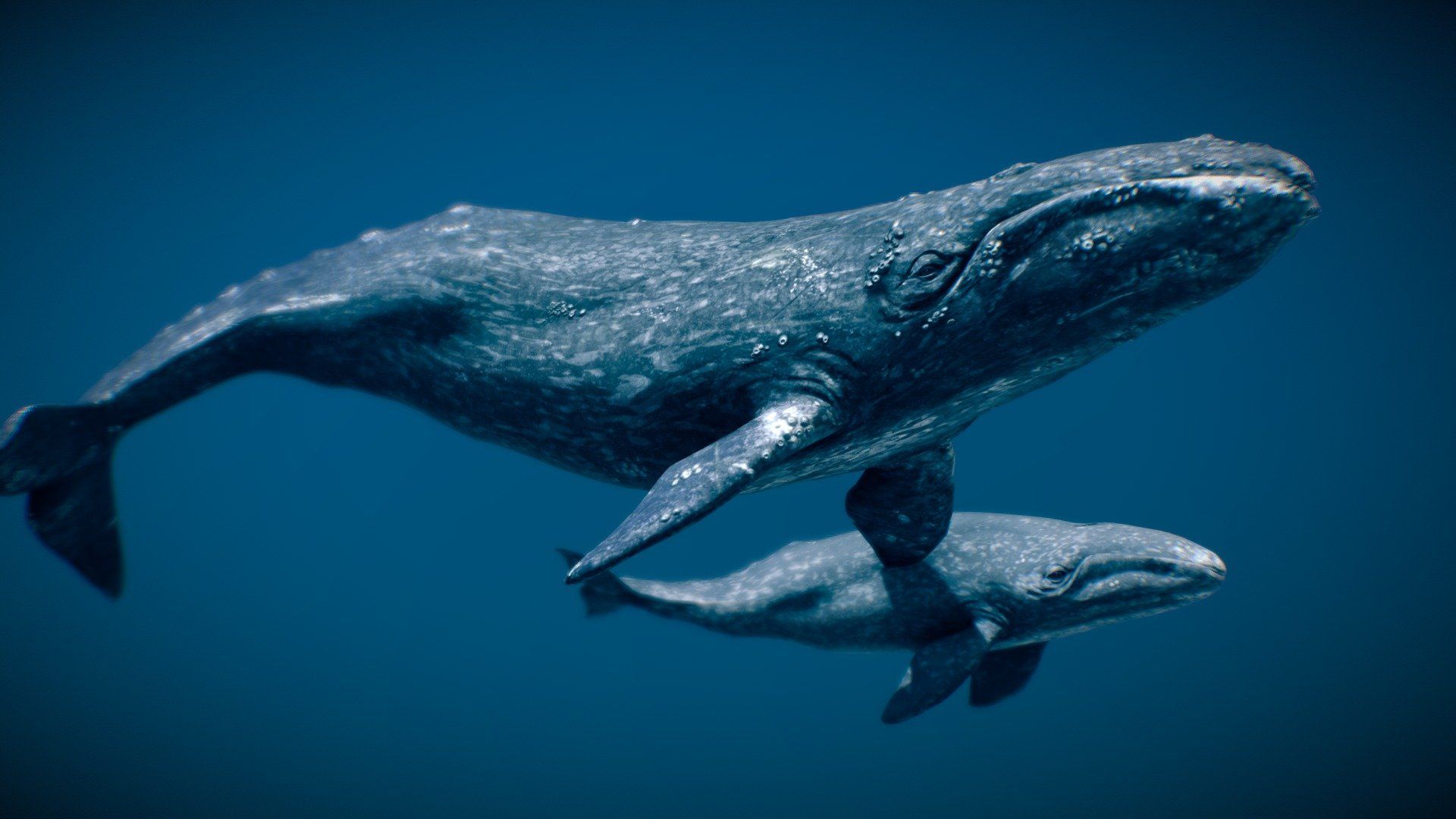
How far do gray whales migrate?
Gray whales (Eschrichtius robustus) undertake one of the longest annual migrations of any mammal, traveling 15,000-22,000 km round-trip each year. They migrate between their summer feeding grounds in cold Arctic waters (Chukchi and Bering Seas) and their winter breeding/calving grounds in warm Mexican waters (Baja California lagoons). Each direction takes 2-3 months.
A Year of Constant Motion
Every year, gray whales travel a distance that would take a human a lifetime of driving. They migrate from Arctic feeding grounds in the Bering and Chukchi Seas to warm Mexican lagoons and back again, 22,000 kilometers round-trip through the Pacific Ocean.
A single whale's lifetime migration can cover distances equivalent to multiple trips between the Earth and the Moon. They do this year after year for decades, swimming continuously along the Pacific coast of North America in one of the most remarkable mammal migrations on Earth.
They are the only whales that feed on seafloor sediment, and they are among the most accessible migrating whales, their route hugs coastlines where humans can watch them from shore.
The Animal
Gray whales are medium-large baleen whales.
Physical features:
- Length: 12-15 meters (adults)
- Weight: 30-40 tons
- Color: mottled gray with white patches
- Baleen: short, coarse plates
- Body: robust and muscular
- No dorsal fin: distinctive characteristic
- Knuckles: series of bumps on back
- Barnacles: covered in clusters
The "gray" of gray whales:
The name reflects their characteristic coloration:
- Gray base color
- White patches from barnacles and whale lice
- Unique individual patterns
- Distinctive mottled appearance
Marks (barnacles and lice):
Their skin hosts parasites:
- Acorn barnacles
- Whale lice
- Create white patches
- Unique to each individual
- Used for photo-identification
The Extraordinary Migration
Gray whales travel one of the longest mammal migrations.
Migration distances:
- Eastern Pacific round-trip: 15,000-22,000 km
- Individual migrations: up to 10,000+ km one way
- Annual distance: equivalent to moon distance
- Lifetime total: 700,000+ km
Routes:
Eastern Pacific:
- Feeding grounds: Chukchi and Bering Seas (summer)
- Migration south: along Alaskan coast → British Columbia → US West Coast → Mexico (late fall/winter)
- Calving grounds: Baja California lagoons (winter)
- Migration north: reverse route (spring)
Western Pacific:
- Feeding: Sea of Okhotsk (summer)
- Migration: South along Asian coast
- Breeding: East Asian coastal waters (winter)
- Return: Back north in spring
Speed and travel:
- Average speed: 8-11 km/h
- Daily distance: ~190 km per day
- Duration each direction: 2-3 months
- Continuous travel: day and night
Visibility:
Their coastal route makes them:
- Visible from beaches
- Accessible for whale watching
- Subject of cultural traditions
- Target of tourism
Unique Feeding
Gray whales have unusual feeding behavior.
Bottom feeding:
Unlike other baleen whales, gray whales feed on the seafloor:
- Swim on their side
- Dive to bottom (typically 30-50m)
- Use head to stir up sediment
- Open mouth, filter sediment
- Baleen catches tiny organisms
- Sediment ejected
The prey:
Their food includes:
- Amphipods: small crustaceans (primary)
- Cumaceans: small worm-like crustaceans
- Small worms: various species
- Mollusks: small clams and snails
Feeding impacts:
Their feeding creates:
- Sediment plumes: visible from surface
- Cleared areas: where they've fed
- Nutrient mixing: bringing bottom nutrients up
- Benefits: other species feed on exposed prey
Daily consumption:
- Maximum: 1,100 kg per day (in feeding season)
- Typical: hundreds of kilograms
- Fasting: during migration and breeding
The Three Populations
Gray whales existed in three populations; one is now extinct.
Eastern Pacific:
- Largest surviving population
- Recovered from whaling
- 20,000-26,000 individuals
- Least Concern (IUCN)
Western Pacific:
- Separate, smaller population
- Critically Endangered
- Less than 200 mature individuals
- Rediscovered in 1980s after assumed extinct
Atlantic population (extinct):
- Hunted to extinction in 18th century
- European/American whalers
- No survivors
- Some occasional sighting reports but not confirmed populations
The loss:
The Atlantic extinction represents:
- Complete population loss
- Whaling consequences
- Can never be reversed
- Lesson for current conservation
Historical Whaling
Gray whales were heavily hunted.
Commercial whaling:
- 1800s: intensive hunting began
- 1850s: population crashes
- 1900-1930s: continued hunting
- 1946: International Whaling Commission protection
Population impact:
- Eastern Pacific: from 15,000+ to ~1,000 (90% loss)
- Western Pacific: similar severity
- Atlantic: completely eliminated
Recovery:
After 1946 protection:
- Eastern Pacific: gradual recovery
- 1960s: ~10,000 individuals
- 1990s: ~20,000 individuals
- 2020s: 20,000-26,000 (stable or recovering)
Recovery story:
Eastern Pacific gray whale recovery is:
- One of greatest marine mammal conservation successes
- Example of what protection can achieve
- Model for other species
- Takes decades to achieve
Modern Threats
Gray whales face new challenges.
Current threats:
Ship strikes:
- Coastal routes intersect with shipping lanes
- Major mortality source
- Slow speeds of whales, fast speeds of ships
Climate change:
- Arctic feeding ground changes
- Prey distribution shifts
- Sea ice changes
- Water temperature
Prey declines:
- Amphipod populations changing
- Climate-related shifts
- Food availability uncertain
- Ecosystem transformations
Pollution:
- Ocean pollution impacts
- Chemical contaminants
- Plastic ingestion
- Noise pollution
Entanglement:
- Fishing net encounters
- Commercial fishing gear
- Can be fatal
- Difficult to monitor
Mortality events:
Recent concerning pattern:
- 2019-2024: approximately 700 gray whales died in Eastern Pacific
- Significant population decline
- Multiple causes under investigation
- Population recovery reversing
Conservation
Multiple efforts protect gray whales.
Legal protections:
- International Whaling Commission: protection since 1946
- Endangered Species Act (US): Eastern Pacific delisted, Western Pacific listed
- Marine Mammal Protection Act (US): general protection
- CITES Appendix I: trade restriction (Western)
Conservation efforts:
Marine protected areas:
- Baja California lagoons (critical calving)
- Various Alaskan waters
- Korean coastal waters
- Ongoing additions
Research and monitoring:
- Satellite tracking
- Population surveys
- Photo-identification
- Climate impact studies
Shipping lane adjustments:
- Some coastal areas
- Reduce ship strikes
- Still insufficient in many regions
Cultural Significance
Gray whales have cultural importance.
Indigenous peoples:
Pacific coastal nations have centuries-long relationships:
- Makah Nation (US): traditional whaling rights
- Various Alaskan tribes: cultural importance
- Mexican coastal communities: historical connections
- Japanese coastal cultures: traditional importance
Whale watching tourism:
Major industry:
- Baja California: world-famous calving lagoon tours
- California: migration watching
- Oregon, Washington: migration routes
- Alaska: summer feeding grounds
Economic value:
- Billions of dollars annually
- Supports coastal economies
- Funds conservation
- Educates millions of tourists
The Baja California Lagoons
These Mexican bays are crucial.
Three primary lagoons:
- San Ignacio Lagoon: largest calving area
- Magdalena Bay: major breeding ground
- Scammon's Lagoon: historical calving area
Why important:
- Warm water for calves
- Protected from predators
- Shallow enough for safe calves
- Food available for mothers
- Mating location
Famous behaviors:
Gray whales in these lagoons:
- Approach boats curiously
- Allow touching by humans
- Mothers bring calves near boats
- Intimate human-whale interactions
Unique experience:
Most famous whale interactions occur here:
- Whales voluntarily approach
- Make eye contact with people
- Allow closeness impossible with most whales
- Foster conservation ethic
Reproduction
Gray whale breeding cycle is intense.
Cycle:
- Females reach maturity at 5-10 years
- Gestation: 12-13 months
- Calf born in Mexican lagoons
- 8-10 months nursing
- Females rest 2 years between pregnancies
Calves:
- Born 4.5 meters long
- 600-900 kg at birth
- Rapid growth on rich milk
- Stay close to mothers
- Learn migration route
Lagoons as schools:
Calves in lagoons:
- Learn swimming techniques
- Develop strength
- Socialize with others
- Prepare for migration
First migration:
Calves' first migration:
- At ~9 months old
- With mother
- Gradual journey north
- Many don't survive
Behavior
Gray whales show distinctive behaviors.
Surface displays:
- Breaching: spectacular jumps
- Spyhopping: rising vertically to look
- Tail slaps: hitting water
- Pec slaps: fin displays
Social behavior:
- Generally solitary during migration
- Female-calf pairs travel together
- Small groups in feeding areas
- Large aggregations at lagoons
Human interaction:
Famous for:
- Curiosity about boats
- Approaching people
- Allowing touch (especially in lagoons)
- "Friendly whale" phenomenon
Vocalizations:
Less studied than other whales:
- Moans and grunts
- Sometimes "singing"
- Communication purposes
- Mother-calf calls
The Whale Watching Industry
Gray whale tourism is major.
California Coast:
- Annual migration watchable from land
- Multiple prime locations
- Organized tours
- Educational programs
Baja California:
- Mexican lagoons world-famous
- Eco-tourism industry
- Local community economic benefit
- Conservation funding
Tourism benefits:
Beyond economics:
- Public education
- Research partnerships
- Conservation advocacy
- International cooperation
Concerns:
- Boat traffic increases
- Behavior modifications
- Crowd pressures
- Need careful management
Research Programs
Gray whales are extensively studied.
Major research areas:
Migration:
- Satellite tracking
- Route analysis
- Climate impact
- Population connectivity
Feeding:
- Bottom feeding ecology
- Prey availability
- Ecosystem impact
- Arctic changes
Population:
- Demographic monitoring
- Mortality investigations
- Recovery tracking
- Threat assessment
Behavior:
- Coastal interactions
- Lagoon behavior
- Human proximity
- Cognitive studies
Why Gray Whales Matter
Gray whales represent multiple significant roles.
Ecological:
- Arctic feeding ecosystem participant
- Bottom feeding unique role
- Migration connects ocean regions
- Climate change indicator
Conservation:
- Recovery success story
- Ongoing vulnerability
- Population monitoring critical
- International cooperation
Scientific:
- Migration biology model
- Feeding innovation
- Population dynamics
- Climate research
Cultural:
- Pacific coastal cultures
- Modern tourism
- Conservation awareness
- Indigenous traditions
The Coastal Journey
Every year, thousands of gray whales travel the entire length of the Pacific coast of North America.
They swim past San Francisco, Los Angeles, San Diego, Tijuana. Past beaches where millions of people stand. Past coastal highways. Past fishing harbors. Past shipping lanes.
Their path is visible. Their journey is observable. They hug the coast closely enough that whale watchers can see them from shore or from small boats. They've been making this migration for countless generations, likely since before the last ice age.
And they recover. After nearly being eliminated by 19th-century whaling, their Eastern Pacific population has largely recovered. The Western Pacific population remains critically endangered. The Atlantic population is gone forever.
Current population health is uncertain. Recent mortality events suggest new challenges, climate change, changing prey, continuing human activity impacts. Their future isn't guaranteed even after decades of protection.
For now, the migration continues. The 22,000-kilometer annual journey persists. The lagoons in Baja California still fill with calving mothers. The Arctic feeding grounds still support their summer feeding. The coastal route from Alaska to Mexico still winds past coastlines where people watch them pass.
Every gray whale traveling this route today is connected to all previous generations that made the same journey. Each migration is both ancient and newly accomplished. Each successful round trip is a victory against the pressures that have reduced their populations repeatedly throughout recent history.
They continue. For now, at least, they continue.
Migration Distances of Major Marine Species
The gray whale's 22,000-kilometer annual round-trip migration ranks among the longest mammalian migrations ever documented, rivaled primarily by humpback whales and specific populations of bluefin tuna. Our research team compiled a comparison of the longest animal migrations in the ocean.
| Species | Round-Trip Distance | Route |
|---|---|---|
| Arctic tern | 70,000+ km | Arctic to Antarctic, both hemispheres |
| Gray whale (Eastern Pacific) | 22,000 km | Bering Sea to Baja California |
| Humpback whale (some populations) | 16,000-18,000 km | Polar feeding to tropical calving |
| Leatherback sea turtle | 20,000 km | Nesting beaches to feeding zones |
| Great white shark (Nicole) | 20,000 km (individual record) | South Africa to Western Australia |
| Northern elephant seal | 21,000 km | California to North Pacific |
| Bluefin tuna (Atlantic) | 15,000 km | Gulf of Mexico to Mediterranean |
| Pacific salmon (sockeye) | 3,000-4,000 km | Ocean to natal river |
A 2011 study by Bruce Mate and colleagues at Oregon State University used satellite-linked tags on gray whales in the Western Pacific Sakhalin Island population. One tagged female, nicknamed Varvara, traveled 22,511 kilometers from Russian feeding grounds to Mexican calving lagoons and back - the longest documented movement for any mammal and the first confirmation that some Western Pacific grays actually migrate to Eastern Pacific calving grounds [1].
The Recent Unusual Mortality Event
Beginning in 2019, the Eastern Pacific gray whale population entered an Unusual Mortality Event (UME) officially declared by NOAA, with over 690 confirmed gray whale deaths along the Pacific coast through 2023. Population estimates dropped from approximately 27,000 in 2016 to 14,526 by 2023, nearly a 45 percent decline in seven years.
"The gray whale UME represents one of the most rapid large-population declines of any baleen whale in the satellite-tagging era. The pattern of emaciated individuals arriving at calving lagoons and of mass strandings along migration routes strongly suggests food-limitation in Arctic feeding grounds linked to sea ice retreat and benthic community restructuring. The species may be experiencing the first measurable population-level impact of Arctic climate change." - Dr. John Calambokidis, Cascadia Research Collective [2]
The primary feeding grounds off St. Lawrence Island and in the Chirikov Basin have shown dramatic reductions in benthic amphipod biomass since 2015. Gray whales, which feed by suctioning sediment and filtering amphipods through their baleen, have shifted to secondary prey and alternative feeding grounds with apparent nutritional costs.
Recovery from Near-Extinction
The North Pacific gray whale population was reduced by commercial whaling from an estimated pre-exploitation peak of 23,000 to 24,000 individuals to approximately 1,000 to 2,000 by 1937 when international protection was granted. Full recovery to pre-whaling numbers was documented in the early 2000s, making the gray whale one of the clearest cetacean conservation success stories.
"The Eastern Pacific gray whale recovery is often cited as a flagship example of effective marine mammal protection. The species was pulled back from functional extinction in the 19th century, rebuilt a population approaching historical abundance by 2016, and has now entered a new period of concern driven by climate change. Whether this second challenge produces another recovery or a permanent decline will depend on how quickly Arctic ecosystems stabilize." - Dr. Donna Kuroki, Pacific States Marine Fisheries Commission [3]
The Western Pacific population, by contrast, has never recovered. Estimated at fewer than 150 individuals today, this population is listed as Critically Endangered by the IUCN. Conservation efforts now focus intensively on reducing Sakhalin Island offshore oil development impacts during the limited summer feeding window.
References
- Mate, B. R., Ilyashenko, V. Y., Bradford, A. L., et al. (2015). Critically endangered western gray whales migrate to the eastern North Pacific. Biology Letters, 11(4), 20150071. DOI: 10.1098/rsbl.2015.0071
- Calambokidis, J., Laake, J. L., & Klimek, A. (2023). Abundance and population structure of seasonal gray whales in the Pacific Northwest 1998-2015. Journal of Cetacean Research and Management, 24, 1-20.
- Punt, A. E., & Wade, P. R. (2012). Population status of the eastern North Pacific stock of gray whales in 2009. Journal of Cetacean Research and Management, 12(1), 15-28.
- Moore, S. E., & Huntington, H. P. (2008). Arctic marine mammals and climate change: impacts and resilience. Ecological Applications, 18(sp2), S157-S165. DOI: 10.1890/06-0571.1
Related Articles
- Blue Whale: The Largest Animal That Ever Lived
- Humpback Whale Songs: The Ocean's Culture
- Arctic Tern: The 70,000 km Annual Migration
Frequently Asked Questions
How far do gray whales migrate?
Gray whales (Eschrichtius robustus) undertake one of the longest annual migrations of any mammal, traveling 15,000-22,000 km round-trip each year. They migrate between their summer feeding grounds in cold Arctic waters (Chukchi and Bering Seas) and their winter breeding/calving grounds in warm Mexican waters (Baja California lagoons). Each direction takes 2-3 months.
Individual migrations can cover 10,000+ kilometers one way for those whales that travel the full range. This is significantly longer than most mammal migrations, and some gray whale individuals may cover the equivalent of the moon’s distance from Earth during their lifetime. They swim at average speeds of 8-11 km/h during migration, traveling approximately 190 km per day.
Their migration follows coastal paths visible from land - making them one of the most observable migrating whales. The western Pacific population makes similarly long migrations to Asian coasts. Climate change is affecting their migration timing in many regions.
How do gray whales eat?
Gray whales are unique among great whales for their bottom-feeding technique. They swim on their sides along the seafloor, using their heads to stir up sediment, then filter small organisms through their baleen plates. They target amphipods (small crustaceans) and other invertebrates that live in seafloor sediments. Their feeding creates massive plumes of suspended sediment visible from the surface. They essentially plow the seafloor looking for food.
An adult gray whale can consume 2,400 pounds (1,100 kg) of food daily during feeding seasons. They have relatively small baleen plates compared to other baleen whales, adapted for processing fine sediment rather than catching fish schools. Their feeding technique is unique - no other baleen whale feeds like this. It requires them to target shallow sandy or muddy seafloor areas.
The disruption they cause brings nutrients to the surface and benefits other species like seabirds that feed on organisms exposed by their feeding. Their specialized feeding style limits them to shallow coastal environments, which is partly why their migration routes follow coasts closely.
Are gray whales endangered?
Gray whale conservation status varies by population. The Eastern Pacific gray whale population has recovered from near-extinction and is now listed as Least Concern globally - numbering approximately 20,000-26,000 individuals. However, the Western Pacific gray whale population (different genetic group) remains Critically Endangered with fewer than 200 mature individuals. Historical whaling devastated both populations.
Eastern Pacific was hunted to approximately 1,000 individuals by the 1850s before recovery began. Western Pacific grays were believed extinct but were rediscovered in the 1980s. The Atlantic gray whale population was completely exterminated by 18th century whalers and no Atlantic grays survive. Recovery of the Eastern Pacific population is one of the most successful marine mammal conservation stories.
However, recent years have seen concerning mortality events - from 2019-2024, approximately 700 gray whales died in the Eastern Pacific, representing significant population decline. Climate change, prey decreases, and other factors are being studied. Their current status remains carefully monitored, with concerns that gains from earlier recovery could be reversed.
Where do gray whales live?
Gray whales inhabit the North Pacific Ocean, with two distinct populations showing limited genetic exchange. The Eastern Pacific population migrates between Alaska and Mexico, feeding in the Bering and Chukchi Seas during summer, then migrating south along the North American Pacific coast to Baja California lagoons (San Ignacio, Scammon’s, and Magdalena Bay) for winter breeding and calving.
The Western Pacific population migrates between the Sea of Okhotsk (feeding) and East Asian coastal waters (breeding). Western grays are sometimes observed in Chinese, Korean, and Japanese waters. They prefer coastal environments - typically within 10 km of shore during migration. They prefer shallow waters (under 50 meters during feeding) for their seafloor feeding technique.
Different populations maintain cultural traditions - the Eastern Pacific has developed unique feeding behaviors in specific locations. Climate change is affecting their habitats, particularly in the Arctic where sea ice changes impact their summer feeding grounds. Whale watching tourism is particularly successful for gray whales because of their coastal migration paths.
How big do gray whales get?
Adult gray whales reach 12-15 meters (40-50 feet) in length and weigh 30-40 tons. Females are typically larger than males. The largest verified gray whale was 14.1 meters long, weighing approximately 36 tons. They are medium-to-large whales, smaller than blue whales (30 meters) but larger than humpbacks (16 meters).
Their bodies are covered in white patches called ‘marks’ that are actually barnacles and whale lice - external parasites that attach to their skin and remain throughout life. These marks are unique to each individual and help researchers identify gray whales by photography. Their skin is gray with these distinctive patches, giving them the mottled appearance that earned their name.
Gray whale newborns are approximately 4.5 meters long and 600-900 kg at birth. They grow rapidly on nutrient-rich mother’s milk. Sexual maturity occurs at 5-10 years, and they can live 50-70 years in the wild. Their size combined with their slow migration along coastlines makes them easily observable by people in coastal communities along their Pacific migration route.