
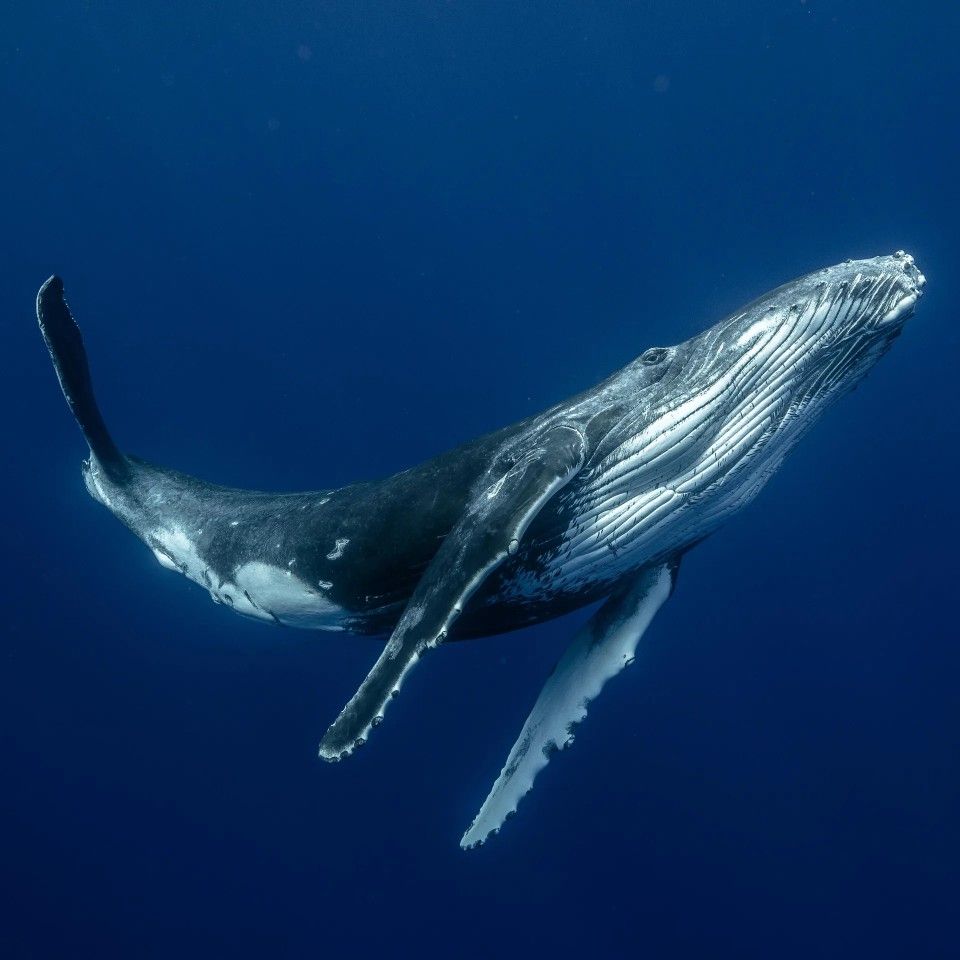
How big is a blue whale?
Blue whales (Balaenoptera musculus) reach up to 30 meters (98 feet) long and weigh up to 200 tons (400,000 pounds). This makes them the largest animal known to have ever existed - larger than any dinosaur, including the largest sauropods.
Bigger Than Any Dinosaur
The largest dinosaur ever discovered - Argentinosaurus - weighed an estimated 70-100 tons. The largest land mammal in history - the giant hornless rhinoceros Paraceratherium - weighed around 20 tons. The largest living land animal - the African elephant - reaches about 6 tons.
The blue whale weighs up to 200 tons. It is, by a wide margin, the largest animal ever to exist on Earth in the 4 billion years of life's history.
Nothing that ever walked, flew, or crawled approached blue whale scale. To understand the blue whale is to understand how the ocean permits biological architectures impossible on land - and how an animal can grow so large that its heartbeat can be heard through water from kilometers away.
The Numbers
Size metrics for adult blue whales:
| Feature | Measurement |
|---|---|
| Maximum length | 30 meters (98 feet) |
| Maximum weight | 200 tons (400,000 lbs) |
| Tongue weight | 3-4 tons (as much as an elephant) |
| Heart weight | 180 kg (400 lbs) |
| Heart size | about the size of a small car |
| Mouth capacity | 90 tons of water + krill |
| Blood vessels | large enough for a human to swim through |
Birth statistics:
- Newborn length: 7-8 meters
- Newborn weight: 2.5 tons
- Daily weight gain (first year): up to 90 kg per day
- Time to adult size: approximately 10 years
A blue whale calf is born larger than most adult dolphins and heavier than most cars. It doubles in weight roughly every six weeks during its first year.
How They Got So Big
Blue whale evolution to extreme size is a relatively recent development in geological terms.
The timeline:
Ancestors of modern whales returned to the ocean roughly 50 million years ago, evolving from small deer-like land mammals. For most of whale evolutionary history, whales were modest-sized - comparable to dolphins or medium-sized dinosaurs. Truly giant whales appeared only in the last 4-5 million years.
What changed:
The evolution of giant baleen whales coincides with climate changes that produced enormous seasonal blooms of krill in polar waters. When cold ocean currents carried nutrient-rich water to the surface, sunlight drove explosive plankton growth, which supported massive krill populations.
Whales that could consume these seasonal krill blooms efficiently - by growing large mouths, taking huge gulps, and storing vast fat reserves - outcompeted smaller whales that could not exploit the resource. Size itself became the adaptation.
Why water makes giant size possible:
A 200-ton blue whale on land would crush under its own weight. Skeletal structure cannot support that mass against gravity without crumbling. But water is dense enough to support the whale's body - buoyancy cancels most of the weight load.
This is why the largest animals in Earth's history have been marine. Sauropod dinosaurs stretched land-animal size to its maximum; blue whales show what marine buoyancy allows beyond that.
Lunge Feeding
Blue whales eat using one of the most extreme feeding strategies in animal biology.
The lunge:
A blue whale approaches a krill swarm at speed, opens its mouth wide, and lunges through the swarm. The throat pleats expand like an accordion, allowing the mouth to take in a volume of water and krill larger than the whale's own body.
A single lunge can intake 90 tons of water mixed with krill.
The filter:
Inside the mouth hang hundreds of baleen plates - fringed structures made of keratin (the same material as fingernails). The whale closes its mouth and pushes water out through the baleen using its tongue, trapping krill against the plates.
The whale then swallows the filtered krill and begins another lunge.
Daily consumption:
During feeding season in polar waters, an adult blue whale eats approximately 3.6 tons (8,000 pounds) of krill per day. That works out to roughly 40 million individual krill daily.
Seasonal fasting:
Blue whales feed heavily during summer in polar waters, then migrate to tropical breeding grounds where they eat little or nothing for several months. Their massive fat reserves fuel this migration and reproductive period.
The Loudest Animal on Earth
Blue whales produce the loudest sounds ever recorded from any animal.
Volume:
Blue whale vocalizations reach 188 decibels at the source. For comparison:
- Human conversation: 60 dB
- Heavy traffic: 85 dB
- Jet engine at 30 meters: 140 dB
- Rocket launch: 180 dB
- Blue whale call: 188 dB
At 188 decibels, the sound would be physically painful to a human listener close enough to hear it - but because it is at frequencies below human hearing (10-40 Hz), we cannot actually perceive blue whale calls directly without specialized equipment.
Range:
Low-frequency sound travels extraordinarily far through ocean water. Blue whale calls can travel 1,600 km (1,000 miles) and remain audible to other blue whales.
This long range allows populations spread across entire ocean basins to remain in acoustic contact. A blue whale off the coast of California can hear calls from blue whales near Hawaii.
What they communicate:
Research on blue whale calls is ongoing, but confirmed functions include:
- Locating other blue whales across vast distances
- Courtship signaling (mostly by males)
- Coordinating migration timing
- Possibly marking feeding grounds
Each blue whale population has distinctive call patterns. Researchers can identify which population a recorded call comes from based on frequency signature alone.
Heart and Circulation
The blue whale's circulatory system is as extreme as the rest of its body.
Heart size:
The blue whale heart weighs approximately 180 kg and is roughly the size of a small car. This is the largest heart ever recorded in any animal.
Heart rate:
During normal swimming at the surface, a blue whale's heart beats 8-10 times per minute. During deep dives, it slows to 2-4 beats per minute. Peak rate, during surface activity after a dive, may briefly reach 25-37 beats per minute.
For a human, slow heart rate means rest. For a blue whale, the beats are so widely spaced that each contraction must push enormous volumes of blood through the body.
Blood vessels:
Blue whale aortas are large enough for an adult human to crawl through. Total blood volume is estimated at 8,000 liters. Each heartbeat pumps several hundred liters.
Surface-to-volume advantages:
One reason blue whales can thrive in cold polar waters is their favorable surface-to-volume ratio. Larger animals have less surface area per unit of mass, meaning they lose heat more slowly. Their sheer size is itself a thermal insulator - combined with a thick blubber layer (up to 50 cm thick in some areas), blue whales stay warm in water just above freezing.
Migration
Blue whales undertake some of the longest migrations of any animal.
Seasonal pattern:
- Summer: Feed in polar waters (Antarctic, North Pacific, North Atlantic) rich with krill
- Winter: Migrate to tropical and subtropical waters for breeding
- Distance: Up to 8,000 km each way
- Speed during migration: approximately 8-14 km/h cruising
Migration routes connect specific feeding and breeding grounds. Populations from different ocean basins generally do not mix.
Why migrate at all:
Polar waters offer abundant food but are too cold for newborn calves, which lack adequate blubber. Tropical waters are warmer for calves but lack the krill density needed to feed adults. The migration balances these requirements, accepting the enormous energy cost of swimming thousands of kilometers to access both conditions at different life stages.
The Whaling Catastrophe
Blue whales were nearly exterminated during the industrial whaling era.
Pre-whaling population:
Historical estimates suggest roughly 350,000 blue whales existed globally before commercial whaling - most in Southern Ocean waters around Antarctica.
The kill:
From approximately 1900 to 1970, industrial whaling fleets killed an estimated 360,000 blue whales. In Antarctic waters alone, the kill rate peaked at thousands per year during the 1930s. Whalers targeted blue whales specifically because a single whale yielded more oil than any other species.
The collapse:
By the late 1960s, fewer than 5,000 blue whales remained globally. The species was on the verge of extinction.
Protection:
In 1966, the International Whaling Commission banned commercial hunting of blue whales. Some Soviet whaling continued illegally into the 1970s, but by the 1980s, effective global protection was in place.
Recovery:
Current population estimates range from 10,000 to 25,000 blue whales worldwide. This represents dramatic recovery from 1970 lows but remains less than 10 percent of pre-whaling numbers.
Blue whales reproduce slowly - one calf every 2-3 years with gestation of 10-12 months. Full population recovery, even with complete protection, may require centuries.
Modern Threats
Even with hunting banned, blue whales face ongoing threats.
Ship strikes:
Large container ships and tankers can kill blue whales by collision. Shipping lanes that cross whale migration routes or feeding areas produce regular kills. California's coast has documented multiple blue whale deaths from ship strikes in recent years.
Entanglement:
Fishing gear - particularly nets and lines - can entangle blue whales. While often not immediately fatal, dragging heavy gear exhausts the whale, disrupts feeding, and eventually kills the animal.
Noise pollution:
Ocean shipping produces enormous amounts of low-frequency noise overlapping with the frequencies blue whales use to communicate. Heavily trafficked ocean areas may effectively block long-distance whale communication.
Climate change:
Warming oceans disrupt krill populations. If krill densities decline significantly, blue whales could face food shortages. Krill depend on sea ice for their life cycle in some regions, and sea ice loss threatens the foundation of the polar food web blue whales evolved to exploit.
The Ultimate Scale
Blue whales occupy a unique position in life's history - the absolute upper limit of biological size, achieved by an animal currently alive and swimming in oceans today.
Every other "largest ever" record in animal history belongs to extinct species. The largest insect ever (a dragonfly with a 65 cm wingspan) died out 300 million years ago. The largest land mammal, the largest sauropod, the largest theropod dinosaur - all extinct.
The blue whale is the one exception. The largest animal in Earth's history is still here, swimming through oceans, feeding on krill swarms, calling across basins, raising calves, facing human-caused threats.
Killing them took industrial technology and decades of systematic effort. Losing them would mean losing the single largest living thing this planet has ever produced - and there is no biological pathway to producing something like it again within any meaningful timeframe.
Blue Whale Subspecies and Regional Populations
Genetic analysis has identified four or five distinct subspecies of blue whale (Balaenoptera musculus), each adapted to specific ocean basins. Our research team summarized the recognized subspecies based on the most recent peer-reviewed taxonomic work.
| Subspecies | Population | Maximum Length | Range |
|---|---|---|---|
| B. m. musculus (Northern) | 3,000-5,000 | 26 m | North Atlantic, North Pacific |
| B. m. intermedia (Antarctic) | 2,000-3,000 | 33.6 m | Southern Ocean |
| B. m. brevicauda (Pygmy) | 5,000 | 24 m | Indian Ocean, South Pacific |
| B. m. indica (Northern Indian) | 1,000 | 21 m | Northern Indian Ocean |
| B. m. unnamed (Chilean) | 500-1,500 | 24 m | Southeast Pacific |
The Antarctic subspecies (B. m. intermedia) is the largest animal ever to have lived, with individuals reaching 33.6 meters in length and weighing up to 199 metric tons. This subspecies was the primary target of Antarctic whaling from 1904 to 1966, during which over 360,000 Antarctic blue whales were killed.
The Lunge Feeding Engine
Blue whales are ram-filter feeders that consume prey through engulfment lunges, taking into their mouth a volume of water equal to approximately 140 percent of the whale's own body mass in a single strike.
A 2011 study published in The Journal of Experimental Biology by Jean Potvin and Jeremy Goldbogen calculated that a single lunge requires approximately 3,000 kilojoules of energy output, but yields an estimated 34,000 kilojoules of caloric gain from captured krill - a net energy efficiency of 11.3 to 1 [1].
"Blue whale lunge feeding is the largest biomechanical event in the entire animal kingdom. A 150-ton animal must accelerate, open its mouth to 80 degrees, balloon its ventral groove pleats outward by 300 percent, engulf a volume of water larger than itself, close its mouth, and force the water out through baleen - all in about 30 seconds. No other vertebrate executes a motor task of this scale." - Dr. Jeremy Goldbogen, Stanford University Hopkins Marine Station [1]
Each whale performs 100 to 200 lunges per day during peak Antarctic summer feeding, consuming approximately 16 metric tons of krill daily. The annual krill requirement for a single blue whale reaches approximately 1,500 metric tons, supporting the whale's fasting migration to tropical breeding grounds.
Acoustic Communication Across Ocean Basins
Blue whales produce some of the most powerful sounds generated by any animal. Their long-duration low-frequency calls, centered around 10 to 40 Hz, can exceed 188 decibels at the source - loud enough to rupture human eardrums at close range. Through the deep-sea SOFAR sound channel, these calls propagate across entire ocean basins.
"Before the industrial era, we estimate that an average 188-decibel blue whale call would have been detectable by conspecifics at ranges of 1,500 to 3,000 kilometers. Shipping noise has reduced that effective communication range by perhaps 90 percent in most ocean basins. The whales we record today are essentially shouting into a stadium that fills continuously with competing noise." - Dr. Christopher Clark, Bioacoustics Research Program, Cornell University [2]
A remarkable 2009 study documented that blue whale call frequencies have been dropping by approximately 0.2 Hz per year across all populations studied since the 1960s. The cause remains debated - possibilities include population recovery enabling lower-intensity calls, ocean noise pollution driving frequency shifts, or adjustments to sea-water acoustic properties under climate change.
References
- Potvin, J., Goldbogen, J. A., & Shadwick, R. E. (2010). Scaling of lunge feeding in rorqual whales: an integrated model of engulfment duration. Journal of Theoretical Biology, 267(3), 437-453. DOI: 10.1016/j.jtbi.2010.08.026
- McDonald, M. A., Hildebrand, J. A., & Mesnick, S. L. (2009). Worldwide decline in tonal frequencies of blue whale songs. Endangered Species Research, 9, 13-21. DOI: 10.3354/esr00217
- Branch, T. A., Stafford, K. M., Palacios, D. M., et al. (2007). Past and present distribution, densities and movements of blue whales Balaenoptera musculus in the Southern Hemisphere and northern Indian Ocean. Mammal Review, 37(2), 116-175. DOI: 10.1111/j.1365-2907.2007.00106.x
- LeDuc, R. G., Dizon, A. E., Goto, M., et al. (2007). Patterns of genetic variation in Southern Hemisphere blue whales and the use of assignment test to detect mixing on the feeding grounds. Journal of Cetacean Research and Management, 9(1), 73-80.
Related Articles
- Sperm Whale: The Deepest Diving Mammal
- Killer Whales: The Apex Predators of the Ocean
- Whale Migration: The Longest Journeys on Earth
Frequently Asked Questions
How big is a blue whale?
Blue whales (Balaenoptera musculus) reach up to 30 meters (98 feet) long and weigh up to 200 tons (400,000 pounds). This makes them the largest animal known to have ever existed - larger than any dinosaur, including the largest sauropods. Their tongue alone weighs as much as an adult elephant (3-4 tons), and their heart is the size of a small car and weighs 180 kg. A blue whale’s mouth can hold approximately 90 tons of water and krill at once.
Newborn blue whale calves are already 7-8 meters long and weigh 2.5 tons at birth - larger than most adult dolphins. Blue whales grow to adult size within 10 years, gaining up to 90 kg per day during their first year of life.
What do blue whales eat?
Blue whales eat almost exclusively krill - small shrimp-like crustaceans typically 1-2 cm long. An adult blue whale consumes up to 3.6 tons (8,000 pounds) of krill per day during feeding season. They feed by lunging into dense krill swarms with mouths open, taking in up to 90 tons of water and krill in a single gulp.
Their throat pleats expand like an accordion, then contract to push water out through their baleen plates (keratin filter structures that trap krill). A blue whale consumes an estimated 40 million individual krill per day. Despite their massive size, blue whales feed on one of the smallest animals in the ocean - a remarkable evolutionary strategy that exploits enormous seasonal krill blooms in polar waters.
How loud is a blue whale?
Blue whale calls reach up to 188 decibels - the loudest sounds produced by any animal on Earth. For comparison, a jet engine at takeoff is around 150 decibels. Their low-frequency vocalizations (between 10 and 40 Hz, often below human hearing range) travel up to 1,600 km (1,000 miles) through ocean water. Blue whales use these calls to communicate with other blue whales across entire ocean basins.
Each population has distinctive call patterns that researchers can use to identify which group a whale belongs to. Interestingly, blue whale songs have been deepening in pitch by about 30 percent since the 1960s - a change researchers believe may be linked to population recovery and changing ocean noise conditions.
Why did blue whales get so big?
Blue whales evolved to their extreme size over the past 4-5 million years, likely in response to changing ocean conditions that produced massive seasonal krill blooms.
Gigantic body size provides several advantages: blue whales can consume enormous amounts of krill during brief feeding seasons, store vast fat reserves to survive migration and fasting, maintain body temperature in cold polar waters with favorable surface-to-volume ratios, and resist predation from sharks and killer whales. Water supports their weight in ways air cannot - on land, a 200-ton animal would collapse under its own weight.
Ocean buoyancy makes extreme size possible. The evolution of lunge feeding (inhaling huge volumes of krill-filled water) required a large body to generate the necessary power and volume.
Are blue whales endangered?
Blue whales are listed as Endangered by the IUCN, though populations are recovering from near-extinction. During the industrial whaling era (roughly 1900-1970), an estimated 360,000 blue whales were killed, reducing global populations from approximately 350,000 to fewer than 5,000 by the 1970s. Commercial whaling of blue whales was banned internationally in 1966.
Current global population estimates range from 10,000 to 25,000 blue whales - a dramatic recovery but still far below historical levels. Modern threats include ship strikes, entanglement in fishing gear, ocean noise pollution, and climate change affecting krill populations. Blue whales reproduce slowly (one calf every 2-3 years), meaning full recovery will take centuries even with complete protection.