
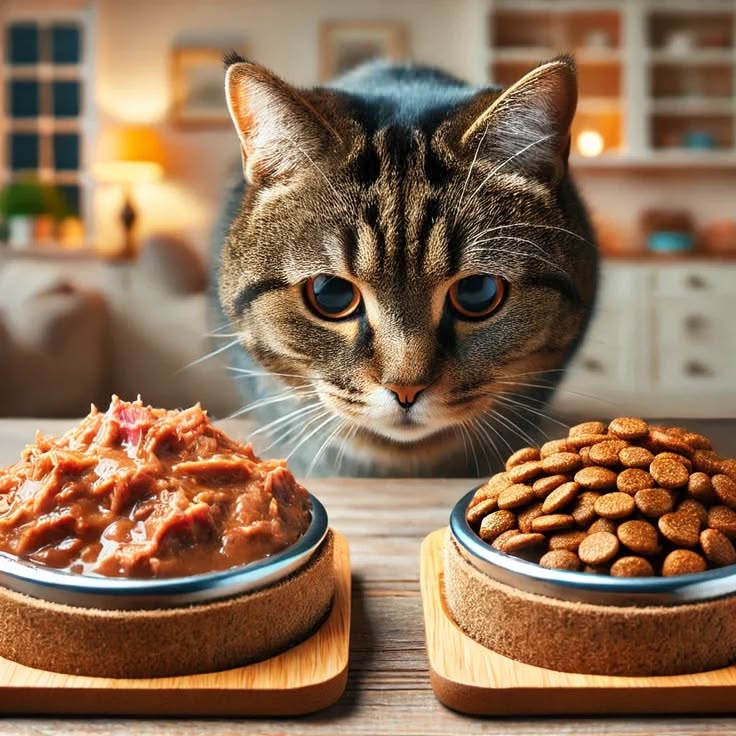
The question of wet versus dry food is more consequential for cats than for dogs, and the answer leans more clearly in one direction. While both formats can provide complete and balanced nutrition, the unique physiology of cats, particularly their evolutionarily adapted low thirst drive, creates a case for wet food that most veterinary nutritionists consider compelling.
This does not mean dry food is harmful or that every cat must eat wet food. But understanding why the recommendation exists, what the evidence says about urinary tract health, and what the practical trade-offs are will help you make the best decision for your cat.
Why Cats and Water Have a Complicated Relationship
The domestic cat (Felis catus) descends from Felis silvestris lybica, a small wild cat that evolved in the arid ecosystems of North Africa and the Middle East. In those environments, free water sources were scarce. Cats adapted by extracting the majority of their hydration from prey, a mouse is approximately 70-75% water, providing substantial fluid with every meal.
This evolutionary history shaped cats' physiology in a way that persists in modern house cats: they have a weak thirst drive. Unlike dogs and humans, who feel thirst long before reaching meaningful dehydration, cats do not experience an urgent drive to seek water until they are already in a state of significant fluid deficit.
"Cats are not efficient drinkers relative to their body size and metabolic needs. On a dry food diet, cats voluntarily consume approximately half the total water intake, from food plus drinking combined, compared to cats eating wet food. This difference is not fully compensated by increased voluntary water intake from bowls." Buckley, C. M. F., et al., Journal of Feline Medicine and Surgery, 2011
Dry cat food contains 8-10% moisture. Canned wet food contains 70-80% moisture. A cat eating dry food that weighs approximately 50-60 grams (typical portion for a 10 lb adult) consumes approximately 5-6 mL of water from food. A cat eating the equivalent calories from wet food consumes approximately 140-170 mL of water from food, a difference of nearly 160 mL per day, which represents a substantial fraction of a cat's daily water requirement.
Urinary Tract Health: The Core Argument for Wet Food
The consequence of chronically low water intake in cats is concentrated urine. Concentrated urine creates conditions that promote:
Struvite (magnesium ammonium phosphate) uroliths: Struvite crystals and stones form in concentrated alkaline urine. They are the most common type of urinary stone in cats, though dietary management has shifted their prevalence relative to oxalate stones over the past 30 years.
Calcium oxalate uroliths: Form in concentrated, somewhat acidic urine. The second most common urolith type in cats, and the incidence has increased as dietary manipulation for struvite reduction has changed urine pH.
Feline idiopathic cystitis (FIC): A painful inflammatory condition of the bladder wall that occurs without identifiable infection or stones. FIC accounts for approximately 55-65% of all feline lower urinary tract disease (FLUTD) cases. The condition is strongly associated with indoor housing, stress, and low water intake. Diluting urine through increased water consumption is a primary management strategy.
Urethral obstruction: Male cats have a narrow urethra that can become obstructed by plugs of inflammatory material, crystals, or small stones. Urethral obstruction is a potentially fatal emergency. The risk is higher in cats with concentrated urine.
"Increasing water intake through dietary modification, specifically transitioning to or increasing the proportion of wet food in the diet, is the most practical and effective means of increasing urine volume and diluting urine in cats prone to FLUTD. This approach is well-supported by clinical evidence." Buffington, C. A., Westropp, J. L., & Chew, D. J., Journal of Feline Medicine and Surgery, 2006
Macronutrient Comparison: Wet vs Dry on a Dry Matter Basis
As with dog food, meaningful comparison between wet and dry cat food requires converting nutrient values to a dry matter (DM) basis, eliminating the moisture difference.
| Nutrient | Typical Dry Cat Food (DM basis) | Typical Wet Cat Food (DM basis) |
|---|---|---|
| Protein | 30-40% | 45-65% |
| Fat | 10-20% | 20-40% |
| Carbohydrate | 30-45% | 3-15% |
| Fiber | 2-5% | 0.5-2% |
| Moisture (as fed) | 8-10% | 70-80% |
| Kcal/kg (as fed) | 3,400-4,000 | 700-1,100 |
The most notable pattern: dry cat food typically contains significantly more carbohydrate and less protein than wet food on a dry matter basis. As obligate carnivores, cats have no dietary requirement for carbohydrates. Their metabolic machinery is optimized for processing protein and fat, and their liver enzymes are configured for continuous gluconeogenesis (producing glucose from protein) rather than processing large starch loads.
"Cats have a limited capacity to digest and metabolize large amounts of starch compared to dogs and humans. The domestic cat lacks salivary amylase and has comparatively lower intestinal amylase activity, although postprandial glucose handling improves with high-starch diets. Whether the higher carbohydrate content of dry diets has long-term metabolic consequences in cats remains an active area of research." Verbrugghe, A., & Hesta, M., Veterinary Sciences, 2017
Cats with diabetes mellitus are often managed more effectively on lower-carbohydrate, higher-protein diets. Wet food's lower carbohydrate and higher protein content on a dry matter basis makes it frequently the dietary format of choice for diabetic cats, though specific therapeutic diets also exist in dry format.
Dry Food Advantages for Cats
Despite the strong case for wet food from a hydration and macronutrient perspective, dry food retains meaningful advantages:
Cost: Dry food is significantly less expensive per calorie. For owners on a budget, high-quality dry food from a reputable manufacturer with AAFCO complete and balanced labeling is far preferable to low-quality wet food.
Convenience and storage: Open bags store at room temperature for weeks. No refrigeration required. Easier to measure precisely.
Dental mechanical effect: While the evidence is limited, dry kibble does provide some abrasive action during chewing. Cats that chew dry food thoroughly may have marginally lower plaque accumulation than cats eating exclusively soft food. However, this is not a substitute for professional dental care.
Some cats simply prefer dry food: Individual palatability preferences vary significantly. Cats that refuse wet food may eat dry food readily. Getting appropriate total nutrition from a food the cat actually eats outweighs theoretical advantages of a food they refuse.
Easier multiple-cat management: In households with multiple cats where meal monitoring is impractical, a timed feeder with dry food is easier to manage than multiple fresh wet food servings throughout the day.
Wet Food Advantages for Cats
Hydration: The single most important practical advantage, as detailed above. Wet food essentially eliminates the dehydration risk associated with dry-only feeding.
Protein content: Wet food generally provides higher-quality animal protein in higher relative amounts, which more closely matches a cat's natural prey diet.
Lower carbohydrate content: For cats with diabetes mellitus, food allergy to grain-based ingredients, or inflammatory bowel disease, wet food's lower carbohydrate profile may provide benefits.
Palatability for seniors: Older cats commonly experience decreased appetite, reduced sense of smell, and dental pain. Wet food's strong aroma, soft texture, and high palatability make it much easier to feed to cats with reduced appetite.
Kidney disease management: Increased water intake from wet food supports kidney function in cats with chronic kidney disease (CKD), which is extremely common in senior cats. Many cats with CKD can maintain quality of life significantly longer on well-managed therapeutic wet food diets.
Weight loss: Because wet food has lower caloric density per gram fed, larger volumes can be fed for a given calorie count. This increases satiety and makes it easier to manage portion feeding for overweight cats.
The Feline Dental Health Question
The relationship between food texture and dental health in cats is frequently overstated in marketing materials.
Cats are facultative biters; they often swallow small kibble whole without extensive chewing. Studies monitoring actual chewing behavior in cats fed dry food find that many cats engage in minimal occlusal contact, limiting the abrasive benefit of kibble texture.
"Current evidence does not support the claim that standard dry cat food prevents periodontal disease. While there is some evidence for reduced calculus accumulation with certain dental-formulation diets, the effect of regular kibble on feline periodontal disease is not clinically significant." American Veterinary Dental College, 2021
The VOHC (Veterinary Oral Health Council) recognizes specific dental diets for cats based on clinical trials. Standard kibble, regardless of brand, does not carry this recognition. If dental health is a priority for your cat:
- Daily tooth brushing with feline-specific enzymatic toothpaste
- VOHC-approved dental chews or dental diet
- Regular professional veterinary dental cleanings (typically every 1-2 years for most cats)
Mixed Feeding: The Recommended Middle Ground
A mixed feeding approach, using wet food as the primary diet supplemented with dry food, or feeding some meals as wet and some as dry, captures the advantages of both formats:
- Wet food meals provide hydration and high protein content
- Dry food provides caloric density, cost efficiency, and some dental abrasion
- Variety in texture and aroma helps prevent the "food imprinting" that some cats develop, making them difficult to transition later if medical diet changes are needed
A practical mixed approach for an average 10 lb indoor neutered adult cat needing approximately 200-220 kcal/day:
- One 3 oz can of wet food at dinner (approximately 70-80 kcal)
- Measured dry food at breakfast to provide the remaining 130-150 kcal (approximately one-third to one-half cup, depending on the food's kcal/cup)
This provides meaningful hydration benefits while keeping cost manageable.
Recommendations by Health Condition
| Condition | Recommended Format | Notes |
|---|---|---|
| Healthy indoor adult | Wet primary or mixed | Hydration benefit reduces urinary risk |
| History of FLUTD/crystals | Wet primary | Urine dilution is primary management goal |
| Chronic kidney disease | Wet primary, therapeutic diet | Increased hydration; phosphorus restriction |
| Diabetes mellitus | Wet, high-protein/low-carb | Consult veterinary internist |
| Obesity, weight loss | Wet or mixed | Lower caloric density aids satiety |
| Dental disease/missing teeth | Wet only | Kibble too hard for painful or absent teeth |
| Senior, low appetite | Wet primary | Higher palatability; easier to eat |
| Healthy adult on budget | Quality dry + water fountain | Water fountain increases voluntary intake |
| Kittens | Wet or mixed | Soft food easier to chew; kitten-formulated required |
Increasing Water Intake for Cats on Dry Food
If circumstances require dry food feeding (cost, convenience, cat preference), several strategies can increase voluntary water intake:
Water fountains: Many cats prefer moving water to standing water. Ceramic or stainless steel fountains increase voluntary water intake in most cats compared to standard bowls.
Multiple water stations: Place water bowls in several locations around the home, away from the food bowl (cats in the wild avoid drinking near prey kill sites where contamination is high).
Add water to dry food: A small amount of warm water added to kibble increases palatability for some cats and adds moisture to the meal.
Low-sodium chicken broth: A small amount of plain, onion-free, low-sodium chicken broth added to water can increase intake for reluctant drinkers.
Regular bowl cleaning: Cats are sensitive to bacterial biofilm on plastic bowls. Stainless steel or ceramic bowls cleaned daily are preferred.
Related Articles
- What Can Cats Eat
- How Much to Feed a Cat by Weight
- Foods Toxic to Cats Complete List
- Wet vs Dry Dog Food: Which Is Better
- What Can Dogs Eat
References
- Buckley, C. M. F., Hawthorne, A., Colyer, A., & Stevenson, A. E. (2011). Effect of dietary water intake on urinary output, specific gravity and relative supersaturation for calcium oxalate and struvite in the cat. British Journal of Nutrition, 106(S1), S128-S130. https://doi.org/10.1017/S0007114511001462
- Buffington, C. A., Westropp, J. L., & Chew, D. J. (2006). From FUS to pandora syndrome: where are we, how did we get here, and where to now? Journal of Feline Medicine and Surgery, 8(6), 385-397. https://doi.org/10.1016/j.jfms.2006.06.009
- Verbrugghe, A., & Hesta, M. (2017). Cats and carbohydrates: the carnivore fantasy? Veterinary Sciences, 4(4), 55. https://doi.org/10.3390/vetsci4040055
- National Research Council. (2006). Nutrient Requirements of Dogs and Cats. National Academies Press. https://doi.org/10.17226/10668
- American Veterinary Dental College. (2021). AVDC Position Statements on Dental Products and Oral Hygiene. https://avdc.org/position-statements/
- Lulich, J. P., & Osborne, C. A. (2014). Changing paradigms in the diagnosis and management of feline lower urinary tract disease. Veterinary Clinics of North America: Small Animal Practice, 44(2), 261-279. https://doi.org/10.1016/j.cvsm.2013.11.001
Frequently Asked Questions
Should cats eat wet food or dry food?
Many veterinary nutritionists recommend wet food as the primary diet, or a mixed wet-and-dry approach, particularly for indoor cats. Cats have a low thirst drive and do not compensate adequately for dry food’s low moisture content by drinking more water. Wet food more closely matches the 70-80% moisture content of natural prey and supports urinary tract health. However, both can provide complete, balanced nutrition.
Does dry cat food cause urinary problems?
Exclusive dry food feeding is associated with more concentrated urine and increased risk of urinary tract disease, including struvite and oxalate crystal formation and feline idiopathic cystitis (FIC). This is not because dry food is chemically harmful, but because cats on dry-only diets typically consume less total water, leading to chronically concentrated urine. Adding wet food increases water intake significantly.
Is wet cat food better for cats with kidney disease?
Yes, wet food is generally preferred for cats with chronic kidney disease. Increased water intake supports kidney perfusion and helps dilute the waste products the kidneys must filter. Veterinary therapeutic kidney diets (Hill’s k/d, Royal Canin Renal) are available in both wet and dry formats, but the wet versions provide additional hydration benefit.
Why don't cats drink much water?
Cats evolved from Felis silvestris lybica, a small wild cat native to arid regions of North Africa and the Middle East. Their physiology adapted to obtain hydration primarily from prey (which is 70-75% water) rather than free water. This means cats have a weaker thirst sensation than dogs or humans; they do not feel thirsty until significantly dehydrated. On a dry food diet, this creates a chronic mild dehydration state.
What is feline idiopathic cystitis?
Feline idiopathic cystitis (FIC) is a painful inflammatory condition of the bladder that occurs in the absence of infection or stones. It is the most common cause of FLUTD (feline lower urinary tract disease) in young to middle-aged cats. FIC is strongly associated with stress, indoor housing, and low water intake. Increasing water consumption through wet food is a core dietary management strategy.
Is dry cat food bad for cats' teeth?
Dry cat food provides minimal dental benefit. The mechanical abrasion of chewing kibble has some marginal plaque-reducing effect, but most cats do not chew kibble thoroughly enough to create significant dental cleaning. The Veterinary Oral Health Council (VOHC) recognizes only specific dental-formulation diets. Regular professional cleanings and tooth brushing remain the standard of care for feline dental health.