
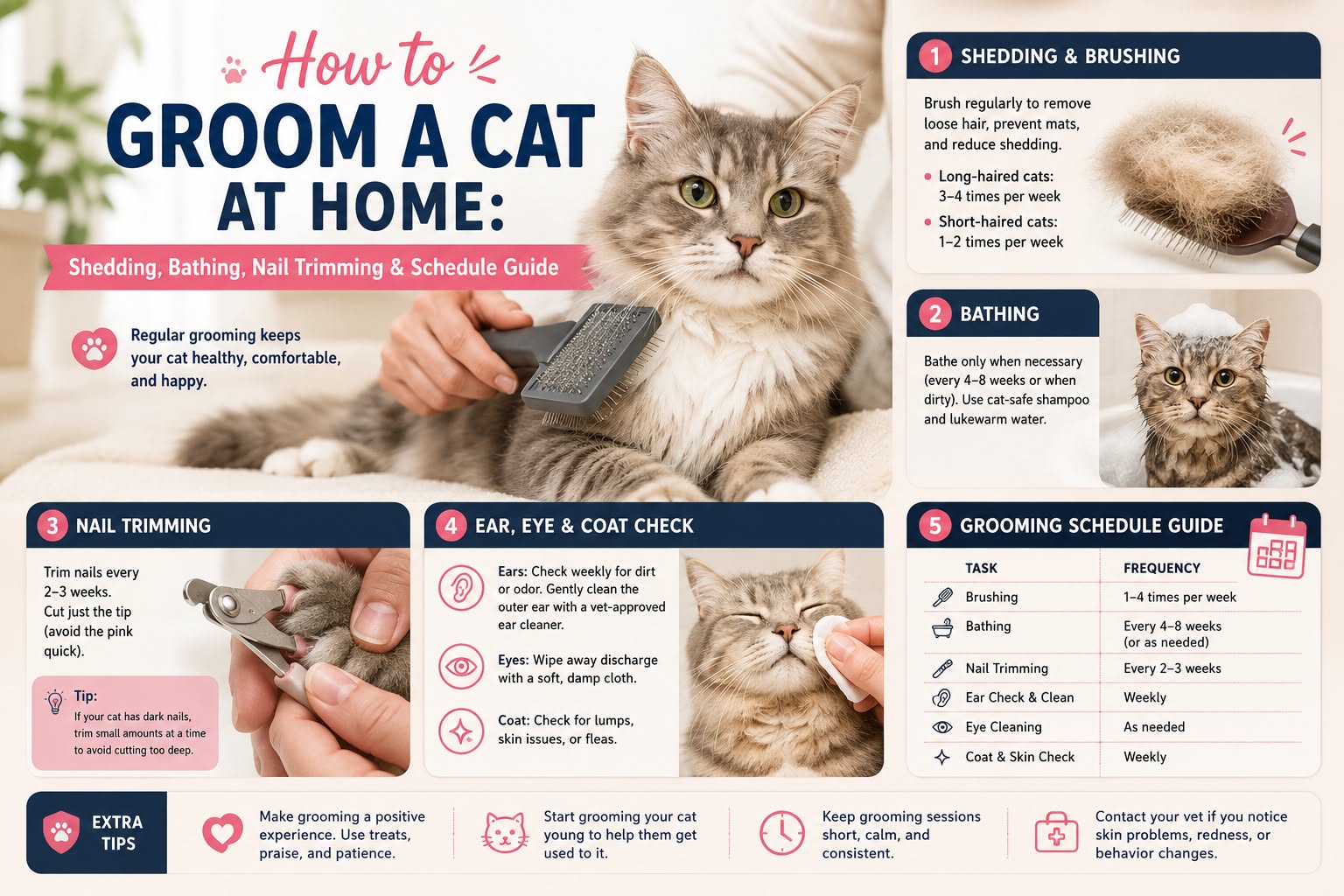
Cats are self-grooming animals that spend an estimated 30-50% of their waking hours on self-maintenance. Their barbed tongues remove loose fur, debris, and external parasites with remarkable efficiency. This natural behaviour leads many owners to assume cats need no help, an assumption that fails long-haired cats, older cats with reduced flexibility, overweight cats that cannot reach all body parts, and cats with dental or skin conditions.
Regular owner-assisted grooming reduces hairballs, detects health problems early, decreases shedding throughout the home, and builds trust between cat and owner. This guide covers brushing by coat type, the rarely necessary but sometimes unavoidable home bath, nail trimming, ear care, and teeth brushing, with techniques based on feline behaviour research and veterinary dermatology guidelines.
Understanding Cat Grooming Behaviour
Before imposing any grooming tool on a cat, understanding how cats relate to touch and handling improves outcomes substantially.
Cats are control-oriented animals. Unlike dogs, which are generally more tolerant of physical handling, cats are more likely to react negatively to restraint and imposed contact. Successful grooming builds on the cat's existing comfort with being touched, in short sessions, entirely on the cat's terms at first.
The research of Kristyn Vitale (2019, Current Biology) demonstrated that most domestic cats are securely attached to their owners and return to them as a safe base. This attachment can be leveraged: grooming done gently within the context of regular positive interaction is received differently than grooming imposed on a cat the owner rarely handles.
Signs a cat is tolerating but not enjoying grooming: ears rotated back, tail swishing, skin rippling, dilated pupils. Stop before the cat reaches this point and end the session.
Signs of relaxed grooming acceptance: slow blinking, rubbing the head against the brush, kneading, purring.
Equipment for Cat Grooming
| Tool | Purpose | Coat Types |
|---|---|---|
| Rubber curry brush or grooming mitt | Short sessions; removes loose fur; many cats accept this as petting | Short coats |
| Slicker brush | Removes loose fur and light tangles | Medium to long coats |
| Stainless steel comb (wide and fine tooth) | Detects and works through tangles; checks for parasites | Long coats |
| Dematting comb | Works through small mats without pulling | Long-coated breeds |
| Cat nail clippers (scissor type) | Nail maintenance | All cats |
| Styptic powder | Stops bleeding from quick nicks | All cats |
| Veterinary ear cleaning solution | Ear hygiene | All cats |
| Enzymatic cat toothpaste and toothbrush | Dental disease prevention | All cats |
| Pet-specific cat shampoo | For the uncommon bath | All cats |
Do not use: human shampoo, essential oil-based products, or any product containing tea tree oil, cats are particularly sensitive to phenols, salicylates, and essential oils that humans and dogs tolerate.
Brushing by Coat Type
Short Coats (Domestic Shorthair, Siamese, Russian Blue, Abyssinian)
Short-coated cats manage the vast majority of their own grooming. Owner brushing serves primarily to:
- Remove loose fur before it is swallowed (reducing hairball formation)
- Distribute skin oils
- Provide a bonding activity the cat learns to enjoy
Frequency: Once a week is sufficient during normal periods; daily during heavy shedding seasons.
Technique: A rubber grooming mitt or rubber curry brush mimics the feel of a massage, which most cats tolerate better than a bristle brush initially. Brush in the direction of coat growth, following the natural lie of the fur. Spend extra time on the belly, chest, and rump where cats often have difficulty self-grooming.
Medium and Long Coats (Maine Coon, Norwegian Forest Cat, Ragdoll, Birman)
Semi-long to long-coated cats shed year-round and are prone to mat formation at friction points: behind the ears, under the armpits (axilla), at the base of the tail, and where collars rub.
Frequency: Every other day minimum; daily for the most mat-prone breeds.
Technique: Use a slicker brush followed by a comb check. The comb should glide through without resistance, any catching indicates a tangle or forming mat. Start at the head and work toward the tail. Lift sections of coat with the comb rather than dragging through the whole coat at once.
For friction points: gently work the comb through using your free hand to support the skin at the base of the mat, do not pull the mat away from the body, pull the comb through toward the end of the hair. Detangling spray applied to the mat area eases the process significantly.
Dealing with mats: Work small mats apart with fingers first, then a dematting comb. Large, tight mats against the skin are a veterinary groomer situation. Attempting to cut out mats with scissors risks cutting the skin, which hangs in folds under mats and is very close to the surface.
The Sphinx and Hairless Breeds
Hairless cats (Sphynx, Peterbald, Donskoy) accumulate oil on their skin and need weekly bathing with a gentle cat-specific shampoo; they cannot distribute oils through a coat as furred cats do. Ear wax accumulates more visibly than in furred cats. Wrinkle folds should be cleaned with a damp cloth to prevent bacterial accumulation in skin folds.
Bathing a Cat: When and How
Most cats never need a bath. Their self-grooming is highly effective for normal maintenance. Circumstances that make bathing appropriate:
- Skin conditions requiring medicated shampoo (prescribed by a vet)
- Flea treatment when topical products alone are insufficient
- Contact with toxic or extremely sticky substances
- Severe diarrhoea or incontinence
- Severely matted or soiled coat in a cat that cannot self-groom
- Hairless breeds (routine)
Making the Experience Less Traumatic
Cats that have never been bathed as kittens often react with intense distress to bathing. Preparation matters:
- Trim nails a day before to reduce scratch injury risk
- Brush thoroughly before bathing
- Use a non-slip mat in the sink or shallow tub
- Fill the sink/tub first to avoid the stress of running water
- Have all supplies within arm's reach before placing the cat in water
- Work quickly and efficiently, shorter duration reduces stress
- Use a cup or very gentle sprayer, not a powerful shower head
Water temperature: Comfortably warm to the back of your hand. Cats are particularly sensitive to temperature.
Technique: Wet from neck to tail, avoiding the face. Apply cat-specific shampoo and lather gently. Rinse extremely thoroughly, shampoo residue on cat skin causes irritation. For the face, wipe with a damp cloth.
Drying: Wrap immediately in a large warm towel and hold the cat against your body, body heat and gentle pressure from the towel is calming. Most cats will groom themselves dry. Blow-dryers frighten most cats; if necessary, use the lowest heat setting at maximum distance.
Nail Trimming
Indoor cats need nail trimming every 2-3 weeks. Outdoor cats wear down nails naturally and may need less frequent trimming. Untrimmed indoor cat nails catch on fabrics, can curve into the paw pad, and cause injury to people and other animals.
Anatomy
Cat nails are retractile. To expose the nail, gently press the top and bottom of the toe pad between your thumb and forefinger until the nail extends fully. The quick (blood vessel and nerve) is the pink area inside the nail and is generally easy to see in cats.
Trimming Technique
- Choose a calm moment, after a meal, when the cat is relaxed
- Work in a comfortable position, many owners sit with the cat on their lap facing away
- Expose one nail by pressing the toe pad
- Identify the quick (pink triangular area inside the nail)
- Clip just the clear, curved tip, well before the quick
- The nail narrows to a point; clip at the narrowing, before the quick
- Scissor-type nail clippers give more control than guillotine style for most cat owners
- Reward with treats after each nail or after each paw, depending on the cat's tolerance
If you cut the quick: Apply styptic powder immediately. The cat will object. End the session on a calm note, not by trying to continue immediately.
Nail trimming conditioning: If a cat is resistant, start with simply holding paws and rewarding, then expose a nail and reward, then make a clipping motion (not on the nail) and reward. Progress to one nail per session with a high-value treat immediately after.
Ear Care
Cats' ears are self-cleaning to a large extent through the migration of wax toward the ear opening. Routine flushing of healthy cat ears is not necessary and can introduce moisture that causes problems.
Routine: Inspect ears weekly. Healthy ears have a light coating of pale yellowish wax at most, no odour, and pink inner surfaces.
Cleaning when needed: For cats that accumulate visible ear wax but have no infection:
- Apply a small amount of veterinary ear cleaning solution to a cotton ball
- Wipe the accessible inner surface of the ear flap (pinna) gently
- Do not insert cotton balls or swabs into the ear canal
- Allow the cat to shake their head if they wish
Warning signs requiring veterinary attention: Dark brown or black waxy discharge (possible ear mites), white or yellow discharge, strong odour, excessive scratching at ears, head tilting, balance loss. Ear infections in cats can be bacterial, yeast, mite-based, or a combination and require diagnosis before treatment.
Ear mites (Otodectes cynotis): The most common external parasite of cats. They cause intense itching, a dark, coffee-ground-like discharge, and are highly contagious between cats. Visible under magnification in the ear canal. Treatment requires a veterinary prescription acaricide.
Teeth Brushing
The ASPCA and American Veterinary Dental College estimate that by age 3, approximately 70% of cats show signs of periodontal disease. Dental disease is painful, causes systemic bacterial exposure, and is largely preventable with regular brushing.
Frequency: Daily is ideal; three times per week provides meaningful benefit.
Getting a cat to accept tooth brushing:
- First week: Let the cat lick enzymatic cat toothpaste from your finger
- Second week: Run a toothpaste-coated finger along the outer surfaces of the teeth
- Third week: Introduce a finger toothbrush
- Progress to a cat toothbrush as tolerance increases
Technique: Focus on the outer surfaces of the upper teeth, the canines and back molars accumulate plaque fastest. Use small circular motions at a 45-degree angle to the gum line. Aim for the gum line, where plaque causes disease. The inner surfaces are less critical but worth attempting.
Never use human toothpaste: Fluoride is toxic to cats when swallowed. Enzymatic cat toothpaste is designed to be effective without rinsing and is safe if swallowed.
Alternatives to brushing (less effective, but helpful adjuncts):
- VOHC-accepted dental chews or treats formulated for cats
- Water additives with antiseptic properties
- Dental diets with specific texture designed to mechanically reduce plaque
Signs of advanced dental disease requiring veterinary attention: visible tartar (yellow-brown buildup, especially on canines and upper molars), inflamed red gum line, bad breath, drooling, dropping food from the mouth, pawing at the mouth, or reduced interest in hard food.
Anal Glands in Cats
Unlike dogs, cats rarely experience anal gland impaction and expression is not part of routine cat grooming. Cats naturally express their anal glands themselves during defecation. If you notice a cat scooting across the floor, licking excessively under the tail, or a fishy smell, veterinary evaluation is appropriate.
Grooming Senior Cats
Older cats often groom themselves less effectively due to:
- Arthritis reducing flexibility (cannot reach all areas)
- Obesity preventing access to the lower back and tail base
- Dental pain causing reduced self-grooming
- Chronic illness lowering energy for maintenance
Senior cats need more regular owner assistance with brushing, particularly at the lower back and base of tail. Any sudden increase in coat condition deterioration in an older cat warrants a veterinary visit; it is often the first visible sign of systemic illness.
Grooming Frequency Summary
| Task | Short-Haired Cats | Long-Haired Cats |
|---|---|---|
| Brushing | Once weekly | Every 1-2 days |
| Bathing | Rarely (as needed) | Every 4-6 weeks for mat-prone coats; otherwise as needed |
| Nail trimming | Every 2-3 weeks | Every 2-3 weeks |
| Ear inspection | Weekly | Weekly |
| Ear cleaning | As needed | As needed |
| Teeth brushing | 3+ times weekly | 3+ times weekly |
References
Vitale, K.R., et al. (2019). "Attachment bonds between domestic cats and humans." Current Biology, 29(18), R864-R865. https://doi.org/10.1016/j.cub.2019.08.036
American Veterinary Dental College. (2019). AVDC Position Statement: Companion Animal Dental Disease.
Robertson, S.A. (2020). "Feline pain assessment and management." Veterinary Clinics of North America: Small Animal Practice, 50(4), 847–861.
Moriello, K.A. (2022). "Cat skin care basics: Skin conditions, grooming, and shampoos." Merck Veterinary Manual.
Veterinary Oral Health Council (VOHC). (2023). Accepted Products for Cats. http://www.vohc.org
Related reading:
- How to Groom Your Dog at Home
- Why Do Cats Groom So Much
- Signs of a Healthy Cat
- How Long Do Cats Live
- Cat Dental Care Guide
Frequently Asked Questions
Do cats need to be groomed if they already groom themselves?
Short-haired cats manage most of their own grooming, but still benefit from weekly brushing to reduce hairballs and allow early health detection. Long-haired cats (Maine Coons, Ragdolls, Persians) need daily or every-other-day brushing to prevent mats. Older, overweight, or arthritic cats often cannot reach all body parts and develop coat problems without owner assistance.
How do I stop my cat from biting me during grooming?
Biting during grooming is usually a stress response. Work in very short sessions (1-2 minutes), use treats throughout, and stop before the cat shows discomfort signals (tail swishing, ears back, skin rippling). Build tolerance gradually over many sessions rather than forcing completion of a full grooming routine. A cat that bites when its lower back or belly is touched may be in pain, a veterinary visit is appropriate.
How often should I trim my cat's nails?
Indoor cats need nail trimming every 2-3 weeks. Outdoor cats wear nails down naturally and may need less frequent trimming. To trim, gently press the toe pad to extend the retractile nail, identify the pink quick inside the nail, and clip just the curved transparent tip. Scissor-style cat nail clippers give more control than guillotine type.
Do I need to clean my cat's ears regularly?
Healthy cat ears are largely self-cleaning and do not need routine flushing. Inspect weekly and wipe visible surfaces of the inner ear flap with a veterinary ear solution on a cotton ball only when wax is visible. Never insert cotton swabs into the ear canal. Dark crumbly discharge, odour, or persistent scratching at ears warrants veterinary attention, these indicate infection or ear mites.
Is it safe to bathe a cat?
Yes, though most cats resist bathing and rarely need it. Use cat-specific shampoo (never human shampoo or essential oil products, which are toxic to cats), lukewarm water, and a non-slip mat. Trim nails first. Keep the session as short as possible. Most healthy short-haired cats never need bathing. Hairless breeds and cats with skin conditions prescribed medicated shampoos need regular bathing.
What is the best way to brush a cat's teeth?
Build acceptance gradually: let the cat lick enzymatic cat toothpaste from your finger, progress to rubbing your finger along the outer tooth surfaces, then introduce a finger toothbrush, then a full cat toothbrush. Focus on the outer surfaces of the upper teeth. Use only cat-specific enzymatic toothpaste, human toothpaste contains fluoride, which is toxic to cats when swallowed.