
The indoor vs. outdoor cat debate is not evenly balanced by evidence. Outdoor cats face mortality rates dramatically higher than indoor cats.
A widely cited 2013 study in Nature Communications by Loss et al. estimated that free-roaming cats kill between 1.3 and 4 billion birds annually in the United States alone, making them the leading human-caused source of bird mortality in North America. Life expectancy data consistently shows indoor cats living 12-18 years while outdoor cats average 2-5 years.
Despite this, many cats become restless, destructive, or unhappy when kept strictly indoors without adequate environmental enrichment. The problem is not indoor living itself; it is indoor living without appropriate mental and physical stimulation. This guide covers creating an environment that genuinely satisfies indoor cats and, for owners of cats that previously had outdoor access, how to transition to indoor living.
The Evidence on Outdoor Cat Mortality
The reduced lifespan of outdoor cats is not primarily due to traffic, though vehicles are a significant risk. Major causes of outdoor cat mortality and injury include:
| Risk | Notes |
|---|---|
| Predation (coyotes, foxes, dogs, birds of prey) | Common in suburban and rural areas |
| Road traffic | Leading preventable cause of death in urban cats |
| Infectious disease (FIV, FeLV, feline panleukopenia) | Contact with other cats and wildlife |
| Traumatic injury (fights, falls from trees, traps) | Fighting with other cats causes abscesses requiring veterinary care |
| Poisoning (rodenticides, antifreeze, plant toxins) | Neighbour-applied rodenticides particularly dangerous |
| Hypothermia and heatstroke | Weather exposure |
"Our results suggest that free-ranging cats cause far greater wildlife mortality than previously thought and are likely the top source of anthropogenic mortality for US birds and mammals." Loss, S.R., et al., Nature Communications, 2013
The wildlife impact of outdoor cats is also relevant to owners who care about conservation. Domestic cats are highly efficient predators that wildlife did not evolve to coexist with in the environments where most domestic cats now live.
What Indoor Cats Actually Need
A cat that spends its life in an enrichment-poor environment, the same furniture, no novel stimuli, no outlet for predatory behaviour, is genuinely deprived. The solution is environmental design, not resignation.
The core needs of an indoor cat:
1. Vertical space Cats are vertical animals. In the wild, elevated positions provide safety, visual advantage, and territory marking opportunities. A home with only floor-level space is spatially impoverished for a cat. Providing cat trees, wall-mounted shelves, and window perches at different heights substantially improves the perceived space available to a cat.
Multiple vertical levels allow cats in multi-cat households to maintain appropriate distance from each other, a critical resource in preventing conflict.
2. Hiding spaces Cats under stress strongly need access to enclosed spaces where they can retreat unseen. Cardboard boxes, covered cat beds, and cat caves serve this function. The absence of hiding spots causes chronic low-grade stress in cats that have experienced threat or are by nature more cautious.
3. Perches with views A window overlooking a garden, bird feeder, bird bath, or squirrel activity is remarkably high-value entertainment for indoor cats. The "cat TV" function of wildlife viewing at a window provides hours of daily visual and auditory stimulation. Placing a cat tree, shelf, or cushioned perch at a window with an interesting view transforms a static indoor environment into a dynamic one.
4. Hunting/predatory behaviour outlet The predatory motor sequence (stalk → rush → pounce → catch → bite and kill) is neurologically wired in cats and must be expressed in some form. Without an outlet, cats become frustrated. Wand toys (feather wands, fishing-rod toys with prey-mimicking attachments) are the most effective way to allow this sequence. Allow the cat to "catch" the toy periodically, endless pursuit without capture builds frustration.
Interactive play sessions of 10-15 minutes, twice daily, are the minimum meaningful threshold.
5. Olfactory stimulation Cats process their world primarily through smell. Novel scents are cognitively engaging. Effective olfactory enrichment:
- Catnip (Nepeta cataria): Produces a euphoric response in approximately 70% of cats (the response is genetic, non-responders simply don't have the receptor). The response lasts 10-15 minutes and requires a 30-minute reset period.
- Silver vine (Actinidia polygama): Produces a similar response to catnip, including in cats that do not respond to catnip. A 2019 study in BMC Veterinary Research found silver vine produced a response in 80% of cats, including 75% of catnip non-responders.
- Valerian root: A third option for cats unresponsive to both catnip and silver vine.
- Outdoor scents: Wearing gardening clothes or bringing in leaves, sticks, or soil introduces novel outdoor smells.
6. Social stimulation Cats are often described as solitary but are capable of forming strong social bonds with familiar humans and other cats. Regular positive interaction, play, grooming, sitting near the owner, is valuable enrichment. A second cat as a companion can significantly enrich an indoor environment, but only if the cats are compatible; incompatible pairs cause chronic stress.
Designing an Enriched Indoor Environment
The Window Situation
A garden-facing window is among the highest-return investments in cat wellbeing. Enhanced window setup:
- Install a stable shelf or perch at the window (several commercial products exist; cat window hammocks are also effective)
- Place a bird feeder in clear view of the window
- Add a bird bath if space allows
- In warm months, a screen extension ("catio window box") allows fresh air and outdoor smells while preventing escape
Cat Trees and Climbing Structures
Cat trees should be:
- Tall enough to provide genuine height (minimum 120 cm; 150+ cm preferred)
- Stable, a wobbly cat tree creates anxiety rather than security
- Placed near a window when possible
- Equipped with hammock-style perches for cats that prefer to be fully enclosed while elevated
In addition to commercial cat trees, wall-mounted floating shelves create "catwalks" at different heights. Several companies produce dedicated cat wall furniture; regular shelf brackets and wooden planks work equally well.
Multiple Feeding Stations (Multi-Cat Households)
In multi-cat households, resource competition is a major source of chronic stress. Resources that should be distributed throughout the home:
- Feeding stations: One per cat, ideally in different rooms
- Water sources: Multiple locations; cats often prefer running water (a pet fountain)
- Litter boxes: One per cat plus one additional (the "n+1" rule)
- High perches: Enough that no cat monopolises all elevated space
- Hiding spots: Multiple per floor
Puzzle Feeders and Foraging Enrichment
Bowl feeding takes 30 seconds. In the wild, cats spend 4-6 hours per day in hunting and foraging activity. Replacing bowl feeding with puzzle feeders provides physical and cognitive engagement:
Level 1 (beginner): Ball dispensers that release kibble when rolled. Most cats accept these immediately.
Level 2 (intermediate): Multi-compartment trays with lids the cat lifts or slides. Requires learned manipulation.
Level 3 (advanced): Multi-step puzzles requiring sequential actions. After a cat masters this level, commercial puzzles can be customised.
Mouse hunt: Hide multiple small portions of food in different locations throughout the home, under furniture, on shelves, in cardboard tubes. The cat hunts for each meal. Particularly effective at providing whole-environment enrichment.
Research by Dr. Liz Bales found that cats fed entirely via puzzle feeders showed significant reductions in obesity, anxiety-related behaviours, and aggression compared to bowl-fed cats.
Transitioning an Outdoor Cat to Indoor Living
Cats with established outdoor access do not transition easily to indoor living without significant enrichment compensation. Expect a period of adjustment (1-4 weeks for most cats) with:
- Increased vocalisation at doors and windows
- Restlessness and pacing
- Possible scratching at exit points
- Attempts to dart through open doors
This is not evidence that indoor living is wrong for the cat; it is the adjustment period to the removal of environmental access that must be compensated by enriching the indoor environment.
Transition Strategy
Before transitioning:
- Fully prepare the indoor environment first: cat tree installed and stable, window perch in place, bird feeder visible from window, puzzle feeders acquired, hiding spots established
- Introduce the enrichment before removing outdoor access so the cat has indoor options from day one
The transition:
- Begin keeping outdoor access times shorter and more structured if the cat currently has free outdoor access
- Gradually shift to supervised access only (harness + leash or supervised time in an enclosed garden)
- Increase interactive play sessions during the transition period to approximately 20 minutes twice daily
- Expect vocalisation at doors, do not reward this with door opening; wait for quiet before any interaction in that context
For cats that are extremely distressed: Some cats with long outdoor histories require longer adjustment periods. Providing a catio (enclosed outdoor structure) allows safe outdoor access. Harness training provides supervised outdoor experience.
Harness Training Cats
Some cats can be successfully trained to walk on a harness and leash, providing supervised outdoor time. Not all cats accept this:
- Start with the harness inside the home; leave it near feeding stations for several days before putting it on
- First fittings should be very brief (30 seconds) with immediate treats
- Build up time worn indoors before attempting outdoor walks
- First outdoor excursions should be in a quiet, enclosed space
- Allow the cat to set the pace, dragging a cat outdoors produces fear, not enjoyment
Cat harnesses should be escape-proof (cats are flexible and escape H-style harnesses far more easily than "jacket"-style harnesses designed for cats).
The Catio: Best of Both
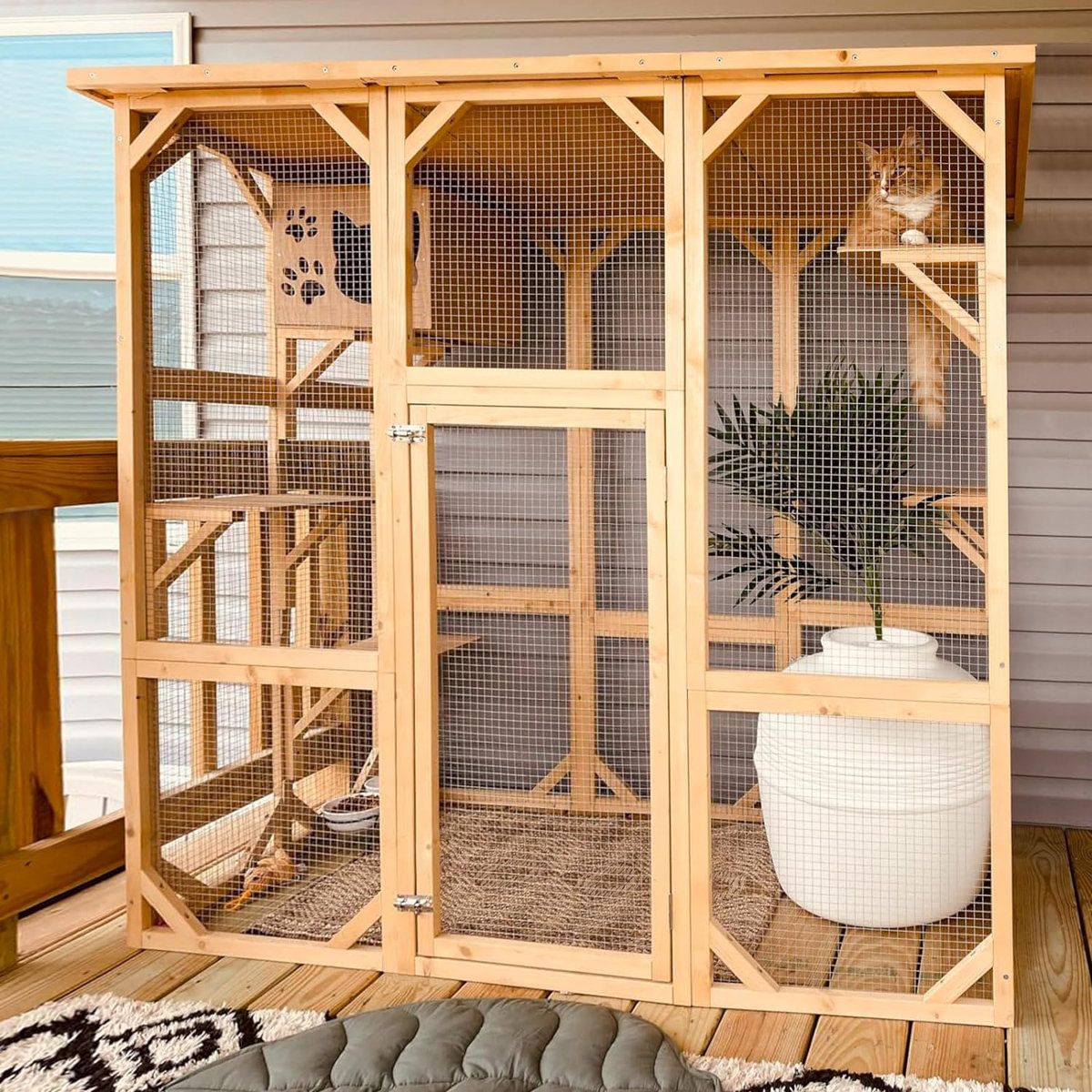
A catio is an enclosed outdoor structure connected to the house, allowing cats to experience outdoor air, sounds, and smells without the risks of free roaming. Catios range from simple window-box extensions to large walk-in garden enclosures.
Basic window box catio: Attaches to a window, provides 0.5-1 m² of outdoor space with fresh air and exterior views. Suitable for apartments.
Attached outdoor pen: A fully enclosed run connected to a cat door, providing 2-10+ m² of outdoor space. Allows sunbathing, grass contact, and outdoor smells.
Garden enclosure: Full garden netted or walled to contain cats while allowing free roaming of the garden space.
Catios are the single best solution for owners who want their cats to have outdoor access safely and who care about wildlife protection. Many cats with strong outdoor drives become satisfied with catio access.
Cat-Safe Plant Toxicity
Many common houseplants are toxic to cats. Indoor cats that lack outdoor access may show increased interest in houseplants. Toxic plants to remove from or restrict access to in cat-inhabited spaces include:
| Plant | Toxicity |
|---|---|
| Lilies (all Lilium and Hemerocallis species) | Highly toxic, acute renal failure; can be fatal from even small ingestion |
| Tulip bulbs | Gastrointestinal and cardiac effects |
| Oleander | Cardiac glycosides, potentially fatal |
| Cyclamen | Gastrointestinal and cardiac effects |
| Sago palm | Acute liver failure, highly toxic |
| Pothos / Epipremnum | Oral irritation, vomiting |
| Peace lily | Oral irritation, calcium oxalate crystals |
The ASPCA Animal Poison Control Center (APCC) maintains a comprehensive plant toxicity database at aspca.org/pet-care/animal-poison-control.
References
Loss, S.R., et al. (2013). "The impact of free-ranging domestic cats on wildlife of the United States." Nature Communications, 4, 1396. https://doi.org/10.1038/ncomms2380
Bales, E. (2015). The NoBowl Feeding System Research. Veterinary Practice News.
Bol, S., et al. (2017). "Responsiveness of cats (Felidae) to silver vine, Tatarian honeysuckle, valerian and catnip." BMC Veterinary Research, 13, 70. https://doi.org/10.1186/s12917-017-0987-6
American Association of Feline Practitioners (AAFP). (2022). Environmental Needs Guidelines. https://catvets.com
Ellis, S.L.H., et al. (2013). "AAFP and ISFM Feline Environmental Needs Guidelines." Journal of Feline Medicine and Surgery, 15(3), 219–230. https://doi.org/10.1177/1098612X13477537
Related reading:
- How to Groom Your Cat at Home
- Why Do Cats Knead
- How Smart Are Cats
- How Long Do Cats Live
- Signs of a Healthy Cat
- Foods Toxic to Cats Complete List
Frequently Asked Questions
Can cats be happy living indoors?
Yes, with appropriate environmental enrichment. The problem is not indoor living but indoor living in an unstimulating environment. An indoor cat with vertical space (tall cat trees, wall shelves), window views with wildlife activity, twice-daily interactive play sessions, puzzle feeders, hiding spots, and olfactory stimulation (catnip, silver vine) has a genuinely higher quality of life than a free-roaming outdoor cat exposed to predators, disease, and traffic.
How do I transition an outdoor cat to indoor living?
Fully prepare the indoor environment before transitioning, install cat trees, window perches, set up bird feeders, acquire puzzle feeders. Begin by shortening outdoor access periods, then shift to supervised-only access (harness walks, enclosed catio). Increase interactive play to 20 minutes twice daily during the adjustment period. Expect 1-4 weeks of vocalisation at doors, do not reinforce this by opening the door.
Most cats adjust successfully with adequate enrichment compensation.
What is a catio?
A catio is an enclosed outdoor structure connected to the home that allows cats safe outdoor access. Options range from small window-box extensions (0.5-1 m²) suitable for apartments to large walk-in garden enclosures. Catios allow cats to experience fresh air, outdoor smells, and sunshine while eliminating traffic, predation, disease, and wildlife impact risks. They are the best solution for cats with strong outdoor drives.
Is catnip safe for cats?
Yes, catnip is safe and non-addictive. Approximately 70% of cats have a genetic receptor for the compound nepetalactone and experience 10-15 minutes of euphoric response. Cats that don’t respond to catnip can try silver vine (Actinidia polygama), which produces a similar response in 80% of cats including 75% of catnip non-responders. A 30-minute reset period is needed between catnip exposures.
Which plants are toxic to indoor cats?
The most dangerous to cats are all true lilies (Lilium species) and daylilies (Hemerocallis species), even small ingestions cause acute renal failure and can be fatal. Also toxic: sago palm (liver failure), oleander, cyclamen, tulip bulbs, pothos, and peace lily. Remove these plants from cat-accessible areas entirely. The ASPCA Animal Poison Control Center at aspca.org maintains a complete toxicity database.
How do I harness train my cat for outdoor walks?
Use a jacket-style escape-proof harness (not H-style, which cats escape easily). Begin by leaving the harness near the cat’s feeding area for several days. First fittings should last 30 seconds with immediate treats. Gradually increase time worn indoors. First outdoor excursions should be in a quiet, enclosed space, with the cat setting the pace completely.
Not all cats will accept harness walking, some become frozen or extremely anxious outdoors, which is a signal to stop.