
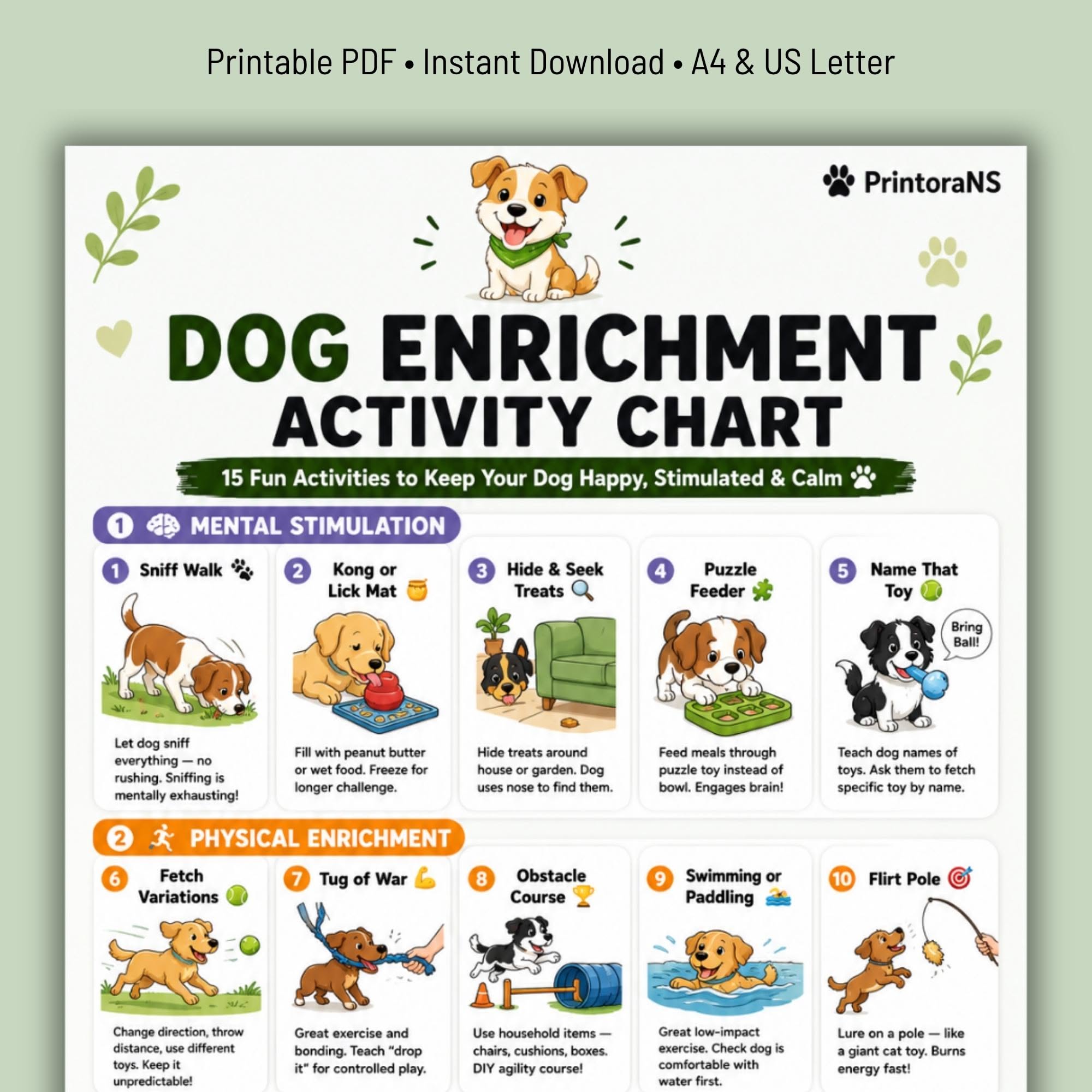
Pet exercise and enrichment are physical necessities for dogs and cats, not optional extras. Insufficient physical activity is a documented cause of obesity, behavioural problems, anxiety, destructive behaviour, and reduced lifespan. Equally important, and more often overlooked, is cognitive enrichment: stimulation of the animal's problem-solving capacities, social needs, and natural behaviours through environmental design and interaction.
This guide covers evidence-based exercise requirements for dogs and cats by life stage, the distinction between physical exercise and mental enrichment, and practical activities that address both simultaneously.
Why Exercise and Enrichment Are Different Things
Exercise addresses the cardiovascular, muscular, and metabolic needs of the body. Walking, running, swimming, and fetch are primarily exercise.
Enrichment addresses the cognitive, sensory, and behavioural needs of the mind. It encompasses activities that allow animals to express species-typical behaviours: foraging, hunting, exploring, social interaction, and problem-solving.
The two overlap, fetch provides both exercise and mild cognitive engagement, but they are not substitutable. A dog that runs 5 miles per day but lives in a blank kennel environment still shows stereotypic behaviours (repetitive purposeless movements) from lack of enrichment. A dog with complex daily enrichment but minimal physical exercise is obese and physically compromised.
Excellent pet welfare requires both.
"Behavioural needs are biological needs. The failure to meet them produces the same kind of suffering as the failure to meet physical needs, even if the suffering is not immediately visible." Marian Stamp Dawkins, University of Oxford, Animal Welfare Research
Dog Exercise Requirements
Dog exercise needs are breed-dependent to a significant degree. Working breeds, sporting breeds, and herding breeds were selectively bred for sustained physical activity and have genuine athletic requirements. Companion and toy breeds have lower but still meaningful requirements.
Adult Dogs: Exercise Guidelines by Breed Category
| Breed Category | Minimum Daily Exercise | Ideal | Examples |
|---|---|---|---|
| High-energy working/sporting/herding | 90-120 minutes | 2+ hours | Border Collie, Siberian Husky, Vizsla, Weimaraner, Jack Russell Terrier |
| Active medium breeds | 60-90 minutes | 90+ minutes | Labrador, Golden Retriever, Boxer, Dalmatian, Beagle |
| Moderate-energy breeds | 45-60 minutes | 60-90 minutes | Cocker Spaniel, Poodle, Shih Tzu, Bulldog |
| Low-energy/companion breeds | 30-45 minutes | 45-60 minutes | Pug, Basset Hound, Chow Chow, Mastiff |
| Brachycephalic breeds | 20-30 minutes, low intensity | 30-45 minutes, careful monitoring | French Bulldog, Pug, Bulldog, Boston Terrier |
Brachycephalic breeds (flat-faced dogs) have significant respiratory limitations due to narrowed nostrils, elongated soft palates, and narrowed tracheas. These dogs cannot thermoregulate effectively through panting and are at high risk of heatstroke. Exercise should be in cool conditions, kept to low intensity, and supervised carefully. Any evidence of distress (excessive panting, blue gums, collapse) requires immediate cessation and veterinary attention.
Puppies: The 5-Minute Rule and Growth Plates
Puppies need exercise but must be protected from joint damage during skeletal development. The widely cited rule of thumb, 5 minutes of exercise per month of age, twice daily, provides a reasonable guideline:
| Puppy Age | Maximum Exercise Per Session | Frequency |
|---|---|---|
| 8 weeks | 10 minutes | Twice daily |
| 12 weeks | 15 minutes | Twice daily |
| 4 months | 20 minutes | Twice daily |
| 6 months | 30 minutes | Twice daily |
| 9 months | 45 minutes | Twice daily |
These guidelines apply to structured, repetitive exercise (walking, jogging) on hard surfaces. Free play, including running and play with other dogs, uses self-regulation to a degree, but even free play should be moderated in puppies under 6 months.
Growth plates (physis) in large and giant breeds close later than in small breeds: typically 12-18 months for large breeds, and 18-24 months for giants like Great Danes and Mastiffs. High-impact repetitive exercise on hard surfaces before growth plate closure risks physeal damage. Swimming is an excellent low-impact alternative during this period.
Senior Dogs
Dogs are generally considered senior at approximately 7 years for large breeds and 9-10 years for small breeds. Senior dogs need continued daily exercise but adjusted for health status, mobility, and energy levels.
Key principles for senior exercise:
- Maintain daily exercise, deconditioning accelerates in senior dogs and worsens mobility
- Prioritise low-impact activities: walking at a comfortable pace, swimming, gentle play
- Watch for signs of pain during or after exercise: stiffness the following morning, reluctance to walk, limping, difficulty rising
- Shorten individual sessions if needed, increasing frequency (three 20-minute walks beats one 60-minute walk for arthritic dogs)
- Swimming is particularly valuable for dogs with hip or elbow arthritis, full cardiovascular exercise with minimal joint loading
Best Exercise Activities for Dogs
Walking: The foundation. Regular daily walks on varied routes provide both exercise and significant sensory enrichment (smell is a dog's primary sense, "sniff walks" where the dog is allowed to sniff extensively are cognitively enriching even at slow pace).
Fetch and retrieve: High cardiovascular intensity for relatively short sessions. Excellent for dogs with strong retrieve drive (Labrador, Golden, Springer Spaniel). Use a soft ball or a fetch toy rather than a stick, which causes oral injury.
Swimming: Low-impact, full-body exercise. Particularly valuable for dogs with orthopaedic conditions and older dogs. Most retrievers have natural water affinity. Always ensure a safe exit route and supervise closely.
Dog sports: Agility, flyball, dock diving, canicross (running with dogs), nosework/scent work, Treibball, and herding trials provide high-intensity exercise combined with intense cognitive engagement.
Off-lead running: High value for exercise but requires a reliable recall and a safe enclosed space. Dog parks provide social exercise with other dogs, valuable but requires monitoring for conflict and disease risk management.
Cat Exercise Requirements
Cats are obligate carnivores with a hunting-based activity model: short, intense bursts of predatory activity followed by extended rest. This is fundamentally different from the sustained aerobic pattern of dogs. Most adult domestic cats rest for 12-16 hours per day; this is normal, not laziness.
However, indoor cats, particularly those without stimulation, can become dramatically under-exercised. Obesity affects an estimated 30-40% of domestic cats in developed countries. Insufficient exercise is a primary contributor.
Adult Cats
Minimum meaningful exercise: Two to three dedicated interactive play sessions per day of 10-15 minutes each. Total targeted activity: 20-40 minutes of active play per day.
This does not need to be continuous. Cats naturally engage in multiple short activity bouts throughout the day and night.
Best activities for cats:
- Wand toys (feather wands, Da Bird, other prey-mimicking toys): Mimic the natural prey-catching sequence (stalk, chase, catch, dissect). Allow the cat to "catch" the prey periodically, endless pursuit without catching causes frustration.
- Laser pointers: High prey engagement but should always end with the cat catching a physical toy (not just a dot that disappears), as the inability to catch the dot causes frustration in some cats.
- Crinkle balls, spring toys, and small plush mice for independent batting
- Food puzzle toys and feeders (see Enrichment section)
Senior Cats
Cats over 10-12 years typically have reduced activity drive and may have arthritis or other mobility limitations. This does not mean no exercise, continued activity maintains muscle mass, joint health, and cognitive function.
For senior cats:
- Shorter play sessions (5-10 minutes) more frequently
- Lower-impact toys that do not require jumping (ground-level wand dragging, shuffling crinkle balls along the floor)
- Ramps or steps to favourite elevated resting spots if jumping becomes difficult
- Gentle massage of limbs to maintain circulation and assess for pain
The Five Freedoms and the Five Domains: Enrichment Framework
The Five Freedoms (Brambell, 1965) and their modern refinement, the Five Domains (Mellor, 2017), provide the framework used by the veterinary and animal welfare community to assess animal wellbeing. The Five Domains:
- Nutrition: Access to appropriate food and water
- Physical environment: Appropriate shelter, substrate, space
- Health: Disease management, injury prevention
- Behavioural interactions: With environment, other animals, and humans
- Mental state: Positive emotional experiences
Enrichment primarily addresses domains 4 and 5, behavioural expression and positive mental states.
Enrichment by Category
Foraging and Feeding Enrichment
In the wild, carnivores spend a significant portion of their waking hours in food acquisition. Domestic pets receive food in a bowl in seconds, removing a major source of cognitive and physical activity.
For dogs:
- Food puzzle toys (Kong, Nina Ottosson puzzles, Licki Mats): Extend feeding time from 30 seconds to 10-20 minutes; engage problem-solving
- Scatter feeding: Spread dry kibble in the grass for dogs to sniff out; activates foraging behaviour
- Sniff walks: Allow the dog to sniff-explore freely during walks; olfactory processing is cognitively demanding
For cats:
- Puzzle feeders: From simple ball-dispensing feeders to multi-step puzzles. Start with easy levels and increase difficulty as the cat becomes proficient.
- Mouse hunt: Hide multiple small portions of food in different locations around the house; the cat hunts for each portion
- The NoBowl Feeding System: A commercial product based on Dr. Liz Bales' research; replaces the bowl entirely with hunting-based meals
"Free-fed cats that receive their entire diet through puzzle feeders show significantly reduced obesity rates, anxiety behaviours, and aggression compared to bowl-fed cats in the same household." Ellis, S.L.H., et al., Applied Animal Behaviour Science, 2015
Environmental Enrichment
Vertical space (cats): Cats are vertical animals. A cat-friendly home should provide multiple levels, cat trees, shelves, windowsills, and perches at different heights. Elevated resting spots feel secure; horizontal space alone is insufficient.
Outdoor access, controlled (cats): Outdoor access provides enormous enrichment but carries significant risks (traffic, predators, disease). Solutions that provide outdoor sensory access safely include: fully enclosed catios (outdoor enclosures attached to the home), window boxes with screening, and supervised harness-and-leash access. A single bird feeder or bird bath visible from a window provides ongoing wildlife viewing enrichment.
Den spaces and hiding areas (cats): Cats under stress strongly prefer to hide. Cardboard boxes, paper bags, covered beds, and elevated hiding spots allow cats to regulate their own social exposure.
Novel objects (both species): New objects introduced regularly provide investigation opportunity. Cardboard boxes, paper bags, tunnels, and novel-scented items (catnip, valerian, silver vine for cats; novel smells from outside for dogs) provide olfactory and investigative enrichment.
Social Enrichment
For dogs: Interaction with familiar people and dogs is the highest-value enrichment for most dogs. Regular off-lead time with compatible dogs, training sessions with owners, and free interactive play are the most powerful positive welfare contributors for social breeds.
For cats: Social enrichment needs are more variable. Many cats prefer a single bonded companion; others prefer solitary status. Multi-cat households should provide multiple feeding stations, multiple litter boxes, and multiple perches to allow resource distribution without conflict. Forced proximity between incompatible cats causes chronic stress.
Human interaction: Active owner engagement, training, interactive play, and positive handling, is consistently associated with higher welfare scores in both dogs and cats.
Cognitive Enrichment: Training as Enrichment
Training is among the most cognitively demanding activities available to pets. Learning new behaviours engages working memory, attention, and reward processing. Positive reinforcement-based training sessions of 5-15 minutes, two to three times per day, provide:
- Direct cognitive stimulation from problem-solving
- A structured source of positive human interaction
- Physical exercise in performance (particularly for dogs learning more active behaviours)
- A communication system between owner and pet that reduces frustration-based behaviour problems
For cats specifically: Cats are highly trainable and respond strongly to clicker-based positive reinforcement. Teaching cats even simple behaviours (sit, high five, come when called) provides meaningful cognitive enrichment and dramatically improves the owner-cat relationship.
Signs of Insufficient Exercise and Enrichment
| Sign | More Likely in Dogs | More Likely in Cats |
|---|---|---|
| Destructive behaviour (chewing, scratching furniture) | Yes | Yes |
| Excessive vocalisation / attention-seeking | Yes | Yes |
| Hyperactivity, difficulty settling | Yes | Less common |
| Obesity | Yes | Yes |
| Stereotypies (repetitive behaviours: spinning, pacing) | Yes | Less common |
| Anxiety and fearfulness | Yes | Yes |
| Aggression / redirected aggression | Yes | Yes |
| Excessive grooming or self-harm | Dogs: less common | Cats: psychogenic alopecia |
| Indoor elimination outside the litter box (cats) | , | Yes, stress behaviour |
References
Brambell, F.W.R. (1965). Report of the Technical Committee to Enquire into the Welfare of Animals kept under Intensive Livestock Husbandry Systems. Her Majesty's Stationery Office.
Mellor, D.J. (2017). "Operational Details of the Five Domains Model and Its Key Applications to the Assessment and Management of Animal Welfare." Animals, 7(8), 60. https://doi.org/10.3390/ani7080060
Ellis, S.L.H., et al. (2015). "The influence of prey type on the domestic cat's prey preference and body weight." Applied Animal Behaviour Science, 173, 69–77.
Raffan, E., et al. (2016). "A Deletion in the Canine POMC Gene Is Associated with Weight and Appetite in Obesity-Prone Labrador Retriever Dogs." Cell Metabolism, 23(5), 893–900.
Overall, K.L. (2013). Manual of Clinical Behavioral Medicine for Dogs and Cats. Elsevier Mosby.
Zulch, H., & Mills, D. (2012). Life Skills for Puppies. Hubble & Hattie.
Related reading:
- How to Train a Puppy
- How to Leash Train a Dog
- How Smart Are Dogs
- How Smart Are Cats
- Senior Dog Nutrition Guide
- Senior Cat Nutrition Guide
Frequently Asked Questions
How much exercise does a dog need per day?
Exercise requirements vary significantly by breed. High-energy working, sporting, and herding breeds (Border Collies, Huskies, Vizslas) need 90-120+ minutes daily. Active medium breeds (Labradors, Goldens, Boxers) need 60-90 minutes. Companion and low-energy breeds need 30-60 minutes. Brachycephalic breeds (French Bulldogs, Pugs, Bulldogs) should exercise only 20-30 minutes in cool conditions due to respiratory limitations.
How much exercise do cats need?
Cats need 2-3 interactive play sessions of 10-15 minutes each daily, totalling 20-40 minutes of active play. Unlike dogs, cats operate in short intense bursts; they are not built for sustained aerobic exercise. Wand toys that mimic prey movement provide the highest engagement. Always allow the cat to ‘catch’ the toy periodically, as endless pursuit without catching causes frustration.
What is enrichment and why do pets need it?
Enrichment provides cognitive, sensory, and behavioural stimulation that satisfies an animal’s species-typical needs beyond basic physical exercise. It includes foraging activities (puzzle feeders, scatter feeding), environmental complexity (vertical space for cats, novel objects), social interaction, and training.
Insufficient enrichment causes destructive behaviour, excessive vocalisation, stereotypies, anxiety, and obesity even in physically exercised animals.
How much exercise should a puppy get?
The guideline is 5 minutes of structured exercise per month of age, twice daily: so a 3-month puppy gets 15-minute sessions, a 6-month puppy gets 30-minute sessions. This protects developing growth plates from repetitive-impact damage. Large and giant breed growth plates close at 12-18 months (large breeds) or 18-24 months (giant breeds). Swimming is an excellent low-impact alternative during skeletal development.
What are the best enrichment activities for indoor cats?
The most effective enrichment for indoor cats includes: wand toys and interactive play sessions twice daily, puzzle feeders replacing or supplementing bowl feeding, multiple vertical levels (cat trees, shelves), window access with bird/wildlife viewing, hiding spots and cardboard boxes to explore, and regular novel-scented objects.
Clicker training with positive reinforcement provides intense cognitive stimulation and is highly recommended even for basic behaviours.
How do I know if my pet needs more exercise or enrichment?
Signs of insufficient exercise or enrichment include: destructive behaviour (chewing, scratching furniture), excessive barking or vocalisation, hyperactivity and difficulty settling, obesity, anxiety or fearfulness, repetitive purposeless movements (pacing, spinning), redirected aggression, and in cats, elimination outside the litter box or excessive grooming causing hair loss.
Many behavioural problems attributed to ‘personality’ resolve with adequate exercise and enrichment.