
Do Komodo dragons actually have venom?
Yes. Research published in 2009 by Bryan Fry and colleagues confirmed that Komodo dragons possess venom glands in their lower jaws that produce toxic proteins causing a rapid drop in blood pressure, inhibition of blood clotting, and induction of shock. This overturned decades of belief that Komodo dragon bites killed through bacterial infection alone.
Lizards are among the most successful vertebrate groups on Earth. With more than 7,000 described species spanning every continent except Antarctica, they have colonized deserts, rainforests, oceanic islands, mountain peaks, and urban environments with a versatility that few other animal groups can match.
They range in size from the diminutive Brookesia micra chameleon of Madagascar - small enough to perch on a matchstick head - to the formidable Komodo dragon, a three-meter predator capable of bringing down water buffalo.
What makes lizards remarkable is not merely their diversity in form, but the sheer breadth of their evolutionary innovations. They have independently evolved flight-like gliding, adhesive toe pads that defy gravity, chemical defense systems that weaponize their own blood, and regenerative abilities that continue to astonish biomedical researchers. To study lizards is to study the full repertoire of survival strategies available to vertebrate life.
"The lizard is the most ancient of all living reptilian groups, and in many ways the most successful. Their evolutionary plasticity is unmatched among terrestrial vertebrates." - Eric Pianka, Ecology and Natural History of Desert Lizards (1986)
Diversity and Classification
Lizards belong to the order Squamata, which they share with snakes and amphisbaenians (worm lizards). Within this order, lizards are distributed across roughly 40 families and occupy an extraordinary range of ecological niches. The major families include:
- Gekkonidae (geckos) - over 1,500 species, found on every warm continent
- Scincidae (skinks) - approximately 1,700 species, the largest lizard family
- Iguanidae (iguanas) - roughly 40 species, predominantly in the Americas and Pacific islands
- Agamidae (dragon lizards) - about 500 species across Africa, Asia, and Australia
- Varanidae (monitor lizards) - approximately 80 species, including the Komodo dragon
- Lacertidae (wall lizards) - around 300 species, dominant across Europe and Africa
- Chamaeleonidae (chameleons) - over 200 species, famous for color change and projectile tongues
- Teiidae (tegus and whiptails) - roughly 150 species in the Americas
This taxonomic breadth translates into astonishing morphological and behavioral diversity. Lizards have evolved elongated, snake-like bodies (glass lizards), laterally compressed, tree-dwelling forms (anoles), dorsoventrally flattened desert runners (horned lizards), and fully aquatic marine specialists (marine iguanas). Their reproductive strategies span egg-laying, live birth, and even parthenogenesis - reproduction without males.
Komodo Dragons: The Last Great Lizard Predators
The Komodo dragon (Varanus komodoensis) is the largest living lizard, with males routinely exceeding 2.5 meters in length and weighing 70 to 90 kg, though exceptional individuals have been recorded at over 3 meters and 166 kg. Found exclusively on a handful of islands in southeastern Indonesia - Komodo, Rinca, Flores, and Gili Motang - these animals represent the last surviving members of a lineage of giant monitor lizards that once ranged across Southeast Asia and Australia.
The Venom Discovery
For decades, the prevailing explanation for Komodo dragon lethality was bacterial infection. The hypothesis held that the dragon's mouth harbored virulent bacteria from rotting meat, and that a bite introduced these pathogens into the prey's bloodstream, causing fatal sepsis within days. This "septic bite" model was widely taught and accepted.
In 2009, Bryan Fry and an international team of researchers overturned this paradigm entirely. Using MRI imaging and dissection of preserved Komodo specimens, they identified venom glands in the lower jaw that produced a cocktail of toxic proteins. These toxins cause a rapid drop in blood pressure, prevent blood clotting, and induce shock - explaining why bitten prey often collapses relatively quickly after being attacked [1].
The study, published in Proceedings of the National Academy of Sciences, demonstrated that Komodo dragons are among the largest venomous animals on Earth. The finding also revised the understanding of venom evolution in squamate reptiles, suggesting that venom is far more widespread in lizards than previously recognized.
Hunting Strategy
Komodo dragons are patient, methodical predators. Their primary hunting strategy involves ambush - they lie motionless beside game trails, sometimes for hours, before launching a sudden burst of speed reaching up to 20 km/h to seize passing prey. Their serrated, shark-like teeth deliver deep lacerations, and the combined effect of physical trauma, blood loss, and venom quickly incapacitates victims.
Prey species include Timor deer, wild pigs, and water buffalo. Younger Komodos are arboreal, spending much of their first years in trees to avoid being eaten by larger adults, which are aggressively cannibalistic.
Adult Komodo dragons have been documented consuming prey up to 80 percent of their own body mass in a single feeding, after which they may not eat again for several weeks.
Parthenogenesis
In 2006, researchers at Chester Zoo in England documented something extraordinary: a female Komodo dragon named Flora produced viable eggs without ever having been in contact with a male. Genetic testing confirmed that the offspring were produced through parthenogenesis - a form of asexual reproduction in which an unfertilized egg develops into an embryo.
This was the first confirmed case of parthenogenesis in Komodo dragons and has significant implications for the species' survival on isolated islands where males may be absent [2].
Geckos: Defying Gravity with Molecular Physics
Geckos have captivated scientists for centuries with their seemingly effortless ability to climb smooth vertical surfaces and traverse ceilings upside down. The mechanism behind this ability, once attributed to suction or secretions, is now understood to be one of the most elegant applications of molecular physics in the animal kingdom.
Van der Waals Forces and Setae
Each gecko toe pad is covered with approximately 500,000 microscopic hair-like structures called setae, each roughly 100 micrometers long. Each seta branches at its tip into 100 to 1,000 even smaller structures called spatulae, each only about 200 nanometers wide. At this scale, the spatulae interact with surfaces through van der Waals forces - weak intermolecular attractions that arise from temporary fluctuations in electron distribution.
Individually, each spatula generates a negligible force. But collectively, the billions of spatulae on a gecko's four feet produce adhesion strong enough that a single gecko could, in theory, support a load exceeding 130 kilograms - roughly the weight of two adult humans - if every spatula made simultaneous contact. In practice, only a fraction of the spatulae engage at any time, giving the gecko fine control over its grip [3].
What makes this system extraordinary is its versatility. Gecko adhesion works on glass, metal, wood, and rough rock. It functions in vacuum conditions. It works wet or dry. And crucially, it is self-cleaning - debris does not accumulate on gecko toe pads because particles adhere more strongly to walking surfaces than to the spatulae themselves.
Synthetic Applications
The gecko adhesion mechanism has inspired a significant field of biomimetic engineering. Researchers at Stanford University, MIT, and numerous other institutions have developed synthetic "gecko tapes" - dry adhesive materials that mimic the setae-spatulae structure. Applications under active development include:
- Robotic wall-climbing systems for inspection and disaster response
- Reusable surgical adhesives that grip tissue without sutures or staples
- Space debris capture devices for cleaning up orbital junk
- Industrial gripping systems for manufacturing and logistics
In 2014, a Stanford team demonstrated a pair of hand-held gecko-inspired pads that allowed a 70 kg researcher to climb a vertical glass wall, directly replicating the gecko's feat at human scale.
Iguanas: Herbivorous Specialists and Island Survivors
The iguanas represent one of the most recognizable lizard families, with species ranging from the common green iguana - a popular, if demanding, pet - to some of the most ecologically specialized lizards on Earth.
Marine Iguanas of the Galapagos
The marine iguana (Amblyrhynchus cristatus) of the Galapagos Islands is the world's only sea-going lizard. Found nowhere else on Earth, it dives into the cold Pacific waters to graze on algae growing on submerged rocks, routinely reaching depths of 12 meters and remaining submerged for up to 30 minutes. Larger males can dive to 20 meters or more.
Charles Darwin, upon encountering marine iguanas during his visit to the Galapagos in 1835, was notably unimpressed by their appearance. In The Voyage of the Beagle, he described them as "hideous-looking" and "most disgusting, clumsy lizards." Yet he also recognized their scientific significance, noting their unique feeding ecology and their remarkable adaptation to marine life - observations that contributed to his developing theory of natural selection.
"It is a hideous-looking creature, of a dirty black colour, stupid, and sluggish in its movements. The usual length of a full-grown one is about a yard, but there are some even four feet long." - Charles Darwin, The Voyage of the Beagle (1839)
Darwin's observations of the Galapagos iguanas - both marine and land species - were instrumental in shaping his understanding of adaptive radiation. The clear differences between iguana populations on different islands provided tangible evidence that species could diverge when subjected to different environmental pressures, a cornerstone of evolutionary theory.
Marine iguanas face a constant physiological challenge: excess salt ingested while feeding. They solve this through specialized nasal salt glands that excrete concentrated brine, which the iguanas expel by sneezing - giving them the appearance of constantly blowing salt crystals from their nostrils.
Galapagos Land Iguanas
The Galapagos is also home to three species of land iguana (Conolophus spp.), which are primarily herbivorous, feeding on the pads and fruits of prickly pear cactus. The most recently described species, the pink iguana (Conolophus marthae), was not formally identified until 2009 despite being visually distinct. Genetic analysis revealed it diverged from other Galapagos land iguanas approximately 5.7 million years ago, making it one of the oldest lineages in the archipelago.
Horned Lizards: Blood-Squirting Defenders
The horned lizards (genus Phrynosoma) of North America have evolved one of the most unusual defensive mechanisms in the animal kingdom. When threatened by predators - particularly canids such as coyotes and foxes - certain species can squirt blood from their eyes in directed streams reaching distances of up to 1.5 meters.
This behavior, known as autohaemorrhaging, is achieved by restricting blood flow from the head through contraction of muscles around the major veins. The resulting increase in blood pressure ruptures tiny blood vessels in the sinuses surrounding the eyes, producing a jet of blood mixed with noxious chemical compounds. The blood contains compounds that are specifically distasteful to canid predators, though birds of prey - which lack the same taste receptors - are unaffected.
Not all horned lizard species possess this ability. It is most developed in the Texas horned lizard (Phrynosoma cornutum) and the regal horned lizard (Phrynosoma solare). The trait appears to have evolved specifically in response to predation by canids, as populations with higher canid predation pressure show a more developed autohaemorrhaging response [4].
Horned lizards also employ a complementary suite of passive defenses: their flattened body profile and cryptic coloration provide excellent camouflage, and a crown of sharp, bony spines makes them difficult and painful for predators to swallow.
Basilisk Lizards: Running on Water
The basilisk lizards (genus Basiliscus) of Central and South America have earned the nickname "Jesus Christ lizards" for their extraordinary ability to run across the surface of water. When startled, a basilisk drops from its perch - typically an overhanging branch - and sprints across the water's surface on its hind legs at speeds of approximately 1.5 meters per second.
The physics behind this feat involve three phases in each stride cycle:
- Slap - the foot strikes the water surface, creating a pocket of air beneath it
- Stroke - the foot pushes downward through the air pocket, generating upward force
- Withdrawal - the foot is pulled free before the air pocket collapses
High-speed camera analysis has revealed that basilisks generate support forces equal to approximately 1.25 times their body weight during the slap and stroke phases combined. The key is speed: if the lizard slows below a critical threshold, the air pockets collapse before the foot can withdraw, and the lizard sinks. Juvenile basilisks, being lighter, can run farther across water than adults.
A juvenile weighing just 2 grams can cross several meters of open water with ease, while an adult weighing 200 grams typically manages only 4 to 5 meters before sinking and reverting to swimming [5].
Thorny Devils: Drinking Through Skin
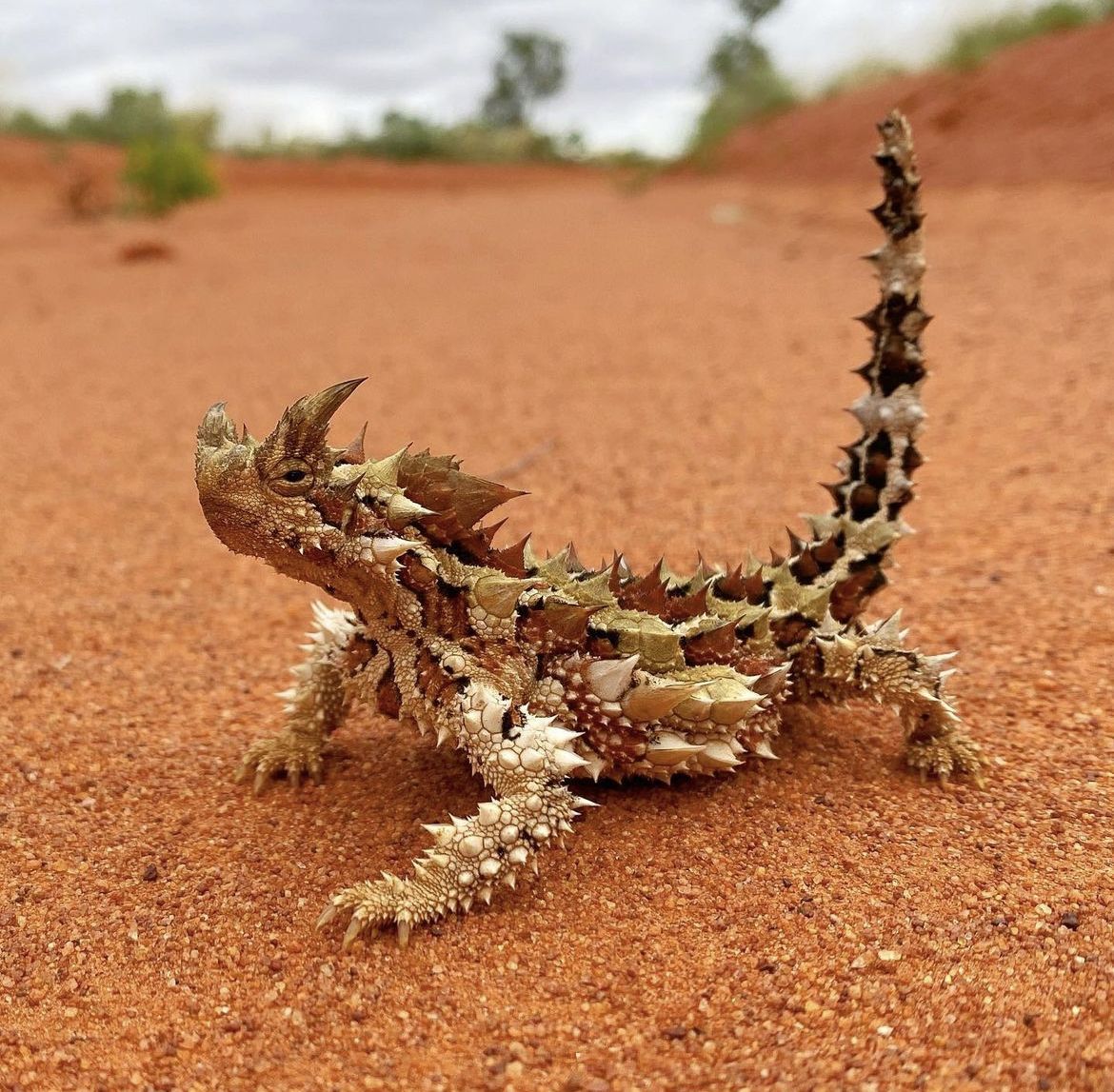
The thorny devil (Moloch horridus) of the Australian arid interior has evolved a water-collection system so sophisticated that engineers have studied it as a model for passive water-harvesting technology. The thorny devil's entire body surface is covered with a network of hygroscopic micro-channels - tiny grooves between its scales that transport water via capillary action.
When dew forms on the lizard's body in the cool desert morning, or when it steps in a puddle, water is drawn through these channels from any point on the body surface directly to the corners of the mouth, where the lizard drinks it by rhythmic jaw movements. The system works entirely passively, requiring no muscular effort, and can collect water from contact with damp sand, fog condensation, or even humidity in the air.
This micro-channel network represents a form of passive fluid transport that has inspired research into self-filling water bottles, fog-harvesting nets for arid regions, and moisture-wicking textiles.
Blue-Tongued Skinks: The Art of the Bluff
The blue-tongued skinks (genus Tiliqua) of Australia and Southeast Asia have adopted a defensive strategy built entirely on intimidation. When threatened, a blue-tongued skink opens its mouth wide and extends its broad, cobalt-blue tongue - a vivid flash of color against the pink interior of the mouth.
Research has shown that the blue tongue reflects strongly in the ultraviolet spectrum, making it appear even more conspicuous to predators such as birds and snakes that perceive UV light. The sudden display of this large, brightly colored tongue mimics the warning signals of genuinely toxic animals, startling predators and buying the skink time to escape.
The display is often accompanied by loud hissing and body inflation, creating a multi-sensory threat display from an animal that is, in reality, completely harmless.
Glass Lizards: Legless but Not Snakes
The glass lizards (family Anguidae, genus Ophisaurus and relatives) are frequently mistaken for snakes due to their elongated, limbless bodies. However, several key anatomical features distinguish them from true snakes:
| Feature | Glass Lizard | Snake |
|---|---|---|
| Eyelids | Moveable eyelids present | No eyelids; transparent spectacle covers eye |
| Ear openings | External ear openings visible | No external ear openings |
| Jaw structure | Fused lower jaw | Flexible, loosely connected lower jaw for swallowing large prey |
| Tail proportion | Tail comprises up to two-thirds of body length | Tail is a relatively short portion of total length |
| Body flexibility | Relatively rigid; lateral grooves along body | Highly flexible throughout |
| Tail autotomy | Can shed tail when threatened | Cannot shed tail |
The name "glass lizard" derives from their tendency to break when handled roughly - the tail, which can constitute up to two-thirds of the animal's total length, detaches readily at fracture planes, leaving a predator with a wriggling tail segment while the lizard escapes. The disproportionate length of the tail means that a glass lizard that has lost its tail appears dramatically shorter, leading to the folk belief that the animal "shattered like glass."
Glass lizards are found across North America, Europe, and Asia. The eastern glass lizard (Ophisaurus ventralis) of the southeastern United States can reach lengths of over 1 meter, making it one of the largest legless lizards in the Western Hemisphere.
Lizard Regeneration: Lessons for Human Medicine
The ability of many lizard species to regrow lost tails has fascinated scientists for centuries and is now at the forefront of regenerative medicine research. The process, known as caudal autotomy, involves a deliberate self-amputation at predetermined fracture planes within the tail vertebrae. These fracture planes are areas of structural weakness where the vertebra can split cleanly, allowing the tail to detach with minimal blood loss due to rapid vasoconstriction.
The detached tail continues to thrash and writhe for several minutes, distracting the predator while the lizard escapes. Regeneration then begins from the wound site, with a new tail typically taking 60 days to over a year to fully regrow, depending on species, age, and nutritional condition.
However, the regenerated tail is not a perfect replica of the original:
- The original bony vertebrae are replaced by a tube of cartilage
- The color and scale pattern often differ from the original
- The regenerated tail is typically shorter and less flexible
- Muscle arrangement is simplified compared to the original
Research at Arizona State University has identified over 300 genes involved in lizard tail regeneration, many of which have counterparts in the human genome. Key areas of investigation include:
- Stem cell activation - how lizards reactivate dormant stem cells at the wound site
- Immune system regulation - how inflammation is controlled to permit regeneration rather than scarring
- Wnt signaling pathways - molecular signals shared between lizard regeneration and human embryonic development
- Satellite cell proliferation - how muscle precursor cells are mobilized to rebuild lost tissue
The green anole (Anolis carolinensis) has become a primary model organism for regeneration studies, in part because its genome was fully sequenced in 2011. Understanding the genetic switches that activate regeneration in lizards - switches that appear to be conserved but suppressed in mammals - could eventually lead to breakthroughs in treating spinal cord injuries, limb loss, and degenerative tissue diseases in humans [6].
Conservation and the Future of Lizard Diversity
Despite their abundance and adaptability, lizards face mounting threats globally. Habitat destruction, climate change, invasive species, and the wildlife trade have placed an estimated 20 percent of lizard species at risk of extinction according to IUCN assessments. Island species are particularly vulnerable - the Galapagos marine iguana, the Jamaican iguana, and numerous gecko species endemic to small Pacific islands face critical population declines.
Climate change poses a particularly insidious threat. Research published in Science in 2010 by Barry Sinervo and colleagues documented local extinctions of 12 percent of monitored lizard populations worldwide between 1975 and 2009, driven primarily by rising temperatures that force lizards to spend more time sheltering from heat and less time foraging. The study projected that under current warming trends, 20 percent of lizard species could be extinct by 2080.
The study of lizards - their diversity, their innovations, their vulnerabilities - is ultimately a study of evolution's capacity for invention. In 7,000 species spread across every terrestrial biome, lizards demonstrate that survival is not about being the biggest, the fastest, or the strongest. It is about being adaptable.
It is about finding solutions - whether running on water, drinking through skin, or regrowing a lost limb - that fit the specific demands of a specific environment. In that sense, lizards are not merely survivors. They are evolution's master problem-solvers.
References
Fry, B.G., Wroe, S., Teeuwisse, W., et al. (2009). A central role for venom in predation by Varanus komodoensis (Komodo Dragon) and the extinct giant Varanus (Megalania) priscus. Proceedings of the National Academy of Sciences, 106(22), 8969-8974.
Watts, P.C., Buley, K.R., Sanderson, S., et al. (2006). Parthenogenesis in Komodo dragons. Nature, 444(7122), 1021-1022.
Autumn, K., Liang, Y.A., Hsieh, S.T., et al. (2000). Adhesive force of a single gecko foot-hair. Nature, 405(6787), 681-685.
Sherbrooke, W.C. & Middendorf, G.A. (2001). Blood-squirting variability in horned lizards (Phrynosoma). Copeia, 2001(4), 1114-1122.
Hsieh, S.T. & Lauder, G.V. (2004). Running on water: Three-dimensional force generation by basilisk lizards. Proceedings of the National Academy of Sciences, 101(48), 16784-16788.
Hutchins, E.D., Marber, G.J., Eckalbar, W.L., et al. (2014). Transcriptomic analysis of tail regeneration in the lizard Anolis carolinensis reveals activation of conserved vertebrate developmental and repair mechanisms. PLoS ONE, 9(8), e105004.
Frequently Asked Questions
Do Komodo dragons actually have venom?
Yes. Research published in 2009 by Bryan Fry and colleagues confirmed that Komodo dragons possess venom glands in their lower jaws that produce toxic proteins causing a rapid drop in blood pressure, inhibition of blood clotting, and induction of shock. This overturned decades of belief that Komodo dragon bites killed through bacterial infection alone.
The venom works alongside the physical trauma of the bite to incapacitate large prey such as water buffalo.
How do geckos walk on walls and ceilings?
Geckos adhere to surfaces through van der Waals forces - weak intermolecular attractions that collectively generate powerful adhesion. Each gecko toe pad contains approximately 500,000 microscopic hair-like structures called setae, each splitting into hundreds of spatulae just 200 nanometers wide. This system requires no liquid adhesive and works on nearly any surface, wet or dry.
A single gecko could theoretically support over 130 kg if all setae engaged simultaneously.
Can lizards really regrow their tails?
Many lizard species can regenerate lost tails through a process called autotomy, where the tail detaches at predetermined fracture planes in the vertebrae. However, the regrown tail is not identical to the original - it contains a cartilage rod rather than vertebrae and typically differs in color and scale pattern. Regeneration takes 60 days to over a year depending on species.
Research into lizard tail regeneration is informing human regenerative medicine, particularly regarding stem cell activation and tissue regrowth.