
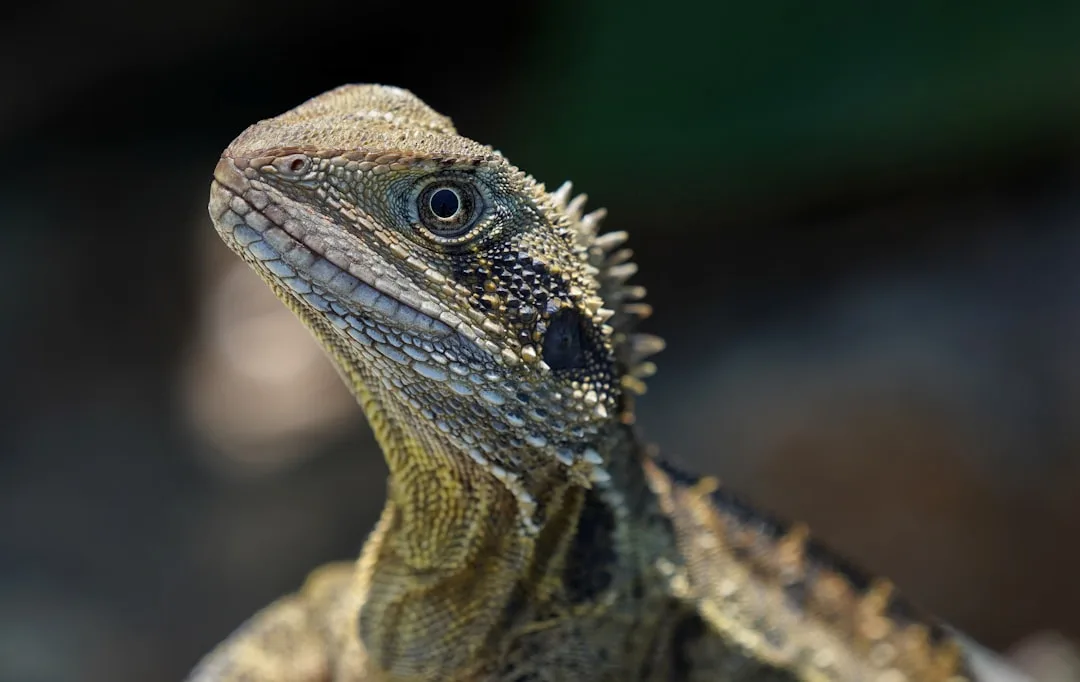
The central bearded dragon is one of the most remarkable lizards in the world and, without much argument, the most familiar one kept in homes across Europe, North America, and Asia. Pogona vitticeps is a medium-sized Australian agamid named for the spiny pouch of skin under its throat - the "beard" - which it can inflate, flare outward, and darken almost to black during display or threat.
Beyond that single striking feature, the species carries a catalogue of biological oddities: arm-waving submission signals, temperature-driven sex reversal documented in a landmark 2015 study, seasonal brumation, social cognition that includes recognising individual humans, and a stomach that accepts everything from grasshoppers to dandelion flowers.
This guide covers the full picture: taxonomy, size and appearance, Australian desert ecology, diet and hunting, reproduction and the temperature-sex reversal phenomenon, behaviour, captive morphs, lifespan, and conservation. It is a reference entry, not a summary - so expect specifics: centimetres, grams, temperatures, and the peer-reviewed work behind the weirder claims.
Etymology and Classification
The genus name Pogona comes from the Greek pogon, meaning "beard", a direct reference to the spiny gular pouch that defines the genus. The species epithet vitticeps combines Latin vitta (band or stripe) and ceps (head), describing the dark markings that run from the corner of the eye back toward the ear opening. The species was formally described by Ahl in 1926, though specimens had been collected by European naturalists working in inland Australia much earlier.
There are eight recognised species in the genus Pogona, all Australian:
- P. vitticeps - central bearded dragon (the species in the pet trade)
- P. barbata - eastern bearded dragon
- P. minor - western bearded dragon
- P. henrylawsoni - Lawson's or Rankins dragon
- P. microlepidota - small-scaled bearded dragon
- P. mitchelli, P. nullarbor, P. minor minima - regional forms
Pogona vitticeps sits within Agamidae, a family of Old World lizards that also includes water dragons, frilled lizards, and the uromastyx spiny-tails. Within Australia, agamids fill the ecological niches occupied by iguanids in the Americas, which is why bearded dragons and green iguanas can appear superficially similar without being closely related - a textbook example of convergent evolution.
Size and Physical Description
Central bearded dragons are medium-sized lizards. They are compact rather than slender, with a flattened body profile, a triangular head wider than the neck, and a tail that is about as long as the body.
Adult males:
- Total length: 45-60 cm
- Snout-to-vent length: 22-28 cm
- Weight: 350-500 g
- Broader head and heavier jowls than females
- Larger, more pronounced femoral and preanal pores
- Beard typically larger, darker during display
Adult females:
- Total length: 40-55 cm
- Snout-to-vent length: 20-25 cm
- Weight: 250-400 g
- Narrower head, smaller jowls
- Slight abdominal swelling when gravid
Hatchlings:
- Total length: 8-10 cm
- Weight: 2-4 g
- Colour: pale cream to grey, darkening with age and temperature
The body bears rows of soft, keeled spines along the flanks and in a continuous fringe across the back of the head - these are skin projections, not true scales, and they are flexible enough to lie flat against the body. A row of slightly larger spines runs from the corner of each eye back along the lower jaw to form the outer edge of the beard.
The dorsum is typically sandy fawn to rich red-brown in wild animals, with paler diamond-shaped markings arranged in rows along the back. Some populations, particularly those around Alice Springs and the Red Centre, display strikingly saturated red and orange tones. Captive morphs have pushed the palette much further, producing lines that are almost white, solid orange, or patterned to imitate hypomelanistic forms.
Colour is not fixed. A bearded dragon can lighten or darken its skin tone within minutes in response to temperature, stress, or social context. A cold dragon in the morning is often nearly black across the back to absorb solar radiation; by midday the same animal is pale, even silvery, as it sheds heat. Pregnant females and dragons preparing to brumate show characteristic patterns as well.
Built for the Australian Interior
The central bearded dragon is a specialist of arid and semi-arid Australia - the vast interior that covers most of the continent away from the coasts. This is a landscape of eucalypt woodlands, mulga scrub, spinifex grassland, and rocky outcrops, where summer temperatures routinely exceed 40 degrees Celsius and winter nights can fall below freezing.
Key adaptations:
- Flattened body profile that maximises surface area for basking
- Dorsal pigmentation that can darken under cold conditions to absorb heat
- Pale lateral skin revealed by tilting the body to shed heat
- Semi-arboreal habit - basking on logs, fence posts, branches, and termite mounds to escape hot ground
- Ability to extract most required water from food, with opportunistic drinking after rain
- Brumation through cool winters to bypass food scarcity
Bearded dragons are active thermoregulators. A wild adult on a summer morning emerges from a burrow or crevice, climbs to an exposed basking spot, and orientates its body precisely so that the dorsal surface catches direct sun. The animal holds the pose until its core temperature rises into the preferred range of 34-37 degrees Celsius, then begins the day's activity.
When the body reaches the upper end of the range, the dragon raises itself on extended legs, gapes its mouth to dump heat through evaporation, and shuttles into shade. Late afternoon brings a second basking session before retreat to a burrow for the night.
The raised, four-legged posture with an open mouth is often misread by new keepers as stress. In a well-designed enclosure with a proper temperature gradient, it is simply a dragon thermoregulating - behaviour identical to what wild animals perform many times each day.
Diet and Feeding
Central bearded dragons are opportunistic omnivores, and the proportion of animal to plant matter in the diet shifts dramatically with age.
Juveniles (under 6 months):
- 70-80 per cent insects: crickets, small roaches, small grasshoppers, soft-bodied caterpillars
- 20-30 per cent greens and flowers
- High growth demand drives high protein intake
Sub-adults (6-18 months):
- Roughly 50/50 animal and plant
- Diet broadens to include larger prey, soft fruit, and a wider range of leaves
Adults:
- 60-80 per cent plant matter: dandelion and endive leaves, bok choy, rocket, parsley, hibiscus and dandelion flowers, soft fruits such as berry and papaya
- 20-40 per cent animal matter: adult crickets, dubia roaches, black soldier fly larvae, occasional pinky mice in wild populations
- Water mostly from food and rain, with occasional drinking from dew or shallow pools
In the wild, a central bearded dragon is a generalist predator of arthropods and a casual browser. Stomach contents from field-collected specimens routinely include whole grasshoppers, several beetle species, ants, flowers, fresh leaf fragments, and occasionally a small skink or gecko. Adult males have been recorded taking newborn mice when the opportunity presents itself.
Captive feeding needs careful attention. Insects must be appropriately sized - the rule of thumb is no wider than the space between the dragon's eyes - to prevent impaction. Calcium and vitamin D3 supplementation is essential because captive diets rarely provide enough of either mineral and because indoor UVB output is lower than Australian sunlight. Metabolic bone disease remains the most common cause of premature death in pet bearded dragons and is almost entirely a husbandry failure.
Behaviour and Social Signals
Bearded dragons have one of the most developed signalling repertoires of any lizard, rivalled only by certain iguanas and monitors. Captive researchers have catalogued at least a dozen distinct displays.
Head-bobbing: Rapid up-and-down nodding used by dominant males to claim territory and during courtship. Faster, sharper bobs are assertive; slower, looser bobs can be conciliatory.
Arm-waving: A slow, circular lift of one forelimb, held briefly at the top of the arc. Smaller, subordinate, or younger animals use it to signal non-threat. Gravid females wave to courting males. Hatchlings wave to larger conspecifics. The behaviour is innate - it appears in dragons hatched from eggs and raised in isolation - and is one of the clearest social signals in any squamate.
Beard display: The throat pouch inflates by expansion of the hyoid apparatus and the underlying skin stretches to expose darker pigment. Within seconds, melanophore cells push melanin into the upper skin layers, turning the beard glossy black. Coupled with a gaping mouth that exposes a bright yellow interior, the result is a strong visual warning - sharp colour contrast, exaggerated apparent size, and an implicit threat to bite.
Colour change: Beyond the beard, dragons use body-wide colour change for thermoregulation and mood. A cold animal darkens across the dorsum to absorb heat. A stressed or subordinate one may pale toward the belly. Males in breeding condition often develop richer reds and oranges along the flanks.
Yawning and gaping: Slow, exaggerated mouth-opening events that are unrelated to tiredness. Yawns stretch the hyoid, re-seat the jaw after heavy feeding, and assist breathing in hot conditions. Gaping with the mouth held open and body raised is a primary heat-dumping posture.
Captive studies at the University of Lincoln have shown that bearded dragons can learn by observing another dragon perform a task - a form of social learning long thought to be restricted to birds and mammals. Separate work has documented individual recognition of human caretakers by visual and auditory cues. For a lizard, these are remarkable cognitive capacities.
Reproduction and Temperature-Driven Sex Reversal
Bearded dragon reproduction operates on an annual cycle synchronised with the Australian seasons. Mating peaks in spring (September to November in the southern hemisphere), following emergence from winter brumation.
Mating:
- Males compete through head-bobbing, beard displays, and push-up posturing
- Successful males chase and mount receptive females, gripping the nape with the jaws
- Copulation lasts a few minutes; mating may repeat over several days
Egg-laying:
- Females excavate a deep burrow in sandy soil, typically 30-60 cm
- Clutch size: 11-30 eggs, occasionally more
- Up to three clutches per breeding season from a well-conditioned female
- Incubation: 55-75 days, strongly temperature-dependent
Hatching:
- Hatchlings emerge within a few hours of one another
- Immediate independence; no parental care of any kind
- First-year mortality is very high due to predation and drought
The most scientifically interesting aspect of bearded dragon reproduction is the sex determination system and its breakdown at high temperatures. Pogona vitticeps has a ZZ (male) / ZW (female) chromosomal system, so in principle genetics fixes sex at fertilisation. But when eggs are incubated at temperatures above roughly 32 degrees Celsius, genetically male (ZZ) embryos develop as phenotypic females.
These sex-reversed females are fully functional and fertile, and Holleley and colleagues confirmed the phenomenon in wild populations in a landmark 2015 paper in Nature. They showed that reversed females lay larger clutches, breed more rapidly, and can dominate local populations under heat stress.
The central bearded dragon is now a flagship model for studying how climate change might reshape reptile sex ratios - potentially pushing entire populations toward one sex over time.
Brumation
Central bearded dragons do not hibernate in the mammalian sense, but they do enter a slowed physiological state called brumation during cool Australian winters. Between roughly May and August, adult dragons retreat into burrows or rock crevices, drop body temperature with the environment, stop feeding, and emerge only occasionally on warmer days.
Brumation in captivity is a legitimate and often recommended practice, especially for breeding stock. Keepers drop enclosure temperatures, shorten day length, and allow dragons to settle into several weeks or months of inactivity. Not every captive dragon brumates reliably, and the timing can be unpredictable in non-native latitudes.
Brumating animals should have access to water and should be periodically weighed to detect any abnormal fat loss. Attempted brumation in underweight or diseased animals is dangerous and should be aborted.
Captive Morphs and Domestication
The central bearded dragon is arguably the only truly domesticated lizard. Since the 1980s, and especially since commercial captive breeding expanded in the 1990s, generations of selection for temperament and appearance have produced animals that differ from wild Pogona vitticeps in behaviour and colour but remain the same species.
Major morph categories include:
| Morph | Key feature |
|---|---|
| Classic | Wild-type coloration; sandy fawn with diamond patterning |
| Red / citrus | Concentrated red or orange pigment across body |
| Hypomelanistic | Reduced dark pigment; lighter background and markings |
| Translucent | Increased skin transparency; blue-tinged belly in hatchlings |
| Leatherback | Reduced spinal scale size; smoother appearance |
| Silkback | Fully scaleless form from double leatherback gene; high-care |
| Zero | Silvery white with minimal patterning |
| Witblits | Patternless pale morph from South African breeding line |
Not all morphs are welfare-neutral. The silkback lacks the protective scale layer of wild animals, is vulnerable to skin damage, dehydrates faster, and requires more careful husbandry. Some combined morphs produce genetic or developmental problems. Responsible breeders avoid certain combinations, and several reptile welfare organisations advise against keeping silkbacks.
Every bearded dragon in the international pet trade traces its ancestry to animals exported from Australia before that country's 1960s ban on native wildlife export. Australia does not permit live export of native reptiles today, so the global captive population is fully self-sustaining and genetically separate from wild stock.
Lifespan and Health
Wild central bearded dragons live roughly six to ten years. Predation, drought, and road mortality limit the wild lifespan. Captive dragons, properly cared for, routinely reach ten to fifteen years, and the record for a documented captive dragon is over eighteen years.
Common captive health problems:
- Metabolic bone disease: deformed limbs, soft jaw, tremors, fractures. Caused by inadequate calcium, vitamin D3, or UVB lighting.
- Impaction: intestinal obstruction, usually from oversized prey, coarse substrate, or dehydration.
- Parasitic infections: coccidia and pinworms are common; routine faecal testing is recommended.
- Atadenovirus: a viral infection associated with wasting and immune suppression in captive lines.
- Yellow fungus disease (CANV): a dermatophyte infection that causes yellow, crusted skin patches and can be fatal.
Most of these conditions are preventable with good husbandry: correct enclosure size, a proper basking gradient, high-quality UVB lighting replaced on schedule, varied diet, supplementation, clean substrate, and routine veterinary checks.
Conservation Status
The IUCN lists Pogona vitticeps as Least Concern. The species has a wide range across interior Australia, stable population trends, and tolerance of modified landscapes such as grazing country, roadsides, and the fringes of small towns. The bearded dragon is also legally protected from unlicensed collection and commercial export by Australian state and federal wildlife law.
Current threats are mostly local and diffuse:
- Vehicle mortality on outback roads, especially in basking season
- Predation by invasive feral cats and foxes, particularly of hatchlings
- Habitat simplification from intensive grazing and land clearing
- Long-term climate pressure from extreme heat events, which can alter wild sex ratios through the temperature-driven sex reversal pathway
None of these pressures currently threatens the species at a continental scale, but the sex-reversal mechanism makes bearded dragons one of the more climate-sensitive reptiles to monitor over the coming decades.
Central Bearded Dragons and People
Few lizards sit closer to people than Pogona vitticeps. Estimates of the global captive population run into the millions. The species dominates reptile-keeping hobbies in North America, Europe, and East Asia, and is a staple of educational animal collections, schools, and zoos. Captive-bred dragons are calm, handleable, long-lived, and rarely bite - qualities that explain their rise.
That popularity has downsides. Impulse purchases of hatchlings by owners who underestimate space, lighting, and dietary needs lead to a steady flow of surrendered adults at reptile rescues. A bearded dragon is a ten-to-fifteen-year commitment requiring continuous investment in heating, UVB, live food, and veterinary care. The phrase "beginner reptile" understates this. They are forgiving relative to other lizards, but they are not low-maintenance.
For Australians, the central bearded dragon is a familiar wild animal - often seen basking on fence posts, roadside logs, and the edges of tracks in the interior. Indigenous Australian communities across the species' range have long recognised and named the animal, and the dragon features in traditional stories from several language groups. In a very real sense, the species stands at a unique intersection of wild ecology, climate science, social cognition research, and global popular culture.
Related Reading
- Lizards: Masters of Adaptation and Survival
- Green Iguana: The Herbivorous Canopy Giant
- Komodo Dragon: The Largest Lizard on Earth
- Marine Iguana: The Swimming Lizard of the Galapagos
References
Relevant peer-reviewed and governmental sources consulted for this entry include the IUCN Red List assessment for Pogona vitticeps, the Atlas of Living Australia occurrence database, the Holleley et al. 2015 paper in Nature on sex reversal under high incubation temperatures, follow-up work by Quinn and colleagues on reptile sex-determination systems, behavioural studies from the University of Lincoln on social learning in lizards, and Australian state wildlife agency guidance on native reptile protection.
Husbandry benchmarks reflect published reptile-veterinary references and the Association of Reptilian and Amphibian Veterinarians' husbandry guidelines.
Frequently Asked Questions
How big do central bearded dragons get?
Adult central bearded dragons (Pogona vitticeps) reach 40 to 60 centimetres in total length, with the tail accounting for roughly half of that. Snout-to-vent length is typically 20 to 28 centimetres. Mature males are somewhat larger than females, developing broader heads, heavier jowls, and a more prominent throat beard. Typical adult weight ranges from 250 to 500 grams, though well-fed captive animals sometimes exceed 600 grams.
Hatchlings emerge at around 8-10 centimetres and weigh 2-4 grams, reaching near-adult size within the first 12-18 months under good conditions.
What do bearded dragons eat?
Central bearded dragons are opportunistic omnivores with a diet that shifts with age. Hatchlings and juveniles eat mostly invertebrates - roughly 70 to 80 per cent insects by volume - with crickets, grasshoppers, roaches, beetles, and caterpillars dominating. As the dragon matures the balance flips, and adults take 60 to 80 per cent plant matter: dandelion and endive leaves, flowers, soft fruits, squash, and tender shoots.
Wild dragons also eat small lizards, geckos, rodents, and carrion when available. Captive dragons need calcium and vitamin D3 supplementation to avoid metabolic bone disease, and feeder insects should be gut-loaded before being offered.
Where do bearded dragons live?
The central bearded dragon is native exclusively to Australia, where it occupies arid and semi-arid habitat across the interior of the continent - from central Queensland and New South Wales through South Australia and into the Northern Territory. They prefer open eucalyptus woodland, dry shrubland, rocky outcrops, and spinifex country.
Dragons are semi-arboreal, basking on fallen logs, fence posts, low branches, and termite mounds that lift them above the hot ground surface. They do not naturally occur anywhere else in the world - every bearded dragon outside Australia is a descendant of animals exported before Australia’s 1960s wildlife export ban, and the global pet trade now depends entirely on captive-bred stock.
Why does a bearded dragon wave its arm?
Slow, circular forelimb waving is a ritualised signal used by bearded dragons to communicate submission or non-threat. A smaller dragon will often wave when approached by a larger one, effectively saying ‘I recognise you and I’m not challenging’. Juveniles wave frequently in shared enclosures; adult females wave at courting males. The behaviour is innate - hatchlings reared in isolation still perform it correctly at the appropriate moment.
Head-bobbing, by contrast, tends to signal dominance or courtship, and the two displays often alternate during social encounters. Arm-waving is shared by several Pogona species and a few close agamid relatives but is rare across lizards as a whole.
How does temperature determine a bearded dragon's sex?
Central bearded dragons have a ZZ/ZW genetic sex determination system, which normally fixes sex at fertilisation. However, when eggs are incubated above approximately 32 degrees Celsius, genetically male (ZZ) embryos develop as phenotypic females that are fully functional and fertile.
Holleley and colleagues confirmed the phenomenon in wild populations in a 2015 paper in Nature, showing that sex-reversed females produce viable offspring and can dominate local populations under heat stress. These reversed females tend to lay larger clutches and reproduce more rapidly, raising concerns about how rising temperatures may restructure wild bearded dragon populations.
The central bearded dragon is now a model species for studying sex determination under climate change.
Why does a bearded dragon's beard turn black?
The ‘beard’ is the expandable spiny pouch of skin under the throat, supported by the hyoid bone structure. When a dragon feels threatened, is courting, competing with rival males, or defending territory, it flares the beard outward to exaggerate apparent body size. At the same time, pigment cells called melanophores in the beard skin release melanin, turning the pouch a deep, almost black shade within seconds.
Females and subordinate males also darken their beards, though usually less intensely. The display is coupled with gaping the mouth to reveal the bright yellow interior, which contrasts sharply with the black beard to maximise the visual warning.
Do bearded dragons make good pets?
Central bearded dragons are widely kept and are generally considered one of the most suitable reptile pets for beginners. Adults are calm, handleable, and rarely bite once acclimated.
A healthy captive setup requires an enclosure at least 120 centimetres long for one adult, a basking zone of 38-42 degrees Celsius, a cooler zone around 24-28 degrees, UVB lighting across the full enclosure, and a varied omnivorous diet with calcium and vitamin D3 supplementation. Correctly cared for, a bearded dragon can live 10 to 15 years or more.
Common health problems include metabolic bone disease from poor lighting or diet, impaction from oversized feeder insects, and parasitic infections, all of which are preventable with good husbandry.
Are bearded dragons endangered?
The IUCN lists the central bearded dragon as Least Concern, reflecting a wide Australian range, stable wild populations, and no evidence of broad-scale decline. The species benefits from occupying habitat that is not heavily targeted for agriculture, and dragons tolerate modified landscapes such as grazing country and roadsides.
The main local threats are vehicle mortality on outback roads, predation by feral cats and foxes, and possible long-term climate pressure from extreme heat shifting the wild sex ratio through temperature-driven sex reversal.
Australia protects all native reptiles from unlicensed collection and export, and every bearded dragon in the international pet trade today is a captive-bred descendant of animals exported before the export ban took effect in the 1960s.