
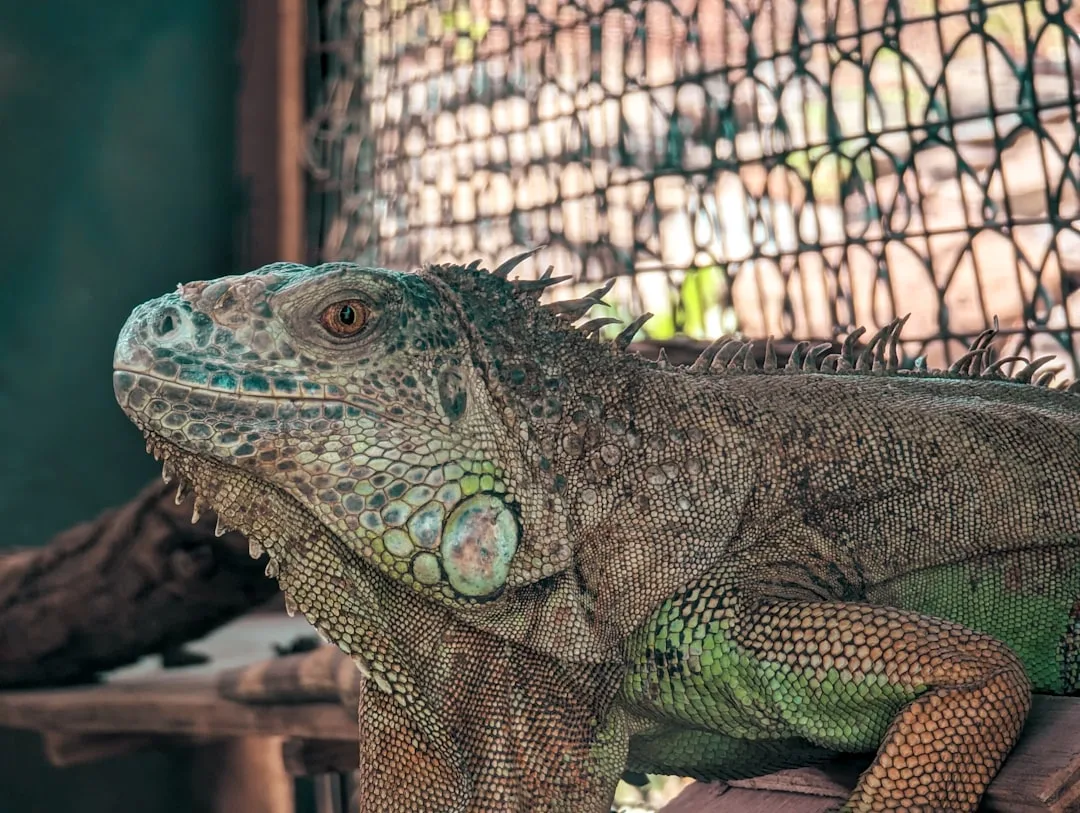
The green iguana is one of the most recognisable lizards on Earth - an emerald, spine-crested tree dweller that has come to symbolise tropical America. Unlike most lizards, Iguana iguana is a dedicated herbivore, processing leaves and flowers through a fermentation gut more commonly associated with cattle.
Unlike most reptiles its size, it lives high in the rainforest canopy and routinely throws itself from 12-metre branches into rivers to escape predators. And unlike almost any other vertebrate, it carries a third, working eye on top of its skull.
This guide covers every aspect of green iguana biology and ecology: size and anatomy, the parietal eye, herbivorous diet, reproduction and lekking, arboreal and aquatic locomotion, cold-stunning and "falling iguanas" in Florida, invasiveness, and the strange cultural history of a lizard once carried by sailors as shipboard meat. It is a reference entry, not a summary - so expect specifics: centimetres, kilograms, latitudes, chromosomes, clutch sizes, and verified records.
Etymology and Classification
The generic and specific name Iguana iguana comes from the Taino word iwana, adopted into Spanish as iguana during early European contact in the Caribbean. The Linnaean binomial was formalised by Carl Linnaeus in the 1758 tenth edition of Systema Naturae. Across its range the lizard carries dozens of regional names - garrobo in parts of Central America, bamboo chicken in Belize and Guyana for its culinary use, and gallina de palo (tree chicken) in Spanish-speaking Caribbean communities.
Taxonomically the green iguana sits in the family Iguanidae within the order Squamata. It is the type species of the genus Iguana, which also includes the Lesser Antillean iguana Iguana delicatissima. Recent molecular work has split some Central American and South American lineages as candidate subspecies, though I. iguana remains treated as a single widely distributed species by most taxonomic authorities.
The genus is closely related to the desert iguanas (Dipsosaurus), the spiny-tailed iguanas (Ctenosaura), and more distantly to the Galapagos marine and land iguanas.
Hybridisation between Iguana iguana and other iguanid species has been recorded in the wild, including rare crosses with Galapagos land iguanas on contact islands and with the marine iguana Amblyrhynchus cristatus in unusual circumstances, producing fertile but intermediate offspring.
Size and Physical Description
Green iguanas are the largest members of their family apart from a few of the Ctenosaur relatives. They exhibit pronounced sexual dimorphism in the adult stage, with males considerably larger and more heavily ornamented than females.
Adult males:
- Total length: 1.5-1.8 metres (rarely over 2 metres)
- Snout-to-vent length: 35-45 cm
- Weight: 5-9 kg, occasionally more in captivity
- Dorsal crest: tall, spined, most prominent behind the head
- Dewlap: large, pendulous, used for display and thermoregulation
- Jowls: heavy muscular cheeks that develop with age
Adult females:
- Total length: 1.2-1.5 metres
- Weight: 3-5 kg (heavier when gravid)
- Dorsal crest: present but lower than male's
- Dewlap: smaller than male's
- Femoral pores: present but less developed
Hatchlings:
- Length: 18-25 cm
- Weight: roughly 12 grams
- Colour: bright emerald green, helpful for canopy camouflage
Green iguanas are built for arboreal life. Their long, laterally compressed tail is longer than the combined head and body, functioning as a balance beam during climbs, a rudder while swimming, and a lash-weapon during defence. Long, clawed fingers grip thin twigs, and their skin is protected by hard, overlapping scales that reduce water loss and resist abrasion. A row of tall, flexible spines runs from the nape down the back and tail, giving the animal its dinosaur-like silhouette.
The famous green colour is not pure pigmentation. The skin contains yellow pigment cells (xanthophores) layered above iridophores - microscopic platelets that scatter short-wavelength light through structural interference. The combined effect produces vivid green. Iguanas can shift tone slightly with mood, temperature, and age: juveniles are brighter, older males can become rust-orange during breeding season, and stressed individuals darken toward grey-brown.
The Parietal Third Eye
One of the most unusual features of the green iguana is the parietal eye, visible as a pale, translucent scale on the top of the skull between the true eyes. The parietal eye is a real, functional photoreceptor organ. It has a rudimentary cornea, lens, and retina, and it connects via a nerve to the pineal gland beneath the skull roof.
The parietal eye cannot form images. What it does is detect changes in light intensity and the movement of shadows from above. For a lizard that spends most of its life in the rainforest canopy, that signal is critical - the silhouette of a hawk, owl, or harpy eagle crossing the sun is the single most important cue for immediate predator avoidance. Iguanas with damaged parietal eyes show measurably slower responses to overhead threats.
Beyond predator detection, the parietal eye is tied to circadian and thermoregulatory control. It feeds light information to the pineal gland, which regulates melatonin and basking behaviour. Many lizards, tuataras, and several fish have similar parietal structures. In mammals and birds the parietal photoreceptor is lost, leaving only the pineal gland buried deep in the brain. The iguana's third eye is therefore a live window onto a very ancient vertebrate feature.
Diet: A Lizard That Eats Like a Cow
Herbivory is vanishingly rare among lizards. Out of more than six thousand described lizard species, fewer than two per cent are strict herbivores. The green iguana is one of them. More than eighty per cent of its wild diet by mass is leaves, with the remainder split between flowers, fruit, and tender shoots.
Primary food items:
- Leaves from legumes (Leguminosae), figs (Moraceae), and annonas (Annonaceae)
- Flowers, especially calcium-rich hibiscus and bauhinia
- Ripe fruit from canopy trees and vines
- Young shoots and buds
- Occasional clay or soil for mineral content
Digestion:
Green iguanas have a specialised digestive system built for fermenting fibrous plant matter. The hindgut expands into a chambered fermentation vat populated by bacteria and protozoa that break down cellulose into volatile fatty acids the iguana can absorb. This arrangement is superficially similar to a cow's rumen, though the iguana ferments in the hindgut rather than the foregut.
To seed their gut microbiome, hatchlings practise coprophagy, eating small amounts of adult faeces in their first weeks.
The herbivorous lifestyle has cascading consequences. Iguanas are poorly equipped to catch moving prey - their jaws are designed to shear leaves, not grip wriggling animals. They regulate body temperature more slowly than insectivorous lizards because plant digestion is thermally demanding. They rely on consistent warm temperatures and long basking sessions to process a full stomach of leaves.
And they need abundant calcium to build eggshells and bone, which is why wild iguanas preferentially browse calcium-rich flowers and visit mineral-rich clay banks.
Swimming, Jumping, and Arboreal Life
Green iguanas are arboreal first and aquatic second, but the combination is what makes them unusual. Most of their daylight hours are spent in the middle and upper canopy of trees along rivers, lakes, and coastal waterways. They bask on exposed branches to warm up, retreat to shaded foliage in midday heat, and sleep wedged against the trunk at night.
When a predator approaches, the iguana's escape strategy is counterintuitive: it drops. A threatened iguana will leap from a branch and plummet into the water below, sometimes from heights exceeding 12 metres. The dive is not a last resort but a primary defence. The dense layer of keratinised scales, long muscular tail, and strong body absorb the impact.
Once in water, the iguana tucks its legs against its body, holds its breath, and swims with undulations of the tail exactly like a crocodile - a style that carries it quickly into dense submerged vegetation.
Locomotion data:
| Metric | Value |
|---|---|
| Top running speed | 35 km/h (sprint, short distance) |
| Typical leap from branch | 6-12 m drop into water |
| Maximum recorded drop-and-dive | Over 15 m in forest canopy studies |
| Swim speed | 3-5 km/h sustained |
| Breath-hold under water | Up to 30 minutes at rest |
Adult iguanas can remain submerged, motionless, on river bottoms for up to thirty minutes by slowing their heart rate. On land they sprint in short bursts but tire quickly - they are built for climbing, not running.
Reproduction, Lekking, and Nesting
Green iguana reproduction is tied to seasonal rainfall patterns across the neotropics. In most of the native range, mating occurs in the dry season (roughly October to December), with egg laying concentrated at the start of the wet season when new vegetation is most abundant for hatchlings.
Unlike many reptiles, the green iguana has genetic sex determination. Sex chromosomes follow a ZW system, with females carrying one Z and one W chromosome and males carrying two Z chromosomes. Incubation temperature does not determine sex - a key distinction from sea turtles, crocodilians, and many other large reptiles. This makes green iguana populations more robust to climate warming than species with temperature-dependent sex determination, though heat still affects embryonic survival.
Males establish territories in the upper canopy and gather at community display trees known as leks. A lek tree may host half a dozen large males, each defending a perch and advertising with head bobs, dewlap extensions, and dorsal crest flares. Fights are common and can be brutal - bite wounds to the flanks, torn dewlaps, and broken crest spines are frequent. Dominant males in the best positions attract multiple females over the season.
Reproductive cycle:
- Courtship and mating: October-December (varies by latitude)
- Female migration to nesting ground: December-January
- Egg laying: January-February
- Incubation: 65-115 days, buried in warm soil
- Hatching: April-May, timed to wet-season leaf flush
- Clutch size: 20-71 eggs, typical mean around 40
Females leave the canopy to lay eggs and often travel several kilometres to favoured sandy or loamy banks, where they dig a tunnel system 0.5-2 metres deep. Nest sites are reused year after year, and large gatherings of females can build a warren of interconnecting tunnels. Once the eggs are deposited and covered, the female returns to the canopy with no further parental care.
Hatchlings dig their way to the surface in groups, disperse into low vegetation, and begin life as bright-green, highly camouflaged insect-and-leaf eaters. Survival through the first year is low - less than twenty per cent in many populations - with snakes, motmots, hawks, coatis, and raccoons being major predators.
Predators and Defence
Adult green iguanas are large enough to deter most rainforest predators but still face multiple threats. Juveniles are taken by colubrid snakes, falconets, toucans, coatis, and opossums. Adults fall prey to large raptors (harpy eagle, black-hawk), boas and anacondas, jaguarundis, ocelots, and crocodilians where ranges overlap. Humans are a major predator across much of the native range, both for meat and for the pet trade.
Defensive repertoire:
- Canopy drop into water - the first response to aerial threat, often before the iguana even visually confirms the predator.
- Tail whip - the long, muscular tail is swung in a horizontal arc and can break skin on handlers or draw blood from a predator's snout. Tail lashes from a large male can fracture small bones.
- Bite - serrated, leaf-shearing teeth produce long, slow-healing cuts. Iguanas will hold on after biting.
- Claw rake - the hind claws are long and sharp and are used in close combat with predators or during handling.
- Caudal autotomy - juveniles and subadults can shed the tail at a fracture plane and regrow a shorter, cartilage-supported replacement. Adults lose this ability largely.
- Dewlap and crest display - an iguana facing a threat extends the dewlap, flares the dorsal crest, and opens its mouth to look larger and more threatening.
The combined effect is that a full-sized adult is a difficult meal for any predator short of a large raptor or caiman, which is why most predation pressure falls on the first two years of life.
Thermoregulation and Climate Sensitivity
Green iguanas are ectothermic and depend entirely on behavioural thermoregulation. Their preferred body temperature range during active hours is 29-37 degrees Celsius, with the basking "switching-on" temperature around 32 degrees. Below 15-16 degrees Celsius iguanas become sluggish. Below about 7 degrees they enter a cold-stunned torpor in which neural control of grip is lost - which is how the famous "falling iguana" phenomenon occurs.
The dewlap plays a surprising role in thermoregulation. By extending the dewlap, an iguana increases the exposed skin surface presented to the sun during cool mornings, accelerating warming. Conversely, in hot conditions the animal may shift to a shade perch and flare the dewlap into moving air to dissipate heat. The dewlap is therefore both a display organ and a radiator.
Arctic comparison aside, the green iguana is one of many tropical reptiles whose geographic range is expanding northward and southward as subtropical zones warm. It is already established well beyond the original latitudinal range in Florida, Texas, and parts of the Gulf Coast because brief winter freezes are becoming rarer.
Distribution and Invasive Populations
The native range of the green iguana runs from southern Mexico (Sinaloa and Veracruz southward) through all of Central America and into much of tropical South America as far as Paraguay, southern Brazil, and the Lesser Antilles. Native populations occupy a wide range of habitats - rainforest canopy, gallery forest along rivers, mangrove edges, dry tropical scrub, and disturbed edges of human settlement.
Invasive range:
| Location | Status | Primary origin |
|---|---|---|
| Florida, USA | Widely established | Pet trade escape / release |
| Puerto Rico | Very abundant, nuisance | Pet trade + stock |
| Hawaii | Established, controlled | Pet trade escape |
| Cayman Islands | Established, displacing native blue iguana | Pet trade |
| Fiji | Recent, active control | Smuggling / pet trade |
| Taiwan | Established in south | Pet trade escape |
Florida hosts the largest and most famous invasive population. Green iguanas escaped or were released from pet owners beginning in the 1960s; by the 2000s the species was established across the southern peninsula. Today they damage ornamental landscaping, devastate native tree-snail and orchid populations, burrow into seawalls and levees (causing real structural damage), and foul swimming pools.
The Florida Fish and Wildlife Conservation Commission classifies the green iguana as an unprotected nuisance species that can be humanely removed year-round on private property without a permit.
During rare cold snaps below 4 degrees Celsius, torpid iguanas drop out of canopy trees and land intact in yards, roads, and pools. The National Weather Service in south Florida now issues public advisories warning of "falling iguanas" during winter cold fronts - a uniquely twenty-first-century weather hazard.
Human Uses and Cultural History
Green iguanas have been part of human diets across the neotropics for thousands of years. Archaeological sites in Panama and the Yucatan show iguana bones in midden assemblages dating to the pre-Columbian period. The flesh is mild and resembles chicken, earning nicknames like gallina de palo and bamboo chicken. In many rural communities iguana meat and eggs remain an important source of protein, particularly during religious fasts when red meat is restricted.
Spanish, Portuguese, and British ships in the sixteenth to eighteenth centuries sometimes carried live green iguanas on long Atlantic crossings. Bound and stored in the hold, iguanas could survive weeks without food or water thanks to their low metabolic rate, providing fresh meat for the crew on voyages that would otherwise depend on salted provisions. Historical records describe cargoes of dozens or hundreds of iguanas shipped north from the Caribbean and Central America for this purpose.
Modern uses are mixed. The pet trade is the single largest commercial use, with hundreds of thousands of hatchlings exported from Central American iguana farms each year. Ecotourism in Costa Rica, Honduras, and Belize markets wild iguana watching as a gentler alternative. Several range states operate captive breeding programmes ("iguana farms") that provide meat to local markets while reducing pressure on wild populations, though enforcement and wild-caught mislabelling remain problems.
Conservation Status
The IUCN Red List currently classifies Iguana iguana as Least Concern on a global scale, reflecting its enormous native range, high fecundity, and adaptability to disturbed habitats. Local populations, however, show very different trends. Some Caribbean island populations and fragmented Central American populations are in serious decline from hunting, habitat loss, and road mortality. Others, particularly in urban-edge habitats of Central and South American cities, have adapted and stabilised.
The biggest conservation paradox for the species is that it is simultaneously threatened in parts of its native range and a major invasive pest in other regions. Conservation strategies therefore operate in two opposite directions: protecting wild populations where they are declining, and suppressing feral populations where they are damaging native ecosystems. Neither goal is served by the uncontrolled international pet trade, which both drains wild populations and seeds new invasive ones.
Related native species are under greater pressure. The Lesser Antillean iguana Iguana delicatissima is Critically Endangered, partly because of hybridisation with feral green iguanas on its home islands. The Grand Cayman blue iguana Cyclura lewisi and several rock iguanas are all threatened, and feral green iguanas compete with them for food and nest sites.
Related Reading
References
Relevant peer-reviewed and governmental sources consulted for this entry include IUCN Red List assessments for Iguana iguana and Iguana delicatissima, Florida Fish and Wildlife Conservation Commission nuisance species reports, CITES trade databases, and published research in Journal of Herpetology, Copeia, Biological Invasions, and Comparative Biochemistry and Physiology.
Natural history details reflect consolidated findings from Central American and Caribbean field studies, with population and invasive status figures current as of the most recent assessments.
Frequently Asked Questions
How big do green iguanas get?
Adult green iguanas (Iguana iguana) reach 1.2 to 1.8 metres in total length, with roughly two-thirds of that length taken up by the tail. Body-only length (snout to vent) is typically 30 to 45 centimetres. Mature males are noticeably larger than females, developing heavier jowls, taller dorsal crests, and larger femoral pores. Typical adult weight ranges from 4 to 9 kilograms, though obese captive animals have exceeded 10 kilograms.
Hatchlings emerge at just 18-25 centimetres and weigh about 12 grams. Growth is rapid in the first three years and then slows, with the biggest males reaching peak mass around age seven to ten.
What do green iguanas eat?
Green iguanas are one of the only strictly herbivorous lizards in the world. Their diet consists of leaves, flowers, fruit, and tender shoots - with leaves making up more than eighty per cent of stomach contents in wild studies. Favoured plant families include Leguminosae, Moraceae, and Annonaceae. Juveniles may occasionally eat insects or eggs, but this drops off sharply as they mature.
To process tough plant fibre, iguanas host a specialised gut flora in an enlarged hindgut fermentation chamber, similar in function to a cow’s rumen. They are also coprophagic as juveniles, eating adult faeces to seed their own gut microbiome. Calcium is critical in the diet, and wild iguanas preferentially eat calcium-rich flowers and mineral-licking clay banks.
Where do green iguanas live?
The native range of the green iguana stretches from southern Mexico through Central America and much of tropical South America as far south as Paraguay and southern Brazil, plus many Caribbean islands. They occupy tropical rainforest canopy, riverbank gallery forest, mangroves, and disturbed habitat near human settlement. Green iguanas are arboreal - most of their lives take place in the middle and upper tree layers near water.
A frightened iguana will drop from the canopy into a river and swim or dive to escape. Outside their native range they have established invasive populations in Florida, Puerto Rico, Hawaii, Fiji, Taiwan, and the Cayman Islands, almost all traceable to pet-trade escapes and releases.
Are green iguanas dangerous?
Green iguanas are not aggressive by default but they are large, strong, and well armed. A defensive adult can deliver a tail whip hard enough to break skin and bruise bone, a bite that severs tendons, and rear-foot claw swipes that open long lacerations. Most serious injuries to humans come from handling pets or cornering wild animals.
Iguanas also carry Salmonella bacteria in their intestinal tract at high rates - the US Centers for Disease Control routinely traces Salmonella outbreaks to pet reptiles. In parts of Florida, nuisance iguanas have caused infrastructure damage by burrowing into seawalls and levees, triggering state-authorised culling programmes. They are not venomous and do not prey on humans.
How long do green iguanas live?
In the wild, green iguanas typically live 10 to 15 years, with survival heavily skewed by predation on juveniles. First-year mortality may exceed eighty per cent - eggs and hatchlings are taken by snakes, birds, and small carnivores. Once iguanas reach adult size and escape into the canopy, life expectancy rises sharply. Captive animals regularly exceed 20 years, with the record at more than 29 years in zoo care.
Long captive lifespans require careful diet control (calcium, vitamin D3, ultraviolet lighting), correct temperature gradients, and space to climb. Metabolic bone disease from calcium deficiency is the most common cause of premature death in pet iguanas.
What is the third eye on an iguana's head?
The pale scale on top of the iguana’s skull, roughly between the true eyes, is the parietal or pineal eye. It sits above the pineal gland and connects to it through a translucent patch of bone. The parietal eye has a rudimentary lens, retina, and nerve connection. It cannot form images the way the paired eyes do - it detects light intensity, shadow, and movement above the animal.
This helps the iguana sense approaching aerial predators such as hawks, regulate circadian rhythm, and manage basking behaviour. Many lizards, tuataras, and some fish have similar parietal eyes, a feature inherited from early vertebrate ancestors.
Are green iguanas really invasive in Florida?
Yes - the green iguana is a serious invasive species in south Florida and several Caribbean territories. Populations established from escaped and released pets in the late twentieth century have exploded, aided by the absence of large native predators and frost-free winters. Florida iguanas damage ornamental plants, undermine seawalls with burrows, foul swimming pools, and destroy native vegetation.
The Florida Fish and Wildlife Conservation Commission classifies the green iguana as an unprotected nuisance species that can be humanely killed year-round without a permit on private property. During cold snaps below 4 degrees Celsius, the cold-blooded iguanas go torpid in the canopy and drop from trees, prompting the widely reported ‘falling iguana’ advisories from the National Weather Service.
Do green iguanas make good pets?
Green iguanas are commonly sold as pets but are widely considered a difficult reptile to keep properly. An adult needs an enclosure at least 3.5 metres long with vertical climbing space, a basking zone of 35-38 degrees Celsius, a cooler zone near 25 degrees, UVB lighting, and high humidity. Their herbivorous diet must be calcium rich, varied, and supplemented correctly.
Males become territorial and aggressive during breeding season, and tail whips or bites can cause serious injury. Many iguanas are surrendered to rescues within five years of purchase when owners learn the true cost and space requirements. A responsibly kept green iguana can live more than 20 years, so acquiring one is a long-term commitment rather than a casual pet choice.