
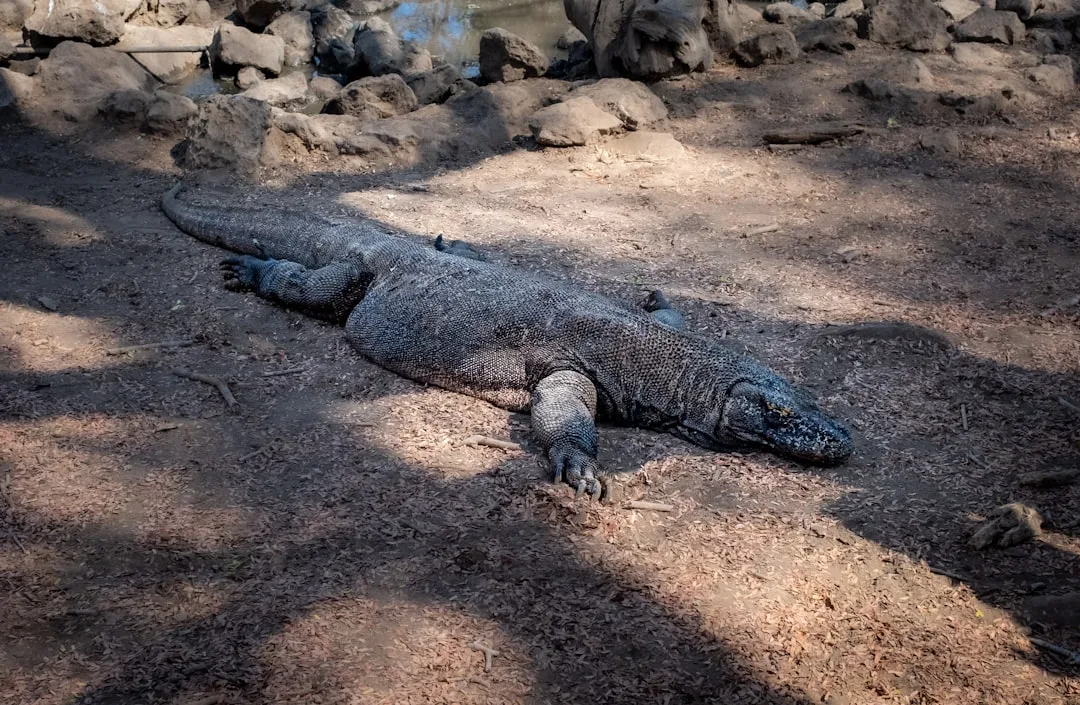
The Komodo dragon is the largest living lizard on Earth and one of the most peculiar predators in the vertebrate world. Unlike any other reptile at its size class, Varanus komodoensis kills with a combined arsenal of serrated teeth, anticoagulant venom, and a mouth teeming with opportunistic bacteria.
It is also capable of virgin birth, cannibalism, tree-climbing as a juvenile, and scent-tracking prey from kilometres downwind. The species occupies an extraordinarily small range - five Indonesian islands, a combined land area of roughly 1,000 square kilometres - and yet has held the role of apex predator there for millions of years.
This guide covers every aspect of Komodo dragon biology and ecology: anatomy, senses, venom, hunting, reproduction, parthenogenesis, juvenile survival, conservation status, and the relationship between dragons and the humans who share their islands. It is a reference entry, not a summary - so expect specifics: kilograms, kilometres, bite mechanics, population counts, and verified records.
Etymology and Classification
The scientific name Varanus komodoensis was coined by Peter Ouwens, a Dutch zoologist, in 1912 after the species was formally described following colonial reports from Indonesia. The genus name Varanus comes from the Arabic waral, meaning monitor lizard. The species epithet komodoensis refers to Komodo Island, from which the first scientifically described specimens were collected.
In Indonesian the animal is called biawak komodo or simply ora by local communities on Komodo and Rinca. The English name "dragon" dates from early twentieth-century Western reports and reflects both the animal's size and the mythology that grew around it before its biology was properly understood.
Komodo dragons belong to the family Varanidae, the monitor lizards, which contains roughly eighty living species distributed from Africa through southern Asia to Australia. Fossil evidence suggests that the Varanus lineage reached its giant body size in Australia several million years ago.
Ancestors of modern Komodo dragons and their extinct relatives, including the four-metre Varanus priscus ("megalania"), were already very large before the lineage dispersed north through Indonesia. Surviving large-bodied monitors retreated to the Lesser Sunda islands as the Australian megafauna collapsed, which is why an apparently tropical island species actually has a dry Australian evolutionary origin.
Size and Physical Description
Komodo dragons are the largest lizards alive today. Sexual dimorphism exists but is moderate compared to, for example, polar bears - males are typically larger and more heavily built than females, but overlap is common.
Adults:
- Length: 2.0-3.0 metres from snout to tail tip
- Weight: 70-90 kg typical, rising to 100 kg or more in very large males
- Record: 166 kg, 3.13 m (suspected to have just swallowed most of a deer)
Hatchlings:
- Length: 30-40 cm
- Weight: 80-100 grams
- Colour: bright green with yellow and black bands, excellent camouflage in tree canopy
The body is long, heavy-limbed, and powerfully muscled. The tail is roughly the same length as the body and doubles as a weapon and a counterbalance. The head is broad and flattened, with a strongly hinged jaw capable of swallowing prey items far larger than would seem possible from the outside. The skin is covered in small, tough, bead-like scales reinforced with osteoderms - tiny bony plates embedded in the dermis - that function as flexible armour against bites from other dragons.
The legs are short relative to body length but extremely strong. Claws are long, curved, and sharp, used for gripping prey, digging, and - in juveniles - climbing trees. Teeth are laterally compressed, recurved, and serrated along the rear edge in a pattern remarkably similar to that of theropod dinosaurs. Each tooth is replaced continuously throughout life, so a dragon may cycle through several thousand teeth over its lifespan.
Senses and Chemoreception
Komodo dragons live in a sensory world dominated by smell and chemical reception rather than vision. Like all monitor lizards they use a forked tongue to collect airborne particles and transfer them to the Jacobson's organ in the roof of the mouth. Each fork samples the air independently, which allows the dragon to compare left and right signals and triangulate the direction of a scent.
A dragon can detect a decomposing carcass or the blood of a wounded animal from up to four kilometres downwind under favourable conditions. Injured prey cannot outrun the scent trail. Dragons often converge on a single kill from several kilometres in multiple directions, arriving in a loose dominance-ordered queue.
Vision is reasonable but less important. Komodo dragons can see in colour and can resolve moving objects at up to 300 metres. They lack a fovea dense enough for fine-detail vision and have limited hearing compared to mammals - their auditory range spans roughly 400-2000 Hz, which means they struggle to detect low-pitched voices or high-pitched warnings. Heat detection is not developed to the degree seen in pit vipers; the dragon's primary sensory advantage is its tongue.
Venom and the One-Two Punch
For most of the twentieth century the accepted explanation for how Komodo dragons kill animals much larger than themselves rested on bacteria. A single bite on a water buffalo or deer, the theory went, injected so many pathogenic microbes that the wound would become septic, the animal would sicken over days, and the dragon would simply follow and wait.
Researchers even catalogued more than fifty bacterial species living in the dragon's mouth, including Escherichia coli, Staphylococcus, Pasteurella, and Providencia.
In 2009 a research team led by Bryan Fry at the University of Melbourne used magnetic resonance imaging to examine the anatomy of a Komodo dragon skull and lower jaw. They discovered functional venom glands - in fact, the largest venom glands ever documented in a reptile - located in the lower jaw.
Biochemical analysis identified anticoagulant proteins and hypotensive peptides in the secretion. Animal models showed rapid blood pressure drops and dramatic increases in bleeding time following envenomation.
The modern picture is therefore one of a two-stage kill:
- Mechanical wounding. Serrated teeth cut deep, ragged wounds. The dragon does not need to hold on. A single sawing bite and release is enough.
- Chemical effect. Venom prevents clot formation and causes systemic hypotension. A large bitten animal can bleed out over hours or days even if the initial wound seems survivable.
- Bacterial contribution. Opportunistic infection from mouth flora develops over the following days. This is no longer considered the primary kill mechanism but still contributes, particularly in hot humid weather.
Roughly eighty per cent of large prey bitten by a Komodo dragon die from the combined effects of blood loss, shock, and infection within a week. The dragon tracks the weakening animal by scent and waits.
Hunting and Diet
Komodo dragons are the undisputed apex predators of their islands. Diet varies with age and with availability.
Adult prey:
- Timor deer (Rusa timorensis) - the single most important food species
- Sunda wild pig (Sus scrofa vittatus)
- Water buffalo (Bubalus bubalis) - feral population, largest available prey
- Goats - wherever domestic or feral herds exist
- Other Komodo dragons (cannibalism)
- Carrion of any of the above, and of whales or other carcasses that wash ashore
Juvenile prey:
- Insects, including large beetles, cicadas, and grasshoppers
- Geckos and small skinks
- Bird eggs and nestlings
- Small rodents
Hunting techniques:
- Ambush. The dominant strategy. A dragon conceals itself near a game trail, waterhole, or grazing meadow and lunges when prey passes within reach. A single explosive sprint covers the few metres between cover and prey.
- Slow pursuit after envenomation. If the first strike does not kill, the dragon follows at a walking pace, sometimes for days, waiting for the prey to weaken.
- Scavenging. Dragons frequently gather at carcasses. A fresh kill or a beached carcass can attract a dozen or more animals. A strict size-based dominance hierarchy determines feeding order, and fatal fights between rivals sometimes occur.
- Cannibalism. Smaller dragons eaten by larger ones may account for roughly ten per cent of adult diet by mass in some populations.
A Komodo dragon can consume up to eighty per cent of its body weight in a single meal. Observers have watched dragons swallow entire goats, half-grown deer, and large sections of water buffalo. Bones, hooves, horns, and hide are all ingested. After a major meal a dragon may rest in the sun for days, drooling aggressively and sometimes vomiting indigestible gastric pellets once digestion is complete. Under normal conditions an adult may eat only once a month.
Life Cycle and Reproduction
Komodo dragons reach sexual maturity at around eight to nine years of age, though growth continues long afterwards. The mating season runs from May through August. Courtship involves tongue-flicking, body rubbing, and - on the part of males - pinning rivals during aggressive displays. Male-male combat during the breeding season is intense, with rivals rearing up on hind legs and tail, grappling, and attempting to throw each other.
Reproductive cycle:
- May-August: mating
- September: females excavate nest chambers in abandoned megapode mounds or dig their own
- September-October: clutch of 15-30 eggs laid, then buried
- Incubation: 7-8 months, with the female sometimes guarding the nest
- April-May: hatchlings emerge
Females sometimes dig multiple decoy burrows around the actual nest to confuse predators - including other Komodo dragons, which will eat eggs and hatchlings without hesitation. Incubation temperature strongly affects development and survival.
Once the eggs hatch, the young dragons are almost immediately on their own. Their first and most important behaviour is to climb. Hatchlings head for the nearest tree, where they spend their first three to four years living in the canopy. Arboreal life provides access to insect and gecko prey and - more importantly - safety from adult dragons, including their mothers.
As they grow heavier, juveniles spend increasing time on the ground and eventually abandon the trees around 20 kilograms of body mass.
Survival and lifespan:
- Hatchling survival to year one: low, with most losses to adult dragons, snakes, and birds of prey
- Juvenile years in trees: roughly 4
- Age at sexual maturity: 8-9 years
- Lifespan in the wild: 30+ years documented in the wild, with captive individuals occasionally exceeding this
Parthenogenesis
Komodo dragons are one of the few large vertebrates in which parthenogenesis - reproduction without fertilisation - has been confirmed. The phenomenon was documented in 2006 when a female named Flora at Chester Zoo, who had never had contact with a male, laid a clutch of fertile eggs. A second case followed at London Zoo that same year. Genetic testing confirmed the offspring carried no male genetic contribution.
The mechanism is tied to the ZW sex-determination system found in Komodo dragons, which is the opposite of the mammalian XY system. Females are the heterogametic sex (ZW) and males are homogametic (ZZ). In parthenogenesis the female duplicates her own chromosomes. A W chromosome duplicated produces WW, which is non-viable. A Z chromosome duplicated produces ZZ, which is a viable male. All surviving parthenogenetic offspring are therefore male.
The evolutionary implication is striking. A single female Komodo dragon arriving on a new island - perhaps carried by a storm or swimming a short strait - could produce a clutch of sons, wait for them to mature, and then mate with them to found a new population from a single founder animal. This capability may partly explain how the species has maintained populations on small, isolated islands despite limited long-distance dispersal ability.
Movement, Range, and Climbing
Komodo dragons are neither fast nor long-ranging by mammal standards. Daily movement within a home range is typically modest, and the species is effectively sedentary outside breeding season and long-distance scent-following to carcasses.
| Metric | Value |
|---|---|
| Top sprint speed | 20 km/h over short distances |
| Sustained walking pace | 4-5 km/h |
| Typical home range (adult) | 1.9-4.5 km^2 |
| Maximum detection of scent | ~4 km downwind |
| Maximum single meal | ~80% of body mass |
Juveniles climb with ease, using hooked claws and tail curls to navigate narrow branches. Adults may attempt trees but typically cannot support their own weight once mass exceeds 20 kilograms. Swimming ability is limited but real - dragons will cross short stretches of water between islands or reefs, and individuals have been observed in the sea several hundred metres from shore. Long-distance oceanic dispersal is rare and is a major reason island populations remain effectively isolated.
Populations and Distribution
Komodo dragons are restricted to five Indonesian islands in the Lesser Sunda chain: Komodo, Rinca, Flores, Gili Motang, and Padar. Total wild population is approximately 3,000 animals as of the most recent surveys.
| Island | Approximate adult population | Notes |
|---|---|---|
| Komodo | ~1,400 | Main stronghold, core of national park |
| Rinca | ~1,300 | Second main stronghold |
| Flores | Small, scattered | Ongoing habitat loss, poaching pressure |
| Gili Motang | ~50-100 | Isolated, vulnerable |
| Padar | Few or none in recent counts | Population appears to have crashed |
Komodo National Park, established in 1980, includes Komodo, Rinca, Padar, and a number of smaller islands. The park was inscribed as a UNESCO World Heritage Site in 1991 and more recently promoted as a flagship conservation site for Indonesia. Flores populations are not inside the park and receive less protection.
Conservation Status and Threats
The IUCN Red List uplisted Komodo dragons from Vulnerable to Endangered in 2021. The decision reflected updated modelling of sea-level rise, which is projected to inundate roughly thirty per cent of current habitat on low-lying islands within the next several decades. Because the range is small to begin with, even moderate habitat loss has outsized consequences.
Primary threats:
- Sea-level rise and climate change. Low-lying coastal habitat on Komodo, Rinca, and Flores is at direct risk. Shifting monsoon patterns may alter prey availability.
- Prey depletion. Poaching of Timor deer for meat removes the single most important food source. Without sufficient deer, adult dragons lose body condition and reproduction suffers.
- Habitat loss on Flores. Agricultural expansion, burning, and settlement pressure reduce the area of suitable dry savanna-forest.
- Small and isolated populations. Island populations cannot readily exchange genes. Low diversity increases vulnerability to disease and environmental change.
- Tourism pressure. Komodo National Park receives tens of thousands of visitors per year. Habituation, altered feeding behaviour, and occasional attacks are ongoing management concerns.
- Human-wildlife conflict. Dragons entering villages to take goats or chickens are sometimes killed. Forensic evidence from Flores, including human bones with Komodo tooth marks, confirms that the species occasionally preys on people, and response to a fatal attack can include retaliatory killing.
Current conservation measures include legal protection under Indonesian law, coordinated monitoring by park authorities and international partners, ranger patrols, and a long-standing captive breeding programme in zoos worldwide that serves as an educational and genetic backup rather than a realistic reintroduction source.
Komodo Dragons and Humans
Local communities on Komodo and Rinca have coexisted with dragons for centuries. Traditional knowledge recognises dragons as dangerous but also as a protected part of the island ecosystem. A local folk belief holds that dragons and humans are descended from twin siblings, which is cited as one reason villagers have historically tolerated the species rather than trying to exterminate it.
Encounters with humans fall into three broad categories. First, opportunistic bites on villagers, farmers, and park staff, some of which have been fatal. Second, rare but real predation events, documented archaeologically on Flores and in the small number of recorded fatalities in modern times.
Third, scavenging in and around villages, where dragons sometimes enter graveyards or take domestic animals. Traditional burial practices on Komodo historically used stone cairns to deter dragons from exhuming remains.
Modern park management relies on trained guides carrying forked sticks, which are used to redirect a dragon's head at close range without injuring the animal. Tourists are kept in small groups and are never allowed to move independently. Research and park staff follow strict protocols around food storage, blood, and open wounds. Women have historically been advised to avoid the park during menstruation, though the empirical basis for this is limited.
Related Reading
- Largest Lizards on Earth: Size, Range, and Ecology
- Monitor Lizards: Diversity and Intelligence
- Reptile Venom: How Lizards and Snakes Deliver Toxins
- Parthenogenesis in Vertebrates
References
Relevant peer-reviewed and governmental sources consulted for this entry include IUCN Red List assessments (2021 update), the Komodo Survival Program population monitoring reports, Fry et al.
(2009) "A central role for venom in predation by Varanus komodoensis" published in the Proceedings of the National Academy of Sciences, work on Komodo parthenogenesis published in Nature (2006), and population and ecological studies published in Biological Conservation, Journal of Zoology, and Herpetological Monographs.
Specific population figures reflect the most recent Komodo National Park and Komodo Survival Program consolidated estimates.
Frequently Asked Questions
How big are Komodo dragons?
Adult Komodo dragons (Varanus komodoensis) typically measure 2 to 3 metres from snout to tail tip and weigh 70 to 90 kilograms. Males are larger than females, and a well-fed adult can approach 100 kg without being unusual. The largest verified wild specimen weighed 166 kg and stretched 3.13 m, though biologists suspect the animal had just swallowed a large portion of a deer.
Hatchlings are minute by comparison - roughly 30 cm long and weighing 80-100 grams when they emerge from the egg. The size difference between a newly hatched dragon and a full-grown adult is one of the most extreme in any vertebrate.
What do Komodo dragons eat?
Komodo dragons are apex carnivores and scavengers. Adults hunt and eat Timor deer, Sunda wild pigs, water buffalo, goats, and smaller dragons. Carrion is a major component of the diet - the species can detect a decomposing carcass from several kilometres away and will travel long distances to reach one. Juveniles eat insects, geckos, small birds, and rodents while they live in trees.
A single meal can weigh up to eighty per cent of the dragon’s own body mass. After such a feed the animal may rest in the sun for days while digestion proceeds, and may not need to feed again for three to four weeks.
Are Komodo dragons venomous?
Yes. For decades the prevailing theory held that Komodo dragons killed large prey through septic bacterial infection alone. A 2009 study using magnetic resonance imaging and molecular analysis confirmed that the lower jaw contains true venom glands - the largest of any reptile - which secrete a mixture of anticoagulants and hypotensive compounds. The venom prevents blood clotting and drops blood pressure dramatically.
A single bite on a large animal such as a water buffalo causes slow but severe blood loss. Bacterial infection from the dragon’s mouth flora contributes to the eventual death but is no longer considered the primary mechanism.
Where do Komodo dragons live?
Komodo dragons are endemic to five small Indonesian islands in the Lesser Sunda archipelago: Komodo, Rinca, Flores, Gili Motang, and Padar. The combined land area of dragon habitat is only around 1,000 square kilometres. Within these islands the species favours tropical savanna grassland, monsoon-deciduous forest, and coastal scrub - mostly below 500 metres elevation.
Komodo National Park, established in 1980 and later designated a UNESCO World Heritage Site, protects most of the global range. The species cannot swim long distances effectively and populations on different islands are effectively isolated, which creates ongoing concerns about genetic diversity.
Are Komodo dragons endangered?
The IUCN uplisted Komodo dragons from Vulnerable to Endangered in 2021, primarily because rising sea levels are projected to shrink suitable habitat on low-lying islands by roughly thirty per cent over the next several decades. Total population is approximately 3,000 individuals, with about 1,400 on Komodo Island and 1,300 on Rinca - the two strongholds. Smaller, more vulnerable populations persist on Flores, Gili Motang, and Padar.
Additional threats include poaching of prey species (particularly Timor deer), habitat loss on Flores, tourism pressure, and a warming climate that could shift monsoon timing. Conservation depends on intact prey populations, protected habitat, and anti-poaching enforcement within the national park.
Can Komodo dragons reproduce without males?
Yes. Female Komodo dragons can reproduce through parthenogenesis - producing viable eggs without fertilisation by a male. The phenomenon was documented in captivity in 2006 at Chester Zoo and London Zoo, where females with no male contact laid fertile clutches.
All parthenogenetic offspring are male because of the ZW sex-determination system in Komodo dragons: a female (ZW) duplicating her own chromosomes can produce ZZ (male) or WW (non-viable) offspring, but not ZW females. This raises the strange possibility that a lone female arriving on a new island could produce sons and then mate with them, founding a new population from a single animal.
How fast can a Komodo dragon run?
A Komodo dragon can sprint at roughly 20 kilometres per hour for short bursts - fast enough to catch a surprised deer or pig over a few dozen metres. The species is not a long-distance runner. Sustained chases are rare because the body overheats quickly and the dominant hunting style is ambush rather than pursuit. Juveniles also climb trees with unusual skill for such large lizards, using hooked claws and prehensile tail movements.
Adults generally lose tree-climbing ability once body mass exceeds about 20 kg, which is one reason young dragons retreat to the canopy for their first years of life.
Are Komodo dragons dangerous to humans?
Attacks on humans are rare but real. Documented attacks include both opportunistic bites on villagers and park staff and a small number of fatalities. Archaeological and forensic evidence on Flores includes human bones with Komodo tooth marks, confirming that the species has preyed on people at various points.
Current practice in Komodo National Park requires visitors to remain with trained rangers carrying forked sticks, which are used to redirect dragons at close range. Women are advised to avoid the park during menstruation because scent-driven behaviour may increase risk. Most serious incidents involve dragons that have become habituated to human food sources or that encounter people in isolated areas.