
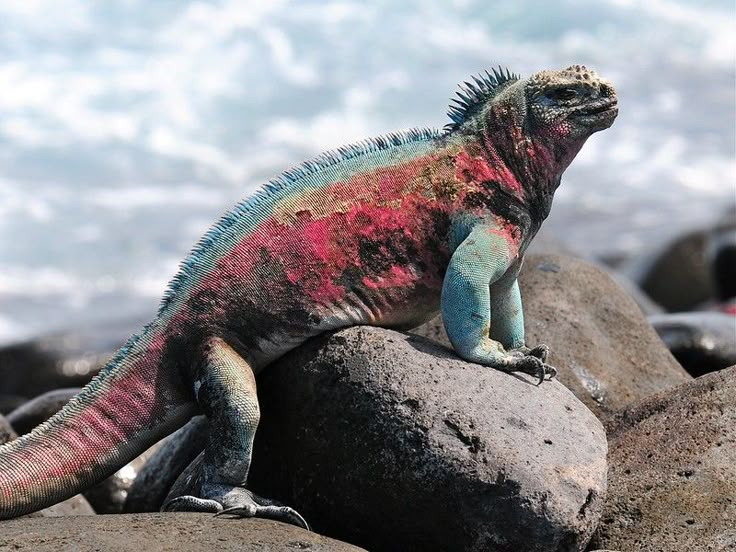
The marine iguana is the only lizard on Earth that forages in the sea. Of the roughly seven thousand lizard species currently recognised, only Amblyrhynchus cristatus has crossed the line between reptile and ocean, earning its food by diving into cold Pacific water and grazing on algae off submerged lava rock.
It lives nowhere else but the Galapagos Islands, a volcanic archipelago 973 kilometres off the coast of Ecuador, and has become one of the most biologically unusual vertebrates on the planet.
This guide covers every aspect of marine iguana biology and ecology: size and physical description, the salt glands that let them drink essentially nothing but seawater, their remarkable ability to shrink and regrow their skeletons during El Nino food shortages, diving behaviour, reproduction, subspecies and island variation, conservation status, and the history of the animal that Charles Darwin called an "imp of darkness" in 1835.
It is a reference entry, not a summary - so expect specifics: metres, kilograms, dive profiles, temperatures, and verified records.
Etymology and Classification
The scientific name Amblyrhynchus cristatus was coined by Thomas Bell in 1825 from Galapagos specimens collected years earlier. Amblyrhynchus means "blunt snout" in Greek, a direct reference to the short, rounded head the animal uses to scrape algae off rock, and cristatus means "crested", referring to the spiny dorsal crest that runs from the back of the head to the base of the tail. In Spanish the animal is simply called iguana marina.
Marine iguanas belong to the family Iguanidae alongside their closest relatives, the Galapagos land iguanas of the genus Conolophus. Molecular clock estimates place the divergence between marine and land iguanas at roughly 4.5 million years ago, which is older than some of the islands the iguanas now occupy.
The implication is that the marine iguana lineage evolved on islands that have since eroded away, and the current population has recolonised the modern Galapagos from those ancestral islands.
Despite their ecological distance from land iguanas, the two lineages remain close enough genetically that hybrids occur where their ranges overlap on South Plaza Island. These hybrids, confirmed genetically in the 1990s, are viable but sterile. A separate and far rarer cross between a marine iguana male and a female pink land iguana (Conolophus marthae) has also been documented on Wolf Volcano on Isabela.
Size and Physical Description
Marine iguanas are medium-sized lizards shaped for clinging to wet rock and diving through surf. Total length ranges from 0.6 to 1.4 metres from snout to tail tip, with weight between 1 and 12 kilograms. Males are notably larger than females, sometimes by a factor of two or more in mass.
Males:
- Total length: 0.9-1.4 metres
- Weight: typically 5-12 kg, occasionally more on Isabela and Fernandina
- Larger dorsal crest and head crown
- Capable of deep foraging dives to 30 m
Females:
- Total length: 0.6-1.0 metres
- Weight: typically 1-3 kg
- Smaller crest, less pronounced colour shift
- Forage almost exclusively intertidally
Hatchlings:
- Total length: 20-25 cm
- Weight: 50-100 grams
- Emerge fully formed from sand-incubated eggs after 89-120 days
Body size varies dramatically between islands because algae productivity varies dramatically between islands. The largest marine iguanas live around Isabela and Fernandina where cold upwellings support the richest algae gardens. The smallest subspecies lives on Genovesa in the north of the archipelago, where warmer water and thinner algae impose a tighter ceiling on body size.
Within a single island, size is also plastic across years: during El Nino, adults can lose up to 20 per cent of their body length, and when algae return they regrow. This remarkable reversible skeletal shrinkage is discussed in detail below.
The body is adapted for life at the ocean edge. The tail is laterally flattened into a blade that provides most of the thrust when swimming. The limbs are short, muscular, and tipped with long curved claws that grip lava rock in pounding surf. The skin is thick, black, and often encrusted with white salt crystals expelled from the nasal glands. The snout is blunt and short, giving the head an almost bulldog profile that supports the tricuspid teeth used to scrape algae from rock.
Diving and Foraging
Marine iguanas are the only lizard species on Earth to forage in the sea. This single fact drives nearly every aspect of their unusual physiology.
Dive performance:
| Metric | Value |
|---|---|
| Typical dive depth | 1-5 m (intertidal and shallow grazers) |
| Maximum dive depth | Approximately 30 m |
| Typical dive duration | 5-10 minutes |
| Maximum dive duration | Up to 60 minutes (rare, large males) |
| Body temperature at depth | Can drop to around 20 C |
Only the largest males dive consistently into deeper water, down to around 30 metres. Females and smaller males feed primarily in the intertidal zone at low tide, grazing exposed algae beds without having to submerge. Juveniles almost never enter the water - they feed on seaweed left behind on warm rocks and remain land-bound for the first year or two of life.
The challenge of foraging in cold Pacific water is thermal. Marine iguanas are ectotherms and cannot generate internal heat. After basking to raise body temperature to around 35-37 degrees Celsius on sun-warmed rock, they enter water that may be as cold as 11 to 23 degrees Celsius. Body temperature falls steadily during the dive, and metabolism slows to match.
To conserve oxygen the animal reduces its heart rate dramatically - in some studies, to around half the surface rate. After emerging, the iguana spreads itself on dark lava and warms back to operating temperature, which can take an hour or more.
This is why marine iguanas cluster on black rocks in the characteristic piles shown in wildlife photographs: thermoregulation dictates almost all of their above-water behaviour.
Their diet is almost entirely marine red and green algae - Ulva, Gelidium, Centroceras, and similar genera. They cannot digest brown algae, which becomes a problem during El Nino when warm water kills the preferred species and leaves behind unprofitable brown species.
Salt Glands: Drinking Seawater and Surviving It
Marine iguanas ingest enormous quantities of sea salt through their algae diet. If that salt accumulated in the bloodstream it would kill the animal. The solution is a pair of specialised nasal salt glands located above the eyes, and a mechanism to eject the concentrated brine.
The glands actively transport sodium and potassium chloride out of the bloodstream using energy-driven ion pumps. The resulting fluid, far saltier than seawater, is stored briefly in the nasal cavity and then explosively ejected through the nostrils as a fine white spray - effectively, the iguana sneezes out its excess salt.
Over time the crystallised brine accumulates on the top of the head, leaving the famous white crown that distinguishes older adults. Visitors to the Galapagos who sit still on lava rocks for a few minutes will eventually hear the distinctive sneezing sound and watch salt crystals arc through the air.
Similar salt glands exist in seabirds, sea turtles, and some sea snakes. Marine iguanas are the only lizard to have evolved them in a marine context, and their glands process salt loads that would be lethal to almost any other reptile.
Shrinking the Skeleton: Surviving El Nino
El Nino years bring warm water to the Galapagos, killing the red and green algae that marine iguanas need and leaving behind indigestible brown algae. In severe events this causes catastrophic starvation mortality - up to 85 per cent of iguanas in some local populations have died in single El Nino years.
Survivors exhibit one of the strangest phenomena in vertebrate biology: reversible skeletal shrinkage. Work by Martin Wikelski and Corinna Thom, published in Nature in 2000, documented marine iguanas on Santa Fe Island shrinking by up to 6.9 centimetres during an El Nino year - around 20 per cent of body length in some individuals. Crucially, the shrinkage was not only due to loss of fat and muscle.
It included reabsorption of bone matrix from the skeleton itself. When algae recovered the animals regrew to their former size.
Documented pattern:
- El Nino warms ocean, red and green algae decline
- Iguanas cannot digest brown algae replacement, starve
- Body mass drops, then body length drops as skeletal material reabsorbs
- Smaller body has lower metabolic requirements, survives on reduced intake
- El Nino ends, algae recover, iguanas regrow
The shrinkage-regrowth cycle has been repeated in the same individuals across multiple El Nino events spanning decades. This makes marine iguanas one of very few vertebrates known to undergo reversible skeletal reduction in response to food availability. The mechanism appears to involve hormonal signalling that triggers digestion of bone matrix, though the full physiology is not yet worked out.
Smaller animals survive El Nino better than larger ones because their absolute metabolic demands are lower. Over evolutionary time this selects against extreme size in populations subject to frequent El Nino events.
Life Cycle and Reproduction
Marine iguana reproduction is tied to the seasonal cool-water season, which provides the best algae growth and therefore the best body condition for breeding.
Breeding sequence:
- December to March (cool season): males develop breeding colours
- January to April: males establish small territories on display rocks, perform head-bob and push-up displays
- Females visit territories, mating occurs
- One to three months later, females dig sand burrows 30-80 cm deep
- 1-6 leathery eggs are laid per clutch, typical 2-3
- Incubation lasts 89-120 days, temperature-dependent
- Hatchlings emerge fully formed and independent
Males in breeding condition shed the uniform sooty black of the non-breeding season and develop patches of red, green, and turquoise across the body and crest. The intensity and pattern vary by subspecies. The most vivid are the Espanola males, whose combination of red and green earns them the tourist nickname "Christmas iguanas". Colour intensity correlates with dominance and mating success on display rocks.
Females are mating-selective and visit multiple males before choosing a partner. Males defend small territories against rivals with head-bobbing displays and occasional physical contact, but lethal combat is rare.
Egg-laying is risky. Females travel inland to sandy beach nest sites where rats, pigs, cats, and native Galapagos hawks pose predation threats. Females will compete for prime nest sites and have been observed fighting fiercely for limited space. Once laid, eggs are abandoned - there is no parental care.
Hatchlings emerge from the sand after roughly three to four months. Their mortality is severe. Galapagos racer snakes ambush them during the run from nest to shore, and the species has been featured in nature documentaries dramatising these hatchling chases. Juveniles that survive the first year rarely enter the water until they are larger and better able to thermoregulate after a dive.
Sexual maturity is reached at 3-5 years in females and 6-8 years in males. Wild individuals routinely live more than 30 years and some marked animals have been estimated at around 60 years old.
Subspecies and Island Variation
Marine iguanas have diversified into eleven recognised subspecies, each restricted to a single island or island group. The subspecies differ in body size, head shape, breeding colour, and algae preference.
Subspecies distribution:
| Subspecies | Island(s) | Notable features |
|---|---|---|
| A. c. cristatus | Fernandina | Largest bodies, deep divers |
| A. c. albemarlensis | Isabela | Very large, variable colour |
| A. c. hassi | Santa Cruz | Medium size, common subject of research |
| A. c. mertensi | San Cristobal, Santiago | Medium size, red and green males |
| A. c. venustissimus | Espanola | "Christmas iguana", vivid red and green |
| A. c. nanus | Genovesa | Smallest subspecies |
| A. c. sielmanni | Pinta | Distinctive head proportions |
| A. c. trillmichi | Santa Fe | Subject of shrinkage studies |
| A. c. jeffreysi | Wolf, Darwin | Remote, little studied |
| A. c. wikelskii | Santiago (distinct population) | Named for researcher Martin Wikelski |
| A. c. godzilla | San Cristobal (distinct) | Named in 2017 |
The 2017 description of new subspecies was based on genetic and morphological data gathered over two decades and reflects the long-recognised reality that each island has produced its own distinct population. Genetic exchange between islands is minimal because adult marine iguanas almost never swim between islands, and the currents rarely carry them far.
Movement and Behaviour
Marine iguanas are remarkably site-faithful. Adult home ranges often span only a few hundred metres of coastline, and individuals may return to the same basking rock daily for years. Social structure is loose: large aggregations occur on warm rocks after dives, but there is no pack or family structure.
Typical daily routine:
- Morning: bask on dark lava to raise body temperature to 35-37 C
- Midday (high tide): retreat from direct sun to avoid overheating
- Low tide: intertidal grazing by smaller iguanas
- Midday to afternoon (for large males): dive to deeper algae beds
- Late afternoon: return to rocks, re-warm, social basking
- Night: group together in crevices to conserve heat
The species is almost entirely diurnal. At night they cluster in crevices and under rocks, sometimes in piles of dozens of animals, to reduce heat loss. Body temperature drops to ambient overnight and the animal is sluggish until sunrise.
Communication is mostly visual - head-bob rates signal dominance and territory - but olfactory cues are important during the breeding season.
Conservation Status and Threats
The IUCN Red List classifies marine iguanas as Vulnerable. Global population estimates fall between 200,000 and 300,000 animals spread across the eleven subspecies. Population size swings with El Nino cycles, which makes year-on-year monitoring noisy, but the long-term trend is considered declining.
Primary threats:
- Introduced predators. Feral cats, dogs, pigs, and rats on populated islands take eggs, hatchlings, and occasionally adults. The most damaging predator on eggs is the pig; on hatchlings it is the cat.
- Oil spills. The 2001 Jessica grounding off San Cristobal killed significant numbers of iguanas in affected populations, including an estimated 62 per cent of the Santa Fe subpopulation in the following year due to toxin accumulation and gut bacteria disruption.
- Plastic pollution. Ingestion of microplastics and entanglement in fishing debris are documented and increasing.
- Climate change. Projections suggest El Nino events will become more frequent and more intense, increasing mortality during crisis years and shortening recovery periods between them.
- Human disturbance. Tourism at breeding beaches, fishing boat traffic, and development on populated islands disrupt nesting and thermoregulation.
- Disease. Limited evidence suggests introduced pathogens from domestic animals may affect populations on inhabited islands.
Several conservation measures are in place. The Galapagos National Park covers 97 per cent of the archipelago's land area and includes the majority of marine iguana habitat. The Charles Darwin Foundation conducts long-term monitoring on multiple islands. Strict biosecurity controls on inter-island travel limit the spread of introduced species. Eradication programmes for feral goats, pigs, and rats have been successful on several islands and have coincided with marine iguana recovery.
Because each subspecies is restricted to one island or island group, local extinctions would be effectively irreversible for the affected subspecies. Conservation planning therefore treats each island population as a separate management unit.
Marine Iguanas and Humans
Charles Darwin encountered marine iguanas in September 1835 during the voyage of HMS Beagle and described them at length in The Voyage of the Beagle. His writing combined distaste and fascination. He called them "hideous-looking creatures, of a dirty black colour, stupid, and sluggish in their movements" and referred to them as "imps of darkness".
The species's reluctance to leave the rocks for the water, despite feeding in the sea, puzzled Darwin enough that he repeatedly threw one individual into the ocean. Each time the animal swam straight back to his feet. Darwin concluded that the iguanas feared predators in open water more than anything on land - a hypothesis modern research on shark predation has effectively confirmed.
Galapagos indigenous and colonial populations rarely ate marine iguanas, which are widely described as unpalatable. This cultural indifference has been a conservation advantage: unlike many other Galapagos reptiles, marine iguanas were never systematically hunted by humans.
Today the species is one of the most visible tourist icons of the Galapagos National Park. Visitors walking the boardwalks at Punta Espinoza on Fernandina, or the rocky coasts of Santa Cruz, routinely encounter marine iguanas within arm's length. Park regulations require a two-metre distance at minimum and prohibit handling. Well-managed tourism provides the economic case for the strict biosecurity measures that protect the species.
The marine iguana's presence in documentaries - particularly the hatchlings-versus-racer-snakes sequence from the BBC's Planet Earth II in 2016 - has raised its public profile dramatically. The animal has become a symbol of island evolution, climate vulnerability, and the biological strangeness of the Galapagos as a whole.
Related Reading
- Green Iguana: Tropical America's Giant Lizard
- Komodo Dragon: The Largest Lizard on Earth
- Lizards: Masters of Adaptation and Survival
References
Relevant peer-reviewed and governmental sources consulted for this entry include the IUCN Red List assessment for Amblyrhynchus cristatus, the Charles Darwin Foundation's Galapagos Species Checklist, the Galapagos National Park Directorate's monitoring reports, and published research including Wikelski and Thom (2000) "Marine iguanas shrink to survive El Nino" in Nature, Wikelski and Trillmich (1997) work on island size variation, MacLeod et al.
(2015) on subspecies genetics, and multiple studies in the Journal of Experimental Biology on thermoregulation and salt gland physiology. Population figures reflect the most recent consolidated estimates as of 2024.
Frequently Asked Questions
How big are marine iguanas?
Adult marine iguanas (Amblyrhynchus cristatus) range from 0.6 to 1.4 metres in total length including the tail, and weigh between 1 and 12 kilograms. Males are substantially larger than females and can reach the upper end of both ranges. Size varies dramatically between the Galapagos islands: animals on Fernandina and Isabela are the largest, while the Genovesa subspecies is among the smallest.
Body mass is highly plastic - during El Nino food shortages adults can lose not only fat and muscle but also measurable skeletal length, shrinking by up to 20 per cent before regrowing when conditions improve.
What do marine iguanas eat?
Marine iguanas are strict herbivores, feeding almost exclusively on marine red and green algae. Large males and some large females dive 1 to 30 metres to graze underwater algae beds, typically for 5 to 10 minutes per dive but sometimes for up to an hour. Smaller iguanas, juveniles, and most females feed in the intertidal zone at low tide, scraping algae off exposed rocks with their short, blunt snouts and tricuspid teeth.
Their preferred species include Ulva, Gelidium, and Centroceras. During El Nino events the warm water kills their preferred red and green algae and leaves behind brown algae that iguanas cannot digest - which is why starvation mortality during El Nino is so severe.
Where do marine iguanas live?
Marine iguanas live nowhere else in the world but the Galapagos Islands, a volcanic archipelago 973 kilometres off the coast of Ecuador. They inhabit rocky coastlines, lava shores, and shallow subtidal reefs on all of the major islands. Eleven subspecies have been described, each associated with one island or island group: Fernandina, Isabela, Santiago, Santa Cruz, San Cristobal, Espanola, Floreana, Marchena, Pinta, Genovesa, and the Plaza Islands.
Because each population is isolated, the subspecies differ in body size, head shape, and breeding colour. The total global range of the species is less than a few thousand kilometres of coastline.
How do marine iguanas get rid of salt?
Salt is the single greatest physiological challenge of eating sea algae. Marine iguanas solve it with a pair of nasal salt glands located above the eyes that actively extract sodium and potassium chloride from the blood. The concentrated brine is stored in the nasal cavity and explosively ejected as a sneeze, producing the fine white spray that builds up on the head and back of older iguanas.
The excreted fluid is far saltier than seawater, and the glands handle a salt load that would kill most reptiles. Similar glands exist in seabirds and sea turtles, but marine iguanas are the only lizard to have evolved them in a marine context.
Why do marine iguanas shrink during El Nino?
El Nino events warm Galapagos waters and kill the cold-water red and green algae that marine iguanas depend on. Faced with months of near-starvation, iguanas first burn through body fat and then muscle. Research by Martin Wikelski and Corinna Thom, published in Nature in 2000, showed that adult marine iguanas on Santa Fe Island also lose measurable length - up to 6.9 centimetres in an animal originally around 90 centimetres long.
Skeletal reabsorption appears to be driven by hormonal and mechanical changes that digest bone matrix. When algae recover, the iguanas regrow to their former size. The shrinkage and regrowth cycle is reversible and has been repeated in the same individuals across multiple El Nino events, making marine iguanas one of very few vertebrates known to undergo reversible skeletal reduction.
How long do marine iguanas live?
Marine iguanas are long-lived by lizard standards. Individuals routinely exceed 30 years in the wild, and some recaptured animals have been estimated at around 60 years old based on marking studies that began in the 1960s. Survival varies sharply with El Nino cycles: a strong El Nino can kill up to 85 per cent of iguanas in some local populations, particularly larger animals which have higher metabolic demands and cannot shrink fast enough.
Survivors of multiple El Nino events tend to be smaller-bodied individuals with efficient diving and feeding. Sexual maturity is reached at about 3 to 5 years in females and 6 to 8 years in males, after which breeding occurs roughly annually for the rest of the animal’s life.
Are marine iguanas endangered?
The IUCN lists marine iguanas as Vulnerable. Global population estimates range from 200,000 to 300,000 animals distributed across the 11 subspecies, but the numbers fluctuate dramatically with El Nino cycles.
Ongoing threats include introduced predators (feral cats, dogs, rats, and pigs that take eggs and juveniles), oil spills such as the Jessica grounding in 2001 that killed a significant fraction of the Santa Fe population, plastic pollution, human disturbance at breeding beaches, and climate change which is projected to increase the frequency and severity of El Nino events.
Because each subspecies is confined to a single island or island group, local extinctions would be effectively irreversible. Conservation is managed through the Galapagos National Park and Charles Darwin Foundation, with strict biosecurity on inter-island travel.
Did Charles Darwin really call them 'imps of darkness'?
Yes. Darwin encountered marine iguanas on the Galapagos in September 1835 during the voyage of HMS Beagle. In his journal and later in ‘The Voyage of the Beagle’, he described the animals as ‘hideous-looking creatures, of a dirty black colour, stupid, and sluggish in their movements’, and referred to them as ‘imps of darkness’ basking on the lava rocks.
Darwin was puzzled by their strong attachment to land despite feeding in the sea - he repeatedly threw one individual into the water and each time it swam straight back to the rocks at his feet. He concluded that the iguanas feared marine predators such as sharks far more than anything on shore.
Modern research has confirmed that shark predation is indeed a significant risk for iguanas diving in deeper water, which is why larger males do most of the deep foraging.