
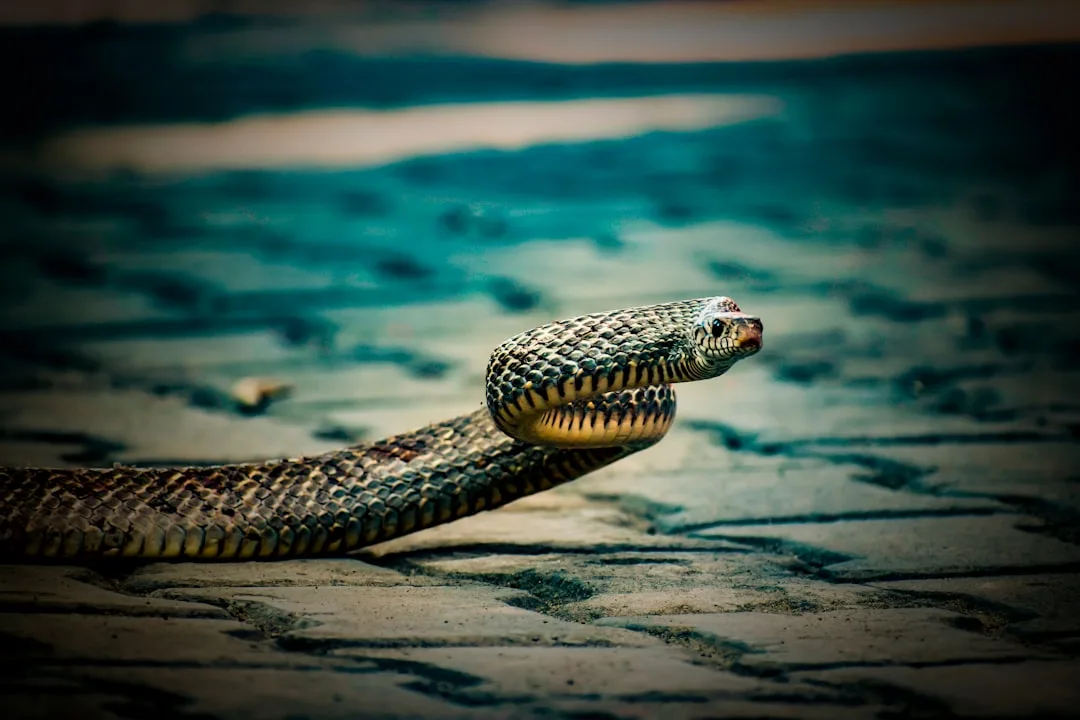
What is the most venomous snake in the world?
In the world of snakes, the inland taipan (Oxyuranus microlepidotus) of central Australia possesses the most toxic venom of any land species. A single bite delivers enough venom to kill approximately 100 adult humans or 250,000 mice. Despite this extreme toxicity, the inland taipan is reclusive and rarely encounters people, resulting in very few recorded bites.
No animal provokes a more visceral, instinctive reaction in humans than the snake. The mere sight of a serpentine form - a garden hose coiled in the grass, a curved stick on a forest path - is enough to trigger an adrenaline surge in even the most rational person. This fear, known as ophidiophobia, is among the most common phobias on the planet, affecting an estimated one-third of all adults.
Evolutionary psychologists argue it is hardwired, a relic of millions of years during which primates who noticed snakes quickly were primates who survived.
Yet this deep-seated fear has produced a profound misunderstanding. Of the more than 3,900 known snake species inhabiting every continent except Antarctica, only about 600 are venomous, and fewer than 200 pose any serious medical threat to humans. The vast majority of snakes are harmless, ecologically vital creatures that control rodent populations, cycle nutrients, and serve as prey for countless other species.
To understand snakes is to confront one of evolution's most elegant and radical experiments in vertebrate design - an animal that abandoned limbs entirely and conquered the world regardless.
Anatomy of the Limbless: How Snakes Work
The snake body plan is a study in extreme specialization. Every organ, every bone, every scale has been reshaped by natural selection to function within a long, narrow cylinder. Understanding this anatomy is essential to appreciating how snakes hunt, move, and survive.
The Skeleton and Locomotion
A snake's skeleton is remarkably simple in concept but staggering in execution. Most species possess between 200 and 400 vertebrae, each connected to a pair of ribs by ball-and-socket joints that permit extraordinary flexibility in three dimensions. Humans, by comparison, have just 33 vertebrae.
This modular design allows snakes to move via four distinct locomotion modes: lateral undulation (the classic S-shaped slither), rectilinear movement (a slow, straight-line creep using belly scales), concertina movement (an accordion-like bunching used in tight spaces), and sidewinding (a looping diagonal movement used on loose sand).
Each belly scale, called a ventral scute, functions like an individual tread on a tank track. Muscles attached to the ribs can move these scutes forward and backward independently, gripping the substrate and propelling the snake forward with remarkable efficiency. On smooth surfaces, snakes lose much of their traction - a fact that explains why they are rarely found on polished floors despite horror movie depictions.
Jaws and Feeding
Perhaps the most famous anatomical feature of snakes is their kinetic skull. Unlike mammals, whose skull bones are fused into a rigid structure, snake skulls are composed of loosely connected bones joined by elastic ligaments. The two halves of the lower jaw are not fused at the chin but connected by a stretchy ligament, allowing them to spread apart independently.
Combined with a highly flexible quadrate bone that connects the lower jaw to the skull, this arrangement allows snakes to swallow prey items three to five times wider than their own head.
The process of swallowing large prey is a slow, methodical affair. The snake "walks" its jaws over the prey, alternating left and right sides in a ratcheting motion. Backward-curving teeth prevent the prey from slipping out. A specialized tracheal extension - essentially a snorkel - allows the snake to continue breathing while its mouth is fully occupied. Digestion is equally extreme: powerful stomach acids with a pH as low as 1.5 can dissolve bone, fur, and feather within days.
The Jacobson's Organ and Chemical Sensing
Snakes possess a sensory apparatus that has no parallel in human experience. The constantly flicking forked tongue is not a weapon or a moisture-sensing organ - it is a chemical sampler of extraordinary precision. When a snake flicks its tongue, it collects microscopic particles from the air and the ground. The tongue is then retracted and the two tines are inserted into a pair of openings in the roof of the mouth that lead to the Jacobson's organ (also called the vomeronasal organ).
This organ analyzes the chemical composition of the collected particles with a sensitivity that rivals or exceeds the olfactory abilities of the best scent-tracking dogs. The forked design is not decorative - each tine samples independently, providing directional chemical information. If more scent molecules land on the left tine, the prey is to the left.
This stereo-smell system allows snakes to track prey trails that are hours old, detect approaching predators, and locate mates over distances of several kilometers.
"The snake's tongue is the most sophisticated chemical sampling device in the vertebrate world. It turns the air itself into a three-dimensional map of opportunity and danger." - Harry W. Greene, Professor of Ecology and Evolutionary Biology, Cornell University, Snakes: The Evolution of Mystery in Nature (1997)
The King Cobra: Royalty Among Serpents
The king cobra (Ophiophagus hannah) is the longest venomous snake on Earth, with confirmed specimens reaching 5.85 meters (19.2 feet). Found across South and Southeast Asia from India to the Philippines, this species commands a unique place in both herpetology and human culture.
Despite its common name, the king cobra is not a true cobra. It belongs to its own genus, Ophiophagus, which translates literally to "snake eater" - an apt name, as its diet consists almost exclusively of other snakes, including other venomous species. A king cobra will readily consume rat snakes, kraits, and even smaller king cobras.
The Hood Display
The king cobra's signature hood display is one of nature's most effective threat signals. When threatened, the snake raises the anterior third of its body off the ground - sometimes lifting its head to eye level with a standing human - and flattens its neck ribs outward, stretching the loose skin into a broad, intimidating hood.
This display is accompanied by a deep, resonant hiss that sounds more like a growling dog than a typical snake hiss, produced by pushing air through tracheal diverticula that act as low-frequency resonating chambers.
Nest Building: A Unique Behavior
The king cobra is the only snake species known to build a nest for its eggs. The female constructs a mound of dead leaves and vegetation, sometimes over a meter in diameter, and deposits 20 to 50 eggs inside. She then coils on top of the nest and guards it aggressively for the entire 60 to 90 day incubation period, rarely leaving to feed.
The decomposing vegetation generates heat, effectively creating a natural incubator that maintains temperatures between 26 and 28 degrees Celsius. The female departs shortly before hatching, likely to avoid the instinct to consume her own offspring.
The Reticulated Python: Earth's Longest Snake
The reticulated python (Malayopython reticulatus) holds the record as the longest snake species alive today. Specimens exceeding 7 meters (23 feet) have been reliably documented, and unconfirmed reports suggest lengths of up to 10 meters. Native to Southeast Asia, this species inhabits tropical rainforests, grasslands, and even urban environments, where it has been found in sewers, drainage canals, and beneath houses.
The Mechanics of Constriction
For decades, the standard explanation for how constrictors kill was simple: they suffocate their prey by preventing the ribcage from expanding. Research published in the Journal of Experimental Biology in 2015 by Scott Boback and colleagues at Dickinson College overturned this assumption entirely. By implanting pressure sensors and heart monitors in prey animals, the team demonstrated that constriction kills primarily through circulatory arrest, not suffocation.
When a reticulated python - or any large constrictor - seizes prey, it wraps multiple coils around the animal's torso and tightens incrementally with each exhalation. The sustained pressure exceeds the prey's arterial blood pressure, collapsing blood vessels and cutting off circulation to the brain and heart. Cardiac arrest typically occurs within seconds, far faster than suffocation would.
The snake can detect the prey's heartbeat through pressure-sensitive receptors in its body and ceases constricting once the heart stops, conserving energy.
Large reticulated pythons are capable of generating constriction pressures exceeding 30 kPa - roughly equivalent to being buried under a meter of wet concrete. Verified prey items include deer, pigs, and in extremely rare cases, adult humans. Fatal attacks on humans are documented but exceptionally rare, with approximately 1 to 2 confirmed deaths per year globally.
The Black Mamba: Africa's Most Feared Snake
The black mamba (Dendroaspis polylepis) is widely regarded as the most dangerous snake in Africa and one of the most feared reptiles on Earth. Its reputation is built on a terrifying combination of attributes: extreme speed, potent neurotoxic venom, large venom yield, and a disposition that, while not truly aggressive, is decidedly less tolerant of disturbance than most snake species.
Speed and Agility
The black mamba is the fastest snake in the world, capable of moving at speeds of up to 12 mph (19 km/h) over short distances. While this is slower than a running human, it is extraordinarily fast for a snake and more than sufficient to catch off-guard anyone who inadvertently corners one.
The name "black mamba" refers not to the snake's external coloration, which is typically olive, grey, or brown, but to the inky black interior of its mouth, which it displays in a gaping threat posture before striking.
Venom and Lethality
Black mamba venom is a cocktail of potent neurotoxins, including dendrotoxins that block potassium channels in nerve cells, causing rapid paralysis of the respiratory muscles.
Without antivenom, the mortality rate from a black mamba bite approaches 100 percent, with death occurring in as little as 30 minutes to 3 hours depending on the bite location and volume of venom injected. A single bite can deliver 100 to 400 mg of venom, while the lethal dose for a human is estimated at just 10 to 15 mg.
"The black mamba is not the most venomous snake in the world, nor the most common cause of snakebite deaths. But it is, by almost any metric of combined speed, venom potency, venom yield, and temperament, the single most formidable snake a human can encounter in the wild." - Dr. Bryan Grieg Fry, venom researcher and Professor of Biology, University of Queensland
The Inland Taipan: The World's Most Toxic Venom
The inland taipan (Oxyuranus microlepidotus), also known as the "fierce snake," inhabits the arid, sparsely populated black-soil plains of central Australia. It possesses the most toxic venom of any land snake - and it is not a close contest. Drop for drop, inland taipan venom is roughly 100 times more potent than that of the Indian cobra and approximately 10 times more potent than the Mojave rattlesnake.
A single bite from an inland taipan delivers an average of 44 mg of venom, enough to kill approximately 100 adult humans or 250,000 mice in laboratory LD50 tests. The venom contains a complex mixture of taipoxin (an extremely potent neurotoxin), oxylepitoxin-1 (a cardiotoxin), and paradoxin (a component that attacks muscle tissue). Together, these compounds cause simultaneous neuromuscular paralysis, internal hemorrhaging, and kidney damage.
Despite this extraordinary lethality, the inland taipan is responsible for zero confirmed human deaths in modern medical records. The snake's remote habitat, shy disposition, and the ready availability of taipan antivenom in Australia make encounters both rare and survivable when treated promptly.
Rattlesnakes: Evolution's Warning System
The approximately 36 species of rattlesnakes (genera Crotalus and Sistrurus) are found exclusively in the Americas, from southern Canada to Argentina. They are among the most recognizable snakes in the world, thanks to the segmented keratin rattle at the tip of their tail.
The Rattle: Structure and Function
Each time a rattlesnake sheds its skin - typically two to four times per year - a new interlocking segment is added to the rattle. When vibrated at frequencies of 40 to 60 cycles per second, these hollow segments click against each other, producing the iconic buzzing sound that can be heard from 20 meters or more.
The rattle serves as an aposematic warning signal - an honest advertisement that the snake is dangerous and should be avoided. This is a defensive adaptation, not an offensive one: every rattle buzz is a snake saying "do not step on me."
Heat-Sensing Pits
Rattlesnakes belong to the subfamily Crotalinae (pit vipers), named for the heat-sensing loreal pits located between the eye and nostril on each side of the head. These pits contain a thin membrane packed with infrared-sensitive nerve endings capable of detecting temperature differences as small as 0.003 degrees Celsius.
This gives pit vipers the ability to "see" heat in complete darkness, creating a thermal image of warm-blooded prey that overlays their normal vision. The resolution is sufficient to strike accurately at a mouse in total darkness from a distance of half a meter.
Anacondas: Heaviest Snakes on Earth
The green anaconda (Eunectes murinus) of South America is the heaviest snake species in the world. While the reticulated python surpasses it in length, the green anaconda's massive girth gives it a weight advantage: large females routinely exceed 100 kg (220 lbs), and exceptional specimens have been estimated at over 200 kg (440 lbs). The heaviest reliably documented green anaconda weighed 227 kg (500 lbs) and measured 5.2 meters in length.
Aquatic Ambush Predators
Green anacondas are semi-aquatic, spending most of their time in or near water in the swamps, marshes, and slow-moving rivers of the Amazon and Orinoco basins. Water supports their enormous body weight, allowing them to move with a speed and agility that would be impossible on land. Their eyes and nostrils are positioned on the top of the head, allowing them to float almost entirely submerged while scanning for prey - an ambush strategy strikingly similar to that of crocodilians.
Prey items include capybaras, caimans, deer, wild pigs, and large fish. Anacondas are among the few snakes capable of taking prey that outweighs them. Kills are accomplished through constriction, and a large anaconda can exert sufficient force to subdue a full-grown caiman. After consuming a large meal, an anaconda may not feed again for weeks or even months, digesting slowly in a warm, secluded spot.
Sea Snakes: Venomous Masters of the Ocean
The approximately 70 species of true sea snakes (subfamily Hydrophiinae) represent one of the most successful marine reptile radiations since the age of dinosaurs. Found primarily in the warm waters of the Indian and Pacific Oceans, these fully aquatic serpents have evolved a suite of remarkable adaptations for life at sea.
Breathing Adaptations
Sea snakes breathe air and must surface regularly, but they have evolved several mechanisms to extend their dive times dramatically. Their single, elongated lung extends nearly the entire length of the body, providing a far greater air reservoir relative to body size than terrestrial snakes.
Additionally, sea snakes can absorb up to 33 percent of their oxygen requirement directly through their skin, a feat known as cutaneous respiration. Some species can remain submerged for over two hours on a single breath.
A specialized salt gland located beneath the tongue actively excretes excess salt, allowing sea snakes to maintain osmotic balance in seawater without needing to drink fresh water - a problem that has limited many other reptile groups from colonizing marine environments.
Venom Potency
Several sea snake species rank among the most venomous snakes in the world. The Dubois' sea snake (Aipysurus duboisii) and the beaked sea snake (Hydrophis schistosus) possess venoms that rival or exceed the inland taipan in toxicity when measured by LD50 values.
Sea snake venom is primarily myotoxic, destroying skeletal muscle tissue and causing a condition called rhabdomyolysis, which can lead to kidney failure. Despite this potency, sea snake bites in humans are rare, and the snakes are generally docile unless handled or trapped in fishing nets.
Comparison of the World's Most Dangerous Snakes
| Species | Region | Venom Type | LD50 (mg/kg) | Avg. Venom Yield (mg) | Est. Annual Deaths |
|---|---|---|---|---|---|
| Inland Taipan | Central Australia | Neurotoxic/Hemotoxic | 0.025 | 44 | 0 |
| Eastern Brown Snake | Australia | Neurotoxic/Coagulant | 0.053 | 5 | 1-2 |
| Black Mamba | Sub-Saharan Africa | Neurotoxic | 0.32 | 100-400 | ~500 |
| King Cobra | South/SE Asia | Neurotoxic | 1.80 | 400-600 | ~1,000 |
| Saw-Scaled Viper | South Asia/Middle East | Hemotoxic | 2.40 | 13 | ~5,000+ |
| Indian Cobra | South Asia | Neurotoxic | 0.57 | 60-80 | ~10,000+ |
| Russell's Viper | South/SE Asia | Hemotoxic | 0.75 | 130-250 | ~25,000+ |
Note: Lower LD50 values indicate higher toxicity. LD50 is the dose required to kill 50% of test animals (mice, subcutaneous injection). Annual death estimates are approximate and vary by source.
This table illustrates a critical distinction: the most toxic snakes are not necessarily the most deadly to humans. The inland taipan's venom is orders of magnitude more potent than the Russell's viper's, yet Russell's vipers kill thousands of times more people each year due to their abundance in densely populated agricultural regions where barefoot farmers work in tall grass.
The Global Snakebite Crisis
Snakebite is one of the most neglected public health emergencies in the world. The World Health Organization estimates that 5.4 million snakebite cases occur annually, of which 1.8 to 2.7 million result in envenomation - meaning the snake successfully injected venom. Between 81,000 and 138,000 people die from snakebite each year, and roughly 400,000 survivors are left with permanent disabilities including amputations, blindness, and chronic kidney disease [1].
The burden falls overwhelmingly on the rural poor in tropical developing nations. Sub-Saharan Africa, South Asia, and Southeast Asia bear the brunt: India alone accounts for an estimated 46,000 to 58,000 snakebite deaths annually - nearly half the global total. Victims are predominantly agricultural workers bitten while farming, walking to water sources, or sleeping on the ground in homes without sealed walls.
The Antivenom Shortage
Antivenom - the only specific treatment for envenomation - is in critical short supply across much of the developing world. Quality antivenom production requires maintaining colonies of venomous snakes, extracting and processing venom, immunizing horses or sheep, and purifying the resulting antibodies. This process is expensive, technically demanding, and commercially unattractive because the patients who need antivenom the most are the least able to pay for it.
In 2010, Sanofi Pasteur ceased production of Fav-Afrique, the only antivenom effective against the venoms of the ten most dangerous snake species in sub-Saharan Africa.
The last batches expired in 2016, leaving the continent in what Doctors Without Borders called a "full-blown antivenom crisis." While new products have since entered the market, many are of questionable quality or efficacy, and the price of a course of antivenom treatment can equal six months' wages for a rural African family [2].
In 2017, the WHO added snakebite envenoming to its list of Category A Neglected Tropical Diseases, a designation that has helped attract research funding and public attention. However, progress remains slow, and the gap between antivenom supply and demand continues to widen in the regions that need it most.
Snakes in History and Mythology: The Asp of Cleopatra
No account of snakes would be complete without acknowledging their extraordinary place in human mythology and history. The serpent appears in the creation stories of cultures on every inhabited continent, variously symbolizing wisdom, evil, rebirth, fertility, and death.
Perhaps the most famous historical encounter between human and snake is the death of Cleopatra VII in 30 BCE. According to Plutarch and other classical sources, the last pharaoh of Egypt took her own life by pressing an asp - traditionally identified as an Egyptian cobra (Naja haje) - to her breast.
The cobra's venom, a potent neurotoxin, would have caused progressive paralysis and a relatively peaceful death, consistent with ancient descriptions of Cleopatra dying "without convulsions or groaning."
Modern historians have questioned this account. The Egyptian cobra is a large snake, difficult to conceal in the basket of figs that Plutarch describes, and its bite is not reliably fatal without a large envenomation.
Some scholars have proposed that Cleopatra may have used a mixture of plant poisons instead, or that the asp story was Roman propaganda designed to cast her death as dramatically fitting for an Egyptian queen. Whatever the truth, the legend has endured for over two millennia, cementing the snake's association with both death and royal power in Western culture.
Conservation: The Threats Snakes Face
While much public attention focuses on the danger snakes pose to humans, the reverse relationship is far more consequential. Human activity threatens snake populations worldwide through habitat destruction, road mortality, persecution, and the illegal wildlife trade.
An estimated 1.8 million snakes are killed on roads in the United States alone each year. In India, king cobras are losing habitat at an alarming rate as tropical forests are cleared for agriculture and development. The Burmese python, ironically, is both an invasive threat in the Florida Everglades and a declining species in its native Southeast Asian range due to overharvesting for the leather and traditional medicine trades.
A comprehensive assessment published in Nature Ecology and Evolution in 2022 found that approximately 10 to 15 percent of assessed snake species are threatened with extinction, though the true figure is likely higher because the conservation status of most snake species has never been formally evaluated [3].
Snakes receive a fraction of the conservation funding and public sympathy directed at mammals and birds, despite their critical ecological roles as both predators and prey in virtually every terrestrial ecosystem.
The Future of Snake Science
Herpetology is experiencing a renaissance driven by new technologies. Environmental DNA (eDNA) sampling allows researchers to detect the presence of elusive snake species by analyzing water and soil samples for genetic traces. Radio telemetry and GPS tracking have revealed migration patterns and home ranges that were previously invisible.
Advances in venom proteomics - the comprehensive analysis of all proteins in a venom sample - are uncovering new compounds with potential applications in human medicine, including blood thinners, cancer treatments, and painkillers derived from snake venom peptides.
The captopril story remains the most celebrated example of snake-venom-derived medicine. This widely prescribed blood pressure medication was developed from a peptide found in the venom of the Brazilian pit viper (Bothrops jararaca). First approved in 1981, captopril and its descendants (the ACE inhibitor drug class) have since been prescribed to hundreds of millions of patients worldwide, saving countless lives with a molecule that evolved to end them [4].
References
[1] World Health Organization. "Snakebite Envenoming: A Strategy for Prevention and Control." WHO, Geneva, 2019.
[2] Harrison, R.A., Hargreaves, A., Mayber, S.C., et al. "The Global Snakebite Crisis - A Public Health Issue Misaligned with Available Solutions." PLOS Neglected Tropical Diseases, vol. 11, no. 7, 2017.
[3] Bohm, M., et al. "The Conservation Status of the World's Reptiles." Biological Conservation, vol. 157, 2013, pp. 372-385. Updated analysis in Nature Ecology and Evolution, 2022.
[4] Ferreira, S.H. "A Bradykinin-Potentiating Factor Present in the Venom of Bothrops jararaca." British Journal of Pharmacology and Chemotherapy, vol. 24, 1965, pp. 163-169.
[5] Greene, Harry W. Snakes: The Evolution of Mystery in Nature. University of California Press, 1997.
[6] Boback, S.M., et al. "Snake Constriction Rapidly Induces Circulatory Arrest in Rats." Journal of Experimental Biology, vol. 218, 2015, pp. 2279-2288.
Frequently Asked Questions
What is the most venomous snake in the world?
The inland taipan (Oxyuranus microlepidotus) of central Australia possesses the most toxic venom of any land snake. A single bite delivers enough venom to kill approximately 100 adult humans or 250,000 mice. Despite this extreme toxicity, the inland taipan is reclusive and rarely encounters people, resulting in very few recorded bites.
In terms of human fatalities, the saw-scaled viper and Indian cobra are far more dangerous due to their proximity to dense human populations.
How do snakes smell with their tongue?
Snakes flick their forked tongue to collect airborne chemical particles from the environment. The tongue is then retracted and inserted into the Jacobson’s organ (vomeronasal organ) located in the roof of the mouth. This organ analyzes the chemical signature of the collected particles, allowing the snake to detect prey, predators, and potential mates.
The forked shape of the tongue enables directional scent detection - each tine samples independently, giving the snake a form of stereo smell that helps it determine which direction a scent is coming from.
How does a python kill its prey through constriction?
Contrary to the common belief that pythons suffocate their prey by crushing the ribcage, recent research has shown that constriction kills primarily through circulatory arrest. The python wraps its coils around the prey and tightens each time the animal exhales. This sustained pressure collapses blood vessels and stops blood flow to vital organs, causing cardiac arrest within seconds to minutes.
The snake can detect the prey’s heartbeat through its coils and knows precisely when to stop squeezing, conserving energy once the heart has ceased beating.