
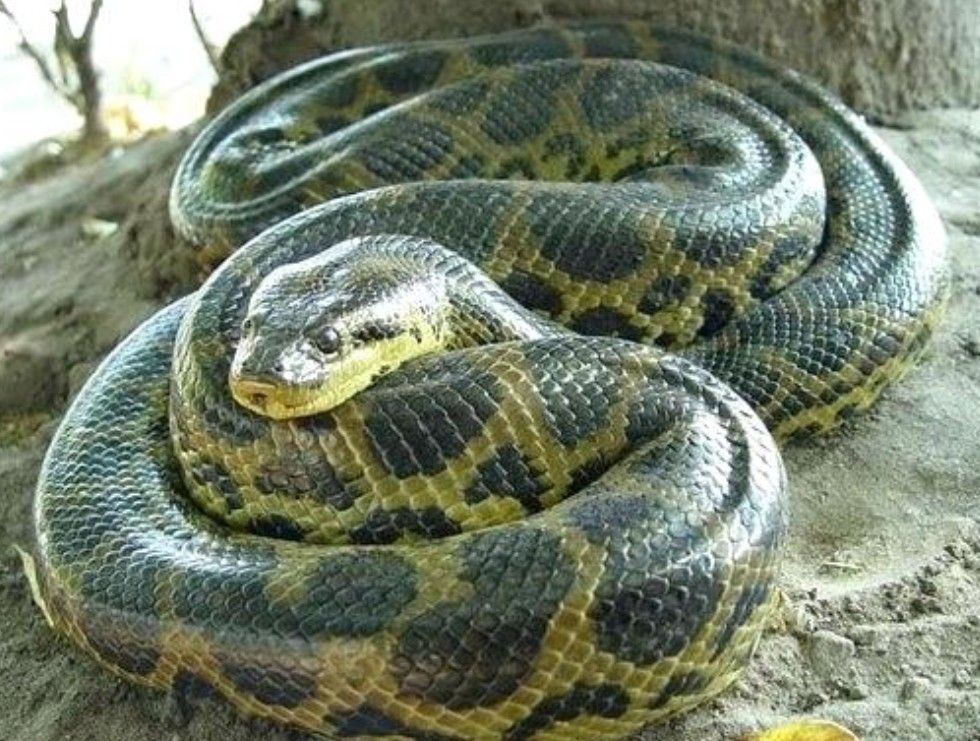
The green anaconda is the heaviest snake on Earth. It is not the longest - that record belongs to the reticulated python of Southeast Asia - but no other living serpent approaches the sheer bulk of a mature Eunectes murinus. A large female can weigh a quarter of a tonne, match the girth of a human torso, and swallow a full-grown capybara or a two-metre caiman without chewing a single bite.
This page is a reference entry for the green anaconda, not a summary. It covers taxonomy, size, habitat, hunting, the famous breeding balls, live-birth biology, the 2024 species split that carved a second anaconda out of E. murinus, conservation status, and the cultural myths that have distorted public perception of this animal for centuries. Expect specifics - metres, kilograms, basins, and numbers - rather than folklore.
Etymology and Classification
The generic name Eunectes derives from the Greek eu ('good') and nektes ('swimmer'), a deliberate nod to the snake's almost entirely aquatic life. The species epithet murinus means 'of mice' in Latin and reflects either the grey-brown base colour of the snake or an early European misunderstanding of its diet. Linnaeus described the species in 1758 in the tenth edition of Systema Naturae, placing it among the boas.
The word anaconda likely comes from the Sinhalese henakandaya, meaning 'whip snake' or 'lightning stem'. The name was originally applied to Asian pythons and later transferred to the South American species by European naturalists who confused the two groups.
In Portuguese Amazonia the snake is called sucuri, in Spanish-speaking South America anaconda verde, and in Indigenous languages across the Amazon it carries names such as yakumama (Quechua, 'mother of the waters') and boia or boiuna in Brazilian folklore.
Anacondas belong to the family Boidae, the true boas, and not to the Pythonidae where many large Old World constrictors sit. Within the genus Eunectes there are now four to five recognised species depending on the taxonomy accepted:
- Eunectes murinus - the southern green anaconda
- Eunectes akayima - the northern green anaconda, described in 2024
- Eunectes notaeus - the yellow anaconda of the Pantanal
- Eunectes deschauenseei - the dark-spotted anaconda
- Eunectes beniensis - the Bolivian anaconda (sometimes treated as a subspecies of E. notaeus)
The 2024 split of the green anaconda was published by a team led by Bryan Fry in the journal MDPI Diversity. The researchers found more than five per cent genetic divergence between populations in the Orinoco and Guiana shield and those in the Amazon proper - a gap larger than the difference between chimpanzees and bonobos. Not all herpetologists have accepted the split yet, and formal recognition is still working through the literature.
Size and Physical Description
Green anacondas are the bulkiest snakes on the planet. Their proportions are dominated by reverse sexual dimorphism - females are vastly larger than males, in one of the most extreme cases known in any terrestrial vertebrate.
Females:
- Length: 4-5 m typical, exceptional specimens over 6 m
- Weight: 60-150 kg typical, record 250 kg
- Girth: up to 30 cm diameter at the widest point
Males:
- Length: 2.5-3.5 m typical
- Weight: 15-35 kg
- Usually four to five times lighter than a mature female in the same population
Neonates:
- Length: 70-80 cm at birth
- Weight: 200-300 g
- Fully independent, feed within days
The record length for a credibly measured green anaconda is 6.27 m, reported from the Venezuelan llanos. Much larger specimens have been claimed - ten and even twelve metre anacondas feature in nineteenth-century travel literature - but none of these claims survive modern scrutiny. The Wildlife Conservation Society long offered a cash prize for a verified 9 m anaconda, and the prize was never claimed.
The body is thick, dark olive green, and marked with paired oval black blotches along the back. A pair of orange-yellow lateral stripes runs across the head from the nostril to the back of the jaw. The eyes and nostrils sit on the very top of the skull, an adaptation that allows the snake to breathe and see while the rest of the body stays submerged.
The scales are small, smooth, and slightly iridescent in sunlight, giving a large anaconda a distinctive wet, oiled appearance. The underside is paler, ranging from cream to yellow, and bears darker speckling.
Built for Water
Green anacondas are not just snakes that happen to swim. They are fully aquatic ambush predators, more comparable in ecology to crocodilians than to pythons. Every major feature of their biology reflects this.
Aquatic adaptations:
- Dorsal nostrils and eyes allow breathing and vision with almost the entire body hidden
- Valvular nostrils close against water intrusion during dives
- Small smooth scales reduce drag through dense aquatic vegetation
- High muscle density and fat reserves provide buoyancy control
- Heart and lungs tolerate extended breath-holding up to roughly ten minutes
On land, an adult green anaconda is slow, awkward, and vulnerable. Without water to support their mass, large females cannot easily lift their own body off the ground, and overland travel is reduced to a belly-dragging crawl. This is why anacondas almost always stay within a few metres of permanent water and typically ambush from shallow mud or floating vegetation rather than from dry banks.
The snake's heat-sensitive pits are arranged along the upper lip rather than in deep pits like those of vipers. These labial pits detect infrared radiation - temperature differences as small as a few thousandths of a degree - and allow the anaconda to locate warm-blooded prey even in opaque, muddy water.
Combined with a forked tongue that samples waterborne scent molecules and a pair of eyes adapted to low light, the sensory array makes it almost impossible for a capybara, deer, or caiman to cross deep water undetected.
Hunting and Diet
Green anacondas are apex predators across much of the Amazon and Orinoco basins. They share the top tier of the food web with jaguars, caimans, and harpy eagles, and they compete directly with the first two for several prey species.
Primary prey:
- Capybara (Hydrochoerus hydrochaeris) - the world's largest rodent
- Spectacled caiman (Caiman crocodilus) up to 2 m
- White-tailed deer (Odocoileus virginianus) in the llanos
- Peccaries (Tayassu and Pecari spp.)
- Large fish including piranha and catfish
- Aquatic birds - herons, storks, ducks
Secondary and opportunistic prey:
- Turtles
- Iguanas and tegu lizards
- Smaller snakes, occasionally
- Agoutis, pacas, and other medium rodents
- Juvenile tapirs on rare occasions
Hunting technique:
- Ambush from water. The anaconda submerges with only nostrils and eyes above the surface, often against a bank or within floating grass mats. It waits for prey to approach the water to drink, bathe, or cross.
- Strike. The snake explodes forward in a sideways S-curve strike, seizing the prey by the head, neck, or leg. Contact is almost instant - strike speeds in the water exceed three metres per second.
- Constriction. The anaconda throws one or two coils around the prey's chest. Each coil tightens on every exhalation of the prey. Peak pressure can exceed 90 kPa, more than enough to collapse the venous return to the heart.
- Cardiac arrest. The prey typically stops moving within one to two minutes. Modern physiological research has confirmed that death occurs through circulatory collapse rather than suffocation.
- Swallowing. The snake walks its jaws over the carcass head-first, aided by the quadrate bone at the back of the skull that allows the lower jaw to extend forward and to the side. Teeth curve rearward, preventing prey from slipping back out.
A fully fed green anaconda can swallow prey that exceeds forty per cent of its own body mass. Digestion is slow, taking weeks for a large meal. Metabolism drops during this period, and a large individual may not feed again for six to twelve months after consuming an adult capybara or caiman.
Reproduction and the Breeding Ball
Anaconda reproduction is one of the strangest chapters in vertebrate biology. It begins with scent and ends, sometimes, with cannibalism.
Breeding takes place at the end of the dry season, roughly April to June in the llanos and shifted by a few months elsewhere. Females release a pheromone trail along water margins and wetland vegetation. Males follow the scent, sometimes from a kilometre or more away. Because the range is dense with vegetation, multiple males often converge on the same female within hours.
The breeding ball:
When several males - up to thirteen recorded in a single case - find the same female, they do not fight in the manner of bull elk or bighorn sheep. Instead they coil around her in a dense, slow-moving knot. The ball may persist for two to four weeks. Males attempt to align their cloacae with hers and use the spurs beside the cloaca (vestigial hind-limb remnants) to stimulate mating. Eventually one male - often the largest, occasionally the most persistent - achieves successful copulation.
After mating:
After the ball dissolves, the female is exhausted and may have lost significant body mass. In some documented cases she consumes the smallest male in the group. Field researchers in the Venezuelan llanos have observed this behaviour repeatedly, and the eaten male can provide enough energy to support the coming gestation. Sexual cannibalism is not universal, but it is frequent enough to be considered a regular part of the species' reproductive biology.
Gestation and live birth:
Green anacondas are ovoviviparous - they do not lay eggs. Embryos develop inside thin-shelled membranes within the mother's body for six to seven months. During this time she typically fasts, sheltering in shaded pools and losing further condition. She gives birth in water to 20-40 fully formed neonates, with extreme cases documented at 82 young in a single litter. The young are independent from the moment of birth, swimming away within minutes and receiving no parental care.
Reproductive interval:
Most females breed every two years. The energetic cost of gestation and post-birth recovery prevents annual reproduction in all but the largest and best-fed individuals.
Life Cycle and Growth
Anacondas grow rapidly for the first several years and then slow down, reaching sexual maturity at three to four years for males and four to five years for females.
| Life stage | Age | Typical size |
|---|---|---|
| Neonate | 0-1 month | 70-80 cm, 200-300 g |
| Juvenile | 1-24 months | 1-2 m, 0.5-5 kg |
| Subadult | 2-4 years | 2.5-3.5 m, 10-25 kg |
| Adult male | 4+ years | 2.5-3.5 m, 15-35 kg |
| Adult female | 5+ years | 4-5 m, 60-150 kg |
| Large female | 10+ years | 5-6 m, 150-250 kg |
Wild lifespan is typically 10 to 12 years. Mortality is high in the first year, when juveniles are vulnerable to caimans, herons, larger anacondas, and jaguars. Captive anacondas, free from predation and food stress, routinely reach 25 to 30 years.
Range and Habitat
Green anacondas occur across the warm, wet lowlands of northern South America. The range can be broken into three major regions:
| Region | Key habitats | Notes |
|---|---|---|
| Amazon basin | Flooded forest, oxbow lakes, slow rivers | Core range of E. murinus |
| Orinoco basin and Guianas | Seasonally flooded llanos, wetlands | Now proposed as E. akayima (2024 split) |
| Pantanal and upper Paraguay | Seasonal marsh, slow rivers | Overlaps with yellow anaconda |
Countries in the range include Brazil, Peru, Ecuador, Colombia, Venezuela, Guyana, Suriname, French Guiana, Bolivia, and Trinidad. Small isolated populations exist on Trinidad and have been reported occasionally from northern Paraguay.
Green anacondas are never far from water. Preferred habitats include:
- Slow-moving rivers and river bends with deep pools
- Seasonally flooded forest (varzea) during the wet season
- Oxbow lakes left behind by meandering rivers
- Permanent marshes with dense aquatic vegetation
- Ranch ponds and reservoirs in the llanos cattle country
The species tolerates disturbed habitat well as long as water and prey remain. Cattle ranches in the Venezuelan llanos support some of the highest known anaconda densities, because seasonal flooding, introduced capybara populations, and reduced predator pressure combine to create ideal conditions.
Conservation Status and Threats
The IUCN Red List classifies Eunectes murinus as Least Concern with a stable global population. The species is not listed under CITES Appendix I, though some range states regulate trade in skins and live specimens. Despite the favourable overall status, several regional and sector-specific threats exist.
Threats:
- Habitat loss. Amazon deforestation, expansion of soy and cattle in the Pantanal, and wetland drainage in the Orinoco llanos reduce prime anaconda habitat. Roads and hydroelectric dams fragment connectivity between river systems.
- Skin trade. Anaconda leather was heavily exploited through the twentieth century, with tens of thousands of skins exported from Venezuela and Colombia. Regulation now restricts the trade, but illegal hunting continues in remote areas.
- Persecution. Rural residents often kill anacondas on sight, driven by folklore, livestock concerns, and fear. Attacks on people are extremely rare and no fatality has been verified in peer-reviewed literature, yet killings are common.
- Pet trade. Large numbers of juveniles are captured for the exotic pet market. Many do not survive transport, and most adults prove unmanageable in private collections and are abandoned or euthanised.
- Pollution. Mercury from artisanal gold mining concentrates up the aquatic food chain and is detectable at high levels in Amazon anacondas. The long-term health consequences are still being studied.
- Climate change. Shifts in rainfall patterns alter the flood cycles that drive prey density and reproduction timing. Droughts in the Amazon during 2023 and 2024 produced documented dieoffs of fish-eating species that anacondas also depend on.
The 2024 split between E. murinus and E. akayima means that future conservation assessments will need to re-evaluate the status of each species separately. The northern green anaconda has a smaller range and may warrant a higher risk category than the Amazonian form.
Anacondas and Humans
Few animals carry as much mythological weight as the anaconda. In Amazonian folklore the snake appears as a shape-shifter, a river spirit, and an agent of retribution. The boiuna of Brazilian legend is a giant black snake that overturns boats and swallows villagers. The yakumama of the Peruvian Amazon is the mother of all aquatic life, whose breath creates eddies and whirlpools.
European perceptions inherited little of this complexity. Early naturalists exaggerated anaconda size - twelve metre specimens, thirty metre monsters, snakes that ate horses. Hollywood amplified the myth with a string of monster movies through the 1990s and 2000s in which anacondas actively hunted humans across the Amazon. None of the cinematic behaviour matches the actual species.
Documented anaconda attacks on humans are extremely rare. No fatal attack on an adult has ever been confirmed in the peer-reviewed literature. Children and very small adults could plausibly be taken by an exceptionally large female, but the evidence for any such case remains anecdotal. Anacondas will bite defensively if cornered, and a bite from a large female can cause serious lacerations from the rearward-curving teeth, but envenomation is impossible because there is no venom.
Anacondas are occasionally eaten by Indigenous Amazonian groups, who process the fat for traditional medicine and use the skin for drum heads. Large-scale commercial hunting for leather has been regulated across most of the range since the late twentieth century. Eco-tourism in the llanos and the Pantanal has created economic incentives to protect anacondas as a draw for wildlife photographers and researchers.
Related Reading
- Largest Snake in the World
- King Cobra
- Black Mamba
- Snakes: The Most Feared and Misunderstood Reptiles
References
Peer-reviewed and governmental sources consulted for this entry include Fry et al. (2024) Diversity on the proposed split of Eunectes akayima, Rivas (2000) PhD dissertation on the Venezuelan llanos anaconda population, Calle et al. (1994) on green anaconda reproductive biology, Boback et al.
(2015) Journal of Experimental Biology on constriction physiology, IUCN Red List assessments (2021, 2023), and the Wildlife Conservation Society long-term anaconda monitoring programme in the Venezuelan llanos. Length and weight records reflect peer-reviewed field measurements rather than traveller accounts.
Frequently Asked Questions
How big does a green anaconda get?
Typical adult green anacondas (Eunectes murinus) measure 3 to 5 metres in length and weigh between 30 and 70 kilograms. Exceptional females regularly exceed 5 metres and 100 kilograms. The verified record length is a 6.27 m specimen, and the heaviest credible record is a 250 kg female from the Venezuelan llanos. The reticulated python of Southeast Asia grows longer - confirmed to 6.95 m - but no snake approaches the mass of a large anaconda.
A 250 kg anaconda can be as thick as a human torso at its widest point.
What do green anacondas eat?
Green anacondas are generalist ambush predators with a preference for large-bodied prey. Their recorded diet includes capybara - the world’s largest rodent - spectacled caiman up to two metres long, white-tailed deer, peccaries, tapirs (juveniles), turtles, large fish including piranha, aquatic birds, and occasionally other snakes. A single large meal may exceed forty per cent of the snake’s body mass and sustain it for six to twelve months.
Juveniles take fish, frogs, small lizards, and birds. Anacondas hunt by ambush from shallow water, grabbing prey in the jaws, then wrapping coils around it and constricting until circulation stops.
Are green anacondas venomous?
No. Green anacondas are non-venomous constrictors. They kill by biting, then wrapping their coils around prey and tightening with each exhalation until blood circulation collapses. Older accounts described death by suffocation, but modern physiological studies using instrumented prey show that cardiac arrest from circulatory collapse occurs well before oxygen deprivation.
A large anaconda can exert roughly 90 kilopascals of pressure in its coils, far more than the peripheral blood pressure of any mammal. Once the prey is dead the snake swallows it whole, head-first, using rearward-curving teeth to walk the carcass into the throat.
Where do green anacondas live?
Green anacondas inhabit the warm wetlands of northern South America. The core range covers the Amazon basin across Brazil, Peru, Colombia, Ecuador, and Bolivia, as well as the Orinoco basin in Venezuela and Colombia, the Llanos seasonal floodplains, the Pantanal to the south, and the Guiana Shield. They prefer slow-moving rivers, oxbow lakes, seasonally flooded forest, marshes, and swamps. The species is almost always found close to water.
A 2024 study proposed that the northern populations in the Orinoco basin and the Guianas represent a separate species, Eunectes akayima, genetically divergent by more than five per cent from Amazonian populations.
How do green anacondas reproduce?
Green anacondas breed at the end of the dry season, from roughly April to June depending on latitude. Females release pheromone trails that draw males from considerable distances. Several males then locate the same female and coil around her in what biologists call a ‘breeding ball’, a dense knot of bodies that can persist for two to four weeks. The largest or most persistent male eventually mates successfully.
Females retain the embryos internally for six to seven months, then give birth to 20 to 40 live young, each 70 to 80 cm long. Newborns are fully independent and receive no maternal care. Because gestation imposes a heavy energetic cost, females typically breed only every other year.
Is it true that female anacondas eat their mates?
Sometimes, yes. Sexual cannibalism has been documented in wild green anacondas, most notably in long-term studies from the Venezuelan llanos where field researchers observed females consuming exhausted males following breeding balls. The behaviour is not universal - most matings end without cannibalism - but when it occurs the consumed male provides a substantial energy reserve that supports the long gestation.
Given the extreme size disparity between the sexes, a large female can overpower a much smaller male with little effort. Cannibalism is easier to document in anacondas than in many other snakes because the remains are sometimes visible as a body-length bulge in the female’s abdomen after mating.
Is the green anaconda the largest snake in the world?
It depends on what ‘largest’ means. By weight, yes - the green anaconda is the heaviest snake on Earth, with verified individuals at 250 kg. By length, no - the reticulated python of Southeast Asia is longer, with a confirmed record of 6.95 metres and credible reports approaching 7.5 m. An anaconda’s bulk, however, makes it look and feel far more massive.
A 5 m anaconda weighs as much as a large adult human, while a 5 m reticulated python might weigh less than half as much. Fossil evidence shows that the extinct Titanoboa cerrejonensis, which lived 58 million years ago in what is now Colombia, exceeded 12 m and 1,000 kg, dwarfing any living snake.
Is the green anaconda endangered?
The IUCN lists Eunectes murinus as Least Concern. The species has a vast range, occurs at high densities in good habitat, and breeds prolifically. Threats exist but have not caused measurable population-wide declines. Hunting for the skin trade remains a problem in parts of Venezuela and Colombia, where tens of thousands of skins were exported legally and illegally during the twentieth century before regulation tightened.
Habitat loss through Amazon deforestation, oil and gas development, and the conversion of the Pantanal and Llanos to cattle pasture affects some populations. Humans kill anacondas on sight in many rural areas out of fear, though attacks on people are extremely rare and fatalities are unverified in the scientific literature.