
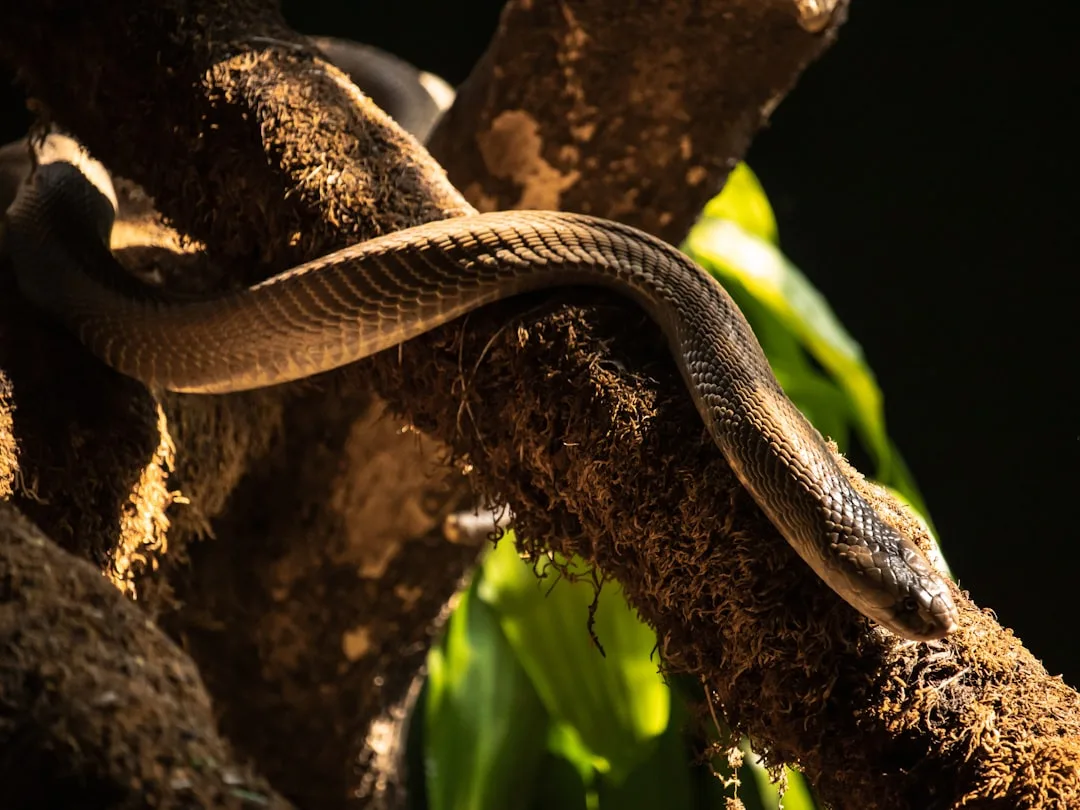
The king cobra is the longest venomous snake on Earth and one of the strangest predators in the reptile world. Despite its name, it is not a true cobra at all. Ophiophagus hannah belongs to its own genus, sister to the mambas, and specialises in a diet that would be suicidal for almost any other predator: it eats other snakes, including highly venomous ones.
It grows to four metres as a matter of routine and sometimes reaches nearly six. It can rear a third of its body upright and still advance toward a threat. It growls rather than hisses. And uniquely among snakes, it builds a nest and guards its eggs like a bird.
This guide covers every major aspect of king cobra biology: taxonomy, size, habitat, diet, venom chemistry, reproduction, intelligence, conservation, and the cultural weight the species carries across South and Southeast Asia. It is a reference entry, not a summary - so expect specifics: milligrams, metres, decibels, clutch sizes, and verified records.
Etymology and Classification
The scientific name Ophiophagus hannah was coined by Danish naturalist Theodore Edvard Cantor in 1836. The genus name Ophiophagus derives from Greek ophis (snake) and phagos (eater) - literally 'snake-eater'. The species epithet hannah honours the mythological tree-dwelling nymphs of Greek and Roman lore, a nod to the species' tendency to climb. In Hindi the king cobra is nagaraja, king of serpents; in Thai it is ngu jong ang; in Malay and Indonesian it is ular tedung selar.
Early taxonomists placed king cobras within the genus Naja alongside the common Asian cobras. Morphological and genetic analysis eventually demonstrated that king cobras are only distantly related to true cobras.
In 1945 they were permanently reassigned to the monotypic genus Ophiophagus, and molecular work since 2000 has shown that their nearest relatives are the mambas (Dendroaspis) of sub-Saharan Africa rather than any Asian elapid. The split between the king cobra lineage and mambas is estimated at roughly 20 million years ago.
A 2024 revision based on genome-wide data proposed splitting Ophiophagus hannah into four species along geographic lines: the Western Ghats lineage (O. kaalinga), the northern lineage (O. hannah), the Indo-Chinese lineage (O. bungarus), and the Sundaic lineage (O. salvatana). Whether these splits will be universally accepted is still debated, but the genetic divergence between the four groups is well established.
Size and Physical Description
The king cobra is the longest venomous snake alive today. No other front-fanged snake comes close.
Typical adult dimensions:
- Length: 3.0 to 4.0 metres
- Weight: 6 to 10 kilograms
- Head: distinctly broader than the neck, with large occipital scales behind the hood
- Fangs: short and fixed (proteroglyphous), 8 to 10 mm long
Record specimens:
- Longest verified: 5.85 metres (captured on the Malay Peninsula in 1937, transferred to London Zoo)
- Heaviest verified: 12.7 kilograms (a specimen held at the New York Zoological Park)
- Longest captive: a 5.54 m individual at the Bronx Zoo in the 1960s
Hatchlings:
- Length at emergence: 45 to 55 cm
- Colour: jet black with bright yellow or white crossbands, fading with age
- Venom: fully active from the first hour of life
Adult king cobras are olive-green, yellowish-brown, or nearly black depending on subspecies and region. Juveniles carry bold banded patterns that gradually fade as the animal matures. The belly is cream or pale yellow. The hood is narrower and more elongated than that of a true Naja cobra and lacks the distinctive spectacle or monocle markings seen on Indian and Chinese cobras. Two large occipital scales at the back of the head are diagnostic: no other elapid in the region has them.
The body is slender relative to total length, built for active hunting rather than ambush. Unlike pit vipers or pythons, king cobras are strong climbers and competent swimmers, and they can sustain locomotion for far longer than most other large snakes.
Range and Habitat
King cobras occupy one of the largest geographic ranges of any elapid. They are found from the foothills of the Himalayas through most of South and Southeast Asia.
Countries with confirmed populations:
- India (Western Ghats, Eastern Ghats, north-east India)
- Nepal and Bhutan (low-elevation forests)
- Bangladesh (Chittagong Hill Tracts and Sundarbans fringes)
- Myanmar, Thailand, Laos, Cambodia, Vietnam
- Southern China (Yunnan, Guangxi, Guangdong, Fujian, Hainan)
- Malaysia (peninsular and East Malaysia)
- The Philippines (Luzon, Mindanao, Mindoro, Palawan)
- Indonesia (Sumatra, Borneo, Java, Bali)
Preferred habitat types:
- Dense evergreen and deciduous tropical forest
- Mangrove swamps and estuarine forest edges
- Bamboo thickets
- Tea, rubber, and coffee plantations adjacent to forest
- Stream and river corridors within otherwise dry landscapes
King cobras need cover, water, and a dense prey base of other snakes. They avoid open agricultural land, urban areas, and dry scrub. Radio-telemetry studies in Agumbe, India, have recorded individual home ranges of 10 to 25 square kilometres, with adult males ranging further than females. The snakes are active by day (diurnal) in cooler months and shift toward crepuscular or nocturnal activity during hot summers.
Diet and Hunting
The king cobra is the most specialised ophidiophage among all snakes. The scientific name says it plainly: Ophiophagus means snake-eater, and snakes are what it eats.
Documented prey species:
- Rat snakes (Ptyas spp.) - the most common prey across much of the range
- Indian cobra (Naja naja)
- Monocled cobra (Naja kaouthia)
- Banded krait (Bungarus fasciatus)
- Reticulated python (Malayopython reticulatus) up to 3 m
- Keelbacks and water snakes (Natricidae)
- Vine snakes (Ahaetulla)
- Monitor lizards (occasionally)
- Small mammals and birds (rare, usually in captivity or during famine)
Snakes make up more than ninety per cent of recorded wild meals. The king cobra's venom is pharmacologically tuned to this diet. Standard elapid neurotoxins would be largely ineffective against other elapids, whose neuromuscular junctions are partly resistant. The king cobra's venom cocktail includes specialised three-finger toxins and ophiophagus cytotoxins that bypass those defences.
Hunting sequence:
- Long-range prey detection by scent, using the forked tongue and Jacobson's organ
- Visual confirmation once within a few metres - king cobras have unusually sharp eyesight for a snake, able to detect movement up to 100 metres away
- A fast forward strike that pins the prey snake mid-body
- Envenomation: the king cobra grips and chews, working its short fixed fangs deeper
- Prey is swallowed head-first once immobilised, typically within 10 to 30 minutes
A single large meal - a 2 m rat snake or a young python - can sustain a king cobra for several weeks. Captive specimens feed approximately once a month; wild activity budgets suggest a similar rate outside the breeding season.
Venom
King cobra venom is primarily a neurotoxic cocktail designed to shut down the neuromuscular system of prey. It differs significantly from the cytotoxic venoms of most true cobras.
Major components:
- Alpha-neurotoxins: block acetylcholine receptors post-synaptically, causing flaccid paralysis
- Cardiotoxins: damage myocardial tissue directly
- Ophiophagus-specific three-finger toxins: effective against snake prey
- Hyaluronidase and other spreading factors: speed tissue penetration
- Phospholipases A2: contribute to local tissue damage
Venom statistics:
| Metric | Value |
|---|---|
| Dry yield per bite | 380-600 mg |
| LD50 (mouse, subcutaneous) | ~1.93 mg/kg |
| Estimated lethal human dose | ~12 mg |
| Time to respiratory failure (human) | 30-45 minutes untreated |
| Peak yield (very large specimens) | Up to 7 ml liquid, ~1,000 mg dry |
The sheer quantity of venom a king cobra can inject is a larger factor in human lethality than the chemical potency per milligram. Several Indian cobras are more toxic on a milligram-for-milligram basis, but none deliver close to the 500 milligrams typical of a full king cobra bite. Documented envenomations of humans without antivenom show mortality rates above 50 per cent.
Despite this, king cobras are reluctant biters. Field studies estimate that roughly half of defensive strikes are dry bites - the snake closes its jaws without activating the venom gland, delivering a warning rather than a lethal dose. The animal appears to economise venom for hunting rather than defence, which takes energy and time to replace.
The Growl, the Hood, and the Threat Display
Most snakes hiss when threatened. King cobras growl. Acoustic recordings show a low-frequency vocal signature centred around 600 Hz - roughly an octave below the sounds produced by other snakes - with substantial energy extending below human hearing thresholds into the infrasonic range.
The growl is produced through enlarged diverticular pouches branching off the trachea that act as resonance chambers, amplifying and deepening the airflow. Handlers describe the sound as closer to the rumble of a large dog or a growling cat than to any reptilian hiss.
The full threat display is unmistakable.
Sequence of a king cobra threat display:
- The snake lifts the anterior third of its body vertically off the ground, reaching heights of 80 to 100 centimetres
- The long narrow hood flares, powered by elongated ribs beneath the neck
- The growl begins, often preceding any visible movement
- The snake tracks the target with its head while still able to move the rest of its body forward
- If the threat does not retreat, short feints and bluff strikes may follow
- Only after those fail does the snake deliver a bite, and many bites are dry
The ability to remain upright and mobile is unusual. Most cobras that rear up must anchor the rest of their body in place. A king cobra can continue to slide forward during the display, effectively walking on the lower two-thirds of its length while the upper third maintains eye contact at human head height.
Reproduction and the Snake That Builds a Nest
The king cobra is the only snake on Earth known to build a nest. This single behavioural trait sets the species apart from thousands of other serpents that simply drop eggs or give live birth.
Breeding timeline:
- March to April: males locate females by following pheromone trails
- Male combat: rival males engage in non-lethal wrestling matches, raising the front third of their bodies and pressing against each other until one submits
- Mating: lasts several hours and may be repeated over several days
- April to May: the female selects a forested site near water and begins gathering nest material
The female uses coils of her body to rake fallen leaves, twigs, bamboo litter, and forest debris into a double-layered mound roughly a metre across and half a metre high. The lower chamber holds the clutch; the upper chamber is where she rests, providing both physical protection and additional warmth from her body above the eggs.
Clutch and incubation:
- Eggs per clutch: 20-40
- Egg size: 50-54 mm long, 28-32 mm wide
- Incubation: 60-90 days, depending on ambient temperature
- Target incubation temperature: 28 degrees Celsius
The decomposing vegetation in the nest mound generates heat through microbial action, while the mother's presence provides further regulation. She aggressively defends the nest against any approaching animal - mongooses, monitor lizards, wild pigs, even elephants in credible historical accounts.
Shortly before the eggs hatch, the female leaves the nest. The timing is too consistent to be coincidence. Biologists believe she departs to avoid the strong instinct to consume other snakes; hatchling king cobras emerging from their eggs would almost certainly register as prey. The strategy works: most hatchlings make it out of the nest alive and disperse into surrounding forest within hours.
Hatchlings are between 45 and 55 cm long, boldly banded in black and yellow, and fully venomous. Their venom is proportionally as potent as an adult's and they are capable of delivering a medically significant bite from day one. Juvenile mortality nonetheless is high: predation by civets, mongooses, hornbills, monitor lizards, and adult king cobras themselves accounts for most losses during the first year.
Sexual maturity is reached at four to five years of age, at which point males average around 2.5 m and females slightly smaller.
Intelligence and Individual Recognition
Among herpetologists and experienced snake handlers, king cobras are widely considered the most intelligent snakes known. Evidence is partly anecdotal and partly experimental.
Observed cognitive behaviours:
- Individual recognition of human handlers in captivity
- Differentiated responses to regular staff versus strangers
- Demonstrated learning of feeding schedules and enclosure layouts
- Avoidance of previously encountered hazards
- Apparent curiosity - investigating novel objects in controlled settings rather than defaulting to avoidance
Studies at the Madras Crocodile Bank Trust have documented captive king cobras that consistently acted defensively toward new staff while remaining calm in the presence of their usual keeper. When the usual keeper was disguised or wore unusual clothing, the snakes often still responded as though recognising the individual - suggesting scent and subtle movement cues, not simply visual pattern recognition.
Wild king cobras display complex territorial behaviour, remembering specific hunting grounds, refuges, and routes between them across home ranges of 10 to 25 square kilometres. None of this is consistent with the old view of snakes as purely instinct-driven reflex machines.
Conservation Status and Threats
The IUCN Red List classifies the king cobra as Vulnerable with a decreasing population trend. Regional assessments vary; in parts of Vietnam and the Philippines, the species is now considered critically endangered.
Primary threats:
- Habitat loss. The most significant pressure across the entire range. Tropical forest conversion to palm oil, rubber, coffee, and tea plantations destroys both cover and the snake prey base on which king cobras depend.
- Snake-charmer trade. Illegal across most of India but persistent at village and tourist levels. Captured animals rarely survive long in captivity. Fangs are often crudely removed or mouths sewn shut.
- Skin trade. King cobra hide is used in leather goods, particularly in Southeast Asia. International trade is restricted under CITES Appendix II but enforcement is patchy.
- Road mortality. New forest roads penetrating previously remote areas create kill zones. Surveys in Karnataka recorded adult king cobras killed by vehicles within days of road completion.
- Fear-based killing. Villagers in several range states routinely kill king cobras on sight, despite the species' low propensity to bite humans.
- Climate change. Rising temperatures affect nest incubation success, and prolonged dry seasons reduce stream-side refuge habitat.
Conservation measures:
- India protects the species under Schedule II of the Wildlife Protection Act 1972, making killing a criminal offence.
- CITES Appendix II restricts international trade.
- Dedicated king cobra research and conservation projects operate in Agumbe (India), northern Thailand, and parts of Malaysia.
- Community rescue-and-release programmes in southern India have reduced retaliatory killings significantly since 2010.
No quantitative global population estimate is currently available. The species is cryptic, secretive, and occupies very large individual home ranges, making any census extremely difficult.
Global Distribution Summary
| Region | Status | Notes |
|---|---|---|
| Western Ghats, India | Vulnerable | Proposed as distinct species O. kaalinga |
| North and north-east India | Vulnerable | Largest known populations, Sundarbans fringes |
| Indo-China | Declining | Proposed as O. bungarus; Vietnamese populations critical |
| Southern China | Declining | Loss of bamboo and primary forest |
| Malay Peninsula | Vulnerable | Stable in protected forest reserves |
| Sundaic (Sumatra, Borneo, Java) | Declining | Proposed as O. salvatana; palm oil pressure |
| The Philippines | Declining | Habitat fragmentation on Luzon and Mindanao |
King Cobras and Humans
Few animals carry as much cultural weight across as many cultures as the king cobra. In Hindu mythology the cobra - specifically the nagaraja, king of serpents - is associated with Shiva, who wears one around his neck, and with Vishnu, who rests upon the multi-headed serpent Shesha. The Naga deities in Hindu and Buddhist traditions are frequently depicted with the hood of a king cobra.
In Thailand and Myanmar the species is revered and associated with guardian spirits. In Cambodia stone king cobras flank the entrances of Angkor-period temples.
Snake charming with king cobras remains a highly visible - and controversial - practice across India and parts of Southeast Asia despite being officially illegal in most range states. The charmers typically remove fangs or sew the snake's mouth, which shortens the animal's life dramatically. Conservation and animal-welfare organisations have been campaigning against the practice for decades with limited success in rural areas.
Medical consequences of king cobra envenomation remain serious. Unlike bites from smaller elapids, a king cobra bite delivers enough venom to overwhelm standard polyvalent antivenoms unless multiple vials are administered rapidly. Mortality without treatment exceeds 50 per cent in documented Indian and Thai cohorts. With prompt antivenom and mechanical ventilation, most patients survive, though residual neuromuscular weakness and local tissue damage are common.
Despite all of this, documented unprovoked king cobra attacks on humans are extremely rare relative to the species' range and prey abundance. The overwhelming majority of human encounters end with the snake retreating. Bites typically follow accidental contact, attempted handling, or nest defence.
Related Reading
- Cobras of the World: Hoods, Venom, and Myth
- How Snake Venom Evolved
- Black Mamba: Africa's Speed Specialist
- Reticulated Python: The World's Longest Snake
References
Relevant peer-reviewed and governmental sources consulted for this entry include IUCN Red List assessment for Ophiophagus hannah, molecular phylogenies published in Molecular Phylogenetics and Evolution (2021, 2024), behavioural studies from the Agumbe Rainforest Research Station, venomics work published in Journal of Proteomics and Toxicon, and nest-construction observations documented by the Centre for Herpetology and Madras Crocodile Bank Trust.
Record-length specimens are corroborated by accession records of the London Zoo (1937) and the New York Zoological Park. Cultural and ethnographic context draws on standard reference works on South and Southeast Asian religious iconography.
Frequently Asked Questions
How big is a king cobra?
Adult king cobras (Ophiophagus hannah) typically measure 3.0 to 4.0 metres in length and weigh 6 to 10 kilograms. Exceptional individuals exceed 5 metres. The record is a 5.85 m specimen captured in 1937 on the Malay Peninsula and sent to London Zoo, where it lived for several years. Males average longer and heavier than females. Hatchlings emerge from the egg at 45-55 cm, already carrying fully developed fangs and venom.
For comparison, the king cobra is longer than any other venomous snake on Earth - black mambas top out near 3 m and inland taipans rarely exceed 2.5 m.
What do king cobras eat?
King cobras are ophiophagous, meaning they eat other snakes almost exclusively. The Latin genus name Ophiophagus translates literally as ‘snake-eater’. Their diet includes rat snakes, Indian cobras (Naja naja), banded kraits, pythons up to three metres long, and keelbacks. They occasionally take monitor lizards and small mammals, but snakes make up well over ninety per cent of recorded prey.
Their venom is specialised to overwhelm the neurotoxin-resistant tissues of other elapids, which is why they can prey on species whose venom would kill most other predators. After a large meal a king cobra may not feed again for weeks or even months.
Where do king cobras live?
King cobras occur across South and Southeast Asia, from the foothills of the Himalayas and the Western Ghats of India through Bangladesh, Bhutan, Myanmar, Thailand, Laos, Cambodia, Vietnam, southern China, Malaysia, the Philippines, and the Indonesian islands of Sumatra, Borneo, and Java.
They prefer dense tropical forests, bamboo thickets, mangrove swamps, and tea or rubber plantations where small streams provide cool refuges and prey snakes are plentiful. Unlike many cobras they avoid cities and dry open country. Recent genetic work suggests that what was treated as a single species may actually represent four distinct lineages, with the Western Ghats, northern, Indo-Chinese, and Sundaic populations showing significant divergence.
How dangerous is king cobra venom?
A king cobra delivers between 380 and 600 milligrams of dry venom per bite - several times the lethal human dose. The venom is primarily neurotoxic, composed of post-synaptic alpha-neurotoxins that block acetylcholine receptors at the neuromuscular junction, along with cardiotoxins that damage heart tissue.
A fully envenomated human bite can cause respiratory paralysis within 30 minutes and is frequently fatal without prompt antivenom and mechanical ventilation. Documented cases include king cobras killing adult Asian elephants through bites to the trunk or toe web. Despite this potency, king cobras rarely bite humans. Most encounters end with the snake retreating.
When bites do occur, roughly half are dry bites that deliver little or no venom, likely because the snake wishes to conserve it for prey.
Do king cobras really build nests?
Yes. The king cobra is the only snake species in the world known to construct a nest. Between March and May, a gravid female uses coils of her body to gather fallen leaves, twigs, and forest debris into a double-layer mound roughly a metre across. She lays 20 to 40 eggs in the lower chamber and rests in the upper chamber above them.
Her body heat and the decomposition of the leaves maintain incubation temperatures around 28 degrees Celsius for 60 to 90 days. She aggressively defends the nest, striking at animals that approach - including elephants in some documented cases. Shortly before the eggs hatch the female leaves, likely to prevent the instinctive predation of the newly emerged young.
Is the king cobra endangered?
The IUCN Red List classifies the king cobra as Vulnerable with a decreasing population trend. Habitat loss from deforestation, plantation conversion, and road construction is the primary threat. Secondary threats include collection for the snake-charmer trade (illegal but persistent across the Indian subcontinent), the skin trade, killing out of fear, and traffic mortality on new forest-edge roads.
Climate change is shifting the range in some areas and drying out streamside habitats. Population estimates are difficult because king cobras are secretive and occupy vast territories, but several range states - Vietnam and the Philippines in particular - report sharp local declines. India protects the species under Schedule II of the Wildlife Protection Act 1972.
How does a king cobra produce its growl?
The king cobra’s warning sound is not the sharp hiss produced by most snakes. Acoustic analysis shows it is a low-frequency growl centred around 600 Hz, with significant energy dropping below human hearing thresholds. The sound is produced through specialised diverticular pouches branching off the trachea that act as resonance chambers. The result is described by handlers as closer to the rumble of a large dog than to a reptilian hiss.
No other snake species produces anything comparable, and the growl appears to serve as a long-range warning that can reach other animals - and humans - before a visual threat display is needed.
Can a king cobra really kill an elephant?
Yes, in rare and specific circumstances. There are credible historical reports from India and Myanmar of elephants dying within a few hours of a king cobra bite, typically delivered to a soft, well-vascularised area such as the tip of the trunk, the inside of the ear, or the toe web between the toenails. A bite to thick, tough hide usually fails to inject venom effectively.
The lethality comes from sheer volume: a single defensive bite may deliver close to 600 mg of venom, several times what is needed to disable respiratory muscles in even a very large mammal. For context, a single drop of dry king cobra venom contains enough neurotoxin to kill roughly twenty adult humans without treatment.