
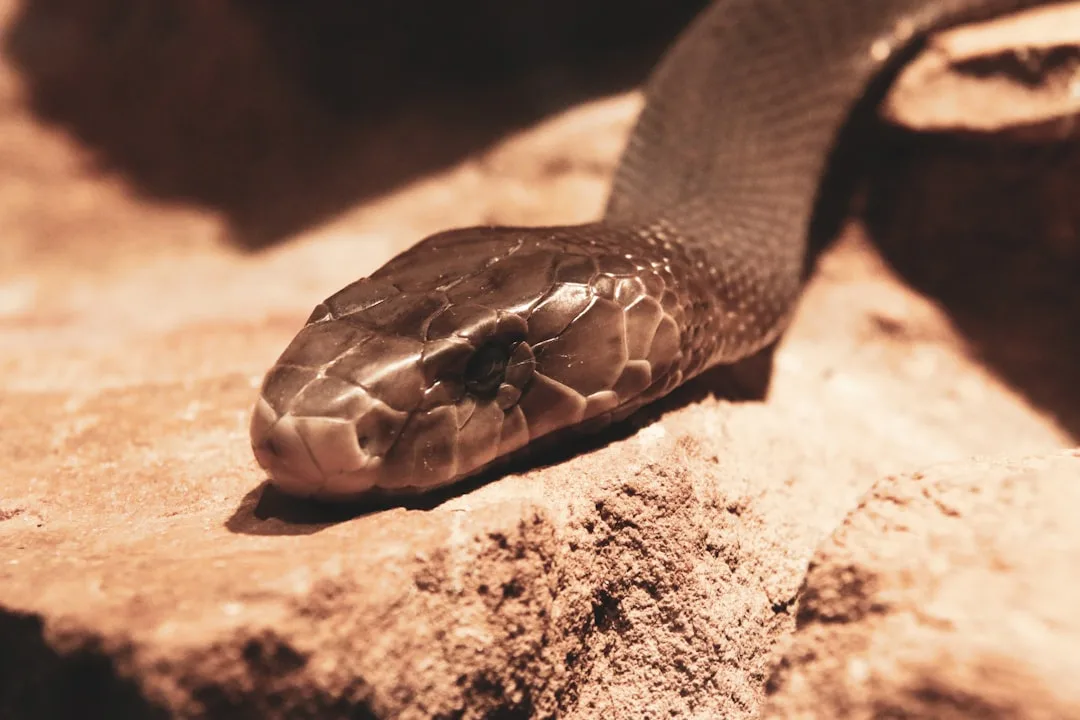
The black mamba is the most feared snake in Africa, and with good reason. It is the longest venomous snake on the continent, the fastest-moving snake on land anywhere in the world, carries one of the most potent cocktails of neurotoxins and cardiotoxins in the animal kingdom, and delivers enough venom in a single full bite to kill an adult human roughly twenty times over.
Before effective antivenom reached rural clinics, a confirmed black mamba envenomation was essentially a death sentence. The species has no close competitor for its particular combination of size, speed, reach, and chemical firepower.
This guide is a reference entry, not a summary. It covers black mamba biology and ecology in detail: taxonomy, size, colouration, speed, venom chemistry, hunting behaviour, reproduction, habitat, conservation, and the relationship between mambas and the human communities that share their range. Expect specifics - millimetres, milligrams, minutes, and documented records rather than legend.
Etymology and Classification
The scientific name Dendroaspis polylepis comes from the Greek dendron (tree) and aspis (snake or shield, often used for elapids), plus polylepis meaning "many scaled". The genus Dendroaspis contains four recognised species - the black mamba plus three mostly green, smaller tree mambas - all confined to sub-Saharan Africa.
The common name "black mamba" is a famous misnomer. The body is not black. Typical colour ranges from olive-green to slate grey, gunmetal brown, or dull khaki, with a paler cream or greyish underside. The inside of the mouth, however, is an intense ink-black lined with a matte non-reflective surface. When threatened, the snake gapes its jaws wide to expose this dark cavity as a warning.
European naturalists in the nineteenth century noticed the behaviour and the name stuck. The Zulu name imamba emnyama and the Swahili mamba mweusi both translate as "black mamba" and reflect the same observation.
In parts of East Africa the snake is also known by names meaning "seven-step snake" - a folk reference to the belief that victims can only walk seven steps before dying, which is folklore rather than fact but captures the speed of envenomation.
The black mamba is a member of the family Elapidae - the same family as cobras, kraits, coral snakes, sea snakes, and the Australian taipans. Elapids share fixed front fangs that cannot fold back, relatively slender bodies compared to vipers, and predominantly neurotoxic venoms. Within the family the mambas are among the most specialised for active diurnal hunting.
Size and Physical Description
The black mamba is the longest venomous snake in Africa and the second longest in the world after the king cobra. Adults typically measure 2.0 to 3.0 metres from snout to tail, with many individuals exceeding 3 metres in prime habitat. The longest reliably measured specimen was 4.5 metres, a figure verified under controlled conditions and now cited as the upper anatomical limit for the species.
Size at a glance:
- Typical adult length: 2.0-3.0 m
- Large adult length: 3.0-3.5 m
- Maximum recorded length: 4.5 m
- Typical adult weight: 1.6-2.0 kg
- Hatchling length: 40-60 cm
The species is slender for its length. A 3-metre black mamba weighs less than a mid-sized domestic cat. This build reflects lifestyle - the mamba kills with venom rather than constriction, and slim bodies are better suited to rapid movement across open ground and through tree branches.
The head is coffin-shaped, distinct from the narrow neck, with large dark eyes and round pupils that suit its diurnal habits. The tail is long and tapered, accounting for roughly a quarter of total body length in adults.
Scalation gives the species its name. Polylepis means "many-scaled", and the black mamba has numerous small smooth dorsal scales arranged in 23 to 25 rows at midbody. The ventral scales are broad, as in most fast-moving terrestrial snakes. Juveniles are noticeably lighter in colour than adults, sometimes almost silver, and darken over the first two to three years of life. Some adults develop a nearly charcoal dorsal sheen that probably fuels the black-body misconception.
Speed and Movement
The black mamba is the fastest-moving snake on land. Controlled trials and field measurements place its top speed at approximately 20 km/h over short distances on flat ground. For comparison, a fit human sprinter runs around 24 km/h only briefly, and an average jogger moves at about 9 km/h. The mamba is therefore comfortably faster than a brisk jog and competitive with a casual sprint.
Several anatomical features contribute. The body is slim and light. The ventral scales are broad and provide strong grip on uneven surfaces. The muscle fibres along the spine are oriented for rapid wave propagation, and the animal can hold its head and neck elevated while the rest of the body flows forward. The result is a running gait that looks almost flowing rather than coiled.
Maximum speed is used for escape rather than pursuit. Black mambas do not chase humans despite numerous folk stories. When startled, an adult mamba moves as quickly as possible toward the nearest familiar refuge - usually a termite mound, rock crevice, or hollow tree it has used for years.
A person standing between the snake and its burrow is in genuine danger, but through coincidence rather than malice. Studies of mamba encounters in South African farmland repeatedly show that given space, the snake flees.
On rougher terrain the mamba slows substantially. Most foraging movement is much gentler than the escape sprint. Typical cruising speeds during active hunting are 5 to 10 km/h, with the snake pausing frequently to investigate scent trails and visual cues.
Venom Chemistry and Effects
Black mamba venom is one of the most rapid-acting and lethal snake venoms known. It is a mixture of several protein families, dominated by two classes of neurotoxin and a set of cardiotoxins.
Primary venom components:
- Dendrotoxins. Small proteins unique to mambas that block voltage-gated potassium channels in nerve cells, causing uncontrolled neurotransmitter release. The result is hyperexcitability of nerves followed by exhaustion and failure.
- Alpha-neurotoxins. Bind tightly to acetylcholine receptors at the neuromuscular junction, blocking nerve signals from reaching muscle fibres. This causes the characteristic descending paralysis - drooping eyelids first, then slurred speech, difficulty swallowing, diaphragm failure, and respiratory arrest.
- Fasciculins. Inhibit acetylcholinesterase, compounding neuromuscular chaos.
- Cardiotoxins. Damage cardiac muscle directly and contribute to the collapse of cardiovascular function in severe envenomations.
A single full bite delivers approximately 100 to 400 mg of venom measured as dry weight. The estimated lethal dose for an adult human is 10 to 15 mg. Even a partial bite therefore carries roughly ten times the amount needed to kill.
Typical progression of untreated envenomation:
| Time after bite | Typical symptoms |
|---|---|
| 0-10 minutes | Metallic taste, local tingling, drowsiness, drooping eyelids |
| 10-30 minutes | Slurred speech, difficulty swallowing, weakness in limbs |
| 30-90 minutes | Ataxia, diaphragm weakness, laboured breathing, irregular heart rhythm |
| 1-3 hours | Respiratory arrest, cardiovascular collapse, death in rapid cases |
| 7-15 hours | Death in slower cases depending on bite site and dose |
Before antivenom reached rural Africa, the untreated mortality rate for confirmed black mamba bites was effectively 100 per cent. Modern polyvalent antivenom manufactured in South Africa has transformed outcomes when administered in hospital settings with full airway support, but treatment requires large doses (commonly 8 to 20 vials) and the cost and logistics remain a major public health challenge in the region.
A single defensive encounter can involve up to twelve rapid successive strikes, each injecting a full venom load. The mamba does not need to deliver a second bite to kill; it simply can, and this multi-strike behaviour is one reason the species is so feared by snake handlers.
Threat Display and Defensive Posture
When cornered or surprised at close range the black mamba adopts one of the most unmistakable threat postures in the snake world.
The full display includes:
- Raising up to one third of its body off the ground - a 3 m snake can lift its head a full metre to eye level with a standing adult.
- Spreading a narrow neck hood, less pronounced than a cobra's but clearly visible from the front.
- Gaping the jaws to expose the ink-black lining of the mouth.
- Emitting a prolonged dry hiss.
- Striking repeatedly, often up to a dozen times, with a lunge that can extend around 40 per cent of body length.
Few natural predators encountering this display will press the attack. Mongooses, honey badgers, and certain raptors occasionally kill mambas, but cost-benefit usually favours retreat. The display is honest - the venom delivery is fully capable of matching the theatre.
Hunting and Diet
Black mambas are active diurnal hunters. Unlike ambush vipers they patrol through their home range by day, using speed, excellent vision, and chemical cues via the flicking tongue to locate prey.
Typical prey:
- Rock hyrax (dassie) - a favoured staple in southern Africa
- Bushbabies (galagos) - taken at dusk or from daytime roosts
- Rodents - rats, mice, multimammate mice
- Squirrels and tree shrews
- Nestling and adult birds
- Occasional bats taken from roosts
- Juveniles also take lizards and small snakes
Mambas are opportunistic. A large adult will eat anything warm-blooded of suitable size that it can overpower. Prey is bitten once or twice, then released; the venom is fast enough that the snake rarely needs to restrain its meal. The mamba then tracks by scent. A successful hunt of a hyrax or large rodent can sustain an adult for one to three weeks.
Active hunting involves considerable movement through the home range. Mambas regularly climb into trees and tall bushes after birds, and excellent arboreal ability is one of the species' less-advertised features. They are among the few large elapids that are equally comfortable on the ground and in the canopy.
Habitat and Range
The black mamba inhabits sub-Saharan Africa from around Senegal and Ethiopia in the north down to northern KwaZulu-Natal in South Africa. The species is most common across eastern and southern Africa and reaches highest density in savanna and mixed woodland habitat.
Preferred habitats:
- Savanna grassland with scattered trees
- Mixed open woodland
- Rocky hills, kopjes, and outcrops
- Dry riverine forest edges
- Semi-arid scrub
- Agricultural mosaic with bush cover
The species avoids closed-canopy rainforest and true desert. It tolerates moderate human land use and is regularly encountered around farmsteads, sugarcane fields, thatch roofs, and village outskirts. Adult mambas usually establish a permanent refuge - most often a termite mound, hollow tree, or rock cleft - and return to it daily across years. Researchers tracking radio-tagged adults in South Africa have documented individuals using the same burrow continuously for more than a decade.
Home ranges are modest. Adult males in South African studies occupy roughly 20 to 60 hectares, with considerable overlap between neighbours. Density estimates are hard to produce reliably because of the species' cryptic habits, but suitable habitat can support one to several adult snakes per square kilometre.
Reproduction and Life Cycle
Black mambas reproduce seasonally. Mating takes place in early spring (September to October in southern Africa). Males engage in ritual combat for access to females, rising up and attempting to pin each other's heads to the ground. Combat is non-venomous - males do not bite one another - and the loser departs without injury.
Reproductive cycle:
- Spring (Sep-Oct): courtship and mating
- Early summer (Nov-Dec): female deposits 6-17 eggs in a hollow log, termite mound, or burrow
- Late summer (Feb-Mar): hatchlings emerge at 40-60 cm in length
- First year: rapid growth, high mortality, switch from lizard prey to small mammals
- Years 2-3: approach adult size, begin breeding
Unlike many large snakes the female does not guard the eggs beyond site selection. Hatchlings are fully equipped from emergence - fully formed venom glands, functional fangs, coordinated strikes, and a toxin load already potent enough to kill a small mammal. Juvenile mortality is nonetheless high, with most losses to raptors, mongooses, monitor lizards, and other snakes.
Wild adults typically live around 11 years according to field estimates. Captive specimens with veterinary care and reliable feeding have exceeded 20 years.
Natural Predators
Despite the fearsome reputation, adult black mambas do face predators. The most frequent are:
- Mongooses. Several species, including the yellow mongoose, are fast and agile enough to kill mambas with care. They also carry partial venom resistance.
- Honey badgers. Powerful jaws, loose skin, and high venom tolerance make the badger a rare but capable mamba predator.
- Snake-eating raptors. Secretarybirds, martial eagles, and brown snake eagles take mambas, usually attacking from above before the snake can rear.
- Other snakes. File snakes and young adult mambas occasionally fall to larger serpents.
Hatchlings and juveniles face much longer predator lists including monitor lizards, owls, and domestic poultry.
Conservation Status and Threats
The IUCN classifies the black mamba as Least Concern with a stable population trend. The species occupies a very large continental range, tolerates habitat modification, and remains common in suitable landscapes across sub-Saharan Africa.
Local pressures exist. Killing on sight is widespread in farming communities where fear and real bite risk combine. Habitat conversion to intensive agriculture reduces available prey and refuges in some regions. Collection for the skin trade occurs locally, and venom extraction for antivenom production places sustained demand on captive stocks.
None of these pressures currently reach the intensity needed to threaten the species continentally, but locally significant declines do occur and are poorly monitored.
The black mamba contributes to human antivenom supplies in a meaningful way. Venom milked from captive specimens at facilities such as the South African Vaccine Producers in Johannesburg is the raw material for the polyvalent antivenom used across the region. This gives the species a quiet economic value that supports conservation arguments against indiscriminate killing.
Black Mambas and Humans
The black mamba is responsible for a non-trivial share of serious snake bites in eastern and southern Africa, although the exact proportion is difficult to pin down because hospital records often class bites generically. Puff adders kill more people in absolute numbers because they are more common and more often stepped on, but the black mamba carries a reputation out of proportion to its bite frequency because of the speed and severity of envenomations.
Practical risk factors in rural Africa:
- Thatched roofs that mambas climb to hunt rodents
- Woodpiles and termite mounds near homes
- Sugarcane harvesting, which disturbs refuge sites
- Walking in savanna at mamba-active temperatures
- Night-time toilet trips past mamba refuges
Prevention is mostly mundane: clear bush near dwellings, store firewood away from walls, wear boots, carry a torch at night, and never attempt to kill a mamba without professional training. Professional snake removers relocate many hundreds of mambas per year from South African suburbs alone without casualties.
Culturally the black mamba features heavily in African folklore and modern media. It carries spiritual weight in parts of southern Africa, sometimes associated with ancestors and occasionally with witchcraft. In modern popular culture it has become shorthand for lethal speed and precision, inspiring nicknames for athletes, assassins in fiction, and a long list of film references.
None of this changes the underlying biology, but it helps explain why the species commands more attention in public imagination than its population size alone would justify.
Related Reading
- King Cobra: The Longest Venomous Snake on Earth
- Largest Snake in the World
- Snakes: The Most Feared and Misunderstood Reptiles
References
Relevant peer-reviewed and governmental sources consulted for this entry include the IUCN Red List assessment for Dendroaspis polylepis, the African Snakebite Institute field data and bite statistics, clinical reviews published in Toxicon and Clinical Toxicology, and venom composition studies in the Journal of Proteomics.
Population and bite-rate figures reflect the most recent consolidated estimates available as of current assessments, with rural clinical data drawn from South African, Kenyan, and Eswatini hospital records.
Frequently Asked Questions
How big is a black mamba?
Adult black mambas (Dendroaspis polylepis) typically measure 2.0 to 3.0 metres from snout to tail. Large adults routinely exceed 3 metres, and the longest reliably measured specimen reached 4.5 metres, making the species the longest venomous snake in Africa and the second longest in the world after the king cobra.
Body mass is modest for the length - most adults weigh only 1.6 to 2.0 kg - because the snake is slender and built for speed rather than constriction. Hatchlings emerge at 40 to 60 cm and grow rapidly in their first two years.
Why is it called black when it isn't black?
The common name refers to the inside of the mouth, not the body. A black mamba’s dorsal colour ranges from olive-green to grey, gunmetal brown, or khaki, with a paler cream or grey belly. Juveniles are often lighter, sometimes almost silver.
When threatened the snake gapes its jaws to expose the lining of the mouth, which is a deep, almost ink-black - a visual warning signal that European naturalists noticed in the nineteenth century and which became the basis for the species name. No other large African snake shares this specific display, so a confirmed glimpse of the black mouth is diagnostic.
How fast can a black mamba actually move?
The black mamba is the fastest-moving snake on land. Short-distance field measurements and controlled trials put its top speed at approximately 20 km/h - around 5.5 metres per second - on flat open ground. This is quicker than most humans can sprint and comfortably faster than a brisk jog. The snake cannot sustain top speed for long, however. Maximum velocity is reserved for escape, not pursuit.
Black mambas do not chase people, despite popular stories to the contrary. When startled they move at speed toward the nearest familiar refuge, usually a termite mound or rock crevice, and any human standing between snake and refuge is at risk by coincidence rather than intent.
How venomous is a black mamba bite?
Extremely. The venom is a mixture of potent neurotoxins (primarily dendrotoxins and alpha-neurotoxins) and cardiotoxins. A single full bite delivers 100 to 400 mg of venom, while the estimated lethal dose for an adult human is 10 to 15 mg. Without antivenom, confirmed envenomations were historically almost uniformly fatal.
Symptoms begin within minutes - metallic taste, local swelling, drooping eyelids, slurred speech - and progress to respiratory paralysis and cardiac collapse over 30 minutes to several hours. Modern polyvalent antivenom produced in South Africa has transformed survival rates in hospitals with stocks on hand, but rural clinics far from supply chains still see deaths.
Treatment requires large doses (often 8 to 20 vials) administered intravenously with full airway support.
Where do black mambas live?
Black mambas inhabit sub-Saharan Africa, with strongholds across eastern and southern regions including South Africa, Eswatini, Mozambique, Zimbabwe, Zambia, Malawi, Tanzania, Kenya, Uganda, Ethiopia, Somalia, Botswana, Namibia, and into parts of central Africa. They prefer savanna, open woodland, rocky hills, riverine forest edges, and semi-arid scrub. Unlike many snakes they avoid closed rainforest.
Individual adults typically maintain a long-term home burrow - a termite mound, hollow tree, or rock cleft - and return to it daily. The species tolerates some human modification of landscapes and is regularly encountered on farmland and village outskirts, which accounts for most bite incidents.
What do black mambas eat?
Black mambas are opportunistic carnivores that feed mainly on small warm-blooded prey. Typical diet includes dassies (rock hyrax), bushbabies, rodents, squirrels, and birds taken from nests. Larger adults will eat hares and young dik-dik when the opportunity arises. Juveniles also take lizards and the occasional small snake. The mamba hunts actively during the day, using speed, excellent vision, and its long reach rather than ambush.
Once a prey animal is bitten the snake usually releases it and tracks by scent, since the venom acts quickly enough that pursuit is rarely needed. A single adult meal of a hyrax or large rodent can sustain a mamba for one to three weeks.
Are black mambas aggressive?
Black mambas have a strong reputation for aggression but the reality is more nuanced. The snake is genuinely defensive rather than offensive. When cornered or surprised at close range it will rear up to a third of its body length, spread a narrow neck hood, gape its black mouth, hiss, and deliver multiple rapid strikes - sometimes twelve or more in quick succession, each with a full venom dose.
This display is one of the most intimidating threat postures in the snake world and accounts for most of the species’ fearsome reputation. Given space, however, the black mamba prefers to flee to cover. The majority of serious incidents occur when people accidentally block the snake’s retreat route or attempt to kill it at close range.
Is the black mamba endangered?
The IUCN lists the black mamba as Least Concern. The species has a very wide African range, tolerates a variety of habitats including human-modified landscapes, and shows no evidence of population-level decline. Local threats include killing on sight in villages and farmland, habitat conversion in some regions, and collection for the skin trade, but none of these currently reach the intensity needed to threaten the species continentally.
Venom from captive specimens is also used commercially to produce antivenom, which has conservation implications both positive (value to humans) and negative (collection pressure on wild stocks where regulation is weak).