
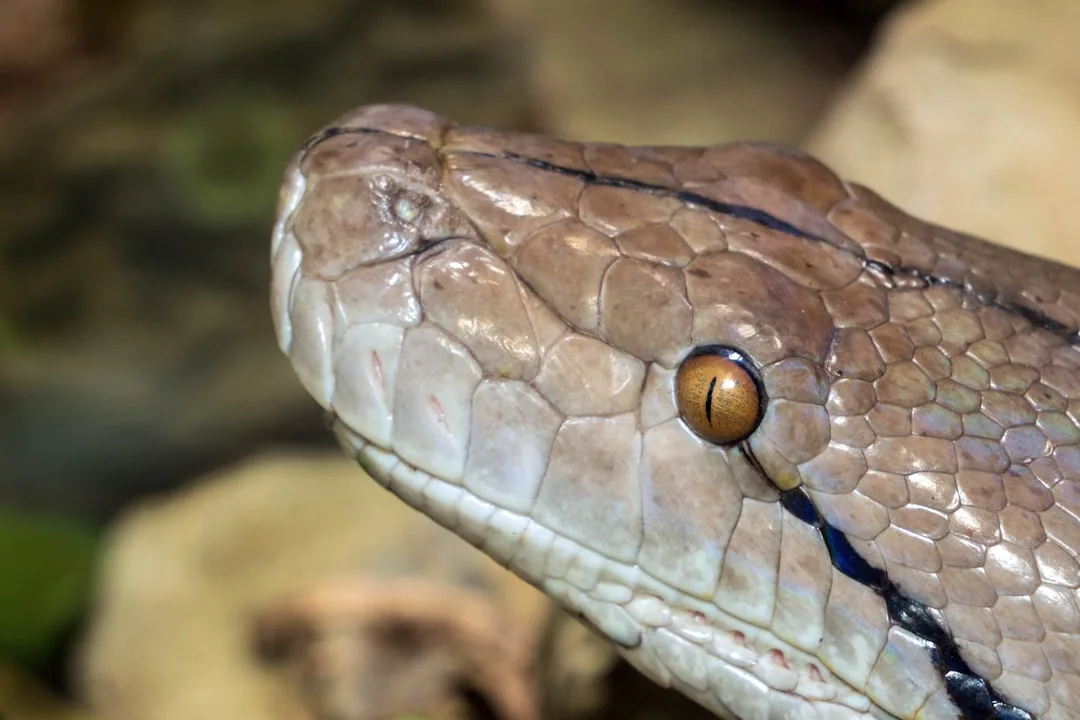
The reticulated python is the longest snake in the world. Verified museum specimens reach 9.6 metres, and captive individuals above 7 metres are routinely documented in zoos and wildlife collections. Malayopython reticulatus is a non-venomous constrictor native to Southeast Asia, where it occupies everything from primary rainforest and river floodplains to the drainage systems of capital cities.
It is one of only a handful of snakes ever confirmed to have killed and swallowed an adult human, a distinction reinforced by two well-documented fatal cases in Indonesia during 2017 and 2018.
This guide covers every aspect of reticulated python biology and ecology: size and measurement, distribution, habitat, hunting behaviour, diet, reproduction and shiver-incubation, movement and swimming, conservation status, human conflict, and the commercial skin trade. It is a reference entry, not a summary - so expect specifics: metres, kilograms, dates, case numbers, and verified records.
Etymology and Classification
The scientific name Malayopython reticulatus combines a geographic prefix, referring to the Malay region, with the Latin word reticulatus, meaning 'net-like'. The species name describes the complex geometric pattern of diamonds, zigzags, and irregular blotches that covers the body and breaks up the snake's outline against the dappled floor of tropical forests.
Local names vary across the enormous range - sawa in Indonesian and Malay, ngu lueam in Thai, hebi in several Japanese-influenced dialects of the Philippines, and athi or python reticule in older European literature.
For most of the twentieth century the species was classified as Python reticulatus. In 2008 a molecular phylogenetic study separated the reticulated python and the Timor python into a distinct genus, Malayopython, based on genetic divergence from the African and Asian pythons remaining in Python.
The species retains three recognised subspecies: M. r. reticulatus across mainland Southeast Asia and most of Indonesia, M. r. jampeanus on Tanahjampea, and M. r. saputrai on Selayar and adjacent small islands in the Flores Sea. Dwarf island forms on some smaller Indonesian islands rarely exceed 2 metres as adults.
Size and Measurement
Reticulated pythons are the longest snakes alive today. Any discussion of their size has to distinguish between reliable measurements and the long history of exaggerated reports that accompany nearly every large snake.
Typical adult size:
- Females: 4.0-6.0 m, occasionally to 7 m or more
- Males: 2.5-4.0 m
- Weight of average adult female: 75-160 kg
- Weight of average adult male: 20-50 kg
Verified records:
- Longest confirmed specimen: 9.6 m, killed in Sulawesi in 1912 and measured from intact skin
- Longest specimen alive: "Medusa", 7.67 m in 2011, Missouri, USA (Guinness)
- Heaviest credible wild individual: approximately 160 kg
Reports of snakes exceeding 10 metres have circulated for more than a century, ranging from the supposed Bornean pythons of early colonial accounts to a modern bounty offered by the New York Zoological Society for any 30-foot (9.14 m) specimen delivered live - a prize that has never been claimed. Rigorous measurement of a live python is surprisingly difficult.
A living snake is flexible enough to contract along its spine; stretching it artificially adds several per cent to any measurement; even a freshly killed specimen changes length depending on whether it is measured tight, relaxed, or skinned. The 9.6 m Sulawesi specimen remains the gold standard because the skin was measured flat under controlled museum conditions.
By contrast, the green anaconda of South America is the heaviest snake on Earth. A 5 m anaconda can weigh more than a 7 m reticulated python. The reticulated python is longer; the anaconda is thicker and more massive. Extinct giants such as Titanoboa cerrejonensis from Paleocene Colombia exceeded 12 m and 1,000 kg, dwarfing both species.
Appearance
The reticulated python's pattern is one of the most recognisable in the snake world. A complex lattice of dark diamonds and chevrons covers a base colour ranging from olive green and yellow through tan, grey, and near-black. The patterning is not decorative. Against a forest floor littered with fallen leaves and broken light the animal is almost invisible.
Observers at close range repeatedly report losing sight of large pythons that have not moved. Juveniles hatch with a brighter, higher-contrast pattern that fades and muddies with age.
The head is long, heat-pit-fringed, and rectangular in outline, distinct from the body by a narrow neck. Two black stripes run from the top of the head down each side and through the eye. The belly is plain cream or yellow. Males and females are externally similar apart from size, although males retain small pelvic spurs - vestigial hind limb remnants - used during courtship.
Heat-Pit Senses and Ambush Behaviour
Like other pythons, the reticulated python has a row of heat-sensitive pits along both lips. These pits detect infrared radiation at wavelengths invisible to the human eye. The sensory array is sensitive enough to register temperature differences of a few thousandths of a degree Celsius at short range, allowing the snake to target warm-blooded prey in total darkness or through thick vegetation.
Behaviourally the species is primarily nocturnal. During daylight hours pythons rest in hollows, burrows, tree cavities, water, or dense vegetation. After dusk they move out along game trails, waterways, and the edges of clearings. Hunting is almost entirely by ambush. A python will position itself on a trail used by rodents, wild pigs, or deer and wait motionless for hours. The heat-pit array provides the trigger for a strike regardless of visibility.
Strike, bite, and coil take roughly a tenth of a second in sequence. The teeth lock the prey in place while the body throws coils around the torso. Constriction follows immediately. Modern instrumentation studies on prey show that circulatory collapse, not suffocation, causes death - the coils exert pressure well above mammalian systolic blood pressure within seconds, and cardiac arrest follows within a minute or two for small prey. Larger prey may take several minutes.
Diet and Hunting
Reticulated pythons are generalist predators of almost any warm-blooded animal they can subdue. The documented prey list is long and varied.
Common prey:
- Rats and other rodents
- Palm civets, binturongs, and other viverrids
- Monkeys, especially macaques
- Monitor lizards (medium and large)
- Wild pigs, piglets and adults
- Small and medium deer including muntjac and juvenile sambar
- Porcupines (digested despite quills)
- Domestic dogs, cats, goats, chickens
- Large birds and their eggs
Exceptional prey records:
- Adult sun bear (approximately 23 kg), documented in Malaysia
- Adult leopard, reported in Indonesia, body recovered inside python
- Adult wild pig approaching 60 kg
- Adult humans, documented twice in Indonesia (see below)
A large reticulated python can swallow prey weighing up to and occasionally exceeding its own body mass. Ingestion of prey wider than the snake's head is made possible by the elastic ligaments connecting the mandibles to the skull and by the mobile quadrate bone at the rear of the skull. The jaws do not dislocate - a common but inaccurate description - they simply separate and rotate around flexible joints.
After a large meal a reticulated python may rest in cover for a week or more while digestion proceeds. Metabolic rate surges during digestion, the digestive tract temporarily regrows, and the heart enlarges. Between large meals the snake may go months without eating.
Documented Human Fatalities
Attacks on humans by wild snakes that end in predation are extremely rare, and for centuries most reported cases were either unverifiable or second-hand. The reticulated python is one of only two or three species with modern, well-documented cases of swallowing adult human beings.
Case 1 - March 2017, Sulawesi, Indonesia. A 25-year-old farmer named Akbar Salubiro disappeared from his palm plantation on the evening of 26 March 2017. Villagers searching the following day found a 7-metre reticulated python with a distended body near the plantation. The snake was killed and cut open; Salubiro's body was recovered intact. The case was widely reported internationally with photographic and video documentation.
Case 2 - June 2018, Sulawesi, Indonesia. A 54-year-old woman named Wa Tiba disappeared from her vegetable garden in Muna, Southeast Sulawesi, on 14 June 2018. Searchers found a 7-metre python in the garden the following morning. The snake was killed and opened, and Wa Tiba's body was recovered.
Both cases followed a similar pattern: solitary work in a garden near forest edge at dusk or night, a prey-sized adult woman or man, and an unusually large python in an area where natural prey may have been depleted.
Older twentieth-century accounts from the Malay peninsula, Sumatra, and the Philippines describe similar incidents, but few are supported by the photographic, forensic, or journalistic evidence available for the Sulawesi cases. Zoologists and epidemiologists treat the 2017 and 2018 fatalities as verified, and regard any risk calculation as dependent on rural proximity to water, night-time solitary work, and the size distribution of local pythons.
Reproduction and Shiver-Incubation
Reticulated pythons are oviparous. Mating takes place during cooler months and varies with latitude - from December to March in the north of the range, more diffusely elsewhere. Males locate receptive females by following pheromone trails and compete for access by wrestling rather than biting. Pelvic spurs are used during courtship to stroke the female.
A large female lays between 15 and 80 eggs in a single clutch, typically 30 to 60 in wild populations. Eggs are deposited in a concealed chamber: hollow logs, rodent burrows, abandoned termite mounds, or dense vegetation. The female then coils around the clutch in a pyramid shape and remains there for the entire incubation period, roughly 88 days on average.
Shiver-incubation:
During incubation the brooding female rhythmically contracts her body muscles, producing heat through physiological work. The behaviour is called shiver-thermogenesis and raises egg temperature several degrees above ambient, even in cooler conditions. It is one of the few well-documented cases of endothermic heat production in a reptile. The female does not eat during the roughly three months she guards the clutch. By the time the eggs hatch she has lost significant body mass.
Hatchlings emerge 60 to 75 centimetres long, fully independent, and disperse within hours of leaving the shell. Mortality in the first year is high - monitor lizards, birds of prey, pigs, crocodiles, and larger snakes all take neonate pythons. A hatchling that survives its first year rapidly becomes too large for most predators. Sexual maturity arrives at three to four years of age for females and slightly earlier for males.
Movement, Swimming, and Island Colonisation
Reticulated pythons are strong overland travellers and exceptional swimmers. The species has colonised a remarkable number of offshore islands across Indonesia and the Philippines. Many of those islands are separated from the nearest land by open ocean channels several kilometres wide, and biogeographic reconstruction shows that reticulated pythons must have colonised them by swimming, either directly or by rafting on floating vegetation.
Observations of reticulated pythons swimming in open sea are common in the Indonesian archipelago. Fishing crews regularly report large pythons swimming between islands in clear daylight, with only the head raised above the water. Stomach contents occasionally include marine fish, crabs, and seabirds, suggesting that some individuals feed during long swims rather than only at terminal destinations.
| Metric | Value |
|---|---|
| Typical daily movement | 0.2-2 km |
| Maximum observed overland speed | approximately 3 km/h |
| Swim speed | approximately 2-3 km/h |
| Maximum confirmed crossing | inter-island, open ocean, many km |
| Home range (adult female) | varies widely, 20-150 ha in studied sites |
The ability to cross water has made the reticulated python one of the most successful large terrestrial predators in the Indo-Pacific. It is present on islands where tigers, leopards, and wild cattle never arrived naturally.
Habitat and Urban Adaptation
The species occupies almost every habitat in tropical Southeast Asia below 1,500 m elevation. Preferred habitats include lowland rainforest, riverine forest, mangrove, and grassland. Secondary habitats include plantations - especially oil palm and rubber - rice paddies, and the peripheries of villages, towns, and cities.
Urban adaptation is a defining feature. Bangkok, Jakarta, Kuala Lumpur, Manila, and Singapore all have resident reticulated python populations. Large individuals are captured regularly from sewers, storm drains, construction sites, gardens, swimming pools, and occasionally inside homes. Bangkok's fire department removes thousands of snakes each year, most of them reticulated pythons.
The species thrives in cities because urban environments provide abundant rodents and stray animals, sheltered resting sites, and few natural predators. Climate suits the snake, and the reticulated python is adept at squeezing through pipes, vents, and drainage channels. Urban individuals can reach large sizes - captured specimens of 4 to 6 metres are not unusual in major Southeast Asian cities.
Conservation and the Skin Trade
The IUCN lists Malayopython reticulatus as Least Concern. The species has a huge geographic range, dense populations in good habitat, and a high reproductive rate. There is no evidence of population-wide decline.
However, the reticulated python is one of the most commercially exploited reptiles on Earth. Its skin, marketed as "python skin", is a major material in the luxury leather industry. Watch straps, handbags, wallets, belts, and boots made from reticulated python skin command premium prices in Europe, Japan, and the United States.
Trade numbers:
| Metric | Value |
|---|---|
| CITES listing | Appendix II |
| Skins exported annually (legal trade) | ~500,000 (peak years) |
| Major source countries | Indonesia, Malaysia, Vietnam |
| Major destination markets | EU, Japan, USA, Switzerland |
Appendix II status means trade is regulated but permitted. Exporting countries set annual quotas based on population estimates. Sustainability remains contested. Monitoring studies have found no measurable decline in wild populations in well-surveyed areas, but data for remote regions are sparse. Animal welfare concerns around killing methods used in the skin trade are a separate issue from population sustainability.
Other pressures:
- Habitat conversion. Palm oil expansion has fragmented lowland forest across Sumatra, Borneo, and the Malay peninsula. Pythons persist in plantations but at lower densities.
- Direct killing. Farmers routinely kill pythons near livestock. Large individuals taken in this way are often sold into the skin trade.
- Road mortality. Highway construction through forested areas kills pythons that cross at night.
- Pet trade. Live reticulated pythons, particularly dwarf island forms and colour morphs, supply an international exotic pet market.
Despite these pressures the species remains common and widespread.
Reticulated Pythons and Humans
Relationships between reticulated pythons and the people who share their range are complex. The snake is feared, hunted, eaten, farmed, worshipped, traded, kept as a pet, and occasionally killed in self-defence or retaliation. Different communities across Southeast Asia hold different attitudes, often shaped by personal experience.
In parts of rural Indonesia, python meat is eaten and prized. In Chinese communities across the region the fat, gall bladder, and bile have traditional medicinal uses. In some animist traditions large snakes are considered spiritual beings associated with rivers and rain. In urban environments the species is more often treated as pest, nuisance, and occasional novelty.
The international exotic pet trade moves tens of thousands of live hatchlings each year. Captive reticulated pythons can reach their full adult length, requiring enclosures of professional scale. Welfare problems and escape incidents in the United States and Europe have led to restrictions in several jurisdictions. Adult reticulated pythons are strong, intelligent, and dangerous animals; they are not suitable pets for inexperienced keepers.
Scientific research on the species continues to advance. Recent molecular work has sharpened the boundaries between subspecies and clarified colonisation pathways across the Indo-Pacific. Physiological studies on constriction mechanics and shiver-thermogenesis have replaced long-standing assumptions with quantitative data. Ongoing monitoring of the skin trade and of urban populations will be central to the species' long-term prospects.
Related Reading
- Green Anaconda
- Largest Snake in the World
- King Cobra
- Black Mamba
- Snakes: The Most Feared and Misunderstood Reptiles
References
Relevant peer-reviewed and governmental sources consulted for this entry include the IUCN Red List assessment for Malayopython reticulatus, CITES trade data from the UNEP-WCMC database, molecular phylogenetic studies in Molecular Phylogenetics and Evolution on the 2008 genus reclassification, published case reports and news documentation of the 2017 Akbar Salubiro and 2018 Wa Tiba incidents, and field research on constriction mechanics in Biology Letters and on shiver-thermogenesis in pythons in Journal of Experimental Biology.
Historical size records reference the 1912 Sulawesi specimen and Guinness records for captive individuals including "Medusa".
Frequently Asked Questions
How big does a reticulated python get?
Typical adult reticulated pythons (Malayopython reticulatus) measure between 3 and 6 metres. Mature females, which are the larger sex, often reach 6 to 7 metres and 75 to 160 kilograms. The longest verified specimen, measured from an intact skin collected in Sulawesi in 1912, was 9.6 metres. A live specimen known as Medusa, kept in captivity in Missouri, measured 7.67 m in 2011 and was recognised by Guinness as the longest snake alive.
The heaviest credible wild individuals approach 160 kg, though most adults are far lighter. The reticulated python is the longest snake species on Earth but not the heaviest - green anacondas of South America outweigh it at comparable lengths.
What do reticulated pythons eat?
Reticulated pythons are generalist ambush predators that take almost any warm-blooded animal they can subdue. Recorded prey includes rats, civets, monitor lizards, monkeys, wild pigs, small deer, porcupines, domestic dogs and cats, goats, chickens, and occasionally adult humans. Juveniles feed on rodents, frogs, and birds. Large females have been documented swallowing sun bears, adult deer weighing more than 60 kilograms, and fully grown pigs.
A single large meal can sustain an adult for many months. The snake kills by biting, wrapping its coils around the prey, and tightening until circulation collapses - then swallows the carcass whole, head first.
Are reticulated pythons venomous?
No. Reticulated pythons are non-venomous constrictors. They immobilise prey by biting with rearward-curving teeth, anchoring the body in coils, and squeezing until cardiac arrest occurs. Physiological studies on constriction show that death in mammalian prey comes from circulatory collapse rather than suffocation - the coils exert pressure greater than peripheral blood pressure within seconds.
Once the prey is dead the python unhinges its jaw by loosening the quadrate bone at the back of the skull, then walks its teeth along the carcass to swallow it whole. Bites from large pythons are still serious injuries because of the size of the teeth and the risk of infection, even without venom.
Can a reticulated python really eat a human?
Yes, and it has been documented more than once. Two widely verified cases both occurred in Sulawesi, Indonesia. In March 2017 a 25-year-old farmer named Akbar Salubiro was found inside a 7-metre python after villagers cut it open. In June 2018 a 54-year-old woman named Wa Tiba was similarly recovered from a 7-metre python near her garden. Earlier reports through the twentieth century exist but lack photographic or forensic confirmation.
These cases are extremely rare given how many reticulated pythons share rural landscapes with humans across Southeast Asia. Risk factors include solitary night-time work in forest gardens, proximity to water, and the presence of unusually large pythons in areas where prey has become scarce.
Where do reticulated pythons live?
Reticulated pythons inhabit tropical and subtropical Asia from eastern India and Bangladesh through Myanmar, Thailand, Cambodia, Laos, Vietnam, and peninsular Malaysia, across the Indonesian archipelago including Sumatra, Borneo, Java, and Sulawesi, and throughout the Philippines.
The species is strongly associated with water - rivers, lakes, swamps, and coastal mangrove - but also occupies secondary forest, plantations, grasslands, and the edges of major cities. Bangkok, Jakarta, Kuala Lumpur, and Singapore all routinely remove large pythons from drainage systems, gardens, and construction sites. The species is an excellent swimmer and has colonised small offshore islands across Indonesia by crossing open ocean.
How do reticulated pythons reproduce?
Reticulated pythons are oviparous. Mating occurs during the cooler months, with timing varying across the species’ enormous latitudinal range. A female lays between 15 and 80 eggs in a hidden chamber - hollow logs, rodent burrows, abandoned termite mounds, or dense vegetation. She then coils around the clutch in a tight pyramid and remains there for roughly 88 days without feeding.
During incubation the female rhythmically contracts her muscles, a behaviour known as shiver-thermogenesis, which raises the temperature of the eggs several degrees above ambient. This is one of the rare cases of endothermic heat production in a reptile. Hatchlings emerge 60 to 75 centimetres long, fully independent, and receive no further maternal care.
Is the reticulated python endangered?
The IUCN lists Malayopython reticulatus as Least Concern. The species has a vast range, adapts readily to human-modified landscapes, and breeds prolifically. Populations are not considered to be in broad decline. However, the reticulated python is one of the most heavily exploited reptiles in the world for its skin. Hundreds of thousands of skins enter the leather trade each year, regulated under CITES Appendix II.
Sustainability concerns remain in several range states, especially where wild-caught pythons dominate the trade. Other pressures include habitat loss from palm oil expansion, direct killing by farmers who blame the snakes for livestock loss, and road mortality. Despite these threats the global population remains large and resilient.
How long do reticulated pythons live?
Wild reticulated pythons typically live 20 to 25 years, provided they reach adulthood. Juvenile mortality is high - many hatchlings are eaten by monitor lizards, birds of prey, larger snakes, wild pigs, and feral cats. Adults above 3 metres have few natural predators other than crocodiles and humans. In captivity, with stable temperatures, veterinary care, and regular feeding, individuals commonly reach 25 to 30 years.
The captive record stands at 32 years. Females mature at around three to four years of age and may breed every one to three years depending on condition and prey availability.