
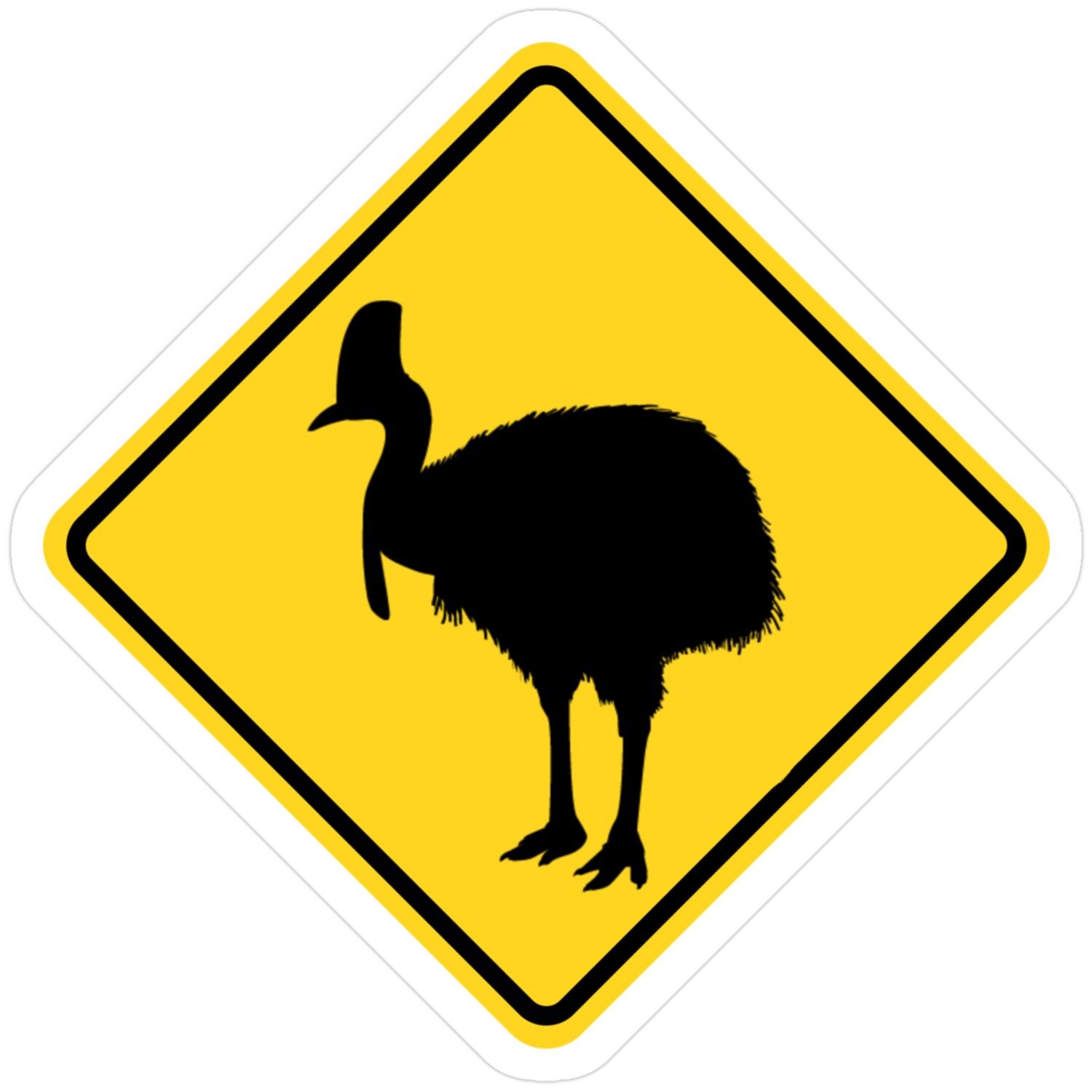
The southern cassowary is often described as the closest thing to a living dinosaur still walking the planet. With a bony helmet crowning a glossy black body, a bright blue neck, two red wattles hanging from the throat, and a dagger-shaped claw on each foot, Casuarius casuarius looks more like a feathered theropod than a modern bird.
It is the second heaviest bird on Earth, the heaviest native land animal across most of New Guinea, and the single most important seed disperser in the tropical rainforests of far northeastern Australia. It is also - by reputation and by the record - the most dangerous living bird.
This guide is a reference entry on the biology, ecology, and conservation of the southern cassowary.
It covers size and anatomy, the disputed function of the casque, habitat and range, diet and the unusual keystone role in rainforest regeneration, reproduction and the male-only parenting system, movement and swimming, subpopulations across Australia and New Guinea, conservation status, and the long and tangled relationship between cassowaries and humans. Expect specifics: kilograms, centimetres, hertz, hectares, and documented records.
Etymology and Classification
The genus name Casuarius was introduced by Mathurin Jacques Brisson in 1760 and traces back to the Malay word kasuari or kesuari, used across the Malay Archipelago for the bird long before European contact. The species name casuarius is simply a repetition, as was common in early binomial naming. The southern cassowary was formally described by Linnaeus in 1758 from specimens brought back by Dutch traders.
In Australian English the bird is often simply called a "cassowary" because the southern species is the only one present; in New Guinea several Indigenous language groups maintain distinct names for each of the three cassowary species.
Cassowaries belong to the ratite lineage, an ancient group of large flightless birds with a flat unkeeled sternum. Other living ratites include the emu, ostriches, rheas, and kiwis. Genetic evidence indicates that ratites do not share a single flightless ancestor; instead, flight was lost independently multiple times after their ancestors dispersed across the fragmenting southern supercontinent Gondwana.
The cassowary-emu clade is an ancient Australasian branch that likely separated from the other ratite lines more than fifty million years ago.
Three species of cassowary are recognised today:
- Southern cassowary (Casuarius casuarius) - the largest and most widely known, with two wattles and the tallest casque
- Northern or single-wattled cassowary (Casuarius unappendiculatus) - restricted to northern New Guinea
- Dwarf or Bennett's cassowary (Casuarius bennetti) - smaller, occupying montane forest across New Guinea
The three species partition habitat and elevation, which is why wild hybrids are almost unknown even where their ranges approach. A handful of confirmed hybrids exist in captivity.
Size and Physical Description
The southern cassowary is a massive, muscular bird built for covering ground through dense forest rather than flying above it.
Females:
- Height: 1.5-2.0 metres
- Body length: approximately 1.3 metres from bill to rump
- Weight: 55-75 kg, with exceptional individuals above 80 kg
- Generally larger, more brightly coloured, and more dominant than males
Males:
- Height: 1.3-1.7 metres
- Weight: 30-35 kg on average
- Often duller in wattle and neck colour, more secretive outside breeding
Chicks and juveniles:
- Hatchlings: approximately 500 g, covered in longitudinal brown and cream stripes
- Sub-adults: lose stripes at around 5-6 months, develop adult black plumage between 2 and 4 years
- Casque begins growing in the second year and continues throughout life
The plumage is glossy black, coarse, and shaggy. Cassowary feathers lack the interlocking barbules that give modern bird feathers their smooth zipped surface. The result is plumage that looks more like thick hair, sheds heavy tropical rain effectively, and protects the body while the bird crashes through spiny rattan and sharp lawyer vine.
The small wings are reduced to a cluster of five or six naked modified quills - essentially black hollow spines - that lie flat against the flanks and are used mainly to shove through vegetation.
The head and neck carry the species' most distinctive features. The skin of the face and neck is bare and a vivid electric blue, with patches of purple along the nape. Two long red wattles dangle from the throat, wobbling as the bird walks.
On top of the head sits the bony casque, a helmet of hollow bone covered in keratin that rises 13 to 17 centimetres above the skull and grows throughout the bird's life. The bill is pale, laterally compressed, and sharp enough to handle large fruits and the occasional small vertebrate.
The legs are thick, scaled, and enormously powerful. Each foot carries three forward-pointing toes. The inner toe bears a straight, dagger-shaped claw up to 12 centimetres long - the feature that gives the cassowary its reputation as the world's most dangerous bird.
The Dagger Claw and Defensive Kicks
A cassowary defends itself by kicking. The bird lowers its head, charges forward, and delivers one of two motions: a sharp forward stamp with the full weight of the body behind it, or a jumping kick with both legs extended at once. Either movement drives the inner-toe claws into a target. In a full-force strike the claws can penetrate human skin and muscle, puncture abdominal organs, break ribs, and in rare cases kill.
Documented fatalities are few but real. A 16-year-old boy named Phillip McClean was killed in Queensland in 1926 after he and a companion attempted to club a cornered cassowary. A Florida keeper was killed in 2019 when a captive bird struck him after he fell.
Injuries are more common: across compiled records from the twentieth and early twenty-first centuries, roughly 150 to 200 incidents involving cassowary attacks on humans have been documented. A large majority involve birds that had been habituated to human food, either through deliberate feeding by tourists or through residents leaving food scraps near rainforest edges.
Wild undisturbed cassowaries are almost universally shy. Hikers in the Wet Tropics typically glimpse a bird only briefly as it retreats into undergrowth. Attacks by naive wild birds on unprovoked humans are vanishingly rare. Attacks by food-conditioned birds, provoked birds, or birds defending chicks are the dangerous category.
The Casque: What Is It For?
The bony helmet on the cassowary's head has puzzled naturalists since the species was first described. It is not a simple ornament - the casque is made of hollow trabecular bone overlaid by a thick keratin sheath, and it continues to grow throughout the bird's life, expanding both in height and in shape. Four hypotheses dominate the modern literature, and current evidence suggests that more than one is correct at the same time.
Thermal radiator. Infrared imaging studies published in 2019 and after showed that the casque's surface temperature tracks ambient temperature closely and that the bird shunts blood through the casque in heat-stressed conditions. In other words, the casque may act like an elephant's ear - a thermal window that radiates excess body heat into the air. This would be a substantial advantage for a 55-kilogram black-feathered animal living in 30-degree tropical humidity.
Acoustic resonator. Southern cassowaries produce booming calls with dominant frequencies near 23 hertz, at the very edge of human hearing. Acoustic modelling and anatomical work suggest that the hollow casque may act as a resonance chamber that amplifies these low-frequency sounds and helps them travel long distances through dense rainforest, where higher-frequency calls would be attenuated quickly.
Sexual and social signal. Casque shape and height vary by age, sex, and condition. Larger casques may honestly advertise body condition or age to potential mates and to rivals. This function overlaps with the first two, because a hotter or better-resonating casque is also a larger casque.
Physical shield. The oldest hypothesis, dating to early European descriptions, held that the casque protects the skull when the bird crashes through tangled vines and low branches. Modern biomechanical work finds this plausible but difficult to quantify, because captive birds with damaged casques have not shown obvious head injury increases.
The weight of current evidence points to the casque as a multi-purpose structure with thermal regulation, acoustic amplification, and social signalling all contributing to its shape and size.
Booming Voice
The cassowary's vocal repertoire is unusual among birds. Its signature sound is a deep rolling boom with dominant frequency around 23 hertz - among the lowest fundamental frequencies ever measured in a bird. Humans standing within a few metres of a calling cassowary often feel the sound in the chest before recognising it with the ears.
Low-frequency sound travels well through dense vegetation, where higher pitches are absorbed. This is why elephants, tigers, rhinoceroses, and southern cassowaries have independently converged on infrasonic or near-infrasonic calls. The cassowary uses booms during the breeding season, during territorial disputes, and apparently as general contact calls in dense forest.
Males and females both call, and captive observations suggest the birds can produce booms even with the bill closed, pushing air through the body cavity.
Habitat and Range
Southern cassowaries live in lowland tropical rainforest and its adjacent habitats: swamp forest, melaleuca paperbark woodland, and in some coastal areas mangrove margins. The species occupies three broad regions:
- Far northeastern Queensland, Australia - a narrow coastal strip from approximately Cooktown to Townsville, including the Daintree, the Atherton Tablelands, the Mission Beach area, and parts of Hinchinbrook.
- New Guinea - the entire island including the Indonesian provinces of Papua and West Papua and the independent country of Papua New Guinea. Cassowaries occur from sea level to approximately 1,100 metres, above which they are replaced by the dwarf cassowary.
- Indonesian islands - Seram in the southern Moluccas and the Aru Islands. Populations on Seram may have been introduced by early humans; Aru populations are likely natural.
Within these regions the birds prefer habitats with a dense fruit-producing understorey, regular access to fresh water, and forest patches large enough to support seasonal movement between fruiting trees. Individual home ranges in Australia vary from about 1 to 5 square kilometres, with males typically defending smaller areas during chick-rearing and females ranging more widely. Home ranges may overlap at the edges.
Diet and Keystone Seed Dispersal
Cassowaries are primarily frugivores. In one Australian study, 238 plant species were recorded in the cassowary diet in a single region. Fruit makes up more than 90 per cent of adult intake, with fungi, invertebrates, small vertebrates, and carrion making up the remainder. Chicks eat a higher proportion of insects and small animals because they need dense protein during rapid growth.
The species' ecological role is what makes it genuinely important rather than merely charismatic. More than 150 rainforest tree species in the Australian Wet Tropics depend on cassowaries for seed dispersal, and for several dozen species the cassowary is the only seed disperser capable of handling the fruit. Cassowary-adapted fruits tend to be large, colourful when ripe, and often toxic to other animals. Trees that exemplify the pattern include:
- Cassowary plum (Cerbera floribunda) - large purple fruits with toxic flesh that deters other frugivores
- Blue quandong (Elaeocarpus grandis) - cobalt blue stone fruit up to 3 cm across
- Davidson's plum (Davidsonia spp.) - cauliflorous fruit growing directly from the trunk
- Ryparosa kurrangii - an understorey tree whose seeds germinate dramatically better after passing through a cassowary gut
The cassowary's digestive tract is gentle on seeds. Most pass through intact in 30 minutes to a few hours, coated in a warm dung pile that provides fertiliser, moisture, and microbial inoculation for the seedling. Dispersal distances regularly exceed a kilometre from the parent tree.
Loss of cassowaries from a forest patch therefore represents a long-term degradation of the forest's capacity to regenerate after cyclones, fire, or disturbance. This is one of the most clearly documented keystone species relationships in any tropical system.
Reproduction and Male-Only Parenting
Southern cassowary reproduction runs on a system that is the mirror image of most bird families: females compete for territory and mates, females are larger and brighter, and males do every stage of incubation and chick care.
Breeding timeline:
- April-May: Females begin booming and patrolling territory; multiple males may be present
- June-September: Courtship and egg laying; female lays 3-5 large lime-green eggs in a simple scrape on the forest floor
- June-November: Male incubates the eggs for 47-56 days, rarely leaving the nest, barely eating or drinking
- Hatching: Striped chicks emerge covered in longitudinal camouflage bands
- 0-9 months after hatching: Male guards and leads chicks through the forest; teaches fruit locations and predator avoidance
- 9-12 months: Chicks disperse; male returns to non-breeding condition
The female typically takes no further part after egg-laying. In good fruiting years a single female may mate with additional males in her territory and produce additional clutches within the same season. This reversed parental system is the ancestral condition for the ratite lineage - emus, rheas, and kiwis share similar arrangements.
The eggs themselves are striking: 9 to 14 cm long, 85 to 155 grams each, and a vivid lime-to-avocado green that darkens over the weeks of incubation. The green pigment is a by-product of biliverdin deposition in the eggshell and may provide some camouflage on the forest floor amid mosses, leaf litter, and filtered light.
Cassowary chicks are precocial. They can walk within hours of hatching, follow their father almost immediately, and begin probing for fallen fruit and insects within a day. Striped plumage provides good concealment in the dappled light of the forest floor for the first five to six months.
Lifespan, Predation, and Survival
Wild southern cassowaries appear to live 40-50 years, which is long for a bird of their body size. Captive animals have exceeded 60 years. Sexual maturity arrives at around three to four years of age.
Natural predators:
- Saltwater crocodiles (Crocodylus porosus) - a risk near river crossings and estuaries
- Amethystine pythons (Simalia amethistina) - can take chicks and occasionally small juveniles
- Birds of prey - take chicks but rarely challenge guarded broods
- Feral pigs - destroy nests and predate eggs and chicks
Adult cassowaries have few natural enemies beyond crocodiles. Their combination of size, kicking ability, and aggressive defence of chicks is enough to deter most predators. Chick mortality, however, is high - estimates range from 25 to 75 per cent in the first year.
The species survived the end-Pleistocene megafauna extinction that eliminated most of Australia's giant marsupials, giant birds, and large reptiles around 45,000 to 40,000 years ago. This makes the southern cassowary one of the last surviving members of the original Sahul megafauna, persisting alongside the cassowary-dependent rainforest that evolved to exploit it.
Movement, Running, and Swimming
Cassowaries are built for sprinting through dense understorey and for moving long distances along regular fruiting circuits. Top running speed is estimated at 50 kilometres per hour over short distances, achieved with a long stride and a forward-leaning posture that lets the bird burst through thickets. Standing jumps of 1.5 metres vertically have been recorded; this is enough to clear low fences and to reach fruit on slightly elevated branches.
Despite their weight, cassowaries swim readily. The plumage traps air and provides flotation; the long neck is held clear of the water; the powerful legs paddle steadily. Swims of several hundred metres between forest patches or across tidal creeks are routine. Some New Guinea populations are known to swim between near-shore islands.
Populations and Subpopulations
Australia. The Wet Tropics World Heritage Area and adjacent rainforest patches hold fewer than 4,000 mature individuals. Key strongholds include the Daintree lowlands, the Atherton Tablelands uplands, the Mission Beach area, and the Cassowary Coast south to Hinchinbrook. Fragmentation is severe: many populations are isolated by roads, agricultural land, and cleared coastal development.
New Guinea. Total population is poorly quantified but is likely much higher than in Australia, possibly tens of thousands. Hunting pressure varies strongly by region and by cultural practice. Some tribal groups protect cassowaries near villages; others hunt them for meat and for casque and feather ornaments.
Seram and Aru. Small but stable populations persist, with some local harvest.
Genetic exchange between the Australian and New Guinea populations ceased when the Torres Strait flooded at the end of the last Ice Age roughly 10,000 years ago. The two populations are diverging slowly but remain the same species.
Conservation Status and Threats
The IUCN Red List classifies the southern cassowary as Vulnerable. Australian federal law lists the Queensland population as Endangered in the Wet Tropics and North Queensland bioregions. Key threats include:
- Habitat loss and fragmentation. Urban, agricultural, and tourism development has cleared or divided large areas of lowland rainforest. Remaining patches are often too small or too isolated to support viable populations without connectivity.
- Vehicle strikes. Cars are the single most-recorded cause of adult cassowary deaths in Australia. Roads crossing rainforest and the ecotone between rainforest and cleared land are high-risk zones. Dedicated cassowary crossing signs, speed reductions, and wildlife underpasses reduce but do not eliminate strikes.
- Dog attacks. Free-ranging domestic and stray dogs attack chicks and, in packs, adults. Dog attacks are particularly damaging near semi-rural settlements.
- Feral pigs. Pigs compete for fallen fruit, damage understorey, predate eggs, and may kill chicks. Pig control is a standard part of cassowary habitat management.
- Cyclones. Severe tropical cyclones - Larry in 2006 and Yasi in 2011 were major examples - strip fruiting trees and can trigger cassowary starvation for months afterwards. Supplemental feeding programmes have been trialled in cyclone recovery but carry habituation risks.
- Soil pathogens. Phytophthora cinnamomi kills important food plants and is spread on vehicle tyres and boots.
- Hunting. Not a major issue in Australia but locally important in parts of New Guinea, particularly near urban centres with commercial meat trade.
Coordinated recovery actions include the Queensland Cassowary Recovery Plan, reserve acquisitions under the Daintree Buyback programme, road speed limits and wildlife crossings in known corridors, community dog control, and research partnerships with Traditional Owners of Wet Tropics country.
Cassowaries and Humans
Cassowaries hold deep cultural significance across New Guinea and Indigenous Australia. In many New Guinea societies, cassowary feathers, casques, and claws feature in ceremonial regalia, and cassowaries appear in creation stories and clan totems. Some groups maintain strict taboos against killing them in particular contexts.
Wet Tropics First Nations peoples, including the Djiru, Girramay, Kuku Yalanji, and Mamu, recognise the cassowary as both a practical presence - the bird whose dung plants the forest - and a cultural figure.
Modern interactions are mixed. Ecotourism in the Mission Beach area and the Daintree generates income and awareness. Wildlife hospitals in far north Queensland run dedicated cassowary triage and rehabilitation programmes. At the same time, cassowaries killed by cars, dogs, and cyclone starvation arrive at these hospitals in numbers that make clear the species' precarious position.
A firm rule holds across the range: do not feed cassowaries. Food-conditioned birds approach humans, cross roads more often, attack in pursuit of scraps, and teach their chicks the same habits. Feeding a cassowary is the single most effective way to kill it over the following year.
Related Reading
References
Relevant peer-reviewed and governmental sources consulted for this entry include IUCN Red List assessments for Casuarius casuarius, the Queensland Department of Environment and Science Cassowary Recovery Plan, acoustic research on ratite low-frequency calls published in Ibis and Journal of Zoology, thermoregulation studies in Biology Letters, seed dispersal analyses in Austral Ecology and Biotropica, and long-term field observations from the Wet Tropics World Heritage Area monitoring programmes.
Frequently Asked Questions
How big is a southern cassowary?
Adult southern cassowaries (Casuarius casuarius) stand 1.5 to 2 metres tall and are the second heaviest bird on Earth after the ostrich. Females are substantially larger than males, typically weighing 55-75 kg with exceptional individuals exceeding 80 kg. Males weigh 30-35 kg on average, roughly half the female mass. The bony casque on top of the head adds another 13-17 cm of height and varies in shape between individuals.
Chicks hatch at around 500 grams and grow rapidly on a diet of fallen fruit and insects provided by the father. Adult body length from bill tip to rump is about 1.3 metres.
Why is the cassowary called the world's most dangerous bird?
The southern cassowary carries a dagger-like inner toe claw that can reach 12 cm in length, backed by powerful leg muscles capable of delivering downward and forward kicks. A charging cassowary can open large wounds, break bones, and has been documented killing humans.
The most frequently cited modern fatality occurred in Florida in 2019, when a captive cassowary killed its keeper after he fell, and a 1926 Australian case involved a boy killed in a provoked encounter. Across thousands of wild and captive records, roughly 150-200 human injuries have been documented, most involving birds that had been habituated to human food.
In the wild, cassowaries are shy and retreating; most serious attacks follow deliberate feeding, cornering, or interference with chicks.
Where do southern cassowaries live?
Southern cassowaries inhabit lowland tropical rainforest and adjacent swamp forest, mangrove, and melaleuca woodland across three main regions: the Wet Tropics of far northeastern Queensland in Australia, the entire island of New Guinea (including Papua New Guinea and Indonesian Papua), and the Indonesian islands of Seram and Aru. In Australia the species is confined to a narrow coastal belt between Cooktown and Townsville.
They prefer areas with dense fruit-bearing understorey and regular access to water. Individuals maintain home ranges from about 1 to 5 square kilometres depending on fruit availability, and will swim rivers or cross narrow sea channels to reach new foraging grounds.
What do cassowaries eat?
Cassowaries are primarily frugivores - fallen rainforest fruit makes up more than 90 per cent of the adult diet. They consume fruits from more than 238 plant species in Australia alone, including the large blue quandong, native nutmegs, figs, laurels, and palms. Many of these fruits are too large or too toxic for other Australian frugivores to handle. Secondary foods include fungi, snails, frogs, small lizards, carrion, and invertebrates.
Chicks rely more heavily on insects and small vertebrates for protein during the first months of growth. Because cassowaries swallow fruits whole and deposit seeds in nutrient-rich dung piles up to a kilometre from the parent tree, they function as keystone seed dispersers for the entire rainforest community.
Why do male cassowaries raise the chicks alone?
Cassowary reproduction is built around female defence of territory and male investment in young. Females are larger, more brightly coloured, and defend multi-male breeding territories. During the June-to-October breeding season the female lays a clutch of three to five pale green eggs in a simple scrape on the forest floor, then leaves. The male incubates the eggs for 47-56 days, barely eating or drinking and losing substantial body mass.
Once the striped chicks hatch he guards them for approximately nine months, teaching them foraging routes, driving off predators, and brooding them in cool or wet weather. The female may produce additional clutches with other males during the same season. This system, called reversed parental investment, is rare among birds but universal in the ratite lineage that includes cassowaries, emus, rheas, and kiwis.
What is the casque on a cassowary's head for?
The bony casque is an extension of the skull covered by a keratin sheath, rising 13-17 cm above the head. Its function has been debated for more than a century. The three most-supported hypotheses are not mutually exclusive. First, it may act as a sexual and social display structure, signalling age, condition, and dominance.
Second, acoustic research published in 2023 showed the casque resonates at low frequencies and may amplify the bird’s deep booming calls, which travel long distances through dense forest. Third, thermal imaging studies have found that the casque radiates heat, suggesting it helps regulate body temperature in the hot, humid rainforest environment.
Older ideas - that the casque protects the head when the bird crashes through vines, or is used for digging - have less supporting evidence but are still cited. The casque continues to grow throughout the bird’s life.
Are cassowaries endangered?
The IUCN Red List classifies the southern cassowary as Vulnerable, with a declining population trend. Estimates for Australia put the mature population at fewer than 4,000 individuals, scattered across fragmented rainforest patches. The species is likely more numerous in New Guinea but poorly surveyed.
Primary threats are habitat loss and fragmentation from agriculture and urban development, vehicle strikes (cars kill more cassowaries in Australia than any other identified cause), dog attacks on adults and chicks, feral pigs that compete for fallen fruit and eat cassowary eggs, and cyclone damage to fruiting trees that triggers starvation.
Secondary threats include illegal hunting in parts of New Guinea for meat and ceremonial feathers, and the spread of the soil pathogen Phytophthora that kills key food plants.
How long do cassowaries live?
Wild southern cassowaries are thought to live 40-50 years, although precise long-term data are limited because adults are difficult to mark and track in dense rainforest. Captive cassowaries have exceeded 60 years in zoo care. Sexual maturity is reached at around three to four years, and females may continue breeding into their fourth decade.
Chick mortality is high - estimates range from 25 to 75 per cent in the first year, with dogs, pigs, pythons, and accidental falls being the main causes. Once a cassowary reaches adult size it has few natural predators beyond large saltwater crocodiles near river crossings. The combination of slow reproduction, late maturity, and small population size makes the species highly sensitive to even modest increases in adult mortality.