
How fast can an ostrich run?
Ostriches can sprint at 70 km/h (44 mph) and sustain speeds of 50 km/h over distances. This makes them the fastest bird on land and the fastest bipedal (two-legged) animal on Earth. They can maintain sustained running longer than most predators can chase, making them effectively uncatchable by natural African predators except during ambush attacks.
The Bird That Traded Flight for Speed
At first glance, the ostrich looks like a biological contradiction - a bird so enormous it seems to defy the very definition of bird. Standing nearly three meters tall, weighing as much as a grown man, and utterly incapable of flight, the ostrich seems to have taken wrong turn on the evolutionary map.
But the ostrich is not a failure of bird design. It is a triumph of specialization. Where other birds became masters of the air, the ostrich became master of the African ground - running faster than any other bipedal animal alive, surviving in habitats that would kill flying birds, and developing weapons that let it stand its ground against lions.
The Largest Living Bird
The ostrich (Struthio camelus) holds multiple size records in the bird world.
Dimensions:
- Height: 2.1-2.8 meters (males), 1.7-2 meters (females)
- Weight: 100-160 kg (males), 90-110 kg (females)
- Leg length: approximately 1.5 meters
- Neck length: approximately 1 meter
- Stride length at full sprint: 3-5 meters
An adult male ostrich is taller than any human and heavier than many. Stand next to one and the scale becomes vividly clear - these are not birds in any scale we intuitively grasp from watching chickens or pigeons.
Their eyes are also the largest of any land vertebrate - roughly 50 mm in diameter, larger than their brains. Ostriches see predators from several kilometers away and react long before a threat gets close.
| Trait | Ostrich (Struthio camelus) | Emu (Dromaius novaehollandiae) | Cassowary (Casuarius casuarius) | Rhea (Rhea americana) |
|---|---|---|---|---|
| Height | Up to 2.8 m | Up to 1.9 m | Up to 1.8 m | Up to 1.5 m |
| Weight | 100-160 kg | 45-60 kg | 50-80 kg | 20-40 kg |
| Top speed | 70 km/h | 50 km/h | 50 km/h | 60 km/h |
| Toes per foot | 2 | 3 | 3 | 3 |
| Native range | Africa | Australia | New Guinea and Queensland | South America |
| Conservation status | Least Concern | Least Concern | Least Concern | Near Threatened |
How Fast Can an Ostrich Run?
The ostrich is the fastest bird on land and the fastest bipedal animal of any kind currently alive.
Speed metrics:
- Sprint speed: up to 70 km/h (44 mph)
- Sustained running speed: 50 km/h over long distances
- Stride length: 3-5 meters at full sprint
- Stride rate: approximately 4 strides per second during peak speed
This is not a short burst. An ostrich can maintain speeds near 50 km/h for extended periods - long enough to outrun most African predators, which tire quickly after initial bursts.
For comparison: the fastest human sprinter (Usain Bolt) reaches 45 km/h briefly over 100 meters. The ostrich exceeds that and sustains it. A healthy adult ostrich is effectively uncatchable by lions or cheetahs on open ground. Predators must rely on ambush or targeting weak or young individuals.
The Anatomy of Speed
Ostrich running performance depends on several anatomical adaptations not found in other birds.
Two-toed feet.
Most birds have four toes. Ostriches have only two - a massive main toe and a smaller side toe. The main toe ends in a thick claw that functions like a cleat, digging into the ground and providing enormous traction. This reduction in toe number is unique among living birds and clearly evolved for speed.
Extremely long legs.
Ostrich legs are proportionally longer than those of any other bird. Long legs produce long strides, and long strides produce high speed with relatively few foot strikes per second.
Powerful thigh muscles.
The ostrich's thighs are enormous - comprising the majority of the bird's muscle mass. This is why ostrich meat from the thigh is such a prized product: a single thigh can provide kilograms of lean, dense muscle tissue.
Elastic tendons.
Ostrich legs contain long, spring-like tendons that store energy during each stride and release it on the next step. This tendon-based energy recovery makes ostrich running extraordinarily efficient - they use roughly half the metabolic energy per meter that other running animals require.
Efficient stride mechanics.
High-speed video analysis shows ostriches keep their bodies remarkably steady while running. Energy is directed almost entirely into forward motion rather than vertical bouncing. This efficiency allows them to maintain high speeds for long durations.
Why Can't Ostriches Fly?
The ostrich evolved from flying ancestors. At some point in the deep past, birds that could fly gave up flight and began growing larger and faster on the ground. The ostrich represents the extreme end of that evolutionary path.
The flight trade-off:
Flying imposes strict weight limits. A bird that gets too heavy cannot generate enough lift to stay airborne. Birds that abandon flight can grow far larger - and size brings advantages in fighting predators, storing food reserves, walking long distances efficiently, and reaching food sources high or low that smaller birds cannot.
Ostrich wings today:
Ostriches still have wings, but they serve different purposes. The wings are used for:
- Balance during running - held out to the sides during sharp turns
- Thermoregulation - raised to dissipate heat in hot weather
- Courtship displays - males perform elaborate wing-waving dances
- Shade for chicks - females spread wings over ostrich chicks during bright sun
The wings cannot generate aerodynamic lift. An adult ostrich weighs too much and the wings are too small and structurally weak.
Other flightless birds:
Ostriches are part of a group called ratites - flightless birds including emus, cassowaries, rheas, and kiwis. Genetic analysis suggests flight was lost multiple times independently in this group, with each species adapting to specific ground-based niches.
The Kicking Weapon
Ostriches are dangerous in a fight. Their primary weapon is the kick.
Kick mechanics:
An ostrich kicks forward with its long leg, driving the clawed foot into the target. The force generated is approximately 2,000 Newtons - enough to fatally injure a human, a lion, or a similar-sized predator.
The claw:
The main toe's claw reaches up to 10 cm long and resembles a curved dagger. This claw can puncture skin, muscle, and organs. A well-placed kick can disembowel an attacker or crush a skull.
Targets:
Ostriches kill approximately 2-3 humans per year, typically:
- Farm workers handling the birds carelessly
- Zoo staff who enter enclosures without precautions
- Tourists who approach too close
Lions occasionally kill ostriches but usually focus on chicks or injured adults. A healthy ostrich standing its ground can drive lions away - and in documented cases, has killed lions with kicks.
Why ostriches stand their ground:
Despite their running speed, ostriches do not always flee from predators. A mother protecting chicks or a male defending territory will fight. The kick provides enough deterrent that most predators prefer to target easier prey.
The Head-in-Sand Myth
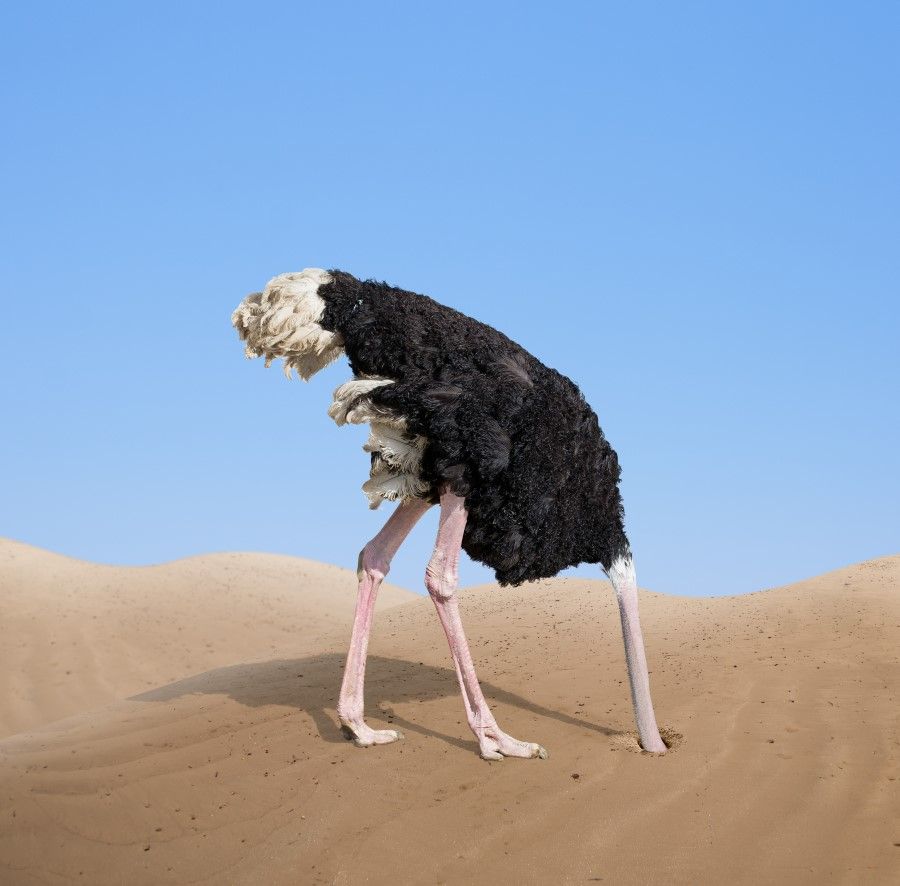
No myth about the ostrich is more persistent than the claim that ostriches bury their heads in the sand when frightened.
The truth: They do not. Ever. This is complete fiction.
Where the myth came from:
The Roman author Pliny the Elder wrote in the first century CE that ostriches hide their heads in bushes, imagining no one can see them. Over centuries, "bushes" became "sand" in retelling. The myth stuck because it made a perfect metaphor for willful ignorance.
What ostriches actually do:
Several behaviors look like head-burying from a distance:
- Swallowing stones. Ostriches swallow small stones that remain in their gizzard to help grind food. They lower their heads to the ground to pick up these stones.
- Tending eggs. Ostriches nest in shallow pits in the ground. They lower their heads into the pit to rotate eggs or check on them.
- Predator avoidance. When an ostrich spots a predator, it sometimes presses its body flat against the ground with neck extended, making itself look like a shrub or mound from a distance. The head stays visible but held low.
None of these involve actually putting the head into the ground. Modern zoologists and ornithologists have definitively debunked the myth, though it continues to appear in popular language.
Social Behavior and Reproduction
Ostriches live in groups of 5-50 birds, often with one dominant male, a dominant female, and several subordinate females plus chicks.
Nesting:
The dominant female lays eggs in a communal ground nest. Subordinate females also lay eggs in the same nest, but the dominant female rolls her own eggs to the center. If predators raid the nest, her eggs are most likely to survive.
Ostrich eggs are the largest of any living bird:
- Weight: 1.4 kg (equivalent to about 24 chicken eggs)
- Dimensions: 15 cm long, 13 cm wide
- Shell: so thick it requires force to crack
A single ostrich egg can feed several adults and is considered a delicacy in many African countries.
Incubation:
The dominant male and dominant female take turns sitting on the eggs. The female incubates during the day (her brown plumage blends with the ground) and the male incubates at night (his black plumage is invisible in darkness). After about 42 days, chicks hatch already able to walk and run.
Ostriches and Humans
Humans have interacted with ostriches for thousands of years.
Farming:
Ostriches are farmed throughout southern Africa and increasingly worldwide for:
- Meat - low-fat, high-protein red meat similar to beef
- Leather - distinctive follicle-patterned hide used in luxury goods
- Feathers - historically used in fashion, still used in dusters and decor
- Eggs - sold as food and as decorative shells
Racing and riding:
South African ostrich farms offer ostrich racing and riding experiences to tourists. Ostriches can be trained to carry adult humans at speeds up to 50 km/h, though the experience is famously uncomfortable.
Conservation status:
Wild ostriches are listed as Least Concern by the IUCN - populations are stable across their African range. However, the Arabian ostrich subspecies went extinct in the 20th century due to hunting pressure.
The Fastest Biped on Earth
What makes the ostrich extraordinary is not any single feature but the combination. Other animals run fast on four legs (cheetahs at 110 km/h, pronghorns at 90 km/h over distance). Other animals stand tall (giraffes, elephants). Other birds are large and flightless (emus, cassowaries).
The ostrich combines bipedal running speed beyond any other living two-legged animal with sheer physical size that makes it nearly unattackable. It represents an evolutionary path no other bird fully committed to - total abandonment of flight in exchange for ground dominance at African-savanna scale.
The sky has peregrine falcons and eagles. The ocean has sailfish and marlin. The savanna, for birds, has ostriches - and nothing else competing on their specific turf has ever seriously threatened their 40-million-year run as Africa's dominant flightless giants.
Biomechanics of the Ostrich Stride
Detailed biomechanical studies by Jonas Rubenson and colleagues at the University of Western Australia have shown that the ostrich is not just fast - it is the most energetically efficient runner ever measured. Rubenson's team used high-speed force plates and electromyography to track ostrich stride mechanics across a wide range of speeds.
"The ostrich's hindlimb morphology allows it to achieve the lowest cost of locomotion of any running animal studied to date, including humans, horses, and greyhounds." - Jonas Rubenson, Journal of Experimental Biology, 2011 [1]
The key finding was that the gastrocnemius tendon of the ostrich acts like a biological pogo stick. On each stride, the tendon stretches as the foot hits the ground, storing elastic energy. As the foot pushes off, the tendon recoils and returns most of that energy to forward motion. This means the muscle itself does relatively little work; the spring does most of it. The efficiency comes at almost no metabolic cost beyond the energy needed to stretch the tendon in the first place.
| Metric | Ostrich | Human | Greyhound | Horse |
|---|---|---|---|---|
| Top recorded speed | 70 km/h | 45 km/h | 72 km/h | 88 km/h |
| Cost of transport (J/kg/m) | 1.8 | 3.4 | 2.5 | 2.1 |
| Stride length at top speed | 5 m | 2.5 m | 4.5 m | 7 m |
| Strides per second at top speed | 4.0 | 5.0 | 4.5 | 3.5 |
| Percentage of energy from elastic storage | ~65% | ~35% | ~40% | ~50% |
The practical consequence is that an ostrich can run for an hour at 50 km/h without exhausting itself. Cheetahs, by contrast, overheat and collapse after 30 seconds of sprinting at 100 km/h. The ostrich does not need to be the fastest animal - it simply needs to be faster than any predator can sustain, for longer than any predator can chase.
Evolutionary History
The ratite lineage that produced the ostrich is ancient. Molecular studies indicate that the common ancestor of all living ratites lived in the Cretaceous, possibly more than 80 million years ago. For decades, scientists assumed flightlessness evolved once in this group, on the supercontinent Gondwana, with each modern lineage simply carried to its current continent by continental drift.
That view has been overturned. A 2014 study by Mitchell and colleagues, published in Science, used ancient DNA from extinct elephant birds and moas to build a complete ratite phylogeny. The conclusion was startling: flightlessness evolved at least three separate times within the ratite clade. The common ancestor of today's ratites was probably a small flying bird similar to a tinamou [2].
This matters for the ostrich story because it means the ostrich's giant bipedal form is not a leftover from the age of dinosaurs. It is a relatively recent specialization, built on top of an ancient flightless foundation but pushed to extremes only after the African savanna expanded in the late Miocene, roughly 10 million years ago. The ostrich we know is a product of the same grassland revolution that produced the horses, antelopes, and big cats of modern Africa.
Ostrich Cognition and Vision
The claim that an ostrich's brain is smaller than its eye is true - but the implication that ostriches are stupid is false. Behavioral studies at research farms in Oudtshoorn, South Africa, have documented a range of learned behaviors that put ostriches well above the cognitive baseline of most farm animals.
Ostriches can be trained to follow handlers, respond to individual names, and recognize specific vehicles. They show place memory for water sources across ranges that may exceed 50 square kilometers in the wild. Chicks imprint on their parents within the first few days and follow them in organized creches of up to 100 young birds shepherded by a single pair of adults.
"We underestimate these animals because they have small brains relative to their bodies. But relative brain size is a poor predictor of intelligence in birds. Ostriches solve the problems they need to solve, which include finding water across huge arid ranges and avoiding predators over very long time horizons." - Maud Bonato, ostrich behaviorist, Cape Peninsula University of Technology [3]
The giant eye is the cognitive secret. With an eye 50 mm across, the ostrich has roughly five times the visual resolving power of a human of equivalent range. Ostriches can resolve a stalking lion at four kilometers in clear air and a low-flying vulture at nearly ten. The visual cortex processes this information with remarkable speed - an ostrich can change direction at full sprint in less than 100 milliseconds in response to a visual cue.
Temperature Tolerance and Physiology
Ostriches live in some of the hottest environments on Earth. Daytime surface temperatures in the Kalahari and Namib routinely exceed 50 degrees Celsius. Ostriches tolerate these conditions through a series of physiological adaptations that have drawn interest from researchers studying heat tolerance in other animals, including livestock bred for warming climates.
Selective brain cooling. A network of blood vessels called the rete mirabile sits at the base of the ostrich skull. Venous blood returning from the evaporative surfaces of the nasal passages cools the arterial blood headed for the brain, keeping the brain up to three degrees cooler than the body core.
Gular fluttering. Ostriches pant by rapidly vibrating the muscles of the throat, increasing evaporative cooling from the moist lining of the esophagus and mouth. They can dissipate more than 200 watts of metabolic heat this way.
Wing shading. The large wings are held away from the body to expose the bare skin of the flanks to the air. The underside of the wings also functions as a radiator, with blood vessels running close to the surface.
Water conservation. Ostriches produce dry, pelleted feces and concentrated urine, similar to desert mammals. They can survive more than a week without free water, drawing moisture from vegetation and metabolic water from fat stores in the body.
These adaptations make the ostrich one of the most physiologically extreme birds alive. Much of what we know about how a vertebrate can survive 50 degree heat with limited water comes from ostrich research.
Farming and Economic Significance
Commercial ostrich farming began in earnest in the mid-nineteenth century in the Little Karoo region of South Africa, initially to supply plumes for European fashion. The "feather boom" collapsed around 1914, when fashion moved on and World War I disrupted trade. The industry rebuilt around leather and meat in the late twentieth century and now supports roughly two million farmed birds worldwide.
| Product | Annual Global Output (approx.) | Main Producers |
|---|---|---|
| Ostrich meat | 12,000-15,000 tonnes | South Africa, Namibia, USA, China |
| Ostrich leather | 220,000-250,000 hides | South Africa, USA, Australia |
| Ostrich feathers | 1.1 million kg | South Africa, Zimbabwe |
| Ostrich eggs (for food) | 2 million+ | South Africa, USA, UAE |
Ostrich meat has roughly one-third the fat of beef and higher iron content, making it a minor but growing health-food category in Europe and North America. A single bird produces about 35 kilograms of meat and a hide worth up to 500 US dollars at wholesale. The economics are marginal compared to cattle, but ostrich farming has expanded into marginal rangelands where cattle cannot thrive, particularly in the arid belt from Namibia through the Little Karoo.
What Are the Fastest Land Animals on Earth?
The cheetah (Acinonyx jubatus) leads all land animals at 110-113 km/h in short sprints, powered by a flexible spine, non-retractable claws, and oversized heart and lungs. The pronghorn antelope (Antilocapra americana) reaches 90 km/h and, crucially, sustains it over long distances.
The ostrich (Struthio camelus) follows at 70 km/h - the fastest bird on land and fastest bipedal animal alive, with a 3-5 meter stride length, roughly 100-160 kg body mass, and two-toed feet optimized for speed. Other fast runners include the springbok at 88 km/h, quarter horse at 88 km/h, and lion at 80 km/h.
Among extinct bipeds, some estimates place smaller theropod dinosaurs at 40-60 km/h, but no extinct biped clearly exceeded the ostrich's verified speed.
What Are the Top Three Fastest Animals on Earth?
Including all environments, the top three are: the peregrine falcon at 389 km/h in its stoop, the golden eagle at 322 km/h, and the gyrfalcon at 209 km/h - all aerial predators exploiting gravity during vertical dives. For land animals only, the top three are the cheetah at 110-113 km/h, pronghorn antelope at 90 km/h, and springbok at 88 km/h.
Among bipeds, the ostrich dominates at 70 km/h, followed by the emu (50 km/h) and cassowary (50 km/h) among living species. An ostrich's 1.5-meter legs, 3-5 meter stride, and large eye-to-brain ratio (the largest eyes of any land vertebrate at 50 mm diameter) allow it to spot predators kilometers away and outrun most mammalian hunters.
What Is the Fastest Land Animals on Earth?
The cheetah (Acinonyx jubatus) is the fastest land animal, hitting 110-113 km/h in short sprints under 30 seconds. The ostrich (Struthio camelus) is the fastest running bird and the fastest two-legged animal alive at 70 km/h, surpassing every other living biped including humans (Usain Bolt's peak of 44.7 km/h) and other ratites - the emu reaches 50 km/h, the cassowary 50 km/h, and the rhea 60 km/h.
The pronghorn antelope of North America sustains 90 km/h over longer distances, making it the fastest land endurance runner. Ostriches weigh up to 160 kg and stand 2.8 meters tall, yet their two-toed feet and 1.5-meter legs produce strides that cover 3 to 5 meters at full sprint, making them effectively uncatchable by most African predators.
References
- Rubenson, J., Lloyd, D. G., Heliams, D. B., Besier, T. F., and Fournier, P. A. (2011). "Adaptations for economical bipedal running: the effect of limb structure in running ostriches." Journal of Experimental Biology, 214(13), 2149-2158.
- Mitchell, K. J., Llamas, B., Soubrier, J., Rawlence, N. J., Worthy, T. H., Wood, J., Lee, M. S. Y., and Cooper, A. (2014). "Ancient DNA reveals elephant birds and kiwi are sister taxa and clarifies ratite bird evolution." Science, 344(6186), 898-900.
- Bonato, M., Malecki, I. A., Wang, M. D., and Cloete, S. W. P. (2013). "Early human-ostrich chick bonding improves docility but compromises growth." Applied Animal Behaviour Science, 148(3-4), 232-239.
- IUCN Red List. (2022). "Struthio camelus assessment." International Union for Conservation of Nature.
- Cooper, R. G. (2004). "Ostrich (Struthio camelus var. domesticus) chick and grower nutrition." Animal Science Journal, 75(6), 487-490.
Related Articles
- Flightless Birds: Why Some Birds Lost the Ability to Fly
- Cassowary: The Most Dangerous Bird in the World
- Emu: Australia's Giant Flightless Bird
Frequently Asked Questions
How fast can an ostrich run?
Ostriches can sprint at 70 km/h (44 mph) and sustain speeds of 50 km/h over distances. This makes them the fastest bird on land and the fastest bipedal (two-legged) animal on Earth. They can maintain sustained running longer than most predators can chase, making them effectively uncatchable by natural African predators except during ambush attacks. A single ostrich stride can cover 3-5 meters at full sprint.
Their speed comes from extremely long legs, specialized two-toed feet that function like cleats, and exceptional stride efficiency. Ostriches are among the only birds that have evolved toward pure running rather than flight.
How tall are ostriches?
Adult male ostriches stand 2.1-2.8 meters (7-9 feet) tall and weigh 100-160 kg. Adult females are slightly smaller at 1.7-2 meters tall and 90-110 kg. This makes them the tallest living birds - and the second-heaviest after emus and cassowaries. Their necks alone are approximately 1 meter long. Their legs are 1.5 meters long and incredibly powerful.
Ostriches are larger than any human, and even children visiting ostrich farms often express surprise at the birds’ enormous size compared to any other poultry.
Do ostriches really bury their heads in the sand?
No, ostriches do not bury their heads in the sand. This persistent myth has no biological basis. Ostriches actually lower their heads close to the ground in several situations that may have created the misconception: when swallowing sand and small stones that help grind food in their gizzard, when tending eggs in ground nests, or when startled (they press their bodies low to avoid being seen at distance).
None of these behaviors involve actually putting their heads underground. The myth likely originated with ancient Roman writer Pliny the Elder, who misinterpreted observed behaviors. Modern zoologists have completely debunked this belief, though it persists in popular language and metaphor.
Can an ostrich kill a lion?
Yes, an ostrich can kill a lion with a well-placed kick. Ostrich legs generate approximately 2,000 Newtons of force during a kick - enough to fatally injure a large predator. Their feet end in two sharp claws, with the larger claw reaching 10 cm long and resembling a curved dagger. A direct kick can rupture organs or cause fatal lacerations.
Documented cases of ostriches killing lions exist, though such encounters are uncommon because predators typically avoid adult ostriches. Lions prefer to attack ostrich chicks or injured individuals rather than healthy adults. Ostriches also kill approximately 2-3 humans per year - usually farmers or zoo workers who underestimate the danger.
Why can't ostriches fly?
Ostriches evolved from flying ancestors but lost flight capability over millions of years. They are now far too heavy (100+ kg) for their wings to generate lift. Their wing structure is atrophied - the wings are used for balance during running and display during courtship, but cannot provide aerodynamic lift. The trade-off worked: by abandoning flight, ostriches could grow much larger, run faster, and exploit food sources unavailable to flying birds.
Other ratites (emus, cassowaries, rheas, kiwis) made similar evolutionary trades. The lineage of flightless ratites descended from a common ancestor that could fly, then lost flight multiple times independently as different species adapted to specific ecological niches.