
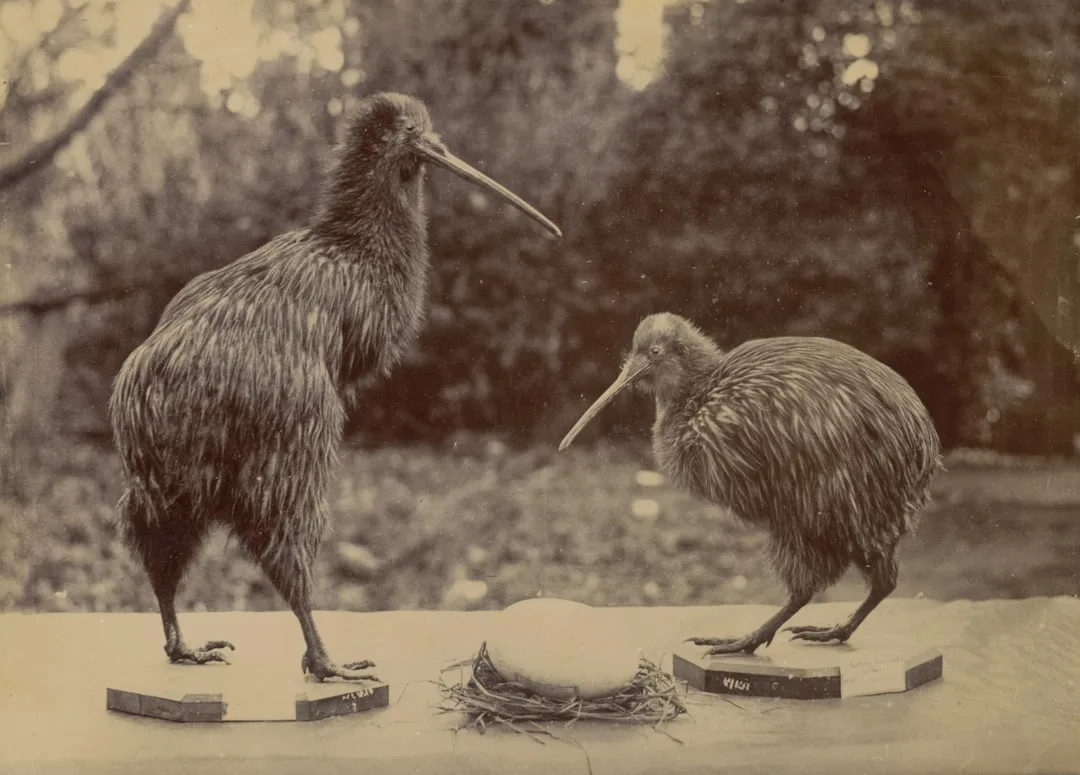
The kiwi is arguably the strangest bird on Earth. It is a flightless, nocturnal, shaggy-feathered, ground-dwelling creature with whisker-like bristles around its bill, marrow-filled bones, a body temperature closer to a mammal than to most birds, and nostrils located at the tip of its long curved bill - a placement found in no other bird species alive or extinct.
It lays, relative to its body, the largest egg of any bird on the planet. And it just so happens to be the national symbol of New Zealand, to the point where the country's own citizens are globally known as Kiwis.
This guide covers the full biology and ecology of the five surviving kiwi species: size and anatomy, the extraordinary sensory world of a nocturnal flightless bird, foraging, the unique egg and reproduction, taxonomy and evolutionary origins, threats, and the conservation response that has pulled the group back from the edge. This is a reference entry, not a summary - so expect specifics: grams, centimetres, percentages, and the actual numbers behind the strange headlines.
Etymology and Classification
The word kiwi comes directly from te reo Maori, where it is both the name of the bird and an onomatopoeic rendering of the shrill whistling call of the male North Island brown kiwi. European naturalists adopted the Maori name almost immediately on encountering the bird in the 18th century, and the word has since become one of the most recognised indigenous-origin animal names in the English language.
The scientific genus Apteryx was coined by George Shaw in 1813 from Greek a (without) and pteryx (wing) - literally "wingless". The name honestly describes the bird. The kiwi's wings are reduced to tiny 5-centimetre vestigial stumps, buried under shaggy plumage and ending in a tiny functionless claw. The species name mantelli, applied to the North Island brown kiwi, commemorates the English palaeontologist Gideon Mantell, whose son Walter Mantell collected early specimens in New Zealand.
Kiwi occupy their own order (Apterygiformes) and family (Apterygidae), both containing only the single genus Apteryx. This reflects their extraordinary evolutionary isolation. Kiwi are ratites - a group of large flightless birds that also includes ostriches, emus, rheas, cassowaries, the extinct moa of New Zealand, and the extinct elephant birds of Madagascar.
For most of the 20th century biologists assumed the kiwi was most closely related to the moa because they shared an island and a body plan. Molecular phylogenetics overturned this view.
DNA evidence from kiwi bones and from recovered elephant bird bones confirmed that the closest living and recent relatives of the kiwi are, in fact, the extinct Malagasy elephant birds - separated by thousands of kilometres of open ocean. Ratite phylogeny is now understood to involve multiple independent losses of flight by flying ancestors that dispersed across the southern hemisphere.
Five living kiwi species are currently recognised:
- North Island brown kiwi (Apteryx mantelli) - most widespread, most numerous
- Southern brown kiwi or tokoeka (A. australis) - South Island and Stewart Island
- Okarito brown kiwi or rowi (A. rowi) - a single population on the South Island west coast
- Great spotted kiwi (A. haastii) - largest species, northwest South Island
- Little spotted kiwi (A. owenii) - smallest species, extinct on the mainland, surviving on offshore islands
Size and Physical Description
Kiwi are small to medium-sized ground birds, roughly the size of a domestic chicken or a small duck, although the similarity ends at the outline. Females are consistently larger than males across all species - a pattern called reverse sexual size dimorphism.
Adult size ranges across the five species:
| Species | Height | Weight (female) | Weight (male) |
|---|---|---|---|
| North Island brown | 40 cm | 2.2-2.8 kg | 1.8-2.2 kg |
| Southern brown/tokoeka | 45 cm | 2.5-3.0 kg | 2.0-2.5 kg |
| Okarito brown/rowi | 40 cm | 2.5-3.0 kg | 1.9-2.4 kg |
| Great spotted | 45 cm | 3.0-3.3 kg | 2.4-2.6 kg |
| Little spotted | 25 cm | 1.3-1.9 kg | 0.9-1.3 kg |
The body is compact, rounded, and pear-shaped when the bird is standing at rest. The tail is essentially absent. The head is small and the neck short, giving kiwi a slightly hunched profile as they probe the ground. The legs are short, thick, and extraordinarily powerful for the bird's size - roughly a third of the total body weight is concentrated in leg musculature.
Kiwi can run briskly, jump small obstacles, and deliver a sharp kick when cornered. Each foot has three forward-facing toes tipped with stout claws used for digging burrows and raking leaf litter.
The feather coat is one of the strangest features of kiwi anatomy. Most bird feathers are held together by microscopic hooks called barbules that zip adjacent barbs into a smooth surface suitable for flight or insulation. Kiwi feathers have essentially no barbules. The result is a shaggy, loose plumage that resembles coarse hair more than typical feathers.
This hair-like coat is well suited to pushing through dense ground vegetation and does not need to maintain the rigid structure required for flight. It also sheds water reasonably well and provides good insulation in the cool, damp New Zealand forest.
The bill is long (typically 10-15 cm in females, shorter in males), slender, slightly down-curved, and flexible at the tip. The nostrils sit at the very tip of the bill - a feature found in no other living bird. Dense clusters of sensory bristles ring the base of the bill, functioning as tactile whiskers in the style of a mammal's vibrissae.
The eye, in contrast, is vestigial: kiwi have the smallest eyes relative to body size of any bird and the smallest optic lobes in the brain. They barely use vision.
The Sensory World of a Nocturnal Flightless Bird
Kiwi are primarily nocturnal, emerging from burrows at dusk and foraging through the night. Their sensory toolkit has evolved around this way of life and is radically different from that of most birds.
- Olfaction. Kiwi have one of the largest olfactory bulbs relative to brain size of any bird. Behavioural experiments demonstrate that they can locate buried earthworms and insect larvae by smell alone through several centimetres of soil. Nostrils at the tip of the bill allow continuous sniffing while probing, rather than an occasional sample.
- Touch. The bill tip carries a concentration of mechanoreceptor organs (Herbst and Grandry corpuscles) similar to those in the bill tips of probing shorebirds. Kiwi can detect subtle vibrations of prey moving underground and the changing density of substrate layers.
- Whiskers. The bristles around the base of the bill are thought to help the bird feel its way through the dark interior of burrows and dense undergrowth, much the way rodent whiskers do.
- Hearing. Kiwi have well-developed ears and use hearing for communication. The shrill call of the male and the lower hoarse call of the female carry long distances through forest and serve to reinforce pair bonds and defend territories.
- Vision. Essentially de-emphasised. Kiwi function fully in total darkness and are clumsier in daylight than at night.
The bird's body temperature sits at around 38 degrees Celsius. Most birds run hotter, around 40-42 degrees, and many passerines run hotter still. A cooler body temperature, combined with ground-dwelling habits and marrow-filled bones, gives the kiwi a metabolic profile that looks more like a small mammal than a typical bird.
Foraging and Diet
Kiwi are omnivores with a strong invertebrate focus. The staple food is earthworms, supplemented with cicada and beetle larvae, spiders, amphipods, centipedes, snails, and a small fraction of plant material including fallen fruit, berries, and seeds. Diet varies by species and region - Stewart Island tokoeka consume more amphipods and coastal invertebrates, while great spotted kiwi in high-altitude beech forest target larvae under rotting wood.
Foraging proceeds by patrolling a territory at night, probing the ground repeatedly with the bill. When scent or touch signals prey below the surface, the bird drives its bill deeper, sometimes pushing right up to the eye. Small prey are swallowed whole. Larger earthworms are pulled out in a characteristic backward step, then manipulated and swallowed. Kiwi will also turn over leaf litter, dig shallow pits, and probe under fallen logs.
Estimated daily food intake for an adult kiwi is in the range of 150-250 grams of invertebrates. Over a year an individual may consume tens of thousands of earthworms and larvae. In regions where exotic earthworms have displaced native species, kiwi diet has shifted accordingly without apparent harm, but the dependence on healthy soil invertebrate communities is one reason heavily modified landscapes support fewer kiwi even where predators are controlled.
The Extraordinary Kiwi Egg
The single most famous fact about the kiwi is the size of its egg. A female kiwi lays an egg that weighs up to 20 percent of her own body mass - proportionally six times larger than would be expected from simple body-size scaling in birds. For a 2 kg female North Island brown kiwi this means a 400 gram egg. Translated to human proportions, a 70 kg woman would give birth to a newborn weighing roughly 8 kg - around twice the normal human birth weight.
Several features of the egg and the female reproductive system reflect this extreme.
- Egg composition. The yolk takes up around 65 percent of the egg by volume - a far higher proportion than in typical bird eggs (usually 35-40 percent). This enormous yolk provides the chick with a week-long energy reserve after hatching, reducing the need for parental feeding.
- Female pelvic anatomy. The pelvic girdle of female kiwi has evolved a wider opening than any other living bird to allow passage of the egg.
- Egg production cost. The female invests so much in a single egg that she often stops foraging in the days before laying. In species that produce a second egg in the same clutch, the two are typically laid around three weeks apart to allow the female time to rebuild body condition.
The most widely accepted evolutionary explanation is that kiwi descended from larger flightless ancestors whose body size has decreased over millions of years while egg size has not scaled down at the same rate. The enormous egg is therefore a kind of evolutionary inheritance, maintained because a huge yolk produces a large precocial chick that hatches ready to survive with minimal parental provisioning - an advantage in an environment historically free of mammalian predators.
Reproduction and Life Cycle
Kiwi are socially monogamous. Pairs can remain bonded for decades, defending overlapping territories that range from 2 hectares in high-quality forest to more than 100 hectares in marginal habitat. The two adults keep in vocal contact across their territory each night, with the male producing a shrill ascending whistle and the female a deeper, hoarser call.
Breeding is strongly seasonal, with most eggs laid between June and January across the main range, although exact timing varies by species and region. The nest is typically a burrow - dug into the ground, under a log, or inside a hollow tree - lined sparingly with leaves.
Once the female has laid, the male takes on most or all of the incubation duties. Incubation lasts 74-85 days, which is among the longest of any bird. During this time the male sits on the egg for most of each day, emerging at night to forage briefly. In some species the female returns to help incubate in short spells; in others the male is the exclusive incubator.
Chicks hatch as miniature adults. They are fully feathered in shaggy down, have functional legs, and carry a large absorbed yolk sac inside the abdomen. This yolk sustains them for the first week. Parents do not actively feed the chick - the young bird leaves the burrow on its own within a week or two, begins probing the ground for invertebrates, and follows the adults at a distance.
Independence comes early, often within 4-6 weeks of hatching, although the juvenile remains within its natal territory for months.
Sexual maturity is reached at 3-5 years. Female kiwi may produce one to two clutches per year in good conditions, although many pairs skip years. Longevity is exceptional for a bird of this size - wild kiwi reach 25-50 years, and individuals in predator-free sanctuaries have exceeded 60.
Distribution and Habitat
All five kiwi species are endemic to New Zealand. Historically kiwi occurred across nearly all native forest and shrubland on the main islands and many offshore islands, from sea level to above the tree line. Today the distribution is fragmented, with surviving populations concentrated in the northland and central North Island, pockets of Fiordland and Stewart Island in the south, the Okarito forest on the west coast, and several predator-free offshore islands.
Habitat is flexible. Kiwi occupy lowland podocarp forest, subalpine beech forest, regenerating scrub, exotic pine plantations, and rough farmland fringes, provided they have access to soft ground for probing, daytime refuge in burrows or dense vegetation, and minimal exposure to introduced predators. Populations persist in surprisingly modified landscapes as long as active predator control is in place.
Conservation Status and Threats
All five kiwi species are currently listed as threatened by the IUCN, ranging from Vulnerable to Nationally Critical under New Zealand's domestic Threat Classification System. The underlying story is consistent across the group: kiwi evolved for tens of millions of years on islands with no mammalian predators, lost flight, became ground-nesting, and then encountered an abrupt wave of introduced mammals against which they have few defences.
Pre-human New Zealand supported an estimated 12 million kiwi. Today the total population across all five species is approximately 70,000. The main drivers of the decline are:
- Stoats. Introduced in the late 19th century to control rabbits, stoats kill an estimated 60 percent of kiwi chicks in unmanaged forest before the chicks reach the weight at which they can defend themselves. Stoats are the single largest cause of kiwi chick mortality.
- Dogs. Domestic and feral dogs are the main cause of adult kiwi mortality. A single uncontrolled dog can kill dozens of adult kiwi in a short period.
- Cats and ferrets. Both kill chicks and sometimes adults.
- Vehicles. Road strikes are a significant cause of adult mortality near settled areas.
- Habitat loss and fragmentation. Historical forest clearance for pasture has reduced the area of continuous habitat and isolated surviving populations.
- Pig predation on eggs. Feral pigs dig out and consume kiwi eggs in some regions.
The Okarito brown kiwi has fewer than 600 individuals in the wild. Without active management several species would follow the moa into extinction within decades.
Operation Nest Egg and the Kiwi Recovery Programme
New Zealand's response has been one of the most intensive national conservation efforts for a single bird group anywhere in the world. The Department of Conservation coordinates kiwi recovery across all five species in partnership with Kiwis for Kiwi, iwi (Maori tribal groups), regional councils, sanctuaries, and community trusts.
Operation Nest Egg is the central intervention. Field teams locate wild nests, remove the eggs (or very young chicks), transfer them to captive incubation, and raise the juveniles in predator-free enclosures or on predator-free offshore islands until the birds reach approximately 1 kg - the threshold at which a juvenile kiwi can usually kick off a stoat.
The young birds are then released back into monitored wild habitat. Chick survival to independence rises from around 5 percent in unmanaged forest to over 65 percent for Operation Nest Egg birds.
Alongside Operation Nest Egg, landscape-scale predator control operates across millions of hectares of native forest. Techniques include trap lines, ground-based toxin bait stations, and aerial 1080 (sodium fluoroacetate) operations. Predator-free offshore islands act as insurance populations. A national goal of "Predator Free 2050" aims to eradicate rats, stoats, and possums from the entire country by mid-century.
The programme is working. The North Island brown kiwi population is now increasing overall for the first time in more than a century. The great spotted kiwi is stable. The rowi and little spotted kiwi remain fragile but their declines have been arrested. Conservation success here is one of the more encouraging stories in global bird conservation.
Kiwi and New Zealand Identity
Few animals are as tightly bound to a national identity as the kiwi is to New Zealand. The bird appears on the country's one-dollar coin, on military insignia going back to the First World War, and on the New Zealand passport. New Zealanders refer to themselves as Kiwis - never to the fruit, which in New Zealand is always called kiwifruit to avoid confusion.
For Maori, kiwi feathers were traditionally used in ceremonial cloaks (kahu kiwi) worn by people of high rank. The bird carries deep cultural significance and is treated as a taonga (treasured species) under the Treaty of Waitangi framework that governs conservation partnerships between the Crown and iwi.
The cultural prominence of the kiwi has been central to the scale of conservation investment. Public support for predator control and for Operation Nest Egg is strong precisely because the bird is inseparable from New Zealand's sense of itself. Few bird conservation programmes anywhere enjoy comparable political and community backing.
Related Reading
- Cassowary
- Emperor Penguin
- Ostrich: The Fastest Running Bird
- Flightless Birds: When Wings Became Optional
References
Key sources consulted for this entry include IUCN Red List assessments for all five Apteryx species, the New Zealand Department of Conservation kiwi recovery plans, Kiwis for Kiwi population monitoring reports, peer-reviewed research on ratite phylogenetics published in Science and Proceedings of the Royal Society B, olfactory and sensory studies from the University of Auckland, and long-term Operation Nest Egg outcome data from DOC and regional sanctuary partners. Population figures reflect the most recent consolidated national estimates.
Frequently Asked Questions
How big is a kiwi?
Adult kiwi (genus Apteryx) stand 25-45 cm tall at the shoulder and weigh between 1.3 and 3.3 kg depending on species. Females are consistently larger than males across all five species, typically 10-20 percent heavier. The North Island brown kiwi (A. mantelli) averages 2.2 kg for females and 2.0 kg for males. The great spotted kiwi (A. haastii) is the largest, with females reaching 3.3 kg.
The little spotted kiwi (A. owenii) is the smallest at roughly 1.3 kg. Kiwi have round, compact bodies, long slender bills, short powerful legs, and vestigial wings barely 5 cm long hidden inside shaggy feather coats. Chicks hatch at around 300 grams - already a functional miniature adult.
Why do kiwi have nostrils at the tip of the bill?
Kiwi are the only birds on Earth with external nostrils at the distal tip of the bill rather than at the base, and the adaptation is directly tied to their foraging strategy. Kiwi hunt by probing soft ground - leaf litter, moss, and the first few centimetres of soil - in search of earthworms, cicada nymphs, beetle larvae, spiders, and amphipods.
Placing the nostrils at the tip of the bill lets the bird sniff continuously as it probes, locating prey that cannot be seen in darkness and is hidden underground. Olfactory anatomy supports this: kiwi have one of the largest olfactory bulbs relative to brain size of any bird, and behavioural experiments confirm they can detect buried food items purely by smell.
The bill itself is long, slender, slightly curved, and tipped with dense tactile sensors that complement the olfactory input.
How big is a kiwi egg and why is it so large?
A kiwi egg is the largest egg relative to body size laid by any living bird. A single egg can weigh up to 20 percent of the female’s body mass - in a 2 kg North Island brown kiwi, that is a 400 gram egg. Proportionally, a human parallel would be a woman giving birth to a newborn weighing around 8 kilograms. The egg is roughly six times larger than would be predicted by simple scaling from body size.
The most widely accepted explanation comes from evolutionary biology: kiwi evolved from larger ancestors whose body size has decreased over time, but egg size has not shrunk at the same rate. Because the yolk takes up about 65 percent of the egg, chicks hatch with enormous energy reserves and emerge as tiny but fully feathered and mobile adults, which is a major advantage in an environment where parental provisioning of the nestling is minimal.
Why are kiwi bones different from other birds?
Most flying birds have pneumatised bones - hollow interior cavities filled with air sacs that reduce weight while retaining strength. Kiwi bones are not hollow. They contain marrow in the same way mammalian bones do.
This reflects the long evolutionary loss of flight in the ratite lineage: once flight became unnecessary, the metabolic cost of building lightweight air-filled bones no longer provided a survival advantage, and heavier marrow-filled bones evolved. The result is a skeleton that is denser, stronger for digging and running, and biologically more similar to a small mammal than to a typical bird.
Several other kiwi traits converge on mammalian biology, including body temperature, shaggy hair-like feathers, tactile whiskers, and nocturnal foraging.
How many species of kiwi are there?
There are five recognised living species of kiwi, all endemic to New Zealand and all in the genus Apteryx. The North Island brown kiwi (A. mantelli) is the most numerous and widespread. The South Island brown kiwi, also called the tokoeka (A. australis), is restricted to parts of the South Island and Stewart Island.
The Okarito brown kiwi, or rowi (A. rowi), is confined to a small patch of forest on the South Island west coast and is the rarest species, with fewer than 600 individuals. The great spotted kiwi (A. haastii) is the largest species, found in the northwest South Island. The little spotted kiwi (A. owenii) is the smallest and was extirpated from the mainland by introduced predators; it now survives on predator-free offshore islands.
All five species are threatened to varying degrees, ranging from Vulnerable to Critically Endangered.
What threats do kiwi face?
Kiwi evolved in isolation for tens of millions of years in forests with no mammalian predators, which is why the birds lost flight and became ground-nesting. The arrival of humans - first Maori around 1300 CE, then Europeans from the 18th century onward - introduced dogs, cats, rats, pigs, ferrets, and especially stoats, against which kiwi have no effective defences.
Stoats kill around 60 percent of kiwi chicks in unmanaged forest before they reach weaning weight. Adult kiwi are killed by dogs, vehicle strikes, and habitat destruction. Over 95 percent of kiwi chicks die before breeding age without active predator control. Habitat loss from forest clearance for farming has also fragmented surviving populations.
The combined pressure has driven the national kiwi population from an estimated 12 million before humans arrived down to roughly 70,000 today, although active conservation has recently stabilised or reversed declines in several regions.
What is Operation Nest Egg?
Operation Nest Egg is a long-running conservation programme coordinated by the New Zealand Department of Conservation in partnership with Kiwis for Kiwi and regional sanctuaries. The programme intervenes at the most vulnerable stage of the kiwi life cycle.
Researchers locate wild nests, remove the eggs, incubate them in captivity, hatch the chicks, and raise them in predator-free enclosures or on offshore islands until they weigh around 1 kg - the threshold at which a juvenile kiwi can usually defend itself against a stoat. The young birds are then released back into their natal territories. Survival rates jump from roughly 5 percent in unmanaged forest to over 65 percent for Operation Nest Egg chicks.
The programme has been a central pillar in stabilising kiwi populations, together with landscape-scale predator control using traps and toxin operations across millions of hectares of native forest.
How long do kiwi live and how do they breed?
Kiwi are long-lived for birds their size. Wild individuals typically reach 25-50 years, with some documented beyond 60 in sanctuary populations. Sexual maturity arrives late - around 3-5 years. Kiwi are socially monogamous and pairs often remain together for decades, defending territories of 2-100 hectares depending on habitat quality. Breeding is highly seasonal, with most eggs laid between June and January.
The female produces one or occasionally two enormous white or pale green eggs per clutch, laid at intervals of about three weeks. The male then takes on most or all of the 74-85 day incubation, sitting in a burrow, under fallen vegetation, or inside a hollow log.
Chicks hatch precocial and fully feathered, leave the burrow after about a week, and are typically independent from their parents within 4-6 weeks, although they remain vulnerable to predators for many months afterward.