
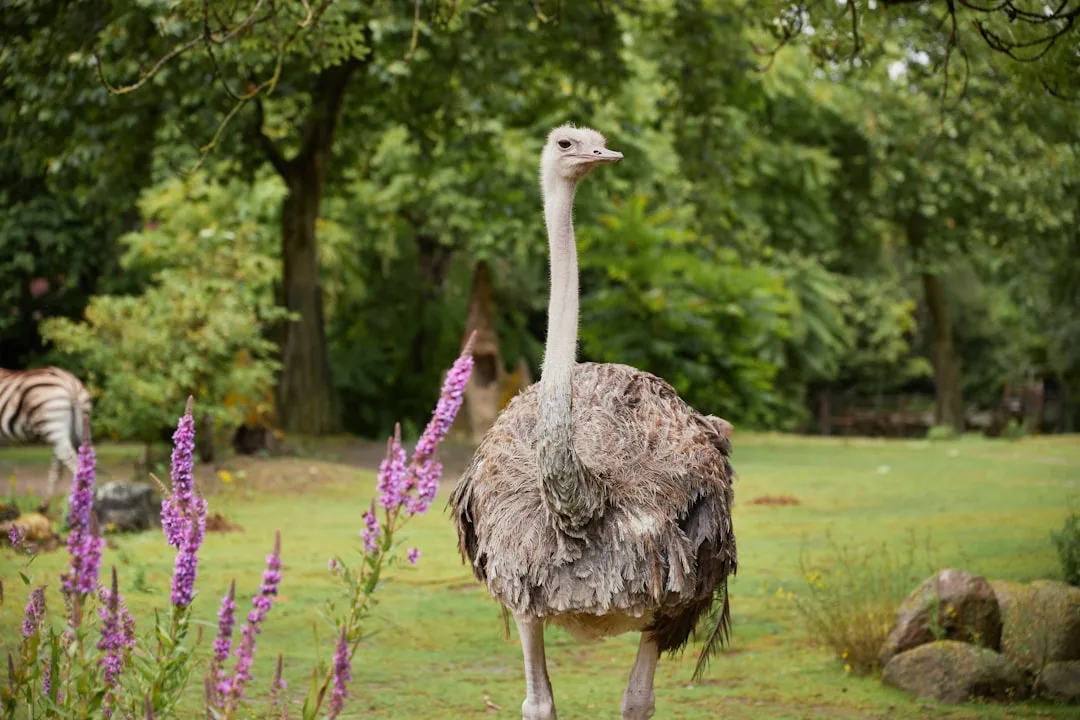
The ostrich is the largest living bird on Earth and the fastest animal on two legs. A mature male common ostrich stands nearly three metres tall, weighs as much as a professional rugby pack front row, lays eggs the size of a small cannonball, and can outrun every terrestrial predator in Africa over flat ground. It is also the only bird in the world with exactly two toes - a structural oddity that mirrors the hooves of horses and antelope rather than the claws of any other feathered animal.
This guide covers every aspect of ostrich biology and ecology: size, speed, anatomy, diet, reproduction, communal nesting, defence, conservation status, and the relationship between ostriches and humans. It is a reference entry, not a summary - so expect specifics: kilograms, kilometres per hour, stride lengths, egg weights, populations, and verified records.
Etymology and Classification
The scientific name Struthio camelus combines two Greek and Latin roots. Struthio comes from the Greek strouthos, meaning 'large bird'. Camelus means 'camel'. Greek naturalists called the bird strouthokamelos - 'camel-sparrow' - because the long neck, oversized eyes, two-toed feet, heat-tolerant physiology, and desert habitat all reminded them of the camel.
That name survives today in the German Strauss ('ostrich' and 'bouquet'), the French autruche, and the English word itself, all descended from strouthokamelos via Latin avis struthio.
The ostrich belongs to the ratites, a group of large flightless birds with flat breastbones and no keel to anchor flight muscles. Other ratites include the emu, the rhea, the cassowary, and the kiwi, along with several extinct species such as the moa of New Zealand and the elephant bird of Madagascar. Ratites are not a single clean lineage; molecular evidence shows they share a common ancestor with flying tinamous and that flight was lost several times independently across the group.
Ostriches themselves were long considered a single species with four living subspecies. In 2014, after genetic and morphological study, the Somali ostrich (Struthio molybdophanes) was formally elevated to full species status, leaving the remaining three living subspecies under Struthio camelus. A fifth subspecies, the Arabian ostrich (Struthio camelus syriacus), was hunted to extinction in the mid-twentieth century.
Size and Physical Description
Ostriches are the largest living birds by every standard measure - height, weight, egg size, leg length, and stride. Sexual dimorphism is significant, particularly in plumage colour.
Males:
- Height: 2.1-2.8 metres at top of head
- Weight: typically 100-160 kg
- Plumage: jet black body feathers with white wing and tail plumes
Females:
- Height: 1.7-2.0 metres
- Weight: typically 90-110 kg
- Plumage: uniform grey-brown, camouflaged for incubation
Chicks at hatching:
- Height: roughly 25 cm
- Weight: 900 g - the size of a large chicken
- Colour: buff with dark streaks for camouflage
The ostrich body plan is built entirely around running. The legs are long, heavily muscled at the thigh, and very slender at the shin and foot. Almost all the mass is concentrated close to the hip, which reduces the rotational inertia of each stride and allows extremely rapid leg cycling.
The wings are large but flightless and are used for balance, shade, courtship display, and thermal regulation. The neck is nearly a metre long and contains fifteen cervical vertebrae, one more than the average mammal.
The feet are perhaps the most striking feature of ostrich anatomy. Every other bird on Earth has three or four toes. The ostrich has two. The outer toe is small and claw-less; the inner toe is massively enlarged and carries a single 10 cm claw. The foot as a whole functions more like a hoof than a typical bird foot, with a thick cushioning pad on the underside that absorbs the shock of repeated 50-plus kilogram impacts at sprint speeds.
Built for Speed
Ostriches are the fastest running birds and the fastest bipeds alive today. Sustained cruising speed is 50-60 km/h. Running at 70 km/h for several kilometres at a time is routine. Short-burst top speed, measured on captive tracks and open savanna, reaches 96 km/h - faster than any racehorse.
Speed adaptations:
- Two-toed feet: reduced ground contact area, reduced weight
- Long slender lower legs: low rotational inertia
- Thick elastic tendons in the ankle: act as springs, storing and releasing energy at every step
- Short femur, long tibiotarsus: maximum leverage for each stride
- Concentrated thigh musculature: the 'drumstick' is enormous relative to body size
- Large air-sacs in the body cavity: efficient cooling during sustained effort
A sprinting ostrich covers five to six metres with each bound. Slow-motion video of wild birds running from predators shows both feet simultaneously off the ground for most of each stride - true running, not merely fast walking.
Compared on a cost-per-kilometre basis, ostrich running is among the most energetically efficient forms of terrestrial locomotion ever measured; research in the Journal of Experimental Biology shows that elastic recoil in the leg tendons provides about 50 per cent of the energy needed for each stride, meaning the birds get half their running energy effectively for free.
Speed is the ostrich's primary defence. A healthy adult can simply outrun lions, cheetahs (which give up after a few hundred metres), hyenas, and wild dogs across open ground. Ostriches also turn sharply at full speed by dropping one wing to act as an air brake and rudder.
The Largest Egg and Communal Nesting
Ostriches lay the largest eggs of any living bird. A single egg measures roughly 15 cm long, 13 cm wide, and weighs between 1.4 and 1.9 kg. In volume it is equivalent to roughly 24 chicken eggs. The shell is 2 mm thick and tough enough that a human adult can stand carefully on it without breaking it.
Despite their size, ostrich eggs are actually the smallest bird eggs relative to the body mass of the parent - a female ostrich's egg is about 1 per cent of her body weight, while a kiwi's egg, the record-holder, is nearly a quarter of its mother's mass.
Ostrich breeding biology is more complex than that of most birds and involves communal nesting. A territorial male establishes a shallow sand scrape as a nest. He then courts and mates with a single dominant major hen, which is his primary partner, as well as several additional minor hens. The major hen lays seven to ten of her own eggs first. Minor hens add theirs over the following days.
A finished nest may contain 40-60 eggs in a single scrape, although only about 20 will be actively incubated - the rest are pushed to the outside of the nest or abandoned.
Incubation is shared. The major hen sits by day, using her grey-brown plumage as camouflage against the sand. The black-plumaged male sits by night, invisible in darkness. Incubation lasts 42-46 days. Eggs are turned regularly using the beak, which is where the 'head in the sand' myth originates - observers see ostriches repeatedly lowering their head and neck into the nest scrape to rotate and check the eggs, which at a distance looks like burial.
Chicks hatch at roughly 900 g and are precocial - fully feathered, alert, and mobile within hours. Within days they can run at 50 km/h alongside their parents. Multiple clutches of chicks often merge into mixed creches guarded by a few dominant adults, producing the impression of enormous ostrich families. First-year mortality is extremely high, around 85 per cent, due primarily to predation by jackals, hyenas, lions, cheetahs, and eagles.
Diet and Digestion
Ostriches are omnivores with a strong plant bias. The core of the diet is grasses, shrubs, seeds, flowers, and fruit, with insects, small reptiles, and carrion taken opportunistically. Because open savanna forage is low in calories and nutrients, an adult ostrich typically spends most of the daylight hours feeding.
Typical diet breakdown:
| Food category | Approximate share by mass |
|---|---|
| Grasses, leaves, shrubs | 60-70% |
| Seeds, roots, flowers, fruit | 20-30% |
| Insects and small vertebrates | 5-10% |
Ostriches have no teeth. To break down tough plant material the birds swallow stones. These gastroliths sit permanently in the gizzard and act as a mechanical grinder, reducing fibrous vegetation to a digestible paste. A mature ostrich may carry more than one kilogram of gastroliths at any given time, and the stones wear down and are replaced continually through life.
The digestive tract is unusual for a bird in several respects. Ostriches have three functional stomachs (most birds have two), an elongated small intestine for extracting maximum nutrition from poor forage, and a large caecum where bacterial fermentation breaks down cellulose - a process more typical of grazing mammals than of birds. Their urinary system is also mammalian-like: urine is separated from faeces rather than expelled together as in almost every other bird.
Ostriches can go for extended periods without drinking, producing metabolic water from food and reducing water loss through concentrated urine and dry faeces. When free water is available, however, they drink deeply.
Defence and the Lion-Killing Kick
Running is the ostrich's first and preferred defence. When flight is impossible - a cornered bird, a defending parent, or a trapped animal - the ostrich turns to its second defence, which is the kick.
The kick:
- Delivered forward and downward only
- Powered by heavily muscled thighs
- Leads with the inner toe and its 10 cm claw
- Delivers force estimated at several hundred kilograms
- Can disembowel a lion in a single strike
- Regularly kills farm workers globally each year
The inner claw is the key weapon. Unlike the talons of most birds, which are designed for gripping, the ostrich's claw is a single oversized spike on the leading toe. The kick motion drives this spike through muscle and abdominal wall. Documented cases exist of ostriches fatally wounding lions, leopards, hyenas, and humans. Captive ostriches on farms and in zoos are handled with care precisely because a startled territorial male can kill an experienced handler in seconds.
The kick is a strictly forward defence. Ostriches cannot kick sideways or backward effectively - an attacker approaching from behind can sometimes evade the strike, which is why predators such as lions and cheetahs prefer rear ambushes when hunting ostriches.
Eyes and Senses
The ostrich has the largest eye of any land animal - roughly 5 cm across, which is physically larger than the bird's own brain. The eye is positioned on the side of the head and gives the ostrich an almost complete panoramic view of its surroundings, with only a narrow blind spot directly behind. Visual acuity is exceptional: an ostrich can detect a moving predator at three kilometres on open ground.
This long-distance early warning system is why ostriches often share feeding areas with zebras, wildebeest, and antelope - the mixed herds benefit from the ostrich's early threat detection, while the ostriches benefit from the prey animals' sensitivity to ground vibration and scent.
Hearing is good, though less studied than vision. The nasal passage is long and the sense of smell appears limited. Taste is thought to be reduced compared to many birds.
Range, Habitat, and Subspecies
Wild common ostriches live across sub-Saharan Africa in a wide variety of open habitats: savanna grassland, semi-arid shrub, open woodland, and desert edge. They avoid dense forest and closed canopy habitat, which their running-based ecology cannot use. The North African subspecies historically ranged across the Sahel into the southern Sahara; its remaining population is now reduced to a few hundred birds in a handful of reserves and breeding facilities.
Living subspecies of Struthio camelus:
| Subspecies | Range | Conservation status |
|---|---|---|
| S. c. camelus (North African) | Sahel, southern Sahara | Critically Endangered |
| S. c. massaicus (Masai) | Kenya, Tanzania | Least Concern |
| S. c. australis (Southern) | Southern Africa | Least Concern |
The separately recognised Somali ostrich (Struthio molybdophanes) lives across the Horn of Africa - Somalia, Ethiopia, and northern Kenya - and is distinguished by a bluish neck and thighs, a genetically distinct lineage, and a slightly different behavioural repertoire. It is listed as Vulnerable by the IUCN.
Conservation Status and Threats
The common ostrich as a species is listed as Least Concern on the IUCN Red List. Wild populations number in the hundreds of thousands and are stable across much of East and Southern Africa. Commercial ostrich farming - which produces leather, meat, feathers, and eggs - supports millions of birds worldwide and reduces pressure on wild populations. South Africa, Namibia, Israel, the United States, China, and Australia all support commercial ostrich industries.
Outside these strongholds the picture is harsher. The North African subspecies is Critically Endangered with only a few hundred individuals left, victim of a century of overhunting for meat and feathers, habitat loss, and persistent drought. The Arabian subspecies is already extinct - the last wild bird was killed in the 1960s. The Somali ostrich is Vulnerable and declining due to poaching, egg collection, and habitat encroachment.
Primary threats to wild ostriches:
- Poaching for meat, feathers, leather, and eggs
- Habitat loss to agriculture and grazing
- Drought and desertification in the Sahel
- Fence entanglement and vehicle collisions in farming regions
- Nest raiding by humans and domestic animals
- Hybridisation between wild and escaped farm stock
Conservation action focuses on protected area management in East and Southern Africa, captive breeding and reintroduction for the North African subspecies, and anti-poaching enforcement. The commercial farming industry provides a paradoxical but real conservation benefit by decoupling global demand for ostrich products from pressure on wild populations.
Ostriches and Humans
Humans have used ostriches for at least 100,000 years. Archaeological sites in South Africa contain engraved ostrich eggshell beads dated to 75,000 years ago - some of the earliest known decorative objects in human history. Ancient Egyptian and Mesopotamian art depicts ostrich plumes as symbols of status, and ostrich feathers remained a major luxury commodity into the twentieth century.
The modern ostrich industry began in South Africa in the 1860s when farmers realised that birds could be raised in enclosures for their feathers, then used as fashion accessories across Europe and North America. The feather boom collapsed after World War I with changes in fashion. The industry reinvented itself after 1945 around leather and meat.
Ostrich leather, recognisable by its distinctive follicle pattern, is now one of the most valuable exotic leathers in the world. Ostrich meat is low-fat, high-protein, and marketed as a healthier alternative to beef.
Live ostriches are farmed in at least fifty countries. Breeding stock is carefully managed to preserve genetic diversity, and escaped farm ostriches occasionally establish feral populations - small groups exist in parts of Australia and the southwestern United States.
Human-ostrich conflict occurs in farming regions and among tourists who underestimate the danger of a territorial adult. Documented fatalities from kicks occur almost every year worldwide. Ostrich racing - a fairground entertainment in which humans ride adult birds - is legal in several countries but produces frequent injuries and is criticised on welfare grounds.
Related Reading
- Ostrich: The Fastest Running Bird on Earth
- Flightless Birds: When Wings Became Optional
- Cassowary: The World's Most Dangerous Bird
- Emperor Penguin: Antarctic Survivor
- Kiwi: New Zealand's National Bird
References
Relevant peer-reviewed and governmental sources consulted for this entry include IUCN Red List assessments for Struthio camelus and Struthio molybdophanes (2018, 2024), published research in the Journal of Experimental Biology on ratite locomotion, The Auk on ostrich breeding biology, Biology Letters on the 2014 taxonomic split of the Somali ostrich, and long-term field data from Kenya's Tsavo and Samburu research programmes.
Commercial farming figures reflect the most recent statistics published by the South African Ostrich Business Chamber and the FAO.
Frequently Asked Questions
How big is an ostrich?
Adult male common ostriches (Struthio camelus) stand 2.1-2.8 m tall and weigh 100-160 kg, making them by a wide margin the largest living bird. Females are smaller at 1.7-2.0 m and 90-110 kg. The head alone can reach almost 3 m off the ground when the neck is fully extended. Newly hatched chicks are already the size of a farmyard chicken, roughly 25 cm tall and 900 g in weight, and they grow at about 30 cm per month for the first six months of life.
No other living bird approaches this size - the next largest, the Somali ostrich, is closely related, and after that the cassowary and emu are noticeably smaller.
How fast can an ostrich run?
Ostriches are the fastest running birds on Earth and the fastest animals on two legs. They cruise at 50-60 km/h for extended periods, maintain 70 km/h over distance, and have been clocked at 96 km/h in short bursts. A single stride at sprint covers 5-6 m.
The anatomy behind this speed is striking: huge thigh muscles, long flexible legs, two-toed feet that reduce contact area and weight, and a springy tendon system in the lower leg that stores and releases elastic energy with each step. Their speed is the ostrich’s primary defence - most predators simply cannot catch a healthy adult in open country.
Why do ostriches only have two toes?
Almost every bird species has three or four toes. The ostrich is the sole living bird with only two. The outer toe is small and claw-less, while the inner toe is massively enlarged and carries a 10 cm claw. Functionally the foot works like an ungulate hoof - it reduces ground contact, cuts weight, and allows the leg to act as an efficient spring during high-speed running.
This two-toed design is a specialised adaptation for sustained open-country sprinting and evolved independently of similar hoof-like structures seen in mammals such as horses and antelope.
How big are ostrich eggs?
An ostrich egg is the largest egg of any living bird - roughly 15 cm long, 13 cm wide, and weighing 1.4 to 1.9 kg. A single egg holds the yolk and albumen equivalent of about 24 chicken eggs and takes 45-60 minutes to hard-boil. The shell is 2 mm thick and strong enough to support the weight of an adult human standing carefully on top.
Eggs are laid in shallow communal scrapes in the sand where a dominant hen may lay 7-10 eggs of her own and up to 6 secondary hens add further clutches, producing nests of 40-60 eggs. Only the dominant female and the territorial male incubate. Incubation takes 42-46 days.
Do ostriches really bury their heads in the sand?
No. The ‘head in the sand’ behaviour is a persistent myth with no basis in ostrich biology. What observers actually see is ostriches turning, rotating, and checking their eggs in shallow sand nests, which requires lowering the head and neck into the scrape for extended periods. From a distance this resembles burying the head.
Ostriches also lower the head and neck flat against the ground as a camouflage posture when threatened - the sandy colour of the neck and head blends with dry earth. The myth dates back to the Roman writer Pliny the Elder in the first century and was repeated without verification for centuries.
Are ostriches dangerous?
Ostriches can be extremely dangerous to humans and large predators alike, particularly during the breeding season or when defending chicks. A kick delivered with the powerful thigh muscles and 10 cm inner-toe claw can disembowel a lion, fatally injure a human, or crack large predator skulls. Captive ostriches on farms cause several human deaths per decade worldwide, almost always when handlers corner or startle a territorial male.
In the wild they generally prefer to run from trouble - at 70 km/h they usually can - but trapped or cornered birds attack without warning. The strike is always forward and downward; they cannot kick sideways or backward effectively.
How long do ostriches live?
Wild common ostriches typically live 30-40 years. A significant fraction of mortality happens in the first year - chicks face heavy predation from jackals, hyenas, cheetahs, lions, and raptors, and only about 15% of a nest reaches independence. Once adult, ostriches have few natural predators and can live out long lives. Captive ostriches on farms and in zoos regularly exceed 50 years because food supply, veterinary care, and protection are consistent.
The combination of late maturity (sexual maturity at 3-4 years) and long reproductive lifespan means a single dominant pair can produce hundreds of offspring across a lifetime.
Are ostriches endangered?
The common ostrich as a whole is listed as Least Concern on the IUCN Red List, with a stable wild population estimated in the hundreds of thousands and a very large captive population on commercial farms. However, the picture varies sharply by subspecies. The North African ostrich (Struthio camelus camelus) is Critically Endangered, with only a few hundred individuals left in the Sahel and heavy reliance on captive breeding and reintroduction programmes.
The Somali ostrich (Struthio molybdophanes), split off as its own species in 2014, is listed as Vulnerable due to poaching, habitat loss, and egg collection. Commercial ostrich farming in South Africa, Namibia, Israel, and the United States has taken pressure off some wild populations by supplying meat, leather, and feathers to international markets.