
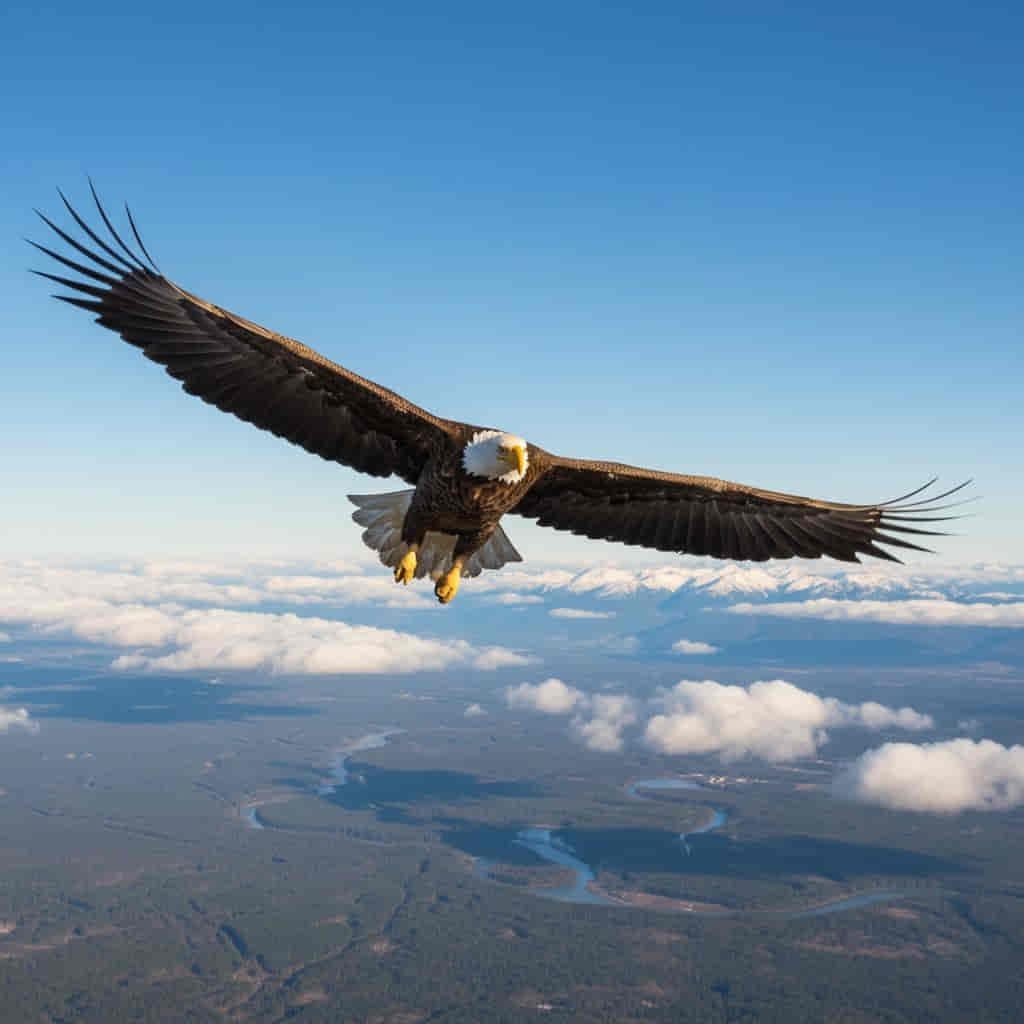
Are bald eagles actually bald?
No, bald eagles are not bald - their name comes from an Old English word 'balde' meaning white, referring to their distinctive white heads. Adults have fully feathered heads with bright white feathers, contrasting with their brown bodies. The full adult plumage (white head, dark body) develops over 4-5 years as juveniles molt through successive stages.
From 417 Pairs to 300,000 Individuals
In 1963, only 417 breeding pairs of bald eagles remained in the contiguous United States. The national bird of America was nearly extinct. DDT pesticide contamination had caused eggshell thinning throughout the population. Eggs were breaking before hatching. The species faced collapse.
Today, over 300,000 bald eagles live in North America. The population has recovered dramatically. Bald eagles were removed from the Endangered Species List in 2007.
This is one of the greatest conservation success stories in history, proof that given time and protection, even critically endangered species can recover.
The Animal
Bald eagles are large North American raptors.
Physical features:
- Females: 4.5-5.5 kg (larger)
- Males: 3-4 kg
- Wingspan: 1.8-2.4 meters
- Body length: 70-102 cm
- White head: fully developed at age 4-5
- Brown body: all life stages
- Yellow beak: distinctive
- Yellow eyes: with intense gaze
Not actually bald:
The name "bald" comes from Old English "balde" meaning white, referring to their white heads, not lack of feathers.
Life stages:
- Juvenile (1-2 years): all brown
- Immature (2-4 years): mottled white patches
- Young adult (4-5 years): transitioning
- Mature adult (5+ years): full white head and tail
The DDT Crisis
Bald eagles nearly went extinct.
The problem:
DDT pesticide used extensively 1940s-1970s:
- Used for agricultural pest control
- Mosquito population control
- Forestry applications
- General spraying
The effect on eagles:
- DDT accumulated in prey fish
- Eagles ate contaminated fish
- DDT concentrated in eagle bodies
- Interfered with calcium metabolism
- Eggshells became thin
- Eggs cracked during incubation
- Birth rates collapsed
Population collapse:
- 1940s: estimated 100,000+ eagles
- 1950s: dramatic decline noted
- 1963: only 417 breeding pairs (lower 48)
- 1970s: concern about total extinction
The role of Alaska:
Alaska never extensively used DDT:
- Populations remained healthy
- Kept species from complete extinction
- Later became source for recovery
- 70% of bald eagles currently Alaska
The Recovery
Conservation and legal protection saved them.
Key actions:
DDT ban (1972):
- Essential first step
- Agricultural pesticide restricted
- US domestic ban
- International follow-up bans
Endangered Species Act (1973):
- Legal protection
- Habitat preservation
- Penalty for harm
- Ongoing enforcement
Specific protection:
- Bald and Golden Eagle Protection Act
- Prohibits disturbance
- Nest site protection
- Enforcement mechanisms
Captive breeding:
- Zoos contributed
- Hacking programs (releasing young)
- Various states participated
- Successful reintroductions
Natural recovery:
As habitat recovered:
- Natural expansion from Alaska
- Eggs began hatching successfully
- Population began growing
- Recovery accelerated
Timeline:
- 1963: 417 breeding pairs
- 1970: ~800 pairs
- 1980: ~2,500 pairs
- 1990: ~8,000 pairs
- 2000: ~18,000 pairs
- 2010: ~50,000 pairs
- 2023: ~74,000 pairs (total population 300,000+)
The milestones:
- 1995: Status changed from Endangered to Threatened
- 2007: Removed from Endangered Species List entirely
- Today: Species is secure
Hunting and Diet
Bald eagles have diverse diets.
Dietary composition:
- Fish: 56% (when available)
- Birds: 28%
- Mammals: 14%
- Other: 2%
Fish prey:
Common species:
- Salmon (when spawning)
- Trout
- Catfish
- Perch
- Shad
- Various others
Bird prey:
- Waterfowl (ducks, geese)
- Smaller raptors rarely
- Young birds
- Various species
Mammal prey:
- Carrion (significant portion)
- Small mammals
- Rabbits
- Young deer (rare)
- Dead animals
Hunting techniques:
Active hunting:
- Surprise swooping attacks
- Fish caught just below surface
- Quick strikes on waterfowl
- Chasing and catching
Scavenging:
- Up to 50% of diet in some areas
- Dead animals from other predators
- Roadkill
- Fishing boat discards
Piracy:
- Stealing food from ospreys
- Intimidating other birds
- Opportunistic stealing
- Common behavior
Where They Live
Bald eagles occupy North America extensively.
Current range:
Major populations:
Alaska:
- 70% of all bald eagles
- Largest population worldwide
- Never severely affected by DDT
- Source of recovery
Pacific Northwest:
- Oregon, Washington, BC
- Coastal populations
- Fishing-dependent
- Strong numbers
Great Lakes:
- All five lakes
- Significant breeding populations
- Seasonal winter concentrations
- Recovery completed
East Coast:
- Chesapeake Bay famous
- Florida populations
- New England
- Full recovery
Southwest:
- Less common
- Water-dependent
- Some lake populations
Canada:
- Significant populations
- Similar to US distribution
- Protection ensured
Mexico:
- Northern Baja California
- Pacific coast
- Limited range
Habitat requirements:
- Large bodies of water
- Abundant fish populations
- Large trees or cliffs for nests
- Access to perches
- Relatively undisturbed areas
Urban adaptation:
Remarkably, bald eagles now:
- Nest in suburban areas
- Use urban river corridors
- Tolerate human proximity
- Adapt to city life
- Surprise residents
Nesting Behavior
Bald eagle nests are impressive.
Nest characteristics:
- Location: tall trees, cliffs, bridges
- Height: usually 20-30 meters up
- Size: massive, grows yearly
- Material: sticks, branches, grass
- Lining: soft grass, feathers
- Weight: up to 2.9 tons (record)
Record nests:
- Largest: 9 feet diameter, 20 feet deep (Florida)
- Heaviest: 2.9 metric tons (St. Petersburg, FL)
- Age: some used 35+ years
Construction:
- Both partners build
- Repair annually
- Add material each year
- Major investment
Nest site fidelity:
- Pairs return to same nest
- Same territory annually
- Rebuild as needed
- Can last decades
Reproduction
Eagle breeding follows specific patterns.
Sexual maturity:
- Adults: 4-5 years
- Full white head/tail
- Ready to breed
Courtship:
Spectacular displays:
- "Cartwheel" maneuver
- Pairs lock talons mid-air
- Spiral downward together
- Separate at last moment
- Dramatic mating ritual
Also:
- Chases and dives
- Perched duets
- Prey presentations
- Synchronized flight
Pair bonding:
- Generally lifelong
- Sometimes multi-year
- If partner dies, seek new
- Long-term commitment
Breeding cycle:
Eggs:
- 1-3 eggs (usually 2)
- Laid in early spring
- Incubation: 35 days
- Both parents incubate
Hatching:
- Staggered (1-2 days apart)
- First chick has advantage
- Sometimes sibling rivalry
- High mortality of second chick
Fledging:
- 10-12 weeks in nest
- Gradually develop flight
- First flight attempt
- Continued parental care
Independence:
- 1-2 years with parents
- Learn fishing skills
- Gradually disperse
- Seek own territory
Lifespan
Bald eagles live long lives.
Typical lifespan:
- Wild: 20-30 years
- Captivity: up to 38 years
- Recorded oldest: 38 years wild
Mortality factors:
- Vehicle collisions: major cause
- Power line electrocutions: significant
- Lead poisoning: from ingested ammunition
- Starvation: during winter
- Disease: various
Population health:
- Overall population healthy
- Individual threats remain
- Generally improving
- Long-term monitoring essential
Social Behavior
Eagles have complex social structures.
Pair bonds:
- Generally lifelong
- Strong commitment
- Territorial together
- Coordinated parental care
Territorial defense:
- Aggressive against intruders
- Size of territory varies
- Primarily defended during breeding
- Some roosting concentrations
Communal roosting:
- Multiple eagles at rich food sources
- Salmon runs attract hundreds
- Winter congregations
- Tolerance increases when food abundant
Communication:
- Calls: distinctive eagle calls
- Not the "cry" in films: those are red-tailed hawk calls
- Body language: posturing, displays
- Multiple call types: different purposes
Cultural Significance
Bald eagles hold special cultural positions.
American symbol:
History:
- 1782: Selected as national bird
- Featured on Great Seal
- Coat of arms
- Military insignia
- Flag variations
Symbolism:
- Freedom
- Strength
- Independence
- Liberty
- Power
Indigenous cultures:
Native American significance:
- Sacred to many tribes
- Eagle feathers have ceremonial importance
- Symbols of courage and wisdom
- Religious observance
- Cultural heritage
Legal framework:
- Bald and Golden Eagle Protection Act (1940): primary protection
- Native American Religious Freedom Act: feather access
- Various state laws: additional protections
- CITES: international protection
Modern Protection
Bald eagles remain legally protected.
Current protections:
- Migratory Bird Treaty Act: protects
- Bald and Golden Eagle Protection Act: specific protection
- Federal offense: to harm or kill
- State laws: additional protections
Violations and penalties:
- Significant fines ($10,000+)
- Possible prison time
- Civil and criminal penalties
- International coordination
Ongoing threats:
Despite recovery:
- Lead poisoning: from ammunition (major issue)
- Vehicle strikes: significant mortality
- Power line electrocution: ongoing problem
- Habitat loss: continuing concern
- Pollution: other chemicals
- Climate change: affecting habitats
Famous Bald Eagles
Several individual eagles have become famous.
Challenger:
- Famous non-flying eagle
- American Eagle Foundation
- Educational ambassador
- National Anthem performances
- Cultural icon
Various pairs:
- Big Bear Lake pair (California)
- Washington D.C. area pairs
- Florida celebrity eagles
- Many tracked pairs nationally
Webcam eagles:
- Live-streamed nests popular
- Decorah Eagle (Iowa) especially
- Millions of viewers
- Educational platform
- Conservation awareness
Comparison with Golden Eagle
Both eagles are large North American raptors.
Visual differences:
Bald eagle:
- White head (adults)
- Brown body
- Yellow beak
- Larger head proportion
Golden eagle:
- Golden-brown head
- Dark body throughout
- Dark beak
- Sleeker appearance
Habitat preferences:
Bald eagle:
- Near water (fish-dependent)
- Lakes, rivers, coasts
- Major bodies of water
Golden eagle:
- Open terrain
- Mountains and plains
- Desert edges
- Hunting grounds
Diet:
Bald eagle:
- Fish primary
- Diverse overall
- Scavenging significant
Golden eagle:
- Mammal-focused
- Hunts rabbits, squirrels
- Strong predator role
Cultural roles:
Bald eagle:
- American national bird
- Symbol of freedom
Golden eagle:
- Mexican national bird
- Symbol in multiple cultures
Why Bald Eagles Matter
Bald eagles represent multiple significant values.
Ecological:
- Apex predators in their ecosystems
- Top of food webs
- Fish population regulation
- Keystone species impact
Cultural:
- American national symbol
- Indigenous cultural significance
- Freedom symbolism
- Conservation inspiration
Conservation:
- Recovery success story
- Proof that conservation works
- Inspiration for other species
- Ongoing protection model
Scientific:
- Research subject
- Population monitoring
- Behavioral studies
- Recovery biology
Tourism:
- Wildlife viewing major
- Economic value
- Education opportunities
- Community engagement
The Recovery Continues
Bald eagles are thriving, but protection continues.
Monitoring:
- USFWS ongoing oversight
- Federal protection maintained
- Citizen science contribution
- Population tracking
New challenges:
- Lead poisoning: persistent issue
- Urban collisions: growing concern
- Climate change: long-term concern
- Plastic pollution: ocean populations
- Human development: pressure
Future outlook:
- Species secure for now
- Continued monitoring essential
- Protective laws important
- Climate adaptation needed
- Long-term vigilance required
The Symbol Restored
Every bald eagle soaring over American waters today represents the successful reversal of near-extinction.
They were down to 417 breeding pairs. That's fewer than 1,000 birds in the lower 48 states. The national symbol of the United States was nearly extinct due to pesticide contamination.
Today, they thrive. More than 300,000 bald eagles live across North America. They nest in all 48 contiguous states. They return to historical ranges. They soar above lakes and rivers throughout the continent.
Their recovery proves:
- Environmental regulations work
- Legal protection saves species
- Natural systems can recover
- Time + protection = results
- Species not automatically lost
The national bird's recovery is one of the greatest conservation stories in American history. It demonstrates that even dire situations can reverse with adequate protection.
Every bald eagle is evidence that we can save species we've harmed. They serve as reminders that conservation succeeds, not just fails. They inspire continued effort for other species still in crisis.
The white-headed birds soaring above American skies today are more than national symbols. They're living proof that we can restore what we nearly destroyed, if we commit the resources and time required.
Lead Poisoning: The Silent Killer That Remains
Although DDT is gone, bald eagles continue to die from another chemical threat: lead from spent ammunition and fishing tackle. When hunters take deer or other large game with lead-core bullets, fragments of lead remain in the discarded offal, which eagles scavenge. Even microscopic lead fragments can be lethal to a raptor; the bird's acidic digestive tract dissolves the metal rapidly into bloodstream-available forms.
"We looked at more than 1,200 bald and golden eagles admitted to raptor rehabilitation centers across the United States between 2010 and 2018. Forty-six percent of bald eagles showed lead levels consistent with clinical poisoning. Of those birds, most had lead fragments clearly attributable to hunting ammunition. This is not a mystery problem - we know exactly where the lead is coming from." - Krysten Schuler, Cornell Wildlife Health Lab, Science, 2022 [1]
A landmark 2022 study in Science by Vincent Slabe and colleagues estimated that lead poisoning reduces the population growth rate of bald eagles by 3.8 percent per year in some regions - roughly doubling the rate at which adult birds die. The study concluded that lead-related mortality is currently the most significant human-caused threat to both bald and golden eagles, surpassing collisions and poisoning combined [2].
| Lead Source | Proportion of Eagle Lead Exposure Cases |
|---|---|
| Hunter-killed carcasses with lead ammunition | ~70% |
| Ingested lead fishing tackle | ~15% |
| Lead-contaminated wetlands and historic mining | ~10% |
| Lead shot (now banned for waterfowl but persistent in soils) | ~5% |
California in 2019 became the first US state to ban lead ammunition for all hunting, following years of evidence that lead fragments in carcasses were poisoning California condors, golden eagles, and bald eagles. Non-lead copper and tungsten alternatives are widely available and perform equivalently in the field, but adoption remains uneven across the United States.
Global Range and Taxonomy
The bald eagle (Haliaeetus leucocephalus) belongs to the sea eagle genus Haliaeetus, which contains eight living species distributed across the Northern Hemisphere, Africa, and Australasia. The genus diverged from other eagle lineages roughly 20 to 25 million years ago. Two subspecies of bald eagle are recognized, distinguished primarily by size.
| Species | Distribution | Body Mass (female) | IUCN Status |
|---|---|---|---|
| Bald eagle (H. leucocephalus) | North America | 3.5-5.5 kg | Least Concern |
| Steller's sea eagle (H. pelagicus) | Russian Far East | 6.5-9.5 kg | Vulnerable |
| White-tailed eagle (H. albicilla) | Europe and northern Asia | 4.0-7.5 kg | Least Concern |
| African fish eagle (H. vocifer) | Sub-Saharan Africa | 3.2-3.6 kg | Least Concern |
| Madagascar fish eagle (H. vociferoides) | Madagascar | 2.5-3.5 kg | Critically Endangered |
| White-bellied sea eagle (H. leucogaster) | South Asia, Australia | 2.8-4.2 kg | Least Concern |
| Pallas's fish eagle (H. leucoryphus) | Central Asia | 2.1-3.7 kg | Endangered |
| Sanford's sea eagle (H. sanfordi) | Solomon Islands | 3.0-4.0 kg | Vulnerable |
"The bald eagle's recovery is a national story in America, but it is also part of a global conversation about what it takes to save a sea eagle. Its cousins - the Steller's eagle of Kamchatka, the white-tailed eagle of Europe, the Madagascar fish eagle - each tell a different chapter of the same story." - Todd Katzner, US Geological Survey, Journal of Wildlife Management, 2019 [3]
Wintering Concentrations and Long-Term Monitoring
One of the most dramatic wildlife spectacles in North America is the winter concentration of bald eagles at locations with abundant ice-free water and salmon carcasses. In Alaska's Chilkat Valley, more than 3,500 bald eagles gather each November along a single four-mile stretch of the Chilkat River, drawn by a late salmon run that the rest of the state lacks.
At Klamath Basin on the Oregon-California border, winter eagle counts have exceeded 500 birds at a single roost. Along the Mississippi River, open water below dams attracts several thousand eagles each winter from the frozen Canadian interior.
The Kalenux Team reviewed Christmas Bird Count and US Fish and Wildlife Service midwinter eagle survey data back to 1979. The midwinter count rose from approximately 13,000 eagles in 1979 to nearly 70,000 eagles in 2020. The numbers flatten in the most recent years, suggesting that the rapid recovery phase is ending and the population is approaching carrying capacity in many regions.
The recovery curve followed almost exactly the pattern predicted by conservation biologists in the 1970s - slow initial response to protection, rapid exponential growth once breeding populations stabilized, and eventual leveling as the best habitats filled up.
References
- Schuler, K. L., et al. (2022). "Lead toxicosis in wild raptors: a national assessment." Science, 375(6582), 779-782.
- Slabe, V. A., Anderson, J. T., Millsap, B. A., Cooper, J. L., Harmata, A. R., Restani, M., Crandall, R. H., et al. (2022). "Demographic implications of lead poisoning for eagles across North America." Science, 375(6582), 779-782.
- Katzner, T. E., et al. (2019). "Status and conservation of the world's sea eagles." Journal of Wildlife Management, 83(6), 1331-1345.
- US Fish and Wildlife Service. (2021). "Bald Eagle Population Size: 2020 update." USFWS Division of Migratory Bird Management.
- Buehler, D. A. (2020). "Bald Eagle (Haliaeetus leucocephalus)." Birds of the World, Cornell Lab of Ornithology.
Related Articles
- Eagle Vision: 8 Times Better Than Humans
- Peregrine Falcon: The Fastest Animal on Earth
- Harpy Eagle: The Amazon's Most Powerful Predator
Frequently Asked Questions
Are bald eagles actually bald?
No, bald eagles are not bald - their name comes from an Old English word ‘balde’ meaning white, referring to their distinctive white heads. Adults have fully feathered heads with bright white feathers, contrasting with their brown bodies. The full adult plumage (white head, dark body) develops over 4-5 years as juveniles molt through successive stages.
Young bald eagles are actually all brown and can be mistaken for golden eagles until they develop adult coloration. The species’ scientific name Haliaeetus leucocephalus means ‘white-headed sea eagle’ in Greek. Their white head serves multiple functions: social signaling to other bald eagles, species identification from distance, and possibly advertising adult status. Their distinctive appearance made them an ideal choice for national symbolism.
The name ‘bald’ was chosen in 1782 when the species was selected as the national bird of the United States. Many Americans today are surprised to learn the ‘bald’ doesn’t refer to lack of feathers.
How did bald eagles recover?
Bald eagle recovery is one of the greatest conservation success stories in history. From just 417 breeding pairs in 1963 (nearly extinct in lower 48 states), populations recovered to over 300,000 individuals by 2023. The primary cause of decline was DDT pesticide contamination, which caused eggshell thinning - eggs cracked before hatching.
Recovery happened through: DDT banned in US in 1972, Endangered Species Act protection since 1978, captive breeding programs in 1980s, habitat protection at key sites, Alaska populations (unaffected by DDT) serving as source for recolonization, and extensive public education. Alaska retained healthy populations throughout the crisis - their lower 48 populations recovered through natural expansion plus relocation efforts.
By 1995, bald eagles were reclassified from Endangered to Threatened. In 2007, they were removed from Endangered Species list entirely. By 2023, breeding pairs exceeded 74,000. They remain legally protected but no longer endangered. This recovery proves conservation works when given adequate time and resources.
Where do bald eagles live?
Bald eagles inhabit North America almost exclusively, from northern Mexico to northern Alaska and Canada. Their range includes all 48 contiguous United States (all states have breeding populations), Alaska (largest population), Canada (significant populations), and Mexico (northern Baja California and Pacific coast).
They require specific habitat features: abundant fish populations (primary prey), access to large bodies of water (rivers, lakes, coasts), large trees or cliffs for nesting, and minimal human disturbance near nest sites. Major populations exist at: Alaska (approximately 70% of all bald eagles), Pacific Northwest, Great Lakes region, Chesapeake Bay, Florida, and various river systems.
They migrate seasonally in northern parts of range - Alaska populations are mostly resident, while lower 48 populations may move between summer breeding and winter feeding areas. Their recovery has brought them to: urban areas (surprisingly adaptable), suburban river corridors, recreational waterways, and many places they hadn’t been seen in decades. Their presence now is widespread across North America.
Do bald eagles mate for life?
Bald eagles generally mate for life, forming long-term pair bonds that can last 10-20+ years. They return to the same nests annually, continuously adding material until nests can weigh over 1 ton (record: 2.9 tons). Their courtship includes spectacular aerial displays - ‘cartwheel’ maneuvers where pairs lock talons and spiral downward, separating at the last moment. They return to the same territory and often the same nest each year.
Bonds form around age 4-5 when eagles reach sexual maturity. If one partner dies, the survivor typically finds a new mate rather than remaining alone. They don’t form immediate reunions - the new bond must be established through courtship rituals. Their fidelity relates to territory and nest investment, not pure romantic bonding. The combined effort of defending territory, building/maintaining nests, and raising young makes partnership essential.
Their long lifespans (up to 38 years in wild) allow for decades of successful partnerships. Their commitment to specific nest sites means pairs often raise dozens of offspring over their lifetimes together.
What do bald eagles eat?
Bald eagles are primarily fish-eating raptors but actually have diverse diets. Their consumption: 56% fish (when available), 28% birds, 14% mammals, and 2% turtles/other prey. They are opportunistic hunters. Fish preferences include salmon, trout, catfish, and various others. They can catch fish of up to 5-6 pounds flying. Common birds eaten: waterfowl (ducks, geese), smaller raptors (though rarely), and various smaller species.
Mammals consumed: carrion (significant portion of diet), small mammals like muskrats and beavers, and occasionally larger animals when fresh dead. They are also known scavengers - up to 50% of diet can be carrion in some populations. Their hunting techniques include: surprise swooping attacks on surface fish, shallow water wading for crabs, steals from other birds (piracy), and carcass exploitation.
Winter diet shifts heavily to carrion in many regions as fishing becomes difficult. They can go days without food using stored energy. Their adaptable diet is part of what allows them to thrive in varied environments across North America.