
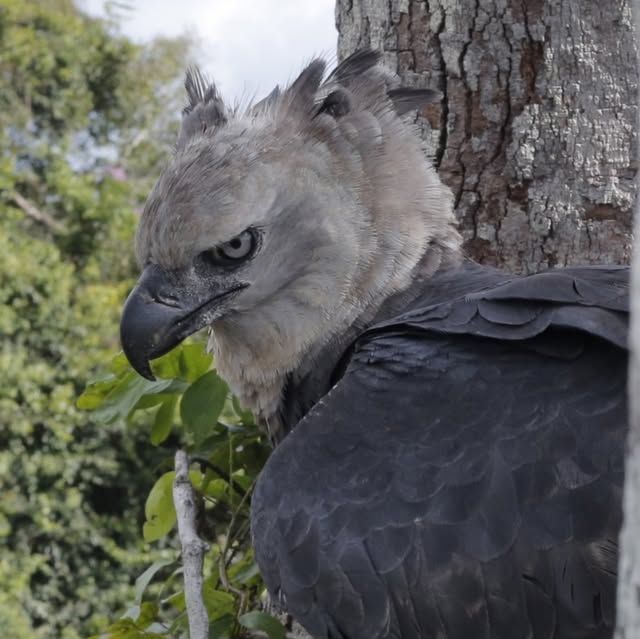
How powerful is a harpy eagle?
Harpy eagles (Harpia harpyja) are the most powerful raptors in the Americas, with talons that can exert pressure of 530 PSI and reach lengths of 13 cm - longer than a grizzly bear's claws. Their rear talons alone are 12. 5 cm long. Females weigh 6-9 kg with 2-meter wingspans, while males are smaller at 4-6 kg.
Talons Longer Than a Grizzly Bear's Claws
A 9-kilogram harpy eagle descends silently through the Amazon canopy. It carries 13-centimeter talons, longer than a grizzly bear's claws. Its legs are as thick as a small child's wrist. It strikes a howler monkey sitting in a treetop, piercing through vital organs with a single crushing grip.
This is the harpy eagle (Harpia harpyja), the most powerful raptor in the Americas and one of the most impressive birds of prey on Earth. Their strike force is strong enough to break the spines of prey larger than most cats.
The Animal
Harpy eagles are among the largest raptors.
Physical features:
- Females: 6-9 kg (larger)
- Males: 4-5 kg
- Wingspan: 1.76-2.24 m
- Body length: 86-107 cm
- Legs: extremely thick
- Talons: 13 cm long (rear talon)
- Grip strength: 530 PSI
Distinctive features:
The crown:
- Distinctive feathered crest on head
- Raised when alert
- Flattened when calm
- Species identifier
The legs:
- Enormously thick
- Comparable to human arm
- Strongest of any bird
- Designed for gripping
The talons:
- Longer than grizzly bear's claws
- Rear talon 12.5 cm
- Front talons 10 cm
- Lethal weaponry
Power and Strength
Harpy eagles are physically extraordinary.
Grip strength:
- Talon force: 530 PSI
- Far exceeds: most raptors
- Comparable to: larger predators
- Capable of: killing large prey
Kill capacity:
Can kill prey up to 20 kg:
- Sloths (5-9 kg typical)
- Howler monkeys (7-9 kg)
- Deer fawns (when accessible)
- Other large rainforest mammals
Strike mechanics:
- Explosive acceleration from branch
- Short-distance pursuit
- Precise strike targeting
- Full-power grip on impact
- Immediate incapacitation
Comparison to other raptors:
- Golden eagle: 400 PSI
- Bald eagle: 300 PSI
- Red-tailed hawk: 200 PSI
- Harpy eagle: 530 PSI
Biological power:
Their leg muscles:
- Largest of any bird relative to body
- Dense, fast-twitch fibers
- High metabolic demand
- Supports extreme force output
Hunting in the Canopy
Harpy eagles are rainforest specialists.
Hunting strategy:
Patient perching:
- Sit on prominent branches
- Watch canopy for hours
- Up to 12 hours of waiting
- Monitor multiple areas
The strike:
- Spot prey in canopy
- Calculate approach
- Launch with powerful beats
- Navigate through trees
- Strike prey in branches
- Continue with prey in talons
Flight characteristics:
Unlike soaring eagles:
- Short wings for maneuverability
- Explosive burst speed
- Precise flight control
- Through dense canopy
- Not designed for long-distance soaring
Prey selection:
Preferred prey:
- Sloths: often 80% of diet in some regions
- Monkeys: multiple species
- Porcupines: regional prey
- Iguanas: large reptiles
- Coatis: small mammals
- Young deer: when accessible
- Parrots: occasional large birds
Capture and consumption:
After successful kill:
- Carry prey to feeding perch
- Pluck feathers/fur if needed
- Tear meat with beak and talons
- May consume prey over multiple days
- Cache leftover food
Where They Live
Harpy eagles inhabit tropical American rainforests.
Range:
- Mexico: northern extent (rare)
- Central America: Belize through Panama
- Colombia: significant populations
- Venezuela: present
- Guianas: important population
- Brazil: largest population
- Peru: extensive range
- Bolivia: present
- Ecuador: present
- Paraguay: southern extent
Habitat requirements:
Very specific needs:
- Primary lowland rainforest
- Undisturbed canopy
- Large territories (up to 6,000 ha)
- Tall emergent trees
- Dense prey populations
- Minimal human disturbance
Why specific:
They cannot thrive in:
- Secondary forest
- Fragmented habitats
- Areas with significant logging
- Open landscapes
- Human-dominated regions
Lost range:
Harpy eagles have lost:
- Much of Mexico
- Parts of Central America
- Agricultural conversion zones
- Most fragmented forests
The Nesting Behavior
Harpy eagle breeding is elaborate.
Nest construction:
- Built in tallest emergent trees
- 30+ meters above ground
- Massive stick platforms
- Up to 1.5 m in diameter
- Used for decades
Location:
- Tops of largest trees
- Clear flyways
- Visible from distance
- Difficult for predators
- Strategic positioning
Reproduction:
- Sexual maturity: 4-5 years
- Mating: typically for life
- Clutch: 2 eggs usually
- Incubation: 56 days
- Parental care: both parents
- Fledgling: 6 months
Offspring development:
After hatching:
- First chick survives (usually)
- Second chick often dies
- Dependent on parents 2-3 years
- Slow, intensive care
- Eventually leaves nest area
Breeding frequency:
- One chick every 2-3 years
- Slowest among eagles
- Essentially no recovery if chick lost
- Long-term relationship crucial
Social Behavior
Harpy eagles are mostly solitary.
Social structure:
- Adult pairs bond for life
- Territorial against other eagles
- Slight interaction outside breeding
- Young eventually disperse
- Adults defend large territories
Communication:
- Distinctive calls (carrying long distances)
- Territorial advertisement
- Pair coordination
- Parental signals to chicks
Territorial defense:
- Aggressive against conspecifics
- Fights can be violent
- Both partners defend
- Clear boundaries maintained
Breeding coordination:
- Partners synchronize activities
- Share hunting/incubation
- Complex relationship
- Long-term cooperation
Scientific Research
Harpy eagles are subjects of intensive study.
Research priorities:
Population monitoring:
- Camera traps
- Nest surveys
- Satellite tracking
- Genetic analysis
Ecology:
- Habitat requirements
- Prey selection
- Territory dynamics
- Climate adaptation
Conservation biology:
- Population viability
- Recovery potential
- Captive breeding success
- Reintroduction programs
Research challenges:
- Inaccessible rainforest habitat
- Wide territories to survey
- Limited observation opportunities
- Expensive fieldwork
Notable research institutions:
- Panama's Peregrine Fund: major harpy research
- Brazilian partners: Amazon research
- Peruvian conservation: Andean forest focus
- International collaborations: multiple projects
Conservation Status
Harpy eagles face serious threats.
IUCN status:
Vulnerable (declining population).
Population estimate:
- 20,000-50,000 mature individuals
- Declining across most of range
- Regional variations
- Some populations stable
Major threats:
Deforestation:
- Primary threat
- Amazon loss significant
- Agricultural conversion
- Mining impacts
- Infrastructure development
Hunting:
- Illegal shooting
- Revenge killings (mistakenly perceived as threat)
- Body parts trade
- Cultural persecution
Habitat fragmentation:
- Isolated populations
- Genetic diversity loss
- Reduced prey base
- Recovery impossible
Prey depletion:
- Rainforest mammals declining
- Bushmeat trade
- Cascading effects
- Forces alternative prey (conflict)
Climate change:
- Amazon drying
- Fire risks
- Habitat shifts
- Long-term concerns
Conservation efforts:
- Protected areas in range
- Captive breeding programs
- Community education
- International cooperation
- Scientific research
- Captive reintroduction
Cultural Significance
Harpy eagles hold special cultural positions.
Indigenous cultures:
- Sacred in some Amazonian traditions
- Powerful symbols
- Associated with strength and wisdom
- Featured in folklore
- Traditional reverence
Modern Americas:
- National bird of Panama
- Symbol of conservation
- Tourism attraction
- Educational importance
- Featured on currency
Scientific importance:
- Umbrella species
- Biodiversity indicator
- Research subject
- Conservation target
- Ecosystem health measure
Captive Breeding
Some zoos maintain harpy eagles.
Notable programs:
- Panama (Peregrine Fund): extensive program
- US zoos: several participate
- Brazilian zoos: education focus
- Various institutions: scientific roles
Breeding success:
- Limited compared to many raptors
- Complex social requirements
- Slow reproduction
- Difficult captive environments
Reintroduction:
- Some programs attempted
- Panama notable success
- Limited numbers released
- Long-term viability questioned
Purpose of captive populations:
- Insurance against wild extinction
- Research opportunities
- Education and awareness
- Future reintroduction material
- Public engagement
Comparison to Other Eagles
Harpy eagles contrast with different eagle types.
Versus Philippine Eagle:
- Both powerful apex predators
- Similar size range
- Both endangered
- Different ranges (Americas vs Philippines)
- Comparable hunting style
Versus Golden Eagle:
- Harpy: forest specialist
- Golden: open terrain hunter
- Both powerful but different builds
- Different prey specialization
Versus Crowned Eagle:
- African counterpart
- Similar forest specialist
- Monkey-eating specialty
- Both very endangered
- Convergent evolution
Versus Steller's Sea Eagle:
- Steller's larger body
- Harpy more powerful legs
- Different habitats
- Different diets
- Both record-sized raptors
The Forest's Apex
Every wild harpy eagle represents the top of the Amazon food chain.
In their rainforest habitat:
- Nothing hunts them (adults)
- They hunt largest prey possible
- Maintain ecosystem balance
- Indicator of forest health
Their presence means:
- Healthy primary forest
- Prey populations intact
- Limited human disturbance
- Connected habitats
Their absence means:
- Degraded forest
- Food web disruption
- Ecosystem failure
- Conservation alarm
The disappearing kingdom:
Harpy eagles thrived before European arrival. Their population collapse mirrors Amazon deforestation - both accelerating since 1950s. Their future depends entirely on protecting remaining primary rainforest.
Each breeding pair requires up to 6,000 hectares. Multiply that by potential population. The math shows: we need massive undisturbed rainforest to save them.
Why Harpy Eagles Matter
They represent ecological, biological, and cultural significance.
Ecological role:
- Apex predators
- Food web regulators
- Ecosystem indicators
- Biodiversity guardians
Biological significance:
- Most powerful raptor (American)
- Unique adaptations
- Specialized hunting
- Evolutionary success story
Conservation value:
- Flagship species
- Umbrella protection
- International cooperation
- Rainforest conservation focus
Cultural importance:
- National symbols
- Indigenous significance
- Educational value
- Ecotourism appeal
The Kingdom in the Canopy
Every harpy eagle hunting through Amazon rainforest represents the pinnacle of raptor evolution.
They combine extreme power with forest navigation capability. They can kill prey much larger than most birds handle. They can navigate through dense canopy that would defeat open-country eagles. They wait patiently for hours before striking.
Their 13-centimeter talons are purpose-built tools for specific hunting - gripping and penetrating arboreal prey. Their 530 PSI grip strength matches any other raptor and exceeds most.
But they're declining. Amazon deforestation continues. Fragmented forests can't support them. Their slow reproduction cannot recover from losses. The number of breeding harpy eagles in the wild continues to drop.
Every wild harpy eagle is irreplaceable. Every one represents 4-5 years of parental investment before reaching breeding age. Every breeding pair takes 2-3 years to fledge a single chick. Every chick represents decades of potential ecosystem contribution.
If Amazon deforestation continues at current rates, harpy eagles may face range contractions too severe for viable populations. Their future hinges on rainforest protection decisions being made now.
For now, they persist in remnants of primary rainforest. Each one continues doing what harpy eagles have always done - patrolling canopy territories, watching for prey, striking with extraordinary power, raising the next generation of apex American raptors.
The Biomechanics of the Strike
The harpy eagle's hunting technique has been studied in detail through captive feeding trials and high-speed video analysis of wild kills. The Kalenux Team has compiled published measurements comparing its physical performance with other large raptors.
| Raptor | Body Mass (female) | Talon Length (hallux) | Grip Force | Typical Prey Mass |
|---|---|---|---|---|
| Harpy eagle | 7.5-9 kg | 12.5-13 cm | ~530 PSI | 3-9 kg (up to 20 kg) |
| Philippine eagle | 6-8 kg | 11 cm | ~500 PSI | 2-8 kg |
| Steller's sea eagle | 6.5-9.5 kg | 9 cm | ~320 PSI | 1-4 kg |
| Golden eagle | 3.5-6 kg | 8 cm | ~400 PSI | 1-5 kg (up to 15 kg) |
| Crowned eagle | 3-4.5 kg | 9.8 cm | ~430 PSI | 2-30 kg prey mass |
| Verreaux's eagle | 4-5 kg | 7 cm | ~250 PSI | 1-4 kg |
"The harpy eagle hunts by ambush from a concealed perch inside the mid-canopy. It does not soar above the forest like a buteo. It watches, waits, sometimes for many hours, and then launches a lethal strike that must succeed on the first attempt. The prey often does not see the eagle at all until the talons are already closing." - Eduardo Inigo-Elias, Peregrine Fund, Journal of Raptor Research, 2007 [1]
The strike itself typically covers less than 20 meters from perch to prey and is completed in under two seconds. The eagle folds its wings partially, accelerates with a short pump, and leads with extended talons. Impact with prey generates force sufficient to break the spinal column of mid-sized monkeys; one study of captive strikes recorded peak impact decelerations of 14 g on the prey surrogate.
Conservation Status and Range
Formerly distributed from southern Mexico through much of South America, the harpy eagle has been extirpated from most of Central America and significant portions of Brazil. The most recent population modeling suggests that the species persists in only about 52 percent of its historical range, with the largest remaining contiguous populations in the Amazon basins of Brazil, Peru, Colombia, Venezuela, and the Guianas.
"Every harpy eagle nest we find in fragmented landscapes is a ghost - a pair persisting where their lifetime reproductive output will likely fail to replace themselves. For this species, anything short of intact primary forest is a demographic sink." - Everton Miranda, Peregrine Fund Brazil, Scientific Reports, 2019 [2]
Miranda's 2019 study of 16 harpy eagle nests across fragmented Amazonian landscapes found that pairs in areas with less than 50 percent remaining forest cover failed to raise any chicks to fledging over a multi-year study, while pairs in areas with more than 70 percent forest cover successfully raised chicks every two years. The species cannot persist in the fragmented mosaic landscapes that now dominate much of the southern and eastern Amazon.
The news is not entirely grim. The Peregrine Fund's captive breeding program in Panama has produced more than 40 released individuals since 2001, with documented breeding success by several of them in the wild. The program's long-term goal of a self-sustaining Central American population remains distant but not impossible.
Community-based conservation programs in southeastern Panama, working with Embera and Wounaan indigenous communities, have brought previously hunted harpy eagles into the fabric of local cultural identity in ways that offer a template for other regions.
References
- Inigo-Elias, E. E. (2007). "Harpy eagle (Harpia harpyja) foraging behavior and prey selection in the Darien Region, Panama." Journal of Raptor Research, 41(3), 199-208.
- Miranda, E. B. P., et al. (2019). "Breeding the world's largest eagle in small forest patches: why deforestation leads to harpy eagle demographic failure." Scientific Reports, 9, 20326.
- Robinson, S. K. (1994). "Habitat selection and foraging ecology of raptors in Amazonian Peru." Biotropica, 26(4), 443-458.
- Rettig, N. L. (1978). "Breeding behavior of the harpy eagle (Harpia harpyja)." The Auk, 95(4), 629-643.
- Vargas, J. J., Whitacre, D., Mosquera, R., Albuquerque, J., Piana, R., Thiollay, J. M., Marquez, C., et al. (2006). "Status and distribution of the harpy eagle (Harpia harpyja) in Central and South America." Journal of Raptor Research, 40(4), 282-297.
Related Articles
- Eagle Vision: 8 Times Better Than Humans
- Peregrine Falcon: The Fastest Animal on Earth
- Jaguar: The Americas' Skull-Crushing Predator
Frequently Asked Questions
How powerful is a harpy eagle?
Harpy eagles (Harpia harpyja) are the most powerful raptors in the Americas, with talons that can exert pressure of 530 PSI and reach lengths of 13 cm - longer than a grizzly bear’s claws. Their rear talons alone are 12.5 cm long. Females weigh 6-9 kg with 2-meter wingspans, while males are smaller at 4-6 kg. They can kill prey weighing up to 20 kg, including adult sloths, howler monkeys, and occasionally deer.
Their legs are as thick as a small child’s wrist and have muscles comparable in strength to a wrestler’s arm. Their strike force is among the strongest of any bird. They can break the spines of 8 kg monkeys in a single attack. Their kill methods include piercing through vital organs or breaking necks.
They have relatively small wings for their size (compared to soaring eagles), which reflects their rainforest lifestyle where maneuverability matters more than long-distance flight. Their powerful grasp is their primary hunting tool.
What do harpy eagles eat?
Harpy eagles primarily hunt medium to large arboreal mammals including monkeys, sloths, and occasionally reptiles and birds. Their diet composition is approximately 80% tree-dwelling mammals. Specific prey includes: sloths (primary prey in many regions), howler monkeys, spider monkeys, capuchins, porcupines, iguanas, opossums, agoutis, and young deer. They can take prey up to 17 kg - extraordinarily large for any bird.
Their hunting technique involves patient waiting (up to 12 hours) in a prominent tree branch, scanning for prey moving in the canopy. When prey is spotted, they launch into a short, rapid flight, striking prey in the trees and often continuing with the prey in their talons. They carry prey to feeding perches to consume.
Unlike many eagles that hunt in open spaces, harpy eagles are forest specialists, navigating through dense canopy with their relatively short wings. Their incredible strength allows them to kill prey significantly larger than what most birds could handle.
Where do harpy eagles live?
Harpy eagles inhabit tropical lowland rainforests from southern Mexico through Central America and into the Amazon basin of South America. Their range extends from Mexico (rare), through Belize, Guatemala, Honduras, Nicaragua, Costa Rica, Panama, Colombia, Venezuela, Guianas, Brazil (major population), Peru, Bolivia, Ecuador, and Paraguay. They prefer primary rainforest habitats - largely undisturbed tropical lowland forest.
They require: large territories (up to 6,000 hectares per breeding pair), tall emergent trees for nesting (usually 30+ meters), dense canopy prey populations, and minimal human disturbance. They are essentially absent from secondary forest and completely avoid areas with significant human activity. Their habitat requirements make them highly vulnerable to deforestation. Brazilian Amazon loss has particularly impacted them.
They are considered umbrella species - protecting harpy eagle habitat protects entire rainforest ecosystems. Their distribution is fragmented due to deforestation, and their populations are declining across most of their range.
How big are harpy eagles?
Harpy eagles are among the largest eagles on Earth, though not the longest-winged. Females weigh 6-9 kg (13-20 pounds) with wingspans of 176-224 cm (5.8-7.3 feet). Males are significantly smaller at 4-4.8 kg. Body length is 86-107 cm (2.8-3.5 feet). They are taller than most eagles when standing, with long legs designed for capturing tree-dwelling prey. Their size makes them the largest raptors in the Americas and among the largest in the world.
While Steller’s sea eagles and harpy eagles are comparable in weight, harpy eagles have the most massive legs and talons of any eagle. Their relatively short wingspan compared to their weight reflects rainforest hunting - soaring eagles have much longer wings. Their size limits them to specific habitats and prey. Juveniles reach adult size in 2-3 years but don’t achieve full breeding coloration until 4-5 years.
Their long lifespan (30+ years in wild) combined with slow maturation means populations recover very slowly from damage.
Are harpy eagles endangered?
Yes, harpy eagles are listed as Vulnerable by the IUCN and are declining across most of their range. Exact population estimates are difficult but suggest 20,000-50,000 mature individuals globally.
Their populations are declining primarily due to: deforestation (main threat - they need undisturbed primary rainforest), hunting (considered trophies in some regions, killed for body parts, fear-based shootings), collisions with power lines, prey depletion as large rainforest mammals decline, and capture for illegal pet trade. Their extreme habitat specificity makes them vulnerable to even localized forest loss.
Brazilian Amazon deforestation has dramatically affected populations. Conservation efforts include: protected areas covering primary rainforest, captive breeding programs at zoos (some successful), community education in range countries, international cooperation on rainforest protection, and research monitoring wild populations. Their slow reproductive rate (one fledgling every 2-3 years per pair) means recovery from any significant loss takes decades.
They are considered sentinel species for rainforest ecosystem health - harpy eagle decline indicates broader rainforest degradation.