
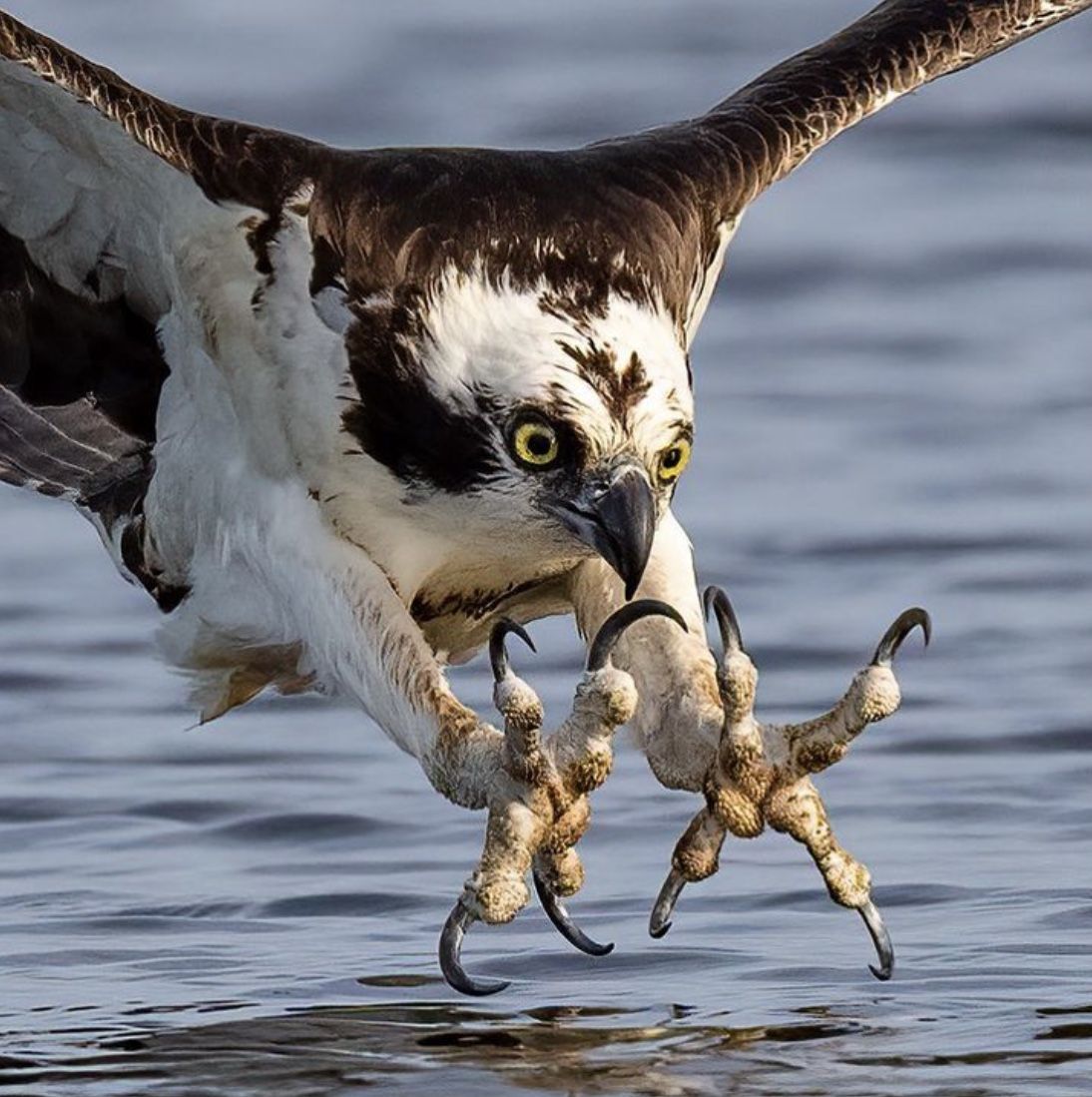
How do ospreys catch fish?
Ospreys (Pandion haliaetus) are uniquely specialized fish hunters among raptors. Their fishing technique involves hovering 10-40 meters above water, spotting fish through water surface, then diving feet-first at 80 km/h into water. Their feet hit the water first with talons fully extended, grabbing fish up to 2 kg. They can submerge up to 1 meter underwater.
The Bird That Catches Fish Underwater
Above a clear lake, an osprey hovers for thirty seconds, studying the surface. Something triggers its attention. Wings fold back. Legs extend forward. The bird dives at 80 km/h. Its feet hit the water first with talons locked open. It disappears beneath the surface briefly, then emerges with a 1 kg fish grasped firmly.
It flies to a perch, rotates the fish so it faces forward (reducing air resistance), and begins to feed.
This is the osprey (Pandion haliaetus), one of the most specialized raptors on Earth, found on every continent except Antarctica, uniquely adapted for underwater fishing among birds of prey.
The Animal
Ospreys are distinctive medium-large raptors.
Physical features:
- Length: 50-66 cm
- Wingspan: 127-180 cm
- Weight: 900-2,100 g (females larger)
- Color: dark brown on top, white underneath
- Distinctive: black eye mask
- Legs: extremely long
- Talons: curved for fish grip
- Plumage: dense and oily
Distinctive markings:
- White underparts with dark band
- Black mask through eyes
- Specific "M" pattern in flight
- Easy field identification
- Iconic appearance
The Diving Fisherman
Ospreys are raptor fishing specialists.
The technique:
Hovering:
- 10-40 meters above water
- Scanning surface
- Up to 30 seconds stationary flight
- Using wind and wingbeats
Spotting prey:
- Watch for fish near surface
- Binocular vision helps
- Specific fish behaviors signal
- Learned prey patterns
The dive:
- Fold wings back
- Legs extend forward
- Head tucked
- Accelerate downward
- Speed: 40-80 km/h
The strike:
- Feet hit water first
- Talons fully extended
- Can submerge 1+ meter
- Specialized leg structure
Recovery:
- Beat wings to rise
- Shake water from feathers
- Orient fish forward
- Fly to perch
Success rate:
- Approximately 25-50%
- Higher than most raptors
- Depends on water clarity
- Experience improves over time
Anatomical Adaptations
Ospreys evolved specifically for aquatic hunting.
Feet:
- Unique reversible outer toe
- Spiny pads for grip
- Curved talons lock on fish
- Specifically designed for scale-covered prey
Plumage:
- Dense and oily
- Waterproof
- Sheds water quickly
- Superior insulation
- Allows diving
Eyes:
- Nictitating membrane (third eyelid)
- Transparent, protects during dives
- Allows underwater vision
- Essential for diving
Nostrils:
- Valves close during dives
- Prevent water inhalation
- Automatic closure
- Critical adaptation
Joints:
- Flexible for water entry
- Handle impact force
- Rapid water exit
- Specialized for aquatic hunting
Bones:
- Denser for diving stability
- Support impact forces
- Long leg bones
- Unique among raptors
Global Distribution
Ospreys live on every continent except Antarctica.
North America:
- Alaska to Mexico
- All 50 states
- Major populations
- Summer breeders
Europe:
- Spain to Sweden
- UK populations
- Eastern Europe
- Migratory to Africa
Asia:
- Russia to Indonesia
- Japan to Middle East
- Multiple populations
- Various migration patterns
Africa:
- All coastal regions
- Major rivers
- Wintering grounds
- Year-round residents in some areas
Australia:
- Significant populations
- Pacific islands
- Tasmania
- Coastal regions
South America:
- Northern regions
- Wintering grounds
- Coastal populations
- Some permanent residents
Oceania:
- Pacific islands
- Occasional visitors
- Resident in some areas
Migration Patterns
Most ospreys migrate long distances.
North American migration:
- Breeding: summer in US/Canada
- Winter: Caribbean, Central/South America
- Distance: up to 10,000 km round trip
- Timing: August-October southward
European migration:
- Breeding: summer in Europe
- Winter: Africa (significant populations in Senegal, Mali)
- Distance: 6,000-7,000 km each way
Asian migration:
- Varies by population
- Some resident, some migratory
- Complex routes
- Climate-dependent
Crossing oceans:
- Gulf of Mexico
- Mediterranean Sea
- Sahara Desert
- Various challenges
Dangerous journey:
- Young ospreys particularly vulnerable
- Many die during migration
- Stormy weather devastating
- Food availability critical
Satellite tracking:
- Modern research uses satellite tags
- Reveals detailed routes
- Tracks individual migration
- Provides conservation data
Diet
Ospreys almost exclusively eat fish.
Primary prey:
Fish of various species:
- Trout, salmon (freshwater)
- Mackerel, herring (saltwater)
- Sole, flounder (shallow water)
- Catfish (rivers)
- Various other species
Secondary prey:
Rarely:
- Small reptiles
- Occasional birds
- Small mammals
- Almost exclusively fish
Daily consumption:
- 200-500 g per day
- Usually 2-4 fish daily
- Larger during breeding
- Growth-related variation
Prey size:
- Typical: 250-800 g fish
- Maximum: 2 kg fish
- Varies by individual
- Bigger fish preferred
Fishing approaches:
- Surface skimmers (usually)
- Deeper dives for specific species
- Schooling fish targets
- Mostly upper 2-3 meters
Nesting Behavior
Ospreys build massive nests.
Nest characteristics:
- Location: high, prominent sites
- Height: typically 20-30+ meters
- Size: grows over decades
- Weight: up to 500 kg or more
- Diameter: up to 2 meters
Construction:
- Both partners build
- Add material yearly
- Maintain continuously
- Replace damaged parts
Locations:
- Dead trees: preferred historically
- Cliffs: coastal areas
- Nest platforms: modern artificial
- Utility poles: power lines
- Buildings: urban adaptation
Artificial platforms:
- Widely used globally
- Support population recovery
- Reduce power line conflicts
- Popular conservation tool
Longevity:
- Nests used for decades
- Same pair returns annually
- Continuous additions
- Can become enormous
Reproduction
Osprey breeding follows seasonal patterns.
Sexual maturity:
- 3-4 years typically
- Both sexes
- Full breeding capability
Courtship:
- Skydancing: spectacular aerial display
- Fish presentation: male brings fish to female
- Coordinated flights: both partners
- Nest maintenance: important part
Pair bonding:
- Monogamous
- Often lifelong
- Return to same nest
- Strong partnership
Eggs:
- 2-4 eggs per clutch
- Incubation: 35-40 days
- Both parents incubate
- Heavily guarded
Chicks:
- Hatch 2-3 days apart
- First chick dominant
- Fed by both parents
- Grow rapidly
Fledging:
- 50-55 days to first flight
- Gradual independence
- Still dependent briefly
- Eventually disperse
Reproductive success:
- Variable success
- Environmental dependent
- Older pairs more successful
- High mortality of first-year birds
Conservation
Ospreys have shown remarkable recovery.
Historical challenges:
- Similar to bald eagles (DDT contamination)
- Population declined 1950s-1970s
- Near extinction in many regions
- Urgent conservation needed
Recovery:
- DDT banned 1972
- Protected species status
- Captive breeding programs
- Artificial nest platforms
- Habitat protection
Current status:
- IUCN: Least Concern globally
- Recovered: many populations
- Growing: still increasing in some areas
- Stable: maintaining numbers
Regional variations:
- Europe: strong recovery
- US: significant recovery
- Asia: varies by country
- Africa: stable populations
- Australia: growing populations
Threats:
Still facing:
- Fishing line entanglement
- Lead poisoning
- Climate change impacts
- Habitat loss
- Collisions
Habitat Requirements
Ospreys need specific conditions.
Water:
- Rivers: significant populations
- Lakes: widely used
- Coastal: many populations
- Estuaries: prime habitat
- Wetlands: important
Fish populations:
- Must be abundant
- Varies by species
- Water quality important
- Seasonal availability
Nest sites:
- Tall, prominent
- Safe from predators
- Stable locations
- Long-term viability
Migration corridors:
- Protected flyways
- Key stopover sites
- Food and rest locations
- Climate-stable routes
Ospreys and Humans
Positive relationships in many areas.
Cultural significance:
- Tourism value
- Wildlife viewing
- Educational importance
- Conservation ambassador
Urban adaptation:
- Some populations thrive in cities
- Coexistence examples
- Artificial nest platforms
- Positive human-wildlife example
Research subjects:
- Extensively studied
- Satellite tracking common
- Behavioral research
- Conservation success stories
Conflict (minimal):
- Fish farming issues
- Power line collisions
- Human disturbance
- Generally positive coexistence
Scientific Importance
Ospreys are significant research subjects.
Research areas:
Evolutionary biology:
- Unique phylogenetic position
- Divergence from other raptors
- Adaptive radiation
- Specialized evolution
Fishing biology:
- Diving mechanics
- Prey capture techniques
- Success rate analysis
- Comparative hunting
Conservation biology:
- Population recovery models
- Protection effectiveness
- Climate change response
- Management strategies
Migration ecology:
- Long-distance patterns
- Climate influences
- Stopover ecology
- Timing mechanisms
Special Research Projects
Some famous osprey research.
Chesapeake Bay monitoring:
- Long-term population study
- Recovery tracking
- Scientific findings
- Conservation insights
European satellite tracking:
- Migration route revelation
- African wintering grounds mapped
- Individual journey studies
- Adaptation research
North American recovery:
- Large-scale protection
- Platform construction
- Population growth tracking
- Model for other species
International cooperation:
- Global migration studies
- Multi-country projects
- Data sharing
- Conservation networks
Osprey vs Other Fish Eagles
Ospreys are unique among fish-eating raptors.
Versus bald eagles:
- Ospreys: specialized divers
- Bald eagles: surface grabbers
- Different techniques
- Different success rates
Versus African fish eagles:
- Different continents
- Similar ecological roles
- Both fish-eating specialists
- Unrelated evolution
Versus white-tailed eagles:
- European relatives
- Larger and heavier
- Different hunting style
- Broader diet
Versus Japanese eagles:
- Asian fish specialists
- Different species
- Different techniques
- Unique to regions
Why Ospreys Matter
Ospreys represent important biology.
Ecological:
- Fish population regulation
- Water quality indicators
- Ecosystem health measures
- Top aquatic predators
Conservation:
- Recovery success story
- International cooperation
- Population monitoring
- Successful protection
Scientific:
- Unique evolutionary lineage
- Specialized biology
- Migration research
- Adaptation studies
Cultural:
- Worldwide distribution
- Various cultural significance
- Educational importance
- Tourism appeal
The Global Fisher
Every osprey diving for fish somewhere in the world demonstrates millions of years of evolution for one specific ecological niche.
They could have remained generalist hunters like most raptors. Instead, they specialized entirely for fishing. Their entire body became optimized for this single task: long powerful legs, reversible toes, waterproof plumage, diving capabilities, worldwide distribution.
This specialization made them among the most widely distributed raptors. Fish are available globally. Ospreys can exploit fish everywhere. They travel between continents twice a year. They find fish in Arctic summers and tropical winters.
Their population crash and recovery demonstrate that specialized species can rebound. Their current abundance across the globe shows successful conservation. Their artificial nest platforms show human-wildlife cooperation.
Every summer, young ospreys learn from parents. Every fall, they migrate. Every spring, they return. They're masters of their specific niche, the fish hunters of the raptor world, specialized for something no other bird of prey does quite as well.
Dive Performance and Capture Success
The osprey is the only diurnal raptor that plunges fully into water. High-speed video studies by Paolo Rinaldi and colleagues at the University of Bologna quantified the biomechanics of the dive in Mediterranean ospreys, producing the first detailed performance envelope for the behavior.
| Dive Metric | Osprey Value | Comment |
|---|---|---|
| Typical attack height | 10-30 m | Scan for prey during slow flap-soar |
| Vertical dive speed at water impact | 45-70 km/h | Wings partially folded |
| Maximum underwater depth | ~1 m | Limited by buoyancy and air-filled feathers |
| Time submerged | 1-3 seconds | Limited by buoyancy rebound |
| Capture success rate | ~25-50% | Highest documented for any raptor on vertebrate prey |
| Fish size range | 100-800 g | Maximum recorded: 2.0 kg |
"No other raptor routinely strikes prey beneath the surface of the water. Ospreys do it so reliably that their capture success rate - consistently between one in four and one in two attempts - is higher than that of any eagle or falcon we have measured for any prey type." - Alan Poole, Ospreys: The Revival of a Global Raptor, 2019 [1]
The capture is made possible by a suite of unique anatomical features. Ospreys possess dense oil-rich feathers that shed water rapidly, a reversible outer toe that gives them an effective X-shaped grip (two toes forward, two back), and spicules - backward-pointing scales - on the soles of their feet that lock onto slippery fish scales. No other raptor has all four features together.
Migration Tracking and the African Connection
European ospreys have been satellite-tagged in large numbers since the 1990s, and the tracking data revolutionized our understanding of their annual cycle. The Scottish Wildlife Trust's "Tracking the Birds" program has followed dozens of Scottish and British ospreys through their entire annual migrations to West Africa and back, documenting precise routes, stopover sites, and individual variation.
"The first thing satellite tracking taught us about ospreys was how fast they move. A juvenile from a Scottish loch can be in Senegal three weeks after fledging, covering more than 5,000 kilometers with no prior experience and no adult guide. That is an extraordinary level of innate navigation." - Roy Dennis, Scottish osprey researcher, Ibis, 2010 [2]
Scottish and Scandinavian ospreys winter along the coasts of West Africa, concentrating in the Bay of Banc d'Arguin in Mauritania, the Sine-Saloum delta in Senegal, and the Bijagos archipelago off Guinea-Bissau. These wintering sites hold tens of thousands of European ospreys each year and are now formally protected under the Ramsar Convention on Wetlands.
North American ospreys show a different pattern. Eastern birds winter across Central and South America, with some tracked as far south as Argentina. Western North American ospreys winter in Mexico and Central America. Ospreys do not typically cross hemispheres as arctic terns do, but their individual migrations of 6,000 to 10,000 kilometers each way remain impressive.
Conservation Recovery and Artificial Nesting
The osprey's story parallels the bald eagle's. DDT-induced eggshell thinning caused catastrophic declines across North America and Europe between 1950 and the early 1970s. The Connecticut osprey population, for example, fell from 200 breeding pairs in the 1930s to fewer than 15 pairs by 1972. Similar declines occurred in Scotland, Germany, Sweden, and throughout the Chesapeake Bay region.
The recovery has been dramatic. DDT bans, endangered species protection, and - critically - the widespread installation of artificial nest platforms on utility poles and channel markers produced steady population growth from the late 1970s onward. The Kalenux Team reviewed current regional estimates:
| Region | Estimated Breeding Pairs (2020) | Trend Since 1980 |
|---|---|---|
| North America | 30,000+ | Quadrupled |
| Western Europe | 12,000-14,000 | Tenfold increase |
| Scandinavia | 7,000-9,000 | Strong recovery |
| Russia | 5,000-7,000 | Partial recovery |
| Asia | Variable, locally declining | Mixed |
| Australia | 1,000-2,000 (white-bellied subspecies) | Stable |
Chesapeake Bay now hosts roughly 10,000 breeding osprey pairs - the highest regional density on Earth. The recovery was made possible by human-built platforms. Without them, natural nesting trees in much of the bay have been lost to development, making the osprey an ongoing case study in dependence on active human management for continued population growth.
References
- Poole, A. F. (2019). Ospreys: The Revival of a Global Raptor. Johns Hopkins University Press.
- Dennis, R. H., and Dixon, H. (2010). "The use of satellite telemetry to study osprey migrations from Scotland." Ibis, 150(Suppl. 1), 86-91.
- Bierregaard, R. O., Poole, A. F., Martell, M. S., Pyle, P., and Patten, M. A. (2020). "Osprey (Pandion haliaetus)." Birds of the World, Cornell Lab of Ornithology.
- Martell, M. S., Henny, C. J., Nye, P. E., and Solensky, M. J. (2001). "Fall migration routes, timing, and wintering sites of North American ospreys as determined by satellite telemetry." The Condor, 103(4), 715-724.
- Washburn, B. E., Martell, M. S., Bierregaard, R. O., Henny, C. J., Dorr, B. S., and Olexa, T. J. (2014). "Wintering ecology of adult North American ospreys." Journal of Raptor Research, 48(4), 325-333.
Related Articles
- Bald Eagle: America's National Bird
- Harpy Eagle: The Amazon's Most Powerful Predator
- Peregrine Falcon: The Fastest Animal on Earth
Frequently Asked Questions
How do ospreys catch fish?
Ospreys (Pandion haliaetus) are uniquely specialized fish hunters among raptors. Their fishing technique involves hovering 10-40 meters above water, spotting fish through water surface, then diving feet-first at 80 km/h into water. Their feet hit the water first with talons fully extended, grabbing fish up to 2 kg. They can submerge up to 1 meter underwater.
Once they grab a fish, they emerge, shake water from feathers mid-air, and fly to a perch with the fish oriented headfirst (reducing air resistance). Their success rate is approximately 25-50% - considerably higher than most raptors, though many dives end without catches.
They have several specialized adaptations: long, strong legs for water entry, reversible outer toes to grasp slippery fish, dense oily feathers for waterproofing, clear membrane protecting eyes underwater, valves closing nostrils during dives, and barbed pads on feet for grip. Unlike other eagles that snatch fish from surface, ospreys truly dive - sometimes fully submerging before emerging with prey.
This fishing specialization makes them unique among raptors.
Why are ospreys on every continent?
Ospreys are found on every continent except Antarctica, making them one of the most widely distributed raptors globally. Their distribution includes: all of North America (excluding high Arctic), South America (coastal and major rivers), Europe (widespread), Africa (all coastal regions, major rivers), Asia (vast range), Australia (significant population), and Oceania (Pacific islands).
Their global distribution reflects: their fish-based diet (fish available worldwide), adaptability to various climates, strong flight abilities for migration, and tolerance for varied water bodies. They can thrive in freshwater (rivers, lakes) and saltwater (coastal, estuaries). Their range spans from Arctic coastal areas to tropical regions.
They migrate seasonally - North American ospreys travel to South America, European ospreys winter in Africa, and Asian populations move to Southeast Asia. This cosmopolitan distribution allows them to exploit fish populations across the globe. They’ve been called ‘the world’s most widespread raptor’ by some researchers, though the exact title varies by species definition.
Their successful adaptation to varied environments makes them a subject of significant evolutionary study.
How do ospreys survive underwater diving?
Ospreys have multiple evolutionary adaptations for their unique diving lifestyle. Their diving adaptations include: dense, oily plumage that sheds water quickly after emergence, specialized nasal valves that close during dives to prevent water inhalation, clear nictitating membrane (third eyelid) that protects eyes underwater while maintaining vision, long, powerful legs that survive high-impact water entry, long wings that help rapid water exit, curved talons that lock around fish automatically, reversible outer toes that rotate for enhanced grip, and specialized ankle joints for water entry angles.
They typically hit water feet-first at approximately 30-80 km/h - a forceful impact that would injure most birds. Their bodies are built to handle this impact: strong bone density, flexible joints, waterproof insulation, and quick recovery. The entire diving sequence from spot-and-strike takes approximately 10-15 seconds. They’ve been observed submerging up to 1 meter below surface. Their success rate of approximately 25-50% is much higher than most hunting predators, making them efficient despite the difficulty of fishing. Their specialized biology represents millions of years of evolution for specific predatory niche.
What is the lifespan of an osprey?
Ospreys typically live 7-10 years in the wild, with exceptional individuals reaching 25-32 years. The oldest documented osprey was 32 years old (Europe). Their relatively short average lifespan reflects high mortality from various causes.
Main mortality factors include: predation (especially of young), migration challenges (extremely dangerous), starvation (especially during harsh winters), disease (various pathogens), and collisions (with buildings, power lines). Despite this, they can live significantly longer under favorable conditions. Their breeding age is 3-4 years - so successful individuals have 5-10+ years of reproductive life.
They form long-term monogamous bonds and usually return to the same nest site annually. Older pairs produce more surviving offspring - experience improves breeding success. Their migratory habits are particularly dangerous - young ospreys face their first migration vulnerable. Captive ospreys live longer than wild counterparts, sometimes exceeding 30 years.
Their long reproductive potential in optimal conditions allows successful pairs to raise dozens of chicks across their lifetimes. Each successful older osprey represents significant conservation value for the species.
Are ospreys related to eagles?
Ospreys are more distantly related to eagles than most people assume. They belong to the family Pandionidae, distinct from both true eagles (Accipitridae) and falcons (Falconidae). Ospreys are the only member of their family - a unique evolutionary lineage that diverged from other raptors approximately 30 million years ago.
While they share general raptor characteristics (hooked beaks, talons, binocular vision), ospreys evolved their own specialized features for fishing. Genetic research has confirmed their distinct evolutionary path. They share common ancestry with eagles and hawks but specialized for fishing rather than the broader predation patterns of most raptors.
Their specialized adaptations (reversible toes, nictitating membrane for diving, dense oily plumage) evolved specifically for aquatic hunting. Other species in Pandionidae exist only in fossil record. Their unique position in raptor evolution makes them scientifically significant - they represent an independent evolution of predatory bird biology. Despite being called ‘fish eagles’ colloquially, they’re technically not true eagles.
Their taxonomy reflects millions of years of evolutionary specialization.