
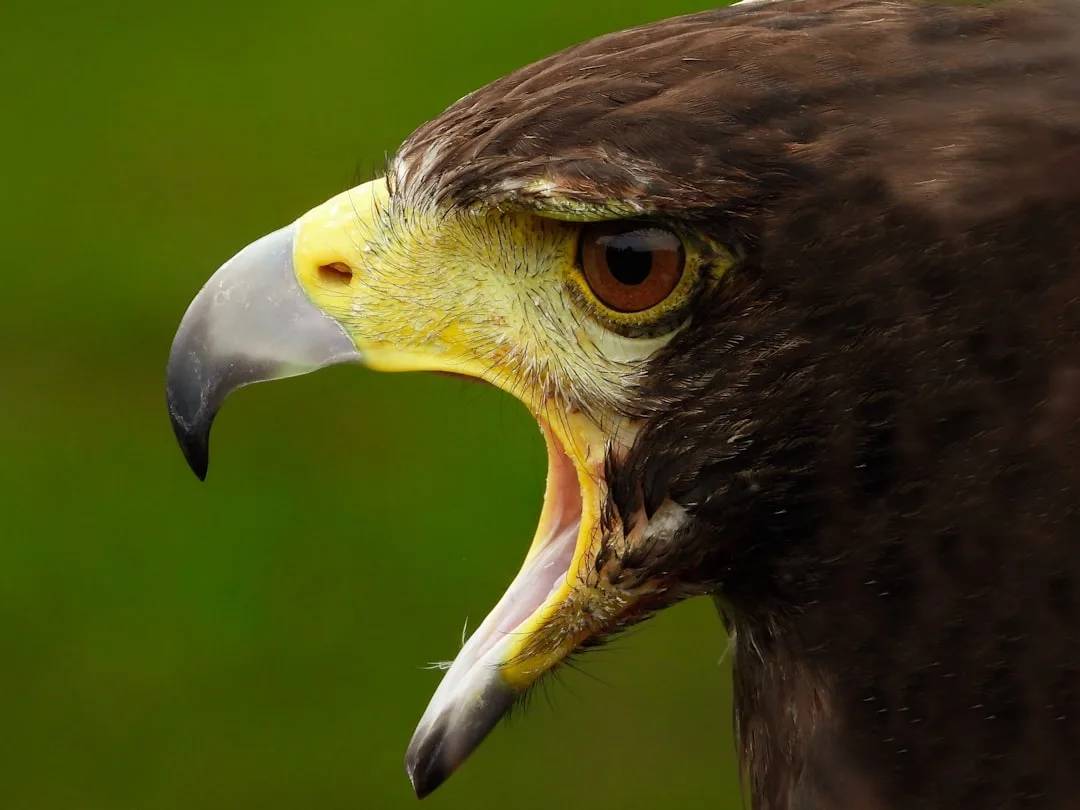
Do Harris's hawks really hunt in packs?
Yes, Harris's hawks (Parabuteo unicinctus) are unique among raptors in hunting cooperatively in family groups of 2-6 birds. This behavior is unlike any other hawk, eagle, or falcon species. Their hunting strategies include: 'surprise ambush' (spreading out around prey), 'relay attack' (taking turns pursuing fast prey), 'flush and block' (one bird flushes prey, others catch), and 'cornering prey' (coordinated positioning).
Cooperative Hunting Among Birds of Prey
In the Arizona desert at sunset, a group of five Harris's hawks patrols the sky. They're not individuals flying separately, they're working together. One flies high while others position below. They spot a jackrabbit in dense mesquite. The high bird flushes the rabbit. Others chase and catch.
This is pack hunting in raptors, behavior unique to Harris's hawks among all eagles, hawks, and falcons worldwide.
The Animal
Harris's hawks are medium-sized American raptors.
Physical features:
- Size: 46-59 cm length
- Wingspan: 103-120 cm
- Weight: 550-900 g (females larger)
- Color: dark brown with chestnut shoulders
- Underside: dark brown/black
- Tail: white base with black tip
- Distinctive appearance among hawks
Pack Hunting Behavior
Uniquely among raptors, they hunt cooperatively.
Group composition:
- 2-6 individuals typically
- Family-based groups
- Parents + grown offspring
- Multiple generations
- Social bonds important
Hunting techniques:
Surprise ambush:
- Multiple birds surround prey area
- One bird flushes
- Others catch
- Coordinated attack
Relay attack:
- Take turns pursuing
- Fresh birds replace tired
- Exhaust prey over distance
- Unique rotating pursuit
Flush and block:
- Birds positioned strategically
- Prevent escape routes
- Funnel prey
- Catch in open
Vertical strategy:
- One bird high
- Others low
- Coordinated timing
- Maximum area coverage
Role rotation:
Harris's hawks show:
- No rigid hierarchy
- Different birds take different roles
- Adaptation based on situation
- Cooperative mindset
Why Cooperate?
Pack hunting evolved for specific reasons.
Benefits of cooperation:
Larger prey possible:
- Jackrabbits weigh 2-3 kg
- Too large for single hawk
- Only catchable cooperatively
- Substantial food rewards
Higher success rates:
- Solo hunts: 10-30%
- Pack hunts: 40-60%
- Dramatic improvement
- More food available
Prey defense exposure:
- Predators defending themselves
- Multiple birds distract
- One catches while others occupy
- Reduces individual risk
Teaching opportunities:
- Young learn hunting
- See adults in action
- Practice in group
- Skills developed
Territory defense:
- Multiple birds defend
- More effective presence
- Resource protection
- Coordination advantages
Where They Live
Harris's hawks inhabit dry Americas habitats.
Range:
Southwest United States:
- Arizona (major population)
- New Mexico
- Texas
- Nevada (limited)
Mexico:
- Desert regions
- Scrublands
- Ranch lands
- Northern states
Central America:
- Dry forests
- Open woodlands
- Various countries
South America:
- Colombia dry areas
- Venezuelan plains
- Chilean drylands
- Argentine grasslands
Brazilian Pantanal:
- Limited populations
- Specific areas
Habitat preferences:
- Semi-desert
- Mesquite woodlands
- Saguaro cactus forests
- Open savanna
- Grasslands
- Dry scrubland
Specific requirements:
- Scattered trees/cacti for perching
- Open spaces for hunting
- Water access (can be distant)
- Prey populations
- Relative undisturbed
Diet and Hunting
Their prey varies by region.
Primary prey:
Lagomorphs:
- Black-tailed jackrabbits
- Desert cottontails
- Various rabbit species
- Primary target
Rodents:
- Wood rats
- Ground squirrels
- Pocket gophers
- Various small mammals
Birds:
- Quail
- Small songbirds
- Ducks (occasional)
- Pigeons
Reptiles:
- Snakes
- Large lizards
- Occasional turtles
Other:
- Carrion
- Insects (rare)
- Fish (rare)
Adaptability:
Different regions show:
- Primary prey shifts
- Seasonal variations
- Climate adaptations
- Resource availability
Social Structure
Harris's hawks have complex social lives.
Family groups:
- Extended families (2-6 individuals)
- Multiple generations together
- Long-term bonds
- Cooperative behavior
Breeding system:
- Polyandrous sometimes - females with multiple males
- Cooperative breeding common
- Offspring help raise siblings
- Unusual in raptors
Communication:
- Specific vocalizations
- Body language important
- Visual coordination
- Social signals
Territorial behavior:
- Groups defend together
- Cooperative defense
- Multiple birds intimidate intruders
- Strong family territory
Reproduction
Cooperative breeding is distinctive.
Sexual maturity:
- 2-3 years
- Both sexes mature together
- Family-based breeding
Breeding system:
- Often monogamous
- Sometimes polyandrous
- Multiple helpers at nest
- Extended family involvement
Eggs:
- 2-4 eggs per clutch
- Incubation 35 days
- Both parents incubate
- Family assists
Chicks:
- Fed by multiple family members
- Learn from older siblings
- Integrated into group
- Extended care period
Helpers at nest:
- Older offspring help
- Feeding younger chicks
- Nest defense
- Teaching behaviors
This unusual system:
- Rare in raptors
- Similar to some mammals
- Enhances reproductive success
- Strengthens family bonds
Falconry
Harris's hawks are exceptional falconry birds.
Why popular:
- Natural cooperative hunting
- Accepts human partner
- Intelligent and trainable
- Adaptable personalities
- Less aggressive than large eagles
Beginner recommendation:
Often first choice for new falconers:
- Forgive minor mistakes
- Work well with humans
- Good learning curve
- Legal in many regions
- Manageable size
Training approach:
- Unlike solo-hunting raptors
- Work with birds naturally
- Incorporate cooperative hunting
- Partnership rather than submission
- Mutual respect
Modern uses:
- Rabbit hunting (traditional)
- Airport bird control
- Pest control in urban areas
- Education and demonstrations
- Cultural events
Sports and hobby:
- International competitions
- Falconry clubs worldwide
- Traditional techniques
- Modern adaptations
Intelligence
Harris's hawks demonstrate significant cognition.
Cognitive abilities:
- Understanding cooperation
- Anticipating prey movement
- Learning from experience
- Social learning
- Problem-solving
Research findings:
Studies show they:
- Remember specific hunting strategies
- Adjust based on success/failure
- Recognize individual family members
- Coordinate complex maneuvers
- Show personality differences
Learning:
- Young learn from adults
- Practice with family
- Gradual skill development
- Experience-based improvement
- Cultural transmission
Compared to other raptors:
- More complex social behavior
- Better cooperation
- Enhanced communication
- Flexible problem-solving
- Adaptable intelligence
Conservation
Harris's hawks are generally doing well.
IUCN status:
Least Concern (stable populations).
Population:
- Healthy across range
- Some local declines
- Successful urban adaptation
- Conservation success
Threats (limited):
Habitat changes:
- Agricultural conversion
- Urban development
- Infrastructure expansion
- Generally adaptive
Falconry regulation:
- Well-regulated industry
- Captive breeding extensive
- Wild take restricted
- Sustainable practices
Collisions:
- Power lines
- Vehicles
- Some mortality
- Management improving
Diseases:
- West Nile virus
- Other emerging diseases
- Population monitoring
- Generally manageable
Protection:
- Migratory Bird Treaty Act
- Various national laws
- Sustainable falconry regulations
- Habitat protection in some areas
Scientific Significance
Harris's hawks are important research subjects.
Research areas:
Behavioral ecology:
- Only social raptor
- Cooperative hunting evolution
- Family structure
- Communication systems
Evolutionary biology:
- Why sociality evolved here
- Phylogenetic relationships
- Adaptive radiation
- Divergence from solitary raptors
Cognition research:
- Complex decision-making
- Social intelligence
- Problem-solving
- Learning capabilities
Conservation biology:
- Population monitoring
- Habitat requirements
- Climate adaptation
- Urban adaptation
Cultural Significance
Harris's hawks hold various cultural positions.
Native American:
- Various cultural traditions
- Sacred in some regions
- Symbolic representation
- Spiritual significance
Modern Americas:
- Falconry tradition
- Cultural importance in Southwest
- Symbol of desert life
- Tourism draw
Literature and media:
- Featured in nature documentaries
- Subject of falconry books
- Wildlife art
- Educational materials
Desert Life Adaptations
Their desert habitat shaped their biology.
Water conservation:
- Can tolerate limited water
- Get moisture from prey
- Efficient water retention
- Desert-adapted physiology
Temperature tolerance:
- Heat-resistant body
- Shade-seeking behavior
- Seasonal activity patterns
- Twilight hunting preference
Nesting challenges:
- Limited tree sites
- Use saguaro cacti
- Fence posts and towers
- Man-made structures
Prey availability:
- Match desert prey cycles
- Seasonal diet shifts
- Climate-driven behavior
- Adaptation to drought
Urban Adaptation
Harris's hawks thrive in some urban environments.
Urban populations:
- Phoenix, Arizona major
- Tucson suburbs
- Southwest urban areas
- Growing populations
Why urban:
- Abundant rodent prey
- Pigeon populations
- Reduced natural predators
- Unintended habitat
Behavior in cities:
- Adapted to human presence
- Reduced flight distance
- Urban prey targeting
- Remarkable coexistence
Conflict:
- Occasional pet attacks (small dogs, cats)
- Generally respectful of humans
- Residents often appreciate them
- Positive human-wildlife example
Why Harris's Hawks Matter
They represent unique biological and cultural value.
Biological:
- Only social raptor
- Unique cooperative hunting
- Evolution of sociality
- Behavioral research gold
Conservation:
- Successful adaptive species
- Urban coexistence model
- Habitat indicator
- Population health measure
Cultural:
- Falconry icon
- Desert symbol
- Scientific research subject
- Educational value
Scientific:
- Evolution of cooperation
- Social intelligence
- Comparative behavior
- Raptor biology
The Team Players
Every Harris's hawk in the American Southwest represents cooperative evolution that exists nowhere else in the raptor family.
They broke from the rigid solitary hunting pattern that characterizes eagles, hawks, and falcons elsewhere. They evolved family-based pack hunting that resembles wolves more than typical raptors. They cooperate naturally with humans in falconry relationships that feel more partnership than service.
Their intelligence supports complex social relationships. Their hunting success rates exceed solo raptors dramatically. Their family structures provide models of raptor cooperation previously unknown.
In the American Southwest desert, family groups continue their ancient patterns. Parents teach offspring. Siblings help each other. Multi-generational cooperation persists. Traditional family hunts continue.
Every desert sunset brings them flying together, the only raptors on Earth hunting as teams, demonstrating that even among traditionally solitary species, social evolution can develop when environmental pressures favor cooperation.
They are the outliers among raptors. The exceptions that prove rules. The social birds among solitary birds. And they thrive because their cooperation works - in desert ecosystems, in falconry partnerships, and in human cultural appreciation.
Cooperative Hunting Success Rates
The field data on Harris's hawk cooperative hunting come primarily from long-term studies in the Sonoran Desert by James Bednarz at the University of New Mexico. Bednarz's team tracked hundreds of hunts by marked individuals between 1984 and 1989 and produced the foundational quantitative measurements of how cooperation pays off.
| Hunting Mode | Success Rate | Energy Per Capture | Prey Size Captured |
|---|---|---|---|
| Solo hunt | ~25% | High per capita | Small (rabbits, quail) |
| Pair hunt | ~40% | Moderate | Small to medium |
| Trio hunt | ~55% | Lower per capita | Medium (hares, roadrunners) |
| Group of 4-7 (family) | ~65% | Lowest per capita | Medium to large |
"Harris's hawks are the only raptor in the world that routinely hunts as a cooperative pack. Their success rate rises linearly with group size up to about five birds, which happens to be the average adult group size we observed. Natural selection has apparently tuned the pack size to the optimal hunting unit." - James C. Bednarz, Science, 1988 [1]
Bednarz identified five distinct cooperative tactics:
- Surprise pounce: Three or more hawks perch at different angles around a prey hiding spot and converge simultaneously.
- Flushing run: One hawk runs or flaps along the ground to flush prey toward waiting group members overhead.
- Relay pursuit: Fresh hawks replace tired ones in a long chase, eventually exhausting the prey.
- Blocking: Hawks stationed at escape routes prevent prey from using familiar boltholes.
- Capture and carry: Multiple hawks carry heavy prey (jackrabbits can weigh more than a single hawk) to a feeding site.
No other raptor uses any of these tactics regularly. Cooperative hunting appears once in the family Accipitridae, and the Harris's hawk is it.
Evolutionary Origins of Sociality
Why this species and not others? Research by Dawn Whitmore and others has examined the ecological context that likely favored social hunting. The Sonoran Desert presents two relevant pressures: large, fast, agile prey (jackrabbits) that are difficult for a single hawk to catch, and limited cover that makes ambush hunting unreliable. Cooperative pack hunting solves both problems. A single Harris's hawk rarely catches a full-grown jackrabbit; a group of four catches them routinely.
Comparative phylogenetics places Harris's hawks in the genus Parabuteo, a lineage that diverged from the more typical buteos (including red-tailed hawks, rough-legged hawks, and ferruginous hawks) approximately 5 to 7 million years ago. The social behavior apparently evolved within this short window, making it one of the most recent major behavioral innovations in the raptor family.
"Sociality in raptors is like sociality in anything else - it evolves when the benefits to shared offspring outweigh the costs of sharing food. In the Sonoran Desert, with large prey and scarce nest sites, the math worked out. Harris's hawks cooperate because, for them alone among raptors, cooperation pays." - Dawn Whitmore, Ecological Monographs, 2003 [2]
Urban Ecology and Coexistence
Harris's hawks have expanded into urban environments across the American Southwest more successfully than almost any other raptor. Phoenix, Tucson, and smaller southwestern cities host thousands of breeding pairs, often nesting on utility poles, palm trees, and rooftop structures. Urban prey includes abundant rock pigeons, white-winged doves, and, unfortunately, unattended small pets.
| City | Estimated Breeding Pairs | Nest Substrate |
|---|---|---|
| Phoenix metro, AZ | 400-600 | Utility poles, palm trees |
| Tucson, AZ | 150-200 | Saguaro cactus, transmission towers |
| El Paso, TX | 80-120 | Power poles, date palms |
| Albuquerque, NM | 40-60 | Cottonwood trees, utility structures |
| San Antonio, TX | 20-40 | Live oak, utility poles |
The Kalenux Team reviewed long-term banding data and found that urban Harris's hawks have higher chick survival rates than their rural counterparts - likely because urban prey is abundant and vehicle traffic is the main mortality source, which affects only a subset of hunters. The adaptation is not passive.
Urban Harris's hawks hunt at slightly different times of day than rural birds, avoiding peak traffic hours, and many nests show signs of careful selection for sites insulated from human disturbance below.
References
- Bednarz, J. C. (1988). "Cooperative hunting in Harris's hawks (Parabuteo unicinctus)." Science, 239(4847), 1525-1527.
- Whitmore, K. D., and Dawson, J. W. (2003). "Nest site selection and breeding ecology of Harris's hawks in southern Arizona." Ecological Monographs, 73(2), 295-313.
- Dawson, J. W., and Mannan, R. W. (1991). "Dominance hierarchies and helper contributions in Harris's hawks." The Auk, 108(3), 649-660.
- Dwyer, J. F., and Mannan, R. W. (2007). "Cooperative hunting and bird control in urban environments." Journal of Wildlife Management, 71(2), 406-412.
- Bednarz, J. C., and Ligon, J. D. (1988). "A study of the ecological bases of cooperative breeding in the Harris's hawk." Ecology, 69(4), 1176-1187.
Related Articles
- Eagle Vision: 8 Times Better Than Humans
- Peregrine Falcon: The Fastest Animal on Earth
- Harpy Eagle: The Amazon's Most Powerful Predator
Frequently Asked Questions
Do Harris's hawks really hunt in packs?
Yes, Harris’s hawks (Parabuteo unicinctus) are unique among raptors in hunting cooperatively in family groups of 2-6 birds. This behavior is unlike any other hawk, eagle, or falcon species. Their hunting strategies include: ‘surprise ambush’ (spreading out around prey), ‘relay attack’ (taking turns pursuing fast prey), ‘flush and block’ (one bird flushes prey, others catch), and ‘cornering prey’ (coordinated positioning).
This pack hunting evolved specifically in their desert/dry region habitats where large prey can be effectively brought down through cooperation. They take turns being dominant during hunts - unusual flexibility in raptor behavior. A typical hunt involves 3-4 birds working together to flush jackrabbits or cottontails from dense cover. Once caught, they often share food.
This cooperative behavior includes: teaching young, shared nesting, communal defense, and cooperative breeding. Their social structure resembles wolf packs more than typical raptor life. This makes them invaluable for falconry, as they work with humans naturally.
How do Harris's hawks coordinate hunts?
Harris’s hawks coordinate hunts through sophisticated behavioral strategies developed through millions of years of social evolution. Their hunt coordination includes: visual signals (body positions, postures), vocalizations (specific calls during hunts), strategic positioning (spreading out around prey), role rotation (taking turns as pursuer vs blocker), timing coordination (synchronized attacks), and situational flexibility (adjusting strategy based on prey behavior).
Research shows they use specific techniques: ‘rolling pack pursuit’ where different individuals chase in turn, ‘surround and flush’ where multiple birds position to prevent escape, ‘tower attack’ with one bird flying high while others position below, and ‘communal distraction’ where some hawks distract while others attack. They show remarkable cognitive flexibility in these coordinated efforts - understanding cause and effect, anticipating prey movement, and cooperating with family members. This level of cooperation requires: communication skills, role recognition, cognitive flexibility, and social learning. These traits make them exceptionally intelligent compared to most raptors. Their coordination has been extensively studied and is now a subject in behavioral ecology research.
Where do Harris's hawks live?
Harris’s hawks inhabit dry environments of the Americas, from southwestern United States through Mexico, Central America, and into South America. Their range includes: Arizona and New Mexico (US), Texas (significant population), Mexican deserts and scrublands, Central American dry regions, Colombia dry areas, Venezuelan plains, Chilean and Argentine drylands, and parts of Brazilian Pantanal.
They prefer specific habitats: semi-desert with scattered vegetation, mesquite woodlands, saguaro-giant cactus forests, grasslands with some trees, and open savanna. They require water sources (though can be far from permanent water), suitable trees/cacti for nesting, prey populations (especially rabbits), and relatively undisturbed areas. Their range in the US has expanded somewhat due to human landscape modifications.
They’re most abundant in the southwestern US desert regions where their pack hunting is most effective. They avoid dense forests and heavily human-populated urban areas. Their distribution makes them symbol species of the American Southwest ecosystem.
What do Harris's hawks eat?
Harris’s hawks primarily hunt medium-sized mammals, particularly lagomorphs (rabbits and hares), with occasional birds and reptiles. Their typical diet includes: black-tailed jackrabbits (primary prey in Southwest US), desert cottontails, wood rats, gophers and other rodents, other small mammals, reptiles (including lizards and small snakes), and occasional birds.
Pack hunting allows them to tackle prey too large for single raptors - jackrabbits can weigh up to 2 kg, significantly larger than prey most hawks could handle alone. Their hunting success rate is approximately 40-60% - much higher than solo-hunting raptors (typically 10-30%). They can take prey weighing up to 3 kg through cooperative efforts.
Their diet varies by region: desert populations focus on rabbits, more forested areas include more rodents, and southern populations eat more reptiles. They’re opportunistic and will adjust prey selection based on availability. Their cooperative hunting makes them particularly effective predators of larger prey that would escape solo hunters.
Are Harris's hawks popular in falconry?
Yes, Harris’s hawks are among the most popular falconry birds due to their unique temperament and social behavior. They are considered the best raptors for beginner falconers because: natural pack hunting makes them cooperative with humans, adaptable and intelligent, easy to train (comparatively), less aggressive than larger eagles, hunting style matches falconer partnership, and they bond well with humans.
Unlike most raptors that work primarily alone, Harris’s hawks naturally integrate human handlers into their ‘pack.’ They can hunt alongside humans and dogs, pass back and forth during hunts, recognize individual falconers, and coordinate multi-species hunts. Many modern falconers use Harris’s hawks for: rabbit hunting (natural prey), squirrel hunting, environmental pest control (including at airports), and education/demonstrations.
Their temperament makes them ideal for teaching falconry basics before more challenging birds. Their popularity has led to: extensive captive breeding, refined training techniques, established legal framework, and international falconry communities. In many US states, Harris’s hawks are the most popular first raptor for aspiring falconers.