
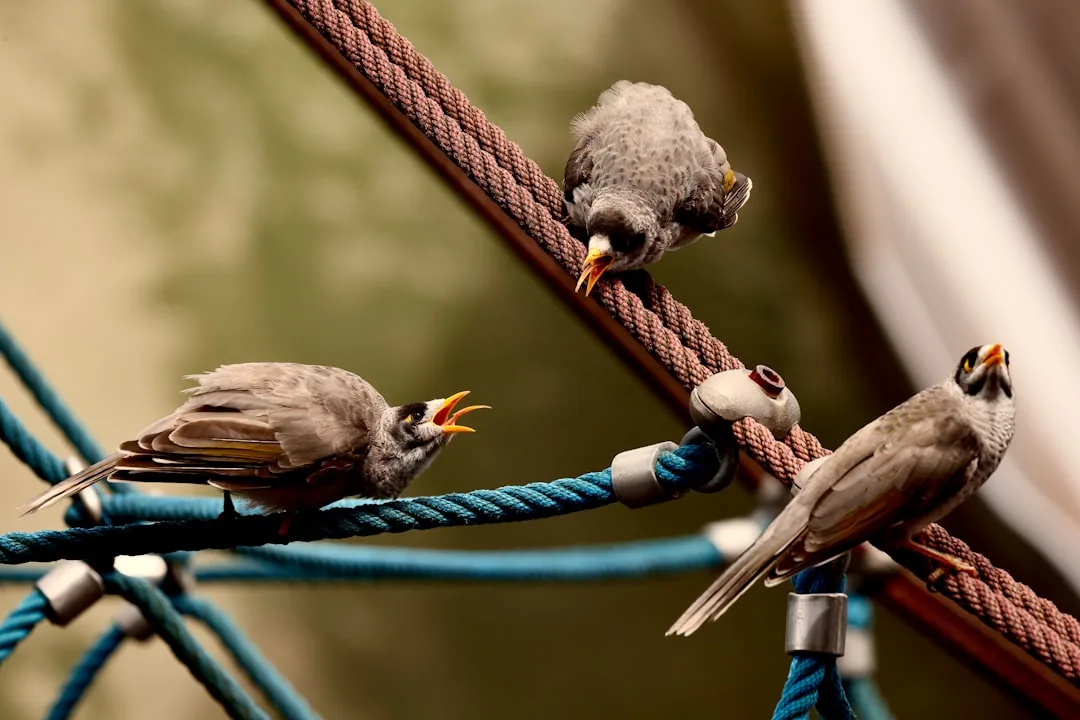
How do birds learn their songs?
Most songbirds learn their songs through a process remarkably similar to human language acquisition. Young birds go through a critical learning period during which they listen to adult tutors, memorize song templates, and then practice through a babbling phase called subsong. Over weeks or months, they refine their vocalizations until they match the tutor's song.
The first light of morning has barely touched the treetops, yet the air is already saturated with sound. A cascade of trills, whistles, and elaborate melodic phrases fills the predawn darkness, each voice distinct, each phrase carrying information encoded over millions of years of evolution. This is the dawn chorus, and the performers are songbirds - the most diverse and vocally sophisticated group of animals on the planet.
Songbirds have captivated human listeners for as long as our species has existed. They have inspired poets, puzzled scientists, and served as models for understanding how complex behaviors are learned and transmitted across generations. Their songs are not mere noise. They are structured, culturally transmitted vocalizations that parallel human language in ways researchers are only beginning to fully appreciate.
Songbird Diversity: Half of All Birds on Earth
Songbirds belong to the order Passeriformes, the largest order of birds and one of the most species-rich groups of vertebrates. With more than 5,000 recognized species, passerines account for roughly half of all living bird species. They are found on every continent except Antarctica, from the dense tropical forests of Borneo to the windswept grasslands of Patagonia, from sea-level mangrove swamps to Himalayan elevations above 5,000 meters.
Within Passeriformes, the suborder Passeri - the oscines, or "true songbirds" - comprises approximately 4,000 species. These are the birds with the most complex vocal abilities, distinguished from their suboscine relatives by their capacity for vocal learning. While suboscines such as tyrant flycatchers produce innate, genetically determined calls, oscines must learn their songs from adult tutors during development.
The diversity of songbird species is staggering. They range in size from the 4-gram goldcrest to the 1.5-kilogram superb lyrebird. Their habitats span virtually every terrestrial ecosystem. Some, like the common raven, have colonized nearly the entire Northern Hemisphere. Others, like the Cebu flowerpecker of the Philippines, cling to existence in fragments of forest measured in hectares.
| Feature | Songbirds (Oscines) | Non-songbird Passerines (Suboscines) | Non-passerines |
|---|---|---|---|
| Number of species | ~4,000 | ~1,300 | ~5,000 |
| Vocal learning | Yes - songs learned from tutors | No - calls are innate | Rare (parrots, hummingbirds only) |
| Syrinx complexity | Highly developed, 4-9 pairs of muscles | Simpler structure | Variable |
| Geographic range | Global except Antarctica | Primarily Neotropics | Global |
| Song complexity | High; multi-phrase, structured songs | Simple calls and whistles | Variable; some complex (parrots) |
The Syrinx: A Vocal Organ Unlike Any Other
The key to songbird vocal ability lies in a unique anatomical structure: the syrinx. Located at the junction where the trachea splits into the two bronchi, the syrinx is found only in birds and has no equivalent in mammals, reptiles, or any other vertebrate group.
Unlike the mammalian larynx, which sits at the top of the trachea and produces sound through a single pair of vocal folds, the syrinx contains two independently controllable sound sources - one in each bronchus. This means a songbird can literally produce two different notes simultaneously, creating harmonies, rapid frequency sweeps, and acoustic textures that would be impossible for any single-voiced animal.
The wood thrush provides a striking example. Its ethereal, flute-like song includes passages where both sides of the syrinx produce different frequencies at the same time, creating the harmonic richness that has made this species' song one of the most celebrated in North American ornithology. Researchers using miniaturized pressure sensors implanted near the syrinx have confirmed that the two sides operate with a high degree of independence, each controlled by its own set of muscles and nerves.
Songbird syrinx muscles are among the fastest in the vertebrate world. Studies have documented contraction rates exceeding 200 times per second, allowing the rapid modulations that give songs their characteristic complexity. The syrinx is also surrounded by an air sac that acts as an acoustic resonance chamber, amplifying and filtering sound before it exits through the trachea and beak.
Song Learning: Parallels to Human Language Acquisition
Perhaps the most remarkable aspect of songbird biology is the process by which songs are learned. Among vertebrates, vocal learning - the ability to acquire vocalizations by imitating others - is exceptionally rare. It occurs in only three groups of birds (songbirds, parrots, and hummingbirds) and a handful of mammalian lineages (humans, cetaceans, bats, elephants, and pinnipeds).
The parallels between songbird vocal learning and human speech acquisition are so extensive that songbirds have become the primary animal model for studying the neurobiology of language.
As the pioneering bioacoustician Peter Marler wrote:
"The process of song learning in birds provides the closest parallel in the animal kingdom to the way in which children acquire language. Both involve a critical period, a memorization phase, and a practice phase in which the learner gradually shapes its output to match a remembered template."
Young songbirds typically pass through several distinct phases of vocal development. During the sensory phase, which often occurs in the first few weeks or months of life, the young bird listens to adult songs and forms auditory memories - song templates - that will guide later production. This is analogous to the period during which human infants absorb the phonemes and prosodic patterns of their native language before producing speech.
The sensorimotor phase follows, during which the bird begins producing vocalizations. Early attempts, called subsong, are highly variable and poorly structured - strikingly similar to the babbling phase of human infants. Over time, subsong gives way to plastic song, which increasingly resembles the adult model but remains variable. Finally, the song crystallizes into its mature, stereotyped form.
The critical period for song learning varies by species. White-crowned sparrows, for instance, must hear their species' song between roughly 10 and 50 days of age to develop normal adult song. Exposure before or after this window has little effect. This mirrors the critical periods observed in human language acquisition, where children who are not exposed to language during the first years of life face severe and often irreversible deficits in linguistic ability.
Song dialects - regional variations in song structure - provide further evidence for cultural transmission. White-crowned sparrow populations separated by as little as a few kilometers may sing distinctly different song dialects, and these dialects persist across generations as young birds learn from local adults. Researchers have mapped dialect boundaries with the precision of linguistic surveys, finding that dialect regions can remain stable for decades.
The Dawn Chorus: Why Birds Sing at First Light
For anyone who has risen before dawn in a temperate woodland during spring, the dawn chorus is an unforgettable acoustic experience. Beginning in near-total darkness, sometimes as early as 45 minutes before sunrise, birds launch into full-throated song with an intensity and coordination that has puzzled naturalists for centuries.
Several hypotheses explain why birds concentrate their singing at dawn. The acoustic transmission hypothesis proposes that predawn atmospheric conditions - still air, high humidity, low ambient noise, and temperature inversions that create favorable sound channels - allow songs to propagate farther and more clearly than at any other time of day. Research has demonstrated that bird song can carry up to 20 times farther in the calm air of dawn compared to the turbulent, noisy conditions of midday.
The inefficient foraging hypothesis notes that light levels before sunrise are too low for effective visual foraging, so the opportunity cost of singing is minimal. A bird that sings at dawn sacrifices little feeding time, whereas singing during full daylight means missed foraging opportunities.
The condition-signaling hypothesis suggests that dawn singing serves as an honest indicator of male quality. A bird that has survived the night - expending energy to maintain body temperature in the cold darkness - and can still muster the energy for vigorous singing at dawn demonstrates its fitness to both rivals and potential mates. Studies of great tits have found correlations between dawn singing performance and male body condition, territory quality, and reproductive success.
The order in which species join the dawn chorus is remarkably predictable and appears to be related to eye size and light sensitivity. Species with larger eyes relative to their body size, such as robins and blackbirds, tend to begin singing earlier, when light levels are still extremely low. Species with smaller eyes join later, as light increases.
The Nightingale: 200 Song Types and Centuries of Poetry
No songbird has inspired more human art and literature than the common nightingale (Luscinia megarhynchos). This small, plain-plumaged bird of European and western Asian woodlands possesses a vocal repertoire of over 200 distinct song types, which it delivers in extended, virtuosic performances that can last throughout the entire night.
The nightingale's song is distinguished by its extraordinary range of notes, from deep, rich whistle sequences to rapid-fire staccato passages and dramatic crescendos. Males sing with particular intensity during the breeding season, and unpaired males sing throughout the night - a behavior rarely observed in other European songbirds.
The cultural significance of the nightingale spans millennia and crosses civilizations. In ancient Greek mythology, Philomela was transformed into a nightingale, and the bird's song was interpreted as a lament. The Roman naturalist Pliny the Elder devoted extensive passages to the nightingale's vocal abilities. In Persian poetry, the relationship between the nightingale (bulbul) and the rose is one of the central metaphors of Sufi literature, symbolizing the soul's longing for divine beauty.
John Keats captured the bird's effect on human listeners in his 1819 "Ode to a Nightingale":
"Thou wast not born for death, immortal Bird! / No hungry generations tread thee down; / The voice I hear this passing night was heard / In ancient days by emperor and clown."
Modern bioacoustic analysis has revealed the structural complexity underlying the nightingale's acclaimed performance. Individual males may have repertoires exceeding 250 song types, arranged in sequences that follow statistical rules - certain song types are more likely to follow others, creating patterns of expectation and surprise that parallel musical composition.
Research at the Free University of Berlin has shown that females preferentially respond to males with larger repertoires and more complex sequencing patterns, suggesting that the song's elaborateness is shaped by sexual selection.
The Northern Mockingbird: Master of Mimicry
If the nightingale is the poet of the bird world, the northern mockingbird (Mimus polyglottos) is the impressionist. Found throughout North America, the mockingbird is named for its extraordinary ability to mimic the songs of other species - a talent it exercises with relentless enthusiasm, often singing for hours on end from exposed perches, rooftops, and telephone poles.
A single male mockingbird may learn and reproduce the songs of more than 200 other bird species over its lifetime. But the mimicry does not stop with other birds. Mockingbirds readily incorporate non-biological sounds into their repertoires, including car alarms, cell phone ringtones, construction equipment, barking dogs, squeaky gates, and emergency vehicle sirens.
One particularly well-documented individual in a Florida suburb was recorded accurately reproducing the sound of a reversing truck's backup alarm.
Males cycle through their enormous repertoires during singing bouts, typically repeating each borrowed phrase three to five times before switching to the next. Older males tend to have larger repertoires, and research has confirmed that females prefer males with more varied performances. The mockingbird's mimicry appears to serve dual purposes: impressing potential mates and intimidating territorial rivals by creating the acoustic illusion of a densely populated territory.
The Superb Lyrebird: Nature's Most Sophisticated Mimic
While the mockingbird is impressive, the superb lyrebird (Menura novaehollandiae) of southeastern Australia may be the most accomplished vocal mimic in the animal kingdom. This large, ground-dwelling passerine - one of the most ancient songbird lineages - reproduces environmental sounds with a fidelity that borders on the uncanny.
Lyrebirds have been documented accurately imitating the calls of at least 20 other bird species simultaneously woven into continuous display sequences. But their mimicry extends far beyond other birds. Individual lyrebirds have been recorded reproducing the sounds of chainsaws, camera shutters and motor drives, car engines, dog barks, crying babies, and even human speech fragments.
The lyrebird's vocal abilities gained global attention through Sir David Attenborough's footage for the BBC, in which a lyrebird in a controlled setting reproduced the sounds of a chainsaw, a camera with motor drive, and a car alarm with stunning accuracy.
While some of that particular footage involved a bird that had been raised in a wildlife park and exposed to human-generated sounds, wild lyrebirds are equally capable mimics, incorporating the sounds of their forest environment into elaborate display sequences that can last more than 20 minutes.
The male lyrebird's vocal display is accompanied by an equally spectacular visual performance. During singing, the male fans his ornate tail feathers - the outermost pair shaped like a Greek lyre, giving the bird its name - forward over his body, creating a shimmering silver canopy while delivering his acoustic performance. This combined audio-visual display is one of the most complex courtship behaviors documented in any animal.
Canaries: From Coal Mines to Concert Halls
The domestic canary (Serinus canaria forma domestica) occupies a unique place in the relationship between humans and songbirds. Descended from the wild Atlantic canary of the Canary Islands, Madeira, and the Azores, domestic canaries have been selectively bred for song quality since at least the 17th century.
The canary's most famous practical application was as a biological gas detector in coal mines. From the late 19th century until 1986 in Britain, miners carried caged canaries into the shafts. The birds' high metabolic rate and efficient respiratory system made them acutely sensitive to carbon monoxide and methane - gases that could accumulate to lethal levels in poorly ventilated tunnels.
A canary showing signs of distress provided an early warning that allowed miners to evacuate. The phrase "canary in a coal mine" has since entered the language as a metaphor for an early indicator of danger.
Selective breeding has produced canary strains with remarkably different song characteristics. The Harz Roller, developed in the Harz Mountain region of Germany, was bred for a soft, rolling song delivered with the beak nearly closed. The Spanish Timbrado, by contrast, was selected for a metallic, bell-like tone.
The Waterslager or Malinois, from Belgium, is prized for its water-note song - sequences that sound remarkably like dripping or bubbling water. These breeding programs represent one of the longest-running experiments in the artificial selection of a complex learned behavior.
Zebra Finches: The Laboratory of Vocal Learning
The zebra finch (Taeniopygia guttata) has become the most important model organism for studying the neuroscience of vocal learning. Native to Australia, this small, hardy finch breeds readily in captivity, has a relatively simple song consisting of a stereotyped sequence of 3-7 syllables, and possesses a well-mapped neural circuitry for song production and learning.
Research on zebra finches has revealed a dedicated network of brain nuclei - collectively called the song system - that controls song learning and production. The HVC (formerly known as the "high vocal center") and the robust nucleus of the arcopallium (RA) form a motor pathway that directly controls the syrinx muscles.
A parallel pathway through Area X and the lateral magnocellular nucleus of the anterior nidopallium (LMAN) is essential for learning but not for producing crystallized song in adults.
These brain regions show striking parallels to the neural circuitry underlying human speech. The HVC and RA correspond functionally to Broca's area and motor cortex regions involved in speech production, while the anterior forebrain pathway through Area X parallels the basal ganglia circuits implicated in human language learning.
The gene FOXP2, mutations of which cause speech and language disorders in humans, is also expressed in songbird brain regions critical for vocal learning, and its expression levels change during the critical period for song acquisition.
Neuroscientists have used zebra finches to investigate questions that cannot be ethically studied in humans, including how sleep consolidates vocal memories, how auditory feedback shapes motor output, and how neural circuits are modified during learning.
Studies using miniaturized neural recording devices on freely singing birds have revealed that individual HVC neurons fire at precise, reproducible times during specific syllables of the song, creating a neural representation of the song's temporal structure with millisecond precision.
Bird Song and Human Music: Convergent Pathways
The structural similarities between bird song and human music have been a subject of serious scientific inquiry since at least the 1960s. Both are organized hierarchically, with individual notes grouped into phrases, phrases into sequences, and sequences into complete performances governed by syntactic rules.
Both use features such as rhythm, pitch variation, repetition, and theme-and-variation structure. Both are learned during critical developmental periods, and both activate reward circuits in the brain.
Neuroscientific research has identified parallel neural pathways in birds and humans for processing and producing complex vocalizations. The anterior forebrain pathway in songbirds, which is essential for song learning, shows functional and genetic similarities to the cortico-basal ganglia-thalamic loops that underlie human speech and musical ability. Both systems rely on dopaminergic reward signaling to reinforce successful vocal production.
Composer and ornithologist Emily Doolittle has analyzed bird songs using standard Western music notation and found that many species employ intervals and rhythmic patterns that correspond to patterns found in human music. The musician wren of Central and South America sings phrases built on consonant intervals - perfect fourths, fifths, and octaves - that align with the same harmonic relationships underlying much human musical composition.
However, it remains debated whether these similarities reflect truly convergent cognitive processes or whether human listeners simply impose musical frameworks on sounds that birds perceive and produce through entirely different perceptual and cognitive mechanisms.
Population Decline: Three Billion Fewer Birds
Against this backdrop of vocal wonder and evolutionary achievement, songbird populations are facing severe declines worldwide. A landmark 2019 study published in the journal Science by Kenneth Rosenberg and colleagues reported that North America has lost approximately 3 billion breeding birds since 1970 - a net decline of 29% across nearly all biomes and habitat types.
The losses are not confined to rare or range-restricted species. Common, widespread songbirds - sparrows, warblers, finches, and blackbirds - account for the largest absolute declines. The study, which synthesized data from long-term monitoring programs including the Breeding Bird Survey and weather radar migration counts, revealed that grassland birds have been hit hardest, with a 53% population reduction, followed by boreal forest species at 33%.
The drivers of decline are multiple and synergistic. Habitat loss and degradation - driven by agricultural intensification, urbanization, and forestry practices - is the primary factor. Domestic and feral cats kill an estimated 1.3 to 4 billion birds annually in the United States alone. Window collisions account for another 600 million to 1 billion deaths per year.
Pesticide use, particularly neonicotinoids, reduces insect prey populations and can directly impair bird reproduction and migration. Climate change is disrupting the phenological synchrony between breeding schedules and peak insect availability.
These population losses have consequences beyond the birds themselves. Songbirds provide critical ecosystem services including insect pest control, seed dispersal, and pollination. Their decline signals broader ecological deterioration that affects human welfare in ways that are only beginning to be quantified.
Conservation and the Future of Songbirds
Efforts to reverse songbird declines are underway at scales ranging from individual backyard habitat improvements to international policy initiatives. The Migratory Bird Treaty Act in the United States and the Birds Directive in the European Union provide legal frameworks for protecting migratory songbird species. Habitat restoration programs targeting grasslands, wetlands, and forest understories have shown measurable benefits in areas where they have been implemented.
Citizen science programs such as eBird, the Christmas Bird Count, and various national breeding bird surveys have become indispensable tools for monitoring population trends. These programs generate millions of data points annually, enabling researchers to track changes in distribution and abundance with unprecedented spatial and temporal resolution.
The study of songbirds continues to yield insights that extend far beyond ornithology. Their vocal learning abilities inform our understanding of human language disorders. Their migratory navigation challenges our understanding of sensory biology. Their population declines serve as a barometer for environmental health. And their songs, filling the air each morning as they have for millions of years, remain one of the most immediate and visceral connections between humans and the natural world.
References
Rosenberg, K.V., Dokter, A.M., Blancher, P.J., et al. (2019). "Decline of the North American avifauna." Science, 366(6461), 120-124.
Marler, P. & Slabbekoorn, H. (2004). Nature's Music: The Science of Birdsong. Academic Press.
Catchpole, C.K. & Slater, P.J.B. (2008). Bird Song: Biological Themes and Variations. 2nd edition. Cambridge University Press.
Brainard, M.S. & Doupe, A.J. (2002). "What songbirds teach us about learning." Nature, 417(6886), 351-358.
Loss, S.R., Will, T., & Mara, P.P. (2013). "The impact of free-ranging domestic cats on wildlife of the United States." Nature Communications, 4, 1396.
Henwood, K. & Fabrick, A. (1979). "A quantitative analysis of the dawn chorus: temporal selection for communicatory optimization." The American Naturalist, 114(2), 260-274.
Doolittle, E. & Brumm, H. (2012). "O Canto do Uirapuru: Consonant intervals and patterns in the song of the musician wren." Journal of Interdisciplinary Music Studies, 6(1), 55-85.
Frequently Asked Questions
How do birds learn their songs?
Most songbirds learn their songs through a process remarkably similar to human language acquisition. Young birds go through a critical learning period during which they listen to adult tutors, memorize song templates, and then practice through a babbling phase called subsong. Over weeks or months, they refine their vocalizations until they match the tutor’s song.
This process involves dedicated brain regions analogous to human speech centers, and birds raised in isolation or exposed to songs outside their critical period often develop abnormal songs.
Why do birds sing at dawn?
The dawn chorus occurs because early morning conditions offer several acoustic advantages. Cool, calm air with minimal wind and low ambient noise allows songs to travel up to 20 times farther than during midday. Low light levels also make foraging inefficient, so singing carries less opportunity cost.
Additionally, males that sing vigorously at dawn demonstrate their fitness to potential mates and rivals, since surviving the night and still having energy to sing signals good health and territory quality.
How many sounds can a mockingbird mimic?
A single northern mockingbird can learn and reproduce the songs of over 200 other bird species throughout its lifetime, along with a wide range of non-biological sounds including car alarms, cell phone ringtones, sirens, and mechanical noises. Males typically cycle through their repertoire during extended singing bouts, rarely repeating the same phrase more than a few times before switching.
Older males generally have larger repertoires, and females tend to prefer males with more varied song collections.