
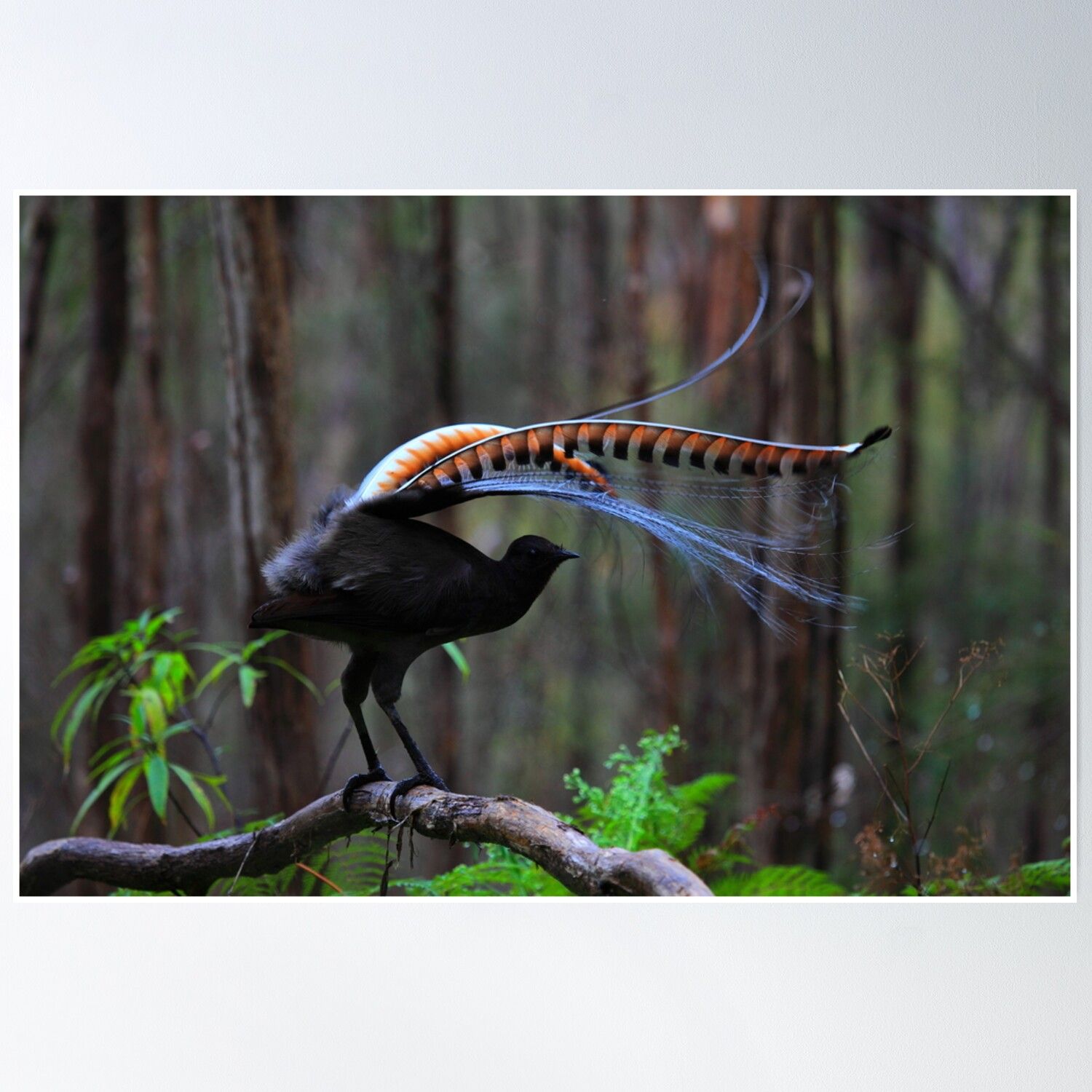
The superb lyrebird is the largest songbird alive on Earth and, by consensus among ornithologists who have recorded it, the finest vocal mimic in the animal kingdom.
Native to the temperate rainforests of south-eastern Australia, Menura novaehollandiae occupies an ecological and acoustic niche all its own: a ground-dwelling, scratch-feeding passerine the size of a small pheasant, whose males sing for four hours a day in the breeding season and can reproduce the songs of more than sixteen other bird species, the calls of distant predators, and - when raised within earshot of humans - the sounds of chainsaws, camera shutters, car alarms, and crying babies with unsettling fidelity.
This guide covers every major aspect of superb lyrebird biology, ecology, and cultural significance: taxonomy, habitat, size, the anatomy of the lyre-shaped tail, the mechanics of song production, the 2021 discovery of mid-mating acoustic deception, the BBC documentary footage that turned a shy Australian rainforest bird into a global phenomenon, and the species' role as the face of the Australian 10-cent coin.
It is a reference entry, not a summary - expect specifics: decibels, hours of singing, tonnes of soil moved, species names, and verified field records.
Etymology and Classification
The genus name Menura derives from Greek men (moon) and oura (tail), a reference to the crescent shape of the male's outer tail feathers. The species epithet novaehollandiae - "of New Holland" - uses the early European name for Australia and was coined by the British naturalist John Latham in 1801, shortly after the first specimens reached London.
Early ornithologists were so confused by the creature's combination of songbird-like anatomy and pheasant-like size that the species bounced between several proposed families before settling into its current position.
Modern taxonomy places the superb lyrebird in its own family, Menuridae, which contains only two living species: Menura novaehollandiae and Albert's lyrebird (Menura alberti), a smaller, shyer relative restricted to a tiny patch of rainforest on the New South Wales-Queensland border.
Both are members of the order Passeriformes (the "perching birds" or "songbirds") and are considered among the most ancient songbird lineages alive today. Molecular dating suggests the split between Menuridae and other passerines occurred roughly 35 million years ago, making the lyrebirds evolutionary relics from a very different Australia.
Common names reflect the bird's most famous feature: the spreadable tail of a courting male recalls the shape of a lyre, the small stringed instrument of ancient Greece. Indigenous Australian languages use a variety of names; in Dharug, for example, the bird is known as Beleck-Beleck, while the Wiradjuri name Woorail refers specifically to the mature male.
Size and Physical Description
The superb lyrebird is the largest member of the order Passeriformes - larger than any crow, raven, or thrush. Males are noticeably larger than females, and only males develop the ornamental tail.
Males:
- Length including tail: 80-100 cm
- Body length excluding tail: 30-35 cm
- Tail length: up to 70 cm in fully mature birds
- Wingspan: 70-76 cm
- Weight: 970-1,100 g
Females:
- Length: 74-84 cm
- Wingspan: 65-72 cm
- Weight: 860-1,050 g
- No ornamental tail - plumage is simpler, with long graduated brown tail feathers
The body plumage is a soft, uniform brown-grey on the upperparts, grading to paler rufous-brown on the throat and belly. Legs and feet are grey and exceptionally powerful for a bird of this size - lyrebirds spend most of their lives walking and scratching rather than flying, and the claws on the middle toe are elongated for raking through leaf litter.
Their flight muscles are proportionally reduced compared with most passerines, and though they can fly short distances, they prefer to glide downhill from high roosts at dusk rather than flap.
The male's tail is the defining anatomical feature of the species. It consists of sixteen specialised feathers: two outer lyrates (broad, curved, brown with dark barring and a pale inner edge), twelve slender filamentaries (white, wispy, and almost gauzy), and two narrow median feathers that arc upward.
At rest the tail trails behind the bird and appears unremarkable; in full display it is flipped forward over the head and spread into a trembling silver fan that almost entirely obscures the bird beneath.
Habitat and Range
Superb lyrebirds are endemic to south-eastern Australia. Core natural range stretches from south-east Queensland in the north, through the coastal and dividing-range forests of New South Wales, and across most of Victoria. An introduced population exists in Tasmania, established through deliberate releases in the 1930s and 1940s - a conservation measure originally intended to protect the species against bushfires on the mainland.
Preferred habitat is dense temperate rainforest, wet sclerophyll forest, and fern-lined gullies with year-round moisture, deep leaf litter, and a dense understorey of tree ferns (Dicksonia and Cyathea species).
Lyrebirds are closely associated with the mountain ash (Eucalyptus regnans) forests of the Central Highlands of Victoria, among the tallest flowering trees in the world, and are particularly abundant along the Great Dividing Range wherever humidity, elevation, and shade combine to keep the forest floor damp.
Altitudinal range runs from near sea level in coastal rainforest patches to more than 1,500 metres in the Australian Alps, where birds forage in snow-dusted forests through winter. Each adult male defends a territory of 2-10 hectares that includes multiple display mounds, feeding areas, and roosting trees. Females occupy overlapping home ranges of similar size and visit male territories during the breeding season.
Diet and Foraging
Superb lyrebirds are almost exclusively insectivorous. Their diet is dominated by soft-bodied invertebrates found in the upper few centimetres of leaf litter and moist soil.
Typical prey items:
- Earthworms and terrestrial flatworms
- Beetle adults and larvae (scarabs, weevils, carabids)
- Amphipods ("land hoppers")
- Centipedes, millipedes, and slaters
- Spiders, including large wolf spiders
- Ant and termite larvae
- Occasional small frogs, skinks, or snails
Lyrebirds do not dig with their bills. They scratch backward with powerful feet, flicking leaves and soil aside in characteristic arcs that leave the forest floor pockmarked with shallow excavations. A single bird can turn over a surprising volume of substrate.
Long-term research in Victorian forests estimates that lyrebirds move roughly 155 tonnes of soil and leaf litter per hectare per year in high-density populations - making them one of the most significant non-mammalian ecosystem engineers on any continent.
This scratching behaviour has consequences far beyond the birds themselves. It alters fungal communities, redistributes seeds, buries combustible litter and thereby reduces fire risk, and creates microhabitats for smaller invertebrates. Some ecologists argue that the decline of lyrebirds in logged or fire-damaged regions is a slow but measurable driver of understorey change across the region.
Vocal Anatomy and Mimicry
The species' reputation rests on its voice. The superb lyrebird has the most elaborately muscled syrinx - the songbird equivalent of a voice box - of any passerine studied to date. Where most songbirds have one or two pairs of syringeal muscles, lyrebirds have three, arranged for fine independent control of both sides of the syrinx.
This allows the bird to produce two entirely independent sound streams simultaneously and to reproduce acoustic features including noise, pitch glide, rapid frequency modulation, and complex harmonics with extraordinary accuracy.
Natural elements in the repertoire:
- Songs of at least 16 local bird species, including the grey shrike-thrush, laughing kookaburra, eastern whipbird, pilotbird, crimson rosella, and yellow-tailed black cockatoo
- Alarm calls of other forest birds
- Wingbeats and machine-like wing-whirring of flocks of cockatoos
- Lyrebird-specific "territorial" song, not known to be mimicked
Mechanical and human sounds recorded in wild or near-human populations:
- Chainsaws and two-stroke engines
- Camera shutters and motor drives
- Car alarms and vehicle reversing beepers
- Mobile-phone ringtones
- Crying human infants
- Human speech fragments
The mechanical mimicry, though widely publicised by the 1998 BBC documentary The Life of Birds narrated by David Attenborough, is less common in truly remote populations than popular videos suggest. A careful 2021 review of wild recordings found that only a small minority of individual males included chainsaw or camera-shutter imitations in their repertoire.
Most famous "chainsaw lyrebird" clips feature either zoo birds - which learn from recorded soundtracks, visitors, and neighbouring aviary inhabitants - or wild birds in forests adjacent to logging or tourist activity. The default wild repertoire is dominated by other bird species.
Young males learn their repertoire during their first three to six years of life by listening to older males at the edges of territorial boundaries, where rival singers perform opposite each other. Mimicry is cultural as well as individual: local "song dialects" emerge in which clusters of males share specific combinations of mimicked species that differ from those used by males in neighbouring valleys.
Courtship, the Display Mound, and the Tail
Males maintain a series of dirt display mounds throughout their territory - typically six to a dozen - which they rake clear of leaves each morning during breeding season. From May to August the male visits each mound in rotation, singing for up to four hours a day. Sustained vocal output of this magnitude is extraordinary; few vertebrates produce comparable song quantities, and the energetic cost is estimated to consume a significant fraction of daily food intake.
When a female approaches a mound, the male launches into a coordinated song-and-display performance. The tail is flipped forward over the head and fanned into the shimmering silver curtain already described. The bird sways, trembles, and dances in time with the song, producing a visual effect that has been compared to a veil of mist lit from behind.
The routine includes at least four distinct phases, each paired with a specific song type, and ends - if the female is receptive - with copulation on the mound.
2021 discovery: acoustic deception during mating. Dr Anastasia Dalziell and colleagues published a landmark study in the journal Current Biology documenting a previously unrecognised behaviour: courting males produce mimicked multi-species mobbing flock alarm calls at the precise moment of copulation, or when a female attempts to leave the display mound before mating is complete.
Mobbing alarms are the sounds normally produced by flocks of small birds harassing a predator and they trigger an instinctive freeze response in nearby birds. The researchers concluded that male lyrebirds deploy these false alarms specifically to keep females on the mound long enough to complete mating.
This is one of the most sophisticated documented examples of acoustic deception in any non-human animal and suggests that lyrebird mimicry has evolved, at least in part, as a tool of sexual manipulation.
After each breeding season the male sheds every ornamental tail feather and regrows the full lyre-shaped set the following year. Juvenile males do not develop the mature tail until they are 6 to 8 years old, and spend their first few seasons as "plain-tailed" apprentices singing at the edges of territorial boundaries held by older males.
Breeding and Life Cycle
Lyrebird breeding is slow and low-output compared with most birds of similar size. A female builds her own nest, usually on the ground, on a stump, or in a fern crown, constructing a dome of sticks lined with fine rootlets and feathers. She lays a single egg per breeding season and incubates it alone for approximately 50 days - one of the longest incubation periods of any passerine.
Breeding timeline:
| Stage | Timing |
|---|---|
| Male song season begins | Late April |
| Peak courtship | May to August |
| Egg-laying | June to August |
| Incubation | ~50 days |
| Chick in nest | ~45 days |
| Fledging | September to November |
| Juvenile independence | ~8 months after fledging |
| Male tail maturity | 6-8 years |
The chick is fed entirely by the female on invertebrates. Males play no role in incubation or chick-rearing - their entire reproductive investment is the song and display performance that attracts mates. Because only a minority of males secure most of the matings in any given season, the species exhibits a highly lek-like mating system, though males do not cluster mounds tightly as in true leks.
Lifespan and Populations
Superb lyrebirds are remarkably long-lived for passerines. Banded wild individuals have been recorded at more than 30 years of age, and the species' slow reproductive rate is compensated by this adult longevity. Each female may lay only 20-25 eggs over her lifetime, but high adult survival keeps populations stable where habitat is intact.
Total population is not precisely known but is estimated at well over 100,000 individuals across the species' natural range. The IUCN Red List classifies the superb lyrebird as Least Concern with a stable or slightly declining trend. Regional pressures include:
- Bushfire. The catastrophic Black Summer fires of 2019-2020 burned an estimated 40-50% of the species' range in a single season. Post-fire surveys found measurable short-term declines and ongoing concerns about habitat recovery.
- Logging. Clear-felling of mountain ash and mixed rainforest eliminates the dense understorey lyrebirds require. Several Victorian populations have contracted with forestry activity.
- Feral predators. Red foxes (Vulpes vulpes) prey on adults, chicks, and eggs. Fox control programmes in Royal National Park south of Sydney correlate with lyrebird population recovery.
- Climate change. Increasing drought frequency and fire intensity threaten the moisture-dependent forests lyrebirds need.
- Habitat fragmentation. Urban sprawl at the edges of Sydney, Melbourne, and coastal New South Wales divides populations and alters soundscapes.
Cultural Significance
Few birds occupy a comparable cultural position in their home country. The superb lyrebird is a national emblem of Australia, recognised by millions who have never visited the rainforests where it lives.
Australian 10-cent coin. Since decimal currency was introduced on 14 February 1966, the Australian 10-cent piece has carried an image of a displaying male superb lyrebird designed by Stuart Devlin. The coin remains in circulation today, essentially unchanged - meaning the lyrebird is probably the most-handled bird image in the southern hemisphere.
Attenborough and the BBC. In 1998 the BBC series The Life of Birds, presented by Sir David Attenborough, included a brief sequence of a wild-raised lyrebird at Adelaide Zoo performing imitations of a chainsaw, a camera motor drive, and a car alarm.
The clip became one of the most widely viewed nature documentary sequences of the internet age after being uploaded to video-sharing sites in the mid-2000s and has accumulated hundreds of millions of views across platforms. For an entire generation of viewers outside Australia, the lyrebird is first and last "the bird that imitates chainsaws."
Australian arts and design. The lyrebird tail has been used as a heraldic motif, appears in the coat of arms of multiple organisations, and has featured on Australian postage stamps, banknotes, and official documents. The species is the faunal emblem of Victoria.
Related Reading
- Songbirds: The Musicians of the Natural World
- Common Nightingale: Europe's Night Singer
- European Robin: The Gardener's Companion
- Canary: The Domesticated Finch
References
Peer-reviewed and governmental sources consulted for this entry include the IUCN Red List assessment for Menura novaehollandiae (BirdLife International, 2024), the Australian Department of Climate Change, Energy, the Environment and Water species profile, and research published in Current Biology, The Auk, Animal Behaviour, and Emu - Austral Ornithology.
Specific details on acoustic deception during mating draw on Dalziell, A. H., Maisey, A. C., Magrath, R. D. and Welbergen, J. A. (2021) "Male lyrebirds create a complex acoustic illusion of a mobbing flock during courtship and copulation" (Current Biology 31, 1970-1976). Population and ecosystem-engineering estimates draw on long-term research in Sherbrooke Forest, Victoria, and Royal National Park, New South Wales.
Frequently Asked Questions
How big is a superb lyrebird?
Adult male superb lyrebirds (Menura novaehollandiae) measure 80 to 100 centimetres from bill to tail-tip, with the tail alone reaching 70 centimetres in mature birds. Body weight sits between 970 and 1,100 grams, making the species the largest songbird alive. Females are slightly smaller at 74 to 84 centimetres and 860 to 1,050 grams, and lack the lyre-shaped ornamental tail of the male.
Despite their size, lyrebirds are primarily ground-dwellers and only fly short distances, gliding downhill from roost trees rather than flapping like most passerines.
Why are lyrebirds such good mimics?
Superb lyrebirds have the most elaborately muscled syrinx - the songbird equivalent of a voice box - of any passerine studied. The syrinx contains three pairs of independently controlled muscles, compared with one or two pairs in most songbirds. This allows lyrebirds to produce two independent sound streams at once and reproduce acoustic features including noise, pitch glide, and rapid frequency modulation with almost perfect accuracy.
Mimicry is learned from the surrounding soundscape during a juvenile male’s first few years, and a bird raised near logging camps, campgrounds, or rural properties will keep those mechanical sounds in his repertoire for life.
Do lyrebirds really imitate chainsaws?
Yes - but with an important caveat. Wild lyrebirds imitate whatever they hear repeatedly, including chainsaws, camera shutters, mobile-phone ringtones, car alarms, crying babies, and human voices. However, these mechanical imitations are rarer in truly remote populations than popular documentaries suggest.
A 2021 review of wild recordings found that only a small percentage of individual males had any mechanical mimicry at all, and most of the famous chainsaw-imitating birds in viral clips were either zoo birds or lived in forests close to human activity. Their default repertoire is dominated by other bird species, not machines.
Where do superb lyrebirds live?
The superb lyrebird is endemic to the temperate rainforests, wet sclerophyll forests, and fern gullies of south-eastern Australia. Core range covers Victoria, eastern New South Wales, and the far south-east of Queensland. The species was deliberately introduced to Tasmania in the 1930s and 1940s to protect the population from mainland fires and is now established in parts of Mount Field National Park.
They prefer densely vegetated slopes with deep leaf litter, moist soil, and fallen logs, and are particularly associated with mountain ash (Eucalyptus regnans) and tree-fern understorey.
What do lyrebirds eat?
Superb lyrebirds are almost entirely insectivorous. They feed by scratching through leaf litter and soft soil with their powerful feet, uncovering invertebrates hidden in the top few centimetres of the forest floor. Prey items include earthworms, beetles and beetle larvae, spiders, amphipods, centipedes, slaters, and occasionally small frogs or lizards. Seeds and plant matter make up only a tiny fraction of the diet.
A single bird turns over an extraordinary volume of soil each year - ecologists estimate roughly 155 tonnes per hectare per year where lyrebirds are common - acting as a major ecosystem engineer.
How does the male's tail display work?
During breeding season, a male clears and maintains a small dirt display mound and sings from it each morning. When a female approaches, he flips his tail forward over his head and back, opening the 16 specialised tail feathers into a shimmering silvery fan. Two outer feathers are broad and curved - the lyre-shaped pair that gives the species its name. Twelve filamentous plumes fill the centre, and two median feathers arc upward.
The effect is a trembling silver curtain that obscures the male’s body while he sings and dances. After the breeding season the male moults every tail feather and regrows the entire ornamental set the following year.
Do lyrebirds really fake predator alarms during mating?
Yes. Research led by Dr Anastasia Dalziell and published in 2021 documented that courting male superb lyrebirds mimic the alarm calls of multiple other species at the precise moment of copulation. Alarm calls normally warn nearby birds of an approaching hawk or other predator, causing them to freeze or flee. The researchers found that males deployed these fake alarms specifically when a female attempted to leave a mating bout.
The behaviour appears to exploit the female’s instinctive freeze response, keeping her on the display mound long enough to complete mating. This is one of the most sophisticated examples of acoustic deception documented in any non-human animal.
How long do superb lyrebirds live?
Superb lyrebirds can live for more than 30 years in the wild, an extraordinarily long lifespan for any passerine bird. Males do not develop their full lyre-shaped tail until they are 6 to 8 years old, and the oldest banded wild individuals have exceeded 30 years. Females begin breeding at around 5 to 6 years of age.
Each female produces just one egg per breeding season and incubates it alone, so the species’ slow reproductive rate is compensated for by adult longevity. The species is currently listed as Least Concern by the IUCN, though habitat loss from wildfire and logging pose long-term regional pressures.