
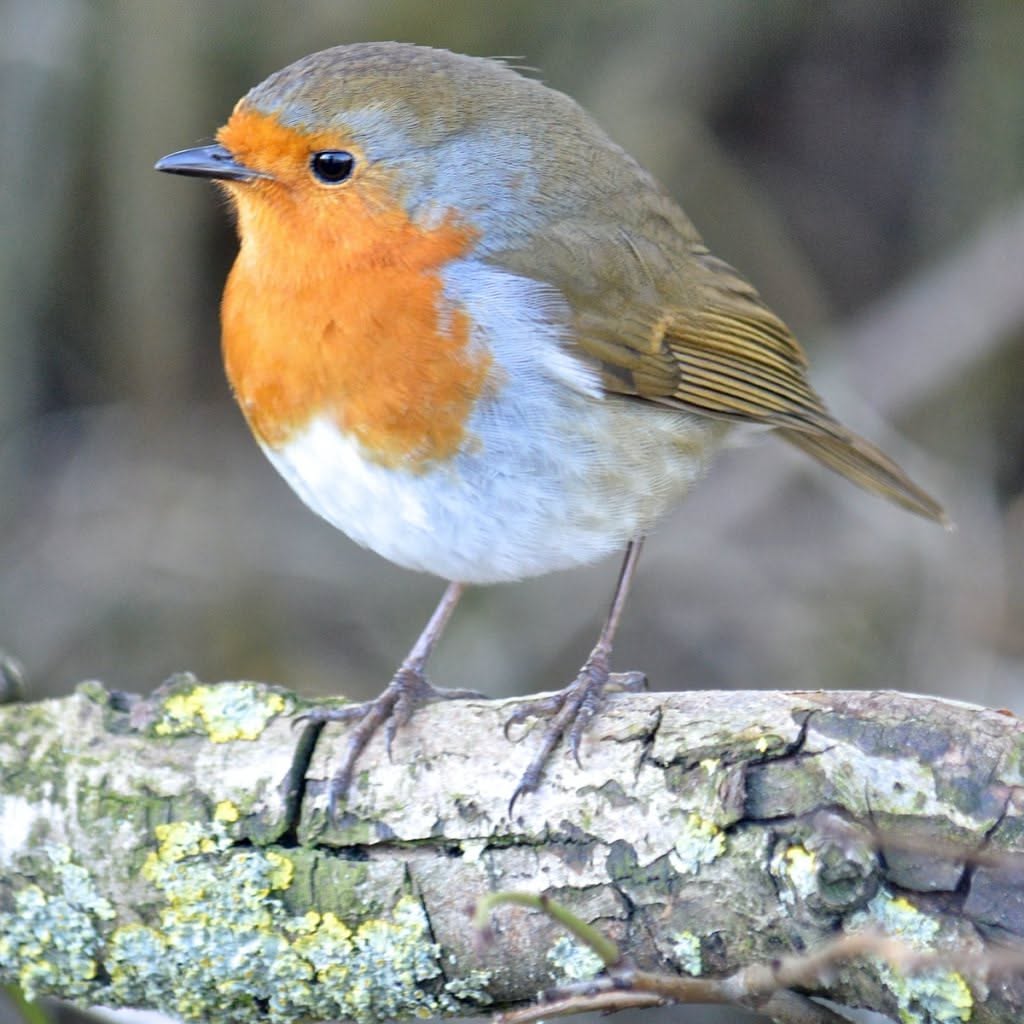
The European robin is one of the most recognisable small birds in the world and arguably the most studied songbird in Europe. A compact, round-bodied passerine with a glowing orange-red breast, it is familiar to anyone who has spent time in a British garden, a French hedgerow, or a Polish woodland.
Yet for all its familiarity, Erithacus rubecula is a genuinely strange animal - a bird that sees Earth's magnetic field through quantum effects inside its eyes, sings through the night under streetlamps, attacks its own reflection for hours, and defends territory with a violence entirely out of proportion to its twenty-gram body.
This guide covers every major aspect of European robin biology and ecology: taxonomy, physical description, territorial behaviour, song, feeding, magnetic navigation, migration, reproduction, cultural history, and conservation. It is a reference entry rather than a summary, so expect specifics - grams, centimetres, song repertoire sizes, mortality rates, and verified records.
Etymology and Classification
The scientific name Erithacus rubecula was coined by Carl Linnaeus in the tenth edition of Systema Naturae in 1758. Erithacus is a Greek word of uncertain origin used in antiquity for an unknown small bird. Rubecula is Latin for "little red one" - a diminutive of ruber, meaning red.
For centuries the European robin was commonly called the "redbreast" in English, with "robin" originally a pet name attached to the species only in the fifteenth century, in the same way a blackbird might be called "Tom". The name eventually became the default.
The European robin belongs to the Old World flycatcher family, Muscicapidae, alongside chats, nightingales, and wheatears. It was formerly classified with the thrushes (Turdidae), which is why the unrelated American robin (Turdus migratorius) ended up sharing its English name: European settlers, faced with an unfamiliar orange-breasted bird, simply reused the word.
The two species are not close relatives, and the shared orange breast is a clear example of convergent plumage - similar colour arising independently in unrelated lineages, probably because orange-red is an effective signal against green and brown backgrounds.
Eight recognised subspecies of European robin exist, differing in size, plumage saturation, and migratory behaviour. The British subspecies (E. r. melophilus) is slightly darker and notably tamer than the nominate continental form (E. r. rubecula), and island forms on the Canary Islands (E. r. superbus) are distinct enough that some ornithologists argue they should be split as a full species.
Size and Physical Description
European robins are small, short-necked songbirds with a round-bodied silhouette and upright posture. Their plumage is instantly recognisable: a glowing orange-red face and breast bordered by a soft blue-grey wash on the sides of the neck, a warm brown back and wings, and a pale buff belly.
Adults:
- Length: 12.5-14 cm from bill tip to tail tip
- Wingspan: 20-22 cm
- Weight: 16-22 g, seasonally variable
- Lifespan: 2-3 years typical, up to 19 years maximum
Juveniles:
- Length: similar to adults by fledging
- Weight: 12-16 g at fledging
- Plumage: heavily spotted brown, no red breast
- Moult: acquires red breast at 2-3 months old
Males and females are nearly indistinguishable. Both sexes carry the full orange-red breast, both sing, and both defend territory. This is rare among songbirds, where males usually carry the bright signal plumage and females wear duller colours. In European robins, the red is a territorial badge rather than a sexual ornament, and it functions equally in both sexes.
The orange colour is produced by carotenoid pigments - compounds the bird cannot synthesise and must obtain from its diet, mostly from insects that in turn have eaten carotenoid-rich plants. A brighter breast signals better health and better foraging skill, which is why territorial disputes are settled more quickly when one bird's breast is visibly duller than the other's.
Juvenile robins are completely unlike adults: mottled brown and buff, with no red at all. The lack of red is a direct adaptation to avoid provoking territorial attacks from adults. Young robins gradually moult into adult plumage between roughly two and three months of age, by which point they have usually dispersed far enough from their parents' territory to be tolerated.
Territorial Behaviour
The European robin is one of the most aggressive small birds in Europe relative to its size. Territorial defence is extreme, year-round, and practised by both sexes - a combination found in only a handful of songbird species.
A territory in typical British woodland covers roughly 0.3 to 0.6 hectares in winter and expands slightly in the breeding season. The boundary is defended by song from high perches at dawn and dusk, by direct pursuit and attack during the day, and by threat display - breast-puffing, tail-cocking, and a rapid flicking of the wings - when another robin approaches the edge of the territory.
Classical experiments by the British ornithologist David Lack in the 1940s demonstrated the raw power of the red breast as a trigger. Lack placed a stuffed adult robin inside a territory and watched the resident attack it. He then placed a tuft of red breast feathers alone, without any bird attached. The resident attacked the tuft just as vigorously.
A juvenile-plumaged stuffed robin, complete in every respect except for the red breast, was almost entirely ignored. The red patch itself, in other words, is the trigger - not the bird around it.
Serious combat in European robins is unusually common and unusually deadly for a bird this small. Fights start with beak stabs and wing strikes and can escalate into grappling on the ground. In some British studies, territorial combat accounts for around ten per cent of adult male mortality - an extraordinary figure for a twenty-gram bird. Females fight too, though slightly less often, and their fights are rarely fatal.
A robin's inability to recognise its own reflection amplifies this aggression in domestic settings. Robins have been documented attacking wing mirrors, chrome kettles, and windows for hours at a time, occasionally dying of exhaustion. Gardeners who notice a robin repeatedly striking a reflective surface are usually advised to cover the surface until the bird moves on.
Song and Vocalisation
The European robin has one of the largest song repertoires of any small European bird. A single adult male may use 275 or more distinct song phrases, combined into long, rambling sequences that avoid obvious repetition. Song is delivered year-round, not just in the breeding season. Females also sing, particularly in autumn when they defend solitary winter territories, making the robin one of the few European songbirds in which female song is a regular feature.
The song itself is a clear, slightly melancholy warble with sharp, descending phrases. Many listeners describe it as a string of silver notes being dropped into still water. Autumn song is usually thinner and more wistful than the fuller spring song, and experienced birders can distinguish the two seasons by ear.
Typical vocal output:
| Context | Vocalisation |
|---|---|
| Territorial advertising | Long, varied warble from high perch |
| Close-range threat | Hard "tic tic" ticking calls |
| Alarm (aerial predator) | Thin high "seeep" |
| Alarm (ground predator) | Scolding chatter |
| Contact call | Soft "tsip" |
Robins are now famous for singing at night in urban areas. Research in Sheffield published in Biology Letters in 2007 showed that the link between night singing and streetlamps is strong but complicated: robins sing at night mostly in areas where daytime noise is highest, suggesting that they shift singing to quieter hours.
Light pollution triggers the hormonal state needed to produce song, and noise pollution determines when the bird actually uses it. The result is familiar to anyone living near a busy road in London, Berlin, or Rome - a robin pouring out full spring song at two in the morning in November.
Night song often fools listeners into thinking they have heard a nightingale. Real nightingales are much rarer in Britain, have a more fluted and variable song, and are almost never heard in well-lit urban areas.
Feeding and the Gardener's Shadow
European robins are opportunistic omnivores, with a strong preference for animal prey in warmer months and a shift toward fruit and seeds in autumn and winter.
Main prey and food items:
- Earthworms (especially in damp soil)
- Beetles, caterpillars, spiders, small snails, flies
- Soft fruit (rowan, elder, yew, haw, ivy berries)
- Seeds (small, soft-coated)
- Suet, mealworms, cheese, and peanut fragments from garden feeders
The typical hunting method is "sit and wait". A robin perches on a low branch, fence, or spade handle, watches the ground below, then drops onto any prey that moves. This perch-and-pounce technique is why robins are so closely associated with newly-dug ground: every spade stroke exposes insects and worms, and the robin is perfectly equipped to exploit them.
The "tame" British robin that follows gardeners around is one of the most famous behaviours of any European bird. Its origin is not tameness in the usual sense.
Continental European robins are in fact shy, woodland-dwelling birds that flee from humans - a difference shaped by centuries of different hunting pressure (robins were historically trapped and eaten across much of southern and eastern Europe, and still are in some regions). British robins were rarely hunted and so never evolved the same fear response.
Instead, British robins evolved to shadow wild boar, pigs, badgers, and large mammals whose rooting exposed food. When wild boar were extirpated from Britain in the medieval period, the birds simply transferred the association to the largest remaining ground-disturbing animal available: humans with tools.
Continental robins are now slowly learning the same behaviour as hunting pressure declines in western Europe. In several German and Dutch botanical gardens, local robins now follow gardeners in ways that would have been unthinkable a century ago.
Magnetic Navigation and Quantum Vision
The European robin is one of the most scientifically important birds on Earth because of what happens inside its eyes. It was one of the first animals in which magnetoreception - the ability to sense Earth's magnetic field - was experimentally confirmed, and it remains the best-studied model species in the field.
In the late 1960s, the German biologists Wolfgang and Roswitha Wiltschko placed captive robins in circular cages during the autumn migration period. With no view of sky or landmarks, the birds still oriented consistently south-west - the correct direction for their migration.
When the Wiltschkos surrounded the cage with a Helmholtz coil and reversed the horizontal component of the magnetic field, the birds turned and faced north-east. The experiment was the first clean demonstration that a bird could detect magnetic field direction.
Later research identified the likely sensor: cryptochrome proteins in the bird's retina. Cryptochromes are light-sensitive molecules also found in plants and insects. When a photon of blue light strikes a cryptochrome molecule, it produces a pair of electrons in a short-lived quantum state known as a radical pair.
The spin of these electrons is sensitive to Earth's magnetic field at the molecular level, and the rate at which the radical pair decays changes according to the field's orientation. The bird is believed to perceive this as a visual pattern overlaid on its field of view - a kind of living compass visible only in one eye (typically the right).
Several lines of evidence support the quantum interpretation:
- European robins cannot navigate in complete darkness or under pure red light - both starve the cryptochromes of the blue photons they need.
- Weak radio-frequency interference at specific frequencies disrupts orientation, exactly as predicted if a radical-pair mechanism is involved.
- Blocking the right eye (but not the left) disrupts magnetic orientation, consistent with asymmetric cryptochrome expression in the retinas.
This makes the European robin one of the very few animals where biology, behaviour, and quantum physics meet in a single measurable system. The species is now a standard model in quantum biology research.
Migration and Range
European robins occupy a huge range, from Ireland and Portugal in the west to the Ob River in western Siberia, south to Morocco, Algeria, northern Tunisia, and parts of the Middle East. Populations exist on most Mediterranean islands, the Azores, Madeira, and the Canary Islands. They are absent from northern Scandinavia, Iceland, and the high Alps, though occasional vagrants reach all of these.
The species is a partial migrant. Northern and eastern populations migrate south and west for winter. Southern and western populations, including most British robins, are largely sedentary. A Scandinavian robin ringed in Finland may winter in Spain, while a robin ringed in a Somerset garden may spend its entire life within a few hundred metres of the nest where it hatched.
Migration patterns by population:
| Region | Behaviour | Typical wintering area |
|---|---|---|
| Scandinavia, Russia | Long-distance migrant | Mediterranean, North Africa |
| Central Europe | Partial migrant | Mediterranean basin |
| British Isles | Mostly sedentary | Natal area |
| Iberia, Italy | Sedentary + winter arrivals | Natal area |
| Canary Islands | Sedentary (endemic subspecies) | Natal area |
Autumn migration peaks in September and October, spring migration in March and April. Migrating robins travel mostly at night, navigating by stars, magnetic field, and polarised light cues at sunset.
Breeding and Reproduction
European robin breeding runs on a tight spring-summer schedule in most of the range, with some early nesters laying in late February in mild British winters.
Breeding cycle:
- Late winter to early spring: pair formation, territory consolidation
- March to early August: nesting, with two to three broods per season
- Nest sites: low in dense vegetation, banks, walls, and notoriously inside garden objects (kettles, boots, letterboxes, coat pockets)
- Clutch: 4-6 white eggs with reddish speckles
- Incubation: 13-14 days, by the female alone
- Fledging: 14 days after hatching
- Independence: 2-3 weeks after fledging
Robin nests are notoriously unpicky about location. Any recess that offers cover will do. Historical British records list nests found inside a skull on a grave, inside a bicycle basket in regular use, inside a pair of kitchen scales, and inside a workshop drawer that was being opened several times a day. This adaptability is part of why robins thrive so well in gardens and villages.
During incubation and early chick-rearing, the male feeds the female on the nest, delivering food every few minutes. After the chicks hatch, both parents feed them heavily - a single pair can deliver more than 100 food items per day. Fledglings are awkward, spotty, and noisy for the first week out of the nest, and mortality is highest during this period.
A successful British pair can raise two or three broods in a single season, producing 10 to 15 fledged young in a good year. This is the species' counterweight to its extraordinarily high adult mortality: they die fast, but they reproduce faster.
Lifespan and Mortality
The gap between average and maximum lifespan in European robins is one of the widest documented in any small bird.
Survival estimates:
- Average lifespan from hatching: 13 months
- Juvenile first-year survival: ~25%
- Adult annual survival: ~55-60%
- Typical lifespan once adult: 2-3 years
- Oldest ringed wild bird: 19 years (extreme outlier)
- Oldest captive bird: 17 years
Major causes of death include severe winters, predation (sparrowhawks, cats, corvids), collisions, territorial combat, and nest predation of chicks. A bad winter in northern Europe can reduce local populations by forty or fifty per cent. Populations recover quickly because of high reproductive output, but individual survival is always poor.
The 19-year record is striking because nothing in the bird's size, ecology, or physiology obviously predicts such a span. Small birds with this body mass usually have maximum lifespans in the four to seven year range. The robin's combination of territoriality, wariness, and genetic factors appears to allow a very small number of individuals to reach extraordinary ages when their territory, pair bond, and winter food supply hold up year after year.
Cultural History
Few birds hold a more entrenched place in European cultural imagination than the robin. In British folklore the robin is associated with the wren, with domestic hearths, with kindness to the dead, and with Christmas.
The Christmas association is specifically Victorian. In the 1860s, postmen in the United Kingdom wore bright red uniform jackets and were nicknamed "robins" or "redbreasts". When the first commercial Christmas cards became popular in the same decade, illustrators depicted postmen delivering cards - and then, in a kind of visual pun, replaced the postmen with actual robins carrying letters in their beaks.
The image caught on, stuck, and became the dominant British Christmas motif, persisting more than a century and a half later despite the postal uniform changing colour in the 1880s.
In a 2015 public poll organised by the ornithologist David Lindo, the European robin was chosen as the unofficial national bird of the United Kingdom, receiving 34 per cent of more than 200,000 votes. The result has never been formally ratified by Parliament, but the robin is now widely treated as Britain's de facto national bird. It features on British postage stamps, coinage, and the logos of several major conservation charities.
Elsewhere in Europe, the robin has historically been viewed more as food than as icon. In parts of France, Italy, and the Balkans, robins were trapped in enormous numbers for the table until well into the twentieth century. Trapping still continues illegally in some Mediterranean areas. The contrast between the beloved British garden robin and the hunted Mediterranean migrant remains one of the sharpest east-west cultural divides in European ornithology.
Conservation Status
The IUCN Red List classifies the European robin as Least Concern. The global population is estimated at roughly 335 million mature individuals, with a range of more than 10 million square kilometres. It is one of the most numerous small birds in Europe.
Regional population trends are generally stable or slightly increasing in western and central Europe, supported by the species' adaptability to gardens, parks, and managed woodland. Intensive agriculture and hedgerow loss reduce local densities in some regions, while climate change is producing mixed effects: milder winters reduce cold mortality in the north, while hotter, drier summers in the south may reduce nesting success.
Main threats, in rough order of impact:
- Illegal trapping in parts of southern Europe
- Hedgerow and scrub removal in intensively farmed areas
- Domestic cats (a major source of garden bird mortality across Europe)
- Window collisions
- Pesticide-driven reductions in invertebrate prey
The species is protected across the European Union under the Birds Directive, and trapping for food is illegal in every EU member state, though enforcement varies. In the United Kingdom, the robin has full legal protection under the Wildlife and Countryside Act 1981.
For a small, short-lived bird, the robin is remarkably secure as a species. Its combination of ecological flexibility, broad diet, dense population, and strong public affection across western Europe means it will almost certainly remain common for the foreseeable future, even as many less adaptable songbirds continue to decline.
Related Reading
- Birds of Europe: Identification, Song, and Behaviour
- Garden Birds: The Most Common Visitors to European Gardens
- How Birds Navigate: Magnetic Fields, Stars, and the Sun
- Nightingale vs Robin: Telling Night Singers Apart
References
Relevant peer-reviewed and governmental sources consulted for this entry include the IUCN Red List assessment for Erithacus rubecula (2021), the British Trust for Ornithology BirdFacts database, David Lack's foundational work The Life of the Robin (1943), the Wiltschko magnetoreception studies beginning in Science (1972), and subsequent quantum-biology research in Nature, Biology Letters, and PNAS. Population estimates reflect the most recent BirdLife International European Red List of Birds.
Frequently Asked Questions
How big is a European robin?
European robins (Erithacus rubecula) are small songbirds measuring 12.5 to 14 centimetres from beak to tail, with a wingspan of 20 to 22 centimetres. Adults weigh just 16 to 22 grams - roughly the weight of four one-pound coins. Males and females are virtually identical in size and plumage, which is unusual for songbirds.
The orange-red breast extends from the forehead down to the upper belly, bordered by a soft blue-grey band on the sides of the neck and face. Juvenile robins lack the red breast entirely and are heavily spotted brown, presumably to avoid provoking territorial attacks from adults.
Why do European robins sing at night?
European robins sing at night primarily because of artificial light. In cities and along major roads, streetlamps fool robins into behaving as if dawn is near, triggering the hormonal state that produces song. Research published in Biology Letters in 2007 found that urban robins in Sheffield sang at night mainly in areas with high daytime noise, suggesting light pollution and noise pollution compound the effect.
Rural robins also sing at night occasionally, especially on moonlit nights or during full territorial defence, but the phenomenon is overwhelmingly an urban one. People often mistake night-singing robins for nightingales, which are considerably rarer and have a more fluted song.
Are European robins territorial?
European robins are among the most aggressively territorial songbirds in Europe. Both sexes defend territory year-round - unusual behaviour, since in most songbird species only males hold territory. A robin will attack any intruder showing red on the breast, and experiments with stuffed decoys and even tufts of red feathers have shown that robins will attack a tuft of red wool as vigorously as a real rival.
Males occasionally fight rivals to death, and territorial combat accounts for roughly ten per cent of adult male mortality in some British studies. Territories shrink during winter and expand during the spring breeding season, when males need enough land to support a nesting pair and chicks.
Can European robins really see Earth's magnetic field?
Yes - and European robins were one of the first animals where this was proven. Experiments beginning in the 1960s with Wolfgang and Roswitha Wiltschko showed that robins use Earth’s magnetic field to navigate during migration. Later research identified cryptochrome proteins in the robin’s retina as the likely sensor.
When blue light hits a cryptochrome molecule it produces a pair of electrons in a quantum state called a radical pair, and the behaviour of that pair is sensitive to the local magnetic field. The bird perceives this as a visual pattern overlaid on what it sees. Blocking one eye or exposing the bird to weak radio-frequency interference disrupts its ability to orient.
This makes the European robin one of the best-documented examples of biological quantum sensing currently known.
Where do European robins live?
European robins live throughout most of Europe, from Ireland and Portugal east through Turkey and into western Siberia, with populations also in North Africa and parts of the Middle East. Preferred habitat is woodland edge, hedgerows, parks, and gardens - anywhere with low cover, open ground for foraging, and song perches.
They are partial migrants: northern and eastern populations migrate south to the Mediterranean and North Africa for winter, while southern and western populations (including most British robins) are largely sedentary. Some Scandinavian robins travel more than 2,000 kilometres between breeding and wintering grounds.
The global population is estimated at roughly 335 million mature individuals, making the species one of the most numerous small birds in Europe.
What do European robins eat?
European robins are opportunistic omnivores. Their core diet is invertebrates - earthworms, beetles, caterpillars, spiders, small snails, and flies - which they hunt by dropping from a low perch onto exposed ground. In autumn and winter they supplement insect prey with berries, soft fruit, and seeds. Garden robins readily take mealworms, suet, cheese, and peanut fragments from feeders and will learn to come to a call.
Their famous habit of following gardeners is believed to have evolved from shadowing wild boar and other rooting mammals, which historically turned up insects and worms wherever they disturbed the forest floor. In Britain, the disappearance of wild boar shifted this behaviour to humans.
How long do European robins live?
The average wild European robin lives just 13 months, and only about a quarter of juveniles survive their first winter. Once a robin survives its first year, annual survival improves to about sixty per cent. The oldest recorded wild European robin, identified by a ringing record, reached 19 years old - an extreme outlier. Typical life expectancy for an adult is 2 to 3 years.
Captive robins kept in aviaries have lived to 17 years, showing that the natural upper limit exists but is almost never reached in the wild because of predation, severe winters, and territorial fighting. High mortality is offset by high reproductive output: a successful pair can fledge two to three broods in a single breeding season.
Is the European robin really the UK's national bird?
Unofficially, yes. In a 2015 public poll organised by ornithologist David Lindo, the European robin received 34 per cent of more than 200,000 votes, beating the barn owl, blackbird, wren, and red kite. The result was never formally ratified by the British government, but the robin is now widely treated as the de facto national bird of the United Kingdom.
The species has held strong cultural status in Britain since at least the Victorian era, when postmen in bright red uniforms were nicknamed ‘robins’ - which is also how the bird became the standard symbol on Christmas cards beginning in the 1860s. The robin appears on British postage stamps, coins, and the logo of numerous conservation organisations.