
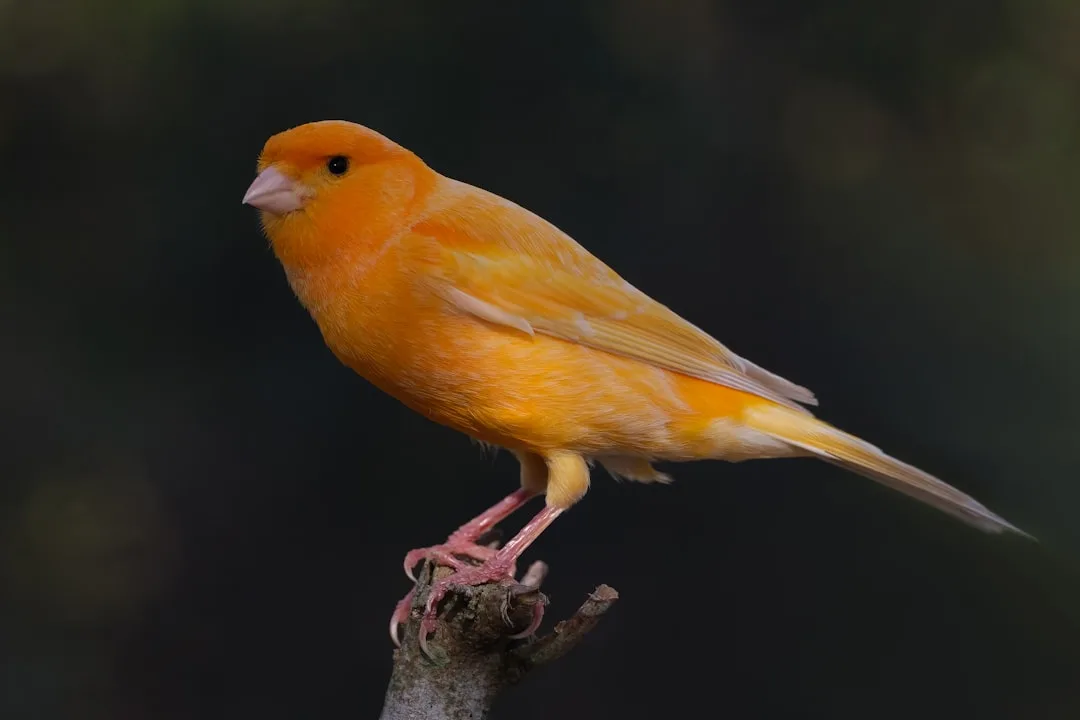
The canary is one of the most familiar small birds in the world and also one of the strangest. It is a finch from three small Atlantic archipelagos that human beings have spent roughly four centuries breeding into more than two hundred different shapes, colours, and songs.
It is a household pet, a laboratory animal, a song-competition athlete, a Victorian mining safety device, and the single species that finally proved the adult vertebrate brain could grow new neurons. Serinus canaria is also a reminder of how quickly human beings can take a plain olive-green forest bird and rebuild it into something that looks and sounds almost nothing like the wild animal.
This guide covers every major aspect of canary biology and history: taxonomy, wild ecology, domestication, breeds, song and vocal learning, neurogenesis research, the coal mine era, reproduction, lifespan, and conservation. It is a reference entry rather than a summary, so expect specifics - grams, centimetres, dates, breed names, and verified records.
Etymology and Classification
The scientific name Serinus canaria was given by Linnaeus in 1758 in the tenth edition of Systema Naturae. Serinus is a Latinised form of the French serin, the name used for small yellow finches across southern Europe. Canaria refers directly to the Canary Islands, the species' principal native range. The English word "canary" derives from the same root via Spanish canario.
The common misconception that the Canary Islands were named after the birds is exactly backwards. The islands were named first. The Roman writer Pliny the Elder recorded that King Juba II of Mauretania sent an expedition to the archipelago around 40 BC and reported that one of the islands was full of large dogs - in Latin, canis.
He named the island Canaria, or "Island of the Dogs", and the name eventually spread to the whole group. The bird, which lived there in large numbers, was then named after the islands it came from, not the other way around.
The identity of the "large dogs" is still disputed - some historians think they were monk seals rather than dogs - but the islands were unambiguously named for canis, and the bird inherited the name second-hand.
Wild canaries belong to the true finch family, Fringillidae, and sit in the genus Serinus alongside the serins, greenfinches, and siskins. Their closest relatives are the island canary (Serinus canaria) itself and the closely allied European serin (Serinus serinus) and Atlantic canary lineages on other North Atlantic islands.
The genus split from other Fringillidae lineages in the Miocene, between 10 and 15 million years ago. The modern species is estimated to have diverged from its nearest mainland relative within the last few million years, after founding populations colonised the volcanic islands from the African mainland.
Native Range and Wild Ecology
Wild canaries live on three Atlantic archipelagos off the north-west coast of Africa: the Canary Islands, Madeira, and the Azores. The range is naturally restricted to these islands, with no mainland populations anywhere, though feral populations of escaped domestic birds now exist in Bermuda, on Midway Atoll in the Pacific, and in Puerto Rico.
On the native islands, canaries favour semi-open habitat with plenty of edge and structure: laurel forest margins, pine woodland clearings, orchards, cultivated terraces, gardens, scrubland, and open rural country. They occur from sea level up to about 1,500 metres on the higher islands. They avoid dense closed-canopy forest and treeless lava fields.
Population density is highest in human-modified landscapes with a mix of seeding plants, shrubs, and song perches - in other words, the bird has always been at home around small-scale farming.
The wild canary is a fundamentally small, plain finch. The upperparts are streaky olive-green with brown and grey markings; the underparts are yellow with dark streaks on the flanks; the wings are dark with pale edges; the rump is brighter greenish-yellow. Males are marginally brighter than females in breeding condition.
This cryptic plumage works extremely well against mossy branches and lichen-covered tree trunks, and anyone looking for a wild canary for the first time is usually struck by how little it resembles the uniform bright yellow of the pet-shop bird.
Wild canaries are primarily seed-eaters, favouring the seeds of grasses, knotweeds, composite flowers, and cultivated cereals, and supplementing this with greens, small soft fruits, and insects during the breeding season, when extra protein is needed for nestlings. Foraging is usually done in small flocks outside the breeding season, breaking up into pairs during spring and summer.
Size and Physical Description
Wild canaries are small, compact finches.
Wild adults:
- Length: 12.5 cm from bill to tail
- Wingspan: 20-23 cm
- Weight: 15-20 g
- Bill: short, conical, pale horn colour
Plumage:
- Upperparts: streaky olive-green and grey-brown
- Underparts: yellow with dark flank streaks
- Face: yellow with greyish cheeks
- Rump: brighter greenish-yellow
- Wings and tail: dark with pale feather edges
Domestic canaries vary dramatically in size and shape depending on breed. Small type canaries such as the Fife Fancy are around 11 centimetres long. Larger show breeds such as the Yorkshire can reach 17 centimetres, and the Parisian Frill regularly reaches 20 to 21 centimetres, with long curled feathers that completely obscure the wild silhouette.
Colour canaries can be pure yellow, white, red, orange, bronze, cinnamon, agate, or mosaic depending on the line. Some breeds carry crests, some have frilled feathers, and some have been selected for dramatic posture.
The one feature that remains broadly consistent across breeds is bill shape: a short, conical, seed-cracking bill. No amount of selective breeding has moved the canary away from being, fundamentally, a small finch.
Domestication and the 17th Century
Canaries were first domesticated in Europe in the 17th century, though their export from the islands began earlier. Spanish sailors began bringing live wild canaries back to mainland Europe from the Canary Islands in the 15th century, initially as curiosities for nobility. Demand grew rapidly because the male's song was unlike any European songbird heard in a cage at the time - varied, sustained, and pleasant at close range.
For most of the 16th century, Spanish traders held a near-monopoly on the canary trade and deliberately exported only males, keeping the breeding stock confined to the islands in order to maintain a steady supply and high prices. The monopoly broke, according to the traditional account, after a Spanish ship carrying canaries was wrecked near the island of Elba in the Mediterranean.
Some of the birds escaped, established a wild population briefly, and - crucially - were caught by Italian bird-keepers who now had breeding pairs. Italian breeders began producing captive stock within a few decades.
By the 1600s, canary breeding had spread across Europe. Tyrolean miners in what is now Austria became famous early breeders, and by the end of the 17th century the small German mining town of Sankt Andreasberg in the Harz mountains was the European centre of song canary breeding. The famous Harz Roller lineage traces back to this town. From there, canary culture spread to Britain, France, the Low Countries, and - later - to the Americas.
The first yellow canaries appeared in Europe in the late 1600s or early 1700s, the product of a recessive mutation that suppressed dark eumelanin pigment. Breeders selected the mutants relentlessly and within a century the yellow domestic canary was the standard form. The wild-type olive-green pattern was retained only in a minority of breeds and in the wild island populations.
Breeds and Varieties
More than 200 distinct canary breeds are recognised by international show organisations such as the Confederation Ornithologique Mondiale (COM). They are grouped into three main categories.
Song canaries - bred for voice:
- Harz Roller (also called Roller or German Roller)
- Waterslager (Belgian Water-Slager)
- Spanish Timbrado
- American Singer
- Russian Singer
Colour canaries - bred for plumage:
- Lipochrome (pure yellow, white, red, ivory)
- Melanin (cinnamon, agate, bronze, phaeo)
- Mosaic (sex-limited patterned plumage)
- Red Factor (orange to deep red, originated from hybridisation with the red siskin Spinus cucullatus)
Type canaries - bred for shape and posture:
- Gloster (smooth or crested)
- Norwich (stocky, heavy-bodied)
- Yorkshire (tall, upright "carrot-shaped")
- Border
- Fife Fancy (miniature Border)
- Lizard (scaled plumage pattern)
- Parisian Frill (dramatic curled feathers)
- Belgian Fancy (extreme hunched posture)
- Japan Hoso (long, slim, upright)
Each breed has a formal written standard defining acceptable size, posture, plumage, and - for song breeds - specific song structure. Show judges award points against the standard, and the difference between a pet-quality and a show-quality bird in any given breed is substantial.
Song and Vocal Learning
The canary is a songbird in the strict biological sense: it learns its song rather than being born knowing it, and the song is produced by a vocal organ called the syrinx under the control of a dedicated brain circuit. Males sing to advertise territory and attract females. Females do not normally sing, though they produce calls and short song-like phrases under some conditions.
A male canary's song is structurally complex. It consists of a long series of discrete phrases, each made up of rapidly-repeated notes called syllables. A single adult male may use more than thirty distinct phrases, and individual birds restructure their repertoire every year, discarding some phrases and adding new ones.
Roller canary song structure:
| Tour | Description |
|---|---|
| Hollow roll | Deep, full-throated rolled "r" sound |
| Bass roll | Lower-pitched continuous roll |
| Water roll | Bubbling, liquid quality |
| Flute | Clear, flowing whistled notes |
| Bell | Sharp ringing repeated notes |
| Schockel | Slow, expressive swinging phrases |
| Klingel | High tinkling notes |
Roller canary competitions are judged on a strict points system. A team of four male rollers is placed in matched cages, covered to encourage quiet song, and uncovered before a panel of certified judges who award points for each tour and deduct for faults. The event is essentially the finch equivalent of a classical music competition, and top teams are traded between breeders for significant sums.
Different song breeds are selected for different priorities. The Spanish Timbrado sings loud, bright, metallic song and is judged in the open rather than under cover. The Waterslager (from Flanders) is judged on deep, liquid "water" notes. The American Singer was developed in the 20th century to combine Roller discipline with louder, more Timbrado-like presentation.
No song canary breed can win a competition by singing what it pleases - each lineage has been selected over generations to produce the specific structures its judges look for.
The HVC Nucleus and Adult Neurogenesis
The canary is one of the most important single species in the history of modern neuroscience because of what is happening inside its brain while it sings.
In the 1970s and 1980s, the neurobiologist Fernando Nottebohm at Rockefeller University's Field Research Center in Millbrook, New York, used canaries to map the brain circuitry that controls song production. He and his colleagues identified a small, compact brain region that they called the HVC - originally "hyperstriatum ventrale pars caudale", later renamed "high vocal centre".
Lesions to the HVC destroyed a canary's ability to produce learned song. Electrical recording showed that HVC neurons fired in precise sequences that matched the structure of the song.
Nottebohm then noticed something that should not have been possible. The HVC in adult male canaries expanded every spring before the breeding season and shrank again in late summer. When he and his colleagues injected adult birds with tritiated thymidine - a radioactive marker that is incorporated into DNA only by dividing cells - they found labelled neurons inside the HVC months later. New neurons were being born in the adult canary brain and being integrated into a functioning circuit.
These results, published in Science in 1983 and 1984, directly contradicted what had been taught to every neuroscientist for the previous century: that the adult vertebrate brain does not produce new neurons. The canary evidence was so clean that it forced a reluctant field to change its mind. The modern research programme on adult neurogenesis - in rodents, in primates, and eventually in humans - traces directly back to the canary experiments.
Female canaries do not normally sing and have a much smaller HVC. In a classic follow-up experiment, Nottebohm's group showed that injecting adult females with testosterone caused the HVC to grow to male-sized proportions within weeks, and the females began producing male-style song. This was one of the cleanest demonstrations ever obtained of hormonal control of adult brain structure and remains a standard teaching example in behavioural neuroendocrinology.
The canary is today a standard model species in the study of vocal learning, motor sequence learning, and adult neurogenesis. Research groups across North America, Europe, Israel, and Japan continue to use Serinus canaria to investigate questions with direct relevance to human language, human motor learning, and human brain repair after injury.
The Coal Mine Era
For nearly a century, canaries served as biological gas detectors in coal mines across Britain, Germany, North America, and elsewhere. Their small body, high metabolic rate, rapid respiration, and sensitive gas exchange surface meant that a canary would collapse from carbon monoxide or methane long before a human miner felt any effect. A dropped canary gave the crew warning to evacuate before the gas reached human-lethal concentrations.
The practice was formalised in Britain after the 1896 Tylorstown colliery disaster in South Wales, in which 57 men and boys died in the aftermath of an explosion. The physiologist John Scott Haldane, invited to investigate, showed that most of the deaths were caused by carbon monoxide poisoning rather than burns or trauma. He recommended the use of small, fast-metabolising animals as early warning systems.
Mice were tried first but were fidgety and hard to observe in the dark. Canaries proved ideal: visible, vocal, and visibly distressed at gas concentrations still invisible to humans.
Haldane also designed a specialised rescue cage that sealed around the canary the moment it collapsed and revived it with a short burst of compressed oxygen, allowing the same bird to be used repeatedly instead of simply dying on duty. Examples of the Haldane-design cage survive in British mining museums.
Canaries remained in service in British coal mines until the late 20th century. The last canaries were officially retired from UK pits in December 1986, when battery-powered electronic gas detectors were finally judged reliable enough to replace them. The phrase "canary in a coal mine" long outlived the practice and is now embedded in English as a metaphor for any early warning indicator.
Reproduction and Life Cycle
Canary reproduction is tightly linked to seasonal photoperiod. In the wild on the native islands, breeding runs from late winter through summer, with birds capable of producing two or three broods per season when conditions are good. Domestic canaries bred under artificial lighting can be cycled through breeding seasons several times a year, which is why commercial breeders can sell fledged young year-round.
Breeding cycle:
- Pair bonding: male sings persistently from a prominent perch until a receptive female approaches
- Nest site: low in dense vegetation (wild) or a provided nest pan (captive)
- Nest materials: grass, hair, moss, feathers, string
- Clutch: 3-5 pale blue-green eggs with fine reddish speckles
- Incubation: 13-14 days, by the female alone; the male feeds her on the nest
- Fledging: 14-21 days after hatching
- Independence: 2-3 weeks after fledging
Chicks are altricial - born naked, blind, and helpless. Both parents feed them, initially on regurgitated seed paste supplemented with soft invertebrates. By the time they fledge, young canaries resemble dull, streaky versions of their mother. Male chicks typically begin producing quiet sub-song a few weeks after fledging, practising in private before graduating to full adult song in their first spring.
Show breeders pair selected birds carefully to preserve breed standards and song structures. A single prize-winning Roller or Yorkshire male may sire hundreds of young over a career.
Lifespan and Health
Wild canaries typically live 5 to 10 years, limited mainly by predation (island falcons, cats, rats, mice), severe storms, and food shortages. Captive canaries regularly reach 10 to 12 years under good husbandry, and well-kept individuals reaching or exceeding 15 years are documented in the bird-keeping literature.
Lifespan varies by breed. Some highly inbred exhibition breeds are shorter-lived because of accumulated genetic issues, while hardier type breeds such as the Norwich, Border, and American Singer often reach the top of the species range. Females generally live slightly shorter lives than males because of the physiological cost of repeated egg-laying.
Common captive health issues include respiratory infections (canaries are notoriously sensitive to airborne irritants - a legacy of the same physiology that made them useful in mines), air-sac mite infestations, scaly-face and scaly-leg mites, egg-binding in overworked females, and the fatty liver disease associated with all-seed diets that lack fresh greens.
Conservation Status
The IUCN Red List classifies the wild canary (Serinus canaria) as Least Concern, with a stable population trend. Total wild population on the native islands is estimated in the low millions, spread across the Canary Islands, Madeira, and the Azores.
Main threats to wild populations:
- Habitat loss from tourism development, especially on Tenerife and Gran Canaria
- Agricultural intensification and loss of small-scale orchard habitat
- Introduced predators (rats, feral cats) on smaller islands
- Pesticide use reducing seed diversity and insect availability
- Illegal trapping for the captive trade (now much reduced but historically significant)
The species as a whole is in no immediate danger and will almost certainly remain common on its native islands for the foreseeable future. Protected areas cover a meaningful fraction of the remaining suitable habitat, and the species' tolerance of human-modified landscapes gives it ecological flexibility most island endemics lack.
Domestic canaries, as a breed complex derived from the wild species, have no conservation status of their own. The relationship between wild and domestic canary is somewhat analogous to the relationship between the wolf and the domestic dog, though the canary timeline is far shorter and the changes are mostly visual and vocal rather than behavioural.
Canaries in Culture
Few small birds have a richer cultural footprint than the canary. The species has been a status symbol in 17th-century royal aviaries, a working miner's companion in the 20th-century industrial revolution, a suburban pet in the mid-20th century, a show-ring athlete in dozens of countries, and a laboratory workhorse in modern neuroscience.
The cartoon character Tweety Bird, created at Warner Bros. in 1942, was designed as a yellow domestic canary, and his bright lemon plumage is a direct visual reference to the selectively-bred mutation rather than to any wild bird. The canary appears on Spanish postage stamps and Canarian regional symbols, and features in the official coat of arms of several Canary Islands municipalities.
The metaphorical "canary in the coal mine" is now one of the most frequently-used phrases in English-language science journalism, politics, and climate reporting. The real practice ended in 1986; the phrase shows no sign of slowing down.
Related Reading
- European Robin: Garden Bird with a Quantum Compass
- Nightingale: Europe's Most Famous Night Singer
- Songbirds: The Musicians of the Natural World
- How Birds Learn to Sing: The Vocal Learning Circuit
References
Relevant peer-reviewed and governmental sources consulted for this entry include the IUCN Red List assessment for Serinus canaria, BirdLife International species factsheets, Fernando Nottebohm's foundational neurogenesis papers in Science (1983, 1984) and subsequent work in Journal of Neuroscience and PNAS, the Confederation Ornithologique Mondiale (COM) breed standards, the UK National Coal Mining Museum archives on the Haldane rescue cage and the 1986 retirement of pit canaries, and classical breed histories in the German, Belgian, and British canary-fancy literature of the 19th and 20th centuries.
Frequently Asked Questions
How big is a canary?
A canary (Serinus canaria) is a small finch roughly 12.5 centimetres from bill to tail, with a wingspan of 20 to 23 centimetres and a body weight between 15 and 20 grams - about the weight of a AA battery. Wild canaries are slightly larger and stockier than many domestic breeds, while selectively-bred show canaries such as the Yorkshire or the Parisian Frill can reach 17 to 21 centimetres.
Males and females are similar in size, with males averaging marginally heavier during the breeding season when they carry more muscle around the HVC song nucleus.
Where do wild canaries live?
Wild canaries are native to three Atlantic archipelagos off the north-west coast of Africa: the Canary Islands, Madeira, and the Azores. Within these islands they favour semi-open habitats - laurel forest edges, orchards, cultivated terraces, pine forest clearings, gardens, and scrubland - from sea level to around 1,500 metres on Tenerife and La Palma.
Introduced populations exist on Bermuda, Midway Atoll, and Puerto Rico, established from escaped or released cage birds. The species is fully absent from mainland Europe in the wild, despite centuries of imported captive stock.
Why are wild canaries green but pet canaries yellow?
Wild canaries are streaky olive-green above and yellow below, with brown and grey markings. This cryptic plumage is an anti-predator adaptation - a canary on a branch against moss and lichen is surprisingly hard to see. The uniform bright yellow familiar from pet shops is the result of selective breeding. Occasional wild birds carry a mutation that suppresses the production of dark eumelanin pigment, leaving the underlying yellow carotenoid colour exposed.
European breeders from roughly the 17th century onwards selected for these yellow mutants generation after generation until the wild camouflage pattern was entirely bred out of domestic stock. Red factor canaries, which have orange or red plumage, were produced in the 20th century by crossing domestic yellow canaries with the red siskin (Spinus cucullatus) and then backcrossing.
Where does the phrase 'canary in a coal mine' come from?
From a real practice. Canaries were used in British, German, American, and Canadian coal mines from the late 19th century onwards to detect carbon monoxide, methane, and other deadly gases. The bird’s small body, high metabolic rate, and sensitive respiratory system meant it would collapse or die from gas concentrations long before a human miner felt any effect, giving the crew warning to evacuate.
The practice was formalised in the UK after the physiologist John Scott Haldane investigated the 1896 Tylorstown mine disaster and recommended small animals - initially mice, then canaries - as biological detectors. Haldane also designed a sealed rescue cage that could revive a collapsed canary with a burst of oxygen, allowing the same bird to be reused.
British coal mines kept canaries in service until December 1986, when battery-powered electronic gas detectors finally replaced them.
How long does a canary live?
Wild canaries typically live 5 to 10 years, limited mainly by predation, severe weather, and food shortages on their island range. Captive canaries regularly reach 10 to 12 years under good care, and individuals approaching or exceeding 15 years are documented in the bird-keeping literature. Well-kept show-bred birds often outlive their wild cousins because they face no predators and have consistent food, water, and veterinary care.
Lifespan varies by breed: some highly inbred show types are shorter-lived due to accumulated genetic issues, while hardier type breeds such as the Norwich and Border canary tend to live longest. Females generally live slightly shorter lives than males because of the physiological cost of egg-laying.
Why is the canary important in neuroscience?
The canary is one of the most important single species in the history of modern brain research. In the early 1980s the neurobiologist Fernando Nottebohm at the Rockefeller University showed that adult male canaries regrow neurons in the HVC, a brain region that controls song production, every single year. Before Nottebohm’s canary work it was a bedrock assumption of neuroscience that adult vertebrate brains do not produce new neurons.
The canary result - published in Science in 1983 and 1984 - forced the entire field to accept that adult neurogenesis was real, and opened the modern research programmes on neurogenesis in mammals, including humans. The HVC nucleus mapped in canaries is now the standard model for how brains learn sequential motor behaviour, with direct relevance to human speech, language, and motor learning.
How many breeds of canary exist?
More than 200 distinct breeds of canary are recognised by international show organisations such as the Confederation Ornithologique Mondiale (COM). They fall into three main categories. Song canaries, such as the Roller, Waterslager, Spanish Timbrado, and American Singer, are bred for specific song structures and are judged at competitions on a strict points system covering defined ‘tours’ - hollow roll, bass roll, water roll, flute, bell, and others.
Colour canaries, such as the Red Factor, Lipochrome, Melanin, and Mosaic, are bred for plumage colour and pattern; the Red Factor line originated from hybridisation with the red siskin. Type canaries, such as the Gloster, Norwich, Yorkshire, Border, Fife, Lizard, and Parisian Frill, are bred for body shape, posture, and feather structure, with some breeds featuring dramatic crests, curls, or elongated bodies.
Are canaries endangered?
The IUCN Red List classifies the wild canary (Serinus canaria) as Least Concern, with a stable population trend. Total population on the native islands is estimated in the low millions, spread across the Canary Islands, Madeira, and the Azores.
Habitat loss from tourism development, agricultural intensification, and urbanisation reduces local densities, and introduced predators such as rats and feral cats take a measurable toll on island populations, but the species as a whole is in no immediate danger.
Domestic canaries are, of course, not wild animals and have no conservation status of their own - they are a breed complex derived from the wild species, roughly comparable to the relationship between wolves and domestic dogs, though much more recent.