
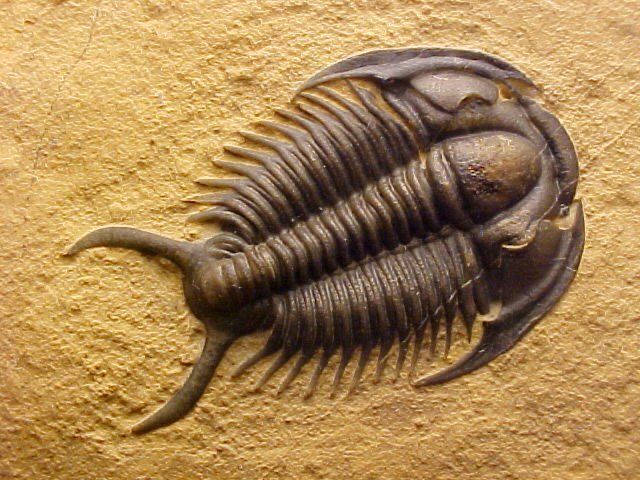
The trilobite is arguably the defining animal of the Paleozoic Era. For 270 million years - longer than the time separating the first dinosaurs from the present day - members of the class Trilobita crawled, swam, burrowed, hunted, scavenged, and filtered their way across the ocean floors of a changing world.
They appeared almost ready-made in the Early Cambrian, diversified into roughly 22,000 described species, survived two of Earth's "big five" mass extinctions, and then vanished completely at the end of the Permian, 252 million years ago. Since their final disappearance, no descendant trilobite and no close relative has ever been found alive.
This guide covers every major aspect of trilobite science: the three-lobed body plan that gave them their name, the calcite lenses that made their eyes unique in the entire history of animal life, the range of lifestyles they adopted from plankton to armoured predators, the mass extinctions that finally ended them, and the long human relationship with their fossils - from Paleolithic beads to modern index fossils used to date Paleozoic rocks.
The representative species used throughout this page is Elrathia kingii, the common Cambrian trilobite of Utah, though the story belongs to the class as a whole.
Etymology and Classification
The name "trilobite" comes from the Greek tri- (three) and lobos (lobe), referring to the three longitudinal lobes that divide the animal's body when seen from above: a raised central axial lobe running nose to tail, and two side (pleural) lobes flanking it.
The scientific description dates from 1698, when the Welsh naturalist Edward Lhwyd illustrated a trilobite from Llandeilo, Wales, and called it a "flat fish". The name Trilobita, in the modern sense, was assigned in 1771 by Johann Ernst Immanuel Walch.
Trilobites belong to the phylum Arthropoda, the same phylum that contains insects, crustaceans, arachnids, and horseshoe crabs. Their exact position inside Arthropoda is debated. Most modern classifications place them in their own subphylum, Trilobitomorpha, distinct from the Chelicerata (horseshoe crabs, spiders, scorpions) and the Mandibulata (crustaceans, insects, myriapods).
Within Trilobitomorpha, the class Trilobita is divided into nine or ten recognised orders, including Redlichiida, Ptychopariida, Asaphida, Proetida, Phacopida, Corynexochida, Lichida, Odontopleurida, Agnostida, and Harpetida. Not all authors treat Agnostida as true trilobites - some workers consider them a separate, non-trilobite group of crustacean-like arthropods.
The representative example used in this entry is Elrathia kingii, from the Wheeler Shale of Utah. It lived during the middle Cambrian, reached only two to three centimetres in length, and is among the most commonly collected trilobites in the world thanks to dense bedding planes exposed by commercial quarrying near Delta, Utah.
Its full taxonomic path runs Animalia to Arthropoda to Trilobitomorpha to Trilobita to the order Ptychopariida, the family Alokistocaridae, the genus Elrathia, and the species E. kingii.
Temporal Range: 270 Million Years
Trilobites first appear in the fossil record in the Early Cambrian, approximately 521 million years ago, during the interval palaeontologists call the Cambrian Explosion. Their final fossils come from the very latest Permian, approximately 252 million years ago, immediately before the end-Permian mass extinction horizon. That gives them a total stratigraphic range of roughly 270 million years.
Trilobite diversity by period:
| Period | Duration (mya) | Trilobite status |
|---|---|---|
| Cambrian | 538-485 | First appearance; rapid radiation; dominant fauna |
| Ordovician | 485-444 | Peak diversity; global distribution |
| Silurian | 444-419 | Moderate diversity; recovery after end-Ordovician extinction |
| Devonian | 419-359 | Major losses in Late Devonian extinction |
| Carboniferous | 359-299 | Reduced diversity; mostly proetids |
| Permian | 299-252 | Final decline; extinction at the boundary |
Trilobite diversity peaked in the Ordovician, when global sea levels were high, warm shallow seas covered most continental margins, and the group reached its maximum geographical and ecological spread.
Thereafter, three successive mass extinctions trimmed the class: the end-Ordovician glaciation event, the Late Devonian extinctions (particularly the Kellwasser and Hangenberg events), and finally the end-Permian Great Dying that closed the story. By the time the Permian began, only a small number of proetid lineages remained - a shadow of the Ordovician peak.
No trilobite is known from any Triassic, Jurassic, Cretaceous, or Cenozoic rock. Their disappearance was total.
Body Plan: Three Lobes, Three Regions
The trilobite body plan is both highly conservative and instantly recognisable. Every trilobite ever described, regardless of age or lifestyle, shares the same fundamental architecture.
Three longitudinal lobes (when viewed from above):
- Central axial lobe, raised, running from head to tail, housing the major muscles and digestive tract
- Two lateral pleural lobes, flanking the axis on either side
Three transverse body regions:
- Cephalon - the head shield, a single fused plate carrying the eyes, antennae, and mouth
- Thorax - a series of articulated segments, each with its own pair of biramous legs
- Pygidium - a fused tail shield made of multiple coalesced posterior segments
The cephalon is where most taxonomic features cluster. It carries the glabella (the raised central bulge above the brain and stomach), the genal spines (often projecting backward from the rear corners), the compound eyes, and the ventral hypostome that covers the mouth. The thorax varies in segment count from two (in agnostids) to more than 40 in some Cambrian olenellids.
The pygidium can be small and tail-like (micropygous) or as large as the cephalon itself (isopygous), an important diagnostic feature for identifying families and genera.
Beneath each thoracic and pygidial segment ran a pair of biramous limbs - a walking leg branch and a feathery gill branch. Limbs are only preserved in exceptional lagerstatten such as the Burgess Shale and Chengjiang, because the ventral exoskeleton was less heavily calcified than the dorsal shield. Trilobites also had a pair of long uniramous antennae projecting from the front of the cephalon, used for chemical and mechanical sensing.
Typical size ranges:
- Smallest: agnostid trilobites, ~1 mm at adult size
- Typical Cambrian seafloor species: 2-10 cm
- Ordovician asaphids: 10-30 cm
- Largest recorded: Isotelus rex, ~72 cm, Ordovician Manitoba
Calcite Eyes: The Only Animals with Mineralised Lenses
The most remarkable feature of trilobites is not their body plan or their longevity - it is their eyes. Trilobites are the only animals in the entire fossil and living record to have built the optical elements of their eyes out of a mineral rather than soft tissue. Their lenses were composed of calcite, the same mineral that forms limestone and marble.
Because calcite preserves readily, it is often still possible to look through a trilobite eye more than 400 million years after the animal's death and see something optically recognisable.
Three main trilobite eye types:
- Holochroal eyes. The oldest and most widespread design. Many small lenses, closely packed with no space between them, covered by a single corneal membrane. Found in most Cambrian and Ordovician trilobites.
- Schizochroal eyes. Fewer, larger lenses, each separated from its neighbours and covered by its own individual corneal surface. Characteristic of the order Phacopida, from the Ordovician onwards.
- Abathochroal eyes. A rarer intermediate form with small, separated lenses. Known mainly from Cambrian eodiscid trilobites.
Calcite is birefringent - it splits light into two rays travelling in different directions - and is therefore a strange choice for optical lenses. Trilobites solved the problem by growing each lens with its optical axis aligned along the crystallographic c-axis of the calcite, which is the one orientation that produces a single, clean image. The result was excellent optical quality.
In some schizochroal eyes, the lens was built as a doublet: an upper calcite unit plus a lower unit of different refractive index, layered to correct spherical aberration. This solution was rediscovered by European lensmakers - independently - only in the seventeenth century, when Descartes and Huygens worked out the geometry of aberration-free lenses.
Eye design varied with lifestyle. Some pelagic trilobites had enormous, nearly hemispherical eyes wrapping around the head for wide-field vision in open water. Bottom-dwelling species had lower, forward-facing eyes suited to a horizontal field of view. A small number of trilobites were fully blind, with the eyes lost secondarily - typical of species living in dark, muddy, or deep-water environments where vision provided no advantage.
Moulting and Growth
Like all arthropods, trilobites grew by moulting. Their hard exoskeleton could not stretch, so they had to shed it periodically and form a new, larger one. The result is that a single trilobite might leave a dozen or more empty moult sheaths behind during its lifetime. The majority of trilobite fossils are actually moulted exuviae rather than the bodies of dead animals. Specialists can often tell the difference by looking at which sutures are open and how the pieces are arranged on the slab.
Trilobite moult sutures were not arbitrary. The cephalon had a precisely placed facial suture that ran through or around the eye, splitting the head shield into a central cranidium and two outer librigenae (free cheeks) during moulting. Four main suture types - proparian, opisthoparian, gonatoparian, and hypoparian - are recognised based on the path the suture takes relative to the genal angle, and they are essential characters for classifying trilobites into orders and families.
Trilobites passed through a three-phase development: the protaspid larval stage (a tiny unsegmented disc), the meraspid stage (progressive addition of thoracic segments through a series of moults), and finally the holaspid adult stage (full segment count reached, with growth continuing only in size). The protaspid was planktonic in most species, which is part of why trilobites spread across the Paleozoic world so effectively.
Defensive Enrolment: The Pill Bug Strategy
Most trilobites could roll their bodies into a tight defensive ball, pressing the cephalon against the pygidium so that the soft ventral side and the vulnerable limbs were enclosed on all sides by the hard dorsal shield. The posture is identical in principle to the one used by modern pill bugs, woodlice, and armadillos. Many specimens are fossilised in this enrolled position, frozen as they must have looked when a predator or a sudden burial event caught them.
Enrolment required careful engineering of the exoskeleton. The body segments had to articulate just enough to fold but not buckle, and a set of coaptive structures - matching ridges, grooves, and interlocking bumps along the segment margins - kept the animal locked in place once rolled. Some groups went further: the order Phacopida developed a complete "sphaeroidal" enrolment, with the cephalon and pygidium meeting edge-to-edge in a perfect sphere.
The fact that defensive rolling evolved early and persisted across hundreds of millions of years strongly suggests that trilobites were frequently hunted. Predation pressure came from early fish, eurypterids (sea scorpions), nautiloid cephalopods, and other trilobites. Many Paleozoic trilobite fossils show bite marks or healed injuries, especially on the posterior pleurae - exactly the region a predator would strike at a fleeing animal.
Diverse Lifestyles
Trilobites were not a single ecological type. Across their 270 million years, they occupied a remarkable range of marine niches:
- Bottom walkers. The commonest lifestyle. Slow crawlers on muddy or sandy seafloors, feeding on detritus or small prey.
- Burrowers. Some asaphids and corynexochids ploughed through soft sediment, often leaving distinctive trace fossils such as Cruziana (feeding traces) and Rusophycus (resting traces).
- Seafloor predators. Large lichids, odontopleurids, and some phacopids had robust spines and reinforced mouthparts suitable for crushing small shelled prey.
- Filter feeders. A number of lineages developed cephalic structures that created currents or trapped particles from the surrounding water.
- Planktonic and pelagic species. Agnostids and some olenids lived in the water column rather than on the seafloor. Their eyes, when present, wrapped around the head for wide-angle vision.
- Chemosymbionts. Certain olenid trilobites appear to have inhabited sulfide-rich low-oxygen waters and may have cultured chemosynthetic bacteria on their gills, much as modern hydrothermal vent animals do.
This diversity of lifestyles - combined with the conservative three-lobed body plan - is part of why trilobites were so successful for so long. They found variations on a theme that worked in almost every marine setting.
Fossil Record and Index Fossils
Trilobite fossils are among the most common macro-fossils in Paleozoic rocks. There are several reasons:
- Their exoskeletons were strongly impregnated with calcium carbonate, so the shell fossilised readily in most marine sediments.
- They moulted repeatedly through life, leaving many exoskeleton fragments for every adult animal that eventually died.
- They occupied every marine environment on Earth for 270 million years, producing an enormous cumulative record.
- Dense shell beds of small species, such as Elrathia kingii in the Wheeler Shale, can contain hundreds of specimens per square metre.
Because trilobite species turned over rapidly and predictably through Paleozoic time, geologists have used them as index fossils for more than 150 years. A well-identified trilobite species often narrows the age of the enclosing rock to a few million years or less, which makes them indispensable for correlating marine sequences between continents. Cambrian stratigraphy, in particular, still relies heavily on trilobite biozones.
Notable trilobite fossil deposits:
| Deposit | Age | Country | Notable genera |
|---|---|---|---|
| Chengjiang | Early Cambrian | China | Naraoia, Eoredlichia |
| Burgess Shale | Middle Cambrian | Canada | Olenoides, Naraoia |
| Wheeler Shale | Middle Cambrian | USA | Elrathia, Asaphiscus, Peronopsis |
| Llandeilo | Ordovician | Wales | Ogygiocarella |
| Fezouata | Early Ordovician | Morocco | Selenopeltis, Asaphellus |
| Hamar Laghdad | Devonian | Morocco | Drotops, Phacops, Reedops |
| Hunsruck Slate | Early Devonian | Germany | Chotecops |
Moroccan Devonian trilobites from sites such as Hamar Laghdad have become major commercial fossils and fill museum displays worldwide. The quality of preservation - with eyes, spines, and sutures intact - makes these some of the most photogenic trilobite specimens ever recovered.
Extinction: The End-Permian Great Dying
The end-Permian mass extinction, 252 million years ago, is the most severe biodiversity crisis in Earth history. An estimated 96% of marine species, 70% of terrestrial vertebrate species, and the vast majority of insect lineages vanished in a geological instant. Every remaining trilobite species went with them.
The immediate drivers were tied to the eruption of the Siberian Traps, one of the largest volcanic provinces in Earth's history. The eruptions injected enormous volumes of carbon dioxide, methane, and sulfur dioxide into the atmosphere over a few hundred thousand years.
The consequences cascaded through the oceans: global warming of 8-10 degrees Celsius, widespread ocean acidification, loss of dissolved oxygen in shallow seas (ocean anoxia), and the collapse of carbonate ecosystems that many marine invertebrates depended on.
Trilobites were already a shadow of their former selves by the Permian. Their long decline began with the end-Ordovician mass extinction, which removed most of the ecologically dominant Cambrian and Ordovician lineages. The Late Devonian crises eliminated most of what remained. By the Carboniferous and Permian, only a reduced assemblage of proetid trilobites occupied restricted marine niches. When the end-Permian shock arrived, these final lineages had no capacity to survive.
No trilobite is known to have crossed the Permian-Triassic boundary. Their disappearance was not gradual - it was final.
Trilobites and Humans
The human relationship with trilobites may be older than palaeontology itself. At the Grotte du Trilobite in the Yonne department of France, archaeologists recovered a drilled trilobite fossil dated to approximately 15,000 years ago, from a Late Paleolithic site. The fossil had been modified into a pendant, with a deliberately bored hole for a cord.
It is among the earliest known pieces of personal ornament made from a fossil, and it suggests that Upper Paleolithic humans recognised the object as unusual and worth keeping.
Native American groups in the Great Basin of western North America collected Elrathia kingii specimens from Utah outcrops as protective amulets long before European palaeontologists arrived. The Pahvant Ute name for the trilobite translates roughly as "little water bug that lives in a stone house" - an intuitive and ecologically accurate description from people who had no written record of the Cambrian.
Formal scientific description began with Edward Lhwyd's 1698 illustration of a trilobite from Llandeilo, Wales. Over the following two centuries, European naturalists assembled the bulk of modern trilobite taxonomy, with major contributions from Joachim Barrande (Bohemia), Charles Doolittle Walcott (United States), and Franco Rasetti (Italy and United States).
Today, trilobites are central to both academic palaeontology and the commercial fossil trade. Specimens from Morocco, Russia, the United States, and China move through global auction houses and mineral shows in quantities that no other fossil group matches.
Why Trilobites Still Matter
Trilobites are not merely interesting fossils. They are one of the clearest windows into the long middle of the history of animal life. Several specific reasons keep them at the centre of modern science:
First, they are the best record we have of Paleozoic marine ecology. With 22,000 described species spanning 270 million years and every ocean basin, no other fossil group provides comparable resolution across the same time interval.
Second, they are unmatched for age correlation. Trilobite biozones remain the primary tool for dating Cambrian and much of the Ordovician marine record, and they underpin the global geological timescale.
Third, their eyes are a natural experiment in optics. The mineral calcite lens is unique in all of animal history, and trilobite visual systems are still mined for insights by optical engineers interested in robust, aberration-corrected micro-lens designs.
Fourth, they are a cautionary tale. A group of animals can persist across three of the five major mass extinctions, dominate an era, fill every marine niche imaginable, and still be completely erased by a single environmental crisis. Trilobites went from global dominance to zero in a geological interval that - measured against the history of the group - passed almost instantly.
Related Reading
- Archaeopteryx: The Urvogel of the Late Jurassic
- Fossils: How We Read the Story of Ancient Life
- Mass Extinctions in Earth History
- The Cambrian Explosion: Life's Big Bang
References
Relevant peer-reviewed sources consulted for this entry include foundational taxonomic work by Whittington, Fortey, and colleagues in the Treatise on Invertebrate Paleontology, Part O (revised edition, 1997); phylogenetic and eye-optics analyses published in Palaeontology, Journal of Paleontology, and Arthropod Structure and Development; calcite-lens optical reconstructions by Clarkson, Levi-Setti, and Horvath; end-Permian extinction studies in Science and Nature Geoscience; and the archaeological record of human trilobite use documented in Proceedings of the Prehistoric Society and the Journal of Archaeological Science.
Species counts reflect consolidated figures from the Paleobiology Database as of the most recent reviews.
Frequently Asked Questions
What is a trilobite?
A trilobite is an extinct marine arthropod belonging to the class Trilobita. The name means ‘three-lobed’ and refers to the longitudinal division of the body into a central axial lobe and two side (pleural) lobes. Trilobites also had three transverse body regions - the cephalon (head), the thorax (segmented middle section), and the pygidium (fused tail shield).
They lived exclusively in marine environments, first appeared in the Early Cambrian around 521 million years ago, and vanished in the end-Permian mass extinction 252 million years ago. Roughly 22,000 species have been formally described, making them one of the most diverse extinct animal groups in the fossil record.
When did trilobites live and when did they go extinct?
Trilobites appeared in the Early Cambrian, around 521 million years ago, and disappeared at the end of the Permian period, around 252 million years ago. That gives them a total run of approximately 270 million years - longer than the time separating the first dinosaurs from humans today. Their final disappearance coincided with the end-Permian mass extinction, also known as the Great Dying, which eliminated an estimated 96% of marine species.
Trilobite diversity had already declined substantially after the Devonian, and only a handful of ptychopariid lineages remained in the Permian seas when the extinction struck.
Why were trilobite eyes so unusual?
Trilobites are the only known animals ever to have built their eyes out of a mineral. Their compound eye lenses were made of highly oriented calcite crystals - the same mineral as limestone and marble - aligned so that their optical axis pointed straight out of the eye.
Three main eye types are recognised: holochroal eyes with many small closely packed lenses, schizochroal eyes with fewer, larger, separated lenses, and abathochroal eyes of a rarer intermediate design. Some schizochroal lenses used a doublet configuration to cancel spherical aberration, a solution rediscovered by human opticians only in the seventeenth century.
Because calcite preserves well, it is sometimes still possible to look through a trilobite eye more than 400 million years after its death and see a recognisable image.
How big were trilobites?
Trilobite size varied enormously depending on species and environment. The smallest agnostid trilobites reached only a millimetre or two at full adult size and lived as plankton in open water. The typical Cambrian-Ordovician seafloor trilobite was a few centimetres long, comparable to a modern coin.
The largest known species, Isotelus rex from the Ordovician of Manitoba, reached about 72 centimetres and weighed several kilograms, placing it among the largest arthropods that have ever lived. Other giants include members of Terataspis, Uralichas, and Paradoxides, with several species approaching 40 to 60 centimetres in length.
How did trilobites live and what did they eat?
Trilobites occupied an astonishing range of marine lifestyles. Most were bottom-dwellers that walked, crawled, or burrowed through seafloor sediment. Within that general pattern, they filled many ecological roles. Some, such as members of the asaphids, were deposit feeders that swallowed sediment and digested the organic fraction.
Others, including large lichids and odontopleurids, were armoured seafloor predators with hardened spines and robust mouthparts. Filter feeders with specialised cephalic structures strained particles from the water. Planktonic groups like the agnostids and some pelagic olenids drifted or swam in the open ocean.
A few olenid trilobites appear to have lived in sulfide-rich, low-oxygen environments, and may have farmed chemosynthetic bacteria for food - similar to modern hydrothermal vent animals.
Why are trilobite fossils so common?
Three factors make trilobite fossils unusually abundant. First, their exoskeletons were strongly calcified - heavily impregnated with calcium carbonate - so the shell fossilised readily in most marine sediments. Second, like all arthropods, trilobites moulted their exoskeletons repeatedly during growth, leaving many empty shells behind for every adult that eventually died. A single animal might leave a dozen or more potential moult fossils during its life.
Third, trilobites were ecologically successful and geographically widespread for 270 million years, occupying every marine province on Earth across most of the Paleozoic. The result is that trilobite fossils occur on every continent - including Antarctica - and often in dense bedding planes with hundreds of specimens per square metre.
Why did trilobites go extinct?
Trilobites disappeared in the end-Permian mass extinction, 252 million years ago, the most severe biodiversity crisis in Earth’s history. The immediate drivers were a cascade of environmental shocks tied to massive volcanic eruptions in what is now the Siberian Traps: widespread ocean warming, ocean acidification, oxygen loss in shallow seas, and disruption of the carbon cycle.
However, trilobite diversity had been declining for tens of millions of years before the final event. After their Cambrian-Ordovician peak, they suffered heavy losses at the end-Ordovician and Late Devonian extinctions. By the Permian, only a few ptychopariid-derived lineages survived. The end-Permian extinction pushed these last lineages past their limit. No trilobite group is known to have crossed into the Triassic.
How did humans first encounter trilobite fossils?
Humans have been collecting trilobite fossils for tens of thousands of years. A drilled trilobite fossil worn as a pendant was recovered from the Grotte du Trilobite in France and dated to roughly 15,000 years ago, making it one of the oldest known ornaments ever made by Homo sapiens.
Native American groups in the Great Basin collected Elrathia kingii specimens as protective amulets - the Pahvant Ute name for them translates roughly as ‘little water bug that lives in a stone house’. The first formal scientific description was published in 1698 by the Welsh naturalist Edward Lhwyd.
Since then, trilobites have become among the most recognisable and widely collected fossils in the world, central to both professional palaeontology and commercial fossil trade.