
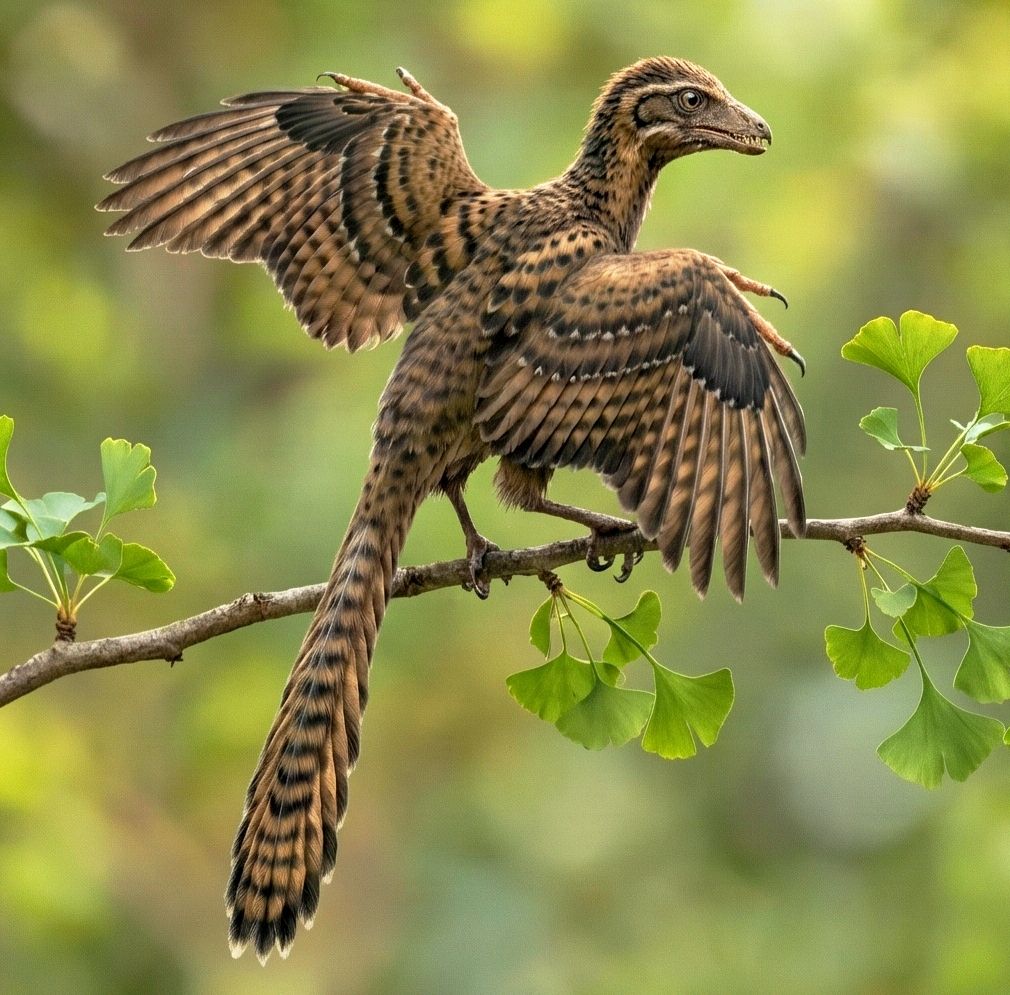
Archaeopteryx is arguably the most famous fossil animal ever discovered. For more than 160 years it has been held up in classrooms, museums, and textbooks as the definitive transitional form between dinosaurs and birds - the so-called Urvogel, or "original bird", of Late Jurassic Germany.
Unearthed from the fine-grained Solnhofen limestone just two years after Charles Darwin published On the Origin of Species, it provided one of the most spectacular and timely confirmations of evolutionary theory in the history of palaeontology.
This guide covers every aspect of Archaeopteryx science: the anatomy that makes it simultaneously reptilian and avian, its 1861 discovery, the twelve known specimens, the Solnhofen lagerstatte that preserved it, what its recovered melanosomes tell us about feather colour, the long debate over whether it could actually fly, and why - even after hundreds of feathered dinosaurs have been found in China and elsewhere - it remains the single most iconic fossil in all of evolutionary biology.
Etymology and Classification
The name Archaeopteryx lithographica was assigned in 1861 by the German palaeontologist Hermann von Meyer. It translates literally as "ancient wing, from lithographic stone", a reference both to the feathered impression preserved in the original specimen and to the exceptionally fine limestone - quarried around Solnhofen for use in lithographic printing plates - that entombed it.
German-speaking scientists quickly adopted the nickname Urvogel, meaning "original bird" or "primeval bird", and the label has stuck in popular writing ever since.
Modern cladistic analysis places Archaeopteryx within the theropod dinosaur clade Avialae. Its full taxonomic path runs Animalia to Chordata to Reptilia, then into the clade Dinosauria, the order Saurischia, the suborder Theropoda, and finally into Avialae, the family Archaeopterygidae, and the genus Archaeopteryx. Under modern phylogenetic definitions, birds - and Archaeopteryx - are dinosaurs.
In the older, pre-cladistic classification still used in some contexts, Archaeopteryx was simply called the earliest bird. Whether you treat it as a dinosaur with feathers or a bird with teeth depends entirely on where you choose to draw a boundary that nature itself never drew sharply.
A small number of researchers split the twelve known skeletal specimens into multiple species - A. lithographica, A. siemensii, and A. albersdoerferi have all been proposed - while others lump them into a single, highly variable species. There is no current consensus, and the number of recognised species has expanded and contracted several times over the past century.
Discovery and History
The Archaeopteryx story begins with a single feather. In 1860, a quarry worker in Solnhofen, Bavaria, split open a slab of limestone and noticed the perfect impression of a fossilised pennaceous feather inside. Hermann von Meyer described it formally in 1861 under the name Archaeopteryx lithographica, treating this lone feather as the type specimen.
The timing could not have been more dramatic - Darwin had published On the Origin of Species in 1859, predicting that transitional fossils bridging major animal groups should exist but had not yet been found.
Later in 1861, the first complete skeleton emerged from the same quarry system. It is now known as the London specimen because it was purchased in 1862 by the British Museum for the then-enormous sum of 700 pounds. The price sparked a rush on Solnhofen quarries. Local workers, quarry owners, and collectors began scouring the limestone for further finds - a small-scale fossil economy that continues to this day.
The Berlin specimen, discovered in 1874 or 1875, became the most famous and most photographed fossil in the world. It preserves the animal with wings fully outstretched, long bony tail trailing, and a halo of feather impressions so clear that individual vanes remain visible. Almost every biology textbook printed since the late nineteenth century carries a photograph or illustration of the Berlin specimen.
Major discovery timeline:
| Year | Event | Specimen |
|---|---|---|
| 1860 | Isolated feather found | Feather holotype |
| 1861 | First complete skeleton unearthed | London specimen |
| 1874-75 | Wings-spread skeleton found | Berlin specimen |
| 1956 | Third skeleton recognised | Maxberg specimen (later lost) |
| 1970 | Specimen reclassified from pterosaur | Haarlem specimen |
| 1974 | Eichstatt specimen described | Eichstatt specimen |
| 1992 | Seventh skeleton found | Solnhofen specimen |
| 1997 | Munich specimen described | Munich specimen |
| 2007 | Thermopolis specimen published | Thermopolis specimen |
| 2011-18 | Additional specimens studied | Daiting, 11th, 12th specimens |
One specimen - the Haarlem Archaeopteryx, uncovered in 1855 before the genus was named - was misidentified as a pterosaur for more than a century. It was not recognised as Archaeopteryx until a re-examination in 1970 by John Ostrom. A separate Archaeopteryx specimen, the Maxberg, was stolen or lost in 1991 and has never been recovered. Only photographs and casts remain.
The Solnhofen fossil trade still generates legal and ethical controversy. Several of the most important Archaeopteryx finds passed through private hands for decades before being described, and the question of who owns a specimen unearthed by a private quarry operator on private land remains contested under German law.
The Solnhofen Lagerstatte
Archaeopteryx is a product of place as much as time. The Solnhofen limestone, which outcrops across a small region of southern Bavaria between Eichstatt and Solnhofen, is one of the most important fossil deposits on Earth. Palaeontologists call such sites Konservat-Lagerstatten - "preservation storehouses" - where unusually fine conditions freeze soft tissues and delicate structures that would normally be lost.
During the Late Jurassic, around 150 million years ago, this part of what is now Germany was a tropical archipelago of low islands and shallow, hypersaline lagoons. The lagoons had restricted circulation, a stratified water column, and an anoxic bottom layer poor in oxygen.
When an animal died and sank to the lagoon floor, there were no scavengers and no burrowing animals to disturb it. Fine carbonate mud gently covered the carcass, layer by layer, eventually turning into the famous platy limestone.
The result is preservation so precise that individual feather vanes on Archaeopteryx specimens can still be resolved under magnification. Barbule structure is visible. Melanosomes - the microscopic pigment-bearing organelles embedded in feather keratin - survive well enough to be analysed with scanning electron microscopy.
Soft tissue outlines, gut contents, and even skin textures have been documented in other Solnhofen fossils. The quarries have produced pterosaurs with wing membrane impressions, small coelurosaurs with preserved feathers, fish, cephalopods, horseshoe crabs, jellyfish, and even the delicate bodies of insects.
In short, Archaeopteryx did not simply live in the Late Jurassic. It died in one of the very few places on Earth capable of preserving a feathered, hollow-boned, crow-sized animal in recognisable form for geological eternity.
Anatomy: Dinosaur Meets Bird
The single most important feature of Archaeopteryx is not any one trait. It is the combination of traits. In a single animal, Archaeopteryx displays features that are indisputably bird-like alongside features that are indisputably reptilian. No living vertebrate shows this combination.
Bird-like features:
- Pennaceous feathers covering the body, with asymmetrical flight feathers on the wings and tail
- Furcula (wishbone) formed by fused clavicles - a hallmark of the bird skeleton
- Reversed hallux (first toe), a foot configuration associated with perching in modern birds
- Hollow, pneumatised bones reducing weight
- Long forelimbs with wing proportions broadly similar to modern birds
- Interlocking feather vanes indicating true feathers rather than filamentous protofeathers
Dinosaur-like features:
- Sharp conical teeth set in sockets - no beak
- Long bony tail of more than 20 vertebrae, each with its own feather attachments
- Three clawed fingers on each hand, not fused into a wing as in modern birds
- Unkeeled sternum (breast bone) - no deep flight-muscle anchor
- Abdominal ribs (gastralia), absent in modern birds
- Large, reflexed second-toe claw reminiscent of dromaeosaur raptors
- Pelvic and vertebral features matching small theropod dinosaurs
Size and proportions:
- Total body length: approximately 50 centimetres from beak to tail tip
- Wingspan: 50-60 centimetres
- Body mass: estimated at 0.9 to 1.4 kilograms
- Skull length: around 7 centimetres
- Tail length: more than half the total body length
Archaeopteryx was roughly the size of a modern magpie or crow. For a palaeontologist, the significance is not the size but the mix - a carnivorous animal the size of a crow with feathers like a pigeon, teeth like a raptor, claws on its hands, and a long reptilian tail running behind it.
Feathers and Feather Colour
Archaeopteryx feathers are modern in structure. Their asymmetry - a narrower leading vane and a broader trailing vane - is a feature associated almost exclusively with flight in extant birds. Symmetrical feathers, by contrast, are used for insulation or display. The presence of asymmetrical flight feathers strongly implies that Archaeopteryx was using its wings for some form of aerial locomotion, even if not full powered flight.
In 2012, a study led by palaeontologist Ryan Carney analysed the original 1860 feather using scanning electron microscopy. Preserved melanosomes - the pigment organelles inside the feather keratin - retained their shape and packing density. Both matched the melanosomes responsible for black colouration in modern birds.
The researchers concluded that the isolated feather, at minimum, had been black, and suggested that parts of the Archaeopteryx wing were similarly dark. Later work has refined that picture: the plumage may have been a more complex mix, with darker wing tips and lighter body feathers, more like a magpie than a crow.
This was a genuine scientific milestone. It demonstrated that fossil melanosomes could preserve recoverable colour information across more than 100 million years of burial. It also anchored Archaeopteryx in a growing field of fossil colour reconstruction that now includes Anchiornis, Microraptor, Sinosauropteryx, and several dinosaur eggshells.
Could Archaeopteryx Fly?
The short answer is "probably, but badly". The long answer has been a matter of scientific debate since the nineteenth century.
Arguments in favour of flight:
- Asymmetrical flight feathers matching those of modern flying birds
- Wing proportions that, scaled up, resemble those of modern weak-flying birds
- A furcula that would have stored elastic energy during the wing stroke
- A 2018 synchrotron study of Archaeopteryx bone micro-architecture showed a bone wall structure similar to that of modern flapping birds
Arguments against strong flight:
- No keeled sternum for large flight muscles
- Shoulder joint geometry that would not permit a full dorsal upstroke
- Relatively small wing area compared with body mass
- Brain and inner ear structure that, while bird-like, was not fully specialised for advanced flight control
Most researchers now converge on a mixed answer. Archaeopteryx could likely perform short bursts of flapping flight, especially downward or from elevated perches, and could glide between trees or down from cliffs. Sustained soaring or powered level flight of the kind practised by modern pigeons or crows is considered unlikely.
Some researchers have suggested that its wings also functioned in running up steep or vertical surfaces - wing-assisted incline running - a behaviour seen in living ground birds such as chukar partridges.
Brain, Senses, and Behaviour
CT scans of Archaeopteryx skulls - especially the London, Munich, and Thermopolis specimens - have produced detailed endocasts of its brain and inner ear. The brain was intermediate in shape and size between non-avian theropods and modern birds. It was larger than a comparably sized reptile brain but smaller than a modern bird brain of the same body size.
The optic lobes were enlarged, suggesting strong visual capability. The inner ear, specifically the semicircular canals, had the geometry associated with rapid head movement and aerial agility - consistent with at least some flight or vigorous three-dimensional movement through its environment.
Beyond hard anatomy, direct behavioural evidence is limited. Archaeopteryx likely hunted small vertebrates and large insects. Its recurved teeth, grasping hands, and enlarged second-toe claws are consistent with predatory theropods. Its tropical lagoon-and-island environment offered small lizards, early mammals, juvenile dinosaurs, and an abundance of insects as prey.
Whether it foraged on the ground, climbed into vegetation, or moved between the two cannot be reconstructed precisely from the fossils.
Growth studies of Archaeopteryx bone histology show slow, incremental growth more reminiscent of reptiles than of modern birds, which grow to adult size within a single season. This implies a long juvenile period and, by extension, a life history closer to a small reptile than to a sparrow.
Specimens: The Twelve Archaeopteryx
Every serious discussion of Archaeopteryx eventually becomes a discussion of specimens. Twelve skeletal fossils are currently recognised, each with its own discovery story, anatomical quirks, and scientific literature.
| # | Specimen | Year | Current location | Notable for |
|---|---|---|---|---|
| - | Feather | 1860 | Berlin Natural History Museum | Type feather; melanosome analysis |
| 1 | London | 1861 | Natural History Museum, London | First skeleton; bought for 700 pounds |
| 2 | Berlin | 1874-75 | Berlin Natural History Museum | Textbook image; wings spread |
| 3 | Maxberg | 1956 | Lost since 1991 | Only casts remain |
| 4 | Haarlem | 1855 (reclassified 1970) | Teylers Museum, Netherlands | Misidentified as pterosaur for 115 years |
| 5 | Eichstatt | 1951 (described 1974) | Jura-Museum, Eichstatt | Smallest, juvenile-like |
| 6 | Solnhofen | 1960s (described 1988) | Burgermeister-Muller Museum | Large, once called Wellnhoferia |
| 7 | Munich | 1992 | Palaeontological Museum, Munich | Shows sternum clearly |
| 8 | Bergermeister-Muller | 2004 | Bergermeister-Muller Museum | Complete articulated skeleton |
| 9 | Thermopolis | c. 1970 (described 2005) | Wyoming Dinosaur Center | Best hyperextended second toe |
| 10 | 11th specimen | 2011 | Private / Munich | Excellent plumage preservation |
| 11 | Daiting | 1996 (described 2018) | Private | Slightly younger stratum |
| 12 | 12th specimen | 2010s | Private collections | Fragmentary |
The number and naming varies by author. Some older literature counts only ten specimens. Some recent papers split specimens across multiple genera - Wellnhoferia, Jurapteryx, Ostromia - though the majority of workers still group them under Archaeopteryx.
Environment and Ecology
During the Late Jurassic Tithonian age, the Solnhofen region was a cluster of small islands separated by shallow, warm lagoons. The wider palaeogeography placed Europe as an archipelago fringing the northern margin of the Tethys Ocean. The climate was tropical to subtropical and seasonal, with extended dry intervals. Land vegetation included conifers, cycads, ginkgoes, and ferns. There were no flowering plants yet - angiosperms would not diversify until the Early Cretaceous.
Archaeopteryx shared its world with small coelurosaurian dinosaurs such as Compsognathus, with pterosaurs of multiple lineages including Pterodactylus and Rhamphorhynchus, with marine crocodiles, with ichthyosaurs and plesiosaurs in nearby seas, and with a diverse fauna of insects, lizards, and early mammals.
Competition from pterosaurs for aerial niches was almost certainly a significant ecological pressure - pterosaurs had already been flying for more than fifty million years when Archaeopteryx appeared.
The isolation of the Solnhofen islands, along with the relative scarcity of large ground predators on small islands, may have been part of why a slow-growing, weak-flying feathered theropod could persist there. Island environments in general have repeatedly produced unusual evolutionary experiments in the vertebrate record.
Position in Bird Evolution
When Archaeopteryx was first described, it was unique. No other fossil animal combined reptilian and avian features so clearly. For more than a century it was routinely described as "the first bird" and drawn as a direct ancestor of modern birds on evolutionary trees.
That simple picture is no longer accurate. Since the 1990s, palaeontologists working in the Liaoning fossil beds of China have recovered dozens of feathered theropod dinosaurs, including Microraptor, Anchiornis, Xiaotingia, Aurornis, Sinornithosaurus, and many more. Some of these animals are older than Archaeopteryx. Some have better-preserved plumage.
Several show aerial adaptations that appear independently evolved. The origin of birds, once a narrow evolutionary thread, is now recognised as a broad radiation of small feathered theropods experimenting with gliding, flapping, and arboreal life across the Middle and Late Jurassic.
Within this revised picture, Archaeopteryx occupies a special but less solitary position. It sits close to the base of Avialae - the clade containing modern birds and their closest feathered relatives - but whether it is a direct ancestor or a side branch is currently uncertain.
In 2011, a phylogenetic analysis briefly pushed Archaeopteryx outside Avialae and into Deinonychosauria; later work returned it to its conventional position. The uncertainty reflects real ambiguity in the fossil record, not sloppy science.
What has not changed is its historical and educational importance. Archaeopteryx is still the fossil that links Darwin's 1859 prediction to the modern consensus that birds evolved from small theropod dinosaurs. It is the anchor around which the rest of the story is told.
Why Archaeopteryx Still Matters
A reasonable reader might ask why, with hundreds of feathered dinosaurs now known, Archaeopteryx still dominates textbooks and museum halls. There are several reasons.
First, it was the first. No later discovery can take away the historical significance of having been unearthed just two years after On the Origin of Species. In 1861, the existence of transitional fossils was a theoretical prediction. Archaeopteryx turned that prediction into a physical object.
Second, its preservation is extraordinary. Few Chinese fossil theropods match the articulation, detail, and three-dimensionality of the best Archaeopteryx specimens. The Berlin specimen, in particular, remains one of the most visually compelling fossils in existence.
Third, it occupies a taxonomic sweet spot. It is advanced enough to be clearly on the bird line but primitive enough to retain the full suite of reptilian features. Later feathered theropods tend to emphasise one side or the other. Archaeopteryx balances both almost perfectly.
Fourth, it keeps producing new science. Feather colour reconstruction, synchrotron bone imaging, high-resolution CT of the brain and inner ear, and continuing phylogenetic revisions mean that even a 160-year-old fossil remains an active research subject.
Related Reading
- Fossils: Windows into Ancient Life
- Feathered Dinosaurs Beyond Archaeopteryx
- Great Extinctions in Earth History
- The Jurassic Period: Giants, Seas, and Skies
References
Relevant peer-reviewed sources consulted for this entry include foundational descriptive work by Hermann von Meyer (1861) and later monographs by Peter Wellnhofer; phylogenetic analyses published in Nature, Science, and the Journal of Systematic Palaeontology; melanosome-based colour reconstruction in Nature Communications (Carney et al., 2012) and related follow-ups; synchrotron bone-wall analyses in Nature Communications (2018); and specimen-level descriptions in the Zoological Journal of the Linnean Society and the Journal of Vertebrate Paleontology.
Specimen information reflects the consolidated catalogue discussed in the 2018 revision of Archaeopteryx taxonomy.
Frequently Asked Questions
What was Archaeopteryx?
Archaeopteryx was a small, feathered theropod dinosaur that lived during the Late Jurassic, around 150 million years ago, in what is now southern Germany. It was about the size of a modern crow - roughly 50 centimetres long and weighing between 0.9 and 1.4 kilograms.
For over 150 years it has been the textbook example of a transitional form between non-avian dinosaurs and modern birds, combining feathers, a furcula (wishbone), and a reversed hallux with reptilian teeth, a long bony tail, and clawed wings. German palaeontologists nicknamed it the Urvogel, meaning ‘original bird’.
When and where was Archaeopteryx discovered?
The first evidence was a single isolated flight feather unearthed in 1860 from the Solnhofen limestone quarries of Bavaria, Germany. It was formally described by Hermann von Meyer in 1861 and named Archaeopteryx lithographica, referencing the fine lithographic limestone that preserved it. Later in 1861 a nearly complete skeleton - now known as the London specimen - emerged from the same quarries and was purchased by the British Museum.
Since then eleven additional skeletal specimens have been recovered, all from the Solnhofen-Eichstatt region. No Archaeopteryx fossils have been found anywhere else in the world.
Was Archaeopteryx a bird or a dinosaur?
Both, depending on definition. Modern phylogenetic analysis places Archaeopteryx within the theropod dinosaur clade Avialae, the group that includes modern birds and their closest feathered relatives. In this sense it is a dinosaur - and birds themselves are surviving theropod dinosaurs. In the traditional, pre-cladistic sense it was treated as the earliest known bird because of its feathers, furcula, and reversed hallux.
Recent discoveries of other feathered theropods such as Anchiornis and Xiaotingia have blurred the line further. Archaeopteryx remains the iconic transitional fossil, though it may be better described as one of many branches near the origin of birds rather than a direct ancestor.
Could Archaeopteryx fly?
Probably - but not well. Archaeopteryx had asymmetrical flight feathers, a feature found only in flying birds today, which strongly suggests some aerial capability. However, its sternum was not keeled, meaning it lacked the large anchor for flight muscles that powers sustained flapping in modern birds. Its shoulder joint geometry also differs from modern birds and would not have allowed the full upstroke needed for powered flight.
Most researchers now think Archaeopteryx was capable of short bursts of powered or burst flight, gliding from tree to tree, and possibly using its wings to aid running up steep surfaces. It likely fell somewhere between a gliding animal and a weak flapping flier - a genuine transitional locomotion.
What colour was Archaeopteryx?
At least some of it was black. A 2012 study using scanning electron microscopy examined the melanosomes - microscopic pigment-bearing structures - preserved in the original 1860 feather and in wing feathers of the Berlin specimen. The shape and distribution of the melanosomes matched those responsible for black colouration in modern birds.
Later work suggested the plumage may have been more mixed, with black concentrated on the wing tips and lighter shades elsewhere. Even partial colour reconstruction is remarkable: it demonstrates that fossil melanosomes can preserve pigmentation evidence across more than a hundred million years of burial.
Why is Archaeopteryx so important to evolution?
Charles Darwin published On the Origin of Species in 1859. His theory predicted that transitional forms linking major groups of animals should exist but had not yet been found. Two years later, the first Archaeopteryx skeleton emerged from a German limestone quarry - an animal with undeniably bird-like feathers and undeniably reptilian teeth, tail, and claws.
It was used by Thomas Henry Huxley and others as decisive evidence that birds evolved from reptile ancestors. Today, with hundreds of feathered dinosaurs known from China and elsewhere, Archaeopteryx is no longer unique. But it remains historically singular - the fossil that showed the theory of evolution could make a risky prediction and be vindicated.
How many Archaeopteryx fossils have been found?
Twelve skeletal specimens are currently recognised, plus the original isolated feather. They are catalogued by the city or institution that houses them: the London, Berlin, Maxberg (now missing), Haarlem, Eichstatt, Solnhofen, Munich, Bergermeister-Muller, Thermopolis, 11th specimen (privately held for years), 12th specimen (the Daiting specimen), and a few disputed fragments.
Some researchers split the specimens into multiple species - A. lithographica, A. siemensii, A. albersdoerferi - while others lump them all into one variable species. The Berlin specimen, with its fully spread wings and halo of feather impressions, is the most widely reproduced image.
What did Archaeopteryx eat?
Archaeopteryx was carnivorous. Its sharp, recurved teeth, raptor-like second toe claw, and grasping hands suggest it fed on small vertebrates - lizards, small mammals, juvenile dinosaurs - as well as insects and other invertebrates. Its Solnhofen environment was a tropical archipelago of shallow lagoons and low islands, and it likely hunted opportunistically along shorelines and in low vegetation.
Unlike modern birds, it had no beak, no crop, and no gizzard of the specialised avian type, so its feeding ecology would have resembled that of small predatory theropods more than any living bird. Stable isotope and tooth wear studies remain limited given specimen rarity.