
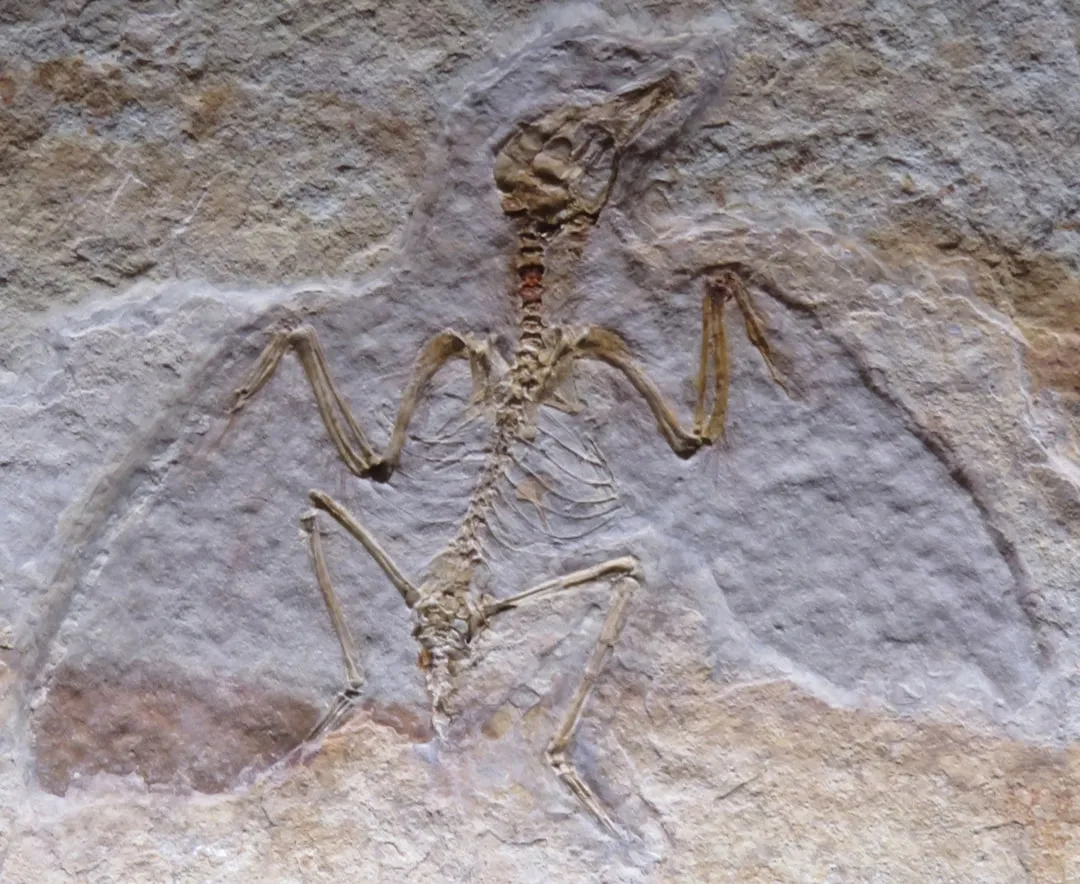
Pterodactylus antiquus is the animal that gave every pterosaur its popular name. Quarried from the Solnhofen limestone of southern Bavaria and first described in 1784 by Cosimo Alessandro Collini, it was the first pterosaur ever scientifically recognised - a full 40 years before anyone named a dinosaur, and decades before the word "palaeontology" had been invented.
When Georges Cuvier renamed it Ptero-Dactyle in 1809 and announced it as a flying reptile, he did more than solve the puzzle of one strange fossil. He used it as primary evidence that entire groups of ancient animals had vanished from Earth - a foundational argument for the reality of extinction.
The casual word "pterodactyl" has since floated free of its scientific moorings. In films, documentaries, and children's books, it refers to every pterosaur that ever lived: the seagull-sized Pterodactylus, the 7-metre Pteranodon, the 11-metre Quetzalcoatlus. Strictly, the name applies only to a single genus of small, fish-eating Jurassic flyers.
This guide covers that real animal - its anatomy, flight biomechanics, Solnhofen habitat, discovery history, and the much larger pterosaur family it represents in the public imagination.
Etymology and Classification
The name Pterodactylus is Greek - pteron meaning "wing" and daktylos meaning "finger" - and it describes the single most important anatomical feature of the genus. A pterosaur wing is not built like a bird wing or a bat wing. The entire flight membrane is supported by one enormously elongated finger, the fourth digit of the hand.
Everything else in the wing architecture - the short arm bones, the tiny three-clawed "hand" in front of the wing finger, the leg attachment behind - is subordinate to that single structural element. Cuvier chose the name carefully. Few scientific names have ever described their animal so precisely.
Pterodactylus sits at the base of the suborder Pterodactyloidea, a group of short-tailed, long-metacarpal pterosaurs that dominated the Late Jurassic and Cretaceous skies. Pterodactyloids replaced the earlier long-tailed "rhamphorhynchoid" pterosaurs and include iconic genera such as Pteranodon, Nyctosaurus, Tupuxuara, Tapejara, and the azhdarchids - the lineage that produced Quetzalcoatlus.
The full classification runs Animalia to Chordata to Reptilia, then into the order Pterosauria, the suborder Pterodactyloidea, the family Pterodactylidae, the genus Pterodactylus, and the type species P. antiquus. Over the years various other species - P. kochi, P. micronyx, P. elegans and more - have been proposed, but many of them are now regarded as juveniles of P. antiquus or reassigned to other genera.
It is worth stressing one classification point. Pterosaurs are not dinosaurs. They share a deeper archosaurian ancestor with dinosaurs, but they form an independent reptile lineage that evolved powered flight roughly 80 million years before birds. Every popular usage of "flying dinosaur" for a pterodactyl is taxonomically wrong.
Discovery and History
The Pterodactylus story begins in 1784 in the Mannheim natural history collection of the Elector Palatine Karl Theodor. Cosimo Alessandro Collini, an Italian naturalist then serving as the Elector's court curator, published a description of a strange, delicate skeleton that had been acquired from the Solnhofen limestone quarries of Bavaria.
The animal had slender, hollow bones; an enormously elongated finger on each hand; long jaws with many small teeth; and a compact body with relatively short hindlimbs.
Collini could not place it. He worked at a time before the concept of extinct animals was widely accepted, without a framework of comparative anatomy that could assimilate an animal so different from anything alive. His published monograph tentatively suggested the specimen might have been a sea creature - something that used its long finger bones as paddles rather than wings. He explicitly declined to assign it to any known group, treating it as a puzzle rather than a discovery.
Twenty-five years later, in 1809, Georges Cuvier published a short paper in Paris that changed the interpretation entirely. Cuvier, by then the most influential comparative anatomist in Europe, examined the Collini specimen via published illustrations. He recognised the elongated finger for what it was: a wing support.
He concluded that the animal was a flying reptile, not a marine one, and coined the name Ptero-Dactyle (later latinised to Pterodactylus). Crucially, he used the specimen as evidence that flying reptiles had existed in the distant past and no longer existed on Earth - a direct illustration of his emerging theory that entire faunas had gone extinct.
Key discovery timeline:
| Year | Event |
|---|---|
| 1784 | Collini publishes first description of the specimen |
| 1809 | Cuvier reclassifies it as a flying reptile and names it Ptero-Dactyle |
| 1812 | Cuvier incorporates the pterosaur into his wider argument for extinction |
| 1830s | Additional Solnhofen specimens recovered; genus expands |
| 1861 | Archaeopteryx discovered in the same quarry system |
| 1873 | Harry Seeley coins the order name Pterosauria |
| 1970s | Detailed re-examination of Solnhofen specimens begins to split species |
| 2000s | Soft-tissue, pycnofibre, and flight-biomechanics studies proliferate |
Since Collini's first description, more than thirty Pterodactylus specimens have been recovered, almost all from the same narrow Solnhofen-Eichstatt fossil corridor. They include small juveniles with wingspans of 30 centimetres and adults with wingspans of about a metre. No confirmed Pterodactylus fossils have been found outside southern Germany, though closely related pterodactyloid genera are known from sites around the world.
The Solnhofen Lagerstatte
Pterodactylus, like Archaeopteryx, is a product of place. The Solnhofen limestone is one of the most important fossil deposits on Earth - a Late Jurassic Konservat-Lagerstatte in which soft tissues, delicate structures, and fine anatomical details are preserved with extraordinary fidelity.
The same quarries that yielded the first pterosaur also produced the first feathered Urvogel, the coelurosaur Compsognathus, superbly preserved fish, horseshoe crabs, jellyfish, small squid, and dragonflies with intact wing veins.
During the Tithonian age of the Late Jurassic, roughly 150 million years ago, the Solnhofen region was a tropical archipelago of low islands surrounded by shallow, warm, highly saline lagoons. The water column was stratified: a surface layer supported fish and invertebrates, but the lagoon floor lay beneath a dense, oxygen-poor layer where no scavenger could survive.
Animals that died and sank into this anoxic basal water were not scavenged or disturbed. Fine carbonate mud gradually covered the corpses, turning with time into the platy limestone once quarried for lithographic printing.
The preservation is so fine that in several Pterodactylus specimens the outline of the wing membrane is visible as a dark film alongside the bones. Internal membrane fibres - the actinofibrils - have been identified in closely related pterosaurs. Pycnofibres, the hair-like filaments that covered pterosaur bodies, are preserved well enough to be described under magnification. A few specimens retain traces of throat pouch tissue and stomach contents.
Without Solnhofen, our image of Pterodactylus would be limited to a skeleton. With Solnhofen, we can say that it was fuzzy, warm-blooded, membrane-winged, and more like a flying furred vertebrate than the bare reptile of outdated illustration.
Anatomy: The Flying Reptile
Every part of Pterodactylus is shaped by the demands of flight. The skeleton is light, hollow, and highly pneumatised. The bones are thin-walled but internally braced by struts of spongy bone, a construction later rediscovered by aerospace engineers for weight-saving structural design.
Head and jaws:
- Long, narrow skull, about 5-10 cm long in adults
- Forward-tapering jaws set with roughly 90 small conical teeth
- Teeth concentrated toward the front of the mouth
- Lightly built, with large openings in the bone reducing weight
- Large eye sockets suggesting good daytime vision
Torso and limbs:
- Compact, short trunk with an ossified sternum for flight muscle attachment
- Keel present on the breastbone for wing-depressor muscles
- Hollow, pneumatised long bones
- Three small clawed fingers on each hand, outside the wing
- Hugely elongated fourth finger supporting the wing membrane
- Relatively short hindlimbs with five clawed toes
- Short tail (a defining feature of Pterodactyloidea)
Wing membrane structure:
- Main flight surface: the brachiopatagium, stretching from the wing finger to the ankle
- Forward membrane: the propatagium, running from shoulder to wrist
- Inner leg membrane: the uropatagium, between the legs
- Internal fibres (actinofibrils) stiffening the membrane
Size:
- Adult wingspan: approximately 1 metre
- Adult body length: 30-40 cm, not counting wings
- Adult body mass: roughly 1-2 kg
- Juvenile wingspan: as small as 30 cm
- Skull length: 5-10 cm
On the ground, Pterodactylus - like other pterodactyloids - was almost certainly a quadruped. Footprint evidence from Late Jurassic pterosaur trackways worldwide shows a four-legged walking gait, with the wing finger folded back and the animal moving on its palms and feet. This was not a belly-dragging reptile. Pterodactylus walked upright on four limbs and could launch into flight from the ground using a powerful forelimb push-off.
Flight Biomechanics
Pterodactylus was a capable powered flyer. This is no longer seriously debated. The biomechanical evidence is strong:
- Keeled sternum providing a large anchor for the main flight-depressor muscles
- Shoulder joint geometry permitting a full dorsal upstroke
- Wing proportions comparable to modern small-to-medium sea birds
- Flight membrane reinforced internally by stiffening fibres rather than floppy skin
- Hollow, pneumatised bones reducing wing mass
- Relatively small body size keeping wing loading manageable
Modelling studies have estimated cruising speeds in the range of 20 to 30 kilometres per hour for a 1-metre-wingspan pterosaur - comparable to a modern seagull or tern. Pterodactylus likely used a mix of flapping flight and gliding, exploiting thermal updrafts and sea breezes over its lagoon habitat. It may well have been a better aerial animal than the feathered theropod Archaeopteryx that shared its sky.
Takeoff is an interesting piece of pterosaur biomechanics. Modern reconstructions, supported by biomechanical simulations, suggest that pterosaurs launched using all four limbs at once. A crouched animal would push explosively off the ground with both forelimbs and hindlimbs simultaneously, achieving enough initial clearance for the wings to start generating lift on the first downstroke.
This "quad launch" hypothesis is consistent with the proportionally powerful forelimbs and short hindlimbs of Pterodactylus.
Landing required a slower, more controlled approach. Solnhofen trackways interpreted as pterosaur landings show a two-footed touchdown followed by a forward pitch onto the forelimbs, with the wings folded back above the body.
Pycnofibres and Thermoregulation
One of the most important developments in pterosaur science since the 1970s has been the confirmation that these animals were not scaly, bare-skinned, cold-blooded reptiles. They were warm-blooded endotherms, and they carried a coat of insulating filaments called pycnofibres.
Pycnofibres are thin, hair-like structures that covered the body, neck, and parts of the limbs of pterosaurs. They are structurally distinct from bird feathers but functionally comparable - they trap a layer of air against the skin, insulating the animal and maintaining a stable internal body temperature. Solnhofen specimens of pterosaurs including Pterodactylus, Rhamphorhynchus, and Scaphognathus preserve pycnofibre impressions in sufficient detail to describe their density and orientation.
In 2018, a controversial study of anurognathid pterosaur specimens from China suggested that at least some pycnofibres shared a branched structure with dinosaur protofeathers, arguing for a deep common origin. If correct, this would push the origin of fibre-type body coverings back to the common ancestor of pterosaurs and dinosaurs, hundreds of millions of years ago. The result remains debated, but even without that inference, pterosaur body covering is enough to confirm endothermy.
An endothermic flying reptile needs to eat frequently. It must maintain a high metabolism, regulate body temperature actively, and power sustained flight. Pterodactylus was not the slow, cold, leathery caricature of old books. It was a warm, insulated, fast-metabolism animal closer in its biology to a seagull than to a crocodile.
Diet and Feeding
Pterodactylus is traditionally reconstructed as a piscivore - a fish-eater. Several lines of evidence support this interpretation:
- Long, narrow jaws adapted for grabbing small slippery prey
- Roughly 90 small conical teeth concentrated toward the front of the mouth
- Tropical lagoon habitat rich in small fish and invertebrates
- Stable isotope studies of pterosaur tooth enamel pointing to marine food webs
- Stomach contents in closely related Solnhofen pterosaurs containing fish scales
Feeding technique is harder to pin down. Researchers have variously proposed plunge-diving, surface skimming, wading in shallows, or aerial snatching of fish near the water surface. Each interpretation has anatomical support and anatomical problems.
Skim-feeding, where the animal flies low with its lower jaw cutting through the water, has been defended and criticised in roughly equal measure. The current consensus leans toward a mixed strategy of surface grabbing and shallow wading rather than dramatic diving.
Beyond fish, Pterodactylus likely took shrimp, small squid, and marine worms. Some researchers suggest it also scavenged dead fish washed up on island shorelines and may have opportunistically eaten insects. The tooth arrangement is versatile enough to accommodate a broader piscivore-generalist diet.
Life History and Growth
One of the most striking features of the Pterodactylus fossil record is the number of juveniles. Many of the smaller specimens, once described as separate species, are now interpreted as young Pterodactylus antiquus. The growth series runs from 30-centimetre-wingspan hatchlings - sometimes called "flaplings" in the literature - up to adults with 1-metre wingspans.
Key inferences from this growth record:
- Pterosaurs hatched capable of flight, or acquired flight very soon after hatching
- Growth was rapid, similar to modern flying birds and unlike slow-growing reptiles
- Juveniles likely foraged independently rather than relying on parental feeding
- Adult size was reached within one to two years
The abundance of juveniles at Solnhofen has led to several ecological interpretations. Some researchers suggest the Solnhofen lagoons were hazardous for inexperienced young animals, which more often succumbed to storms and fell into the anoxic waters. Others argue that juvenile Pterodactylus used the archipelago as nursery habitat and adults dispersed to other regions. Either interpretation implies an active, ecologically complex lifestyle rather than a static lagoonside existence.
Bone histology studies show that Pterodactylus had fibrolamellar bone tissue - a structure associated with fast growth and high metabolic rates - consistent with the warm-blooded, active flyer inferred from its pycnofibre coat and flight apparatus.
The Pterosaur Family Context
Pterodactylus is the type genus of the Pterosauria, but it is only one relatively small member of a vast, 150-million-year radiation of flying reptiles. Pterosaurs first appear in the Late Triassic, around 220 million years ago, as small long-tailed forms with short wing-finger metacarpals.
By the Late Jurassic, pterodactyloid lineages with short tails and long metacarpals had emerged and were beginning to dominate. In the Cretaceous, pterosaurs reached sizes that remain the largest flying animals ever documented.
Selected pterosaur genera for scale:
| Genus | Wingspan (approx.) | Age | Notable for |
|---|---|---|---|
| Pterodactylus | 1 m | Late Jurassic | Type genus; first described |
| Rhamphorhynchus | 1.8 m | Late Jurassic | Long-tailed Solnhofen contemporary |
| Dimorphodon | 1.4 m | Early Jurassic | Puffin-like head |
| Pteranodon | 6-7 m | Late Cretaceous | Iconic crested pterosaur |
| Tupuxuara | 5-6 m | Early Cretaceous | Tall head crest |
| Tapejara | 4-5 m | Early Cretaceous | Sail-like crest |
| Hatzegopteryx | 10-12 m | Late Cretaceous | Giant azhdarchid |
| Quetzalcoatlus | 10-11 m | Late Cretaceous | Largest known flying animal |
When a film calls a Quetzalcoatlus a "pterodactyl", it is compressing a 150-million-year evolutionary radiation into a single genus name that properly belongs to an animal the size of a seagull. The scale mismatch between the pop-culture pterodactyl and the real genus is hard to overstate.
Quetzalcoatlus northropi, the largest known pterosaur, had an estimated wingspan of 10 to 11 metres and stood roughly as tall as a giraffe on the ground. Its weight estimates vary widely, from 200 to over 250 kilograms, and the mechanics of its flight and takeoff remain active research areas. Pterodactylus, by contrast, weighed barely 1-2 kilograms.
Extinction: The End of the Pterosaurs
Pterodactylus itself is known only from the Late Jurassic. Its genus disappears from the rock record long before the final pterosaur extinction. But the broader story of pterosaur extinction - the event that ended the entire order - is tied to the Cretaceous-Palaeogene (K-Pg) boundary, roughly 66 million years ago.
At the end of the Cretaceous, Earth experienced one of the most severe mass extinction events in its history. A 10-kilometre asteroid struck what is now the Yucatan Peninsula of Mexico, creating the Chicxulub crater and triggering a global cascade of fire, darkness, cold, and food-web collapse. At the same time, long-running volcanic activity in the Deccan Traps of India added substantial environmental stress. Non-avian dinosaurs, ammonites, marine reptiles, and pterosaurs all disappeared.
By the end of the Cretaceous, pterosaur diversity was already reduced compared with its Jurassic peak. Most late forms were large azhdarchids adapted to a few narrow ecological niches. The K-Pg catastrophe ended them all. No pterosaur survived into the Cenozoic. The ecological role of aerial vertebrate - predator, scavenger, fisher, insectivore, seed-disperser - was taken over entirely by surviving birds and, tens of millions of years later, bats.
Pterosaurs thus have no living descendants. They are a closed evolutionary experiment, a wholly extinct flying reptile lineage whose only remaining evidence consists of fossils - many of them, fittingly, still coming out of the same Solnhofen limestone that yielded the first Pterodactylus in the 1780s.
Pterodactyl in Culture
Few extinct animals have had as much cultural reach as "the pterodactyl". Despite being a small and somewhat ecologically narrow genus, Pterodactylus and its relatives have become shorthand for flying menace in film, literature, and television. Jurassic Park and its sequels depict what are nominally Pteranodon as "pterodactyls".
Countless animated series feature swooping, screeching pterodactyls carrying off children, livestock, or cavemen - a scene that is chronologically impossible, since no pterosaur overlapped even remotely with any human ancestor.
The broader cultural pterodactyl is the result of two separate misunderstandings. First, the word itself has been generalised from a single Jurassic genus to the entire order. Second, pop imagery has scaled up the real Pterodactylus to the dramatic size of Late Cretaceous giants. The combined result is a chimera: a vaguely bat-winged, screech-voiced, eagle-sized flying reptile that matches no real pterosaur in any time period.
The real Pterodactylus antiquus was smaller, more elegant, and quieter than the cultural icon. Its wings stretched a metre. It carried a coat of fine filaments. It probably called softly or not at all. It fished in tropical lagoons, shared its skies with Archaeopteryx, and died 150 million years before the first human-shaped footprint appeared on Earth.
Why Pterodactylus Still Matters
Nearly 250 years after Collini's first hesitant description, Pterodactylus remains scientifically important for several reasons.
First, it is the origin point of pterosaur palaeontology. Every conversation about pterosaur anatomy, flight, or extinction traces back through later workers to the 1784 monograph and the 1809 renaming.
Second, it is the type genus. Pterodactyloidea is named for it. Pterosauria, though formally coined later by Harry Seeley in 1873, depends on the recognition of Pterodactylus as the anchoring example of a pterosaur.
Third, it is the animal Cuvier used to establish extinction as a scientific reality. Modern biology takes for granted that species go extinct - but in 1800, the concept was genuinely controversial. A flying reptile, unmistakeably different from anything alive, was one of the most difficult examples to explain away.
Fourth, it continues to produce new science. Modern work on pycnofibres, flight biomechanics, bone histology, growth series, and lagoon palaeoecology routinely uses Pterodactylus specimens as benchmark material. A fossil described in the eighteenth century is still actively informing twenty-first-century biology.
Related Reading
- Archaeopteryx: The Urvogel of the Jurassic
- Fossils: Windows into Ancient Life
- Dinosaurs: Rulers of Earth for 165 Million Years
- Mass Extinctions: The Five Times Earth Nearly Died
References
Relevant peer-reviewed sources consulted for this entry include the original description by Cosimo Alessandro Collini (1784), the foundational reclassification by Georges Cuvier (1809, 1812), Peter Wellnhofer's monographs on Solnhofen pterosaurs, pterosaur anatomy reviews in the Zoological Journal of the Linnean Society and the Journal of Vertebrate Paleontology, flight biomechanics and quad-launch modelling in PLOS ONE and Proceedings of the Royal Society B, pycnofibre and soft-tissue studies in Nature Ecology & Evolution (2018) and Palaeontology, and bone histology and growth analyses in Paleobiology.
Specimen-level information reflects the consolidated Solnhofen pterosaur catalogue maintained in the Bavarian State Collection of Palaeontology.
Frequently Asked Questions
What was Pterodactylus?
Pterodactylus antiquus was a small flying reptile that lived during the Late Jurassic, around 150 million years ago, in what is now southern Germany. It belongs to the order Pterosauria - an entirely separate reptile lineage from dinosaurs that evolved powered flight tens of millions of years before birds. Adult Pterodactylus had a wingspan of roughly 1 metre and a body length of 30-40 centimetres, making it about the size of a modern seagull.
It is the animal that gave pterosaurs their popular name. In casual usage ‘pterodactyl’ refers to any pterosaur, but strictly it means only this one genus.
When and where was Pterodactylus discovered?
The first Pterodactylus specimen was described in 1784 by the Italian naturalist Cosimo Alessandro Collini, curator of the natural history collection of the Elector Palatine in Mannheim. It had been quarried from the Solnhofen limestone in Bavaria, Germany. Collini, working decades before palaeontology existed as a science, did not recognise it as a flying animal and cautiously suggested it might have been an aquatic creature.
In 1809 the French anatomist Georges Cuvier re-examined the fossil, correctly identified it as a flying reptile, and coined the name Pterodactylus from Greek roots meaning ‘wing finger’. Since then more than thirty skeletons have been recovered, all from the same Solnhofen-Eichstatt region of southern Germany.
Was Pterodactylus a dinosaur?
No. Pterodactylus was not a dinosaur. Pterosaurs are a separate order of reptiles that shared a common ancestor with dinosaurs further back in the reptile family tree but diverged into their own independent lineage. The two groups lived alongside each other for about 150 million years, but they are not the same thing. Dinosaurs include modern birds, ground-dwelling theropods, sauropods, and ornithischians.
Pterosaurs include Pterodactylus, Pteranodon, Rhamphorhynchus, Quetzalcoatlus, and every other flying reptile from the Triassic, Jurassic, and Cretaceous. All pterosaurs went extinct at the end of the Cretaceous. None of them left living descendants.
How big was Pterodactylus?
Pterodactylus was small for a pterosaur. Adult wingspan reached about 1 metre, with a body length of 30-40 centimetres excluding the wings and a body mass of roughly 1 to 2 kilograms. Juveniles, which are well represented in the fossil record, had wingspans as small as 30 centimetres. This makes Pterodactylus roughly seagull-sized - far smaller than the popular image of a vast flying reptile.
Larger pterosaurs such as Pteranodon reached 6-7 metre wingspans, and the largest known pterosaur, Quetzalcoatlus northropi, had an estimated wingspan of 10 to 11 metres and stood as tall as a giraffe on the ground. Pop culture tends to apply the name ‘pterodactyl’ to all of these, which is scientifically incorrect.
Could Pterodactylus really fly?
Yes. Pterodactylus was a capable powered flier. Its wing was formed by a thin membrane of skin and fibrous tissue stretched between an enormously elongated fourth finger and the animal’s ankle, supported by internal structural fibres called actinofibrils. Its bones were hollow and pneumatised to reduce weight, its breastbone was keeled for flight-muscle attachment, and its shoulder geometry supported a full flapping stroke.
Biomechanical modelling suggests it was an agile flier capable of flapping and gliding flight over open water, likely taking off from the ground using a four-limbed quadrupedal launch similar to that reconstructed for other pterosaurs. It was almost certainly a better flier than Archaeopteryx, which shared its habitat.
What did Pterodactylus eat?
Pterodactylus is generally reconstructed as a piscivore - a fish-eater. Its long, narrow jaws bore many small conical teeth concentrated toward the front of the mouth, well suited for grabbing small slippery prey. Its Solnhofen habitat was a tropical archipelago of shallow lagoons, ideal for fishing.
Stable isotope studies of tooth enamel and circumstantial evidence from jaw shape point to a diet dominated by small fish, possibly supplemented with shrimp, small squid, and other marine invertebrates. Some researchers have suggested Pterodactylus may also have taken insects and scavenged opportunistically. Whether it plunge-dived, skim-fed across the water surface, or waded in shallows remains debated.
Did Pterodactylus have feathers?
Not feathers in the strict sense, but something remarkably similar. Exceptionally preserved Solnhofen specimens of Pterodactylus and its close relatives show a body coat of thin filaments called pycnofibres. These filaments are structurally different from bird feathers but serve a comparable function - insulation. Their presence confirms that pterosaurs were warm-blooded endotherms, maintaining a high body temperature regardless of ambient conditions.
In 2018, a study of other pterosaur pycnofibres suggested they may share deep evolutionary roots with the protofeathers of dinosaurs, pushing the origin of filament-type body coverings far back into the archosaur family tree. So a pterodactyl was fuzzy, warm, and much more bat-like in appearance than the bald lizard of old illustrations.
Why did Pterodactylus go extinct?
Pterodactylus as a genus disappeared long before the end of the pterosaur lineage - it is known only from the Late Jurassic. The wider extinction event that wiped out all pterosaurs occurred at the Cretaceous-Palaeogene (K-Pg) boundary about 66 million years ago, the same catastrophe that ended the non-avian dinosaurs.
A massive asteroid impact off the Yucatan Peninsula, combined with long-running volcanic activity in the Deccan Traps and deep climate disruption, ended a flying reptile lineage that had thrived for around 150 million years. By the time of the impact, pterosaur diversity was already low and dominated by a few very large species. No pterosaur survived into the Cenozoic.
Their ecological role as flying vertebrates was taken over entirely by birds and, later, by bats.