
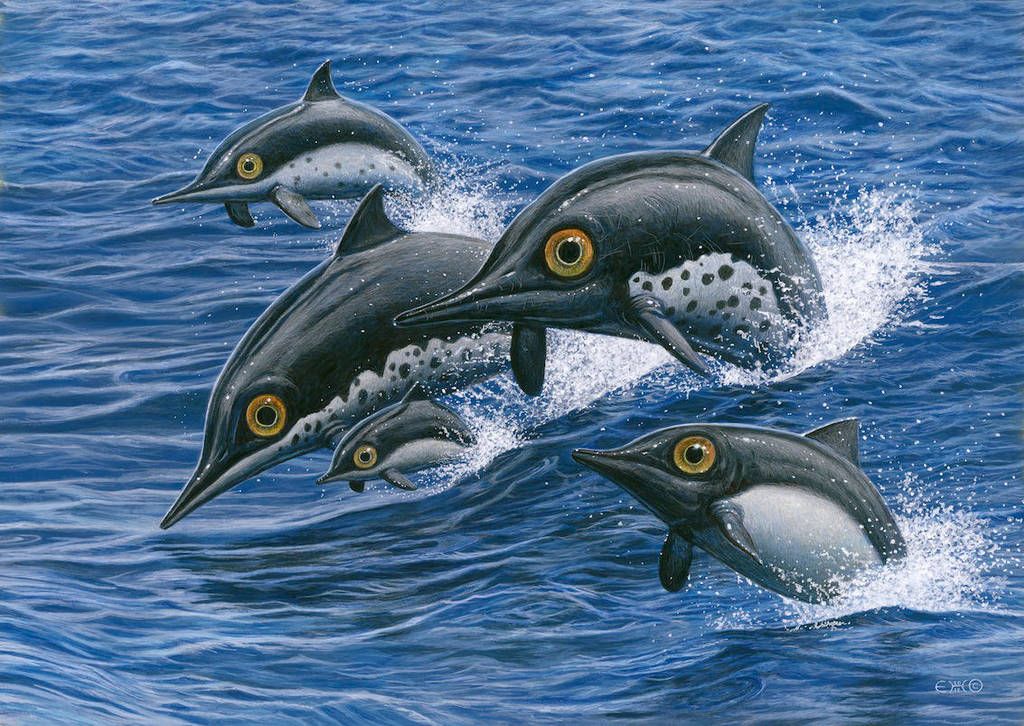
The ichthyosaur is one of the most remarkable animals ever to have lived in Earth's oceans. For roughly 160 million years, from the Early Triassic to the mid-Cretaceous, these marine reptiles cruised the seas of every major ocean basin, evolving a streamlined, dolphin-like body plan that would not appear again on Earth for more than 200 million years. They were not dinosaurs. They were not fish.
They were air-breathing reptiles that had returned so completely to the sea that they gave birth at sea, dived to abyssal depths, and possessed the largest eyes of any vertebrate in the history of life.
This guide covers every aspect of ichthyosaur science: their 250-million-year origin, the dolphin-like body plan that is a textbook example of convergent evolution, the 1811-1812 discovery by a twelve-year-old Mary Anning at Lyme Regis, the giant species Shonisaurus and the immense eyes of Ophthalmosaurus, the live-birth fossils that rewrote our understanding of reptile reproduction, and the mysterious mid-Cretaceous extinction that wiped out the entire order roughly 30 million years before the non-avian dinosaurs disappeared.
Etymology and Classification
The name Ichthyosaurus is a compound of the ancient Greek words ichthys, meaning "fish", and sauros, meaning "lizard" or "reptile". The genus name was coined in 1817 by the English geologist Charles Konig, a curator at the British Museum, after he examined specimens collected by Mary Anning.
The species Ichthyosaurus communis - "common fish-lizard" - was formally described in 1821 by Henry De la Beche and William Conybeare, two of the leading geologists of their day, who used Mary Anning's discoveries to establish that a previously unknown group of extinct reptiles had once inhabited the ancient oceans.
Modern classification places Ichthyosaurus within a much larger group, the order Ichthyosauria. The full taxonomic pathway runs Animalia to Chordata to Reptilia, then into the order Ichthyosauria, the family Ichthyosauridae, the genus Ichthyosaurus, and the species I. communis. The order Ichthyosauria includes hundreds of species spread across more than a dozen families. Not all ichthyosaurs were dolphin-shaped.
Early Triassic forms such as Cartorhynchus and Utatsusaurus looked more like long-bodied marine lizards with paddle-like limbs. The classic, torpedo-shaped body plan evolved later and dominated Jurassic seas.
Where ichthyosaurs sit within the broader reptile family tree has been debated for more than 150 years. They are diapsid reptiles - the major group that also includes lizards, snakes, crocodiles, dinosaurs, and birds - but their exact relationships within Diapsida remain contested.
Current evidence places them as a separate branch that diverged before the split between lepidosaurs (lizards and snakes) and archosaurs (crocodiles and dinosaurs). Ichthyosaurs are not dinosaurs. They are not closely related to dinosaurs. They just happen to have shared the same 160 million years of Earth history.
Discovery and the Mary Anning Story
The story of the scientific ichthyosaur begins in 1811 on the windswept beaches of Lyme Regis, on the Dorset coast of England. A twelve-year-old girl named Mary Anning and her older brother Joseph spotted a strange four-foot-long skull weathering out of the cliffs. Joseph excavated the skull first.
Over the following months, Mary - then still a child - carefully extracted the rest of the seventeen-foot skeleton from the crumbling Jurassic shale. The Anning family sold the specimen to a local collector for roughly 23 pounds. It eventually passed into the collection of Charles Konig at the British Museum, where it was given the name Ichthyosaurus in 1817.
Mary Anning was born in 1799 into a poor Dorset family that survived by selling fossils to tourists. Her father Richard died in 1810, leaving his children to continue the fossil trade. Mary had no formal scientific education. She taught herself anatomy by reading borrowed books, copying diagrams by hand, and dissecting modern animals for comparison.
Over the following decades she would discover the first complete plesiosaur skeleton (1823), the first pterosaur found outside Germany (1828), several more ichthyosaur species, and many important fish and invertebrate fossils. Much of modern knowledge of Early Jurassic marine life rests on her work.
Anning was largely excluded from the scientific establishment of her day. She was a working-class woman in a field dominated by gentlemen geologists, many of whom took credit for specimens she had found and interpreted. Her letters to scientists like William Buckland, Henry De la Beche, and Richard Owen show she understood the anatomical details of her discoveries as well as or better than anyone else alive.
Only late in her life, and more thoroughly after her death in 1847, did the scientific community begin to credit her properly. She has since become one of the most celebrated figures in the history of palaeontology.
Early discovery timeline:
| Year | Event | Location |
|---|---|---|
| 1811 | Joseph Anning finds ichthyosaur skull | Lyme Regis, Dorset |
| 1812 | Mary Anning excavates full skeleton | Lyme Regis, Dorset |
| 1817 | Genus named Ichthyosaurus by Konig | British Museum, London |
| 1821 | De la Beche and Conybeare describe species | Geological Society, London |
| 1823 | Anning finds first complete plesiosaur | Lyme Regis |
| 1828 | Anning finds first British pterosaur | Lyme Regis |
| 1847 | Mary Anning dies at age 47 | Lyme Regis |
| 2001 | Jurassic Coast declared UNESCO site | Dorset and East Devon |
The coastline where Anning worked, running from Exmouth in the west to Old Harry Rocks in the east, was declared a UNESCO World Heritage Site in 2001 under the name the Jurassic Coast. It is still one of the most productive marine reptile fossil localities in the world. Storms and coastal erosion continuously expose new specimens, and amateur collectors and academic palaeontologists still walk the beaches after every winter storm.
Temporal Range and Evolutionary History
Ichthyosaurs had one of the longest runs of any major vertebrate group in the fossil record. Their total temporal range extended from the Early Triassic, around 250 million years ago, to the mid-Cretaceous, around 90 million years ago. That is roughly 160 million years - longer than the time that separates the extinction of the non-avian dinosaurs from the present day.
Major ichthyosaur evolutionary phases:
- Early Triassic (~250 to 247 mya): Small, lizard-like marine reptiles with long bodies and clawed paddles begin to appear shortly after the end-Permian mass extinction. These early forms, such as Cartorhynchus and Utatsusaurus, were close to the ancestors of later ichthyosaurs.
- Middle Triassic (~247 to 237 mya): Rapid diversification. Body plans elongate. The first truly dolphin-shaped species begin to appear. Mixosaurus is a classic example of this transitional phase.
- Late Triassic (~237 to 201 mya): Giant ichthyosaurs dominate. Shonisaurus sikanniensis, at roughly 21 metres, may be the largest of all. Shastasaurus and the recently recognised Ichthyotitan reach similar lengths. Most of these giants went extinct at the end of the Triassic.
- Early Jurassic (~201 to 174 mya): The classic dolphin-shaped ichthyosaurs dominate. This is the time of Ichthyosaurus communis, Temnodontosaurus, and the Dorset specimens collected by Mary Anning.
- Middle to Late Jurassic (~174 to 145 mya): Ophthalmosaurus and its relatives - the ophthalmosaurids - become the dominant open-ocean predators. Huge eyes, deep diving, and streamlined bodies define this group.
- Early Cretaceous (~145 to 100 mya): Diversity begins to decline. Ophthalmosaurid species continue. Ichthyosaur ecological importance diminishes as other marine reptiles rise.
- Mid-Cretaceous (~100 to 90 mya): The final ichthyosaurs, including Platypterygius, disappear from the fossil record during the Cenomanian-Turonian interval.
After the mid-Cretaceous, no ichthyosaur fossils are known. They did not survive into the end-Cretaceous mass extinction. They had already been extinct for roughly 30 million years by the time the asteroid struck.
Anatomy and Body Plan
Later ichthyosaurs, including Ichthyosaurus communis, had a body plan so similar to modern dolphins that early illustrators genuinely struggled to draw them as anything else. This convergence is almost total. It covers body shape, fin placement, skull streamlining, eye adaptations, and locomotion.
Streamlined body:
- Fusiform, torpedo-shaped trunk minimising drag
- Dorsal fin supported by soft tissue, not bone
- Two pairs of paddle-like flippers used for steering, not thrust
- Crescent-moon-shaped tail fluke with the vertebral column bending down into the lower lobe - the opposite of sharks, where the spine runs into the upper lobe
Skull and sensory system:
- Long, narrow snout packed with conical teeth in most species
- Huge orbits (eye sockets) reinforced by a ring of bony plates called a sclerotic ring
- Nostrils placed far back near the eyes, indicating a dolphin-like surfacing breath pattern
- Inner ear structures suggesting high-frequency hearing adapted to marine life
Key anatomical dimensions for Ichthyosaurus communis:
| Feature | Typical Value |
|---|---|
| Total length | 2 to 3.3 metres |
| Skull length | 0.5 to 0.9 metres |
| Weight | estimated 80 to 150 kilograms |
| Tooth count | ~30 to 40 conical teeth per jaw half |
| Flipper length | ~0.3 metres (forelimb) |
| Eye diameter | ~7 to 10 centimetres |
The most striking anatomical feature in later ichthyosaurs is the eye. Ophthalmosaurus, a roughly six-metre Jurassic species, had an eye approximately 23 centimetres in diameter - larger than the eye of any other vertebrate known. For context, the eye of a blue whale, the largest animal alive today, is only about 15 centimetres across. A giant squid eye is about 25 centimetres, but the giant squid is an invertebrate. Among all vertebrates that have ever lived, Ophthalmosaurus holds the record.
Large eyes serve two purposes: light gathering in dim conditions and improved angular resolution. Both fit the hypothesis that Ophthalmosaurus was a deep-diving hunter targeting squid and other soft-bodied prey at depths of several hundred metres where sunlight is nearly absent. Bone histology studies have found vascular damage patterns consistent with decompression sickness in some specimens, supporting the idea of habitual deep diving.
Convergent Evolution with Dolphins
Ichthyosaurs and dolphins occupy one of the most dramatic slots in the textbook of convergent evolution. Two groups of land-dwelling amniotes - one reptilian, one mammalian - returned to the sea roughly 200 million years apart and arrived at almost the same body shape.
Shared features:
- Streamlined fusiform trunk
- Dorsal fin for roll stabilisation
- Paired flippers derived from limbs
- Crescent-shaped tail fluke
- Live birth at sea
- Air-breathing through nostrils placed far back on the head
- Large eyes
- Fish and squid diet
- Likely group-living behaviour for at least some species
Key differences:
- Ichthyosaurs swam by side-to-side movements of the tail, like sharks; dolphins swim by up-and-down strokes
- Ichthyosaur tails had a downward-bending spine; dolphin tails have no spine in the fluke at all
- Ichthyosaurs were reptiles that laid live young but retained reptilian metabolism features; dolphins are endothermic mammals with high metabolic rates
- Dolphins have a single nostril (blowhole) on the top of the head; ichthyosaur nostrils were paired and placed near the eyes
- Dolphins use echolocation; no evidence suggests ichthyosaurs did
The convergence is so close that when ichthyosaur fossils were first found, some naturalists suggested they might be the ancestors of modern cetaceans. Detailed anatomy has since shown that the two groups are completely unrelated and represent independent evolutionary experiments in fast marine vertebrate life.
Live Birth and Reproduction
One of the most important and unusual aspects of ichthyosaur biology is that they gave live birth at sea. This was unusual for reptiles in general - most modern reptiles lay shelled eggs on land - and was critical evidence that ichthyosaurs were fully adapted to ocean life and could not return to land.
The first clear evidence came from the Holzmaden lagerstatte in southern Germany, where Early Jurassic black shales preserve exceptionally detailed fossils. Several ichthyosaur specimens preserve embryos inside the body cavity. One celebrated specimen shows an adult female with a baby emerging tail-first from the birth canal, exactly the pattern seen in modern dolphins.
Tail-first birth prevents the newborn from drowning before it can reach the surface for its first breath - a subtle but biologically crucial detail.
Other specimens contain multiple embryos of different developmental stages, suggesting that ichthyosaurs produced litters rather than single offspring, and that development within the mother may have been prolonged. Some fossils contain as many as eight embryos.
This reproductive strategy means ichthyosaurs were probably social, at least during birthing. Fossil clusters of juveniles and adults from the same bed in some deposits suggest gatherings, though whether these reflect genuine pods or just shared preferred habitat is unclear.
Diet and Hunting
Ichthyosaurs were carnivores. Preserved stomach contents, tooth wear patterns, and jaw mechanics indicate a diet of fish, cephalopods, and smaller marine reptiles.
Typical prey:
- Belemnites (extinct squid-like cephalopods with internal calcite rostra)
- Ammonites, at least for larger species
- Bony fish of many sizes
- Smaller ichthyosaurs, in some documented cases
- Soft-bodied squid and octopus-like prey
Stomach contents preserved in Holzmaden and Lyme Regis specimens include thousands of belemnite hooklets - the tiny chitinous hooks that lined belemnite tentacles. These hooklets are indigestible and accumulated in ichthyosaur stomachs over time, in some specimens forming compact masses. They are one of the most common indicators of cephalopod predation in the Jurassic marine fossil record.
Tooth shape varied with diet. Ichthyosaurus communis and its relatives had sharp, conical teeth suited to catching slippery fish and squid. Larger species such as Temnodontosaurus had reinforced teeth adapted to killing large prey, including other marine reptiles. Some derived forms had reduced or specialised dentition for suction feeding on soft-bodied prey.
Ophthalmosaurus, remarkably, had reduced teeth or was nearly toothless in adults, suggesting suction feeding on squid - exactly the strategy used by deep-diving toothed whales today such as the sperm whale.
Notable Species
The order Ichthyosauria contains more than a hundred recognised species distributed across the Mesozoic. A few stand out for their size, anatomy, or historical importance.
Ichthyosaurus communis: The type species, described from Dorset in 1821. Around 2 to 3.3 metres long, classic dolphin shape, Early Jurassic. The ichthyosaur depicted in most textbooks.
Temnodontosaurus platyodon: A large Early Jurassic predator reaching 9 to 12 metres. Its eye was also unusually large, around 20 centimetres. It preyed on smaller marine reptiles.
Shonisaurus sikanniensis: A Late Triassic giant from British Columbia. Size estimates have varied from 15 to 21 metres. It is one of the largest marine reptiles known and one of the largest animals ever to swim in Earth's oceans.
Ophthalmosaurus icenicus: A Jurassic open-ocean hunter around 6 metres long with the largest eyes of any known vertebrate. Evidence suggests deep diving for squid.
Stenopterygius quadriscissus: A very common Early Jurassic ichthyosaur from the Holzmaden deposits. Many live-birth specimens are assigned to this species.
Mixosaurus cornalianus: A Middle Triassic form showing intermediate features between early lizard-shaped ichthyosaurs and fully dolphin-shaped later species.
Ichthyotitan severnensis: Described in 2024 from Triassic deposits in the United Kingdom. Jaw bone estimates suggest body lengths potentially over 25 metres, making it a candidate for the largest marine reptile ever.
Extinction
Ichthyosaurs disappeared from the fossil record around 90 million years ago, during the Cenomanian-Turonian transition of the mid-Cretaceous. This places their extinction roughly 30 million years before the famous asteroid impact at the end of the Cretaceous that killed the non-avian dinosaurs. Ichthyosaurs did not die with the dinosaurs. They were already gone.
The cause of their disappearance is still debated. Several factors likely acted together.
Proposed contributing factors:
- Cenomanian-Turonian oceanic anoxic events. Prolonged episodes of low oxygen in ocean waters disrupted marine food webs. Plankton communities collapsed regionally, which cascaded through fish populations that ichthyosaurs depended on.
- Global warming. Sea temperatures in the mid-Cretaceous were among the warmest in the past 500 million years. Warm, stratified oceans reduced productivity in many regions.
- Competition from new predators. Mosasaurs, a group of large marine lizards, radiated rapidly in the mid to late Cretaceous and occupied many of the ecological roles previously held by ichthyosaurs. Advanced sharks also diversified during this interval.
- Slowing evolutionary rates within ichthyosaurs. Analysis of late-stage ichthyosaur diversity suggests the group's rate of speciation slowed in the Early Cretaceous, making it vulnerable to environmental change.
No single cause is likely to be the whole story. The combination of stressed ocean ecosystems, new competitors, and reduced evolutionary flexibility meant the ichthyosaur order could not recover from the mid-Cretaceous disruption. Their ecological role would remain largely unfilled for tens of millions of years until cetaceans re-evolved the same body plan in the Eocene.
Fossil Distribution and Famous Sites
Ichthyosaur fossils have been recovered from every continent, including Antarctica. The group was truly global. A few sites stand out for their importance to the field.
Jurassic Coast, England: The type locality for Ichthyosaurus communis and home to Mary Anning's most famous discoveries. Lyme Regis and Charmouth produce Early Jurassic specimens every year.
Holzmaden, Germany: Early Jurassic lagerstatte that preserves ichthyosaurs in extraordinary detail, including soft tissue outlines, stomach contents, and embryos. Many museum specimens worldwide come from Holzmaden.
British Columbia, Canada: Late Triassic giants including Shonisaurus sikanniensis have been found in the Pardonet and Sikanni Chief Formations.
Nevada, United States: The Berlin-Ichthyosaur State Park in Nevada preserves Late Triassic Shonisaurus popularis specimens. It is Nevada's official state fossil.
Patagonia, Argentina and Chile: Rich Jurassic and Early Cretaceous ichthyosaur faunas including the Tyndall Glacier graveyard, a site containing dozens of articulated specimens exposed by glacial retreat.
Svalbard, Norway: Arctic Triassic and Jurassic ichthyosaurs showing the global reach of the group into high-latitude oceans.
These sites continue to produce specimens. Ichthyosaur palaeontology is an active field, and new species are described almost every year.
Cultural Legacy
The ichthyosaur holds a unique place in the history of science. It was among the first animals recognised as extinct in a scientific sense. The very idea that entire forms of life had existed and then disappeared - rather than simply hiding somewhere undiscovered - was controversial in the early nineteenth century. Ichthyosaur fossils, along with those of plesiosaurs and mammoths, helped force that idea into mainstream thought.
Mary Anning's story has been retold in countless books, documentaries, and films, most recently in the 2020 film Ammonite. Her name has been attached to species, museum halls, and a stretch of the Dorset coast itself. The tongue-twister "She sells seashells by the seashore" is widely believed to have been inspired by her fossil-trading trade.
In popular culture the ichthyosaur often plays second fiddle to dinosaurs, mosasaurs, and plesiosaurs. It is not usually as visually dramatic as a tyrannosaur or as iconic as a sauropod. But among palaeontologists and serious fossil enthusiasts, the ichthyosaur remains a favourite precisely because it was the fossil that started it all - the one a twelve-year-old girl dug out of a cliff in 1811 and that, in being named and described, helped invent modern palaeontology.
Related Reading
- Archaeopteryx: The Urvogel of Late Jurassic Germany
- Pterodactyl: The Flying Reptiles of the Mesozoic
- Trilobite: The Paleozoic Arthropod That Defined an Era
- Fossils: How We Read the Story of Ancient Life
References
Relevant peer-reviewed and institutional sources consulted for this entry include published research in the Journal of Vertebrate Paleontology, Palaeontology, PeerJ, and Proceedings of the Royal Society B, along with records from the Natural History Museum London, the Staatliches Museum fur Naturkunde Stuttgart (Holzmaden collection), the Royal Tyrrell Museum of Palaeontology, and the UNESCO Jurassic Coast World Heritage Site documentation.
Species attributions and body size estimates reflect current consensus as of the most recent ichthyosaur monographs and the 2024 description of Ichthyotitan severnensis.
Frequently Asked Questions
What is an ichthyosaur?
An ichthyosaur was a marine reptile with a streamlined, dolphin-like body that lived in the world’s oceans from the Early Triassic to the mid-Cretaceous, roughly 250 to 90 million years ago. The name means ‘fish-lizard’ in Greek. Ichthyosaurs breathed air, gave live birth at sea, and were fully adapted to marine life - they could not return to land.
They ranged in size from small species under two metres to the enormous Shonisaurus sikanniensis at around 21 metres. Despite superficially resembling dolphins or even sharks, ichthyosaurs were reptiles with a completely independent evolutionary history from any modern marine animal.
When were ichthyosaurs discovered and by whom?
The first scientifically described ichthyosaur skeleton was found at Lyme Regis on the Dorset coast of England between 1811 and 1812. Mary Anning - only 12 years old at the time - and her older brother Joseph uncovered the skull in 1811, and Mary excavated the rest of the skeleton over the following year. The specimen was eventually sold to a collector and passed into the British scientific community, where it was described as a strange fish-like reptile.
Anning went on to make many more important finds along the Jurassic Coast over her lifetime and is now recognised as one of the most influential early palaeontologists, although she received limited recognition during her life because she was a working-class woman in an elite male profession.
Are ichthyosaurs dinosaurs?
No. Ichthyosaurs are not dinosaurs, even though they lived during the Mesozoic Era alongside dinosaurs. Dinosaurs are a specific clade of land-dwelling reptiles (Dinosauria) that includes modern birds. Ichthyosaurs belong to their own distinct reptile order, Ichthyosauria, whose exact position within the reptile family tree has been debated for more than 150 years.
Current evidence places ichthyosaurs as diapsid reptiles, distantly related to the ancestors of lizards and snakes, but separate from the archosaur lineage that produced dinosaurs, crocodiles, and pterosaurs. Popular culture sometimes lumps ichthyosaurs in with dinosaurs, but scientifically they are two very different groups that just happened to share the same 160-million-year stretch of Earth history.
Why did ichthyosaurs go extinct?
Ichthyosaurs went extinct in the mid-Cretaceous, around 90 million years ago during the Cenomanian-Turonian boundary, well before the famous end-Cretaceous mass extinction that killed the non-avian dinosaurs 66 million years ago.
The cause appears to have been a combination of factors: a prolonged global warming episode, widespread ocean anoxic events that collapsed marine food webs, rapid evolution of new predatory groups such as mosasaurs and advanced sharks, and possibly a slowing evolutionary rate among ichthyosaurs themselves late in their history.
By the time the asteroid impact occurred at the end of the Cretaceous, ichthyosaurs had already been gone for roughly 30 million years. Their ecological niche was eventually filled, much later, by whales and dolphins.
How big did ichthyosaurs get?
Ichthyosaur body size varied enormously across the group. Small Jurassic species such as Stenopterygius were roughly 2 to 4 metres long. Ichthyosaurus communis itself reached around 2 to 3.3 metres. Ophthalmosaurus, a Jurassic open-ocean hunter, reached about 6 metres. Larger species such as Temnodontosaurus grew to 9 or 12 metres.
The undisputed giant of the group is Shonisaurus sikanniensis from the Late Triassic of British Columbia, which is estimated to have reached about 21 metres in length - roughly the size of a modern sperm whale. A recently described jaw fragment from the UK, attributed to the genus Ichthyotitan, suggests that Triassic ichthyosaurs may have grown even larger, possibly over 25 metres, making them candidates for the largest marine reptiles of all time.
Did ichthyosaurs give live birth?
Yes. Ichthyosaurs were viviparous - they gave birth to live young in the open ocean rather than coming ashore to lay eggs. This has been confirmed by multiple fossil specimens preserving embryos inside the body cavity of the mother.
One especially famous specimen from the Holzmaden deposits of Germany shows an adult female with a baby emerging tail-first from the birth canal, exactly the pattern seen in modern dolphins and whales, where a tail-first birth prevents the newborn from drowning before it reaches the surface. Some ichthyosaur fossils contain multiple embryos at different developmental stages, suggesting litters of several pups.
Live birth was one of the key adaptations that allowed ichthyosaurs to spend their entire life cycle at sea.
Why did ichthyosaurs look like dolphins?
Ichthyosaurs and dolphins look remarkably similar because both evolved into fast, air-breathing marine predators chasing similar prey in similar conditions, and both sets of evolutionary pressures pushed them toward the same body plan. This phenomenon is called convergent evolution. A streamlined fusiform body reduces drag. A crescent-shaped tail fluke maximises thrust per muscle mass. Paired flippers provide steering.
A dorsal fin stabilises against rolling. Large eyes improve prey detection in open water. Ichthyosaurs arrived at this design during the Triassic. Cetaceans arrived at it again around 50 million years ago, more than 200 million years later, working from a completely different ancestral blueprint - land-dwelling mammals. The result is one of the most striking examples of convergence in the entire fossil record.
Why did Ophthalmosaurus have such enormous eyes?
Ophthalmosaurus, whose name literally means ‘eye lizard’, had eyes around 23 centimetres in diameter - the largest known eyes of any vertebrate in Earth’s history. Its eyes were larger than those of a blue whale or a giant squid. The leading explanation is that Ophthalmosaurus was a deep-diving hunter that pursued squid and other soft-bodied prey in low-light conditions hundreds of metres below the surface.
Larger eyes gather more photons, providing the light sensitivity needed to hunt where sunlight is nearly absent. The eye was reinforced by a ring of bony plates called a sclerotic ring, which kept it from collapsing under deep-water pressure. Fossil evidence of bent-shaped limb bones consistent with decompression damage supports the idea that Ophthalmosaurus routinely dived deep enough to be affected by pressure changes - much like sperm whales today.