
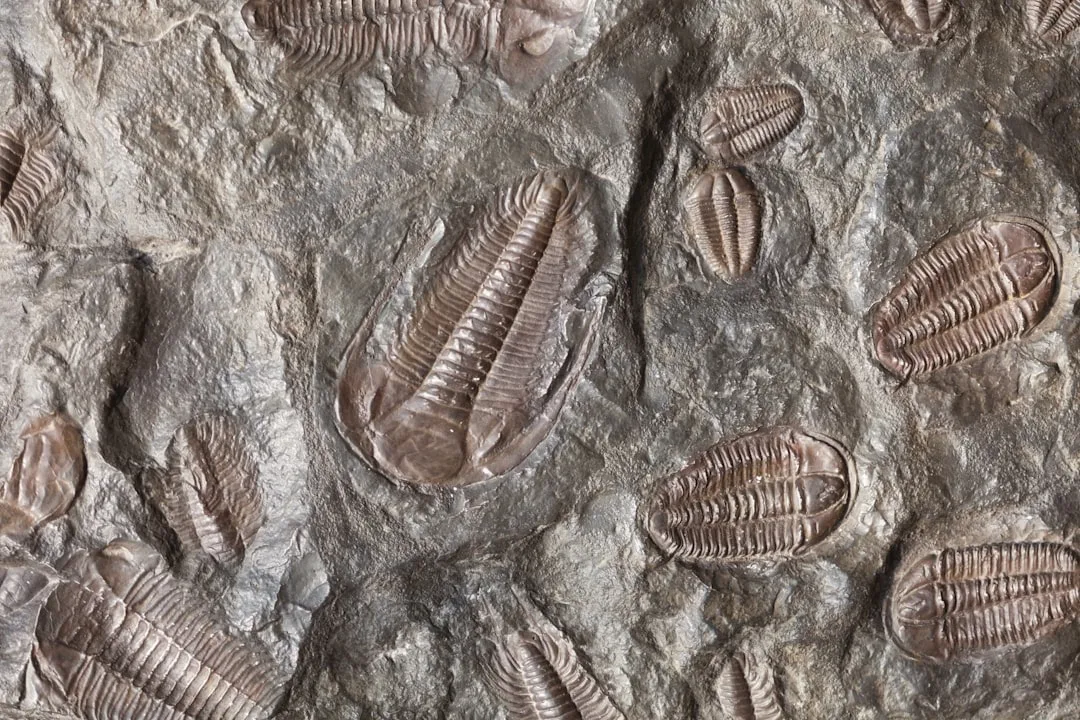
How do fossils form?
Fossils form when organisms are rapidly buried after death, preventing decomposition. Over millions of years, minerals from surrounding sediment replace the original biological material through processes like permineralization, mineral replacement, or carbonization. Hard structures like bones, teeth, and shells are most commonly preserved, while soft tissue fossilization is exceptionally rare and requires specific conditions such as rapid mineral infiltration or.
Every rock layer on Earth is a page in a book that spans 4.5 billion years. Fossils are the words written on those pages - the preserved remains, impressions, and chemical traces of organisms that lived long before any human walked the planet. They are our primary window into deep time, the evidence base for understanding how life evolved, diversified, went extinct, and sometimes persisted nearly unchanged for hundreds of millions of years.
The fossil record is incomplete by nature. The vast majority of organisms that have ever lived decomposed without a trace. Estimates suggest that fewer than one-tenth of one percent of all species that ever existed have been preserved as fossils. Yet even this tiny fraction has yielded millions of specimens, enough to reconstruct ecosystems, track evolutionary lineages, and answer questions about the history of life that would otherwise remain forever unknowable.
What Fossils Are: The Three Major Types
Not all fossils are petrified bones sitting in museum displays. Paleontologists recognize three broad categories, each preserving different kinds of information.
Body Fossils
Body fossils are the preserved remains of an organism's physical structure. These include bones, teeth, shells, exoskeletons, leaves, wood, and in rare cases, soft tissues like skin impressions or feathers. Body fossils provide direct evidence of an organism's anatomy and are the most familiar type to the general public. The dinosaur skeletons mounted in natural history museums worldwide are body fossils, as are the trilobite specimens found in limestone deposits across every continent.
Trace Fossils
Trace fossils, also called ichnofossils, record the behavior of organisms rather than their bodies. Footprints, burrows, feeding marks, coprolites (fossilized feces), and nesting sites all qualify. A set of dinosaur trackways can reveal information about locomotion speed, social behavior, and body posture that no skeleton alone could provide.
The Laetoli footprints in Tanzania, dated to 3.66 million years ago, preserved the tracks of early hominins walking upright through volcanic ash - direct evidence of bipedalism predating the genus Homo.
Chemical Fossils
Chemical fossils, or biomarkers, are molecular remnants left by organisms in rock. These include specific organic compounds such as steranes, hopanes, and particular isotopic ratios that indicate biological activity. Chemical fossils are especially important for studying early life on Earth, where organisms were microscopic and left no visible body fossils.
The detection of biogenic carbon isotope signatures in rocks from Greenland, dated to roughly 3.7 billion years, represents some of the oldest indirect evidence of life on our planet.
Comparison Table: Fossil Types at a Glance
| Fossil Type | What Is Preserved | Examples | Information Provided | Typical Age Range |
|---|---|---|---|---|
| Body Fossils | Physical remains of organisms | Bones, teeth, shells, leaves, amber inclusions | Anatomy, morphology, species identification | All geological periods |
| Trace Fossils | Evidence of organism behavior | Footprints, burrows, coprolites, nests | Locomotion, diet, social behavior, ecology | Precambrian to present |
| Chemical Fossils | Molecular remnants in rock | Steranes, hopanes, isotopic signatures | Presence of life, metabolic processes, environmental conditions | Archean to present (3.7+ billion years) |
The Fossilization Process
Fossilization is the exception, not the rule. For an organism to become a fossil, a specific sequence of events must occur, and the odds are stacked against preservation at every stage.
The process typically begins with rapid burial. An organism dies near or in a body of water, volcanic ash fall, or sediment-rich environment, and its remains are quickly covered before scavengers and decomposers can destroy them. From there, one of several mineralization pathways takes over.
Permineralization
Permineralization is the most common fossilization process for bones and wood. Mineral-rich groundwater percolates through the buried remains, and dissolved minerals - typically silica, calcite, or pyrite - precipitate within the pore spaces of the original biological material. The original structure is preserved in extraordinary detail because the minerals fill gaps rather than replacing the material.
Petrified forests, such as the one in Arizona's Petrified Forest National Park where logs are preserved in vivid reds and oranges by iron-rich silica, are classic examples.
Mineral Replacement
In replacement, the original biological material is dissolved molecule by molecule and simultaneously replaced by a different mineral. The organism's shape is retained, but its chemical composition is entirely changed. Pyritization, where iron pyrite replaces the original material, produces stunning gold-colored fossils. Some of the most exquisitely preserved ammonites and brachiopods from the Jurassic period owe their metallic sheen to this process.
Carbonization
Carbonization occurs when volatile compounds in organic tissue - hydrogen, oxygen, nitrogen - are driven off by heat and pressure, leaving behind a thin film of carbon. This process is responsible for the detailed leaf impressions found in shale deposits and many of the best-preserved insect fossils. The Florissant Fossil Beds in Colorado contain carbonized insects from 34 million years ago with wing venation patterns still clearly visible.
Mold and Cast Formation
When an organism is buried and subsequently dissolved entirely, the void it leaves in the surrounding rock is called a mold. If that void later fills with new mineral material, the result is a cast - a three-dimensional replica of the original organism. Many of the shell fossils found in limestone formed this way.
The famous victims of the Pompeii eruption in 79 AD were preserved through an analogous process: their bodies decomposed within hardened volcanic ash, leaving human-shaped cavities that archaeologists later filled with plaster to create casts.
Dating the Past: How Old Is That Fossil?
Determining the age of a fossil is fundamental to understanding the history of life. Paleontologists and geologists employ two complementary approaches.
Radiometric Dating
Radiometric dating measures the decay of radioactive isotopes within minerals. Each isotope decays at a known, constant rate expressed as a half-life. Potassium-argon dating (half-life of 1.25 billion years) is widely used for volcanic rocks and has been instrumental in dating hominid fossils in East Africa. Uranium-lead dating (half-life of 4.47 billion years) is the gold standard for the oldest rocks on Earth.
Carbon-14 dating, with its half-life of 5,730 years, is effective only for organic material younger than about 50,000 years - useful for archaeology but not for dinosaurs.
Relative Dating and Stratigraphy
Before radiometric methods existed, geologists relied on stratigraphy - the principle that in undisturbed rock sequences, older layers lie beneath younger ones. William Smith, working in early 19th-century England, demonstrated that specific fossil assemblages characterize specific rock layers, allowing correlation of strata across vast distances. This principle of faunal succession remains fundamental.
Index fossils - species that were widespread but existed for only a brief geological span - serve as reliable time markers. Trilobites, ammonites, and certain foraminifera are among the most useful index fossils.
As geologist and author Bill Bryson wrote in A Short History of Nearly Everything: "The fossil record is like a film of evolution from which 999 out of every 1,000 frames have been cut, but you can still get a good sense of the plot."
Amber: Time Capsules From the Cretaceous
Amber preservation represents the most visually spectacular form of fossilization. When tree resin engulfs a small organism, it seals the specimen in a sterile, oxygen-free environment that can maintain three-dimensional structure down to microscopic detail for tens of millions of years.
The amber deposits of Myanmar (Burmese amber) have produced some of the most remarkable specimens in paleontology. In 2016, researcher Lida Xing and colleagues published their discovery of a 99-million-year-old feathered dinosaur tail preserved in amber, complete with soft tissue, feather structure, and visible pigmentation patterns. The specimen, from a small coelurosaur, provided direct evidence of feather morphology in non-avian dinosaurs that no compressed fossil could match.
Other Burmese amber specimens have yielded perfectly preserved ancient insects - ants, beetles, wasps, and spiders - with compound eyes, sensory hairs, and even parasites still attached. A 2020 study published in Science Advances described a tiny bird skull from 99-million-year-old amber, barely 14 millimeters long, representing one of the smallest known dinosaurs.
Flowers have been found in amber in mid-bloom. Mushrooms, moss, and even lizards with skin coloration still partially visible have emerged from these golden time capsules. Amber specimens from the Baltic region (40-50 million years old), the Dominican Republic (15-20 million years old), and Lebanon (130 million years old) have all contributed enormously to our understanding of ancient terrestrial ecosystems.
The 1993 film Jurassic Park famously imagined extracting dinosaur DNA from mosquitoes trapped in amber. The concept captured the public imagination, but the reality is that DNA degrades over time regardless of preservation conditions. Studies have shown that DNA has a half-life of approximately 521 years, meaning that after 6.8 million years, every bond in a DNA molecule would be destroyed.
Extracting usable genetic material from Cretaceous amber, at 66 million years minimum, remains firmly in the realm of science fiction.
La Brea Tar Pits: Ice Age Los Angeles
In the heart of modern Los Angeles, natural asphalt has been seeping to the surface for tens of thousands of years. The La Brea Tar Pits are among the most prolific fossil sites in the world, having yielded over 3.5 million specimens representing more than 600 species of animals and plants from the last 50,000 years.
The preservation mechanism is straightforward but brutally effective. Animals became mired in the sticky asphalt, struggled, and attracted predators, which themselves became trapped. The result is a fossil assemblage skewed heavily toward carnivores - an unusual situation that provides extraordinary insight into predator-prey dynamics during the Pleistocene.
Over 4,000 dire wolf specimens and more than 2,000 saber-toothed cat (Smilodon fatalis) skulls have been recovered. Columbian mammoths, ground sloths, American camels, ancient bison, and the massive short-faced bear (Arctodus simus) are all represented.
The site also preserves plants, insects, and microfossils, allowing scientists to reconstruct the climate and vegetation of ice age southern California in fine detail. Pollen records from the tar pits show that the Los Angeles Basin during the last glacial maximum supported woodlands of juniper and oak rather than the chaparral and scrubland of today.
The Burgess Shale: Window Into the Cambrian Explosion
High in the Canadian Rockies of British Columbia, the Burgess Shale preserves a snapshot of marine life from approximately 508 million years ago - the middle of the Cambrian period. Discovered by Charles Doolittle Walcott in 1909, this site has fundamentally shaped our understanding of the Cambrian explosion, the geologically rapid appearance of most major animal phyla.
The Burgess Shale is exceptional because it preserves soft-bodied organisms that would normally leave no fossil trace. The fine-grained mudstone captured eyes, guts, gills, and nervous systems in organisms that had no hard shells or bones. The resulting fossil assemblage reads like an inventory of alien life forms.
Anomalocaris, the apex predator of Cambrian seas, grew up to one meter long and had circular mouthparts with tooth-like plates, forward-grasping appendages, and large compound eyes with an estimated 16,000 lenses per eye. Hallucigenia, initially reconstructed upside-down and back-to-front, had a worm-like body with pairs of stilt-like legs and dorsal spines.
Opabinia had five eyes and a forward-facing nozzle-like proboscis that baffled researchers for decades. Wiwaxia was covered in scale-like plates and dorsal spines, defying easy classification.
Paleontologist Stephen Jay Gould brought the Burgess Shale to public attention in his 1989 book Wonderful Life: The Burgess Shale and the Nature of History. Gould argued that the Cambrian fauna represented a greater range of body plans than exists today, and that the survival of certain lineages over others was largely a matter of contingency rather than competitive superiority. "Replay the tape of life," Gould wrote, "and the outcome would be utterly different."
While subsequent research has revised some of Gould's more dramatic claims - many Burgess Shale organisms have since been placed within existing phyla rather than representing entirely unique body plans - the site remains one of the most important fossil localities on Earth. Similar Cambrian sites have since been found in China (the Chengjiang biota, 518 million years old) and Greenland (the Sirius Passet fauna), further enriching the picture.
Transitional Fossils: Evolution Caught in the Act
Among the most scientifically significant fossils are those that document evolutionary transitions between major groups. These transitional forms, predicted by evolutionary theory, have been found in abundance.
Tiktaalik: From Water to Land
Discovered in 2004 on Ellesmere Island in the Canadian Arctic by Neil Shubin and colleagues, Tiktaalik roseae lived approximately 375 million years ago during the Late Devonian.
It combined features of lobe-finned fish (scales, fins, gills) with features of early tetrapods (a flattened head, a neck capable of independent movement, robust ribs for supporting the body, and fin bones arranged like a wrist and digits). Tiktaalik represents a key stage in the transition from aquatic to terrestrial vertebrate life.
Archaeopteryx: Dinosaurs Take Flight
First discovered in 1861 in the Solnhofen limestone of Bavaria, Germany, Archaeopteryx lithographica remains one of the most iconic fossils ever found. Dated to approximately 150 million years ago (Late Jurassic), it had the feathered wings of a bird but the teeth, bony tail, and clawed fingers of a theropod dinosaur.
Only twelve specimens and a single feather impression have been found, all from the same geological formation. Archaeopteryx demonstrated the evolutionary link between non-avian dinosaurs and modern birds at a time when Darwin's theory was still fiercely debated.
Ambulocetus: The Walking Whale
Discovered in Pakistan in 1994 by J.G.M. Thewissen, Ambulocetus natans (literally "the walking whale that swims") lived approximately 49 million years ago. About the size of a large sea lion, it had functional legs capable of walking on land and a long, crocodile-like skull adapted for catching fish.
Ambulocetus is part of a well-documented series of transitional forms connecting terrestrial artiodactyls (the group containing modern hippos, pigs, and deer) with fully aquatic modern whales. Other members of this sequence include Pakicetus (a wolf-sized terrestrial ancestor), Rodhocetus (with reduced limbs and a more aquatic lifestyle), and Basilosaurus (fully aquatic with vestigial hind limbs).
Living Fossils: When Evolution Stands Still
Some organisms alive today bear a striking resemblance to their ancestors from hundreds of millions of years ago. While the term "living fossil" is somewhat misleading - these species have continued to evolve at the molecular level - their basic body plans have remained remarkably stable.
The Coelacanth
In 1938, museum curator Marjorie Courtenay-Latimer noticed an unusual fish among the catch of a trawler operating off the coast of South Africa near the Chalumna River. She contacted ichthyologist J.L.B. Smith, who identified it as a coelacanth - a fish thought to have gone extinct with the dinosaurs 66 million years ago. The discovery was a scientific sensation.
Smith named the species Latimeria chalumnae in honor of Courtenay-Latimer. A second population was discovered near Sulawesi, Indonesia, in 1998. The coelacanth's lobed fins, which move in an alternating pattern resembling a trotting horse, make it a living representative of the group that gave rise to all land vertebrates.
Horseshoe Crabs
Despite their name, horseshoe crabs are more closely related to spiders and scorpions than to true crabs. Fossils nearly identical to modern horseshoe crabs date back approximately 450 million years to the Ordovician period. These animals survived every mass extinction, including the end-Permian event that wiped out 96 percent of all marine species.
The Nautilus
The chambered nautilus, with its logarithmic spiral shell, belongs to a lineage of cephalopods that extends back over 500 million years. While modern nautiluses differ from their Paleozoic ancestors in detail, the fundamental shell architecture and jet-propulsion locomotion have remained essentially unchanged since the Ordovician.
The Tuatara
Found only in New Zealand, the tuatara (Sphenodon punctatus) is the sole surviving member of the order Rhynchocephalia, which diverged from other reptiles roughly 250 million years ago during the Triassic. Although superficially lizard-like, tuataras are anatomically distinct in numerous ways, including a unique double row of upper teeth that fits over a single lower row.
They are the most slowly reproducing reptile, with females laying eggs only once every two to five years and a total lifespan that can exceed 100 years.
Mary Anning: The Greatest Fossil Hunter
No account of fossils is complete without the story of Mary Anning (1799-1847), arguably the most important figure in the early history of paleontology and one of the most unjustly overlooked scientists in history.
Born in Lyme Regis, a coastal town in Dorset, England, Anning grew up in poverty. Her father, a cabinetmaker, supplemented the family income by collecting fossils from the crumbling Jurassic-era cliffs along the shore and selling them to tourists. When he died of tuberculosis in 1810, leaving the family in debt, the eleven-year-old Mary took over the fossil-collecting business.
In 1811, at the age of twelve, Anning and her brother Joseph discovered the first correctly identified ichthyosaur skeleton - a marine reptile roughly two meters long embedded in the cliff face. The excavation took months. The specimen was eventually sold and made its way to the British Museum. It was a landmark discovery, but Anning received little credit.
Over the following decades, Anning made a series of discoveries that reshaped scientific understanding of prehistoric life. In 1823, she found the first complete plesiosaur skeleton, a long-necked marine reptile so strange that the great anatomist Georges Cuvier initially suspected it was a forgery. He was wrong.
In 1828, she discovered the first British pterosaur, a flying reptile, and contributed to the identification of coprolites (fossilized feces), demonstrating their value for reconstructing ancient diets and food webs.
Anning taught herself anatomy, geology, and scientific illustration. She corresponded with the leading scientists of the era, including William Buckland, Henry De la Beche, and Richard Owen. Her observations and interpretations directly informed the work these men published under their own names. She was not permitted to join the Geological Society of London, which did not admit women until 1904.
As historian Shelley Emling wrote in The Fossil Hunter: Dinosaurs, Evolution, and the Woman Whose Discoveries Changed the World: "Mary Anning's findings were of enormous significance in the history of science, yet the recognition she deserved eluded her during her lifetime because of her gender and her social standing."
Anning died of breast cancer at age 47. She was virtually unknown to the general public for over a century after her death. In 2010, the Royal Society named her one of the ten British women who have most influenced the history of science. A statue of Anning was unveiled in Lyme Regis in 2022 after a successful public campaign.
CT Scanning and the Digital Paleontology Revolution
Modern technology has transformed how paleontologists study fossils. Computed tomography (CT) scanning, originally developed for medical imaging, allows researchers to examine the internal structures of fossils without cutting into them.
Micro-CT scanners can achieve resolutions of a few micrometers, revealing internal bone structure, tooth enamel thickness, brain endocasts, sinus cavities, and even the internal chambers of fossilized eggs.
A CT scan of the skull of Homo naledi, discovered in South Africa in 2013, revealed brain structures suggesting cognitive abilities more advanced than its small brain volume would predict. Scans of dinosaur eggs from China have revealed embryos curled inside, preserved in the act of developing.
Synchrotron imaging, which uses particle accelerators to generate extremely intense X-rays, has pushed resolution even further. Researchers at the European Synchrotron Radiation Facility in Grenoble, France, have used this technology to image individual cells within 300-million-year-old fossilized soft tissue and to read the chemical composition of pigments in fossil feathers, determining the original colors of extinct animals.
Digital paleontology extends beyond imaging. Three-dimensional models generated from CT data can be shared freely among researchers worldwide, democratizing access to rare specimens. Finite element analysis, borrowed from engineering, allows scientists to model the biomechanics of extinct animals - testing how a Tyrannosaurus rex jaw generated bite force, or whether Pteranodon could launch itself into flight from a standing start.
These tools have not replaced fieldwork. Someone still has to find the fossil, dig it out of the rock, and prepare it for study. But they have dramatically expanded the questions that paleontologists can ask and answer, turning static specimens into dynamic sources of biological data.
The Fossil Record as an Ongoing Story
New fossils are discovered constantly. Each year, approximately 50 new dinosaur species are named - more than at any previous point in the history of paleontology. Fossil sites in China, Argentina, Morocco, and Myanmar have been particularly productive in recent decades. Amateur collectors, construction workers, and hikers continue to make significant finds alongside professional scientists.
The fossil record will always be incomplete. But its incompleteness makes each new discovery all the more valuable. Every specimen adds a sentence, a paragraph, or sometimes an entire chapter to the story of life on Earth - a story that stretches back billions of years and is still being written.
Key Statistics
- Fewer than 0.1% of all species that have ever lived are represented in the fossil record
- The oldest confirmed fossils (stromatolites) are approximately 3.5 billion years old
- Over 3.5 million fossils have been recovered from the La Brea Tar Pits
- Approximately 50 new dinosaur species are named each year
- Archaeopteryx: only 12 specimens have ever been found, all from one formation in Bavaria
- DNA half-life is approximately 521 years, ruling out Jurassic Park-style cloning
- The Burgess Shale fauna dates to approximately 508 million years ago
- Horseshoe crabs have survived largely unchanged for approximately 450 million years
- Mary Anning discovered her first ichthyosaur at the age of 12
References
Shubin, N.H., Daeschler, E.B., and Jenkins, F.A. (2006). "The pectoral fin of Tiktaalik roseae and the origin of the tetrapod limb." Nature, 440(7085), 764-771.
Xing, L., McKellar, R.C., et al. (2016). "A Feathered Dinosaur Tail with Primitive Plumage Trapped in Mid-Cretaceous Amber." Current Biology, 26(24), 3352-3360.
Gould, S.J. (1989). Wonderful Life: The Burgess Shale and the Nature of History. W.W. Norton and Company.
Emling, S. (2009). The Fossil Hunter: Dinosaurs, Evolution, and the Woman Whose Discoveries Changed the World. Palgrave Macmillan.
Allentoft, M.E., Collins, M., et al. (2012). "The half-life of DNA in bone: measuring decay kinetics in 158 dated fossils." Proceedings of the Royal Society B, 279(1748), 4724-4733.
Thewissen, J.G.M., Hussain, S.T., and Arif, M. (1994). "Fossil evidence for the origin of aquatic locomotion in archaeocete whales." Science, 263(5144), 210-212.
Briggs, D.E.G., Erwin, D.H., and Collier, F.J. (1994). The Fossils of the Burgess Shale. Smithsonian Institution Press.
Frequently Asked Questions
How do fossils form?
Fossils form when organisms are rapidly buried after death, preventing decomposition. Over millions of years, minerals from surrounding sediment replace the original biological material through processes like permineralization, mineral replacement, or carbonization.
Hard structures like bones, teeth, and shells are most commonly preserved, while soft tissue fossilization is exceptionally rare and requires specific conditions such as rapid mineral infiltration or entombment in amber or tar.
What is the oldest fossil ever found?
The oldest confirmed fossils are stromatolites from Western Australia, dated to approximately 3.5 billion years ago. These layered rock structures were formed by colonies of cyanobacteria and represent some of the earliest evidence of life on Earth. Microscopic fossil structures potentially dating to 4.28 billion years have been reported from Quebec, Canada, though these remain debated among scientists.
How does amber preserve ancient organisms so perfectly?
Amber forms when tree resin engulfs small organisms such as insects, spiders, or plant material, then hardens over millions of years through polymerization. The resin acts as a natural sealant, cutting off oxygen and moisture while encasing the specimen in a sterile, airtight environment. This process preserves extraordinary external detail including individual hairs, wing veins, and even color patterns.
Some amber specimens are over 99 million years old and have preserved feathered dinosaur tails and flowers in mid-bloom.