
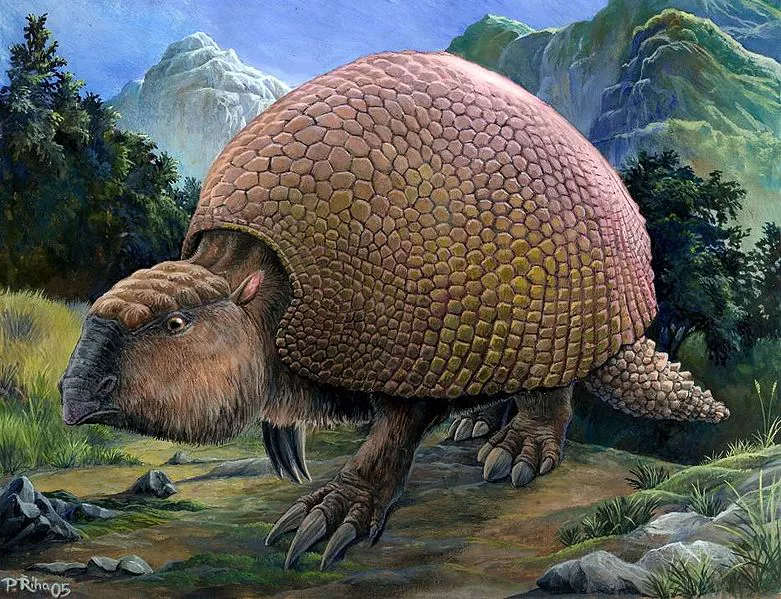
The glyptodon was the Ice Age's armoured giant - a slow, grazing, tank-bodied mammal that lumbered across the grasslands of South America carrying roughly 1,000 fused bony plates on its back.
For nearly 3 million years Glyptodon reticulatus and its close relatives dominated the open landscapes south of the equator, pushed briefly into what is now the southern United States during the Great American Biotic Interchange, and then vanished abruptly at the end of the Pleistocene alongside mammoths, ground sloths, and sabre-toothed cats.
It is one of the strangest-looking mammals ever to live - a roughly Volkswagen-Beetle-sized armadillo with a domed shell, a reinforced skull cap, and in some relatives a clubbed tail that could shatter bone.
This guide covers every major aspect of glyptodon biology and paleobiology: size and anatomy, the structure of the famous bony shell, taxonomy and the 2016 genetic breakthrough, diet and grinding dentition, behaviour, the Doedicurus tail club, habitat, the late Quaternary extinction, evidence of human interaction, and Charles Darwin's role in putting the species on the map.
It is a reference entry, not a summary, and deals in specifics - metres, tonnes, osteoderm counts, millennia, named specimens, and cited research.
Etymology and Discovery
The name Glyptodon was coined by the British anatomist Richard Owen in 1839 and means 'carved tooth' in Greek - a reference to the deeply grooved, sculpted occlusal surfaces of the high-crowned molars Owen was examining. The species name reticulatus refers to the net-like pattern of interlocking osteoderms visible on the shell. Owen described the genus from material that had been collected several years earlier on the other side of the Atlantic by a young naturalist named Charles Darwin.
During the 1832-1833 leg of the HMS Beagle voyage, Darwin spent extensive time on the coasts of Argentina and Uruguay. At Punta Alta near modern Bahia Blanca, and later at several other Pampas sites, he uncovered large bony plates and partial shells that he initially identified as belonging to some kind of gigantic armadillo.
He shipped the specimens back to London where Owen formally studied them and erected the genus Glyptodon a few years later. Darwin discussed the find in the Voyage of the Beagle, noting the curious juxtaposition of giant extinct armoured mammals in the fossil layers of the same region where small living armadillos still burrowed on the surface.
That observation - the same biogeographic province holding both an extinct giant form and a living small relative - fed directly into his later argument about descent with modification, and he cited the South American armoured-mammal succession explicitly in On the Origin of Species.
Glyptodons had in fact been known to local Indigenous peoples and to Spanish colonists for centuries before Darwin and Owen formalised the science. Large shells eroded out of riverbanks on the Pampas regularly, and folk traditions identified them variously as turtles, armadillos, or creatures of myth. What Owen and Darwin added was a systematic framework.
Classification and the 2016 Genetic Breakthrough
Glyptodons sit inside the order Cingulata - the 'girdled ones', named for the banded shell - and the family Chlamyphoridae. Within that family they occupy their own subfamily, Glyptodontinae, which contains roughly a dozen genera including Glyptodon itself, Doedicurus, Panochthus, Hoplophorus, and Neosclerocalyptus.
For more than a century, morphology suggested glyptodons were close relatives of armadillos, but their huge size, fused shell, and fused cervical vertebrae made the relationship harder to pin down. Several earlier classifications placed them in their own family (Glyptodontidae) as a sister group to all living armadillos rather than inside them.
That changed in 2016. A team led by Frederic Delsuc extracted ancient mitochondrial DNA from Doedicurus osteoderms and published the resulting phylogeny in Current Biology. The genetic tree unambiguously placed glyptodons inside Chlamyphoridae as the sister group to a clade containing the giant armadillo, the screaming hairy armadillo, and the pink fairy armadillo.
In other words, glyptodons were not merely related to modern armadillos - they were armadillos, specialised into a giant bulk-grazing body plan. The paper estimated glyptodons diverged from their nearest surviving armadillo relatives roughly 35 million years ago.
The implication is worth pausing on. A glyptodon was a two-tonne armadillo. The closest living animal to Glyptodon reticulatus, genetically, is the 30-to-50-kilogram giant armadillo (Priodontes maximus) currently burrowing through Amazon soils. Evolution has removed the giant form, leaving only the small burrowing survivors - a pattern repeated many times across the late Quaternary megafauna.
Size and Physical Description
Glyptodons are often described as car-sized, and for once the comparison is accurate. Adult Glyptodon reticulatus were roughly the bulk of a Volkswagen Beetle.
Adults (both sexes):
- Total length: 3-4 metres including tail
- Shoulder height: approximately 1.5 metres
- Weight: 1-2 tonnes
- Shell length: about 2.5 metres
- Shell width: about 1.5 metres
- Skull length: roughly 30-35 centimetres
Related genera for comparison:
- Doedicurus clavicaudatus: up to 4 metres long, over 1.5 tonnes, tail nearly 4 metres with bony club
- Panochthus: similar body size to Glyptodon, distinctive rosette-patterned osteoderms
- Neosclerocalyptus: smaller, approximately 1 tonne, slender compared with Glyptodon
The overall silhouette was unlike anything alive today. A tall, domed shell dominated the body, giving the animal the profile of a small geodesic dome on legs. The legs themselves were short, thick, and column-like, built to carry enormous weight rather than to run.
The tail projected backward, armoured in concentric bony rings, and in Glyptodon itself ended in a tapered point - the dramatic club was reserved for Doedicurus and a few other genera. The head sat below a bony cap of fused osteoderms that functioned as a built-in helmet, because unlike a tortoise, a glyptodon could not retract its head into the shell. The skull was short, deep, and mechanically built for grinding.
The Shell: An Armoured Dome
The glyptodon shell is one of the most extraordinary structures in mammalian evolution. Where a modern armadillo wears a flexible banded shell of small, overlapping osteoderms separated by bands of soft skin, Glyptodon fused its osteoderms together into a single rigid dome. Estimates for the total osteoderm count vary by genus and preservation, but range between roughly 1,000 and 1,800 plates in an adult shell.
The plates are hexagonal or polygonal, interlock at their edges, and are decorated with characteristic surface patterns - reticulated nets in Glyptodon, rosettes in Panochthus, and so on. Those surface patterns are distinctive enough that a single isolated osteoderm can usually be identified to genus.
The shell fused to the pelvis and to fused cervical and thoracic vertebrae, locking the spine in place so the animal could not flex its trunk vertically. That sacrificed flexibility in exchange for enormous mechanical rigidity. A large predator attacking from above would have encountered a dome that transferred impact force across the entire structure rather than concentrating it at the point of contact.
Biomechanical studies suggest the shell could withstand bites from Smilodon and other large late-Pleistocene predators without failing.
Shell functions (in descending order of importance):
- Protection from predators such as Smilodon, Arctotherium, and terror birds
- Thermoregulation - the shell may have buffered diurnal temperature swings
- Intraspecific combat - healed fractures on some shells suggest males fought each other
- Display - osteoderm patterns may have been sexually selected markers
Shell construction:
| Feature | Detail |
|---|---|
| Osteoderm count | ~1,000-1,800 fused bony plates |
| Plate shape | Polygonal, interlocking at edges |
| Skin layer | Thin epidermis over the plates (not visible in fossils) |
| Fusion | Plates fused to each other, shell fused to spine and pelvis |
| Weight | Shell alone estimated 200-400 kg |
| Repair | Healed fractures indicate limited remodelling after damage |
Microscopic wear patterns on the ventral edges of some osteoderms show abrasion consistent with the shell occasionally dragging on the ground, suggesting a very low, tank-like posture during slow feeding or rest. Paleontologists examining body proportions generally reconstruct glyptodons as moving at a slow walk rather than a trot, with top sustained speeds probably no more than 5 to 8 kilometres per hour.
Skull, Jaws, and Teeth
The glyptodon skull is short, deep, and mechanically reinforced. The forehead slopes steeply downward to a short, blunt snout, and the whole structure is reinforced by thickened bone designed to absorb grinding loads from the jaws. The nasal opening is small and set high on the skull. Above and behind the skull sits the bony head-cap - a reinforced plate of fused osteoderms that protected the only vulnerable part of an otherwise armoured animal.
The lower jaw is unusually tall and deep, anchoring a massive masseter muscle that generated enormous grinding bite forces. The teeth are hypsodont - high-crowned and continuously growing - an adaptation that evolved independently in horses, cattle, and many other grazing mammals to cope with silica-rich grass that wears enamel down quickly.
Glyptodon teeth lacked true enamel in the conventional sense, relying instead on layered dentine of varying hardness that wore at different rates and produced the self-sharpening grooved surfaces Owen noticed in 1839.
Dental summary:
- Tooth type: hypsodont, ever-growing
- Tooth count: 8 teeth per quadrant, 32 total
- Enamel: absent in the conventional form; replaced by hard and soft dentine layers
- Wear pattern: self-sharpening transverse ridges
- Bite force: very high, driven by a massive masseter
Stable isotope analyses of glyptodon tooth enamel carbonate consistently indicate a C4-grass-dominated diet for populations living on open grasslands, with a more mixed C3-and-C4 diet for forest-edge populations. In other words, glyptodons ate whatever coarse vegetation the local habitat provided, but they were built primarily for grass.
Habitat and Range
Glyptodons were South American specialists that appeared in the fossil record during the Pliocene, diversified through the Pleistocene, and briefly extended their range into the southern parts of North America during the Great American Biotic Interchange following the closure of the Panama land bridge around 3 million years ago. Glyptodon reticulatus itself is best known from Argentina, Uruguay, Bolivia, Paraguay, and southern Brazil, with remains also reported from parts of Central America.
Preferred habitat types:
- Open grasslands and the early Pampas
- Savanna mosaics with scattered trees
- Wooded riverbanks and floodplains
- Edges of subtropical forest
They avoided dense forest interiors and high mountain ranges. Their bulk and short legs made them ill-suited to steep terrain or heavily vegetated understories; their dentition tied them to abrasive graminoid vegetation. The ideal glyptodon landscape was the open, grass-dominated plains of the late Pleistocene Pampas, and that landscape is where most of the major fossil localities are concentrated.
Behaviour and Life Cycle
Direct behavioural data for any extinct species is limited, but biomechanical reconstruction, comparative anatomy with modern armadillos, and the fossil record permit reasonable inferences.
Glyptodons were almost certainly slow-moving, low-metabolism bulk herbivores. Their short column-like legs and rigid armoured trunk ruled out fast running or agile movement. Most likely they spent the majority of each day walking slowly through open grassland, grinding through large volumes of grass, and resting in the shade during the hottest hours. Water balance would have been a concern on the open Pampas, and glyptodons probably visited rivers and waterholes regularly.
Reproduction is unknown in detail, but comparison with modern armadillos suggests small litter sizes - one to four offspring - and long parental investment. Gestation length is speculative but probably comparable to the 3 to 4 months seen in giant armadillos, possibly longer given the larger body size.
Juvenile glyptodons would have been vulnerable because the shell had to grow and ossify over a substantial period; fossil juvenile material is rare but confirms that osteoderms formed gradually rather than all at once.
Intraspecific combat almost certainly occurred, particularly between males. Healed circular fractures on several Doedicurus shells, matched in diameter to the expected impact profile of a Doedicurus tail club, are the clearest evidence. Glyptodon itself lacked a club but still had an armoured tail that could swing with substantial force.
In many ways the social structure was probably convergent on that of modern rhinoceroses - large solitary herbivores with occasional aggressive encounters over mates or territory.
The Doedicurus Tail Club
No discussion of glyptodons is complete without the tail club of Doedicurus clavicaudatus. Doedicurus was a closely related glyptodontine - same subfamily, same family, same order - but it evolved a terminal tail weapon that no other mammal has matched. The last third of the tail fused into a rigid bony mace, sometimes armed with lateral spikes, and the animal swung it in horizontal arcs.
Doedicurus tail club facts:
- Total tail length: up to nearly 4 metres
- Club length: up to 1 metre of terminal fused bone
- Club weight: estimated 40-65 kilograms
- Impact energy: biomechanically modelled as sufficient to crack another glyptodontine shell
- Likely function: intraspecific combat, with predator defence as a secondary benefit
The tail club was mammalian convergence on the weapon system seen in ankylosaurid dinosaurs tens of millions of years earlier - armoured, rigid-bodied, tank-style animals of very different ancestry independently evolving the same solution to the same problem. Glyptodon reticulatus itself had a segmented, armoured tail but lacked the fused club, which is one of the features used to distinguish the genera.
Extinction at the End of the Ice Age
Glyptodons disappeared between roughly 13,000 and 10,000 years ago during the late Quaternary extinction event that eliminated most large mammals in the Americas in a geologically instantaneous interval.
The extinction was not confined to glyptodons - ground sloths (Megatherium, Eremotherium), toxodonts, the American horse lineage, Smilodon populator, the giant short-faced bear Arctotherium, and many other large mammals disappeared in the same window. It was one of the most severe megafaunal collapses in the vertebrate fossil record.
Leading hypotheses for the extinction:
- Climate change. The end of the Pleistocene brought rapid warming, changes in precipitation patterns, and the contraction of open grassland habitats that supported bulk grazers. Forest and scrub expanded at the expense of the Pampas, and the productivity regime glyptodons depended on shrank sharply.
- Human hunting. Humans reached South America by at least 14,500 years ago, with sites like Monte Verde in southern Chile preserving solid evidence. The overlap between human arrival and megafaunal extinction is close to simultaneous in radiocarbon terms.
- Synergistic pressure. The current consensus is that climate change reduced populations to the point where human hunting could tip species over the edge. Neither cause alone explains the selectivity of the extinction, but together they do - the species that vanished were almost all large, slow, and highly visible to human hunters, while smaller and faster species persisted.
Fossil glyptodon sites in Argentina and Uruguay preserve bones with apparent cut marks, burn patterns, and butchery traces. Several archaeological sites also preserve large glyptodon shells in configurations that appear deliberate - inverted or propped up in ways consistent with use as temporary shelters during storms or cold nights.
Whether humans primarily hunted glyptodons or scavenged them remains debated, but the species clearly formed part of the Pleistocene human environment in the region.
Human Use of Glyptodon Shells
The best-documented human interaction with glyptodons is the use of empty shells as shelters. At multiple archaeological sites in Argentina and Uruguay, large glyptodon carapaces have been found inverted or propped on stones in ways that could not be natural depositional orientations.
The interior spaces of such shells are roughly 2 to 3 cubic metres - enough room for a single person or a small family to shelter from weather. Ethnographic analogy is limited because nothing like a glyptodon shell exists today, but the pattern of inverted shells at habitation sites, sometimes with associated hearths and tools, is widely interpreted as opportunistic shelter-making.
Whether humans killed the original animal or simply found the shell after a natural death is not always clear, and probably varied site-to-site. Either way, the evidence confirms that early South Americans encountered glyptodons regularly, understood the structural properties of the shell, and made use of it - the same pragmatic behaviour seen elsewhere in the Ice Age world when large-mammal bones and hides became de facto architecture.
Glyptodon in Modern Science
Glyptodon fossils remain important to several fields of active research. Ancient DNA recovery from osteoderms continues to produce phylogenetic refinements. Stable isotope analyses are mapping dietary and climatic variation across populations and time.
Biomechanical modelling of tail clubs, shell strength, and jaw function uses glyptodons and their relatives as model systems for understanding armoured herbivore evolution. Museum collections across South America, Europe, and North America hold thousands of specimens, many still awaiting detailed description.
The species also plays a quiet role in conservation messaging. The 2016 genetic confirmation that glyptodons were giant armadillos strengthens the argument that modern armadillo lineages carry evolutionary history far deeper and more varied than their current small-bodied diversity suggests. Losing the remaining armadillo species would erase the last branch of a once-much-larger family.
Related Reading
- Woolly Mammoth: The Frozen Giant of the Ice Age
- Saber-Tooth Cat (Smilodon): The Ice Age Predator
- Dire Wolf: The Ice Age Pack Hunter
- Ice Age Megafauna: The Giants That Vanished
References
Key peer-reviewed and institutional sources consulted for this entry include Delsuc et al.
(2016) in Current Biology on glyptodon ancient DNA and armadillo phylogeny, Owen's original 1839 description of the genus, Fariña and colleagues' biomechanical work on glyptodontine locomotion and combat published in Proceedings of the Royal Society B, isotope work on late Pleistocene South American megafauna in Palaeogeography, Palaeoclimatology, Palaeoecology, and archaeological site reports from Monte Verde and the Argentine Pampas.
Darwin's field observations in the Voyage of the Beagle and specimen records held at the Natural History Museum in London remain primary historical sources for the genus.
Frequently Asked Questions
What was a glyptodon?
Glyptodon (Glyptodon reticulatus) was a genus of giant, heavily armoured herbivorous mammals that lived in South America from the Pliocene until the end of the last Ice Age, roughly 3 million to 10,000 years ago. An adult reached 3 to 4 metres in length, stood about 1.5 metres tall at the shoulder, and weighed 1 to 2 tonnes - comparable in bulk to a small car.
Its defining feature was a massive domed shell of fused bony plates, reinforced by a bony cap over the skull and, in some relatives, a clubbed tail. Glyptodons were not reptiles or dinosaurs despite their appearance; they were mammals, and 2016 genetic analysis confirmed they are nested inside the modern armadillo family. They were one of the signature megafauna of Ice Age South America alongside ground sloths, toxodonts, and Smilodon.
Are glyptodons related to armadillos?
Yes - directly and closely. Glyptodons belong to the order Cingulata, the same order as all living armadillos, and morphological studies had suspected the relationship for more than a century.
In 2016 a team led by Frederic Delsuc published ancient DNA sequences recovered from Doedicurus shell osteoderms in Current Biology, showing that glyptodons nest deep inside the family Chlamyphoridae alongside modern giant armadillos, screaming hairy armadillos, and pink fairy armadillos. That makes glyptodons not a sister group to armadillos but a specialised subfamily (Glyptodontinae) within the armadillo family itself.
In practical terms, a glyptodon was a two-tonne armadillo that had traded the flexible banded shell of its cousins for a single rigid dome and abandoned digging in favour of bulk grazing.
How big was a glyptodon?
A typical adult Glyptodon reticulatus reached 3 to 4 metres in total length, stood about 1.5 metres at the shoulder, and weighed between 1 and 2 tonnes. That is roughly the size and mass of a Volkswagen Beetle or a small modern rhinoceros. Its close relative Doedicurus grew even larger - up to 4 metres long and over 1.5 tonnes, with a tail that alone could reach nearly 4 metres.
By comparison, the largest living armadillo, the giant armadillo (Priodontes maximus), weighs only 30 to 50 kilograms. Glyptodons were therefore between twenty and forty times heavier than any living member of their family, and they filled an ecological niche that no surviving mammal occupies today.
Why did the glyptodon go extinct?
Glyptodon disappeared during the late Quaternary extinction event that eliminated most large mammals in the Americas between roughly 13,000 and 10,000 years ago. Two factors combined to drive the species to extinction. First, the end of the Pleistocene brought rapid warming, shifts in precipitation, and the contraction of the open grasslands and savanna habitats that bulk-grazing glyptodons depended on.
Second, modern humans reached South America during the same interval, bringing coordinated hunting with stone-tipped spears and fire-based landscape management. Glyptodon fossils have been found at archaeological sites alongside cut marks and tool assemblages, and hollowed-out shells appear to have been used as temporary shelters.
Current consensus holds that climate stress weakened populations and human hunting delivered the final blow, a pattern shared with the woolly mammoth, ground sloths, and most other late Pleistocene megafauna.
Did humans live alongside glyptodons?
Yes, for several thousand years at minimum. The first widely accepted human arrival in South America dates to at least 14,500 years ago at sites like Monte Verde in Chile. Glyptodon fossils persist in the record until roughly 10,000 years ago, producing an overlap window of about 4,000 to 5,000 years during which humans and glyptodons shared the Pampas and surrounding regions.
Archaeological sites in Argentina and Uruguay preserve glyptodon bones with apparent butchery marks, and several sites show large glyptodon shells inverted or propped up in a way consistent with use as rudimentary shelters during storms or cold nights. Whether humans killed glyptodons directly or primarily scavenged them is still debated, but the coexistence itself is well established.
What did glyptodons eat?
Glyptodons were bulk-feeding herbivores specialised for tough, abrasive plant material. Dental microwear studies, stable isotope analysis, and tooth morphology all point to a diet dominated by grasses and low-growing herbaceous plants, with seasonal additions of soft leaves, fruits, and possibly roots.
Their teeth were hypsodont - high-crowned and continuously growing - an adaptation shared with horses and cattle that evolved specifically to cope with silica-rich grass that grinds enamel down quickly. The lower jaw was unusually tall and deep, anchoring an enormous masseter muscle that delivered strong grinding bite forces.
Isotope work suggests populations in different habitats specialised slightly differently, with some eating predominantly C4 tropical grasses and others favouring mixed C3 vegetation, indicating real dietary flexibility within the genus.
Did the glyptodon have a tail club?
Glyptodon itself had a tail protected by rings of bony armour but lacked the dramatic bony club of some relatives. The most famous club belonged to Doedicurus clavicaudatus, a closely related glyptodontine in which the last third of the tail fused into a rigid mace tipped with bony spikes.
Biomechanical studies of Doedicurus tails estimate impact energies high enough to fracture another glyptodontine’s shell, and fossil shells with healed circular fractures suggest these clubs were used in intraspecific combat - probably between males over mates or territory, similar to modern horn-to-horn fighting in bovids. Glyptodon’s own tail, while less spectacular, was still a heavy, armoured weapon that could deliver meaningful blows.
Both genera illustrate how the glyptodontine body plan converged on the same tank-with-mace design that some armoured dinosaurs had evolved tens of millions of years earlier.
Where did Darwin find glyptodon fossils?
Charles Darwin collected glyptodon remains during the 1832-1833 leg of the Beagle voyage, while the ship surveyed the coasts of Argentina and Uruguay. At Punta Alta, near modern Bahia Blanca, and at several other Pampas sites Darwin uncovered large osteoderms and partial shells which he initially described as belonging to gigantic armadillos. He sent the specimens to Richard Owen in London, who formally erected the genus Glyptodon in 1839.
Those fossils played a quiet but genuine role in Darwin’s thinking about extinction and the geographic succession of related forms - the same region held both giant glyptodons in the fossil layers and small living armadillos on the surface, a juxtaposition Darwin described explicitly in the Voyage of the Beagle and later cited in On the Origin of Species as an example of descent with modification within a region.