
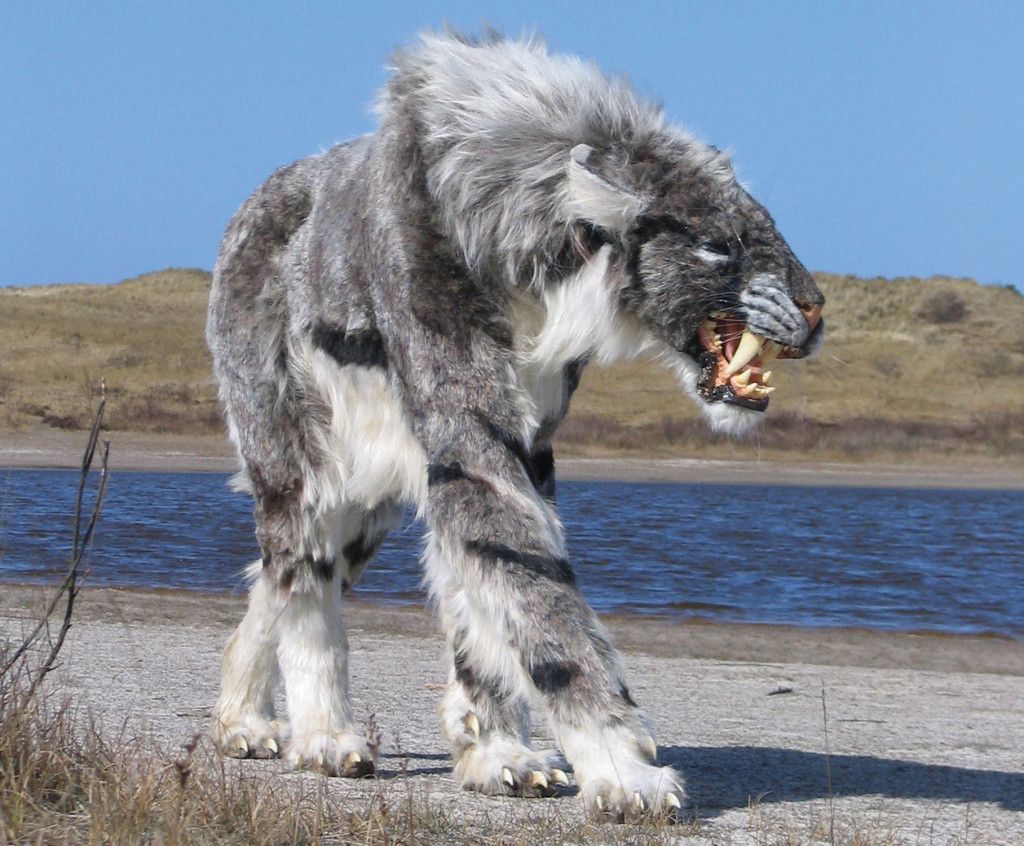
Was the saber-tooth cat a tiger?
No, saber-tooth cats were not tigers. They belonged to an entirely separate subfamily of cats called Machairodontinae that split from modern cats (Felinae) approximately 20 million years ago. The most famous saber-tooth, Smilodon, is not closely related to tigers, lions, or any living cat species.
The Ice Age Predator Built Around a Weapon
For 42 million years, various species of cats walked Earth with canine teeth longer than any modern predator could match. The most famous, Smilodon fatalis, had sabers up to 18 centimeters long - teeth so large they protruded well past the lower jaw even when the mouth was closed. Smilodon populator, the South American giant, had sabers up to 28 centimeters long, the length of an adult human's hand.
These were not just big teeth. They were specialized killing instruments that evolved over tens of millions of years, driving the entire body plan of an entire subfamily of cats. Understanding what saber-tooth cats actually were, and how they actually hunted, requires setting aside almost everything popular culture has taught us about them.
The Name Problem
The "saber-tooth tiger" is not a tiger. It is not even closely related to tigers. This is the first and most persistent misconception about these animals.
Saber-tooth cats belong to the subfamily Machairodontinae, which split from the ancestors of modern cats (subfamily Felinae) approximately 20 million years ago. Since then, machairodonts and modern cats have evolved along parallel but distinct paths. A saber-tooth is as different from a tiger as a dog is from a bear.
The confusion comes from early paleontology. When the first saber-tooth fossils were discovered in the 19th century, scientists assumed any large cat with prominent fangs must be related to tigers. The name "saber-tooth tiger" stuck in popular culture, even after DNA and morphological research showed the evolutionary relationship was not what the name implied.
Modern paleontology uses "saber-tooth cat," "saber-toothed cat," or simply the genus name (Smilodon, Machairodus, Homotherium).
Multiple independent saber-tooth lineages:
Actually, cat-like saber-toothed predators evolved multiple times in completely separate mammalian lineages:
- True machairodonts (subfamily within cats): most famous example, Smilodon
- Nimravids: cat-like carnivores from 40-20 million years ago
- Barbourofelids: another cat-like group with sabers
- Marsupial saber-tooths: Thylacosmilus of South America, a pouched mammal with sabers similar to Smilodon's
The repeated evolution of saber-tooth predators across unrelated lineages suggests saber teeth served a specific ecological purpose that favored their development wherever the right prey was available.
Smilodon: The Archetypal Saber-Tooth
Of all saber-tooth cats, Smilodon is the most famous and best-documented. Three species are recognized:
Smilodon gracilis - smallest species, roughly the size of a modern jaguar (70-100 kg). Lived in North and South America.
Smilodon fatalis - medium-sized species. Weighed 160-280 kg, comparable to a large African lion. Lived throughout the Americas. Most fossils come from California's La Brea Tar Pits.
Smilodon populator - largest species. Weighed up to 400 kg, comparable to a Siberian tiger. Lived only in South America. Had the longest sabers of any saber-tooth cat.
All three species lived during the Pleistocene epoch, from approximately 2.5 million years ago until about 10,000 years ago.
The La Brea Tar Pits
La Brea Tar Pits in Los Angeles, California, is the single richest source of saber-tooth cat fossils. Over 2,000 individual Smilodon fatalis specimens have been excavated from the pits.
The tar pits were natural asphalt seeps that trapped animals that ventured too close. A large herbivore becoming stuck in tar would attract predators. The predators, attempting to feed on the trapped herbivore, often became stuck themselves and died. Over tens of thousands of years, thousands of Smilodon, dire wolves, ground sloths, bison, and other Pleistocene megafauna accumulated in the pits.
La Brea's fossils are extraordinarily well-preserved. Individual Smilodon can be studied in detail - including skeletal trauma, growth patterns, and sometimes even stomach contents preserved by the asphalt. This preservation makes Smilodon the best-known large extinct predator in paleontology.
The Teeth
The defining feature of saber-tooth cats is their upper canines. In Smilodon populator, these teeth reached 28 cm in length - approximately the length of an adult human's hand.
Tooth characteristics:
- Extreme length: up to 28 cm in the largest species
- Flat, blade-like cross-section: designed for slashing and stabbing
- Serrated edges: both front and back edges had fine serrations for cutting
- Curved backward: the teeth arced backward toward the skull, allowing a downward stabbing motion
- Fragile: surprisingly weak against lateral stress
That last point is critical and is often missed in popular depictions. Saber teeth were remarkably fragile. Their enormous length created significant shear stress when biting, and biomechanical analysis shows they would have snapped easily if the cat bit down against resistance.
A Smilodon could not kill large prey by biting it firmly and holding on, the way modern big cats kill. The sabers would break.
Evidence of tooth fragility:
Fossil specimens of Smilodon frequently show broken sabers. Approximately 5 percent of La Brea Smilodon fossils have broken upper canines, often with evidence of healing (the cat survived the break and kept hunting for months or years afterward).
Healed fractures indicate the teeth broke during life, not after death. The frequency of breakage confirms the teeth were mechanically vulnerable and that hunting strategies must have avoided most impacts.
How They Actually Hunted
The fragility of the sabers fundamentally constrains the possible hunting strategies. Smilodon could not bite down on a struggling, resisting animal. So how did it use those massive teeth?
The wrestling-first strategy:
Biomechanical analysis of Smilodon skeletons reveals an animal built for pinning prey rather than chasing it. Key features:
Extremely muscular forelimbs. Smilodon's front legs were more powerful, pound-for-pound, than those of any modern cat. Analysis shows forelimb muscle attachments larger than would be expected for a cat of its size.
Short tail. Smilodon had a short, thick tail compared to long-tailed modern cats. Long tails aid balance during high-speed running and sharp turns. Smilodon's stubby tail suggests it did not chase or maneuver at high speed - it waited in ambush.
Bulky, not streamlined body. Smilodon's proportions favor strength over speed. The animal was not built for extended pursuit.
Robust neck. A thick, heavily muscled neck suggests the cat used its head to deliver precise, powerful downward strikes.
The hunting strategy that fits these features:
- Ambush from cover. Smilodon attacked prey from close range with a sudden burst of power.
- Wrestle to the ground. Using its massive forelimbs, the cat pinned the prey to the ground, using its body weight and grip to immobilize the animal.
- Precise saber strike. Once the prey was motionless or nearly so, the cat delivered a carefully aimed bite to the throat or neck, using the sabers to slice major blood vessels or pierce the spinal cord.
- Wait for death. Blood loss or neural damage killed the prey within a minute or two of the precision bite.
This is completely different from how modern big cats hunt. Lions suffocate prey with sustained throat bites that exhaust the animal before death. Tigers use bone-crushing bites to the skull. Both strategies require biting a struggling animal with sustained pressure - which Smilodon could not do without breaking its teeth.
The "canine shear-bite":
Biomechanists including Dr. Stephen Wroe have called the Smilodon killing bite the canine shear-bite. The technique requires the prey to be nearly motionless. Once the prey is pinned, the cat could deliver a quick, precise stabbing bite with the sabers. The teeth would slice tissue vertically rather than withstand prolonged lateral stress. Blood loss from major vessels (particularly the jugular vein and carotid artery) killed the prey within minutes.
This strategy required overwhelming physical dominance over prey. Smilodon hunted large, slow megafauna - bison, juvenile mammoths, giant ground sloths, horses, camels - that could be wrestled to the ground. It would not have worked on fast, agile prey like deer.
Pack Hunting
The wrestling hunting strategy suggests saber-tooth cats did not hunt alone. Pinning a 500 kg bison to the ground is not a single-cat job. Multiple lines of evidence support Smilodon pack hunting.
Evidence of social behavior:
Healed injuries. La Brea fossils show many Smilodon with healed injuries from broken bones, severe bites, and other traumas. Healing time for a broken femur or major shoulder injury could be weeks to months. A solo predator with a broken leg would starve. The presence of many old individuals with old healed injuries suggests they were fed by pack-mates during recovery.
Aged individuals. Many La Brea Smilodon were old at death, with extensive tooth wear and skeletal signs of age. Solo predators who cannot effectively hunt typically die within weeks of losing hunting ability. Aged Smilodon surviving into advanced decrepitude implies social support.
Fossil associations. Multiple Smilodon skeletons found together in the same deposits, some apparently representing simultaneous deaths, suggest pack associations.
Behavioral parallels. Modern lions, which are the only social big cats, also specialize in wrestling down large prey cooperatively. This ecological niche may favor sociality.
The specific social structure remains debated. Some researchers propose Smilodon lived in stable prides similar to modern lions. Others suggest a looser structure where individuals cooperated occasionally but hunted alone most of the time. Cub-raising appears to have involved extended maternal care regardless of specific social structure.
What They Hunted
Pleistocene North America and South America had abundant large mammals that no longer exist. Smilodon hunted the largest and slowest:
Bison. The American bison (and its ancient relative Bison antiquus, larger than modern bison) was a primary prey species.
Horses. Multiple native North American horse species existed until approximately 10,000 years ago. Slower horse species were probable prey.
Camels. Pleistocene North America had native camels. Yes, really.
Juvenile mammoths and mastodons. Adult proboscideans were too large for Smilodon to handle, but juveniles were likely targeted.
Ground sloths. Giant ground sloths (Megalonyx, Paramylodon) reached bear-like sizes. Smilodon is thought to have hunted juveniles.
Juvenile mammoths. Cave evidence and isotopic analysis suggest Smilodon took young mammoths when possible.
Stable isotope analysis of Smilodon bone confirms this diet pattern. Smilodon fossils show isotopic signatures characteristic of eating large, slow herbivores - not deer, not rabbits, not small animals.
The Extinction
Saber-tooth cats went extinct approximately 10,000 years ago as part of the larger Pleistocene megafaunal extinction. Across the Americas, Europe, Asia, and Australia, approximately 65 percent of large mammal species disappeared within a few thousand years.
The causes:
Climate change. As the last Ice Age ended, global temperatures warmed rapidly. Glaciers retreated. Ecosystems reorganized. The open grasslands that supported large herd animals were replaced in many regions by forests. Smilodon's hunting strategy required open terrain where pack-hunters could ambush and wrestle down prey. Forests neutralized that advantage.
Prey collapse. The large slow herbivores Smilodon depended on were also struggling with climate change. Horses disappeared from North America. Bison declined. Mammoths went extinct. Without adequate prey, Smilodon populations could not sustain themselves.
Human hunting pressure. Humans had entered the Americas approximately 15,000 years ago and by the time of the extinction were actively hunting the same large mammals Smilodon depended on. Human hunters were efficient, social, and could deplete local prey populations faster than they could recover. This put additional pressure on an already stressed food web.
Specialization trap. Smilodon's extreme physical specialization for wrestling large prey made it unable to adapt to new ecological conditions. A more generalist predator could have shifted to smaller, faster prey as large herbivores declined. Smilodon's sabers were useless for catching deer, and its bulky body could not chase fast prey.
By 10,000 years ago, Smilodon was gone from the Americas. The same extinction took dire wolves, American cheetahs, American lions, short-faced bears, cave bears, and dozens of other Ice Age predators.
The extinction is sometimes called the "Quaternary megafaunal extinction" and represents one of the most severe extinction events of the last 10 million years, second only to the dinosaur extinction in scale.
What Smilodon Looked Like
Popular depictions often show saber-tooth cats as tiger-striped, tiger-shaped predators. The real animal probably looked different.
Body shape: Bulky and muscular, proportioned more like a bear than a modern cat. Shorter body, more powerful limbs.
Coat: Unknown. Fur color is difficult to determine from fossils, but some paleontologists have proposed spotted or blotched patterns based on comparison with modern big cats that hunt in similar environments. Some reconstructions suggest Smilodon may have had a lion-like coat with no distinct markings.
Tail: Short and thick, not the long sweeping tail of modern cats.
Skull: Broad, with the massive sabers protruding well past the lower jaw. The skull was built to accommodate the teeth rather than the other way around.
Size: Smilodon fatalis was lion-sized. Smilodon populator was larger than any living cat.
Modern reconstructions based on full skeletal analysis produce a very different image than the tiger-striped cartoon saber-tooth. Smilodon was its own animal, not a decorated version of a modern species.
The Legacy
Saber-tooth cats thrived for over 40 million years. They were among the most successful predator lineages in mammalian history, diversifying across multiple continents and surviving through massive climate changes.
Their extinction, when it came, was fast. Within a few thousand years, one of the most successful predator designs in evolutionary history vanished from Earth.
The saber-tooth cat is a reminder of how ecological specialization becomes a trap when conditions change. The features that made Smilodon so successful in Pleistocene America - the enormous forelimbs, the specialized teeth, the dependence on specific large prey - became lethal when the ecosystem that supported those specializations collapsed.
Modern big cats face a version of the same problem. Tigers, lions, cheetahs, and jaguars are all specialists in environments that are shrinking rapidly due to human activity. Whether they will survive the current extinction crisis depends largely on whether we preserve the ecosystems they depend on.
The saber-tooth cat is an extinct predator that teaches a lesson about living ones: specialization is powerful, but specialization without adaptability is a one-way ticket to the fossil record.
The La Brea Tar Pits Collection
The single richest source of saber-tooth cat fossils on Earth is the La Brea Tar Pits in downtown Los Angeles, where natural asphalt seeps have trapped and preserved animals for the last 50,000 years. More than 2,100 individual Smilodon fatalis have been excavated from the tar pits since the early 1900s, making the species the best-documented extinct mammal in the world. The Page Museum now holds shelves full of saber-tooth skulls, each cataloged and available for scientific study.
| Tar Pit Statistic | Figure |
|---|---|
| Smilodon fatalis individuals recovered | 2,100+ |
| Dire wolves recovered | 4,000+ |
| Total vertebrate specimens | 1 million+ |
| Plant specimens | 158,000+ |
| Insect specimens | 2.5 million+ |
| Ages sampled | 11,000-50,000 years before present |
| Percentage of Smilodon specimens with pathology | ~13% |
"La Brea Smilodon specimens tell us what a saber-toothed cat's life was really like. We see the healed fractures, the tooth breakages, the spinal arthritis. We see old cats who survived injuries that would have killed a lone hunter. They were a social species - there is really no other way for them to have lived long enough to heal from those wounds." - Christopher Shaw, Page Museum, Natural History Museum of Los Angeles County, 2018 [1]
The pathology data from La Brea have produced one of the most contested debates in vertebrate paleontology: whether Smilodon was social. The statistical evidence is strong that social carnivores survive longer with serious injuries than solitary carnivores, because pack members share food with injured individuals.
Studies by Carlo Meloro and Pascal Raia compared injury recovery rates in La Brea saber-tooths to modern solitary and social felids and concluded that Smilodon social structure most closely resembled that of modern lions [2].
Bite Mechanics and the Saber Problem
How did a cat with 25-centimeter teeth actually kill prey? The answer is not as obvious as it sounds. Modern big cats kill large prey with a suffocating throat bite, clamping their jaws around the windpipe for several minutes. This technique requires enormous jaw force but only short teeth that can close fully. Saber-tooth teeth are too long to permit a full jaw closure on a thick neck.
Biomechanical modeling by Colin McHenry at the University of Newcastle, Australia, used CT scans and finite element analysis to simulate Smilodon bites. The results showed that Smilodon's jaw muscles were relatively weak compared to a modern lion of equivalent mass, generating roughly half the bite force. This is strong evidence that Smilodon did not simply bite harder - it bit differently.
The current best model is the "canine shear-bite" hypothesis. Smilodon would use its massively muscled forelimbs to pin prey to the ground, then deliver a precise, deep bite into the prey's throat. The sabers would puncture vital arteries and the trachea in a single stroke, producing rapid death through exsanguination. The bite did not need to be especially strong; it needed to be accurate.
"Smilodon's power came from its neck and shoulders, not its jaws. The whole animal was essentially a grappling hook attached to a pair of precision puncture tools. The technique would not work on live, struggling prey. The prey had to be immobilized first." - Colin McHenry, Proceedings of the National Academy of Sciences, 2007 [3]
This interpretation explains the saber-tooth's unusually robust forelimb bones, its short lumbar region (reducing torsional flexibility in exchange for power), and its very wide jaw-opening angle of nearly 120 degrees. Everything about the anatomy is tuned for the grapple-and-puncture technique.
Contemporary Saber-Toothed Cats Compared
The name "saber-tooth" covers three different cat lineages that evolved enlarged canines independently - a classic example of convergent evolution.
| Species | Lineage | Time Range | Body Size | Canine Length | Primary Range |
|---|---|---|---|---|---|
| Smilodon populator | Machairodontinae | 2 million-10,000 years ago | 220-400 kg | 28 cm | South America |
| Smilodon fatalis | Machairodontinae | 1.5 million-10,000 years ago | 160-280 kg | 18-21 cm | North America |
| Homotherium serum | Machairodontinae | 5 million-10,000 years ago | 150-230 kg | 10-12 cm | Eurasia, North America |
| Thylacosmilus atrox | Sparassodonta (marsupial) | 9-3 million years ago | 80-120 kg | Ever-growing, 15+ cm | South America |
| Barbourofelis fricki | Nimravidae/Barbourofelidae | 13-5 million years ago | 200+ kg | 20 cm | North America |
| Megantereon cultridens | Machairodontinae | 4.5 million-500,000 years ago | 60-100 kg | 10-12 cm | Africa, Eurasia, North America |
The fact that the saber-tooth body plan evolved at least three times in independent lineages suggests it was a highly successful hunting strategy for a particular kind of prey ecosystem - one dominated by large, slow-moving, thick-skinned herbivores. When those prey disappeared at the end of the Pleistocene, all three lineages went extinct within a few millennia.
References
- Shaw, C. A., and Cox, S. M. (2018). "La Brea Tar Pits: a Pleistocene record of Pacific North American ecosystems." Natural History Museum of Los Angeles County Contributions in Science, 527, 1-44.
- Meloro, C., and Raia, P. (2010). "Cats and dogs: body size and social behaviour in Carnivora." Evolutionary Biology, 37(2-3), 102-110.
- McHenry, C. R., Wroe, S., Clausen, P. D., Moreno, K., and Cunningham, E. (2007). "Supermodeled sabercat, predatory behavior in Smilodon fatalis revealed by high-resolution 3D computer simulation." Proceedings of the National Academy of Sciences, 104(41), 16010-16015.
- Van Valkenburgh, B., and Hertel, F. (1993). "Tough times at La Brea: tooth breakage in large carnivores of the late Pleistocene." Science, 261(5120), 456-459.
- Antón, M. (2013). Sabertooth. Indiana University Press.
Related Articles
- Ice Age Megafauna: The Giants That Vanished
- Megafauna: Why the World's Largest Animals Disappeared
- Mass Extinctions: The Five Times Earth Nearly Died
Frequently Asked Questions
Was the saber-tooth cat a tiger?
No, saber-tooth cats were not tigers. They belonged to an entirely separate subfamily of cats called Machairodontinae that split from modern cats (Felinae) approximately 20 million years ago. The most famous saber-tooth, Smilodon, is not closely related to tigers, lions, or any living cat species. Their closest living relatives are other cats generally, but the saber-tooth lineage is as genetically distant from modern tigers as dogs are from bears.
The common name ‘saber-tooth tiger’ comes from early paleontologists who assumed any large fanged cat must be tiger-related. Modern classification calls them ‘saber-tooth cats’ or ‘saber-toothed cats’ instead. They looked somewhat like bulky lions with extended canines - not like tigers at all.
How big were saber-tooth cats?
Smilodon fatalis, the most famous saber-tooth species, weighed approximately 220 kg (485 lb) - slightly larger than a modern male lion. Smilodon populator, the largest species, reached 400 kg (880 lb) - roughly the size of a Siberian tiger. They stood about 1 meter tall at the shoulder and measured 2-2.5 meters long. Their bodies were exceptionally muscular and powerful, with forelimbs thicker and stronger than any modern cat.
This bulk supported their hunting strategy of wrestling large prey to the ground before using the sabers. They had relatively short tails, unlike modern cats, and walked with a more bear-like gait. Fossils from La Brea Tar Pits in California preserve thousands of saber-tooth specimens, making them the best-documented large extinct predator.
How did saber-tooth cats actually hunt?
Saber-tooth cats hunted by ambushing large prey, wrestling the animals to the ground with their powerful forelimbs, then delivering a precise stabbing bite to the throat using their sabers. The massive canine teeth (up to 28 cm long in Smilodon populator) were fragile - the shear strength of the teeth was much lower than their length implies. Biting hard against bone or a struggling animal would snap them.
The hunting strategy therefore required immobilizing prey first, then using the sabers to cut the throat or major blood vessels of a downed, motionless animal. This is completely different from how modern big cats hunt - modern cats use suffocating throat bites on unpinned prey, which would be impossible for saber-tooths because their teeth could not survive the resistance.
Smilodon’s extreme forelimb development is the clearest evidence of this wrestling-first hunting strategy.
Did saber-tooth cats live in packs?
Smilodon fatalis likely lived and hunted in groups, based on multiple lines of evidence. Fossil records at La Brea show many Smilodon specimens with healed injuries from broken bones, severe bites, and other traumas. These injuries required weeks or months to heal - during which time the animal could not hunt effectively.
Survival through these healing periods suggests the animal was being fed by pack-mates, because a solo predator with a broken leg would starve. Additionally, Smilodon’s bulky build made it slow over long distances; catching prey likely required coordinated ambushes with multiple predators blocking escape routes. Some researchers propose Smilodon lived in lion-like prides.
Others suggest a looser social structure similar to modern tigers that allow occasional cooperation. The specific social system remains debated, but solo hunting seems unlikely given the physical and fossil evidence.
Why did saber-tooth cats go extinct?
Saber-tooth cats went extinct approximately 10,000 years ago alongside most large Ice Age mammals (the megafaunal extinction event). The cause was a combination of climate change and human hunting pressure. As glaciers retreated and temperatures warmed, the open plains that supported large herd animals like bison and horses gave way to forests.
Smilodon was specialized for hunting large, slow megafauna in open terrain - it could not catch faster prey in forested environments. Simultaneously, expanding human populations hunted the same megafauna that Smilodon depended on. As their prey base collapsed, saber-tooth cats could not adapt quickly enough to hunt smaller, faster alternatives. Their massive sabers were useless for catching deer or rabbits.
Within a few thousand years, populations that had thrived for millions of years across the Americas vanished completely. The saber-tooth cat is now considered a paradigmatic example of how ecological specialization becomes fatal when environmental conditions change rapidly.