
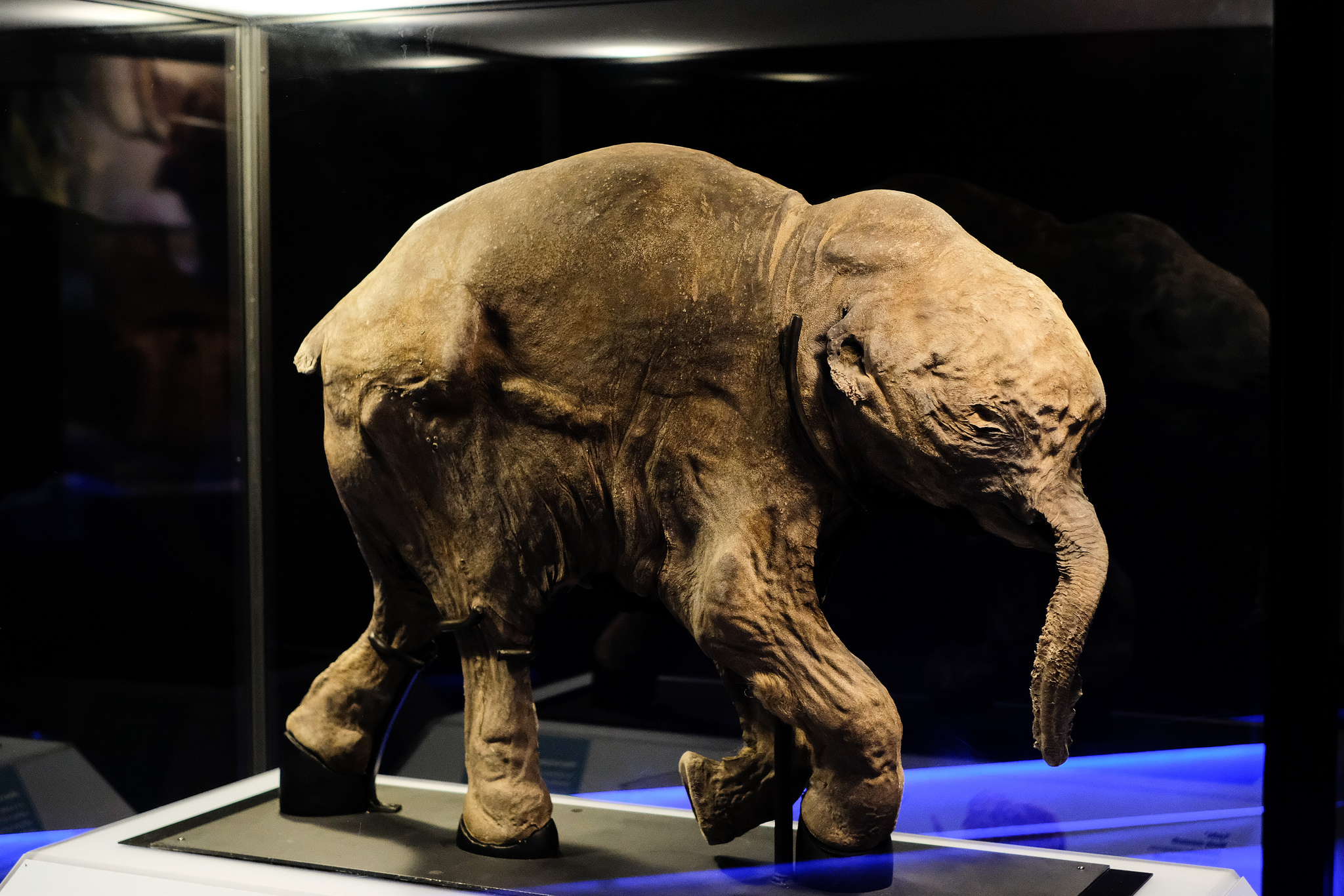
The woolly mammoth is one of the most recognisable extinct mammals on Earth - a shaggy, tusked, cold-adapted elephant that ruled the northern hemisphere during the last ice age. For roughly 400,000 years Mammuthus primigenius grazed a grassland ecosystem that no longer exists, left its body frozen intact in Siberian permafrost, and watched the rise of modern humans from inside its own habitat.
The species was painted on cave walls more than 30,000 years ago, butchered at late Pleistocene kill sites, and survived on a single Arctic island long enough to overlap with the builders of the Great Pyramid of Giza.
This guide covers every major aspect of woolly mammoth biology and ecology: size and anatomy, adaptations to extreme cold, the lost mammoth steppe, diet and trunk mechanics, tusk structure, reproduction, extinction timeline, frozen specimens, and the modern scientific effort to bring the species back through gene editing. It is a reference entry, not a summary, and deals in specifics - kilograms, metres, millennia, and named individuals preserved in the permafrost record.
Etymology and Classification
The scientific name Mammuthus primigenius was coined by Johann Friedrich Blumenbach in 1799. The genus name Mammuthus derives from the Russian mamont, itself likely borrowed from a Siberian Indigenous root meaning 'earth-horn' - a reference to the tusks Siberian peoples had long been finding eroding out of riverbanks. The species name primigenius is Latin for 'first-born' or 'primordial', reflecting Blumenbach's view that this was an ancient ancestral form.
Woolly mammoths sit inside the order Proboscidea, the trunk-bearing mammals, and the family Elephantidae, which contains the two surviving elephant genera and several extinct ones. Within Elephantidae, mammoths are more closely related to Asian elephants (Elephas maximus) than to African elephants.
Genetic comparisons consistently place the Asian elephant and the woolly mammoth as sister lineages that shared a common ancestor roughly 6 million years ago. Asian elephants and woolly mammoths share approximately 99.6% of their genomes, a figure that underpins current de-extinction efforts.
The genus Mammuthus includes several species beyond the woolly mammoth: the steppe mammoth (M. trogontherii), the Columbian mammoth (M. columbi) of North America, the pygmy mammoths of the California Channel Islands, and earlier African species. The woolly mammoth evolved in eastern Asia from steppe mammoth ancestors around 400,000 years ago and spread across Eurasia and into North America as glacial cycles repeatedly opened and closed the Bering land bridge.
Size and Physical Description
Popular culture tends to depict woolly mammoths as larger than modern elephants. In reality, they were roughly the same size as an African elephant - and smaller than their Columbian mammoth cousins that lived further south.
Adult males:
- Shoulder height: 2.7-3.4 metres
- Weight: 5.5-8 tonnes, with exceptional individuals reaching greater mass
- Tusk length: up to 4.2 metres along the outer curve
- Tusk weight: up to 90 kilograms each
Adult females:
- Shoulder height: 2.5-3.0 metres
- Weight: 3-4 tonnes
- Tusks shorter, thinner, less strongly curved
Late Wrangel Island population (final millennia):
- Shoulder height: approximately 2.0-2.5 metres
- Reduced body size reflecting island dwarfing and genetic bottleneck
The woolly mammoth's silhouette differed from modern elephants in several diagnostic ways. A prominent fatty hump rose from the shoulders, giving the animal a distinctive sloping back that falls steeply toward the hindquarters. The head was high and dome-shaped, with a tall single-peaked skull very different from the rounder profile of an Asian elephant.
The tail was short - roughly 60 centimetres - to minimise exposed surface area and frostbite risk. The ears were tiny compared with African elephant ears, only about one-fifteenth the size, again reducing heat loss and frost damage.
The coat was the species' most famous feature. Two layers of fur insulated the body. An outer layer of long guard hairs, reaching up to 90 centimetres on the flanks and belly, shed snow, wind, and rain. Beneath it lay a dense woolly underfur that trapped a still layer of warm air against the skin. Hair colour varied between individuals - genetic studies reveal alleles producing brown, reddish, and dark variants.
Underneath the fur, a fat layer up to 10 centimetres thick provided further insulation and energy reserves, supplemented by the shoulder hump.
Built for the Ice Age
Every significant feature of woolly mammoth anatomy addresses one of two problems: conserving heat in subzero temperatures, or finding enough food on a low-productivity steppe to produce that heat.
Thermal features:
- Double-layer coat with long guard hairs and dense underfur
- Subcutaneous fat up to 10 centimetres thick
- Fatty shoulder hump storing extra energy and insulation
- Small ears reducing surface area and frostbite risk
- Short tail for the same reason
- Compact trunk tip with reduced exposure
- Sebaceous glands producing waterproofing oils
Biochemical adaptations:
- Cold-adapted haemoglobin variant (Campbell et al., 2010) that released oxygen efficiently at low temperatures where modern elephant haemoglobin becomes too 'tight' to unload oxygen to tissues
- Skin and fat composition shifted toward cold resistance
- Metabolic adjustments inferred from the genome but not yet fully characterised
The 2010 haemoglobin study is particularly striking. Researchers resurrected the mammoth protein in the laboratory by inserting ancient DNA sequences into E. coli and showed experimentally that the resulting haemoglobin behaved exactly like a cold-adapted variant - unloading oxygen at temperatures that would paralyse modern elephant haemoglobin. This is one of the few cases where an extinct species' physiology has been tested directly in a living system.
The fur coat was not merely thick but structurally engineered. Hairs had overlapping scale patterns that shed water away from the body, and the guard hairs grew in long curtains that hung below the belly to protect the vulnerable underside from snow and wind. When mammoths walked through deep drifts, the coat acted like a mobile shelter, trapping a pocket of warm air along the entire length of the body.
The Mammoth Steppe
The woolly mammoth cannot be understood without the mammoth steppe, an ecosystem that no longer exists anywhere on Earth. During glacial periods this cold, dry, grass-dominated biome stretched in an almost unbroken belt across northern Eurasia, crossed the Bering land bridge during sea-level lows, and extended into interior Alaska, Yukon, and the northern Great Plains of North America. At its maximum extent it was the largest biome on the planet.
Key mammoth steppe features:
| Feature | Description |
|---|---|
| Climate | Cold, extremely dry, windy |
| Dominant vegetation | Grasses, sedges, forbs, dwarf shrubs |
| Precipitation | Lower than modern tundra |
| Productivity | Higher than modern tundra - supported megafauna densities |
| Soil | Continuous permafrost with active layer |
| Fauna | Mammoth, woolly rhino, steppe bison, horse, saiga, cave lion |
Unlike modern Arctic tundra, which is cold and wet and dominated by mosses and lichens, the mammoth steppe was cold and dry and dominated by nutritious graminoids. This difference is what allowed it to support megafauna densities comparable to the African savanna.
The steppe was kept open partly by climate and partly by the megafauna themselves: mammoths, woolly rhinos, bison, and horses trampled and grazed the landscape, recycled nutrients through dung, and prevented shrub and tree encroachment.
When Pleistocene glaciation ended around 12,000 to 10,000 years ago, warming, higher precipitation, and the collapse of the large herbivore community triggered a cascade. Grassland converted to waterlogged tundra and boreal forest, neither of which can support large-bodied grazers at mammoth-era densities. The mammoth steppe disappeared as an ecosystem, and the species most adapted to it disappeared with it.
Tusks, Trunk, and Teeth
Woolly mammoth tusks were anatomical extremes. Unlike modern elephant tusks, which grow fairly straight with a mild curve, mammoth tusks spiralled forward, inward, and sometimes crossed in front of the animal. The largest recorded tusks approach 4.2 metres along the outer curve and weigh roughly 90 kilograms each. Tusk growth rings, similar to tree rings, record annual growth and climatic stress, letting researchers reconstruct individual life histories decades after death.
Tusks served multiple functions: fighting between males during the reproductive season (strong wear patterns and breakage are common in male specimens), shovelling snow away from grass in winter, stripping bark, digging for water, and signalling status. Heavily lopsided wear on the right or left side of the tusk often reveals individual handedness - mammoths, like people, favoured one side.
The trunk differed from modern elephant trunks in a subtle but important way. The tip carried two opposing finger-like lobes shaped to grip tufts of short, wiry grass rather than to grasp large leafy branches. This is a telltale steppe specialist's trunk, the Ice Age equivalent of a mowing tool. Frozen trunk specimens from Siberia preserve this double-finger morphology clearly, and it matches what cave artists drew tens of thousands of years ago.
The molars were the most specialised feature of mammoth dentition. Each molar was a massive block made of vertical enamel plates compressed together, with far more plates per tooth than modern elephants. This high plate count produced an extremely effective grinding surface for silica-rich steppe grasses, which wear teeth faster than softer forest vegetation.
Like modern elephants, woolly mammoths replaced their molars in sequence, moving new teeth forward from the back of the jaw as the front teeth wore out. A mammoth used six sets of molars over a lifetime. When the last set wore down - usually around 60-80 years of age - the animal could no longer chew enough to survive.
Diet and Feeding Behaviour
Stomach contents from frozen mammoth specimens have given palaeontologists an unusually complete picture of Ice Age diet. The most famous examples - Berezovka (1901), Yuka (2010), and the Lyuba calf (2007) - all preserved identifiable plant remains including seeds, pollen, and intact leaf fragments.
Dominant diet components:
- Grasses (Poaceae)
- Sedges (Cyperaceae)
- Forbs and herbs
- Moss
- Dwarf willow and birch shoots (seasonal)
- Bark and twigs (winter fallback)
An adult mammoth consumed approximately 180 kilograms of plant matter per day, drank 70-100 litres of water, and spent the vast majority of waking hours feeding. On the mammoth steppe, feeding was low-selectivity bulk processing: the animal mowed through grass tufts with its trunk, passing material steadily into its mouth for grinding. Winter feeding required clearing snow - either by sweeping it aside with tusks or by trampling it down - to reach grass below.
Water was a challenge in a frozen landscape. Frozen mammoth specimens show ice and snow in the mouth alongside grass, indicating that the animals ate snow directly in winter. This is inefficient - melting snow in the gut costs significant body heat - but unavoidable when open water is locked in ice for most of the year.
Reproduction and Life Cycle
Mammoth reproduction is inferred from tusk growth rings, bone histology, and frozen specimens rather than direct observation. The picture matches closely with modern elephants, which makes sense given their close relationship.
Reproduction profile (inferred):
- Sexual maturity: 10-15 years in females, slightly later in males
- Gestation: approximately 22 months - the longest of any living or extinct mammal
- Calves per birth: usually one
- Calving interval: 3-5 years
- Weaning: 3-5 years
- Lifespan: 60-80 years (based on tusk ring counts in mature adults)
Males likely entered a state analogous to elephant 'musth' - a period of elevated testosterone and aggression during which they competed for access to females. Breakage and heavy wear on the tusks of mature males supports this. Social structure probably mirrored modern elephant societies: stable matriarchal herds of related females and calves, with males dispersing to bachelor groups or solitary lives at maturity.
The Lyuba calf, preserved in Siberia for roughly 42,000 years, provides the most detailed picture of mammoth early life on record. Lyuba died at approximately one month old, likely by drowning in mud, and froze quickly enough to preserve her internal organs, stomach contents (including her mother's dung, consumed to seed gut bacteria), and skin in near-perfect condition.
She weighs 50 kilograms in her preserved state and remains one of the most important single fossils in Pleistocene palaeontology.
Extinction Timeline
Woolly mammoth extinction was not a single event but a prolonged contraction lasting several thousand years. The timeline is now well constrained by radiocarbon dating, ancient DNA sampling from permafrost, and archaeological evidence from kill sites.
| Date | Event |
|---|---|
| ~400,000 years ago | Woolly mammoth evolves from steppe mammoth ancestors in eastern Asia |
| ~100,000 years ago | Peak range across Eurasia and North America |
| ~14,000 years ago | Rapid warming begins, mammoth steppe fragments |
| ~12,000 years ago | Clovis-era kill sites in North America; mainland range shrinks |
| ~10,000 years ago | Last North American populations disappear |
| ~9,000 years ago | Last mainland Siberian populations gone |
| ~7,000 years ago | St Paul Island (Alaska) population extinct |
| ~4,000 years ago | Wrangel Island population extinct - final woolly mammoths on Earth |
The Wrangel Island persistence is the most striking detail in this timeline. Wrangel is an island in the Chukchi Sea off the Russian Arctic coast, isolated from the mainland by rising sea levels at the end of the Pleistocene. A remnant mammoth population survived there, in isolation, for roughly 6,000 years after the mainland populations had vanished.
Genetic studies of Wrangel mammoths show accumulating deleterious mutations, reduced body size, and signs of severe inbreeding in the final centuries - a phenomenon sometimes called 'genomic meltdown'. When the last Wrangel mammoths died around 2,000 BCE, the Egyptian Old Kingdom had already built its pyramids, Sumer had invented cuneiform writing, and Bronze Age societies spanned the Mediterranean.
Causes of Extinction
Decades of debate about woolly mammoth extinction have now converged on a combined-cause model. Neither climate change alone nor human hunting alone explains the pattern; both mattered, and they reinforced each other.
Climate-change pressure:
- Rapid end-Pleistocene warming collapsed the mammoth steppe
- Grassland fragmented into waterlogged tundra and boreal forest
- Winter snow deepened, burying grass beyond tusk-shovelling depth
- Rising sea levels flooded lowland habitat, especially in Beringia
- Summer moisture favoured shrub and tree encroachment
Human hunting pressure:
- Clovis-era spear points found embedded in North American mammoth bones
- Multiple kill sites across Eurasia and North America document direct hunting
- Coordinated hunting tactics enabled small groups of humans to take megafauna
- Human range expansion coincided with mammoth range contraction continent by continent
Combined effect:
- Climate stress reduced population sizes and reproductive output
- Smaller, fragmented populations were vulnerable to hunting offtake
- Human hunting prevented recovery during brief climatic reprieves
- Island refuges (Wrangel, St Paul) without humans persisted longest - strong evidence that human contact was a decisive factor
The Wrangel Island case is particularly informative. Wrangel experienced the same global climate change as mainland Siberia, yet its mammoths survived 6,000 additional years because no humans reached the island until after the population had already collapsed from genetic causes. This natural experiment separates the climate signal from the human signal more cleanly than any other site.
Frozen Specimens and the Permafrost Record
Siberian and Alaskan permafrost preserves woolly mammoths more completely than any other extinct large mammal is preserved anywhere. Over two centuries of recovery has produced hundreds of specimens, ranging from isolated bones to intact bodies with skin, hair, internal organs, stomach contents, and in a few cases liquid blood.
Notable frozen specimens:
- Berezovka mammoth (1901): Adult recovered from a Siberian riverbank with intact stomach contents and skin. Examined in St Petersburg and still on display there.
- Lyuba (2007): One-month-old female calf, the most complete mammoth ever recovered. Preserved for ~42,000 years. Currently on display at the Shemanovsky Museum in Salekhard.
- Yuka (2010): Juvenile female approximately 39,000 years old, with intact brain tissue, muscle, hair, and skin. Source of viable cell nucleus experiments.
- Berezovka calf and Mascha (1988): Additional juvenile specimens providing growth data.
- Adams mammoth (1799): First documented complete skeleton recovered from permafrost, establishing the scientific reality of mammoths.
Permafrost preservation works through a combination of rapid burial, continuous sub-zero temperature, low oxygen availability, and very low microbial activity. Soft tissues can remain identifiable for tens of thousands of years. Researchers have successfully sequenced DNA from bone and tooth fragments dating to over 1 million years in permafrost, and some specimens have yielded proteins and even red blood cells in recognisable form.
Permafrost thaw driven by contemporary climate change now exposes new specimens each year. The race to recover them before decomposition ruins them has created an informal partnership between local Indigenous communities, Russian and international palaeontologists, and Siberian ivory hunters who encounter specimens in the course of their work.
Cultural Legacy
Woolly mammoths are among the earliest non-human subjects of visual art. European Palaeolithic cave painters - at Rouffignac, Chauvet, Pech Merle, and many smaller sites - depicted mammoths in charcoal, ochre, and engraved outlines between 35,000 and 12,000 years ago. These images capture details like the shoulder hump and sloping back that scientists later confirmed from skeletal evidence.
Ivory figurines carved from mammoth tusks - most famously the Lion Man of Hohlenstein-Stadel and the Venus figurines - show that humans used mammoth material as both raw material and cultural symbol throughout the Upper Palaeolithic.
In Siberia, mammoth remains have been economically and culturally significant for thousands of years. Frozen tusks eroding from riverbanks supplied a steady source of workable ivory long after the last mammoth died. Indigenous peoples developed sophisticated knowledge of where tusks could be found, and the practice continues today.
Modern Siberian mammoth ivory is legal, untaxed, and supplies a commercial market estimated at tens of millions of dollars annually - a trade that has accelerated as permafrost thaws and exposes new material.
De-Extinction Efforts
The woolly mammoth is the most prominent target of the modern de-extinction movement. Several projects are active, but the most advanced is led by Colossal Biosciences in partnership with George Church's lab at Harvard Medical School.
The current approach:
- Sequence mammoth genes from permafrost specimens (already achieved, multiple genomes published since 2015)
- Identify the genetic differences responsible for mammoth-specific traits: cold-adapted haemoglobin, thick fur, small ears, subcutaneous fat, curved tusks, metabolism
- Use CRISPR gene editing to insert mammoth alleles into Asian elephant cells
- Grow modified embryos, using either an Asian elephant surrogate or an artificial womb
- Produce a cold-tolerant mammoth-like elephant hybrid that can restore mammoth ecological function in Arctic grasslands
Intermediate proof-of-concept milestones have been achieved, including the 'woolly mouse' experiments in 2024 and 2025 in which Colossal engineered mice with multiple mammoth-derived traits and demonstrated healthy phenotypic expression. Full mammoth-hybrid embryos and live births have not yet been reported.
Full cloning from preserved mammoth cells has so far failed. Every nucleus recovered from permafrost has been too degraded to support cell division. Direct cloning in the manner of Dolly the sheep is therefore not a viable path. The gene-editing approach is the only current method with realistic prospects of success.
Separately, the 'Pleistocene Park' project in Siberia has been reintroducing extant megafauna - bison, musk oxen, yaks, reindeer, horses - into a restored grassland to test whether large herbivore grazing can convert modern tundra back toward mammoth-steppe conditions.
The ecological hypothesis is that mammoth-steppe productivity depended on the herbivores themselves, and that restoring grazers may restore the ecosystem even without the mammoths - or prepare a landscape where mammoth-analogue hybrids could eventually live.
Related Reading
- Sabre-Toothed Cat: Ice Age Predator
- Giant Ground Sloth: Ice Age Herbivore
- Woolly Rhinoceros: Companion of the Mammoth
- Dire Wolf: North America's Lost Predator
References
Relevant peer-reviewed sources consulted for this entry include Campbell et al. (2010) on mammoth haemoglobin function in Nature Genetics; Palkopoulou et al. (2015) on the woolly mammoth genome in Current Biology; Fry et al. (2020) on Wrangel Island genetic decline; Vartanyan et al. on Wrangel Island radiocarbon chronology; and published work on Lyuba (Fisher et al.) and Yuka specimens.
Additional context comes from Colossal Biosciences technical publications on mammoth gene editing (2023-2025), Pleistocene Park research reports, and the International Mammoth Committee's collated specimen database.
Frequently Asked Questions
When did woolly mammoths go extinct?
Most mainland woolly mammoth (Mammuthus primigenius) populations disappeared around 10,000 years ago, at the end of the last Pleistocene glaciation. A relict population survived on Wrangel Island in the Russian Arctic until roughly 4,000 years ago - about 2,000 BCE.
That means the last mammoths were still walking the Earth while the Egyptian pyramids were being built, the Indus Valley civilisation was flourishing, and written language was spreading across Mesopotamia. The Wrangel Island holdouts were smaller than their mainland ancestors and showed genetic signs of severe inbreeding in their final centuries.
Why did the woolly mammoth go extinct?
The scientific consensus is that woolly mammoth extinction resulted from a combination of climate change and human hunting, not either cause alone. The end of the Pleistocene brought rapid warming, rising sea levels, and the collapse of the mammoth steppe - the cold, dry grassland ecosystem the species depended on. Habitat fragmented into boreal forest and tundra, both poor mammoth food.
At the same time, expanding human populations equipped with spears, atlatls, and coordinated hunting tactics reached nearly every corner of the mammoth’s range. Genetic and archaeological evidence suggests that climate pressure weakened populations and human hunting delivered the final blow, with isolated island refuges like Wrangel persisting longest because they escaped direct human contact.
How big were woolly mammoths?
Woolly mammoths were roughly the size of a modern African elephant, not larger as popular imagination suggests. Adult males stood 2.7 to 3.4 metres tall at the shoulder and weighed 5.5 to 8 tonnes, with exceptional individuals reaching greater mass. Females were smaller. Their tusks were the truly oversized feature - spiralled, curving forward and inward, sometimes reaching 4.2 metres in length and 90 kilograms in weight.
The shoulder hump of fat and long guard hairs made them look bulkier and taller than they actually were, which is why reconstructions often exaggerate their size compared with their living elephant relatives.
How were woolly mammoths adapted to the cold?
Every major feature of Mammuthus primigenius anatomy served cold survival. Their coat had two layers: long guard hairs up to 90 centimetres that shed water and wind, and a dense woolly underfur that trapped air for insulation. A thick layer of subcutaneous fat - up to 10 centimetres - underlay the skin, plus a fatty shoulder hump that doubled as an energy reserve. Sebaceous glands produced oily secretions that waterproofed the coat.
Their ears were tiny compared with African elephants, their tails were short, and their haemoglobin carried a cold-adapted variant described by Campbell and colleagues in 2010 that released oxygen efficiently even at near-freezing blood temperatures. Every visible feature is an answer to the cold.
Can woolly mammoths be brought back?
Serious scientific work is underway but no mammoth has been resurrected yet. Colossal Biosciences, in collaboration with George Church’s lab at Harvard Medical School, is using CRISPR gene editing to insert mammoth traits - cold-adapted haemoglobin, thick fur, small ears, subcutaneous fat, curved tusks - into Asian elephant cells. The Asian elephant is the mammoth’s closest living relative, sharing roughly 99.6% of its genome.
The goal is to produce a cold-tolerant elephant hybrid that could restore mammoth ecological function in Arctic grasslands. The project has published proof-of-concept results including the ‘woolly mouse’ gene edits in 2024 and 2025, but a living mammoth-like calf has not been born as of this writing. Full cloning from preserved cells has so far failed because every recovered nucleus has been too degraded.
What did woolly mammoths eat?
Woolly mammoths were bulk grazers specialised for the mammoth steppe, a cold, dry, grass-dominated ecosystem that covered enormous areas of Ice Age Eurasia and northern North America. Stomach contents from frozen specimens show their diet was dominated by grasses and sedges, with smaller proportions of herbs, dwarf shrubs, mosses, and seasonal willow or birch twigs. An adult mammoth needed roughly 180 kilograms of vegetation per day.
Their trunk tip ended in two finger-like lobes specifically adapted to pluck tufts of short, wiry steppe grass rather than strip leaves from trees like forest-adapted elephants. Their molars had far more enamel ridges than modern elephants’ - an adaptation for grinding abrasive, silica-rich grasses.
Why are frozen woolly mammoths so well preserved?
Siberian and Alaskan permafrost holds sediments that have been continuously frozen since the Pleistocene, sometimes for tens of thousands of years. When a mammoth died and was quickly buried or fell into a mud pit before thawing could occur, its body could freeze-dry in place and remain effectively sealed from decomposition.
Specimens like Lyuba (a one-month-old calf recovered in 2007), Yuka (a juvenile discovered in 2010), and the Berezovka mammoth (excavated in 1901) preserved skin, hair, internal organs, stomach contents, and in some cases even liquid blood and muscle tissue. As permafrost now thaws due to climate change, more specimens are being exposed - but they are also decomposing rapidly once exposed, creating urgency for recovery.
Where did woolly mammoths live?
Woolly mammoths ranged across the entire northern hemisphere during the late Pleistocene, inhabiting a vast cold-climate ecosystem called the mammoth steppe. Their range stretched from Spain and the British Isles across Europe and Siberia, over the Bering land bridge, and into Alaska, Yukon, and the Great Plains of North America.
During glacial maxima the mammoth steppe extended almost unbroken for thousands of kilometres, making Mammuthus primigenius one of the most widely distributed large mammals in Earth’s history. They did not inhabit tropical regions, dense forests, or high mountains. As glaciers retreated and the steppe fragmented into forest and tundra, their range collapsed sharply until only northern Siberia and offshore Arctic islands remained.