
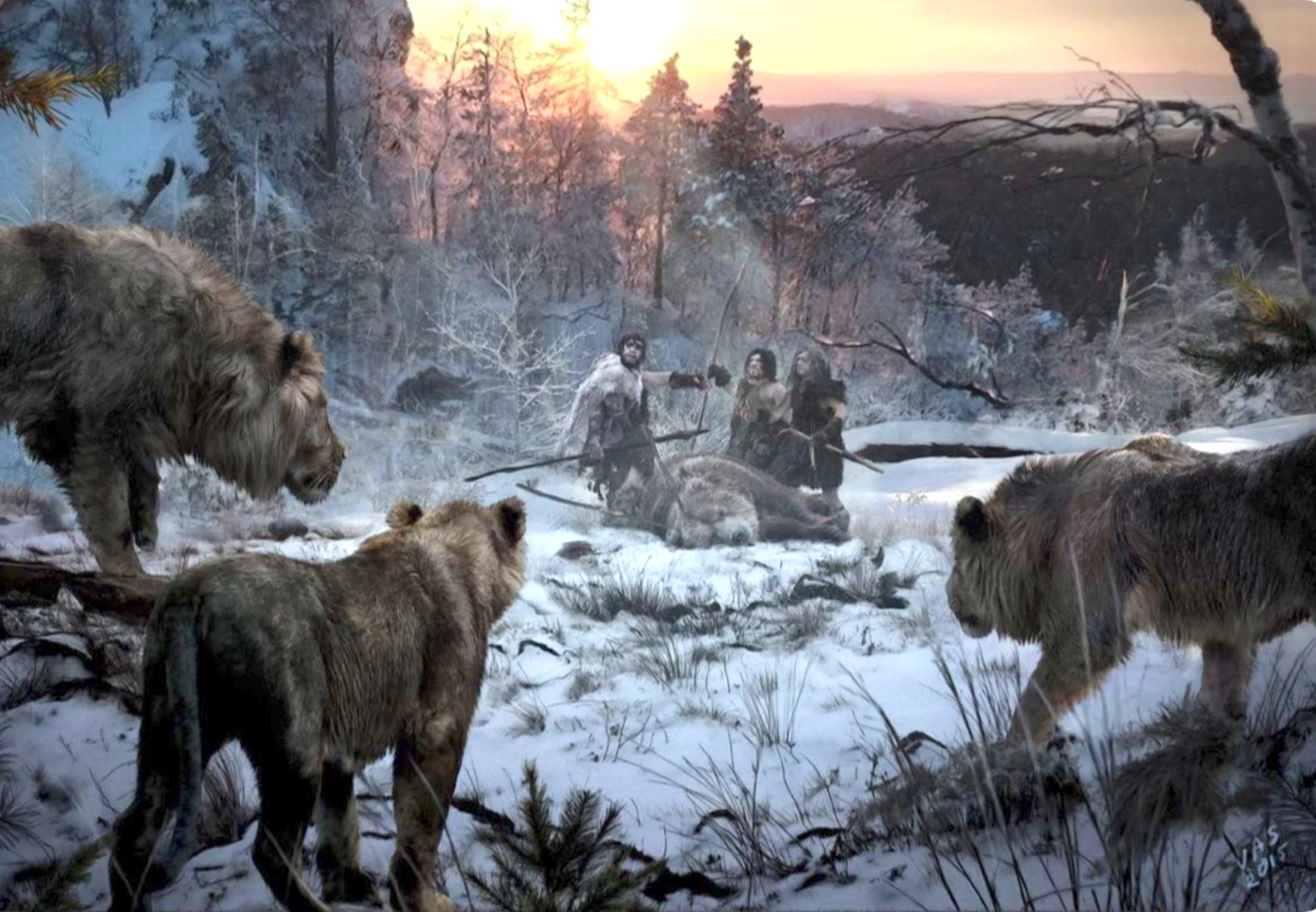
The cave bear is one of the most iconic extinct mammals of the European Ice Age - a massive, dome-headed, plant-eating bear that shared the continent with Neanderthals, mammoths, and the earliest modern humans for more than a quarter-million years.
For most of its history Ursus spelaeus was among the largest terrestrial carnivores on Earth, with dominant males reaching weights of a tonne, yet stable isotope chemistry shows it lived almost entirely on plants.
It hibernated in European caves in such numbers that some single sites now yield tens of thousands of skeletons, and its bones have provided some of the most detailed ancient DNA evidence ever recovered from any extinct species.
This guide covers every major aspect of cave bear biology and prehistory: size and anatomy, adaptations for hibernation, the surprisingly vegetarian diet, relationships with Neanderthals and modern humans, the famous Drachenloch bone accumulations, the rise and fall of the "cave bear cult" hypothesis, the extinction timeline around the Last Glacial Maximum, and the ongoing genomic research that makes this species one of the best-studied extinct mammals in existence.
It is a reference entry, not a summary, and the numbers throughout are specific to the animal.
Etymology and Classification
The scientific name Ursus spelaeus was formally coined by Johann Christian Rosenmuller in 1794 from a skull found in a German cave. Spelaeus is Latin for "of the cave", reflecting the species' defining association with European cave systems where the vast majority of its fossils have been found. The common name "cave bear" translates directly across most European languages - Hohlenbar in German, ours des cavernes in French, orso delle caverne in Italian, peshchernyy medved in Russian.
Cave bears sit firmly inside the genus Ursus, the same group that contains brown bears, polar bears, American black bears, and Asian black bears. Molecular work done since the 2000s on ancient DNA recovered from fossil bones has produced a reasonably confident divergence date. The cave bear lineage split from the brown bear lineage roughly 1.2 million years ago, during the early middle Pleistocene.
That is more than twice the age of the polar bear split from the brown bear. Cave bears spent over a million years as a distinct species before disappearing, which is a long run by large-mammal standards.
A number of closely related bears are sometimes grouped with U. spelaeus under the broader label "cave bears" - Ursus deningeri, Ursus ingressus, Ursus eremus, and Ursus ladinicus have all been proposed as separate species or subspecies based on fossil morphology and ancient DNA. Some of these were regional variants; some overlapped in time with true U. spelaeus.
A smaller and less-studied North American relative, Ursus kirrgeberi, has been described from scattered finds. Cave bears themselves never crossed the Bering land bridge into the Americas.
Size and Physical Description
Cave bears were gigantic by any living standard and rank among the largest carnivores that ever lived on land. Size differences between the sexes were extreme, a pattern biologists call sexual dimorphism.
Adult males:
- Length: 2.5-3.5 metres from nose to tail
- Shoulder height: 1.3-1.7 metres on all fours
- Standing height: up to 3.3 metres on hind legs
- Weight: typically 400-600 kg, with large individuals reaching 1,000 kg or more
Adult females:
- Length: 2.0-2.8 metres
- Shoulder height: 1.2-1.4 metres on all fours
- Weight: 225-500 kg, roughly half the mass of a large male
Cubs at birth:
- Weight: estimated 300-500 grams based on closest living relatives
- Born blind and helpless inside hibernation caves, typical for the genus
For comparison, a large modern male polar bear or Kodiak brown bear typically weighs 400-700 kg, with the heaviest verified individuals of either species approaching 1,000 kg. A healthy adult male cave bear was in the same class as the largest living bears on Earth, and bigger cave bear males exceeded them.
The cave bear silhouette was distinct enough that paleontologists can identify a cave bear skull at a single glance. The skull was tall, dome-shaped, and carried an exaggerated forehead rise that brown bears do not share. The muzzle was relatively short and deep. The forehead sloped sharply upward behind the snout, producing the "high forehead" profile that features in every cave bear illustration ever made.
The shoulders were powerfully built, forming a visible hump even in life, similar to modern brown bears but more pronounced. The forelimbs were massive and thickly muscled, suited to digging and ripping up tough vegetation.
The teeth are a crucial diagnostic feature and a first clue to the animal's real diet. Cave bear premolars are reduced and simplified, and in fact some premolars are absent in adults. The grinding molars, by contrast, are enormous and broad, with crown patterns specialised for chewing fibrous plant material. The canines and incisors are large but dull compared with an obligate carnivore. This is a mouth built for plants, not meat.
Built for Hibernation
Cave bears are defined ecologically by hibernation. Winter mortality in caves is why tens of thousands of skeletons ended up in single sites. Almost everything about their anatomy makes sense as a commitment to a long cold dormant season.
Energy storage features:
- Thick subcutaneous fat: estimated 5-15 cm on healthy autumn animals
- Pronounced shoulder hump storing additional fat reserves
- Large gut capacity for processing bulk vegetation during summer
Hibernation adaptations shared with modern bears:
- Dramatic drop in metabolic rate and body temperature during dormancy
- Months of fasting without eating, drinking, urinating, or defecating
- Nitrogen recycling that preserves muscle mass during dormancy
- Birth of cubs inside the den during mid-winter
Cave bears entered hibernation in autumn after spending the productive season feeding on European summer vegetation. The preferred hibernation caves were karst caverns at moderate to high elevation, often in mountainous regions where cave complexes were abundant. Temperature inside these caves was buffered, typically hovering just above freezing year round, which is energetically ideal for a hibernating bear.
The link between hibernation and cave bear fossil accumulations is direct. Bears that failed to survive the winter - because they entered dormancy with insufficient fat, because they were old or sick, or because the winter was unusually severe - simply did not come out. Their bodies decomposed on the cave floor and their skeletons joined earlier deaths in slowly accumulating sediment.
Over tens of thousands of winters, single caves could accumulate astonishing numbers of individuals. The Drachenloch cave in the Swiss Alps contains an estimated 30,000 cave bear skeletons, and it is not the largest such deposit in Europe.
Diet: A Vegetarian Giant
Cave bears look like predators in every way that matters visually - enormous body, heavy bones, big skull, powerful forelimbs, long canines. For most of the 19th and early 20th century they were assumed to have been fearsome carnivores, and cave bear remains were often displayed in that pose. The chemistry disagrees.
Stable isotope analysis measures the nitrogen-15 and carbon-13 ratios locked into fossil bone collagen. Animals at different trophic levels - plant eaters, omnivores, carnivores - end up with different signatures. The technique is well-validated, and when it was first applied systematically to cave bears in the 1990s the results were consistent and stark.
Cave bears sat near the bottom of the food web, in a range occupied by modern herbivores. They were closer to deer and horses than to wolves or hyenas.
Estimated dietary composition:
| Food category | Share of diet (est.) | Notes |
|---|---|---|
| Grasses and sedges | 30-45% | Bulk summer forage |
| Herbaceous plants | 20-30% | Forbs, broad-leafed herbs |
| Roots, tubers, bulbs | 10-20% | Autumn fat-building phase |
| Berries, nuts, fruit | 10-15% | Seasonal |
| Animal material | 0-5% | Insects, scavenged carcasses (occasional) |
Some regional variation exists. A minority of individuals from certain sites show isotope signatures slightly enriched in nitrogen-15, consistent with some animal protein intake, probably insects, eggs, or the occasional scavenged carcass. A handful of cave bears appear to have been more omnivorous. The overall pattern, though, across thousands of analysed specimens across Europe, is unambiguous. Cave bears were effectively giant vegetarian bears.
This is unusual among the living and fossil bear family, though not unprecedented. The giant panda (Ailuropoda melanoleuca) is a living counterpart - a carnivoran that converted its entire lineage to plant-eating while retaining carnivore dentition and digestive anatomy. The cave bear was, in evolutionary terms, taking a similar route.
Range and Habitat
Cave bears were a strictly European species. Their range stretched from the western Atlantic seaboard to the Ural Mountains and Caucasus in the east, and from Britain and northern Germany south into the Iberian Peninsula, the Italian peninsula, and the Balkans.
Core range regions:
- Iberian Peninsula (caves in Cantabria, Asturias, Pyrenees)
- Western and central Europe (Belgium, France, Germany, Switzerland)
- Alpine and sub-Alpine regions (Alps, Carpathians, Dinaric Alps)
- British Isles (sparser, at northern edge of range)
- Russian plain, Urals, Caucasus (eastern extent)
Cave bears thrived in mountainous and karst-rich landscapes where cave systems were abundant. Within this terrain they used temperate mixed forest, subalpine meadow, cold steppe, and forest-steppe ecotones. They appear to have avoided true high Arctic tundra, where plant productivity was insufficient to support their bulk, and were absent from the extreme northern mammoth steppe.
They also did not colonise North America - their dependence on particular European cave systems may have limited their dispersal, and the short-faced bear (Arctodus) occupied a broadly similar ecological niche in the New World.
Cave Bears, Neanderthals, and Modern Humans
Cave bears overlapped in time and space with several human species across their long tenure. Neanderthals (Homo neanderthalensis) shared European caves with cave bears for at least 150,000 years. Anatomically modern humans (Homo sapiens) arrived in Europe roughly 45,000 years ago and coexisted with cave bears until the latter's extinction at the Last Glacial Maximum around 24,000 years ago.
The relationship between hominins and cave bears had at least three dimensions.
Competition for caves. Both bears and hominins used European caves for shelter. Evidence at sites like Chauvet in France shows cave bear claw marks on cave walls next to human cave paintings, and in some cases over them or under them in clear layered sequences. Bears and humans did not share caves simultaneously - the animals were too dangerous - but they rotated through the same spaces across seasons and centuries.
Direct hunting. Cut-marked cave bear bones at multiple sites prove that Neanderthals and later modern humans killed and butchered cave bears on occasion. The frequency and economic importance of bear hunting are disputed, but the practice is documented. A bear the size of a cave bear yielded enormous amounts of fat, meat, fur, sinew, and bone. A successful hunt would have been a major event.
The "cave bear cult" hypothesis. Early 20th-century excavators, most famously Emil Bachler at Drachenloch, reported arrangements of cave bear skulls and long bones that they interpreted as deliberate ritual deposits by Neanderthals. The idea spread into popular archaeology and anthropology for decades, inspiring novels and films.
Modern re-excavation and taphonomic analysis have largely overturned the cult hypothesis. Natural processes - roof collapse, hibernation-death patterning, water transport across cave floors, differential preservation of dense skull bones over softer material - can produce the very "arrangements" that looked designed.
Some cut-marked bear bones near Neanderthal occupation layers are genuine but do not require ritual explanation. The mainstream archaeological position today is that the cave bear cult was an overinterpretation of coincidental patterns, though a minority of researchers continue to argue for some form of symbolic Neanderthal engagement with the species.
Extinction
Cave bears went extinct around 24,000 years ago, at or just before the coldest peak of the Last Glacial Maximum. The date is well constrained by radiocarbon dating of the youngest cave bear bones across their range. A few late outlier dates have been proposed but have not survived careful re-dating.
The extinction coincides with several converging pressures:
- Climate collapse. The Last Glacial Maximum was the coldest, driest phase of the late Pleistocene. Summer vegetation productivity across Europe dropped, directly threatening a specialised plant-eating bear.
- Habitat restructuring. Forest retreated, steppe and tundra expanded, and the mixed temperate vegetation cave bears depended on became patchy.
- Hibernation stress. Shorter, less productive summers meant less time to build the fat reserves needed to survive long winters.
- Human pressure. Modern humans reached Europe around 45,000 years ago and expanded through cave bear habitat, hunting them, displacing them from key caves, and competing for landscape.
- Population decline already underway. Ancient DNA analysis suggests cave bear effective population size was already declining for tens of thousands of years before extinction, not crashing suddenly at 24,000 years.
No single cause explains the extinction. The honest synthesis is that cave bears were a highly specialised species that had been declining gradually for a long time, and the combined shock of the Last Glacial Maximum plus accelerating human hunting pressure finished a population that was already too reduced to recover. Brown bears, which were more flexibly omnivorous and less dependent on particular cave systems, came through the same bottleneck and survive today.
Ancient DNA and Genomic Research
Cave bears are one of the best-studied extinct mammals on Earth in genetic terms, rivalled only by the woolly mammoth. Their fossil bones preserve DNA well because they are abundant, widely distributed, and often recovered from cold cave environments that slow DNA degradation.
Key milestones in cave bear ancient DNA research:
- 1990s: First partial mitochondrial DNA sequences recovered from cave bear fossils - among the earliest successful ancient DNA extractions from any vertebrate.
- 2000s: Full mitochondrial genomes assembled, revealing multiple geographically structured lineages within what had been assumed to be a single species.
- 2013: First cave bear nuclear DNA fragments recovered from a sample at Sima de los Huesos in Spain, pushing the boundaries of what old nuclear DNA could yield.
- 2018: Barlow and colleagues published high-coverage cave bear nuclear genomes and compared them with modern brown bears, providing the first genome-scale picture of cave bear ancestry.
- 2020: Follow-up work by Barlow's team confirmed repeated gene flow between cave bears and brown bears, and identified fragments of cave bear DNA persisting in modern European brown bear genomes.
The 2020 finding is especially striking. Cave bears as a species are extinct, but a small measurable fraction of cave bear DNA survives today - inside living brown bears, as introgressed ancestral material from ancient hybridisation events. This is functionally similar to the way some Neanderthal DNA survives inside living humans. Extinction in these cases is not absolute, and the genome of the surviving sister species carries traces of the lost relative.
Cave bear ancient DNA has also been used to refine the divergence date from brown bears (roughly 1.2 million years ago), map within-species genetic structure across Europe, identify separate lineages now classified as U. ingressus, U. eremus, and others, and test climate and population hypotheses against real demographic history.
Cave Bears in Human Memory
European folklore across the Alps, Pyrenees, and Carpathians contains persistent tales of giant bears in caves. Some of these traditions may have very long roots, passed down through oral culture from late Pleistocene times when humans and cave bears shared landscapes.
Regional dragons and giants in European mythology are occasionally linked to cave bear skulls found in caves by later peoples - a dome-headed, long-fanged skull the size of a small barrel is easy to interpret as something monstrous.
Cave bears appear rarely in Upper Palaeolithic cave art. Chauvet Cave in France contains a small number of figures interpreted as cave bears, alongside other species. The Chauvet-Pont d'Arc cave also preserves cave bear footprints, claw marks, and a bear skull placed on a natural stone pedestal - sometimes cited in the ongoing discussion of early human symbolic engagement with the species.
In modern popular culture the cave bear tends to be compressed with other Ice Age megafauna into a general "giant bear" template. The reality is more interesting: a species-specific animal with a dome head, a vegetarian diet, a predictable hibernation pattern, and a genome that modern science has read in detail.
Related Reading
- Woolly Mammoth: The Lost Giant of the Ice Age
- Saber-Tooth Cat (Smilodon): Ice Age Apex Predator
- Dire Wolf: The Ice Age Pack Hunter
- Ice Age Megafauna: The Giants That Vanished
- Polar Bear: The Arctic's Apex Predator
References
Relevant peer-reviewed sources consulted for this entry include Barlow et al. (2018, 2020) on cave bear nuclear genomes and brown bear introgression in Nature Ecology and Evolution and related journals, Bocherens et al. (multiple studies 1994-2019) on stable isotope evidence for cave bear herbivory, Stiller et al.
(2010, 2014) on cave bear lineage diversity, Pacher and Stuart (2009) on the extinction chronology in Boreas, and reviews in Quaternary Science Reviews covering the Drachenloch excavations and the cave bear cult hypothesis. Population size estimates, divergence dates, and extinction timing reflect the most recent consolidated radiocarbon and ancient DNA evidence available.
Frequently Asked Questions
How big was the cave bear?
Cave bears (Ursus spelaeus) were among the largest bears that ever lived. Adult males typically weighed 400 to 1,000 kilograms and measured 2.5 to 3.5 metres from nose to tail, with shoulder heights of 1.2 to 1.7 metres on all fours. On their hind legs the largest males stood more than 3 metres tall. Females were roughly half the mass at 225 to 500 kilograms, reflecting strong sexual dimorphism typical of bears.
The largest verified cave bear males exceeded any living terrestrial carnivore, including polar bears and Kodiak brown bears, though the very biggest recorded modern polar bears and Kodiaks do overlap the lower end of cave bear male weights.
What did cave bears eat?
Despite their size and predator-style dentition, cave bears were overwhelmingly herbivorous. Stable isotope analysis of nitrogen and carbon ratios in cave bear bones consistently places them near the bottom of the food web, in a range occupied by herbivores and close to modern giant pandas rather than meat-eating carnivores. Their diet included grasses, herbaceous plants, roots, tubers, bulbs, berries, nuts, and occasional honey.
Some regional variation existed - a small number of specimens show isotope signatures hinting at limited animal protein intake, possibly insects or scavenged carcasses - but the overall pattern across Europe is clear. Their broad, flat molars were specifically adapted for grinding plant material, and their skulls carried the muscle attachments needed to chew tough vegetation for hours a day.
Where did cave bears live?
Cave bears were strictly European. Their range stretched from northern Spain and the British Isles in the west to the Ural Mountains and Caucasus in the east, and from northern Italy and the Balkans up into Belgium, Germany, and southern Scandinavia. They favoured mountainous and karst regions rich in caves - the Pyrenees, Alps, Carpathians, Dinaric Alps, and Ural foothills all contain major cave bear fossil sites.
Within this range they inhabited mixed temperate forest, subalpine meadow, and cold steppe environments. They never crossed the Bering land bridge into North America. A smaller and less-studied North American relative, Ursus kirrgeberi (sometimes classified within the short-faced bear lineage rather than as a true cave bear), occupied a vaguely similar cave-dwelling niche across the Atlantic.
Why did cave bears go extinct?
The cause of cave bear extinction around 24,000 years ago is actively debated, and the honest answer is that it was almost certainly a combination of factors. Climate pressure is central. The run-up to the Last Glacial Maximum was the coldest, driest stretch of the last ice age, and a specialised plant-eating bear needed productive summer vegetation to build the fat reserves required for a long winter hibernation.
Shrinking plant productivity across Europe would have hit cave bears harder than the more omnivorous brown bear, which could switch to animal protein when plants failed. Human hunting pressure is the other major factor. Both Neanderthals and anatomically modern humans coexisted with cave bears and occasionally killed them - cut marks on cave bear bones prove this. Humans may also have driven bears out of preferred hibernation caves.
Ancient DNA studies show cave bear populations were already declining for tens of thousands of years before final extinction, so no single event ended them. The final collapse happened when a climate-stressed, competition-stressed population could no longer replace itself.
Was there really a Neanderthal cave bear cult?
The cave bear cult hypothesis was proposed in the early 20th century based on arrangements of cave bear skulls and bones at sites like Drachenloch in Switzerland and Regourdou in France. Early excavators believed Neanderthals had deliberately arranged bear skulls in stone-lined niches as ritual offerings. Modern re-examination has largely debunked this view.
Most of the suspicious arrangements turn out to be explained by natural processes - roof fall, water transport, hibernation-death deposition patterns, and cave floor compaction can all concentrate bear skulls in ways that look deliberate.
Some sites do show Neanderthal activity near cave bear remains, and Neanderthals clearly hunted and butchered bears on occasion, but the idea of an organised religious cult focused on the species has not survived careful analysis. Most modern archaeologists describe it as an overinterpretation of coincidental patterns.
What is Drachenloch cave?
Drachenloch - German for ‘Dragon’s Lair’ - is a high-altitude cave in the Swiss Alps, 2,445 metres above sea level, excavated by Emil Bachler between 1917 and 1923. It produced the remains of more than 30,000 individual cave bears, one of the largest accumulations of a single extinct species anywhere in the world.
The deposits formed over tens of thousands of years of winter mortality, as bears that failed to survive hibernation died in the cave and their bones gradually accumulated in sediment. Drachenloch is also the original source of the cave bear cult hypothesis, because Bachler reported finding deliberately arranged skulls and long bones that he interpreted as Neanderthal ritual deposits.
Subsequent work has shown the ‘arrangements’ were almost certainly natural, but the sheer density of remains makes Drachenloch a reference site for cave bear biology and population structure.
What has ancient DNA told us about cave bears?
Cave bears were among the first extinct mammals to yield usable ancient DNA, with partial mitochondrial sequences recovered as early as the 1990s and full nuclear genomes sequenced in the 2010s and 2020s. The most important recent study, led by Axel Barlow and colleagues in 2018 and refined in 2020, sequenced high-coverage cave bear genomes and compared them with modern brown bears.
The results showed repeated gene flow between cave bears and brown bears across their shared range. This means brown bears alive today in parts of Europe carry small fragments of cave bear DNA, preserved through hybridisation events during the late Pleistocene.
The same studies confirmed that cave bears were a genetically distinct species with a long independent evolutionary history, having diverged from the brown bear lineage roughly 1.2 million years ago. Cave bears are now among the best-understood extinct mammals in the genomic record, rivalled only by the woolly mammoth.
How did cave bears differ from brown bears?
Cave bears and brown bears diverged from a common ancestor roughly 1.2 million years ago and remained separate species for over a million years despite occasional gene flow. Visually, cave bears were larger and more heavily built, especially in the shoulders and forelimbs.
Their skulls were dramatically different: tall, domed, with a very steep forehead and a pronounced inion (the bony ridge on the back of the skull), compared with the flatter profile of a brown bear. Their teeth were specialised for plant processing, with broader grinding molars and reduced cutting premolars.
Ecologically, brown bears were flexible omnivores that could exploit almost any food source, while cave bears committed to a specialised herbivorous, cave-hibernating lifestyle. When Pleistocene conditions changed, brown bears adapted and survived into the present day; cave bears could not, and their specialisation became fatal.