
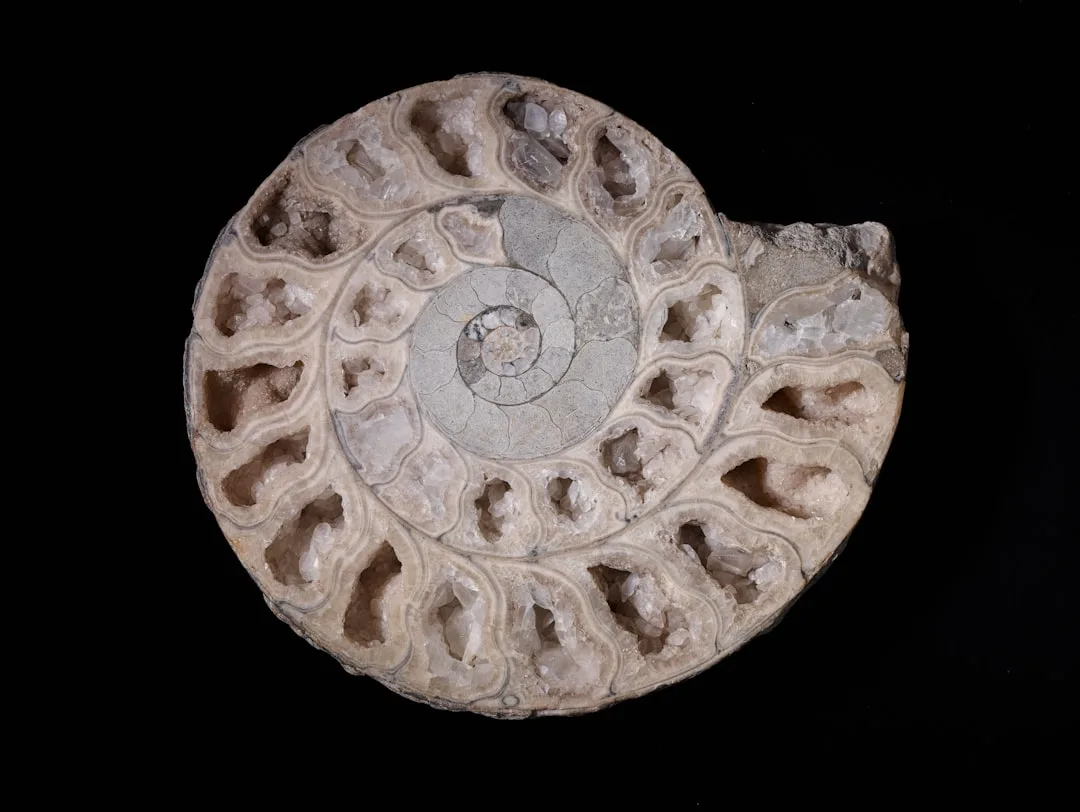
Ammonites are one of the most recognisable fossils on Earth. The spiral, ribbed shells turn up in rocks from almost every continent, across rocks spanning more than a third of a billion years of geological time. They are the reason many people first become interested in fossils. They are also one of the most successful groups of animals that ever lived - and one of the most decisively extinct.
Ammonites ran for roughly 340 million years, survived three of the five great mass extinctions, and then disappeared forever on the same day the non-avian dinosaurs did, when a ten-kilometre asteroid struck the shallow seas off the modern Yucatan Peninsula 66 million years ago.
This guide covers every major aspect of ammonite biology, ecology, paleontology, and cultural history: shell anatomy, suture patterns, size range, swimming and buoyancy, diet, reproduction, the long sequence of near-extinctions they survived, the single extinction they did not, and the myths and legends that grew up around their fossil shells in Europe, Egypt, and India.
It is a reference entry, not a summary - so expect specifics: millions of years, millimetres, metres, named species, and named localities.
Etymology and Classification
The name Ammonoidea - and the informal English word "ammonite" - descends from the Egyptian god Amun, known to the Greeks and Romans as Ammon. Amun was often depicted with the curling horns of a ram, and the ancient world's naturalists connected the spiral shape of the fossil shells to his headdress.
The Roman author Pliny the Elder, writing in his Natural History in the first century AD, called the fossils ammonis cornua, literally "horns of Ammon," and this term survived into modern scientific nomenclature when the subclass was formally established by paleontologists in the nineteenth century.
The group sits squarely inside the phylum Mollusca and the class Cephalopoda. Its formal placement:
- Kingdom: Animalia
- Phylum: Mollusca
- Class: Cephalopoda
- Subclass: Ammonoidea (extinct)
- Representative order: Ammonitida
- Representative family: Scaphitidae
- Representative genus: Hoploscaphites
- Representative species: Hoploscaphites nicolleti
Ammonoidea contains several major orders, including the Goniatitida of the Paleozoic, the Ceratitida that dominated the Triassic, and the Ammonitida that flowered across the Jurassic and Cretaceous until the end of the Mesozoic. Across those orders, paleontologists have named approximately 10,000 species and subspecies.
That number is unusually large even for a long-lived fossil group, and it reflects both the rapid evolutionary turnover of the group and the ease with which their shells preserve.
The species Hoploscaphites nicolleti is used here as a representative because it is one of the best-documented late ammonites. It lived in the Western Interior Seaway of North America during the latest Cretaceous, and its shell shape - a tight initial spiral followed by a straight or gently curving "hook" - is typical of the scaphitid ammonites that made up a significant fraction of late Cretaceous diversity.
Anatomy and the Missing Soft Body
Ammonites are known almost entirely from their shells. Soft-body fossils are rare, and in most cases only a handful of exceptional specimens from unusual preservation sites hint at what the living animal looked like. The shell itself, however, is one of the most thoroughly studied biological structures in the fossil record.
The external shell:
- Made of aragonite, a calcium carbonate mineral
- Usually planispiral - coiled in a single flat plane
- Outer surface often ribbed, tuberculate, or spined
- Diameter ranging from a few millimetres to approximately two metres
- Divided internally into chambers (camerae) by thin walls called septa
The internal chambers:
- Only the outermost chamber, called the body chamber, housed the soft body
- Earlier chambers, collectively the phragmocone, were filled with a mix of gas and fluid and used for buoyancy
- A thin living tissue thread called the siphuncle ran through a hole in each septum, linking all the chambers
The inferred soft body:
- A cephalopod body plan with head, arms, and siphon
- Probably eight to ten arms, based on comparison with coleoid relatives
- Large eyes, a parrot-like beak, and a radula (toothed tongue ribbon)
- No ink sac in most lineages, though a few late Cretaceous forms have ink preserved
The anatomical key feature of ammonites is the wavy line where each internal septum meets the outer shell. This line is called the suture. In the simplest early ammonoids, sutures were nearly straight or only gently curved - a pattern called goniatitic. In the Triassic, ceratitic sutures developed, with smooth outward-pointing lobes and notched inward-pointing saddles.
By the Jurassic and Cretaceous, fully ammonitic sutures had evolved: both lobes and saddles were intensely frilled, producing a pattern that resembles lichen, coral, or lightning. The complexity of the suture is one of the single most useful features for identifying ammonite species and for dating the rocks they are found in.
Shell Shape and Heteromorphs
The classic image of an ammonite - a flat, tightly coiled planispiral shell - is accurate for most of the group, most of the time. But ammonite shell shape was remarkably plastic, especially in the Late Cretaceous, and a surprising number of species produced shells that look nothing like the popular stereotype.
Major shell morphologies:
- Planispiral: flat coil in a single plane, the default and most common
- Involute: tightly coiled, with each whorl largely covering the previous one
- Evolute: loosely coiled, with all whorls visible from the side
- Oxyconic: thin, sharp-keeled shells shaped like a discus
- Serpenticonic: very loosely coiled, resembling a coiled snake
- Heteromorph: shells that depart from the single-plane spiral entirely
The heteromorph ammonites are among the strangest animals in the fossil record. The genus Nipponites from the Late Cretaceous of Japan produced a shell that looks like a chaotic tangle of knots. Diplomoceras grew a paper-clip-shaped shell up to two metres long end-to-end.
Turrilites coiled like a spiral staircase in three dimensions, producing a shell that looks more like a gastropod than a classic ammonite. Baculites uncoiled almost entirely and grew a nearly straight shell up to two metres long.
For decades, heteromorph ammonites were interpreted as signs of evolutionary decline - "decadent" or "aberrant" shells - and taken as evidence that ammonites were already fading before the K-Pg impact. Modern work has largely overturned this view. Heteromorph ammonites were abundant, widespread, and ecologically diverse.
Their shell shapes reflect specialisation for particular depths, currents, and swimming styles, not evolutionary decay. Several heteromorph lineages survived up to the final Cretaceous boundary and were destroyed abruptly at the K-Pg impact, not gradually in the millions of years before it.
Size Range
Ammonite size varied across a vast range. The smallest adult ammonites had shells only a few millimetres in diameter, comparable in size to a lentil or a small pea. Most species fell between three and thirty centimetres across - roughly the size of a coaster up to a dinner plate. Large species in the twenty- to fifty-centimetre range were common throughout the Jurassic and Cretaceous.
At the extreme end, the species Parapuzosia seppenradensis from the Late Cretaceous of Germany produced shells approaching two metres in diameter. The most famous specimen, found in Westphalia in 1895 and now on display at the LWL Museum of Natural History in Munster, measures 1.74 metres across, and slightly larger specimens have since been reported.
Body-chamber volume estimates suggest that living Parapuzosia individuals may have weighed well over 1,500 kilograms including shell, fluids, and soft body. No living cephalopod produces a shell of comparable size today. The nautilus, the largest living shelled cephalopod, rarely exceeds twenty-five centimetres.
| Size class | Shell diameter | Representative genera |
|---|---|---|
| Micro-ammonites | 1-10 mm | Psiloceras juveniles, many heteromorphs |
| Small | 1-5 cm | Hoploscaphites, Placenticeras juveniles |
| Medium | 5-30 cm | Dactylioceras, Perisphinctes |
| Large | 30-100 cm | Pachydiscus, Titanites |
| Giant | >100 cm | Parapuzosia seppenradensis |
Buoyancy, Movement, and Lifestyle
Ammonites swam using a combination of jet propulsion and precise buoyancy control. Water drawn into the body was expelled through a muscular siphon, driving the animal backward through the water. This is the same method used by modern squids, octopuses, cuttlefish, and nautiluses. Flexibility in the direction of the siphon gave them some steering control, and they could probably hover, glide forward slowly, and dart backward when startled.
The buoyancy system was provided by the chambered shell. As an ammonite grew, it periodically sealed off its old living space by secreting a new septum behind itself, then took up residence in a newly grown body chamber further along the spiral.
The abandoned chambers filled with fluid at first and then gradually replaced the fluid with gas through the siphuncle, a thin tissue cord that ran through a small hole in each septum. By adjusting the gas-to-fluid ratio in the chambers, the ammonite fine-tuned its buoyancy and could hover in the water column without constantly swimming.
Functional morphology studies of ammonite shells suggest that different shell shapes suited different lifestyles:
- Streamlined, smooth, involute shells were probably active swimmers capable of sustained horizontal motion.
- Ribbed, ornamented shells had more drag and were probably slow hoverers or drift feeders.
- Heteromorph shells often could not swim horizontally at all - they probably drifted vertically through the water column, feeding on plankton.
- Oxyconic, knife-edged shells were fast slicers through the water, presumably active mid-depth predators.
Depth preferences also varied. Isotope analysis of well-preserved Cretaceous shells has shown that some ammonites lived their whole lives in shallow water, while others lived at depths of several hundred metres. A few lineages appear to have spent different parts of their life cycle at different depths, a pattern that would spread risk across habitats.
Diet and Ecology
Direct evidence of ammonite diet is rare because the soft body almost never fossilises. A handful of exceptional specimens preserve gut contents or jaw apparatuses, and those, combined with comparisons to living cephalopods, point to a primarily carnivorous lifestyle.
Probable diet items:
- Small fish
- Crustaceans, especially small shrimp-like forms
- Zooplankton and small planktonic organisms
- Carrion from larger marine animals
- Possibly the floating eggs and larvae of other marine species
Several specimens preserve ammonite jaw apparatuses called aptychi - paired calcified plates that covered the mouth opening. Some species had sharp, shearing beaks well suited for capturing active prey. Others had broad, crushing aptychi that may have been used to sift plankton or grind shelled microfauna. Heteromorph ammonites in particular often show dentition consistent with slow plankton feeding rather than active predation.
Ammonites themselves were prey for larger marine animals. Cretaceous fossils show distinctive tooth marks on ammonite shells that match the jaws of mosasaurs - giant marine lizards that dominated the Late Cretaceous oceans - including multiple bite marks on single shells that record failed predation attempts. Fish, sharks, and larger cephalopods also certainly fed on ammonites across their long history.
Reproduction and Life Cycle
Ammonite reproduction is inferred from shell morphology and from extremely rare preserved egg cases. The innermost whorls of an ammonite shell preserve the tiny embryonic and juvenile shell, which in most species is only one to two millimetres across at the point of hatching. Adults probably produced large numbers of small eggs, as modern cephalopods do, and the hatchlings probably spent an early phase in the plankton before settling into an adult lifestyle.
A key insight from shell morphology is that many ammonite species show pronounced sexual dimorphism. In these species, one sex - usually presumed to be the female, based on comparison with modern cephalopods - was larger, with a modified body chamber. The smaller sex is called the microconch and the larger the macroconch. Early paleontologists often classified the two forms as separate species until matching found pairs in the same rock layers resolved the confusion.
Life expectancy varied across the group. Some small ammonites probably matured and died within a year. Larger species, on the basis of growth lines and isotope seasonality, probably lived for several years, and a handful of large Jurassic and Cretaceous species may have lived a decade or more.
Mass Extinctions Survived, and the One That Was Not
Ammonites are unusual among successful fossil groups because they lived through three of the Big Five mass extinctions before finally being destroyed by the fourth.
| Extinction event | Time (Ma) | Ammonite response |
|---|---|---|
| Late Devonian (Hangenberg) | ~358 | Severe losses; only a few clymeniid lineages survive |
| End-Permian | ~252 | Bottleneck through ceratitids; near-total wipeout |
| End-Triassic | ~201 | Bottleneck again; Jurassic radiation follows |
| End-Cretaceous (K-Pg) | 66 | Total extinction; subclass ends |
Each of the first three events killed the majority of ammonite species alive at the time. In every case, a small number of surviving lineages then radiated into the vacated ecological space and produced a new burst of diversity within a few million years.
The pattern suggests that ammonite biology was resilient to the kinds of environmental disruption that defined those earlier extinctions - ocean anoxia, acidification, volcanic winter, temperature swings - as long as enough breeding populations survived to seed the recovery.
The K-Pg event was different. The Chicxulub asteroid impact 66 million years ago struck a shallow sulphate-rich continental shelf, releasing sulphur aerosols that cooled the climate abruptly and drove ocean acidification that selectively attacked aragonitic shells like those of ammonites.
Combined with the collapse of oceanic primary productivity - plankton, the base of the marine food web, took tens of thousands of years to recover - the event broke the ammonites completely. Not a single ammonoid lineage is known to cross the K-Pg boundary into the Paleocene. After 340 million years of continuous fossil record, the group vanishes in a layer of iridium-rich clay.
The nautilus, their more distant cephalopod cousin, survived. The coleoids - octopus, squid, cuttlefish - survived. Ammonites did not.
Ammonites and Humans
Long before scientists recognised ammonites as fossilised animals, humans collected and interpreted them as something else entirely. The fossils are visually striking, often polished by weathering, and extremely widespread, so almost every culture that lived near ammonite-bearing rocks noticed them.
Ancient Egypt and the classical world. Ammonite shells were connected to the ram-horned god Amun. Worshippers and scholars collected the shells as sacred or medicinal objects. Pliny the Elder recorded the name ammonis cornua - horns of Ammon - in the first century AD, and the term was still in use in European scholarly writing eighteen centuries later when the formal scientific nomenclature was standardised.
Medieval England. In the town of Whitby on the Yorkshire coast, ammonites weather naturally out of the Jurassic cliffs. Medieval residents sold them as petrified snakes, sometimes carving snake heads onto the tip of the final whorl to make the resemblance more convincing. Local legend credited Saint Hilda, the seventh-century abbess of Whitby Abbey, with turning an infestation of snakes to stone.
The town's coat of arms still features three snake stones. The species Hildoceras bifrons, a common Whitby ammonite, is named after her.
India and Nepal. In Hindu tradition, ammonite fossils collected from the Gandaki River in the Nepalese Himalayas are known as shaligrams and are regarded as a physical form of the god Vishnu.
The shaligram is one of the very few "self-manifested" sacred objects in Hindu worship - that is, it is considered sacred in its natural state without requiring consecration - and genuine specimens are used in temple worship and domestic shrines across the subcontinent. The river has produced ammonite shaligrams for thousands of years, and collection and trade are now regulated.
Canada. The Bearpaw Formation of southern Alberta preserves Late Cretaceous ammonites, primarily Placenticeras meeki and Placenticeras intercalare, whose nacre has been converted by pressure and trace element chemistry into a gem-quality iridescent material called ammolite. The World Jewellery Confederation recognised ammolite as an official gemstone in 1981.
Alberta declared it the official provincial gemstone in 2004. Ammolite is one of only three biogenic gemstones formally recognised, alongside pearl and amber. The material is mined commercially and is used primarily in jewellery.
The Fossil Record and Scientific Importance
Ammonites are one of the most useful fossil groups in geology because they evolved quickly, lived globally, and preserved well. A single Jurassic marine rock layer, anywhere in the world, can usually be assigned to a precise half-million-year interval based on the ammonite species found in it. This practice, called biostratigraphy, underpins much of modern geological mapping. In a real sense, ammonites are the clock of the Mesozoic era.
Why ammonites are ideal index fossils:
- Rapid evolutionary turnover - new species every few hundred thousand years
- Global distribution - floating and swimming lineages reached every ocean
- Robust shell preservation - aragonite survives well in many rock types
- Distinctive ornament and suture patterns - species are identifiable on sight
- Abundant individuals - statistically reliable identifications in small samples
They are also prized by amateur and commercial collectors. Ammonite fossils are among the most commonly available prehistoric fossils on the commercial market, sourced primarily from Morocco, Madagascar, England, Germany, and the United States. Polished specimens are popular display objects and are often cut in half to reveal the internal chambers and the septal pattern.
Much of the public awareness of the Mesozoic era outside palaeontology comes from these polished ammonites in museum shops and mineral fairs.
Related Reading
- Dunkleosteus: Armoured Apex Predator of the Devonian Seas
- Mass Extinctions: The Five Times Earth Nearly Died
References
Relevant peer-reviewed and institutional sources consulted for this entry include the Paleobiology Database occurrences for Ammonoidea, the Treatise on Invertebrate Paleontology volumes on ammonoid cephalopods, published research in Paleobiology, Geobios, Cretaceous Research, and Nature, and the official gemmological recognition of ammolite by the World Jewellery Confederation (CIBJO).
Specific size figures for Parapuzosia seppenradensis follow measurements published by the LWL Museum of Natural History in Munster, Germany. Extinction boundary calibration follows the International Commission on Stratigraphy geological time scale.
Frequently Asked Questions
What exactly were ammonites?
Ammonites were marine cephalopod molluscs belonging to the extinct subclass Ammonoidea. They are cousins of today’s octopuses, squids, cuttlefish, and the nautilus - all members of the class Cephalopoda. Unlike modern octopuses and squids, ammonites lived inside external spiral shells divided into internal gas-filled chambers, with only the outermost chamber occupied by the soft body.
Around 10,000 species have been described across the 340 million year run of the group. Hoploscaphites nicolleti, a Late Cretaceous ammonite from the Western Interior Seaway of North America, is one representative used to illustrate the group.
When did ammonites live and when did they go extinct?
Ammonites first appear in the fossil record during the Devonian period, roughly 409 million years ago, evolving from earlier straight-shelled cephalopods called bactritids. The group survived the Late Devonian mass extinction, the end-Permian mass extinction (the worst in Earth’s history), and the end-Triassic mass extinction, each time bottlenecking through a few surviving lineages and then radiating again.
Their final extinction came at the end of the Cretaceous period 66 million years ago, during the K-Pg mass extinction triggered by the Chicxulub asteroid impact off the modern Yucatan coast. The same event wiped out the non-avian dinosaurs and roughly 75 per cent of species on Earth.
How big did ammonites get?
Ammonite size varied across a huge range. The smallest adult ammonites had shells only a few millimetres across - roughly the size of a lentil. Most species fell between three and thirty centimetres. The largest known ammonite, Parapuzosia seppenradensis from the Late Cretaceous of Germany, had a shell approaching two metres in diameter, with the body chamber alone large enough to hold a person.
Large Parapuzosia specimens are estimated to have weighed over 1,500 kg in life when fully shelled and fluid-filled. No living cephalopod produces a shell on that scale today.
What are the closest living relatives of ammonites?
Most popular accounts compare ammonites to the chambered nautilus because the shell shape is superficially similar. That comparison is misleading. Molecular and anatomical studies indicate ammonites are much more closely related to coleoid cephalopods - octopuses, squids, and cuttlefish - than to nautiluses.
All three groups shared a common cephalopod ancestor, but the ammonite and coleoid lineages split off from the nautiloid line relatively early, and ammonites then developed their own spiral shell convergently. So a living octopus is a closer cousin to an ammonite than a living nautilus is, even though the nautilus looks much more like an ammonite from the outside.
Why are suture patterns so important?
The walls that divide the internal chambers of an ammonite shell are called septa. Each septum meets the outer shell wall along a line called a suture. In simple early ammonoids these suture lines were nearly straight. Over geological time they evolved into extraordinarily complex wavy and frilled patterns, sometimes resembling foliage or lightning.
Because suture complexity changed in predictable ways through time and differed between lineages, paleontologists use the exact shape of the suture line as a diagnostic fingerprint for species identification. Three broad grades - goniatitic, ceratitic, and ammonitic - also help narrow down which geological period an unknown specimen came from.
What did ammonites eat and how did they move?
Direct evidence of ammonite diet is limited because their soft bodies almost never preserve, but a small number of exceptional fossils with preserved stomach contents, together with comparisons to modern cephalopods, suggest they fed on small fish, crustaceans, zooplankton, and carrion. They probably captured prey with tentacles and a parrot-like beak, the same basic toolkit used by modern octopuses and squids.
Movement was by jet propulsion - water expelled through a funnel drove the animal backward - combined with buoyancy control. By adjusting the mix of gas and fluid in the chambered shell through a thin tissue called the siphuncle, ammonites could hover in the water column without constantly swimming, much as modern nautiluses and cuttlefish do today.
Why do ammonites have mythological and religious significance?
The coiled shape of an ammonite shell strongly resembles a ram’s horn, and ancient cultures routinely connected that shape to ram-horned deities. The modern name Ammonoidea descends from the Egyptian god Amun (or Ammon), who was often depicted with the spiral horns of a ram. Pliny the Elder referred to the fossils as ammonis cornua, the horns of Ammon, in the first century AD.
In medieval England the fossils were sold as petrified snakes - ‘snake stones’ - particularly around the town of Whitby in Yorkshire, where local tradition credited Saint Hilda with turning an infestation of snakes to stone. In parts of Nepal and India, ammonite fossils from the Gandaki River are venerated as shaligrams, sacred objects representing the Hindu god Vishnu and used in temple and household worship.
Is ammolite really made of ammonite shell?
Yes. Ammolite is a gem-quality iridescent material produced from the fossilised nacre layer of certain Late Cretaceous ammonites, primarily Placenticeras meeki and Placenticeras intercalare, found in the Bearpaw Formation of southern Alberta, Canada. Geological pressure, heat, and trace-element chemistry transformed the original aragonite nacre into a thin but highly iridescent sheet that flashes red, green, blue, and gold.
The World Jewellery Confederation (CIBJO) recognised ammolite as an official gemstone in 1981, and Alberta declared it the province’s official gemstone in 2004. Only two other gem materials - pearl and amber - are formally classified as biogenic gemstones alongside it.