
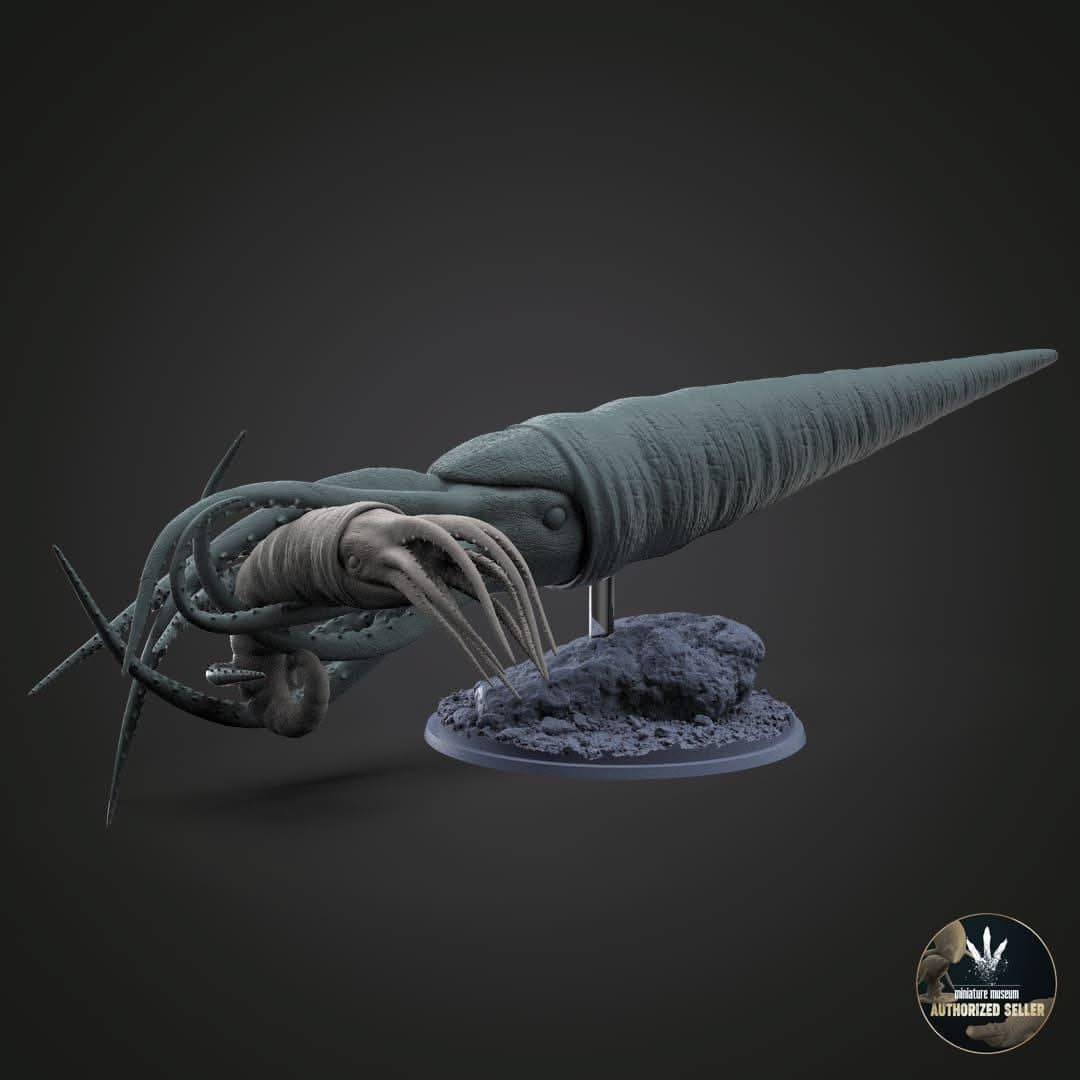
Cameroceras is the giant straight-shelled cephalopod that ruled the warm shallow seas of the Middle and Late Ordovician.
Half a billion years ago, before fish were common, before sharks existed, before any vertebrate had crawled onto land, the top predator on a modern continental shelf was a cone-shaped mollusc as long as a small boat, floating vertically in the water column and grabbing trilobites with its tentacles. That predator was Cameroceras, and it is one of the strangest and most dramatic animals in the entire fossil record.
This guide covers every major aspect of Cameroceras biology, ecology, paleontology, and cultural history: shell anatomy and the orthoconic body plan, size estimates and the debate over whether the animal really reached nine metres, diet and hunting hypotheses, life position in the water column, the end-Ordovician mass extinction that ended the wider lineage, and the Walking with Monsters appearance that made the genus briefly famous outside paleontology.
It is a reference entry, not a summary - so expect specifics: millions of years, metres, named species, named localities, and the places where scientists genuinely disagree.
Etymology and Classification
The genus name Cameroceras comes from the Greek words kamara, meaning "chamber" or "vault," and keras, meaning "horn." Literally translated it means "chambered horn," a name that captures both the internally chambered shell and the horn-like conical shape. The same keras root turns up in words such as rhinoceros ("nose-horn"), triceratops ("three-horned face"), and keratin (the protein in animal horns and nails).
The genus was established in 1842 by the American paleontologist James Hall, one of the founding figures of North American stratigraphic paleontology, on the basis of fossils from the Trenton Limestone of New York state. The type species, Cameroceras trentonense, takes its name directly from the Trenton rocks in which it was first described.
Cameroceras sits squarely inside the phylum Mollusca and the class Cephalopoda, the same large group that contains modern octopuses, squids, cuttlefish, and the chambered nautilus. Its formal placement within that class is:
- Kingdom: Animalia
- Phylum: Mollusca
- Class: Cephalopoda
- Subclass: Endoceratoidea (extinct)
- Order: Endocerida (extinct)
- Family: Endoceratidae
- Genus: Cameroceras
- Species: C. trentonense (type species)
The order Endocerida is one of several major lineages of early nautiloid cephalopods that flourished during the Cambrian and Ordovician and then faded or vanished after the end-Ordovician mass extinction. Endoceratidae is the most famous family within that order because it contains the true giants - Cameroceras, Endoceras, and their close relatives, all of which sported long straight shells and filled the apex-predator role in Ordovician shelf ecosystems.
Taxonomic work on Cameroceras has been messy. Through the nineteenth and twentieth centuries, many long-shelled Ordovician nautiloids from around the world were lumped into Cameroceras on the basis of shell shape alone. Later revisions have moved a number of those specimens into other genera such as Endoceras, Vaginoceras, and Nanno.
As a result, some of the most famous "Cameroceras" figures from older textbooks - including nine-metre length estimates - may actually refer to related genera, and modern paleontologists treat upper size claims with caution.
Anatomy and the Orthoconic Body Plan
Cameroceras is known almost entirely from its shell. Soft-tissue preservation is essentially absent for the genus. What survives in the fossil record is the external shell, the internal chamber system, and a set of hard calcium-carbonate deposits that formed inside the rear of the shell during life. Every reconstruction of the living animal draws on those hard parts plus comparisons with modern Nautilus and with better-preserved younger orthocones.
The external shell:
- Long, straight, gently tapering cone (an orthocone)
- Made of aragonite, a calcium carbonate mineral
- Length in well-preserved adults of three to six metres, with debated upper estimates up to nine metres
- Maximum diameter at the mouth roughly 30-45 centimetres
- Outer surface relatively smooth, with fine growth lines rather than the strong ribs of later ammonites
The internal chamber system:
- Only the outermost chamber, the body chamber, housed the soft body
- Behind the body chamber a stack of gas-and-fluid-filled chambers called the phragmocone provided buoyancy
- Thin calcium-carbonate walls called septa divided the phragmocone into camerae
- Each septum was pierced by a single hole through which a living tissue thread, the siphuncle, ran from the body chamber all the way to the apex
The endocones:
- A series of nested calcium-carbonate cones laid down inside the siphuncle toward the apex of the shell
- Fill most of the apical chambers with solid mineral rather than gas
- Act as a counterweight balancing the buoyant forward chambers
- Are the feature that gives the whole order Endocerida its name
The inferred soft body:
- A cephalopod body plan with head, arms, and funnel
- Likely many tentacles, based on comparison with modern Nautilus which has around ninety
- Large eyes, probably pinhole-type rather than lensed (again by comparison with Nautilus)
- A parrot-like beak capable of crushing trilobite exoskeletons
- A funnel used for jet propulsion by expelling water
The endocones are the single most distinctive internal feature of Cameroceras and its relatives. In life they added substantial weight to the rear of the shell and shifted the animal's centre of mass toward the apex. Without this counterweight the light gas-filled chambers would have made the shell float apex-up; with it, the shell could be held horizontally or vertically in the water column in a controlled way.
The endocones are also the reason Cameroceras fossils survive at all in many rocks, because they are far more robust than the thin shell wall and the fragile septa.
Size and the Nine-Metre Question
Size is where Cameroceras generates the most popular excitement and the most scientific frustration. The literature contains estimates ranging from three metres to more than eleven metres for the genus, and reconciling those figures is genuinely difficult.
The conservative figure, based on well-documented specimens where most of the cone is preserved, puts an adult Cameroceras trentonense somewhere between three and six metres long. Shells in that range have been described from Ordovician rocks in New York, Canada, the Baltic region, and elsewhere across what was then the tropical belt of the planet.
The largest estimates come from partial cone fragments that have been linearly extrapolated to full length. A classic example is a short apical section preserved in a museum collection that, if scaled up assuming a constant taper, would imply a total length of eight or nine metres. Modern paleontologists tend to be sceptical of such extrapolations for three reasons.
First, the taper of a real cone changes gradually along its length, so linear extrapolation over-estimates total length. Second, many of the largest fragments historically assigned to Cameroceras have been reassigned to closely related genera such as Endoceras. Third, the size of the apex alone is a weak predictor of total length because the apex is narrow in all large orthocones.
What can be said with confidence is that Cameroceras was the largest cephalopod of its era and one of the largest animals alive anywhere in the Ordovician ocean. At the upper end of the defensible size range - five to six metres - it would have been longer than a modern great white shark and heavier, in terms of shell volume, than any living cephalopod.
If the historical nine-metre figures hold up even for a close relative, the endoceratid family as a whole contains serious candidates for the largest mollusc ever to have lived.
Life Position and Locomotion
How did an animal carrying a six-metre conical shell actually move? This is one of the most debated questions in early cephalopod paleontology, and the answer affects everything from Cameroceras's likely diet to its behaviour to the kind of seafloor it lived near.
The two main life-position hypotheses are:
- Vertical, head-down orientation. The heavy endocones at the apex act as ballast. The gas-filled forward chambers act as buoyancy. Combined, the shell hangs vertically with the living animal's head pointing down and the apex pointing up. The animal feeds on prey below it using its tentacles, and hovers with minimal energy expenditure like a gas-filled float on a string.
- Horizontal, head-forward orientation. The endocones balance the buoyancy of the forward chambers closely enough that the shell lies horizontally, head forward, and moves through the water by jet propulsion from the funnel. This is the orientation of modern orthoconic nautiloids where soft-tissue preservation is known, and it is also the orientation often reconstructed for smaller Silurian orthocones.
Both hypotheses have problems. A vertical six-metre shell is inherently unstable in a current; a horizontal shell that long is hard to manoeuvre with a cephalopod funnel. The truth may be that Cameroceras adopted different orientations at different times - vertical when hovering and feeding in calm water, horizontal when jetting between hunting grounds - and that individual species within the genus may have had slightly different weight distributions and behaviours.
What is more widely agreed is that Cameroceras was not a fast swimmer. The long shell had too much drag, and the funnel's thrust was limited relative to the animal's mass. Like modern Nautilus, Cameroceras probably relied on stealth, buoyancy control, and sit-and-wait hunting rather than active pursuit.
Diet, Trophic Role, and Prey
Cameroceras lived in a world that looked nothing like the modern ocean. There were no large predatory fish. The jawed fish that would eventually come to dominate marine ecosystems had barely appeared. Sharks did not yet exist. Marine reptiles would not arrive for nearly 200 million years. The largest actively hunting animals in the Ordovician seas were cephalopods, and among those cephalopods the biggest were the endoceratid nautiloids - Cameroceras chief among them.
Likely prey items:
- Trilobites - crushed with the beak
- Eurypterids and other marine arthropods
- Jawless fish, including early agnathans
- Smaller cephalopods, including juvenile endoceratids
- Ostracoderms and other small armoured swimmers
- Possibly large worms and soft-bodied prey captured by tentacles
Likely hunting methods:
- Ambush from vertical or tilted posture, grabbing prey that swam into reach
- Opportunistic scavenging on dead or dying animals that drifted past
- Slow hovering pursuit using funnel jet propulsion
- Cannibalism of juveniles, common in modern cephalopods and plausible here
The trophic role of Cameroceras is often compared to that of a modern orca or great white shark, in the specific sense of "largest, dominant, top-down predator in the local ecosystem." Unlike those modern analogues, however, Cameroceras was slow, invertebrate, and anchored to a long rigid shell. The comparison is ecological, not functional.
The Ordovician World and the End-Ordovician Extinction
The Ordovician period ran from about 485 million to 443 million years ago. It was a warm, humid time characterised by extensive shallow seas covering most of today's continents. Laurentia - the core of modern North America - sat near the equator. Baltica - proto-Europe - lay just south of the equator. The great southern continent Gondwana stretched from the tropics to the South Pole.
Between and across these continents, warm shelf seas teemed with trilobites, brachiopods, bryozoans, coral-like colonial animals, crinoids, and the full range of early cephalopods.
Cameroceras lived in these shelf seas. Its fossils are most abundant in the Trenton Group of New York, the Black River Group and equivalent units in Canada, and various Ordovician limestones of Scandinavia and Baltic Europe. This is the geography of a warm-water apex predator spread across the low-latitude continental shelves of its time.
The Ordovician ended with a two-pulse mass extinction event, now recognised as the first of the "Big Five" mass extinctions. The causes were primarily climatic:
- A rapid glaciation over Gondwana locked water away in continental ice sheets
- Global sea level dropped sharply, draining the shallow epicontinental seas where most Ordovician life lived
- Ocean chemistry shifted, producing widespread anoxia in the remaining shelf waters
- A second pulse of extinction followed the glacial maximum as conditions rebounded
Cameroceras as a genus survived the main extinction pulses, but its relatives in the family Endoceratidae and the wider order Endocerida did not recover meaningfully. By the early Silurian, giant orthoconic nautiloids were no longer a dominant feature of marine ecosystems, and the specific endoceratid body plan - extreme length, massive endocones, apex-predator lifestyle - vanished from the fossil record.
The ecological niche Cameroceras had filled for tens of millions of years was not immediately refilled. Eurypterids, and later jawed fish, would eventually expand into top-predator roles, but the gigantic straight-shelled cephalopod was a one-time experiment.
Fossils, Localities, and Preservation
Preserved Cameroceras shells are exceedingly rare in complete form. The long thin shell is structurally fragile once the soft body dies and the chambers fill with seawater. Storm waves, burrowing scavengers, compaction during burial, and later tectonic deformation typically reduce the shell to sections, fragments, or internal moulds.
Most museum Cameroceras specimens are sections a metre or less long, and assembling an estimate of total length usually requires matching multiple specimens from the same locality.
Classic Cameroceras fossil localities:
- Trenton Group, New York state and Ontario - the type locality and still one of the best sources
- Black River Group limestones of eastern North America
- Lower Palaeozoic limestones of Estonia, Sweden, and the wider Baltic shield
- Parts of the Siberian Ordovician, historically
- Scattered Ordovician rocks in China and central Asia
The endocones are often the best-preserved part of any Cameroceras specimen. Because they are solid calcium-carbonate cones rather than hollow chambers, they resist compaction and scavenging. In some quarries the endocones can be found without the surrounding shell at all - elongate mineral cones on a bedding plane, easily mistaken at first glance for broken belemnites or coral fragments by non-specialists.
Cultural Footprint: Walking with Monsters and Beyond
Outside paleontology, Cameroceras was almost unknown to the general public until the BBC docudrama Walking with Monsters aired in 2005. The first episode of that series featured a Cameroceras depicted as a nine-metre monster patrolling the Ordovician shallows, ambushing a large marine arthropod. The sequence caught the popular imagination and, for many viewers, was their first exposure to the idea that the oceans of the deep past were ruled by giant cephalopods rather than fish or reptiles.
Specialists have pushed back on several details of the Walking with Monsters reconstruction. The nine-metre size estimate sits at the upper limit of what can be defended from fragmentary evidence. The identification of the featured animal as Cameroceras rather than a closely related endoceratid such as Endoceras is contested.
The agile, aggressive hunting behaviour depicted is difficult to reconcile with the drag and mass of a real orthoconic shell. Despite these objections, the cultural impact of the programme is real: when most non-specialists today hear "giant prehistoric nautiloid," the image that comes to mind is essentially the Walking with Monsters Cameroceras.
The genus has since made guest appearances in paleoart, educational books, and the occasional video game. It sits in public imagination alongside other "forgotten giants" of the deep past - Dunkleosteus, Arthropleura, Helicoprion - animals that are not as famous as dinosaurs but that dominate specific moments of evolutionary history.
Related Reading
- Ammonite: Spiral-Shelled Cousins of Cameroceras
- Dunkleosteus: The Armoured Apex Predator of the Devonian
- Mass Extinctions: The Five Times Earth Nearly Died
References
Relevant peer-reviewed and museum sources consulted for this entry include the Treatise on Invertebrate Paleontology (Part K: Mollusca 3, Cephalopoda, General Features, Endoceratoidea, Actinoceratoidea, Nautiloidea, Bactritoidea) revisions, published research in the Journal of Paleontology, Lethaia, and Palaeontology, and monographs on North American and Baltic Ordovician nautiloid faunas.
The original species description of Cameroceras trentonense was published by James Hall in the 1840s as part of the New York State Geological Survey's paleontology volumes. Size estimates and life-position hypotheses reflect the consensus of more recent reviews of endoceratid paleobiology.
Frequently Asked Questions
What exactly was Cameroceras?
Cameroceras was a genus of giant straight-shelled cephalopod molluscs belonging to the extinct order Endocerida, within the subclass Endoceratoidea. It lived in the warm shallow seas of the Middle and Late Ordovician, roughly 470 to 443 million years ago. The type species, Cameroceras trentonense, was described from rocks in New York state in the nineteenth century.
Cameroceras shared the class Cephalopoda with modern octopuses, squids, cuttlefish, and the chambered nautilus, but its specific order - Endocerida - is entirely extinct. Its distinguishing feature was a very long, straight, conical external shell (an orthocone) with internal chambers used for buoyancy and with the soft body occupying only the outermost chamber.
How big did Cameroceras actually get?
Size estimates for Cameroceras have been debated for more than a century. The best-preserved complete shell fragments suggest living animals with shells between three and six metres long, making it comfortably the largest cephalopod of the Ordovician. Some nineteenth-century and early twentieth-century estimates, based on incomplete cones extrapolated to full length, pushed the figure as high as nine metres.
Modern specialists treat those higher numbers cautiously because the longest shell fragments may have belonged to related genera, and because orthoconic shells tend to be over-estimated when only the basal portions are preserved. Even at the conservative end, a six-metre Cameroceras would have been an enormous animal - longer than a great white shark and roughly the length of a small sailing boat.
When did Cameroceras live and what happened to it?
Cameroceras lived during the Middle and Late Ordovician period, between approximately 470 and 443 million years ago. The Ordovician ended with a two-pulse mass extinction event - now counted as the first of the Big Five mass extinctions - driven by a rapid glaciation, sea-level fall, and associated anoxic conditions in shallow seas. Cameroceras as a genus appears to have survived the main extinction pulses but faded in the extinction’s aftermath.
Its close relatives in the family Endoceratidae, and eventually the entire order Endocerida, did not recover. The giant straight-shelled nautiloid ecology collapsed, and by the Silurian the torch had passed to smaller orthocones and to the coiled nautiloids that would eventually give rise to modern Nautilus.
Was Cameroceras related to the modern nautilus?
Only distantly. Cameroceras and the modern chambered nautilus both belong to the class Cephalopoda and share a broadly similar body plan - an external chambered shell with a soft cephalopod body in the outer chamber and a siphuncle running through the septa. They are, however, in different orders.
Cameroceras sits in the extinct order Endocerida, while modern Nautilus belongs to the order Nautilida, which arose later and uses a coiled shell rather than a straight cone. So the living nautilus is a cephalopod cousin of Cameroceras, not a direct descendant, and the two lineages diverged early in cephalopod history. Octopuses and squids are more distant relatives, sitting in the subclass Coleoidea.
What did Cameroceras eat and how did it hunt?
Cameroceras was almost certainly an apex predator in the Ordovician seas it inhabited. Its diet is inferred from three lines of evidence: its beak and jaw morphology, the ecology of modern nautiloids, and the absence of comparable large predators in Ordovician food webs. Likely prey included trilobites, eurypterids and other arthropods, jawless fish, and smaller cephalopods - possibly including juveniles of its own kind. Hunting strategy is debated.
If the shell was held vertically with the head downward, as several paleontologists now suspect, Cameroceras would have hung in the water column like a giant gas-filled spear, using its tentacles to seize prey swimming or crawling below. The parrot-like beak, comparable to that of modern cephalopods, would have crushed trilobite exoskeletons and cracked small shelled prey.
Why is Cameroceras so rarely preserved as a complete fossil?
Complete shells of Cameroceras are extraordinarily rare in the fossil record for simple mechanical reasons. A long straight conical shell up to six metres long is structurally weak once the soft body dies and the shell fills with water. Storm waves, currents, and scavengers typically broke the dead shells into sections before burial.
Most Cameroceras fossils are partial cones, isolated chambers, or the massive calcium-carbonate deposits laid down inside the rear of the shell, which are often the only part sturdy enough to survive intact. The problem is worse in deep-burial rocks where compaction crushes any remaining hollow chambers.
As a result, paleontologists usually reconstruct the full animal from multiple partial specimens rather than from single complete skeletons, and total-length estimates rely on scaling up preserved fragments.
Did Cameroceras really stand vertically in the water?
The vertical-orientation hypothesis is one of several serious proposals for how Cameroceras held itself in the water column. The idea comes from the observation that the rear portion of the shell carries heavy calcium-carbonate deposits - called endocones - while the forward chambers held buoyant gas. A heavy tail plus a light head would naturally orient the shell vertically with the head downward, much like a weighted float.
In this configuration the animal would have been stable and energy-efficient but not especially manoeuvrable. Other researchers argue for a horizontal or tilted orientation, pointing out that the large shell would have been unstable vertically in currents and that modern orthoconic nautiloids known from soft-tissue preservation appear to have been horizontal.
The debate is ongoing, and the true answer may have varied between species and life stages within the genus.
Why is Cameroceras famous in popular culture?
Cameroceras owes most of its modern fame to the 2005 BBC docudrama Walking with Monsters, which depicted a giant orthoconic nautiloid - identified in the programme as Cameroceras - hunting other Ordovician sea life as the terror of its shallow tropical sea. The sequence introduced a mass audience to the idea that the oceans half a billion years ago were ruled by giant cephalopods, not fish or reptiles.
Specialists have since pushed back on several details, including the specific size shown, the identification of the animal as Cameroceras rather than a close relative such as Endoceras, and the implied hunting behaviour. Even so, the cultural impact of the programme means that when most non-specialists hear ‘giant prehistoric nautiloid,’ the image that comes to mind is essentially Cameroceras.