
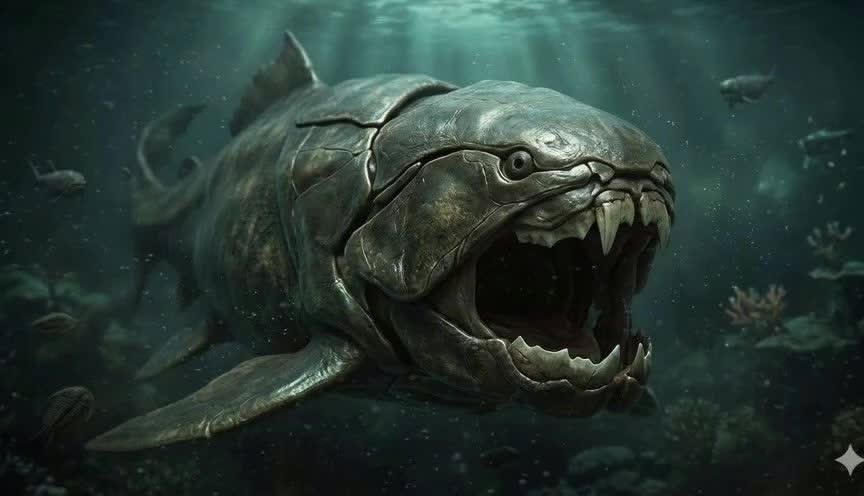
Dunkleosteus was a giant armoured fish that patrolled the shallow tropical seas of the Late Devonian period, roughly 382 to 358 million years ago. Despite a superficial resemblance to modern sharks, it was not a shark, not a bony fish, and not anything alive today.
Dunkleosteus belonged to an entire vertebrate class called Placodermi - a group that dominated Devonian oceans for over fifty million years and then vanished completely during the Late Devonian mass extinction, leaving no living descendants. It is one of the only vertebrate classes in the fossil record to go entirely extinct.
This guide covers every aspect of Dunkleosteus biology, ecology, and fossil history: its armoured head, its missing body, its toothless but terrifyingly effective jaws, its place in the Devonian food web, the mass extinction that killed it, and the ongoing scientific argument about how big it actually was. It is a reference entry - so expect specifics: millimetres of armour, newtons of bite force, millions of years of geological time, and named fossil localities.
Etymology and Classification
The genus name Dunkleosteus was coined in 1956 by American paleontologist Jean-Pierre Lehman in honour of David Dunkle, then curator of vertebrate paleontology at the Cleveland Museum of Natural History. The suffix -osteus is Greek for "bone," a reference to the massive bony plates of the head and thorax.
Before 1956 the animal was lumped into the older genus Dinichthys - literally "terrible fish" - a name that had accumulated nearly every large arthrodire species found in Ohio since the 1870s. Modern work split that wastebasket taxon into several distinct genera, of which Dunkleosteus became the most famous.
The type species is Dunkleosteus terrelli, named for Jay Terrell, the Ohio farmer and amateur geologist who recovered the first skull from the Cleveland Shale in 1867. About ten species are currently assigned to the genus, though several of those assignments are contested and a revision of the genus is likely in coming years. Placement in the broader tree of life is as follows:
- Kingdom: Animalia
- Phylum: Chordata
- Class: Placodermi (extinct)
- Order: Arthrodira (extinct)
- Family: Dunkleosteidae (extinct)
- Genus: Dunkleosteus
- Species: D. terrelli (type), plus D. belgicus, D. denisoni, D. marsaisi, and others
Placoderms are the only entire vertebrate class in the fossil record known to go completely extinct without leaving living descendants. Every other major vertebrate class alive during the Devonian - cartilaginous fish, bony fish, lobe-finned fish, tetrapods - still has living members today. Placoderms do not.
This makes Dunkleosteus and its relatives scientifically interesting far out of proportion to their geological lifespan: they are a complete evolutionary experiment, run to failure, preserved in stone.
Anatomy and the Missing Body
Dunkleosteus is one of the most visually iconic prehistoric animals precisely because its anatomy is so strange and so incomplete. The animal was armoured only across the head and the front portion of the body. Everything behind the thoracic shield was cartilaginous and therefore does not fossilise in normal conditions.
The head shield:
- A single dome-like carapace of bony plates covering the skull roof
- Small, forward-facing eyes set into reinforced orbits
- Large openings for water flow past the gills
- Articulation points that allowed the entire head shield to pivot upward
The thoracic shield:
- A saddle-like arrangement of plates covering the chest and shoulders
- Fused to the head via a pair of balanced ball-and-socket neck joints
- Openings through which the pectoral fins emerged
- The lower plates continued the armour across the belly
The posterior body (inferred):
- Probably shark-like and fusiform, narrowing to a heterocercal tail
- Paired pelvic fins
- Mostly cartilaginous internal skeleton
- No confirmed dorsal fin despite frequent reconstructions showing one
The key anatomical feature is the neck joint between head shield and thoracic shield. Unlike any animal alive today, arthrodire placoderms rotated the entire upper head shield upward at this joint during a bite. Effectively the mouth opened from both ends at once - lower jaw dropping, upper head rotating back - producing a gape out of all proportion to the skull's resting shape and generating strong inward suction.
The mechanism is called cranial kinesis, and while many modern fish have forms of it, the arthrodire version is its own evolutionary invention, unmatched in modern vertebrates.
The Size Debate
For most of the 20th century, the size of Dunkleosteus was estimated by extrapolating from the armoured head outward, using proportions inferred from sharks or from smaller, better-preserved placoderms. Those reconstructions produced figures of six to ten metres in length and body masses of several tonnes. Many museum dioramas and popular reconstructions still use the ten-metre figure.
In 2023, Russell Engelman published a re-analysis in Diversity. Using two independent methods - allometric scaling of eye-socket diameter in living fishes and measurements of preserved pectoral-fin proportions - Engelman argued that adult Dunkleosteus terrelli was probably 3.4 to 4.1 metres long. That is roughly the length of a small great white shark.
The reasoning is that large Devonian arthrodires appear to have had relatively short, stocky bodies rather than the long, tapering tails assumed by older reconstructions. The head was genuinely enormous - up to a metre long on the biggest specimens - but it was a larger fraction of the whole animal than was previously thought.
The 2023 paper has not settled the debate. Some paleontologists argue the allometric method overcorrects and that Dunkleosteus was closer to five or six metres. Others argue Engelman is broadly right. Either way, three conclusions are not in dispute:
- Dunkleosteus was one of the largest known vertebrates of the Devonian, regardless of which size model is correct.
- The head and jaws were massive in absolute terms, making it a formidable predator.
- Older popular culture claims of a "10-metre, 4-tonne" Dunkleosteus are probably too large.
| Estimate source | Length | Approximate mass |
|---|---|---|
| Traditional (20th century) | 6-10 m | 1,000-4,000 kg |
| Carr (1995) | ~6 m | ~1,000 kg |
| Engelman (2023) | 3.4-4.1 m | ~950-1,500 kg |
Jaws, Bite Force, and Speed
The most remarkable feature of Dunkleosteus biology is its feeding apparatus. The jaws lacked true teeth entirely. Instead, the upper and lower jaw bones carried long, blade-like projections of bone covered in dentine - the same material that forms the bulk of a mammalian tooth. These gnathal plates sheared past each other like a pair of scissors when the jaws closed.
Because the plates were made of continuously-growing dentine, they were self-sharpening. Every bite wore the opposing edges into sharper profiles. The plates grew from beneath as they wore above, so in theory the animal never lost its cutting edge. The trade-off was that Dunkleosteus could not shed and replace teeth the way sharks do: if a plate chipped or broke, the animal had to grow the damage out.
The 2006 biomechanical study:
In 2006, Philip Anderson and Mark Westneat published a mechanical model of the Dunkleosteus terrelli skull in Biology Letters. Treating the skull, lower jaw, and suspensorium as a four-bar linkage, they calculated:
- Bite force at the rear cutting edge: ~5,300 N
- Bite force at the tip of the anterior fangs: ~7,400 N
- Jaw opening time: ~20 milliseconds
- Jaw closing time: ~50-60 milliseconds
In terms of raw force, 7,400 newtons is comparable to a large modern alligator or a Tyrannosaurus rex tooth tip. In terms of pressure per unit area at the fang tip, Dunkleosteus is among the highest-pressure biters ever calculated.
And 20 milliseconds to open the jaws is the fastest known vertebrate bite on record - faster than a human can blink, faster than any modern fish's suction feeding, and fast enough to generate significant inrushing water flow that pulled prey into the mouth before it could react.
This combination - shearing bone blades plus crushing force plus explosive opening speed - is unusual in vertebrate evolution. Most large predators specialise in one or two of those traits. Dunkleosteus had all three.
Diet, Hunting, and Cannibalism
Dunkleosteus was the apex predator of its ecosystem. There is no credible candidate for an animal that regularly preyed on adult Dunkleosteus - except other Dunkleosteus. Its diet included:
- Sharks and shark-like cartilaginous fish (Cladoselache, common in the Cleveland Shale)
- Other placoderms, including smaller arthrodires
- Juvenile and sub-adult Dunkleosteus (confirmed by bite-marked skulls)
- Ammonoids and other cephalopods
- Large free-swimming invertebrates
Evidence of cannibalism:
Multiple fossil Dunkleosteus skulls from the Cleveland Shale preserve punch-through injuries whose spacing and shape match the gnathal plates of Dunkleosteus itself. The bite marks are unambiguous. Some skulls show healed damage, indicating that the victim survived the encounter; others show unhealed damage consistent with a killing bite. Cannibalism is common in modern apex predators, but in Dunkleosteus it is directly preserved as fossil evidence 360 million years old.
Evidence of regurgitation:
The Cleveland Shale also preserves clusters of fragmented bone and armour plates that appear to be regurgitated material - the undigested hard parts of prey, coughed back up after the flesh was extracted. This is the same behaviour modern owls and some seabirds use to clear their crops of indigestible bone.
Dunkleosteus appears to have done it on a much larger scale, and the piles of regurgitate preserved in the shale provide a direct record of what the animal was eating in the last few days of its life.
Hunting strategy:
No one has watched Dunkleosteus hunt, but its anatomy implies a strategy. The combination of fast jaw opening and strong suction suggests ambush-style predation rather than long chase.
A plausible model is that Dunkleosteus approached prey from below or from cover, opened its mouth explosively to draw the prey inward, and closed with enough force to either swallow smaller animals whole or shear larger ones into pieces. The forward-facing eyes and heavily reinforced skull are consistent with head-on, high-impact striking.
Habitat and Geographic Range
During the Late Devonian, the world's continents were arranged very differently than today. The supercontinent Gondwana occupied much of the southern hemisphere, while Laurussia (also called Euramerica) sat near the equator and was bordered by shallow tropical seas. Dunkleosteus lived in those shallow tropical seas, and its fossils are found in rocks that once lined the edges of Laurussia.
Major fossil localities:
- Cleveland Shale, Ohio, USA: the richest source, with dozens of skulls preserved in black anoxic mudstone
- Chagrin Shale and Huron Shale, Ohio: contemporaneous with Cleveland Shale
- Pennsylvania and New York, USA: scattered material
- Belgium and Poland: European arthrodire-bearing formations
- Morocco: D. marsaisi and other species from North African shelf deposits
The Cleveland Shale is exceptional because the Devonian seafloor there was oxygen-starved. Scavengers could not survive at the bottom, and carcasses that sank into the mud were buried largely intact. That anoxic burial preserved not only the bony head and thoracic shield, but in rare cases the outlines of soft tissues, stomach contents, and associated prey species. Most of what we know about Dunkleosteus ecology comes from this single Ohio formation.
Life in the Devonian Seas
The Late Devonian is sometimes called the Age of Fishes. The first great radiation of jawed vertebrates was in full swing. The seas contained:
- Placoderms: dominant predators and grazers, including Dunkleosteus and relatives
- Early sharks: Cladoselache and other cladodonts, smaller and faster than today's sharks
- Acanthodians: small "spiny sharks," mostly filter-feeders and small predators
- Early bony fish: lobe-finned and ray-finned lineages, still diversifying
- Ammonoids and nautiloids: shelled cephalopods filling pelagic predator roles
- Trilobites: past their peak but still present on the sea floor
- Reef-builders: stromatoporoid sponges and rugose/tabulate corals
On land, the first forests were spreading across Laurussia and Gondwana, dominated by Archaeopteris and lycophyte trees. The first tetrapods were beginning the transition from shallow water to land. Climate was warm and largely ice-free, and atmospheric carbon dioxide was falling as the new forests buried organic carbon.
Against this background, Dunkleosteus occupied the top of the marine food chain in the shallow tropical seas around Laurussia. Its ecological role is comparable to that of modern large sharks and killer whales combined - a fast, armoured, heavily-biting apex predator with no effective natural enemies as an adult.
Reproduction and Growth
Placoderms were the first vertebrates known to reproduce by internal fertilisation. Several related placoderms (notably Materpiscis and Incisoscutum) have been found with preserved embryos inside the body cavity and with bony pelvic claspers used to transfer sperm.
Whether Dunkleosteus itself bore live young or laid fertilised eggs is not directly known, because the relevant pelvic anatomy of Dunkleosteus is not preserved. But given that internal fertilisation is ancestral for the wider placoderm group, Dunkleosteus probably fertilised internally as well.
Growth patterns can be partially reconstructed from fossil series of different sizes. Small Dunkleosteus skulls have shorter, thicker snouts and proportionally larger eyes. Large skulls have longer snouts and relatively smaller eyes. This is the ontogenetic pattern seen in many modern predatory fish: juveniles rely more on vision, adults more on size and bite force.
Bite-marked juvenile Dunkleosteus skulls suggest that juveniles were preyed upon by adults, which implies a life-history strategy in which young animals grew quickly to escape the size range of cannibal adults.
Extinction: The Late Devonian Mass Extinction
The Late Devonian mass extinction is counted as the third of the five great mass extinctions of the Phanerozoic. It was not a single event but a series of extinction pulses spread over roughly twenty million years at the end of the Devonian period. Two pulses are particularly important for placoderms:
- The Kellwasser event (~372 million years ago): at the Frasnian-Famennian boundary, devastated reef communities and coral-sponge ecosystems
- The Hangenberg event (~358 million years ago): at the Devonian-Carboniferous boundary, finished off the placoderms entirely
Proposed causes include:
- Ocean anoxia: widespread loss of oxygen in shallow seas, directly killing marine animals and preserving black shales like the Cleveland Shale
- Global cooling: driven in part by the expansion of early forests drawing carbon dioxide out of the atmosphere
- Sea-level changes: multiple regressions and transgressions that disrupted the shallow-shelf habitats where placoderms thrived
- Possible volcanic activity: the Viluy large igneous province in Siberia is sometimes implicated in the Frasnian-Famennian pulse
- Meteorite impacts: some impact structures date to this interval, though their role is debated
By the end of the Hangenberg event, the entire class Placodermi was gone. Not a single placoderm lineage survived into the Carboniferous. Sharks diversified into much of the space left empty. Bony fish eventually radiated into the rest. But no placoderm ever evolved again. Dunkleosteus and its relatives are the most spectacular casualties of an extinction event that completely reshaped the vertebrate world.
Fossil History and Scientific Study
The first Dunkleosteus fossil was found in 1867 by Jay Terrell, an Ohio farmer, in exposures of the Cleveland Shale along the shore of Lake Erie. Terrell recognised the material as a large fossil fish and brought it to the attention of John Strong Newberry of the Ohio Geological Survey. Newberry described the specimen in 1873 under the name Dinichthys terrelli. For the next eighty years, nearly every large arthrodire head from Ohio was funnelled into the genus Dinichthys.
The modern taxonomy began with Lehman's 1956 revision, which split Dinichthys and erected the new genus Dunkleosteus for David Dunkle's specimens. Subsequent work through the late 20th century added species, refined relationships, and produced the first mechanical reconstructions of the jaw.
Key 20th and 21st century works:
- Newberry (1873): original description as Dinichthys terrelli
- Lehman (1956): erection of genus Dunkleosteus
- Carr (1991, 1995): major revisions of North American arthrodires and size estimation
- Anderson and Westneat (2006): biomechanical model, bite force and speed
- Engelman (2023): allometric resizing using eye sockets and fin proportions
The Cleveland Museum of Natural History, the Smithsonian, and the American Museum of Natural History hold the largest collections. The mounted skull in the Cleveland museum is one of the most-photographed fossils in the world.
Why Dunkleosteus Matters
Dunkleosteus is scientifically important for reasons that go beyond its size and jaws. It is a window into a vertebrate class that is entirely extinct. Everything placoderms tried - the armoured head, the shearing dentine blades, the rotating cranial joint, the internal fertilisation by claspers - is preserved only in fossils. Modern fish did not inherit those features.
Any direct study of placoderm biology is a study of a parallel evolutionary experiment that ran alongside our own ancestry and then ended.
It is also important as a case study in mass extinction. The Late Devonian extinction disproportionately killed large predators, reef-builders, and shallow-sea specialists - exactly the groups most vulnerable to ocean oxygen loss and sea-level change. Dunkleosteus fits the pattern: a large, shallow-water, top-of-the-food-chain specialist.
Understanding why such animals are selectively vulnerable in mass extinctions is directly relevant to predicting the consequences of modern ocean deoxygenation and warming.
Finally, Dunkleosteus is important to the public understanding of deep time. The animal is visually striking, the story of its extinction is dramatic, and its jaws are mechanically extraordinary. For many people Dunkleosteus is the first prehistoric animal they learn about that is not a dinosaur and not a mammoth - a reminder that the history of life is far older and far stranger than the Mesozoic and Cenozoic alone.
Related Reading
- Extinct Apex Predators of the Paleozoic
- The Five Mass Extinctions Explained
- Placoderms: The Rise and Fall of Armoured Fish
- Ocean Anoxia and Marine Extinction
References
Relevant peer-reviewed sources consulted for this entry include Anderson and Westneat's 2006 paper on Dunkleosteus jaw biomechanics in Biology Letters, Engelman's 2023 body-size revision in Diversity, Carr's revisions of North American arthrodires in the Journal of Vertebrate Paleontology, and the broader placoderm literature in Nature, Proceedings of the Royal Society B, and Geological Society of America Bulletin.
Extinction-event stratigraphy follows the Geologic Time Scale 2020 and the International Commission on Stratigraphy Devonian-Carboniferous boundary framework. Cleveland Shale taphonomy follows work by the Cleveland Museum of Natural History research collections team.
Frequently Asked Questions
How big was Dunkleosteus really?
The honest answer is that the size of Dunkleosteus is actively being revised. Traditional reconstructions from the 20th century extrapolated the missing cartilaginous body from the known armoured head and put adult Dunkleosteus terrelli at roughly 6-10 metres long and several tonnes in weight.
In 2023 Russell Engelman published an allometric analysis using eye-socket diameter and fin proportions in living fishes and concluded that Dunkleosteus was probably 3.4-4.1 metres long - roughly the length of a small great white shark. Even at the downsized figure it was among the largest vertebrates on Earth during the Late Devonian, and its armoured head alone could exceed one metre.
Did Dunkleosteus have teeth?
No. Dunkleosteus had no true teeth. Instead its jaws were lined with two pairs of gnathal plates - blade-like projections of bone covered in dentine - that sheared past each other like scissors. The blades were self-sharpening: as the plates ground against one another during feeding they wore into a chisel edge, and the dentine grew continuously from beneath to replace what was lost.
This gave Dunkleosteus a cutting edge that stayed sharp its entire life without the replacement teeth that sharks evolved. The downside was that once the plates wore out or chipped they could not be shed and replaced like a shark’s teeth.
How strong was the bite of Dunkleosteus?
A 2006 study by Anderson and Westneat modelled the jaw mechanics of Dunkleosteus terrelli using a four-bar linkage and estimated a bite force of roughly 5,300 newtons at the rear cutting edge and 7,400 newtons at the fang tip. In terms of pressure per unit area at the tip, this is among the strongest bites ever calculated for any animal, comparable to a large alligator or Tyrannosaurus rex despite the smaller body size.
Even more remarkable is the speed - the same linkage that concentrates force also snaps the jaws open in about 20 milliseconds, generating strong suction that pulled prey into the mouth before it could react.
When did Dunkleosteus live and when did it go extinct?
Dunkleosteus lived during the Late Devonian period, roughly 382 to 358 million years ago, during the Frasnian and Famennian stages. It is known from fossil beds in what are now Ohio, Pennsylvania, New York, Belgium, Poland, and Morocco - all regions that were part of shallow tropical seas on the margins of the supercontinent Laurussia.
Dunkleosteus and every other placoderm disappeared during the Late Devonian mass extinction, specifically the Hangenberg event at the end of the Famennian around 358 million years ago. This event is counted as the third of the five great mass extinctions and was particularly brutal for marine vertebrates.
Why did all placoderms go extinct?
The Late Devonian extinction had multiple pulses, including the Kellwasser event around 372 million years ago and the Hangenberg event around 358 million years ago. Placoderms were devastated by both.
Contributing factors likely included ocean anoxia (widespread oxygen loss in shallow seas), global cooling linked to the expansion of early forests drawing down atmospheric carbon dioxide, and possible sea-level changes that collapsed the shallow reef ecosystems placoderms dominated.
Placoderms are the only vertebrate class in the early fossil record that went entirely extinct, leaving no living descendants - though they are generally considered the group from which all modern jawed vertebrates ultimately descend.
What did Dunkleosteus eat?
Dunkleosteus was an apex predator of its Devonian shallow-sea ecosystem. Fossilised gut contents and bite-marked skulls indicate it fed on sharks, other placoderms (including smaller Dunkleosteus), cartilaginous fish, ammonoids, and possibly large free-swimming invertebrates. Its blade jaws and rapid suction bite suited large, active prey.
Several Cleveland Shale specimens preserve regurgitated pellets of bone and armour that Dunkleosteus could not digest, much like modern owls. Fossil skulls with distinctive punch-through marks matching Dunkleosteus blades - on other Dunkleosteus skulls - confirm cannibalism as a regular part of its ecology.
What did the rest of the body look like?
That is one of the great open questions in Devonian paleontology. Only the head and the thoracic shield of Dunkleosteus were heavily armoured with bony plates, and those are what fossilise. The rest of the body was cartilaginous like a shark’s, so it decayed before burial in almost every specimen. Reconstructions of the posterior body rely on better-preserved smaller placoderms and on general arthrodire anatomy.
Most modern reconstructions show a streamlined, shark-like fusiform body with paired pectoral and pelvic fins, a heterocercal tail, and no dorsal fin evidence. The 2023 Engelman analysis argued that the body was probably shorter and stockier than the classic long-tapered reconstructions suggested.
Are placoderms the ancestors of modern fish?
Placoderms occupy a key position at the base of jawed vertebrates (Gnathostomata). Every living jawed vertebrate - sharks, bony fish, amphibians, reptiles, birds, mammals - ultimately descends from early jawed fish closely related to or within the placoderm radiation. However, Dunkleosteus itself was a specialist dead end on that tree.
The lineage leading to modern sharks (Chondrichthyes) and bony fish (Osteichthyes) had already split off by the time Dunkleosteus evolved. So placoderms are better described as stem jawed vertebrates: close relatives of our ancestors, but not the direct line, and the Arthrodira - including Dunkleosteus - left no living descendants when the class went extinct.