
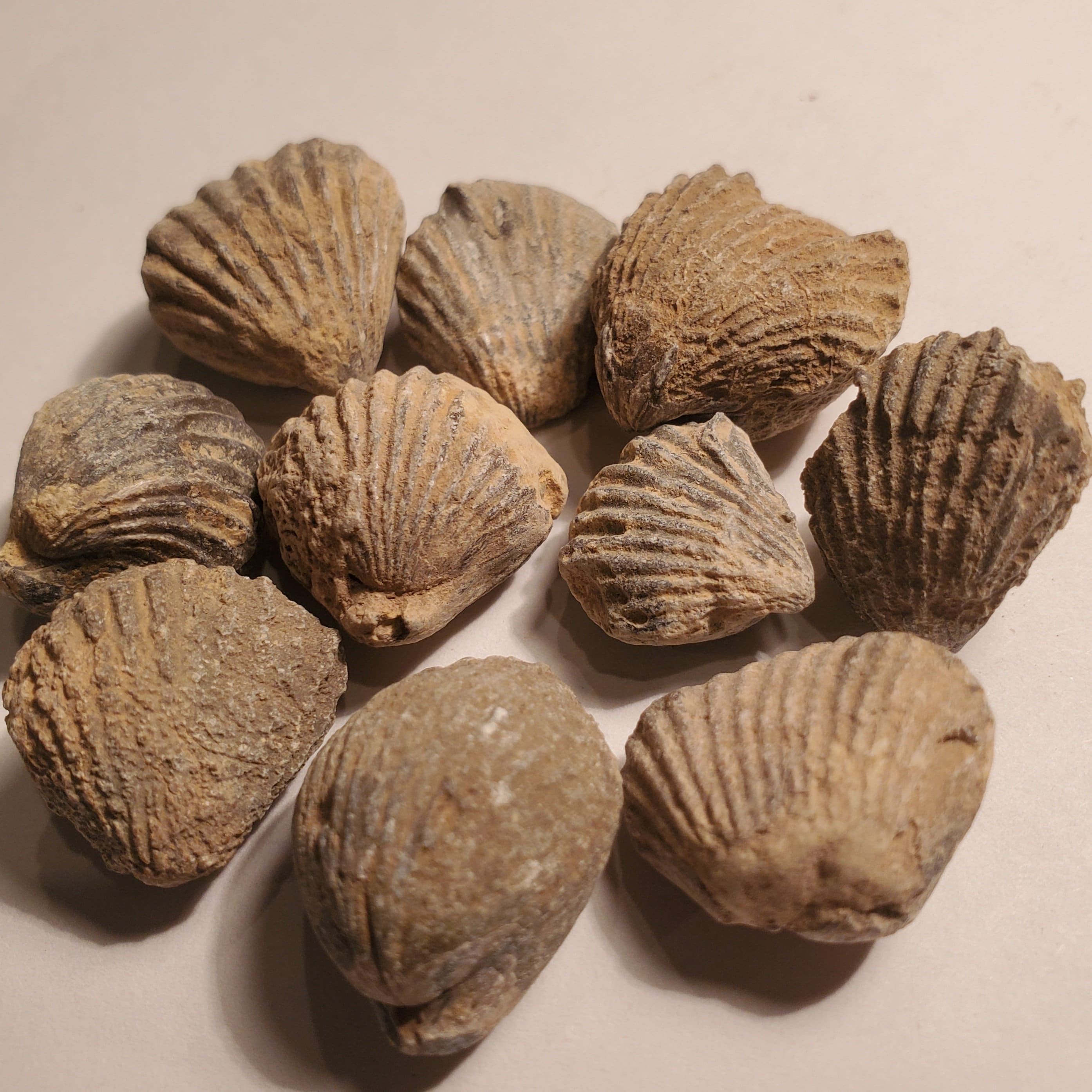
Brachiopods are one of the strangest success stories in the history of animal life - and one of the quietest failures. For most of the Paleozoic era, from the early Cambrian through the end of the Permian, they were the single most abundant and diverse group of shelled animals in the world's seas. A typical Ordovician or Devonian limestone is essentially a rock built out of brachiopod shells.
More than 30,000 fossil species have been named across the group's 540-million-year run, and in many Paleozoic rock units brachiopods outnumber every other fossil combined. Then, 252 million years ago, the end-Permian mass extinction - the worst in Earth history - killed more than 95 per cent of marine species, and brachiopods suffered disproportionately. They survived. They simply never again dominated.
Today, roughly 450 living species remain, tucked into cold-water shelves, deep-sea beds, hydrothermal seeps, and quiet intertidal mud flats. Bivalve molluscs - clams, mussels, oysters - now occupy the ecological roles brachiopods once filled, which is part of the reason the two groups are so often confused. From the outside they look alike.
Internally, anatomically, and evolutionarily, they are entirely different animals. Brachiopods belong to their own phylum. A clam and a brachiopod sharing a rock shelf are about as closely related as an octopus and a snail.
This guide covers every major aspect of brachiopod biology, anatomy, ecology, and paleontology: shell structure and orientation, the lophophore feeding apparatus, the pedicle stalk, shell chemistry, the living fossil genus Lingula, the mass extinctions the group survived and the one that decimated it, and the quiet modern persistence of a phylum that was once the face of shallow marine life on Earth.
It is a reference entry, not a summary - so expect specifics: millions of years, millimetres and metres, named species, classes, orders, and documented behaviours.
Etymology and Classification
The name Brachiopoda derives from the Greek brachion, meaning arm, and podos, meaning foot. Early anatomists mistakenly interpreted the lophophore - the coiled feeding organ inside the shell - as a pair of arm-like feet, and the name survived into modern scientific nomenclature.
The common English name lamp shell comes from a different feature: the ventral valve of many brachiopods has a hole near its hinge through which the fleshy stalk emerges, and the overall shell shape resembles an ancient Roman oil lamp with its wick hole.
Brachiopoda is a phylum in its own right, sitting inside the broader clade Lophotrochozoa alongside phoronids, bryozoans, molluscs, and annelids. Its formal placement:
- Kingdom: Animalia
- Phylum: Brachiopoda
- Major classes: Lingulata, Craniata, Rhynchonellata
- Representative order: Lingulida
- Representative family: Lingulidae
- Representative genus: Lingula
- Representative living species: Lingula anatina
Modern classification recognises three major classes of living and fossil brachiopods. Lingulata, which contains Lingula and its relatives, is the oldest and includes most of the phosphatic-shelled, burrowing, pedicle-anchored forms. Craniata contains shell-cementing brachiopods that attach directly to hard substrates without a free pedicle.
Rhynchonellata contains the largest and most diverse living and fossil brachiopods, including the classic articulated forms with complex hinge teeth and calcium carbonate shells.
The species Lingula anatina is used here as the representative because it is one of the best-documented living brachiopods and because its genus is the longest-surviving of any in the phylum. Fossils that palaeontologists assign to the genus Lingula (or very close relatives in the family Lingulidae) appear in rocks from the early Cambrian onwards, more than 500 million years ago, and the gross body plan has changed remarkably little in that time.
Anatomy and Body Plan
A living brachiopod is a soft-bodied invertebrate enclosed between two mineralised valves, anchored to the seabed (or buried in it) by a muscular stalk, and feeding by filtering particles out of seawater through a specialised organ called the lophophore. Every one of these features distinguishes brachiopods from the superficially similar bivalve molluscs.
The shell (two valves):
- A dorsal (upper) valve, typically smaller
- A ventral (lower) valve, typically larger, often bearing the pedicle opening
- Symmetry runs through both valves, from front to back
- Composed of either calcium carbonate or chitin bonded with calcium phosphate
- Can be punctate (riddled with tiny pores) or impunctate (solid)
The soft body:
- A coelomic cavity, typical of lophotrochozoans
- A lophophore - the horseshoe-shaped or spiral feeding organ
- Muscles that open and close the two valves
- A digestive tract, sometimes ending in an anus (in some lineages) and sometimes blind (in others)
- A reduced but present circulatory system, with a heart
- Separate sexes in most species, with external fertilisation
The pedicle:
- A fleshy, muscular stalk emerging through a hole in the ventral valve
- Used to anchor the animal to rock, shell debris, or burrowed sediment
- In lingulids, extends deep into vertical burrows in mud or sand
- Contains connective tissue, muscle fibres, and in some species chitinous reinforcement
The shell orientation is the single most important anatomical difference between brachiopods and bivalves. In a bivalve mollusc, the two shells sit on the left and right sides of the body and hinge along the back. A bivalve's plane of symmetry runs between its two shells. In a brachiopod, the two shells sit on the top and bottom of the body and hinge along the posterior.
A brachiopod's plane of symmetry runs through both shells, from the front of the animal to the back. If you held a clam and a brachiopod of similar size side by side and rotated one of them ninety degrees, they would still not match - but the mistake is understandable, and it has caused confusion since the earliest days of palaeontology.
The Lophophore and Feeding
The lophophore is the defining feature of brachiopod biology. It is a coiled, horseshoe-shaped, or spiral loop of hollow tentacles fringed with millions of tiny beating cilia. In a living brachiopod with its shell slightly gaped, the cilia drive a gentle and precise current of water into the shell along specific channels, through the lophophore, and back out.
Food particles suspended in the water - phytoplankton, bacteria, organic detritus, occasional small zooplankton - are trapped on the sticky mucus of the lophophore tentacles, transferred to ciliated grooves, and carried down to the mouth at the base of the lophophore.
This is a low-energy, high-efficiency feeding strategy. It requires a predictable supply of suspended food but almost no active movement on the part of the animal. It also requires clear water, because the lophophore cilia can be clogged by heavy sediment loads.
These two requirements - stable productivity and clear water - are part of why brachiopods flourished in the shallow, clear, epicontinental seas of the Paleozoic and now cluster in cold-water shelves, hydrothermal seeps, and deep-water habitats where productivity is steady and turbidity is low.
In fossil brachiopods, the lophophore itself almost never preserves, but the internal shell structures that supported it - features called brachidia, spires, loops, and crura - often do. These structures allow palaeontologists to reconstruct the shape and orientation of the lophophore in long-extinct species and to infer feeding ecology from rocks half a billion years old.
Shell Chemistry: A Strange Feature
Most marine shelled invertebrates - molluscs, corals, echinoderms, foraminifera - build shells of calcium carbonate, either as aragonite or as calcite. Brachiopods do this too, in the classes Craniata and Rhynchonellata, where calcium carbonate shells predominate. The class Lingulata, however, does something unusual: its shells are made of chitin (an organic polysaccharide) bonded to calcium phosphate, a mineral chemistry more typical of vertebrate bone and teeth than of invertebrate shell.
Phosphatic shells are extremely rare in the animal kingdom. Aside from the lingulid brachiopods, the only other major animal groups that routinely use phosphatic hard parts are vertebrates - in bones, teeth, and scales - and a handful of specialised groups like the extinct conodonts.
The fact that brachiopods and vertebrates both evolved to bind calcium phosphate into hard structures, independently of each other and through very different biochemistry, is a striking example of convergent biomineralisation.
For lingulid brachiopods, phosphatic shells have particular advantages in low-pH, low-carbonate waters, which may be part of why they survived mass extinctions that devastated purely calcareous shell builders.
Brachiopod shells also differ in another microscopic feature that is largely invisible to the naked eye but critical to classification. Some brachiopods have punctate shells, riddled with tiny tubular pores that in life contained fleshy extensions of the mantle. Others have impunctate shells, with no such pores.
Still others have pseudopunctate shells, with rod-like internal structures that mimic punctae but do not actually form pores. These microscopic features are among the most reliable ways to distinguish brachiopod lineages, even when the outer shell looks identical, and they form the basis of much of the phylum's modern taxonomy.
Lingula: The Living Fossil
Lingula is the textbook example of a living fossil. The genus has persisted in recognisable form for roughly 500 million years - older than the oldest vertebrates, older than the oldest land plants, older than trees, older than insects. Fossils that palaeontologists assign to the genus Lingula (or very close relatives in the family Lingulidae) appear in rocks from the early Cambrian, and the gross shell shape and burrowing lifestyle have remained essentially unchanged since.
The living species Lingula anatina is widespread across the Indo-Pacific, from Japan and Korea south through Southeast Asia to Australia and New Caledonia. It lives in vertical burrows in intertidal and shallow-water mud flats, with the two valves pointing upward toward the sediment surface and the long pedicle extending deep into the mud below.
When feeding, the animal rises up slightly and gapes its shell to expose the lophophore to clean water flowing above the sediment. When disturbed, it retracts rapidly down the burrow by contracting pedicle muscles, vanishing below the surface.
At the level of gross morphology, Lingula is one of the most conservative animal lineages ever documented. The tongue-shaped shell, the long pedicle, the burrowing habit, and the preferred sediment type have all been stable for hundreds of millions of years. Molecular studies show that Lingula has of course continued to evolve at the genetic level, and modern species are genuinely distinct from their Cambrian ancestors, but the outward form has remained remarkably constant.
The biological reasons for this extreme stability are debated. One common hypothesis is that the deep-burrow lifestyle protects the animal from many of the environmental stressors that drive rapid evolution in more exposed species, including predators, temperature extremes, and oxygen fluctuations.
Another is that the phosphatic shell chemistry resists acidification events that have driven extinctions among calcium-carbonate-shelled lineages. Whatever the reason, Lingula's persistence is one of the most striking examples of evolutionary stasis in the animal kingdom.
Size Range and Diversity
Brachiopods span a wide size range, though none are truly giant. The smallest adult brachiopods have shells only a few millimetres across. Most living species fall between one and five centimetres. The largest brachiopods that ever lived reached around 35 centimetres across - notably certain Devonian productids - though most Paleozoic species were in the same few-centimetre range as modern forms.
| Size class | Shell length | Representative genera |
|---|---|---|
| Micro | 1-5 mm | Many lingulid larvae, some craniids |
| Small | 5-30 mm | Most living Lingula, Terebratulina |
| Medium | 30-100 mm | Magellania, many Paleozoic strophomenids |
| Large | 100-200 mm | Gigantoproductus, Stringocephalus |
| Giant | 200-350 mm | The largest productid brachiopods |
Across the 540-million-year fossil record, brachiopod diversity has varied dramatically. The Cambrian saw the first appearance of major brachiopod lineages, including early lingulids and the extinct inarticulate groups. The Ordovician saw a massive radiation that made brachiopods the dominant shelled animals in shallow seas worldwide.
The Silurian and Devonian sustained this dominance, with hundreds of named species in individual formations. The end-Permian collapse knocked diversity down by more than 95 per cent. Some Mesozoic recovery followed, but the group never again approached its Paleozoic peak, and modern diversity - around 450 living species - is a small fraction of what the phylum once contained.
Mass Extinctions and the End-Permian Collapse
Brachiopods lived through all five of the Big Five mass extinctions, but one of them changed the phylum forever.
| Extinction event | Time (Ma) | Brachiopod response |
|---|---|---|
| End-Ordovician | ~444 | Severe losses, especially among warm-water lineages |
| Late Devonian | ~372-359 | Major declines; productids and strophomenids persist |
| End-Permian (Great Dying) | ~252 | Collapse; >95% of species lost; dominance ends forever |
| End-Triassic | ~201 | Further losses among Mesozoic survivors |
| End-Cretaceous (K-Pg) | ~66 | Modest losses; modern diversity already low before event |
The end-Permian mass extinction was by far the most consequential. Sustained volcanism from the Siberian Traps released enormous quantities of carbon dioxide, sulphur dioxide, and methane into the atmosphere over several hundred thousand years. The resulting global warming, ocean acidification, ocean anoxia, and stratification devastated marine ecosystems. Estimates suggest more than 95 per cent of marine species went extinct, making it the worst extinction event in the history of life.
Brachiopods were hit harder than most groups. Their calcium carbonate shells were vulnerable to ocean acidification. Their suspension-feeding lifestyle depended on clear, productive, well-oxygenated shelf seas, precisely the environments most disrupted by the extinction. Their relatively slow reproduction and low larval dispersal left them poorly equipped to recolonise emptied ecosystems.
When the extinction ended, the ecological space brachiopods had dominated for 300 million years was largely taken over by bivalve molluscs - which reproduced faster, burrowed more effectively, tolerated wider environmental conditions, and recovered more rapidly.
The Triassic and Jurassic saw partial brachiopod recovery, and lineages like the terebratulids and rhynchonellids have persisted continuously from then to the present. But the phylum never again reached Paleozoic levels of diversity or ecological dominance.
Modern brachiopods cluster in marginal habitats - cold-water shelves, deep-sea beds, hydrothermal seeps, and cryptic intertidal mud flats - where competition from bivalves is reduced. This pattern, of a formerly dominant group driven into ecological refugia by a successor, is one of the clearest examples of long-term evolutionary replacement in the fossil record.
Living Brachiopods Today
Modern brachiopod diversity is small by comparison with the Paleozoic peak but still significant. Approximately 450 species across all three living classes persist in oceans worldwide. They are not uniformly distributed. Modern brachiopods concentrate in several habitat types:
- Cold-water continental shelves. Particularly around New Zealand, southern Australia, South America, and Antarctica.
- Deep-sea benthic habitats. Species of Abyssothyris, Pelagodiscus, and others occur in abyssal depths, some more than six kilometres below the surface.
- Hydrothermal seeps and cold seeps. Specialised lineages exploit chemosynthetic productivity at geothermal and chemical vents on the seafloor.
- Intertidal mud flats. Burrowing lingulids, notably Lingula anatina, persist in specific coastlines across the Indo-Pacific.
- Submarine caves and cryptic reef habitats. A few lineages cement themselves to rock surfaces in shaded, low-competition environments.
The geographic bias is partly a relic of evolutionary history. In colder, deeper, or more stable environments, the competitive advantages of bivalves are reduced, and brachiopods can persist at low densities without being displaced. In the warm, shallow, variable shelf seas that once defined the group's range, bivalves overwhelmingly dominate.
Brachiopods and Humans
For most of human history, brachiopods have been noticed primarily as fossils. Their shells weather out of limestone cliffs, road cuts, and riverbeds across most of the world, and many traditional cultures collected and interpreted them as sacred objects, curiosities, or medicinal items. In modern times, they are among the most commonly encountered fossils in school biology and geology classes, and their role as index fossils makes them central to any geological mapping of Paleozoic rocks.
Living brachiopods have a narrower but real cultural footprint. The most famous example is the traditional consumption of Lingula anatina in parts of Japan, the Philippines, and New Caledonia. In Japanese the animal is called midori-shamisen-gai, the "green shamisen shell," a reference to its tongue-like shape resembling the body of a shamisen musical instrument.
It is harvested from intertidal mud flats, typically by digging into the vertical burrows and extracting the animal whole, pedicle and all. It is served grilled, in miso soup, or occasionally as a sushi or sashimi ingredient. Flavour reports are mixed - briny, mildly sweet, slightly earthy, with a chewy texture. The fishery is small and local but has continued for generations. It is one of the rare cases of a living fossil routinely appearing on a dinner plate.
Brachiopods also have value to scientific research far out of proportion to their modern diversity. Because their shells preserve stable isotope ratios of oxygen and carbon in unaltered calcium carbonate, fossil brachiopod shells are used to reconstruct past ocean temperatures and chemistry. Extensive palaeoclimate records of the Paleozoic are built on brachiopod isotope data.
Living brachiopods are also used as model organisms for studies of biomineralisation, evolutionary development, and the ecology of ancient body plans.
The Fossil Record and Scientific Importance
Brachiopods are one of the most useful fossil groups in geology because they evolved rapidly, lived globally, and preserved extremely well. A single Ordovician, Silurian, or Devonian marine rock layer, anywhere in the world, can often be assigned to a precise few-hundred-thousand-year interval based on the brachiopod species found in it.
This practice - biostratigraphy - is central to geological mapping of Paleozoic rocks, and many period and stage boundaries are defined in part by the appearance or disappearance of specific brachiopod species.
Why brachiopods are ideal index fossils:
- Rapid evolutionary turnover, with many species persisting only a few hundred thousand years
- Broad geographic distribution via planktonic larvae
- Robust shell preservation in a wide range of sedimentary environments
- Distinctive external ornament, internal structure, and microscopic shell texture
- Abundant individuals in most marine Paleozoic rock units
Brachiopod shells also preserve geochemical signals with unusual fidelity. Their low-magnesium calcite microstructure resists diagenetic alteration, which means oxygen isotope, carbon isotope, and trace element data from fossil brachiopod shells often record original seawater chemistry hundreds of millions of years after deposition.
Reconstructions of Paleozoic ocean temperature, salinity, and carbon cycling rely heavily on brachiopod data. For anyone mapping, dating, or reconstructing the chemistry of the Paleozoic oceans, brachiopods are an essential tool.
Related Reading
- Ammonite: Spiral Sentinels of the Mesozoic Seas
- Dunkleosteus: Armoured Apex Predator of the Devonian Seas
- Cameroceras: Giant Orthocone of the Ordovician
- Mass Extinctions: The Five Times Earth Nearly Died
References
Relevant peer-reviewed and institutional sources consulted for this entry include the Paleobiology Database occurrences for Brachiopoda, the Treatise on Invertebrate Paleontology volumes on brachiopods, published research in Palaeontology, Paleobiology, Lethaia, and Journal of Paleontology, and the extensive body of work on end-Permian marine extinction dynamics.
Modern brachiopod diversity figures follow the consolidated estimates of the World Register of Marine Species. Data on Lingulidae temporal range follow the Cambrian-through-recent fossil occurrences summarised by the Paleobiology Database and standard invertebrate palaeontology references.
Ecological and life-history information on Lingula anatina follows field studies from Japan, the Philippines, and northern Australia.
Frequently Asked Questions
What exactly is a brachiopod?
A brachiopod is a marine invertebrate belonging to the phylum Brachiopoda, one of the oldest and most distinctive animal phyla on Earth. Brachiopods have two shells - called valves - that enclose a soft body, and they feed by filtering seawater through a horseshoe-shaped organ of ciliated tentacles called the lophophore. Despite their superficial similarity to clams and other bivalves, brachiopods are not molluscs.
Their closest living relatives are the phoronids (horseshoe worms), and their body plan, anatomy, and shell orientation are completely different from any bivalve’s. The group first appears in the fossil record around 540 million years ago in the early Cambrian and has persisted - in reduced form - ever since. Roughly 450 living species remain today, compared with more than 30,000 named fossil species from the Paleozoic and Mesozoic.
Are brachiopods extinct?
Not entirely, but almost. Brachiopods are one of the best examples of a phylum that was once globally dominant and is now a quiet remnant. In the Paleozoic era, especially the Ordovician, Silurian, and Devonian periods, brachiopods were the single most diverse and abundant group of shelled animals in the world’s seas - often making up more than half of all shells in a typical marine rock unit.
The end-Permian mass extinction 252 million years ago wiped out more than 95 per cent of marine species, and brachiopods suffered disproportionately. Some lineages survived and persisted through the Mesozoic and Cenozoic, but they never reclaimed their former ecological dominance. Today roughly 450 living species remain, mostly in cold-water, deep-sea, or cryptic shallow-water habitats.
Bivalve molluscs now occupy most of the ecological roles that brachiopods once filled, which is part of why the two groups are so often confused.
How are brachiopods different from clams and other bivalves?
The confusion is understandable - both groups have two shells enclosing a soft body and both live anchored to or buried in marine sediment - but anatomically they are entirely different. The most fundamental difference is shell orientation. A bivalve’s two shells are on the left and right of the body and hinge along the back. A brachiopod’s two shells are on the top (dorsal) and bottom (ventral) of the body and hinge along the posterior.
As a result, the plane of symmetry runs through both shells of a brachiopod but between the two shells of a bivalve. Other differences include the feeding organ (a ciliated lophophore in brachiopods, gills in bivalves), the attachment method (a fleshy pedicle stalk in most brachiopods, a muscular foot in most bivalves), and shell chemistry (many brachiopods use chitin-calcium phosphate, which is almost unheard of in bivalves).
The two groups are not even close cousins - brachiopods belong to their own phylum, while bivalves are molluscs.
What caused brachiopods to decline so dramatically?
The single most important event was the end-Permian mass extinction 252 million years ago, informally called the Great Dying. Sustained volcanism from the Siberian Traps released enormous quantities of carbon dioxide, sulphur dioxide, and methane into the atmosphere over several hundred thousand years. The resulting global warming, ocean acidification, ocean anoxia, and stratification devastated marine ecosystems.
Estimates suggest more than 95 per cent of marine species went extinct, making it the worst extinction event in the history of life. Brachiopods, which depended on stable shelf seas and built shells out of minerals (both calcium carbonate and calcium phosphate) vulnerable to acidification, were hit especially hard.
A handful of lineages survived, but the ecological space they had occupied was taken over during the Triassic and Jurassic by bivalve molluscs - which reproduce more quickly, burrow more effectively, and tolerate a wider range of environmental conditions. Brachiopods never regained their former abundance.
Why is Lingula called a living fossil?
Lingula is a genus of tongue-shaped, burrowing brachiopods that lives in intertidal and shallow-water mud flats, particularly across the Indo-Pacific. What makes it remarkable is how little it has changed.
Fossils that palaeontologists assign to the genus Lingula (or very close relatives in the family Lingulidae) appear in rocks more than 500 million years old - from the early Cambrian onwards - and they look recognisably similar to Lingula anatina alive today. The gross shell shape, the burrowing lifestyle, the pedicle anchor, and even the sediment preferences have remained largely unchanged for half a billion years.
Genetically and at the microanatomical level Lingula has of course continued to evolve, but morphologically it is one of the most conservative animal lineages known, making it one of the classic textbook examples of a living fossil. It has outlasted mass extinctions, continental rearrangements, and every other kind of environmental upheaval Earth has thrown at it.
Can you eat brachiopods?
Yes, and people do. In parts of Japan, the Philippines, and New Caledonia, lingulid brachiopods - primarily Lingula anatina - are harvested from intertidal mud flats and eaten as a traditional food. In Japanese the animal is called midori-shamisen-gai or simply shamisen-gai, and it is usually served grilled, in miso soup, or, less commonly, as an unusual sushi or sashimi ingredient.
The edible portion is the fleshy pedicle stalk and the body inside the shell. Flavour reports are mixed; descriptions range from briny and mildly sweet to earthy, with a chewy texture. Lingulids are not a major commercial seafood anywhere, but they form a recognised niche food in specific coastal communities, and the sustainable harvesting of them from mud flats has continued for generations.
It is one of the rare cases of a living fossil animal routinely appearing on a dinner plate.
Why are brachiopods so useful as index fossils?
Brachiopods are among the best index fossils - species used to date rocks - for several reasons. First, they evolved quickly: many species persisted for only a few hundred thousand years before being replaced by new forms, which means a brachiopod identification can often narrow a rock’s age to a fine interval.
Second, they were geographically widespread: floating larvae spread species across continents in relatively short times, so the same species often appears in rocks on multiple continents from the same age. Third, their shells preserve extremely well thanks to robust calcium carbonate or calcium phosphate construction, surviving in a wide range of rock types.
Fourth, their shell ornament, size, shape, and internal structures are distinctive enough that trained palaeontologists can identify species from hand specimens. For much of the Paleozoic, brachiopod biostratigraphy is the backbone of geological mapping, and many period and stage boundaries - such as divisions within the Ordovician, Silurian, and Devonian - are defined by characteristic brachiopod assemblages.
What do brachiopods eat and how do they feed?
Brachiopods are suspension feeders. They do not hunt and they do not graze. Instead they filter small particles - phytoplankton, bacteria, organic detritus, and occasional small zooplankton - out of the seawater flowing past them. The feeding organ is the lophophore, a horseshoe-shaped or spiral loop of hollow tentacles fringed with tiny beating cilia.
When the two shells are gaped slightly apart, the cilia drive a gentle current of water into the shell, through the lophophore, and back out. Particles trapped on the lophophore tentacles are moved down ciliated grooves to the mouth at the base of the lophophore. From there they pass into the gut for digestion.
This style of feeding is extremely efficient at low energy cost but requires reliably productive water, which is one reason brachiopods dominated the stable shallow seas of the Paleozoic and now cluster in cold-water, deep-sea, and other high-productivity environments.