
What caused the biggest mass extinction in Earth's history?
The Permian-Triassic extinction, known as the Great Dying, occurred 252 million years ago and wiped out approximately 96 percent of all marine species and 70 percent of terrestrial vertebrate species. The primary cause was massive volcanism from the Siberian Traps, a large igneous province that erupted roughly 7 million cubic kilometers of lava across present-day Siberia.
Life on Earth is 3.8 billion years old. Across that incomprehensible span of time, the biosphere has endured asteroid impacts, supervolcanic eruptions, runaway greenhouse warming, global glaciation, and ocean chemistry collapses that turned the seas into toxic, oxygen-starved dead zones. Most of the time, life absorbs these shocks and continues.
But five times in the last 450 million years, the damage was so catastrophic that the majority of all species on the planet were annihilated in geologically brief intervals - tens of thousands to a few million years. These are the Big Five mass extinctions, the five times Earth nearly died.
Each event reshaped the trajectory of evolution in ways that are still visible today. The dominance of mammals, the existence of grasslands, the absence of trilobites from modern oceans - all of these facts trace directly back to specific extinction events. Understanding mass extinctions is not an exercise in morbid curiosity.
It is essential context for understanding why the living world looks the way it does, and for evaluating whether human civilization is now triggering a sixth catastrophe of the same magnitude.
"Over the last half-billion years, there have been five mass extinctions, when the diversity of life on earth suddenly and dramatically contracted. Scientists are currently monitoring the sixth extinction, predicted to be the most devastating extinction event since the asteroid impact that wiped out the dinosaurs." - Elizabeth Kolbert, The Sixth Extinction: An Unnatural History (2014)
What Defines a Mass Extinction?
Not every period of elevated species loss qualifies as a mass extinction. The term has a specific meaning in paleontology. A mass extinction is defined as an event in which at least 75 percent of all species on Earth disappear within a geologically short interval, typically less than 2 million years and often much faster.
This threshold was formalized by paleontologists David Raup and Jack Sepkoski in their landmark 1982 paper in Science, which analyzed the fossil record of marine families over the Phanerozoic Eon and identified five statistically significant peaks in extinction rate.
Background extinction - the normal, ongoing rate at which species disappear through competition, environmental change, and natural selection - claims roughly one to five species per year out of every million species on the planet. During a mass extinction, this rate increases by a factor of 100 to 1,000 or more. The difference is not merely quantitative.
Background extinction tends to be selective, picking off species that are poorly adapted to changing conditions. Mass extinctions are indiscriminate. They eliminate well-adapted, ecologically dominant organisms alongside marginal ones. Entire ecosystems collapse. Food webs disintegrate. Recovery takes millions of years.
The causes vary - glaciation, volcanism, asteroid impact, ocean chemistry changes - but the pattern is consistent. A mass extinction clears the ecological slate, and the survivors inherit a devastated world full of empty niches. The evolutionary radiation that follows each extinction is what produces the next chapter in the history of life.
The Big Five: A Comparative Overview
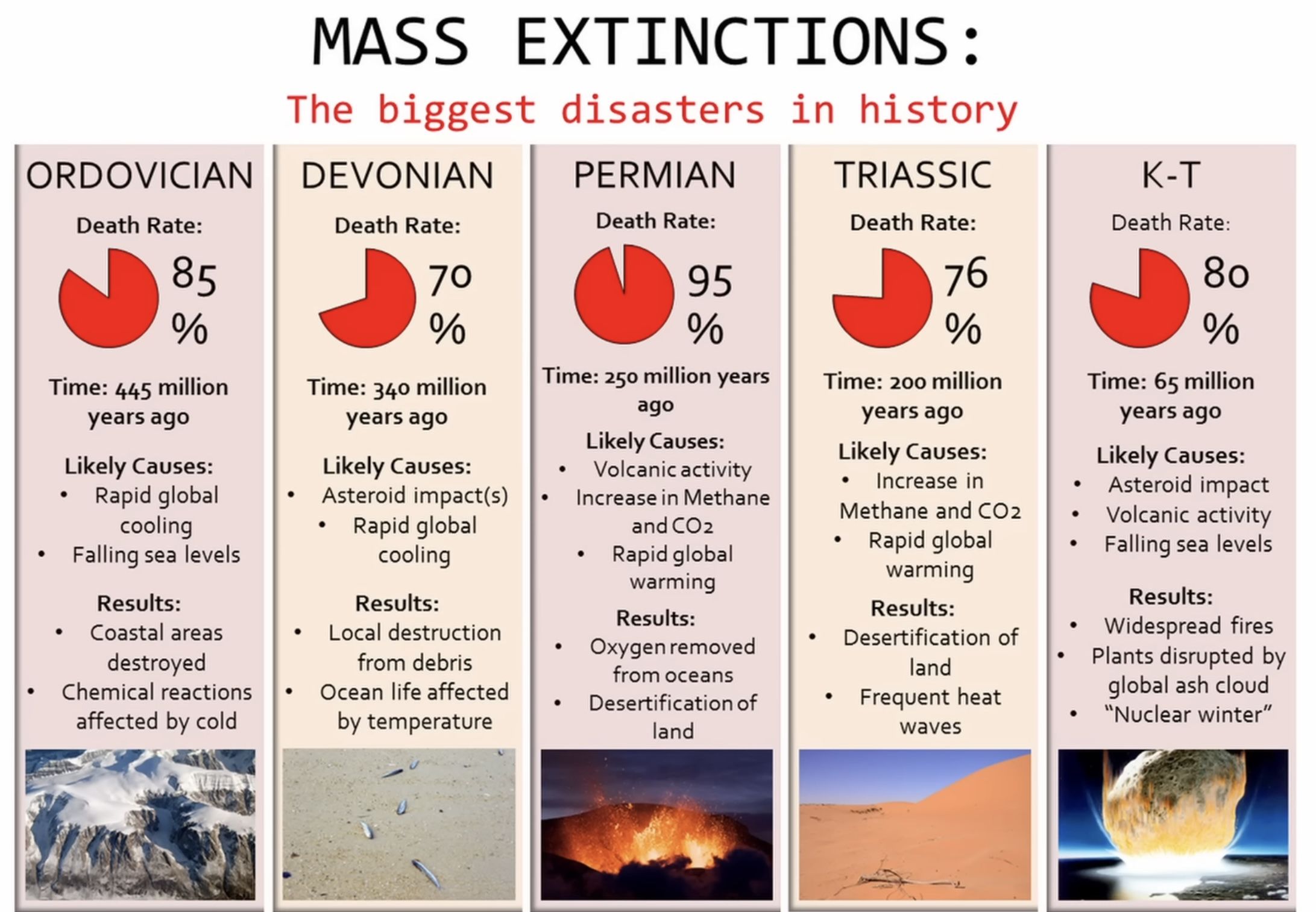
Before examining each event in detail, the following table summarizes the five major mass extinctions by date, severity, primary cause, and notable consequences.
| Extinction Event | Date (Ma) | Species Lost | Primary Cause | Key Consequence |
|---|---|---|---|---|
| Ordovician-Silurian | ~445 Ma | ~86% | Glaciation, sea-level drop | Reef ecosystems devastated; recovery of marine invertebrates |
| Late Devonian | ~375 Ma | ~75% | Ocean anoxia, possible volcanism | Near-total collapse of reef systems; vertebrate diversification |
| Permian-Triassic (Great Dying) | ~252 Ma | ~96% marine, ~70% terrestrial | Siberian Traps volcanism | Most severe extinction; opened path for archosaur (dinosaur) rise |
| Triassic-Jurassic | ~201 Ma | ~80% | Central Atlantic Magmatic Province volcanism | Cleared ecological space for dinosaur dominance |
| Cretaceous-Paleogene | ~66 Ma | ~76% | Chicxulub asteroid impact, Deccan Traps volcanism | End of non-avian dinosaurs; mammalian radiation |
1. The Ordovician-Silurian Extinction (~445 Million Years Ago)
The first of the Big Five struck during the Late Ordovician, a period when life was almost entirely marine. There were no land plants, no land animals, and no vertebrates on the continents. The oceans, however, teemed with trilobites, brachiopods, bryozoans, graptolites, crinoids, and the earliest jawless fish. Coral reefs built by tabulate and rugose corals were among the most complex ecosystems on the planet.
Cause: A Sudden Ice Age
The Ordovician-Silurian extinction unfolded in two distinct pulses, both linked to a brief but severe glaciation. The supercontinent Gondwana drifted over the South Pole, and massive ice sheets formed across what is now North Africa and South America. Global sea levels dropped by an estimated 50 to 100 meters, draining the vast shallow continental seas that hosted the majority of marine biodiversity. Water temperatures plummeted. Ocean circulation patterns shifted dramatically.
The first pulse of extinction struck as glaciation intensified, eliminating species adapted to warm, shallow-water environments. The second pulse occurred as the ice sheets melted and sea levels rose again, flooding previously exposed shelves with anoxic (oxygen-depleted) deep water. Species that had survived the initial cold snap were killed by the chemical aftermath.
Aftermath
Approximately 86 percent of all species vanished. Entire families of trilobites, brachiopods, and bryozoans were eliminated. Reef ecosystems collapsed and would not fully recover for millions of years. The survivors - generalist species capable of tolerating a range of temperatures and oxygen levels - slowly rebuilt marine communities during the early Silurian. The extinction opened ecological space for the rise of jawless fish and, eventually, the first jawed vertebrates.
2. The Late Devonian Extinction (~375 Million Years Ago)
The Devonian period is sometimes called the Age of Fishes. The seas were dominated by armored placoderms, early sharks, and the first bony fish. On land, the first forests had taken root - primitive trees like Archaeopteris formed dense stands along waterways. The Late Devonian extinction was not a single catastrophic event but a prolonged biodiversity crisis spanning roughly 20 million years, with two particularly severe pulses: the Kellwasser Event (~375 Ma) and the Hangenberg Event (~359 Ma).
Cause: Anoxic Oceans and Ecological Collapse
The leading hypothesis for the Late Devonian extinction centers on widespread ocean anoxia - oxygen depletion across vast stretches of the seafloor and water column. The cause of this anoxia is debated, but the most supported mechanism involves the rapid spread of land plants.
As the first forests expanded, their root systems accelerated the weathering of rocks, releasing nutrients - particularly phosphorus - into rivers and ultimately into the oceans. This nutrient influx triggered massive algal blooms, which consumed dissolved oxygen as they decomposed, creating anoxic dead zones on a global scale.
Additional contributing factors may have included volcanic activity (the Viluy Traps in present-day Siberia erupted during this period), global cooling episodes, and possible bolide impacts, though no confirmed impact crater has been definitively linked to the Devonian extinctions.
Aftermath
Roughly 75 percent of all species were lost. The reef ecosystems built by stromatoporoids and tabulate corals were virtually annihilated - a collapse so severe that reef-building organisms did not recover to comparable diversity for over 100 million years. Armored placoderms disappeared entirely. The ecological vacuums left behind, however, proved crucial.
The decimation of Devonian fish communities opened niches for the diversification of lobe-finned fish, some of which eventually gave rise to the first tetrapods - four-limbed vertebrates that would colonize the land.
3. The Permian-Triassic Extinction: The Great Dying (~252 Million Years Ago)
No mass extinction in Earth's history comes close to the devastation of the Permian-Triassic boundary event. Known as the Great Dying, it eliminated approximately 96 percent of all marine species, 70 percent of terrestrial vertebrate species, and an estimated 83 percent of all insect genera. It is the only known mass extinction to have significantly affected insect diversity. It was, by every measure, the worst catastrophe life on Earth has ever endured.
"The Permian extinction was the closest life has come to total annihilation. It took tens of millions of years for the biosphere to recover, and the world that emerged was fundamentally different from the one that had been destroyed." - Peter Ward, Under a Green Sky: Global Warming, the Mass Extinctions of the Past, and What They Can Tell Us About Our Future (2007)
Cause: The Siberian Traps
The primary cause of the Great Dying was the eruption of the Siberian Traps, one of the largest volcanic events in Earth's history. Over a period of roughly one million years, an estimated 7 million cubic kilometers of lava poured across what is now northern Siberia, covering an area larger than Western Europe. But the lava itself was not the primary killing mechanism.
The eruptions injected staggering quantities of carbon dioxide, sulfur dioxide, hydrogen chloride, and methane into the atmosphere, triggering a cascade of environmental catastrophes.
Carbon dioxide levels may have reached 2,000 parts per million or higher (compared to roughly 420 ppm today), driving global temperatures up by an estimated 8 to 10 degrees Celsius. The warming destabilized methane clathrates on the seafloor, releasing additional greenhouse gases in a runaway feedback loop. Ocean temperatures rose to levels lethal to most marine organisms.
Seawater pH dropped as dissolved CO2 formed carbonic acid - a process identical to the ocean acidification occurring today, but far more severe. Dissolved oxygen levels in the oceans plummeted, creating vast anoxic and euxinic (hydrogen-sulfide-rich) zones that were toxic to virtually all aerobic life.
On land, the ozone layer was damaged by volcanic halogen emissions, increasing ultraviolet radiation exposure. Acid rain stripped vegetation from the continents. Soil erosion accelerated. The collapse of plant communities removed the base of terrestrial food webs, triggering cascading extinctions among herbivores and predators.
Aftermath
The world after the Great Dying was an alien landscape. The once-diverse Permian ecosystems - dominated by synapsids (mammal ancestors), diverse amphibians, and extensive coal-forming forests - were replaced by a depauperate biosphere dominated by a handful of disaster taxa. The pig-sized Lystrosaurus, a dicynodont therapsid, comprised an estimated 95 percent of all terrestrial vertebrate individuals in some Early Triassic deposits - an astonishing lack of ecological diversity.
Recovery was agonizingly slow. Marine ecosystems did not return to pre-extinction diversity levels for approximately 10 to 15 million years. Some researchers have argued that certain marine communities took even longer. On land, the ecological vacuum eventually allowed archosaurs - the lineage that includes dinosaurs, pterosaurs, and crocodilians - to rise to dominance, fundamentally reshaping terrestrial life for the next 186 million years.
4. The Triassic-Jurassic Extinction (~201 Million Years Ago)
The fourth mass extinction is perhaps the least well-known of the Big Five, but its consequences were among the most transformative. Occurring at the boundary between the Triassic and Jurassic periods, it eliminated roughly 80 percent of all species and cleared the ecological stage for the most iconic group of animals in Earth's history: the dinosaurs.
Cause: The Central Atlantic Magmatic Province
The Triassic-Jurassic extinction coincided with the breakup of the supercontinent Pangaea. As the landmass rifted apart, massive volcanic activity produced the Central Atlantic Magmatic Province (CAMP), one of the largest large igneous provinces in the geological record. CAMP volcanism released enormous quantities of CO2 and SO2, driving rapid global warming, ocean acidification, and widespread marine anoxia - a pattern strikingly similar to the Permian-Triassic extinction, though less severe.
The eruptions occurred in at least four major pulses over roughly 600,000 years. Each pulse correlates with a spike in atmospheric CO2 and a corresponding decline in biodiversity. Carbon isotope excursions in sedimentary rocks from this period confirm massive disruptions to the global carbon cycle.
Aftermath
The Triassic-Jurassic extinction eliminated many of the dominant terrestrial animal groups, including most large pseudosuchians (crocodilian-line archosaurs), many therapsids, and several lineages of early amphibians. Marine losses included conodonts (which went extinct entirely), many ammonite families, and a significant proportion of bivalves and gastropods.
The most consequential result was the removal of ecological competitors that had previously kept early dinosaurs in check. During the Late Triassic, dinosaurs were relatively small, minor components of terrestrial ecosystems dominated by pseudosuchians and other archosaurs.
After the extinction, dinosaurs diversified explosively, radiating into the full spectrum of ecological niches - from small insectivores to multi-ton herbivores and apex predators - that they would occupy for the next 135 million years.
5. The Cretaceous-Paleogene Extinction (~66 Million Years Ago)
The most famous mass extinction, and the only one whose cause was directly observed in the geological record before it was identified, the Cretaceous-Paleogene (K-Pg) extinction ended the Age of Dinosaurs and ushered in the Age of Mammals. It eliminated approximately 76 percent of all species, including all non-avian dinosaurs, pterosaurs, mosasaurs, plesiosaurs, ammonites, and most marine reptiles.
Cause: The Chicxulub Impact
In 1980, physicist Luis Alvarez and his geologist son Walter Alvarez published a paper in Science reporting anomalously high concentrations of iridium - an element rare on Earth's surface but abundant in asteroids - in the thin clay layer marking the K-Pg boundary at Gubbio, Italy. They proposed that a large asteroid impact had caused the extinction.
The hypothesis was initially controversial, but the 1991 identification of the Chicxulub crater, a 180-kilometer-wide impact structure buried beneath the Yucatan Peninsula of Mexico, provided compelling confirmation.
The impactor was an asteroid roughly 10 to 15 kilometers in diameter, traveling at approximately 20 kilometers per second. The energy released upon impact was equivalent to roughly 10 billion Hiroshima bombs.
The immediate effects included a thermal pulse that ignited wildfires across continents, a megatsunami hundreds of meters high, and the ejection of billions of tons of dust, sulfur, and vaporized rock into the atmosphere. The resulting "impact winter" blocked sunlight for months to years, collapsing photosynthesis on land and in the oceans. Global temperatures first spiked from thermal radiation, then plummeted as dust and aerosols blocked solar energy.
The Deccan Traps Debate
The Chicxulub impact was not the only geological catastrophe occurring near the K-Pg boundary. The Deccan Traps, a massive volcanic province in present-day India, erupted over a period spanning roughly 750,000 years bracketing the extinction event.
The Deccan eruptions released substantial CO2 and SO2, and some researchers - most prominently Princeton geochronologist Gerta Keller - have argued that Deccan volcanism was the primary driver of the extinction, with the asteroid impact serving as a secondary or coincidental factor.
The current scientific consensus, supported by high-precision radiometric dating published by Courtney Sprain and colleagues in Science (2019) and by Blair Schoene and colleagues in the same journal, holds that both events contributed to the crisis. The most intense phase of Deccan volcanism may have stressed ecosystems before the impact, but the asteroid strike itself was the primary killing mechanism.
The temporal resolution of the geological record now places the main extinction pulse within tens of thousands of years of the impact - far too rapid to be explained by volcanism alone.
Aftermath
The extinction of non-avian dinosaurs, pterosaurs, and marine reptiles opened an enormous range of ecological niches. Mammals, which had existed as small, mostly nocturnal creatures for over 150 million years, diversified rapidly in the Paleocene and Eocene epochs. Within 10 million years of the extinction, the ancestors of modern orders - primates, rodents, carnivores, ungulates, whales - had appeared.
Birds, the surviving lineage of theropod dinosaurs, also radiated dramatically, filling niches previously occupied by pterosaurs and small non-avian dinosaurs. Flowering plants, which had been diversifying through the Late Cretaceous, came to dominate terrestrial flora.
What Survived - and Why
Mass extinctions are indiscriminate, but not random. Certain traits consistently improve survival odds across multiple extinction events, and understanding these patterns reveals principles about biological resilience.
Generalists Over Specialists
Species with broad dietary requirements, wide geographic ranges, and tolerance for variable environmental conditions consistently outperform specialists during extinction events. Generalist feeders that could switch between food sources when primary prey or food plants vanished had a critical advantage. In contrast, specialists dependent on specific food sources, narrow temperature ranges, or particular habitats were disproportionately vulnerable.
Small Body Size
Across multiple extinction events, smaller organisms fared better than larger ones. Small animals require less food, can shelter in microhabitats (burrows, crevices, underwater refugia), and typically have larger population sizes and shorter generation times - all of which increase the probability that at least some individuals survive the initial catastrophe.
After the K-Pg extinction, the largest surviving mammals weighed roughly 10 kilograms. The giant dinosaurs, dependent on enormous caloric intake from now-collapsed ecosystems, had no such buffer.
Deep-Sea and Subsurface Organisms
Organisms living in deep-sea environments or below the sediment surface were partially insulated from the surface-level catastrophes - wildfires, temperature swings, atmospheric dust loading, UV radiation increases - that characterized most mass extinctions. Deep-sea benthic communities, though not immune to anoxia events, were less affected by the rapid temperature changes and light-dependent ecosystem collapses that devastated surface and shallow-water ecosystems.
Physiological Tolerance
Species capable of entering dormancy, surviving on minimal metabolic resources, or tolerating wide swings in temperature and oxygen levels had inherent advantages. Freshwater organisms, for instance, survived the K-Pg extinction at higher rates than marine organisms, possibly because freshwater habitats are more variable environments that pre-select for physiological flexibility.
Recovery: The Long Road Back
The aftermath of every mass extinction follows a broadly similar pattern: an initial "dead zone" period characterized by low diversity and dominance by a few disaster taxa, followed by a slow rebuilding of ecological complexity over millions of years.
Recovery timescales vary by extinction severity and by ecosystem type. After the Ordovician-Silurian extinction, marine invertebrate communities rebounded within roughly 5 million years. After the Great Dying, full marine recovery took 10 to 15 million years - some of the longest recovery intervals in the geological record. After the K-Pg extinction, mammalian diversification was well underway within 5 million years, but full ecological complexity in marine systems took longer.
The pattern of recovery is not simply a refilling of old niches. Extinctions reshape evolutionary trajectories. The organisms that diversify in the aftermath are not recreations of what came before - they are novel lineages exploiting opportunities that did not previously exist. Mammals did not replace dinosaurs by becoming dinosaur-like. They radiated into entirely new body plans, behaviors, and ecological strategies. Every mass extinction produces a world that is fundamentally new.
The Sixth Extinction: Are We Next?
The question of whether human activity is driving a sixth mass extinction has moved from scientific debate to mainstream urgency. The evidence is substantial and growing.
The Numbers
Current species extinction rates are estimated at 100 to 1,000 times the background rate, depending on the taxonomic group and the methodology used. A 2015 study by Gerardo Ceballos and colleagues published in Science Advances found that vertebrate species are disappearing up to 114 times faster than expected under normal background extinction rates.
The 2019 Global Assessment Report by the Intergovernmental Science-Policy Platform on Biodiversity and Ecosystem Services (IPBES) concluded that approximately 1 million animal and plant species are threatened with extinction, many within decades.
Amphibians are the most imperiled vertebrate class, with roughly 41 percent of species threatened according to the IUCN Red List. Insect populations are declining at alarming rates - a 2019 meta-analysis in Biological Conservation by Francisco Sanchez-Bayo and Kris Wyckhuys estimated a 2.5 percent annual decline in insect biomass globally, with 40 percent of insect species threatened with extinction over the next several decades.
The Drivers
The primary drivers of the current biodiversity crisis are well-documented: habitat destruction and fragmentation (the single largest factor), climate change, pollution (including pesticides, plastics, and nitrogen runoff), invasive species, and direct overexploitation (hunting, fishing, and wildlife trade).
These drivers operate synergistically - climate change compounds habitat loss, pollution weakens populations already stressed by fragmentation, and invasive species exploit ecosystems destabilized by human activity.
The Debate
Elizabeth Kolbert's Pulitzer Prize-winning The Sixth Extinction: An Unnatural History (2014) brought the concept to wide public attention, documenting case studies from the Panamanian golden frog to the Great Barrier Reef. However, some scientists urge caution in applying the "mass extinction" label to the current crisis.
Paleontologist Doug Erwin of the Smithsonian Institution has argued that current losses, while severe, have not yet reached the 75 percent threshold that characterizes a true mass extinction in the geological record. The distinction matters: calling the current crisis a mass extinction may either galvanize action or, paradoxically, induce fatalism by implying the situation is already beyond recovery.
What is not debated is the trajectory. If current trends continue without aggressive intervention in habitat protection, emissions reduction, and conservation policy, the 75 percent threshold could be reached within centuries - a geological instant.
Lessons From Deep Time
The fossil record offers two lessons that are simultaneously reassuring and terrifying. The reassuring lesson is that life is extraordinarily resilient. Every mass extinction, no matter how severe, was followed by a recovery. Life found a way. New species evolved, new ecosystems assembled, and the biosphere rebuilt itself, often more diverse than before.
The terrifying lesson is the timescale. Recovery from a mass extinction takes 5 to 10 million years. From a human perspective, that is essentially permanent. The species we lose in the coming decades and centuries will not be replaced on any timescale relevant to human civilization.
The decisions being made now - about deforestation, emissions, marine protection, and wildlife conservation - will determine whether the planet's biodiversity survives in a form recognizable to future generations, or whether we bequeath a diminished, impoverished biosphere that will take geological ages to repair.
"Each one of the Big Five resulted in a profound loss of biodiversity, but in each case life eventually recovered - usually in a different form. The question facing us now is whether we want to be the cause of the next one." - Peter Ward, paleontologist, University of Washington
References
Raup, D. M., & Sepkoski, J. J. (1982). "Mass Extinctions in the Marine Fossil Record." Science, 215(4539), 1501-1503. The foundational study identifying the Big Five mass extinctions through statistical analysis of marine family diversity.
Alvarez, L. W., Alvarez, W., Asaro, F., & Michel, H. V. (1980). "Extraterrestrial Cause for the Cretaceous-Tertiary Extinction." Science, 208(4448), 1095-1108. The landmark paper proposing the asteroid impact hypothesis for the K-Pg extinction.
Burgess, S. D., Muirhead, J. D., & Bowring, S. A. (2017). "Initial pulse of Siberian Traps sills as the trigger of the end-Permian mass extinction." Nature Communications, 8, 164. High-precision geochronology linking Siberian Traps volcanism to the Permian-Triassic extinction.
Sprain, C. J., Renne, P. R., Wilson, G. P., & Clemens, W. A. (2019). "High-resolution chronostratigraphy of the terrestrial Cretaceous-Paleogene transition and recovery interval in the Hell Creek region, Montana." Geological Society of America Bulletin, 131(1-2), 103-120.
Kolbert, E. (2014). The Sixth Extinction: An Unnatural History. New York: Henry Holt and Company. Pulitzer Prize-winning account of the current biodiversity crisis in the context of Earth's mass extinction history.
Ceballos, G., Ehrlich, P. R., Barnosky, A. D., Garcia, A., Pringle, R. M., & Palmer, T. M. (2015). "Accelerated modern human-induced species losses: Entering the sixth mass extinction." Science Advances, 1(5), e1400253.
IPBES (2019). Global Assessment Report on Biodiversity and Ecosystem Services. Intergovernmental Science-Policy Platform on Biodiversity and Ecosystem Services. The most comprehensive assessment of global biodiversity status, finding approximately 1 million species threatened with extinction.
Ward, P. D. (2007). Under a Green Sky: Global Warming, the Mass Extinctions of the Past, and What They Can Tell Us About Our Future. Washington, DC: Smithsonian Books.
Frequently Asked Questions
What caused the biggest mass extinction in Earth's history?
The Permian-Triassic extinction, known as the Great Dying, occurred 252 million years ago and wiped out approximately 96 percent of all marine species and 70 percent of terrestrial vertebrate species. The primary cause was massive volcanism from the Siberian Traps, a large igneous province that erupted roughly 7 million cubic kilometers of lava across present-day Siberia.
The eruptions released enormous quantities of carbon dioxide and sulfur dioxide, triggering runaway greenhouse warming, ocean acidification, widespread ocean anoxia, and ozone depletion. The resulting cascade of environmental collapse made it the closest life on Earth has ever come to total annihilation.
Are we currently living through a sixth mass extinction?
Many scientists argue yes. Current species extinction rates are estimated at 100 to 1,000 times the normal background rate, and a 2019 IPBES report found that roughly 1 million animal and plant species are threatened with extinction. Elizabeth Kolbert’s Pulitzer Prize-winning book The Sixth Extinction (2014) documented the accelerating loss of biodiversity driven by habitat destruction, climate change, pollution, invasive species, and overexploitation.
However, some researchers caution that current losses have not yet reached the 75 percent species-loss threshold that defines a mass extinction in the geological record, though the trajectory is alarming.
How long does it take life to recover after a mass extinction?
Recovery from a mass extinction typically takes between 5 and 10 million years, though it varies significantly by event. After the Permian-Triassic extinction, full ecosystem recovery took an estimated 10 million years, with some marine communities requiring up to 15 million years to regain pre-extinction diversity levels. After the Cretaceous-Paleogene extinction, mammalian diversification accelerated within roughly 5 million years.
Recovery depends on the severity of environmental disruption, the diversity of surviving lineages, and the availability of ecological niches vacated by extinct species.