
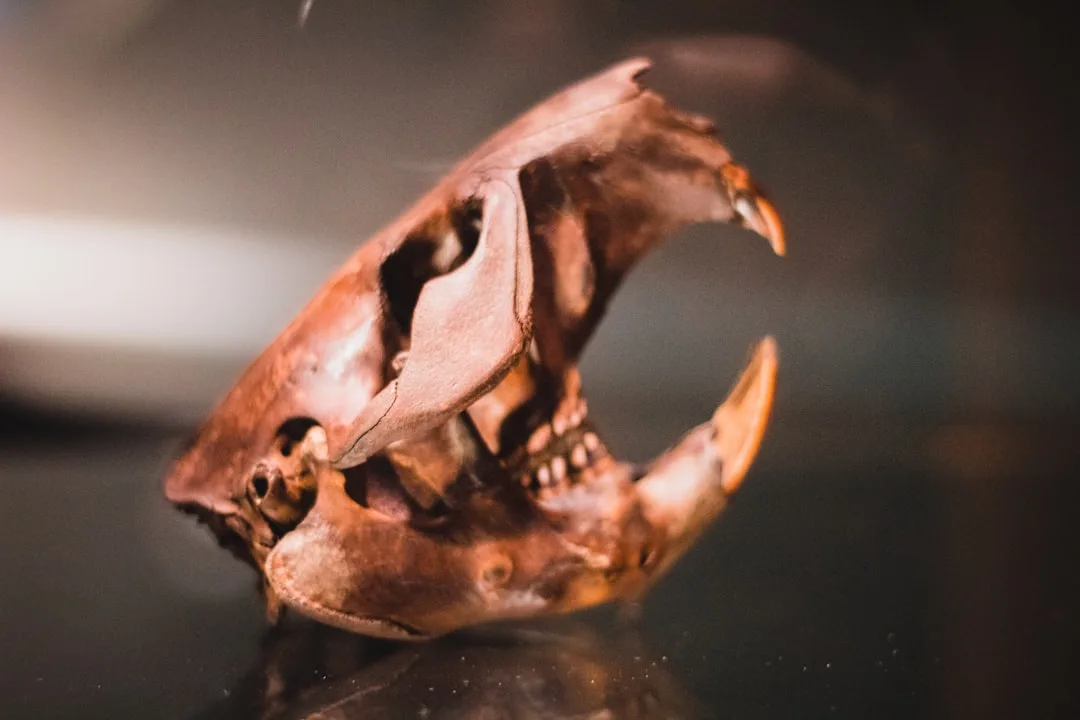
The sabertooth cat is the most famous Ice Age predator of the Americas and one of the most misunderstood animals in the popular imagination. It is not a tiger. It is not the ancestor of any living cat. It is not even a close relative of the lions, leopards, or cheetahs it is so often drawn beside.
Smilodon fatalis was a member of Machairodontinae, a separate subfamily of true cats that left no surviving descendants, and it vanished from North America roughly ten thousand years ago alongside the mammoths, giant ground sloths, native horses, and camelops camels it hunted.
This guide covers the biology, ecology, and extinction of the La Brea sabertooth in detail: how big it was, how those absurd canine teeth actually worked, what prey it took, why so many injured individuals survived long enough for their bones to heal, and what the end of the Pleistocene did to the species. It is a reference entry, not a caricature - so expect specifics: kilograms, centimetres, newtons, gape angles, and verified fossil counts.
Etymology and Classification
The genus name Smilodon was coined by the Danish naturalist Peter Wilhelm Lund in 1842 from Greek roots meaning 'scalpel' and 'tooth'. The species name fatalis, meaning 'deadly' or 'fateful', was added by Joseph Leidy in 1869 after fossils were described from the Mississippi Valley. The informal label 'sabertooth tiger' appeared in popular writing in the late nineteenth century and stuck, despite being taxonomically wrong.
Smilodon fatalis belongs to the order Carnivora, the family Felidae (true cats), and the subfamily Machairodontinae. Machairodontinae split from the ancestors of modern cats more than twenty million years ago. Every living cat - from housecat to tiger - belongs to the other subfamily, Felinae. That means Smilodon is no more a tiger than a tiger is a housecat. It is a deep-time cousin that evolved in parallel and died out without issue.
The genus contains three widely accepted species:
- Smilodon gracilis: the earliest, smallest, and most lightly built. Lived from roughly 2.5 million to about 500,000 years ago. Adult mass around 55-100 kilograms.
- Smilodon fatalis: the North American 'La Brea' sabertooth, the focus of this entry. Lived from roughly 1.6 million to 10,000 years ago. Adult mass 160-280 kilograms.
- Smilodon populator: a South American giant that replaced S. fatalis south of the equator. Lived from roughly 1 million to 10,000 years ago. Adult mass 220-400 kilograms, with exceptional males possibly higher.
Other sabertooth genera inside Machairodontinae - Homotherium, Megantereon, Xenosmilus, Machairodus - are not part of Smilodon, and their lineages are equally extinct.
Size and Physical Description
Smilodon fatalis was roughly the size of a modern African lion but built like a compact wrestler rather than a sprinter. Sexual dimorphism in body size was probably moderate, similar to modern lions.
Adult dimensions:
- Body length: 1.6-2.0 metres, excluding the short tail
- Shoulder height: 1.0-1.2 metres
- Tail length: roughly 20-35 centimetres (short, bobcat-like)
- Weight: 160-280 kilograms, with large males at the upper end
Skull and teeth:
- Skull length: 28-32 centimetres
- Upper canine length along the curve: 20-28 centimetres
- Exposed portion of canine below the upper lip in life: ~18 centimetres
- Canine cross-section: flattened side to side, serrated on both edges
- Gape: up to 120 degrees (vs roughly 65 degrees in a modern lion)
- Estimated bite force at the canines: ~1,000 newtons (vs ~1,300 newtons in a lion)
Smilodon's build is the most distinctive part of its anatomy. The forelimbs were massively overbuilt for a cat, with thick humerus and ulna bones, enlarged muscle attachment sites, and a heavy shoulder girdle. Its hind limbs were proportionally shorter than those of lions or jaguars. The tail was stubby, closer to a lynx than a leopard.
The neck was long and powerfully muscled, built to drive the sabre canines downward with controlled precision. Fur colour and patterning are unknown because no preserved soft tissue survives, but most reconstructions show a plain tawny coat consistent with woodland and shrubland ambush predators.
The Sabre Canines - How They Really Worked
The 20-28 centimetre upper canines are the reason anyone has ever heard of Smilodon, and they are almost universally misunderstood. The teeth were not designed to drive through bone, and they could not. They were flattened side to side, like long curved blades, and they were relatively fragile under any sideways load.
A sabertooth that tried to bite a struggling prey animal head-on would have risked snapping its own teeth - and the fossil record shows plenty of individuals who did exactly that, with healed canine fractures visible in La Brea material.
The current biomechanical consensus is that Smilodon used a two-stage attack:
- Pin the prey. The massive forelimbs and shoulders wrestled large herbivores to the ground, holding the prey still.
- Shear bite. Once the animal was immobilised and stable, the cat drove its head downward with the long neck muscles, opening its jaws to roughly 120 degrees so the canines could clear the rest of the dentition. A precise slashing bite to the throat or soft belly severed the trachea and major blood vessels.
That sequence explains the combination of features that would otherwise look contradictory. It explains why the jaws gape so wide (the canines are so long that normal feline gape would not clear the lower jaw). It explains why the bite force is relatively modest for the cat's size (the killing mechanism is a precise cut, not a crushing clamp).
It also explains why Smilodon is built like a wrestler rather than a sprinter - the entire hunting strategy depends on immobilising prey before the killing bite.
The jaw itself has a characteristic downward flange on the lower mandible, sometimes called the 'chin flange' or 'tongue hook'. The exact function is debated, but most researchers treat it as a guide or brace that kept the lower jaw clear of the long upper canines when the mouth was fully open.
Hunting and Diet
Smilodon fatalis was a hypercarnivore - its diet was nearly pure meat from large prey. Stable isotope analysis of tooth enamel and bone collagen confirms that it targeted big grazing and browsing herbivores rather than small game.
Primary prey:
- Ancient bison (Bison antiquus and Bison latifrons)
- North American horses (Equus species, now extinct on the continent)
- Camelops, the extinct North American camel
- Young mammoths and mastodons
- Giant ground sloths (Paramylodon, Nothrotheriops)
- Tapirs (Tapirus)
Likely opportunistic prey:
- Deer and pronghorn
- Peccaries
- Juvenile individuals of any large herbivore
The focus on megafauna is one of the reasons the species could not survive what happened at the end of the Pleistocene. A cat built to wrestle bison, horses, and young mammoths cannot easily pivot to hunting deer once the big prey vanishes.
Hunting technique summary:
| Phase | Action |
|---|---|
| Detection | Ambush from cover in woodland or shrubland, not long-distance chasing |
| Close approach | Short sprint, relying on heavy musculature for acceleration, not top speed |
| Pin | Massive forelimbs wrestle prey to the ground; claws hold the hide |
| Kill bite | Precise shear bite to throat or belly, severing vessels and windpipe |
| Feeding | Quick feeding, probably in groups, before scavengers arrive |
Unlike cheetahs or wolves, Smilodon was not a pursuit predator. Its short hind limbs and heavy body made sustained running inefficient. It was a closing ambusher - the large mammal equivalent of a jaguar's stalk-and-leap, scaled up and built around that extraordinary canine bite.
Social Life and Group Living
Whether sabertooth cats lived in prides has been argued for more than a century, and the current weight of evidence favours group living. Three lines of argument converge:
- La Brea over-representation. At the La Brea Tar Pits, Smilodon fatalis is the second most common large mammal recovered after dire wolves (Aenocyon dirus), with more than 2,000 individuals excavated. Solitary predators should be rare at such traps; social predators that respond in numbers to the distress of trapped prey should be over-represented. The pattern at La Brea fits the social model.
- Healed serious injuries. Many La Brea specimens show major injuries that healed over months - fractured ribs, pelvic fractures, severe hip arthritis, and skull punctures. A solitary predator that cannot hunt for weeks will starve. Animals that recover from such injuries are almost certainly being fed by companions.
- Behavioural analogues. Playback experiments on modern African carnivores show that group-living species respond more strongly and at greater numbers to distress calls of prey. When researchers modelled that pattern against the La Brea record, the match with social carnivores was strong.
None of those lines of argument is conclusive on its own, and there are researchers who argue for solitary or loosely territorial behaviour. But the combined evidence is the strongest available case for any extinct felid, and most current reconstructions show Smilodon fatalis living in small prides of mixed sex.
Range and Habitat
Smilodon fatalis lived across a wide swath of the Americas during the late Pleistocene. Fossils are known from Alberta and the Yukon in the north, through the continental United States and Mexico, and into parts of Central and northern South America, where it overlapped with the larger Smilodon populator.
The species favoured environments where cover and large prey coexisted:
- Open woodlands and wooded savannas
- Shrublands and chaparral
- River valleys and coastal plains
- Mixed grasslands with tree stands
Dense forest was less suitable - the wrestling kill strategy benefits from room to manoeuvre - and so were completely open grasslands, where a heavy ambush predator cannot approach within striking range. The classic Smilodon habitat looked more like the savannas and woodlands of modern East Africa than the prairie grasslands that replaced them later. La Brea itself, during the late Pleistocene, was a mosaic of oak woodland, chaparral, and seasonal wetland.
The La Brea Tar Pits
If Smilodon fatalis is the most famous sabertooth, the La Brea Tar Pits are the most famous fossil site for that species. The pits are active asphalt seeps at Rancho La Brea in what is now central Los Angeles. For tens of thousands of years, natural petroleum oozed to the surface and formed shallow pools of sticky, black asphalt. Large herbivores that wandered into these pools became stuck. Their distress calls attracted predators and scavengers, who often became trapped themselves.
The numbers are staggering:
- More than 3.5 million fossils recovered
- Over 600 species represented, from insects to mammoths
- More than 2,000 individual Smilodon fatalis excavated
- Deposits span roughly 50,000 to 10,000 years before present
La Brea preserves soft-bodied and hard-bodied fossils in extraordinary condition because the asphalt prevents most microbial decay. The site has produced the best record of Pleistocene predator-prey interactions on Earth, and almost everything known about Smilodon body size, injuries, growth, and diet comes from La Brea material.
Life Cycle and Growth
Direct data on Smilodon fatalis reproduction is limited - soft tissue and behaviour do not fossilise - but growth patterns can be reconstructed from tooth eruption sequences and bone histology, and they tell a consistent story.
Growth pattern:
- Cubs born blind, helpless, and without erupted sabre canines
- Deciduous canines erupted first, followed by permanent sabres
- Permanent canines erupted gradually over roughly 18-24 months
- For a short period both sets were present at once, giving subadults an odd twin-canine appearance
- Full canine eruption and adult body size reached around age 3
The slow growth and long period of parental care fit better with group living than with solitary reproduction. A single mother cannot easily hunt bison-sized prey while protecting cubs whose killing tools are not yet functional. A pride can.
Lifespan estimates from tooth wear and bone remodelling suggest wild sabertooth cats typically lived ten to twenty years, comparable to modern lions.
Sabertooth Cousins - Homotherium and Megantereon
Smilodon is the most famous sabertooth, but it was not alone. Machairodontinae contained several parallel lineages that experimented with different versions of the same predatory idea.
- Homotherium, the 'scimitar-toothed cat', had shorter, coarser, more curved canines with prominent serrations. Its limbs were longer and its build leaner. Homotherium hunted more like a cursorial predator - a big pack-running cat that wore prey down over distance rather than wrestling it. Homotherium fossils are known from North America, Europe, Asia, and Africa, and recent finds show the genus survived in North America until roughly 28,000 years ago. It went extinct before Smilodon did.
- Megantereon was smaller than Smilodon, roughly jaguar-sized, with long, slender dirk-like canines. It lived across Africa, Eurasia, and North America during the Pliocene and early Pleistocene and is thought to be the ancestor or close relative of Smilodon.
- Xenosmilus was a stocky, cookie-cutter-toothed cat known from Florida, built like a bear-cat hybrid.
None of these lineages survived into the Holocene. All true sabertooth forms vanished by about 10,000 years ago.
Extinction
Smilodon fatalis disappeared from North America around 10,000 years ago as part of the Quaternary megafauna extinction. That event removed mammoths, mastodons, native horses, camelops, giant ground sloths, short-faced bears, American lions, dire wolves, and dozens of other large-bodied mammals from the Americas over a few thousand years. The causes are still debated, but three drivers are universally discussed:
- Rapid climate change. The end of the last glacial period brought abrupt warming, altered rainfall patterns, and reorganised biomes across the continent. Open woodland and mosaic grassland habitats that supported large herbivore herds shrank or changed composition, reducing the prey base.
- Megafaunal collapse. The large, slow-reproducing herbivores that Smilodon specialised in were sensitive to any combination of habitat change, disease, and predation pressure. As those prey populations thinned, a cat built to wrestle bison and horses had few alternatives.
- Human arrival and hunting pressure. The first widely accepted dates for humans in North America fall in the same general window as the megafaunal collapse. Skilled hunters targeting the same prey species would have added pressure at the worst possible time. Whether humans were the primary cause or a finishing blow on already-weakened populations remains one of the great debates in Quaternary palaeontology.
Most current researchers favour a combination hypothesis: climate thinned the megafauna, and human hunting pressure pushed already-declining populations past the point of recovery. What is not seriously debated is the outcome. By roughly 10,000 years ago, every sabertooth cat on Earth was gone.
Why Sabertooth Cats Still Matter
The sabertooth cat is studied far beyond its direct relevance to Ice Age ecology for one simple reason: it represents an evolutionary experiment that ran to completion. The sabre-canine body plan appeared independently in multiple mammalian lineages - nimravids, barbourofelids, Machairodontinae, and even a marsupial (Thylacosmilus) - and every one of those lineages eventually went extinct.
Studying Smilodon fatalis gives palaeobiologists a detailed picture of how that body plan functioned, what kind of ecosystems it required, and why it ultimately did not persist.
The species also stands as a warning about apex predator specialisation. A large, slow-reproducing carnivore locked into a small set of large prey species is vulnerable to any disruption of that prey base. When the Pleistocene megafauna collapsed, the sabertooth went with them.
Modern apex predators built around similarly narrow prey dependencies - polar bears on seals, snow leopards on mountain ungulates - live in ecosystems that are now being reorganised on timescales the Pleistocene never saw.
Related Reading
- Mammoth: The Ice Age Icon
- Giant Ground Sloth: Forest Giants of the Americas
- Dire Wolf: North America's Lost Pack Hunter
- Quaternary Extinction Event: What Killed the Megafauna
References
Relevant peer-reviewed sources consulted for this entry include La Brea Tar Pits and Museum technical reports, research published in the Journal of Vertebrate Paleontology, Palaeontologia Electronica, PLOS ONE, Proceedings of the Royal Society B, and Quaternary Science Reviews. Body mass and bite force figures reflect consolidated estimates from biomechanical modelling studies of La Brea material.
Temporal ranges follow the most recent calibrated radiocarbon and stratigraphic compilations for the North American late Pleistocene.
Frequently Asked Questions
How big was the sabertooth cat?
Smilodon fatalis stood about the size of a modern African lion but was built far more heavily. Body length ran 1.6-2.0 metres excluding the short stubby tail, and shoulder height was roughly 1.0-1.2 metres. Weight estimates based on La Brea skeletons fall between 160 and 280 kilograms, with large males pushing the upper end. The closely related South American species Smilodon populator was larger still, with some individuals exceeding 400 kilograms.
All Smilodon species were notable for extraordinarily thick forelimbs, broad shoulders, and a muscular neck built to wrestle big prey to the ground rather than to run it down.
Is the sabertooth cat related to modern tigers or lions?
No. Despite the popular name ‘sabertooth tiger’, Smilodon fatalis is not a close relative of any living cat. All modern cats - lions, tigers, leopards, cheetahs, domestic cats - belong to the subfamily Felinae. Smilodon belongs to Machairodontinae, a separate felid subfamily of true cats that split from the ancestors of modern cats more than 20 million years ago and left no surviving descendants.
The resemblance to a lion is convergent, not a sign of common ancestry. Saying Smilodon is a tiger is like saying a dolphin is a shark.
How long were the canines and what were they used for?
The upper canines of Smilodon fatalis reached 20-28 centimetres along the curve, with roughly 18 centimetres of that protruding below the upper lip in life. The teeth were flattened side-to-side like daggers and carried fine serrations along both edges. They were not designed for bone-crushing - the teeth were relatively fragile and could snap under sideways loads.
Current biomechanical models suggest Smilodon used a precise shear bite to the throat or belly of large prey that had already been pinned by the forelimbs, severing major blood vessels and the windpipe. Once the prey stopped struggling, the sabertooth fed quickly before predators arrived to steal the carcass.
What did sabertooth cats eat?
Smilodon fatalis was a hypercarnivore that specialised in large, slow-moving prey. Stable isotope studies of tooth enamel and bone collagen point to a diet built around grazing and browsing megafauna - ancient bison, native North American horses, camelops camels, young mammoths and mastodons, giant ground sloths, and tapirs. Smaller prey like deer or peccaries were probably taken opportunistically but were not the focus.
The huge canines and overbuilt forelimbs only pay off on large, thick-skinned prey. Starvation during late-Pleistocene megafauna collapse is one leading hypothesis for the species’ extinction.
Did sabertooth cats hunt in prides?
The evidence points strongly toward group living, though it is circumstantial. At the La Brea Tar Pits in Los Angeles, Smilodon fatalis is the second most common large mammal recovered, with more than 2,000 individuals. Many of those skeletons show serious healed injuries - fractured ribs, arthritic hips, pelvic damage, skull punctures - that would have made solo hunting impossible for months.
The fact that these animals survived long enough for bones to heal implies that companions shared food with them. Playback experiments on modern African carnivores also show that social species respond more strongly to distress calls, and Smilodon remains at La Brea are over-represented in exactly the pattern you would expect from pack responders rushing to trapped prey.
Why is La Brea so important to sabertooth research?
The La Brea Tar Pits in what is now central Los Angeles are active asphalt seeps that trapped animals for tens of thousands of years. Large herbivores would wander in, get stuck, and attract predators, who would in turn become mired. The asphalt preserved bones in exceptional condition. More than 2,000 individual Smilodon fatalis have been excavated, making La Brea the richest sabertooth site on Earth.
Because the deposits span roughly 50,000 to 10,000 years ago, scientists can trace changes in Smilodon health, body size, diet, and injury patterns right up to the species’ extinction.
When and why did sabertooth cats go extinct?
Smilodon fatalis disappeared from North America roughly 10,000 years ago as part of the end-Pleistocene megafauna extinction event. Its decline tracks the same wave that wiped out mammoths, mastodons, native horses, camels, giant ground sloths, and short-faced bears across the Americas. No single cause is universally accepted.
The leading hypotheses are rapid climate change at the end of the last glacial period, collapse of the large-bodied prey species Smilodon specialised in, and pressure from newly arrived human hunters exploiting the same prey base. Most current researchers favour a combination - climate shift that thinned the megafauna, then human hunting that pushed weakened populations past the point of recovery.
How many species of sabertooth were there?
The genus Smilodon contains three widely recognised species. Smilodon gracilis was the earliest and smallest, appearing about 2.5 million years ago in North America at roughly 55-100 kilograms. Smilodon fatalis, the La Brea species, evolved later and spread across North America and into northern South America.
Smilodon populator replaced S. fatalis in most of South America and was the largest of the three, with males possibly exceeding 400 kilograms and canines up to 28 centimetres. Beyond Smilodon, the subfamily Machairodontinae included other sabertooth genera - notably Homotherium (the scimitar-toothed cat) and Megantereon - but none of these lineages has living descendants.