
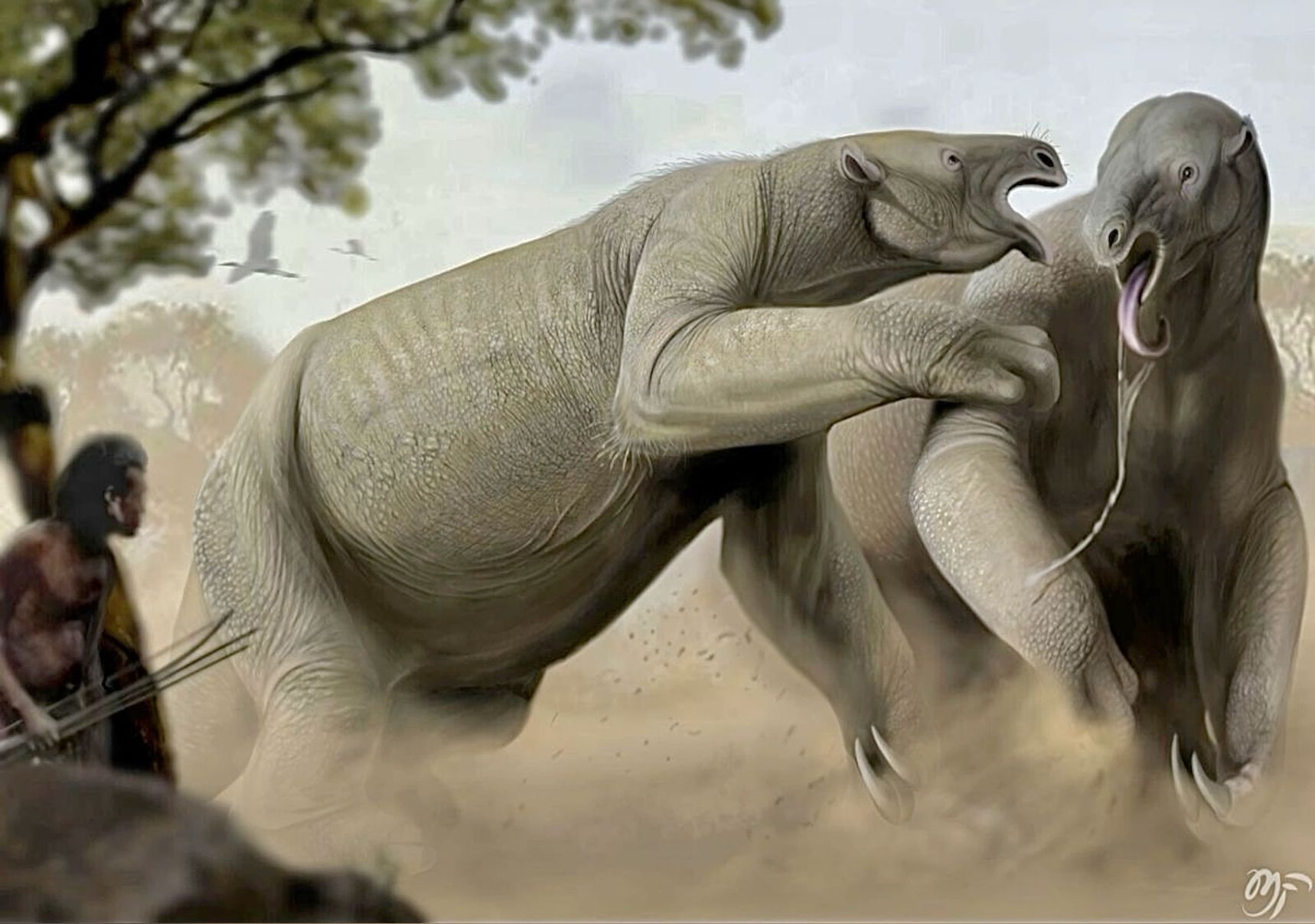
The giant ground sloth is the common English name for a group of enormous, long-extinct mammals that once dominated the Americas. The most famous of them, Megatherium americanum, stood taller than an elephant when it reared up on its hind legs, weighed as much as four tonnes, and carried 30-centimetre claws on its forelimbs.
It was not a single unusual creature but the flagship of a sprawling radiation of ground-dwelling sloths that thrived across South and North America for more than five million years before vanishing at the end of the last Ice Age.
This guide covers the giant ground sloth as a scientific subject and as a cultural phenomenon. It walks through the taxonomy, anatomy, diet, habitat, extinction, and historical importance of Megatherium and its close relatives Megalonyx, Mylodon, Eremotherium, and Glossotherium. It is a reference entry, not a summary - expect specifics: metres, tonnes, radiocarbon dates, fossil localities, and named specimens.
Etymology and Classification
The genus name Megatherium was coined by Georges Cuvier in 1796 from the Greek megas ("great") and therion ("beast"). The species name americanum reflects its New World origin. Cuvier worked from a nearly complete skeleton collected near the Lujan River in Argentina in 1788 and shipped to the Royal Cabinet of Natural History in Madrid, where it was mounted in 1795. That mount, still on display today, is the oldest complete skeleton of an extinct vertebrate ever assembled for public view.
Giant ground sloths belong to the order Pilosa within the superorder Xenarthra, a mammalian radiation that evolved in isolation on the island continent of South America for tens of millions of years. Xenarthra today includes the armadillos (order Cingulata) and the anteaters plus sloths (order Pilosa).
The two living genera of tree sloths - Bradypus (three-toed) and Choloepus (two-toed) - are the last survivors of a family line that once contained dozens of ground-dwelling genera in a range of sizes, from dog-sized forms to the four-tonne Megatherium.
Ancient protein sequences recovered from ground sloth bones have clarified the internal relationships of the group. Mylodon darwinii sits closer to the modern two-toed sloth Choloepus than to the three-toed Bradypus, which implies that living tree sloths arose from at least two independent ground sloth lineages that shrank in size and climbed into the trees. The giant ground sloths are therefore not a direct ancestor of modern sloths so much as their bulky cousins.
Taxonomy at a Glance
- Kingdom: Animalia
- Phylum: Chordata
- Class: Mammalia
- Order: Pilosa
- Suborder: Folivora
- Family: Megatheriidae (Megatherium, Eremotherium) / Mylodontidae (Mylodon, Glossotherium) / Megalonychidae (Megalonyx)
- Genus: Megatherium
- Species: M. americanum
Size and Physical Description
Megatherium americanum was one of the largest land mammals ever to walk the Americas. The dimensions below refer to fully grown adult M. americanum. Related species were smaller but still enormous by modern standards.
Body dimensions:
- Length (nose to tail tip): approximately 6 metres
- Standing height on hind legs: up to 6 metres
- Shoulder height on all fours: roughly 2 metres
- Estimated mass: 3,500-4,000 kilograms
- Skull length: approximately 65-70 centimetres
Limbs and claws:
- Forelimb claws: up to 30 centimetres along the outer curve
- Hind feet: short, broad, with weight borne on the outer edge
- Tail: thick, muscular, used as a tripod support when standing
Relative species sizes:
| Species | Length | Weight | Range |
|---|---|---|---|
| Megatherium americanum | ~6 m | 3.5-4 tonnes | Argentine pampas, southern Brazil |
| Eremotherium laurillardi | ~6 m | 3-4 tonnes | North, Central, and northern S. Am. |
| Mylodon darwinii | ~3 m | 1-1.5 tonnes | Patagonia, southern Argentina/Chile |
| Glossotherium robustum | ~2.8 m | ~1 tonne | Argentina, Uruguay, Brazil |
| Megalonyx jeffersonii | ~3 m | ~1 tonne | Across North America |
At the upper end of the size range, Megatherium was comparable in mass to a modern African bush elephant but differently proportioned. Its torso was short and deep, its hindquarters massive, and its forequarters relatively slim. The bones of the pelvis and the base of the tail are robust beyond anything seen in living mammals, a structural hint that the animal spent long periods rearing up on its hind legs with the tail acting as a third leg.
The forelimbs carried three recurved claws, the largest reaching 30 centimetres along the outer curve. These claws forced the animal to walk on the outer edges of its forefeet rather than flat-palmed. Similar outer-edge walking posture is visible in the fossilised trackways known as Megatherichnum preserved in late Pleistocene sediments of Argentina.
Skin, Hair, and Osteoderms
Remarkably, direct evidence of giant ground sloth skin and hair survives for several species, thanks to desiccation inside dry caves.
The Cueva del Milodon in Chilean Patagonia, explored in the 1890s, yielded a hide of Mylodon darwinii with bristly reddish hair several centimetres long. Embedded in that skin were hundreds of small bony ossicles - osteoderms - roughly the size of peas. These osteoderms, packed densely beneath the fur, would have functioned as a kind of armour, far thinner than the bony shell of an armadillo but still a meaningful defence against predator bites.
Similar preserved skin and dung have been recovered from Gypsum Cave in Nevada (from Nothrotheriops shastensis), from Rampart Cave in Arizona, and from caves in north-western Argentina. Radiocarbon dating of this material has produced direct ages on sloth soft tissue, some of the youngest falling between 13,000 and 11,000 years ago - the final centuries of ground sloth existence on the continental mainland.
Whether Megatherium itself carried osteoderms in its skin is uncertain. Isolated ossicles have occasionally been reported from Megatherium-bearing sediments, but they have not yet been found in clear anatomical association with the species.
Movement and Posture
Giant ground sloths were quadrupedal walkers adapted to slow, powerful, weight-bearing locomotion. The forelimbs were shorter than the hind limbs, so the animal's back sloped upward toward its massive pelvis. The hind feet were broad and short, with the ankle rotated so that the weight of the body passed down the outer edge of the foot. The forefeet were similar, forcing the animal to curl its claws under and walk on the knuckles and outer sole.
Trackway evidence and biomechanical modelling both suggest Megatherium walked at perhaps 1-2 kilometres per hour in relaxed travel, with short bursts of faster movement possible when threatened. Bipedal standing was almost certainly a routine posture, not just an emergency display. The pelvis is enormously broad, the sacrum is fused, and the base of the tail is built up into a massive support structure.
Reconstructed muscle attachments on the femur, pelvis, and caudal vertebrae are consistent with an animal that spent long stretches reared upright to feed, using its tail as the third leg of a stable tripod.
This posture gave Megatherium access to leaves and branches at heights modern elephants cannot comfortably reach. An adult rearing up could browse at 5-6 metres from the ground, which helped the species exploit woodland canopies in southern South America during the Pleistocene.
Diet
Megatherium americanum was primarily a browser. A combination of anatomical evidence, isotope chemistry, and preserved gut contents converges on a diet dominated by:
- Leaves and soft woody shoots from shrubs and low trees
- Fibrous desert plants such as yucca (evidenced from North American relatives)
- Bark and soft wood stripped by the foreclaws
- Fruits and seed pods where available
- Some grasses and low vegetation in open country
The teeth are simple, ever-growing, high-crowned pegs of prism-like dentine. They are unlike the complex grinding molars of ruminants and more like the teeth of a modern rodent scaled to tonnage. The jaw muscles were enormous, attached to bony crests on a deep skull, and the lower jaw joint allowed a strong front-to-back grinding motion. That biomechanical system suggests an animal that needed to crush tough plant material slowly and thoroughly.
The jaw could, by some estimates, deliver bite forces in the hundreds of kilograms, strong enough to sever woody stems several centimetres thick. Combined with the long foreclaws that could hook and pull branches within reach, Megatherium would have functioned as a large-scale woodland pruner - an ecological role similar to that of modern elephants but applied to shrubs and small trees rather than mature forest.
Some researchers, notably Richard Farina, have proposed that Megatherium supplemented its diet with scavenged meat from predator kills and perhaps even occasional active predation. That hypothesis remains a minority view. Most dental microwear, isotope, and gut content evidence points to a primarily herbivorous animal.
Habitat and Geographic Range
Megatherium americanum inhabited the woodlands, savannas, and pampas of what is now Argentina, Uruguay, Bolivia, Paraguay, and southern Brazil from approximately 400,000 years ago to around 11,000-10,000 years ago. Fossil localities cluster in the Lujan Formation and related Pleistocene deposits of the Argentine pampas, where waterlogged stream sediments preserved remarkably complete skeletons.
The wider Megatheriidae ranged much farther. Eremotherium laurillardi, a close relative of similar size, occupied Central America, northern South America, and much of the southern United States. Megalonyx jeffersonii, a different family line, ranged across most of North America, with fossils recovered from at least 35 U.S. states as well as Alaska and the Yukon.
Smaller West Indian ground sloths in the families Megalocnidae and Megalonychidae occupied Cuba, Hispaniola, and Puerto Rico until the mid-Holocene.
Key fossil localities:
| Locality | Country | Species |
|---|---|---|
| Lujan River basin | Argentina | Megatherium americanum |
| Campo Laborde | Argentina | Megatherium americanum |
| Cueva del Milodon (Ultima Esperanza) | Chile | Mylodon darwinii |
| Tarkio Valley | USA (Iowa) | Megalonyx jeffersonii |
| Rampart Cave | USA (Ariz.) | Nothrotheriops shastensis |
| Big Bone Lick | USA (Ky.) | Megalonyx jeffersonii |
| Daisy Cave / Talara | Peru | Eremotherium, Megatherium |
| Toca das Onas / Lagoa Santa | Brazil | Eremotherium laurillardi |
Life History and Reproduction
No soft tissue preserves enough detail to reconstruct ground sloth reproductive biology directly. Inference comes from skeletal growth patterns, comparison with modern sloths and other large mammals, and the few juvenile specimens that have been recovered.
The best estimates suggest that Megatherium produced a single offspring per breeding event, with multi-year gaps between births - a slow reproductive schedule typical of large, long-lived mammals. Juveniles would have been large at birth and probably remained with the mother for an extended period, a pattern seen in modern xenarthrans and in most megaherbivores.
Growth was slow. Cross-sections of long bones show numerous growth lines before the animal reached adult size. Life expectancy in the wild is difficult to estimate but likely ran into several decades, consistent with the low reproductive rate.
A slow-reproducing, long-lived herbivore is ecologically stable in the absence of heavy predation but extremely vulnerable to any source of consistent adult mortality. That vulnerability is central to current thinking on why ground sloths vanished so rapidly during the late Pleistocene.
Extinction
Giant ground sloths disappeared during the late Quaternary megafauna extinction event, which wiped out roughly two-thirds of South America's large mammals and more than 70 per cent of North America's between about 14,000 and 10,000 years ago. The last reliably dated mainland Megatherium americanum fossils fall around 11,000-10,000 years ago. The last Mylodon darwinii dates cluster around 10,200 years.
North American Megalonyx jeffersonii bones extend to about 11,200 years. West Indian ground sloths on Cuba and Hispaniola persisted until roughly 4,400 years ago.
Two interacting pressures are widely accepted as the cause.
Climate change. The end of the last glacial period reorganised vegetation zones across the Americas. In southern South America the pampas dried and grass-dominated ecosystems expanded, while woodland mosaics contracted. Large browsers specialised on woody vegetation - Megatherium among them - lost habitat at the same time that faster cycles of drought and flooding stressed surviving populations.
Human arrival. Anatomically modern humans are confirmed in the Americas by at least 15,000 years ago, with some sites now dated earlier. Stone-tool cut marks on Megatherium bones at Campo Laborde in Argentina, dated to approximately 12,600 years ago, demonstrate direct hunting or butchery. The Arroyo del Vizcaino site in Uruguay preserves damage patterns on ground sloth bones consistent with human processing. In North America, Megalonyx remains have been recovered alongside Clovis artefacts.
Ground sloths were slow to mature and slow to reproduce. Even modest levels of additional adult mortality - from human hunting, stress from a warming climate, or competition with other herbivores - could drive a slow-reproducing megaherbivore to extinction within a few thousand years. The combination of climate change and human predation is sufficient to explain the pattern, and no single-cause hypothesis has held up as well.
West Indian species survived longer because humans reached Cuba, Hispaniola, and Puerto Rico thousands of years later than they reached the mainland. When humans did arrive, those populations collapsed on broadly the same timescale as the earlier mainland extinctions.
Relationship with Modern Sloths
Modern tree sloths weigh 3-8 kilograms, hang upside down in rainforest canopies, and move so slowly that green algae grow in their fur. Megatherium, at 4,000 kilograms, walked the pampas on its knuckles and fore-edges of its feet, reared upright to pull down branches, and swung 30-centimetre claws. The contrast is difficult to overstate.
Both share features that mark them as members of Xenarthra: simplified, peg-like teeth lacking enamel in some lineages, unique accessory joints between the lumbar vertebrae, and distinctive skeletal fusions around the hips. Genetic evidence recovered from ground sloth collagen and other ancient proteins confirms that living tree sloths are not sister taxa.
The two-toed sloth Choloepus is closer to Mylodon than to the three-toed Bradypus, meaning the two living sloth genera arose from different branches of the ground sloth radiation independently shrinking and climbing.
In other words, modern tree sloths are not direct descendants of Megatherium. They are the reduced, arboreal survivors of a once-vast adaptive radiation that included Megatherium, Mylodon, Megalonyx, Eremotherium, and dozens more named genera.
Role in the History of Science
Ground sloths sit at several foundational moments in the history of palaeontology.
Georges Cuvier and extinction as a real phenomenon. Cuvier's 1796 description of Megatherium americanum was one of the early pillars of his argument that entire species can and do go extinct. Before Cuvier, the idea that God would allow species to vanish was theologically contentious. Megatherium was so obviously unlike any living animal that extinction became difficult to avoid as an explanation.
Thomas Jefferson and the birth of American palaeontology. In 1797 Jefferson received a set of large fossil claws and leg bones from a cave in Greenbrier County, Virginia. He initially thought they belonged to a lion-sized predator. In 1799 he presented a formal paper to the American Philosophical Society describing the creature as Megalonyx ("great claw").
The 1799 paper is the first scientific description of a prehistoric mammal published in the United States and a foundational document of American palaeontology. The species was later formally named Megalonyx jeffersonii in his honour.
Charles Darwin and the Beagle fossils. During the 1832-1833 legs of the Beagle voyage, Darwin excavated ground sloth fossils at Punta Alta and Monte Hermoso in Argentina and in Uruguay. The specimens he shipped home to Richard Owen included Megatherium, Mylodon, Scelidotherium, and Glossotherium.
Seeing enormous extinct relatives of modern tree sloths living in the same general region as their small descendants helped crystallise Darwin's emerging ideas about descent with modification. He wrote about this "law of succession of types" in later editions of the Voyage of the Beagle and in his notebooks of 1837-1838.
The Mylodon cave episode. The 1895 discovery of partially preserved skin, hair, and dung of Mylodon darwinii in Cueva del Milodon caused a sensation. Some early reports suggested the specimens might be only a few years old, raising the possibility that the animal still lived somewhere in Patagonia. Bruce Chatwin's 1977 book In Patagonia revisits that romantic misreading in detail.
Radiocarbon dating later established that the youngest Mylodon tissue is roughly 10,200 years old, but the cave remains one of the most evocative palaeontological sites in the world.
Related Reading
- Glyptodon: The Armored Giant of the Americas
- Sabertooth Cat: Smilodon and the Ice Age Predators
- Woolly Mammoth: Ice Age Giant and De-Extinction
- Megafauna: Why the World's Largest Animals Disappeared
- Dire Wolf: Ice Age Predator
References
Relevant peer-reviewed and institutional sources consulted for this entry include the American Museum of Natural History Megatherium specimen descriptions, the Smithsonian National Museum of Natural History Xenarthra collections, published work by Richard A. Farina and Sergio F.
Vizcaino on ground sloth biomechanics, the Campo Laborde excavation reports in Science Advances and the Journal of Archaeological Science, Cuvier's 1796 Notice sur le squelette d'une tres grande espece de quadrupede and the 1799 Jefferson paper in the Transactions of the American Philosophical Society.
Radiocarbon chronology for ground sloth extinction draws on the compiled dataset published in Quaternary Science Reviews and related late Quaternary extinction literature.
Frequently Asked Questions
How big was the giant ground sloth?
Megatherium americanum was among the largest land mammals of the late Pleistocene. An adult measured roughly 6 metres from snout to tail tip and weighed an estimated 3,500-4,000 kilograms, making it comparable in mass to a modern African bush elephant. When it reared up on its hind legs and tail - a posture supported by its massive pelvis and column-like hind limbs - it could reach close to 6 metres in vertical height, taller than any living land mammal.
North America’s Megalonyx jeffersonii was smaller at roughly 1 tonne and 3 metres long, while the Patagonian Mylodon darwinii reached about 1.5 tonnes. Even the smallest recognised ground sloth adults weighed many times more than any modern sloth species.
What did giant ground sloths eat?
Megatherium was a browser specialised for reaching, stripping, and chewing tough woody vegetation. Isotope studies of tooth enamel and preserved dung indicate a diet dominated by leaves, yucca, soft bark, twigs, and fibrous branches from shrubs and low trees. The enormous jaw muscles and deep, hypsodont (high-crowned) cheek teeth allowed the animal to bite through woody stems that would have stopped most modern herbivores.
Standing upright on its hind legs with the tail as a third support, it could pull branches down using its long foreclaws, then grind them in a powerful slow-moving jaw. Some researchers have proposed that Megatherium also scavenged meat opportunistically, but the bulk of fossil evidence - tooth wear, gut contents, dental microwear - points to a primarily herbivorous lifestyle.
Where did giant ground sloths live?
The family Megatheriidae originated in South America during the Oligocene and diversified across the continent through the Miocene and Pliocene. Megatherium americanum itself ranged across the woodlands, savannas, and pampas of what is now Argentina, Uruguay, Bolivia, Paraguay, and southern Brazil from roughly 400,000 years ago until the end of the Pleistocene.
Related genera - Eremotherium, Mylodon, Glossotherium - lived across much of South and Central America. During the Great American Biotic Interchange, several ground sloth lineages crossed into North America, where Megalonyx jeffersonii eventually reached Alaska, the Yukon, and Florida. West Indian ground sloths, smaller in size, colonised Cuba, Hispaniola, and Puerto Rico and persisted there for millennia after their mainland relatives had gone extinct.
When did giant ground sloths go extinct and why?
Megatherium americanum and most other ground sloths disappeared during the late Quaternary extinction event, roughly 12,000-10,000 years ago. Two interacting pressures are generally accepted as the cause. The first is climate change: the end of the last glacial period reorganised vegetation zones, dried parts of the pampas, and shrank the woodland mosaics that large browsers depended on.
The second is the arrival of anatomically modern humans in the Americas, first confirmed by archaeology at least 15,000 years ago and arguably earlier. Butchered Megatherium bones with stone-tool cut marks, notably at Campo Laborde in Argentina, show that humans did prey on these animals. Ground sloths reproduced slowly, probably producing one calf every few years, and could not recover from combined hunting and habitat change.
West Indian species survived thousands of years longer because humans reached those islands later.
What were the giant ground sloth's claws for?
Megatherium’s forelimbs carried three enormous recurved claws, the largest reaching 30 centimetres along the outer curve. They were almost certainly multi-purpose tools. Biomechanical studies suggest the claws were used to hook, pull, and strip branches from trees and shrubs during feeding, with the powerful shoulder and forearm muscles providing leverage to bring food within reach of the mouth.
The same claws would have been formidable defensive weapons against predators such as Smilodon populator and the terror bird Phorusrhacidae, especially when the sloth stood upright and swept its forelimbs in long arcs. Smaller ground sloths such as Mylodon and Glossotherium also used their claws for digging extensive burrow systems - some preserved in the Argentine and Brazilian pampas are wide enough for a human to walk through upright.
There is no strong evidence that Megatherium itself dug burrows, but its relatives clearly did.
How is the giant ground sloth related to modern sloths?
Giant ground sloths and modern tree sloths both belong to the order Pilosa within the superorder Xenarthra, which also contains armadillos and anteaters. Xenarthrans share unique vertebral joints and other skeletal features that unite them as a distinct mammalian radiation that evolved in isolation while South America was an island continent.
Within Pilosa, ground sloths and tree sloths diverged tens of millions of years ago, and the two surviving tree sloth genera - Bradypus (three-toed sloths) and Choloepus (two-toed sloths) - are not each other’s closest relatives. Genetic work on proteins recovered from ground sloth fossils indicates that Mylodon is closer to Choloepus than to Bradypus, meaning modern tree sloths arose independently from different ground sloth lineages.
The living sloths are therefore tiny, arboreal survivors of a once-enormous radiation that included both Megatherium and the 1.5-tonne Mylodon.
What role did giant ground sloths play in the history of science?
Ground sloths sit at the origin of several key moments in palaeontology. Georges Cuvier’s 1796 description of Megatherium americanum, based on a skeleton sent from Argentina to Madrid, helped establish that species can go extinct - a radical claim at the time.
In 1799 Thomas Jefferson presented a paper to the American Philosophical Society describing claws from a Virginia cave and named the creature Megalonyx, the first scientific paper on a prehistoric mammal published in the United States.
Charles Darwin collected ground sloth fossils including Mylodon, Scelidotherium, and a giant Megatherium skull during the 1832-1833 legs of the Beagle voyage in Argentina and Uruguay, and those specimens were among the evidence he used to argue for deep time and descent with modification.
The late 19th century Cueva del Milodon discoveries in Chile, which produced remarkably preserved sloth skin and dung, captured public imagination and briefly fuelled speculation about surviving populations.
Did humans ever see or hunt giant ground sloths?
Yes. Multiple archaeological sites show direct contact between humans and ground sloths in the Americas. At Campo Laborde in the Argentine pampas, excavations have yielded Megatherium bones with unambiguous stone-tool cut marks dated to around 12,600 years ago. The Arroyo del Vizcaino site in Uruguay preserves numerous ground sloth remains with patterns of damage consistent with human butchery and use.
In North America, sites such as Tarkio Valley in Iowa preserve Megalonyx alongside Clovis-era artefacts. Smaller West Indian ground sloths on Cuba and Hispaniola apparently persisted until at least 4,400 years ago, well into the period of human occupation of those islands, before finally vanishing.
The weight of evidence points to humans and giant ground sloths coexisting for thousands of years, with hunting contributing - alongside climate change - to their final disappearance.