
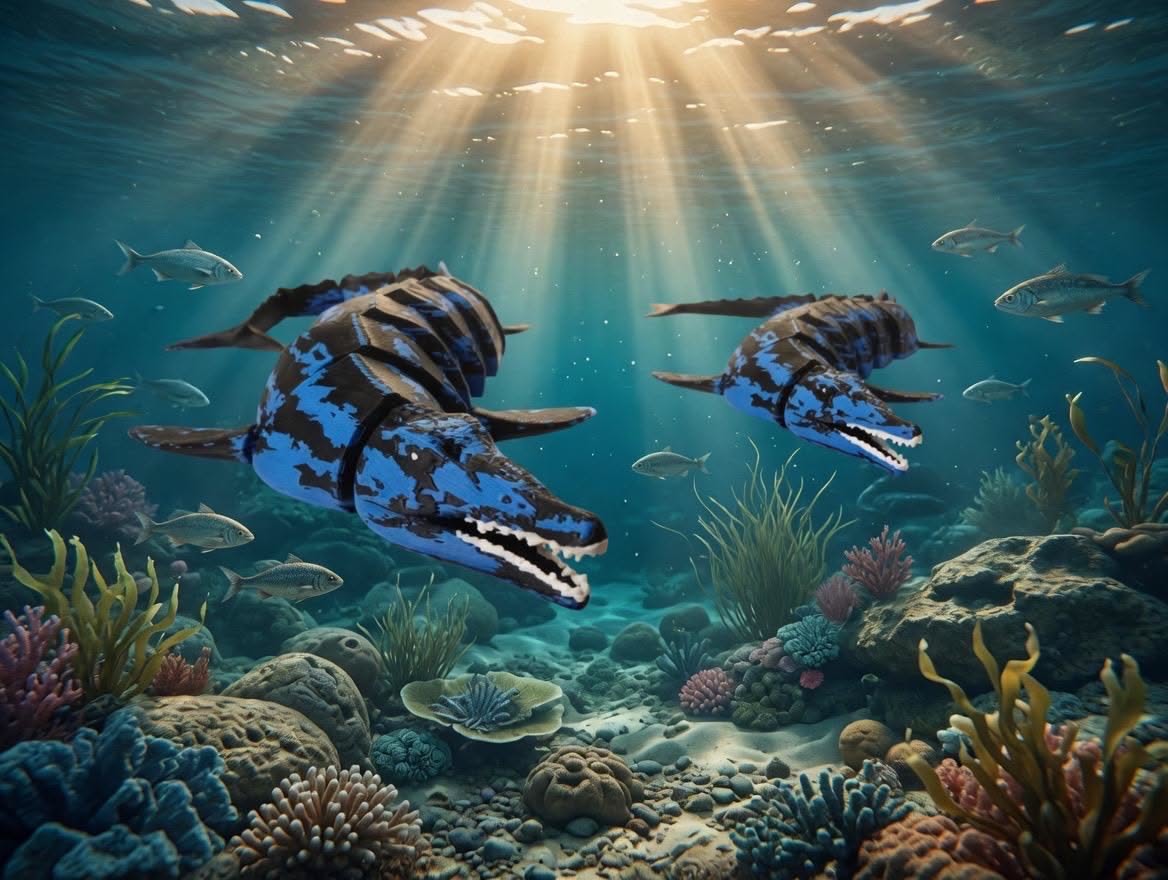
Basilosaurus is one of the strangest and most important whales ever to appear in the fossil record. It lived during the late Eocene, roughly 41 to 34 million years ago, in the warm shallow seas that once covered the southern United States, North Africa, and large tracts of what is now the Middle East.
Basilosaurus cetoides was an apex predator of those seas - a slender, 16 to 20 metre, six-tonne cetacean with a crushing bite, triangular serrated rear teeth, and tiny vestigial hind legs still dangling from a body that had long since committed itself to the water.
The species is also a monument to how badly early palaeontologists could misread a skeleton. The genus name literally means 'king lizard', given in 1834 when its fossil vertebrae were mistaken for those of a giant marine reptile. It is, in fact, a mammal.
This guide covers every aspect of Basilosaurus biology and history that the fossil record supports: anatomy, size, bite, hunting, evolution, discovery, and the place Basilosaurus holds in the story of how land mammals became whales. Expect specifics - metres, newtons, millions of years, and the ongoing scientific disagreements about what its anatomy really tells us.
Etymology and a Famous Misidentification
The name Basilosaurus comes from the Greek basileus (king) and sauros (lizard). It is one of the most notorious misnomers in vertebrate palaeontology.
The story begins in the 1830s in Louisiana, where farmers ploughing fields along the Ouachita River kept turning up enormous vertebrae - smooth, barrel-shaped bones so large that some were repurposed as doorstops, fireplace andirons, and even building material.
In 1834 a selection of these vertebrae reached the American physician and naturalist Richard Harlan, who concluded that the animal had to be an aquatic reptile of some kind, probably a sea serpent or an oversized mosasaur-like creature. He published the name Basilosaurus the same year.
A few years later the British comparative anatomist Richard Owen examined the same material and noticed something Harlan had missed. The teeth were heterodont - different shapes in different parts of the jaw - which is a mammalian trait, not a reptilian one. The inner ear structures were also mammalian. Owen argued the animal was a cetacean, a whale, and proposed the alternative name Zeuglodon (meaning 'yoked tooth') to reflect this correction.
Zoological nomenclature, however, has a firm rule of priority. The first validly published name stands. Harlan's Basilosaurus had been published first and could not be overturned merely because the taxonomy was wrong. The whale was stuck with a reptile's name. To this day the species is formally Basilosaurus cetoides - 'king lizard, whale-like' - which preserves the original error inside the scientific name itself.
Full taxonomic placement:
- Kingdom: Animalia
- Phylum: Chordata
- Class: Mammalia
- Order: Cetacea
- Family: Basilosauridae
- Genus: Basilosaurus
- Species: B. cetoides
Size and Physical Description
Basilosaurus was one of the largest animals of the late Eocene and the longest marine mammal of its time. It did not, however, look like a modern whale.
Size:
- Length: 16-20 metres
- Mass: approximately 6 tonnes
- Skull length: up to 1.5 metres
- Individual vertebra length: up to 40-50 cm
- Hind limb length: approximately 60 cm (vestigial)
For an animal that long, six tonnes is astonishingly light. A modern sperm whale of the same length would weigh anywhere from 30 to 50 tonnes. The reason is Basilosaurus's body shape. Where modern whales are deep-bodied and torpedo-like, Basilosaurus was long, slender, and eel-shaped. Its vertebrae were elongated rather than compact, producing a trunk that undulated horizontally through the water more like an oversized otter or an enormous sea serpent than a contemporary cetacean.
This serpentine body plan is one of the most distinctive features of the genus. Early reconstructions in the 19th century, influenced by Harlan's initial reptilian misidentification, drew Basilosaurus as a coiled sea monster. The reality is less dramatic but still strange: a huge, aquatic mammal with a body proportioned like no modern whale.
Some palaeontologists have argued the animal swam by vertical undulation like living cetaceans; others have proposed a more horizontal, eel-like motion driven by the long lumbar section of the spine.
The head was large and heavily built, with powerful jaw muscles anchored to a pronounced sagittal crest. The neck was short, the ribcage narrow, and the tail ended in a horizontally oriented fluke - a classic cetacean feature that cements Basilosaurus firmly in the whale family rather than the reptile camp that its name implies.
The Vestigial Hind Legs
No single feature of Basilosaurus has attracted more attention than its hind limbs. They are visible, complete, and useless.
Each hind leg measured roughly 60 centimetres long. Every part of a functioning mammalian leg was present in miniature: femur, knee joint, tibia, fibula, ankle, and three small toes. The limbs, however, were not connected to the vertebral column in any load-bearing way. There was no weight-bearing pelvic attachment to support movement on land. Even if Basilosaurus had somehow beached itself, the legs could not have held its six-tonne body up.
Their function has been debated for more than a century. The most common interpretations include:
- Entirely vestigial. The hind legs are a leftover from Basilosaurus's fully terrestrial ancestors, retained because they had not yet been fully lost through evolution.
- Mating guides. A well-developed muscular structure and articulation suggest some researchers have proposed the limbs were used during copulation, much as modern snakes retain small pelvic spurs for the same purpose.
- Hydrodynamic role. Less favoured today, but some 20th-century analyses suggested the limbs could have functioned as small rudders or stabilisers during slow swimming.
Whatever their exact function, the legs are one of the most cited pieces of anatomical evidence for cetacean evolution from land mammals. Modern whales retain vestigial pelvic bones floating inside the musculature of the body wall, but no living whale has external legs. Basilosaurus sits at the point in that transition where the external limbs were still present, still identifiable, but no longer doing any real work.
The Skull and the Strongest Mammalian Bite
Basilosaurus had a large, heavily muscled skull adapted for active predation on large prey. A 2015 biomechanical study using computed tomography scans and finite element analysis estimated the species' bite force at approximately 16,400 newtons. No mammal ever measured - living or extinct - has produced a higher estimate.
For context:
- Lion: ~4,500 N
- Jaguar: ~5,500 N
- Spotted hyena: ~4,500 N
- Hippopotamus: ~8,000 N
- Saltwater crocodile: ~16,400 N
- Basilosaurus: ~16,400 N
- Great white shark: ~18,000 N
- Megalodon: 108,000-182,000 N (estimate)
Basilosaurus's jaw matched a crocodile's crushing power in a mammal's body. The teeth were heterodont, a critical clue that earlier anatomists used to unmask its mammalian identity. The front teeth were conical and slightly recurved - ideal for seizing slippery, struggling prey such as fish or small cetaceans. The rear teeth were triangular, multi-cusped, and heavily serrated, designed for slicing through blubber, muscle, and bone once prey was restrained.
Tooth wear patterns are extreme. Nearly every adult skull shows heavy grinding along the serrated edges and bone-contact fractures on the front teeth, consistent with repeated bite-and-shear attacks on large prey.
Hunting and Diet
Basilosaurus was an apex predator. Everything about its anatomy - the bite, the teeth, the body length, the powerful neck musculature - points to a large, active hunter capable of taking down substantial prey.
Documented and inferred prey:
- Large bony fish
- Sharks (tooth marks on shark vertebrae from Egyptian Basilosaurus localities)
- Dorudon atrox (a smaller contemporary whale in the same family)
- Juvenile and calf Dorudon in particular
- Other small basilosaurids
- Possibly sirenians (sea cows) in coastal waters
The most remarkable evidence comes from Wadi Al-Hitan in Egypt. Stomach contents preserved inside articulated Basilosaurus skeletons include identifiable fish remains and the bones of juvenile Dorudon. Bite-marked Dorudon skulls in the same formation show puncture patterns and shearing damage that match Basilosaurus tooth morphology exactly.
The implication is that Basilosaurus targeted other whales, with a clear preference for juveniles. This makes Basilosaurus one of the earliest known cases of cetacean-on-cetacean predation - a behavioural pattern that would not re-emerge clearly until orcas evolved tens of millions of years later. The hunting method almost certainly involved ambushing or chasing down prey in relatively shallow coastal water and using the powerful jaws to crush the prey's head or neck in a single strike.
Habitat and Geographic Range
Basilosaurus lived in the warm, shallow, tropical to subtropical seas of the late Eocene. At that time Earth was substantially warmer than today, sea levels were higher, and large shallow seas covered regions that are now dry land. Basilosaurus inhabited the margins of these seas, where productivity was high and prey was concentrated.
Key fossil localities:
| Region | Setting | Notes |
|---|---|---|
| Alabama, USA | Gulf Coastal Plain sediments | Official state fossil; abundant material |
| Mississippi, USA | Yazoo Clay and related formations | Also a state fossil |
| Louisiana, USA | Jackson Group sediments | Original discovery location (1834) |
| Wadi Al-Hitan, Egypt | Former Tethys Sea bay | UNESCO site; hundreds of whale skeletons |
| Pakistan | Eocene coastal sediments | Related basilosaurid material |
| Jordan | Tethys-margin sediments | Limited but confirmed fossils |
The Egyptian site is the global centre of Basilosaurus research. The Valley of the Whales, inscribed as a UNESCO World Heritage Site in 2005, preserves dozens of articulated Basilosaurus skeletons - some over 18 metres long - lying exposed on the desert surface in the same positions they settled on the Eocene sea floor tens of millions of years ago. No other site on Earth offers anything comparable for early cetacean research.
Discovery, Naming, and Scientific History
The discovery arc of Basilosaurus spans nearly two centuries and tracks the broader history of vertebrate palaeontology.
Timeline:
- 1832-1834: Enormous vertebrae surface on plantations in Louisiana and Alabama. Some are used as domestic objects before being recognised as fossils.
- 1834: Richard Harlan names Basilosaurus, interpreting the animal as a giant marine reptile.
- 1839: Richard Owen recognises mammalian features and proposes the name Zeuglodon, but priority rules retain Basilosaurus.
- 1845: Albert Koch assembles a chimeric 35-metre 'sea serpent' from multiple Basilosaurus skeletons and tours it through Europe as Hydrarchos. The hoax is exposed, but the name Basilosaurus becomes a household curiosity.
- 1984: Basilosaurus is declared the official state fossil of Alabama.
- Late 20th century: Philip Gingerich and colleagues describe articulated Basilosaurus specimens from Wadi Al-Hitan, including partial hind limbs - a landmark result for cetacean evolutionary studies.
- 2005: Wadi Al-Hitan is inscribed as a UNESCO World Heritage Site.
- 2009: A Smithsonian team publishes new reconstruction work on Basilosaurus skull mechanics and jaw function, including a widely publicised dissection-style analysis of existing museum specimens.
- 2015: Biomechanical analysis produces the 16,400 N bite force estimate, placing Basilosaurus at the top of the mammalian bite force ranking.
Today Basilosaurus specimens form centrepieces in the Smithsonian National Museum of Natural History, the Alabama Museum of Natural History, the University of Michigan Museum of Paleontology, and the Wadi Al-Hitan site museum, among others.
Basilosaurus and the Evolution of Whales
Basilosaurus is not a direct ancestor of modern whales. It is a cousin - a late Eocene representative of the family Basilosauridae, one side branch of which gave rise to the two living groups of cetaceans: toothed whales (odontocetes) and baleen whales (mysticetes).
What makes Basilosaurus central to whale evolution is not lineage but anatomy. By the late Eocene, basilosaurids had reached a clear evolutionary milestone: they were fully aquatic. Earlier whale ancestors - pakicetids, ambulocetids, remingtonocetids, and protocetids - had retained some capacity to move on land or to give birth on shore. Basilosaurus could do neither.
Its hind limbs were too small and too disarticulated from the pelvis to support any terrestrial locomotion. Its ears were fully adapted to underwater hearing, with isolated ear bones and fat-filled jaw channels that transmit sound from the water to the inner ear - the same system used by living toothed whales. Its nasal opening had migrated partway up the skull toward the modern blowhole position. Its tail ended in a horizontal fluke.
Basilosaurus is therefore a transitional form, but in a specific sense. It represents the anatomical stage at which whale ancestors had fully committed to the water. Modern whales descended from smaller, more modestly sized basilosaurid relatives that continued into the Oligocene and diversified from there. Basilosaurus itself, with its extreme body elongation and serpentine plan, is a specialised offshoot that went extinct at the end of the Eocene.
Extinction
Basilosaurus disappeared from the fossil record around 34 million years ago, at the end of the Eocene. No single factor is usually cited as the cause. Instead, the extinction is associated with a suite of global changes known collectively as the Eocene-Oligocene transition.
Environmental changes at the end of the Eocene:
- Global cooling. Earth's climate cooled sharply. Polar ice sheets began to form in Antarctica for the first time in tens of millions of years.
- Sea level drop. Expanding ice reduced ocean volume. Shallow continental seas contracted or drained entirely.
- Habitat loss. The warm shallow seas where Basilosaurus hunted contracted sharply, removing much of the species' preferred habitat.
- Ecosystem reorganisation. Cooler, deeper oceans favoured different prey distributions and different predator body plans. Basilosaurus's serpentine, shallow-water design was poorly suited to the new regime.
Every basilosaurid genus went extinct during or soon after this transition. Modern whales descend from lineages that survived the bottleneck and diversified into the cooler, deeper oceans of the Oligocene. Basilosaurus, spectacular as it was, did not make the crossing.
Cultural Legacy and Public Recognition
Basilosaurus has an unusually active cultural presence for an animal that has been extinct for 34 million years.
- State fossil of Alabama (1984): Adopted after concerted campaigning by school children and local palaeontologists. Classrooms across the state still use Basilosaurus in introductory geology units.
- State fossil of Mississippi (1981): Slightly earlier adoption, based on the rich Yazoo Clay material from Mississippi localities.
- Wadi Al-Hitan (UNESCO, 2005): One of the few UNESCO World Heritage Sites dedicated primarily to a prehistoric animal. Visitors can walk among exposed Basilosaurus skeletons preserved in the desert.
- Museum displays worldwide: Full skeleton mounts at the Smithsonian, the University of Michigan, Alabama museums, and several European institutions.
- Popular reconstructions: Television documentaries including Walking with Beasts (2001) reconstructed Basilosaurus as a serpentine apex predator, introducing the animal to millions of viewers.
- Hoax history: The 19th-century Hydrarchos hoax, in which Albert Koch assembled chimeric Basilosaurus skeletons into a fictional sea serpent for public exhibition, remains one of palaeontology's better-known cautionary tales.
Related Reading
- Megalodon: The Largest Shark That Ever Lived
- Mosasaurus: The Cretaceous Sea Monster
- Prehistoric Marine Life: Monsters of the Ancient Seas
References
Relevant peer-reviewed and institutional sources consulted for this entry include published research in the Journal of Vertebrate Paleontology, PLOS ONE, and Palaeontologia Electronica; University of Michigan Museum of Paleontology Basilosauridae specimen records; Smithsonian National Museum of Natural History cetacean evolution documentation; UNESCO nomination and periodic reporting for Wadi Al-Hitan (2005 and later); Alabama Museum of Natural History public records on the 1984 state fossil designation; and Gingerich et al. studies of basilosaurid hind-limb anatomy.
Size, bite force, and temporal range figures reflect consolidated estimates from the most recent published analyses.
Frequently Asked Questions
How big was Basilosaurus?
Basilosaurus (Basilosaurus cetoides) reached 16 to 20 metres in length, making it one of the largest animals of the late Eocene. Mass estimates centre on roughly 6 tonnes. Its body was unusually slender for an animal of that length - far more elongated than any modern whale. A sperm whale of comparable length weighs five to ten times as much.
This serpentine, eel-like body plan is one of the reasons Basilosaurus looked so alien when its skeletons were first reconstructed. The skull alone measured up to 1.5 metres long, and individual vertebrae could exceed 40 cm, which is how the animal was initially misidentified as a marine reptile.
Was Basilosaurus actually a lizard?
No. Despite the name, Basilosaurus is a whale - a fully aquatic early cetacean. The misleading name dates to 1834, when the American physician and naturalist Richard Harlan received enormous fossil vertebrae from Louisiana and described them as belonging to a marine reptile, coining the name Basilosaurus, meaning ‘king lizard.’ British anatomist Richard Owen examined the same material a few years later and recognised the specimens as mammalian, specifically cetacean. By that point the reptilian name had priority under the International Code of Zoological Nomenclature and could not be changed.
Basilosaurus remains, to this day, a whale with a lizard’s name.
When did Basilosaurus live and when did it go extinct?
Basilosaurus lived during the late Eocene, roughly 41 to 34 million years ago. It patrolled the warm, shallow seas of the Tethys and the proto-Atlantic - waters that covered what is now the southern United States, North Africa, and parts of Pakistan and New Zealand. The species went extinct around the end of the Eocene, about 34 million years ago, in the wave of climate cooling and oceanic reorganisation that closed the period.
None of the basilosaurid whales survived into the Oligocene. Modern whales descended from closely related but distinct basilosaurid lineages that continued through the transition.
Why does Basilosaurus still have hind legs?
Basilosaurus’s hind legs are vestigial structures - evolutionary leftovers from its land-mammal ancestors. Early whales evolved from small four-legged mammals that returned to the water during the Eocene. By the time Basilosaurus appeared, those hind limbs had shrunk dramatically. Each leg was roughly 60 cm long, complete with a hip, knee, ankle, and toes, but no longer connected to the spine in any weight-bearing way.
They could not have supported the animal on land and were almost certainly non-functional for locomotion. Some researchers have speculated they may have played a role in mating, similar to the small pelvic spurs found in modern snakes and some whale embryos. Either way, their presence is one of the most visually striking pieces of evidence for whale evolution from terrestrial ancestors.
How strong was Basilosaurus's bite?
A 2015 biomechanical study of Basilosaurus skulls estimated the animal’s bite force at approximately 16,400 newtons. That is the highest bite force ever measured for any mammal, living or extinct. For comparison, a modern saltwater crocodile bites at roughly 16,000 newtons, a lion at about 4,500, and a great white shark at around 18,000.
Basilosaurus’s teeth were heterodont: front teeth were conical and designed for seizing slippery prey, while rear teeth were triangular, multi-cusped, and serrated - ideal for slicing through blubber, muscle, and bone. Bite-mark evidence on Dorudon skulls indicates Basilosaurus used its jaws to crush the heads of smaller whales rather than simply puncture them.
What did Basilosaurus eat?
Basilosaurus was an apex predator of the late Eocene seas. Its diet included large fish, sharks, and - critically - other marine mammals, including smaller cetaceans. The clearest evidence comes from Egypt’s Wadi Al-Hitan. Stomach content analysis and associated bite-marked skulls show Basilosaurus routinely preyed on Dorudon atrox, a smaller contemporary whale in the same family, with a strong preference for Dorudon calves.
This places Basilosaurus among the earliest known examples of a cetacean hunting other cetaceans - a behavioural pattern that would eventually re-emerge in orcas tens of millions of years later. The animal did not filter-feed; all evidence points to active, jaw-powered predation on large prey.
Is Basilosaurus an ancestor of modern whales?
Not directly. Basilosaurus belongs to the family Basilosauridae, which sits close to the ancestry of all living cetaceans but is a side branch rather than a direct line. Modern toothed whales (odontocetes) and baleen whales (mysticetes) descended from other basilosaurids - close cousins of Basilosaurus rather than Basilosaurus itself.
What Basilosaurus demonstrates is the anatomical stage that whale ancestors had reached by the late Eocene: fully aquatic, unable to return to land, equipped with underwater hearing, tail-driven propulsion, and shrinking hind limbs. In that sense it is a transitional form - not a step on the direct ladder to modern whales, but a clear snapshot of the biological transformation that produced them.
Where can Basilosaurus fossils be found?
Basilosaurus fossils are concentrated in two major regions. In the southeastern United States, rich deposits occur in Alabama, Mississippi, and Louisiana - part of a late Eocene coastline that is now well inland. Alabama adopted Basilosaurus as its official state fossil in 1984, and Mississippi followed in 1981. The world’s most important Basilosaurus locality, however, is Wadi Al-Hitan in Egypt’s Western Desert.
Known as the Valley of the Whales, this UNESCO World Heritage Site preserves hundreds of cetacean skeletons from a vanished Tethys bay, including dozens of articulated Basilosaurus specimens. Additional finds have been reported from Pakistan, Jordan, and other regions that border the ancient Tethys seaway.