
How big was megalodon, and could it still be alive in the deep ocean?
The largest of all prehistoric marine life, megalodon (Otodus megalodon), reached estimated lengths of 15 to 18 meters (50 to 60 feet) and weighed approximately 50 metric tons, making it the largest predatory fish that ever lived. Despite persistent internet claims and sensationalized television specials, megalodon is definitively extinct. The species disappeared approximately 3. 6 million years ago during the Pliocene epoch.
For more than three billion years, the oceans have been Earth's primary theater of evolution. Long before the first vertebrate dragged itself onto a mudflat, long before insects took to the air or dinosaurs shook the ground, the seas teemed with life forms of staggering diversity and, in many cases, terrifying size.
The creatures that ruled these ancient waters - armored fish with self-sharpening bone guillotines, shark relatives the length of a school bus, reptiles that gave live birth in open ocean, and tentacled predators whose lineages spanned four hundred million years - make the modern ocean look almost tame by comparison.
The story of prehistoric marine life is not a single narrative but a series of overlapping dynasties. Each era produced its own apex predators, its own ecological architectures, and its own catastrophic endings. Understanding these creatures is essential not merely as an exercise in paleontological curiosity but as a framework for understanding how marine ecosystems function, collapse, and rebuild over deep time.
"The sea, once it casts its spell, holds one in its net of wonder forever." - Jacques Cousteau
That net of wonder extends backward through hundreds of millions of years, to oceans we can reconstruct only through stone.
The Devonian Seas: When Fish Ruled as Titans
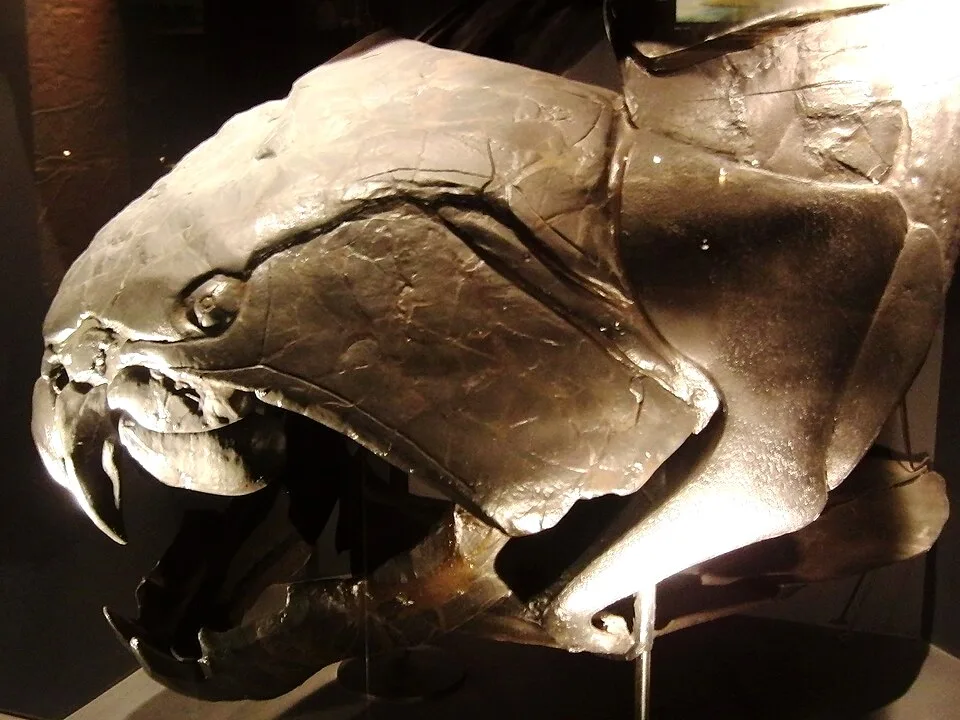
Dunkleosteus: The Armored Executioner
Approximately 380 million years ago, during the Late Devonian period, the apex predator of the world's oceans was not a shark, not a reptile, and not a mammal. It was a placoderm - a class of armored fish now entirely extinct - and its name was Dunkleosteus terrelli.
Dunkleosteus was a nightmare rendered in bone plate and muscle. Adults reached lengths of approximately 6 meters (20 feet) and weighed an estimated 1 metric ton. The anterior portion of the body was encased in thick, interlocking plates of dermal bone that functioned as both armor and weapon. Unlike modern fish, Dunkleosteus had no true teeth. Instead, it possessed paired bony plates along its jaw margins that formed a shearing mechanism of extraordinary efficiency.
Research led by Philip Anderson at the University of Chicago, published in Biology Letters in 2006, calculated that Dunkleosteus could generate a bite force of approximately 6,000 newtons at the tip of its jaw and over 7,400 newtons at the rear blade-like plates - comparable to the bite force of large modern crocodilians. More remarkably, the jaw mechanism could open and close in approximately 20 milliseconds, creating a powerful suction effect that drew prey into the closing blades.
The bony jaw plates were self-sharpening. The upper and lower plates occluded against each other in a way that continuously honed their edges through use, much like a pair of scissors maintains its cutting surface. This meant Dunkleosteus never experienced the dulling that afflicts toothed predators. Every bite was as clean as the first.
Dunkleosteus occupied the apex of a Devonian marine food web that included other large placoderms, early sharks, and abundant invertebrate prey. Its dominance ended with the Late Devonian extinction events around 375 to 360 million years ago, which wiped out the placoderms entirely and opened ecological space for sharks to diversify.
Trilobites: The First Complex Eyes in Earth's History
Before the great marine reptiles, before the armored fish, before even the ammonites, the oceans belonged to the trilobites. These arthropods - distant relatives of modern crabs, insects, and spiders - first appeared in the Early Cambrian period, approximately 521 million years ago, and persisted for an extraordinary 300 million years before finally succumbing to the Permian-Triassic extinction 252 million years ago.
Trilobites are among the most important fossils in the history of paleontology. Over 20,000 species have been described from every continent, including Antarctica. They ranged in size from species barely a millimeter long to Isotelus rex, which reached 72 centimeters (28 inches) in length.
Their most remarkable feature was their eyes. Trilobites possessed the earliest known complex visual systems in the fossil record. Most species had compound eyes composed of calcite lenses - a mineral that, unusually, provides optical clarity suitable for image formation.
Some trilobite species, such as those in the order Phacopida, had schizochroal eyes with individually separated lenses, each with its own cornea, capable of providing depth perception. The optical design of these lenses was so sophisticated that it corrected for spherical aberration - a problem that human lens-makers did not solve until the work of Descartes and Huygens in the seventeenth century.
Trilobites occupied virtually every marine ecological niche: burrowers, swimmers, reef-dwellers, planktonic drifters, and predators. Their 300-million-year reign makes them one of the most successful animal groups in Earth's history.
Ammonites: Index Fossils and a 400-Million-Year Dynasty
The ammonites were cephalopod mollusks - relatives of modern squid, octopuses, and nautiluses - that dominated the world's oceans from the Devonian period (approximately 400 million years ago) until their extinction at the Cretaceous-Paleogene boundary 66 million years ago. Their reign of roughly 340 million years makes them one of the longest-lived and most diverse groups of marine animals ever to exist.
Ammonites inhabited coiled, chambered shells that they used as buoyancy control devices. The animal occupied only the outermost chamber; the interior chambers were filled with gas and fluid, the proportions of which the animal could adjust to control its depth in the water column - the same principle employed by a submarine's ballast tanks.
Shell diameters ranged from under a centimeter in some species to over 2 meters (6.5 feet) in the giant Parapuzosia seppenradensis, the largest known ammonite.
Ammonites are of particular importance to geologists because they are among the most reliable index fossils in the stratigraphic record. Because ammonite species evolved rapidly, had wide geographic distributions, and are abundantly preserved, the presence of a particular ammonite species in a rock layer allows geologists to date that layer with remarkable precision. The Mesozoic Era is divided into dozens of ammonite biozones, each defined by a characteristic species or assemblage.
The closest living relative of the ammonites is the nautilus (Nautilus pompilius), a deep-water cephalopod found in the Indo-Pacific. Nautiluses occupy coiled, chambered shells and regulate buoyancy using the same gas-and-fluid mechanism as their ammonite relatives. However, nautiluses are far less diverse - only a handful of species survive today - and they lack the complex suture patterns that characterize ammonite shells.
Megalodon: The Largest Predatory Fish That Ever Lived
No prehistoric marine creature captures the public imagination quite like Megalodon (Otodus megalodon). This colossal shark patrolled the world's oceans from approximately 23 to 3.6 million years ago, during the Miocene and Pliocene epochs, and represents the absolute pinnacle of predatory fish evolution.
Size and Power
Megalodon size estimates are derived primarily from tooth measurements, since shark skeletons are cartilaginous and rarely fossilize. Individual megalodon teeth exceeding 17 centimeters (7 inches) in length have been recovered from fossil sites on every continent except Antarctica. Based on scaling relationships with modern great white shark dentition, researchers estimate that adult megalodon reached lengths of 15 to 18 meters (50 to 60 feet) and weighed approximately 50 metric tons.
A 2008 study by Stephen Wroe and colleagues at the University of New South Wales used computer modeling to estimate megalodon's bite force at between 108,000 and 182,000 newtons - roughly 10 to 18 times the bite force of a great white shark and the most powerful bite of any animal that has ever lived. For comparison, the bite force of a Tyrannosaurus rex has been estimated at approximately 35,000 to 57,000 newtons.
Nursery Areas and Life History
One of the most significant recent discoveries in megalodon research is the identification of nursery areas in the fossil record. A 2010 study published in PLOS ONE by Catalina Pimiento and colleagues analyzed tooth size distributions at fossil sites in Panama and identified concentrations of small megalodon teeth - indicating juveniles - in warm, shallow coastal waters.
These nursery areas, analogous to those used by modern sharks, provided young megalodon with abundant prey and protection from adult predators, including other megalodon.
Similar nursery sites have since been identified in fossil deposits in Maryland, the Canary Islands, and northeastern Spain, suggesting that megalodon used a globally distributed network of coastal nurseries to rear its young.
Debunking the "Still Alive" Myth
Despite the claims of sensationalized television programs and viral internet content, megalodon is definitively extinct. The evidence is overwhelming:
- Megalodon teeth vanish entirely from the fossil record after 3.6 million years ago. Shark teeth are among the most commonly fossilized marine objects, and megalodon teeth are distinctive and unmistakable. If the species persisted, its teeth would continue to appear in sediment layers and wash ashore.
- Megalodon was a warm-water, coastal predator that depended on large marine mammals - particularly baleen whales - for sustenance. The deep ocean is cold, dark, and calorie-poor, entirely unsuitable for a 50-ton endothermic predator.
- The species' extinction coincides with significant oceanographic cooling events during the Pliocene and the rise of competing predators, including early great white sharks and killer whale ancestors.
"There is absolutely no credible scientific evidence that Megalodon survives in the modern ocean. Extraordinary claims require extraordinary evidence, and in this case, there is no evidence at all." - Dr. Catalina Pimiento, paleobiologist, University of Zurich
Mosasaurs: Apex Predators of the Cretaceous Seas
The mosasaurs were a family of large marine reptiles that dominated the world's oceans during the final 25 million years of the Cretaceous period, from approximately 100 to 66 million years ago. Despite their superficially lizard-like appearance, mosasaurs were not dinosaurs. They were squamates - members of the order that includes modern monitor lizards and snakes - that returned to the sea and evolved into apex predators of extraordinary size and efficiency.
Anatomy and Hunting
The largest known species, Mosasaurus hoffmannii, reached lengths of approximately 15 meters (49 feet), making it comparable in size to a modern sperm whale. Mosasaurs had elongated, streamlined bodies powered by a laterally compressed tail that provided thrust through eel-like undulation. Their limbs had evolved into paddle-like flippers used for steering rather than propulsion.
Mosasaur skulls reveal a suite of predatory adaptations. The jaws contained rows of conical, recurved teeth suited to gripping slippery prey. Many species possessed pterygoid teeth - a second set of teeth on the palate that functioned as a ratchet mechanism, preventing captured prey from escaping the mouth. This double row of teeth is also found in modern snakes, reflecting the close evolutionary relationship between the two groups.
Recent research has demonstrated that mosasaurs possessed binocular vision. The forward-facing orientation of the eyes in species like Platecarpus and Tylosaurus provided overlapping visual fields, enabling depth perception - a critical advantage for an active pursuit predator targeting fast-moving fish and cephalopods in three-dimensional open water.
Viviparity: Born at Sea
One of the most important discoveries in mosasaur paleontology is the confirmation that these animals were viviparous - they gave live birth in open water rather than returning to land to lay eggs. Fossil specimens preserving embryos within the body cavity of adult mosasaurs have been found at multiple sites.
A landmark 2015 study published in Palaeontology confirmed viviparous reproduction in the species Carsosaurus marchesetti, with embryos positioned in a manner consistent with live birth rather than post-mortem displacement.
This adaptation freed mosasaurs entirely from any dependence on land, allowing them to colonize open ocean habitats and pursue a fully pelagic lifestyle.
Plesiosaurs: Long-Necked Legends of the Mesozoic
The plesiosaurs were among the most distinctive and recognizable marine reptiles of the Mesozoic Era. Their lineage spanned approximately 135 million years, from the Late Triassic (about 200 million years ago) to the end-Cretaceous extinction 66 million years ago. They are instantly identifiable by their body plan: a broad, barrel-shaped torso, four large paddle-like flippers, and - in the long-necked forms - an extraordinarily elongated neck topped by a relatively small head.
Mary Anning and the Discovery of Plesiosaurs
The scientific understanding of plesiosaurs owes an enormous debt to Mary Anning (1799-1847), a fossil collector and self-taught paleontologist from Lyme Regis in Dorset, England. Anning grew up in poverty on the Jurassic Coast, where she and her family supplemented their income by collecting and selling fossils from the crumbling coastal cliffs.
In 1823, Anning discovered the first nearly complete plesiosaur skeleton, a specimen so unusual that the great anatomist Georges Cuvier initially suspected it was a forgery. The impossibly long neck - containing as many as 72 vertebrae in some plesiosaur species, compared to just 7 in nearly all mammals - seemed to defy biological logic.
Upon examining Anning's specimen, however, Cuvier confirmed its authenticity, and the discovery established plesiosaurs as one of the defining animal groups of the Mesozoic.
Anning's contributions to paleontology were extraordinary. She also discovered the first correctly identified ichthyosaur skeleton in 1811, at the age of twelve, as well as important specimens of pterosaurs and fossil fish. Despite her groundbreaking work, she was largely excluded from the scientific establishment of her era due to her gender and social class. Her specimens were frequently described and published by male scientists who rarely credited her.
Gastroliths: Stones for Ballast
Plesiosaur fossils frequently contain clusters of gastroliths - smooth, polished stones found within the abdominal cavity. These stomach stones have been the subject of considerable scientific debate. The prevailing hypothesis is that plesiosaurs deliberately swallowed stones to serve as ballast, adjusting their buoyancy for diving and maintaining stability in the water column, much as modern crocodilians swallow stones.
An alternative hypothesis suggests gastroliths aided in grinding food within the stomach, analogous to the gizzard stones used by birds. Some researchers have proposed a combination of both functions. Analysis of gastrolith composition shows that the stones were often transported significant distances from their geological source, indicating deliberate selection rather than accidental ingestion.
The Loch Ness Connection
Plesiosaurs have achieved lasting cultural fame through their association with the Loch Ness Monster. The popular image of "Nessie" - a long-necked creature with a humped back emerging from dark water - closely resembles the body plan of a plesiosaur, and this connection was made almost immediately after the first modern Nessie sightings in the 1930s.
However, the hypothesis that a plesiosaur population survives in Loch Ness is scientifically untenable. Loch Ness is a freshwater lake formed by glacial activity only about 10,000 years ago, contains insufficient biomass to sustain a breeding population of large marine reptiles, and is far too cold for ectothermic reptiles to remain active.
Ichthyosaurs: The Dolphins of the Mesozoic
The ichthyosaurs represent one of the most striking examples of convergent evolution in the history of life.
These marine reptiles, which first appeared in the Early Triassic period approximately 250 million years ago and persisted until the mid-Cretaceous (about 90 million years ago), evolved a body form almost identical to that of modern dolphins and tuna - a torpedo-shaped body, a vertical crescent-moon tail fin, dorsal stabilizing fin, and elongated snout.
This remarkable resemblance to modern marine animals arose through entirely independent evolutionary pathways, driven by the same hydrodynamic constraints.
Eyes the Size of Dinner Plates
Ichthyosaurs possessed the largest eyes relative to body size of any known vertebrate, and in absolute terms, some of the largest eyes in the history of animal life. The species Temnodontosaurus platyodon had eyes measuring approximately 26 centimeters (10 inches) in diameter - roughly the size of a dinner plate. These enormous eyes were supported by a ring of sclerotic bones that maintained the eye's shape against water pressure during deep dives.
The function of such enormous eyes was almost certainly related to deep diving and low-light hunting. Larger eyes collect more light, enabling vision in near-total darkness. Isotopic analysis of ichthyosaur bones suggests that some species regularly dove to depths where sunlight barely penetrated, hunting squid and fish in the twilight zone of the ocean - a lifestyle analogous to that of modern sperm whales.
Live Birth and Speed
Like mosasaurs, ichthyosaurs were viviparous. Multiple fossil specimens have been found preserving ichthyosaur females in the act of giving birth, with juveniles emerging tail-first - the same orientation seen in modern cetaceans, which prevents the newborn from drowning during delivery. One famous specimen from the Holzmaden Lagerstatte in Germany preserves a mother with six embryos at various stages of development.
Ichthyosaurs were almost certainly the fastest marine reptiles of the Mesozoic. Biomechanical analyses of their body proportions, tail shape, and musculature suggest that the most hydrodynamically refined species could reach sustained swimming speeds of 30 to 40 kilometers per hour, with burst speeds potentially exceeding 50 km/h.
Their crescent-shaped (lunate) tail fin is the same shape independently evolved by the fastest modern fish - tuna, mako sharks, and swordfish - confirming its efficiency as a propulsive structure.
Leedsichthys: The Largest Bony Fish That Ever Lived
While megalodon holds the record for the largest predatory fish, the title of largest bony fish in Earth's history belongs to Leedsichthys problematicus, a filter-feeding giant that swam the Jurassic oceans approximately 165 million years ago.
Leedsichthys is known primarily from fragmentary fossils - its bones were enormous but fragile, and complete specimens have never been found. Based on partial skeletons discovered in England and France, paleontologists estimate that adult Leedsichthys reached lengths of approximately 16 meters (52 feet), with some researchers suggesting even larger maximum sizes.
For comparison, the largest modern bony fish, the ocean sunfish (Mola mola), reaches about 3.3 meters, and the largest whale shark - a cartilaginous fish - reaches about 12 meters.
Leedsichthys was a filter feeder, straining plankton and small organisms from the water using enormous gill rakers. It occupied an ecological niche similar to that of modern baleen whales and whale sharks - a niche that, in the Jurassic period, was otherwise unoccupied by vertebrates.
Its existence demonstrates that the filter-feeding gigantism strategy has been independently invented by multiple unrelated lineages throughout Earth's history: by bony fish (Leedsichthys), cartilaginous fish (whale sharks, manta rays), and mammals (baleen whales).
Comparative Table: Prehistoric Marine Giants
| Creature | Era | Size (length) | Key Feature | Diet |
|---|---|---|---|---|
| Dunkleosteus | Late Devonian (~380 Ma) | ~6 m | Self-sharpening bone jaw plates | Active predator |
| Leedsichthys | Middle Jurassic (~165 Ma) | ~16 m | Largest bony fish ever | Filter feeder |
| Ichthyosaurs | Triassic-Cretaceous (250-90 Ma) | Up to 21 m (Shonisaurus) | Dinner-plate-sized eyes; convergent dolphin shape | Fish, squid |
| Plesiosaurs | Late Triassic-Cretaceous (200-66 Ma) | Up to 15 m (Elasmosaurus) | Neck with up to 72 vertebrae; gastroliths | Fish, cephalopods |
| Mosasaurus | Late Cretaceous (100-66 Ma) | ~15 m | Binocular vision; pterygoid teeth; viviparity | Fish, ammonites, other marine reptiles |
| Megalodon | Miocene-Pliocene (23-3.6 Ma) | 15-18 m | Bite force up to 182,000 N; coastal nurseries | Marine mammals |
| Ammonites | Devonian-Cretaceous (400-66 Ma) | Up to 2 m shell diameter | Index fossils; gas-chamber buoyancy | Plankton, small organisms |
| Trilobites | Cambrian-Permian (521-252 Ma) | Up to 72 cm | First complex eyes with calcite lenses | Varied (scavengers, predators, filter feeders) |
The Pattern of Marine Dominance and Collapse
The history of prehistoric marine life reveals a recurring pattern: ecological dominance by a particular group, followed by catastrophic extinction, followed by the radiation of successor groups into vacated niches. Placoderms gave way to sharks. Early marine reptiles replaced large predatory fish at the top of Mesozoic food webs.
The extinction of marine reptiles at the Cretaceous-Paleogene boundary cleared space for the rise of marine mammals - whales, seals, and sea cows - that dominate the modern ocean.
Each transition was driven by external forces: asteroid impacts, volcanic eruptions, climate shifts, and changes in ocean chemistry. The creatures described in this article were not evolutionary failures. They were supremely adapted organisms whose worlds were destroyed by forces beyond any organism's capacity to withstand.
Their fossils serve as both monuments to biological ingenuity and warnings about the fragility of marine ecosystems - a lesson of pressing relevance as modern oceans face acidification, warming, and biodiversity loss at rates not seen since the last mass extinction.
Can You Donate Deep Sea Creatures to Blathers?
This is a video game question about Animal Crossing, but real deep-sea creatures - prehistoric or modern - are preserved in scientific institutions, not donated to fictional owls.
Genuine prehistoric marine specimens like megalodon (Otodus megalodon) teeth exceeding 17 centimeters, Dunkleosteus terrelli jaw plates, and ammonite shells up to 2 meters (from Parapuzosia seppenradensis) reside in museums such as the Smithsonian, the Natural History Museum London, and the American Museum of Natural History. Paleontologists including Dr.
Catalina Pimiento have identified fossil nursery sites in Panama, Maryland, the Canary Islands, and northeastern Spain. Megalodon teeth appear on every continent except Antarctica. Living deep-sea creatures are cataloged in research collections - no institution mimics the whimsical donation system of a Nintendo game.
Can You Sell Deep Sea Creatures to CJ ACNH?
That refers to Animal Crossing: New Horizons, a video game - but in the real world, prehistoric and deep-sea specimens are protected scientific and cultural property, not commercial commodities. Megalodon teeth are legally sold by fossil dealers and can fetch hundreds to thousands of dollars depending on size and preservation, with the largest examples exceeding 17 centimeters.
Commercial fossil trade is regulated: ammonites, trilobites (including the 72 cm Isotelus rex), and placoderm plates may be traded with proper provenance, while many vertebrate fossils are restricted. Deep-sea organisms captured by research vessels go to museums and universities - not to fictional characters.
The genuine market for prehistoric marine fossils exists, but it operates through dealers and auctions, not virtual tanuki-owl economies.
Do Deep Sea Creatures Have Blood?
Yes - virtually all vertebrates and many invertebrates possess circulatory systems with blood or hemolymph. Prehistoric marine vertebrates like the 6-meter Dunkleosteus terrelli and 15-18 meter megalodon (Otodus megalodon) had closed circulatory systems transporting hemoglobin-rich blood.
Ammonites and their living nautilus relatives use hemocyanin, a copper-based respiratory pigment that turns blue when oxygenated rather than red. Modern deep-sea fish possess blood adapted to extreme cold and pressure, often with antifreeze glycoproteins. Trilobites (extinct 252 million years) also circulated hemolymph.
Only a few simple organisms like sponges and some cnidarians lack blood entirely, relying on direct cellular diffusion. Blood chemistry, not its presence, is what varies dramatically between deep and shallow marine species.
References
Anderson, P.S.L. (2006). "Biomechanics of feeding in Dunkleosteus terrelli." Biology Letters, 2(4), pp. 76-79.
Wroe, S., Huber, D.R., Lowry, M., McHenry, C., Moreno, K., Clausen, P., Ferrara, T.L., Cunningham, E., Dean, M.N., and Summers, A.P. (2008). "Three-dimensional computer analysis of white shark jaw mechanics: how hard can a great white bite?" Journal of Zoology, 276(4), pp. 336-342.
Pimiento, C., Ehret, D.J., MacFadden, B.J., and Hubbell, G. (2010). "Ancient nursery area for the extinct giant shark Megalodon from the Miocene of Panama." PLOS ONE, 5(5), e10552.
Motani, R. (2005). "Evolution of fish-shaped reptiles (Reptilia: Ichthyopterygia) in their physical environments and constraints." Annual Review of Earth and Planetary Sciences, 33, pp. 395-420.
O'Keefe, F.R. and Chiappe, L.M. (2011). "Viviparity and K-selected life history in a Mesozoic marine plesiosaur (Reptilia, Sauropterygia)." Science, 333(6044), pp. 870-873.
Emling, S. (2009). The Fossil Hunter: Dinosaurs, Evolution, and the Woman Whose Discoveries Changed the World. Palgrave Macmillan.
Liston, J.J. (2010). "The occurrence of the Middle Jurassic pachycormid fish Leedsichthys." Oryctos, 9, pp. 1-36.
Frequently Asked Questions
How big was megalodon, and could it still be alive in the deep ocean?
Megalodon (Otodus megalodon) reached estimated lengths of 15 to 18 meters (50 to 60 feet) and weighed approximately 50 metric tons, making it the largest predatory fish that ever lived. Despite persistent internet claims and sensationalized television specials, megalodon is definitively extinct. The species disappeared approximately 3.6 million years ago during the Pliocene epoch. There is no credible scientific evidence of its survival.
Megalodon was a warm-water coastal predator that relied on whale-rich nursery areas in shallow seas. The deep ocean is cold, nutrient-poor, and lacks the caloric abundance a 50-ton predator would require. Furthermore, megalodon teeth - which fossilize readily and are found worldwide - abruptly vanish from the fossil record after 3.6 million years ago. If megalodon still existed, its teeth would be washing ashore today.
What is the difference between a mosasaur and a plesiosaur?
Mosasaurs and plesiosaurs were both marine reptiles that lived during the Mesozoic Era, but they were fundamentally different animals. Mosasaurs were closely related to modern monitor lizards and snakes. They had long, streamlined bodies with powerful tails, and they swam with an eel-like undulating motion. They were the apex predators of the Late Cretaceous oceans, with the largest species (Mosasaurus hoffmannii) reaching 15 meters in length.
Plesiosaurs, by contrast, belonged to a completely separate reptile lineage. They are famous for their extremely long necks, small heads, and barrel-shaped bodies propelled by four large paddle-like flippers. Plesiosaurs used a unique underwater flight stroke rather than undulation to move through water.
While mosasaurs appeared relatively late (around 100 million years ago) and lived only until the end-Cretaceous extinction 66 million years ago, plesiosaurs had a much longer evolutionary history spanning from approximately 200 to 66 million years ago.
Could prehistoric marine reptiles like plesiosaurs or mosasaurs still exist in unexplored parts of the ocean?
No. While the idea is popular in cryptozoology - particularly in connection with the Loch Ness Monster legend - there is no scientifically credible possibility that plesiosaurs, mosasaurs, or ichthyosaurs survive today. These animals were air-breathing reptiles that needed to surface regularly, meaning any surviving population would be routinely observed. They also required large prey populations and warm waters to sustain their metabolisms.
The fossil record shows a complete cessation of all marine reptile lineages at the Cretaceous-Paleogene boundary 66 million years ago. Additionally, modern oceanographic surveys, satellite tracking, sonar mapping, and the sheer volume of commercial fishing activity across every ocean make it effectively impossible for large marine reptile populations to remain undetected.
Loch Ness itself is a post-glacial lake only about 10,000 years old - far too young, too cold, and too small to support a breeding population of plesiosaurs.