
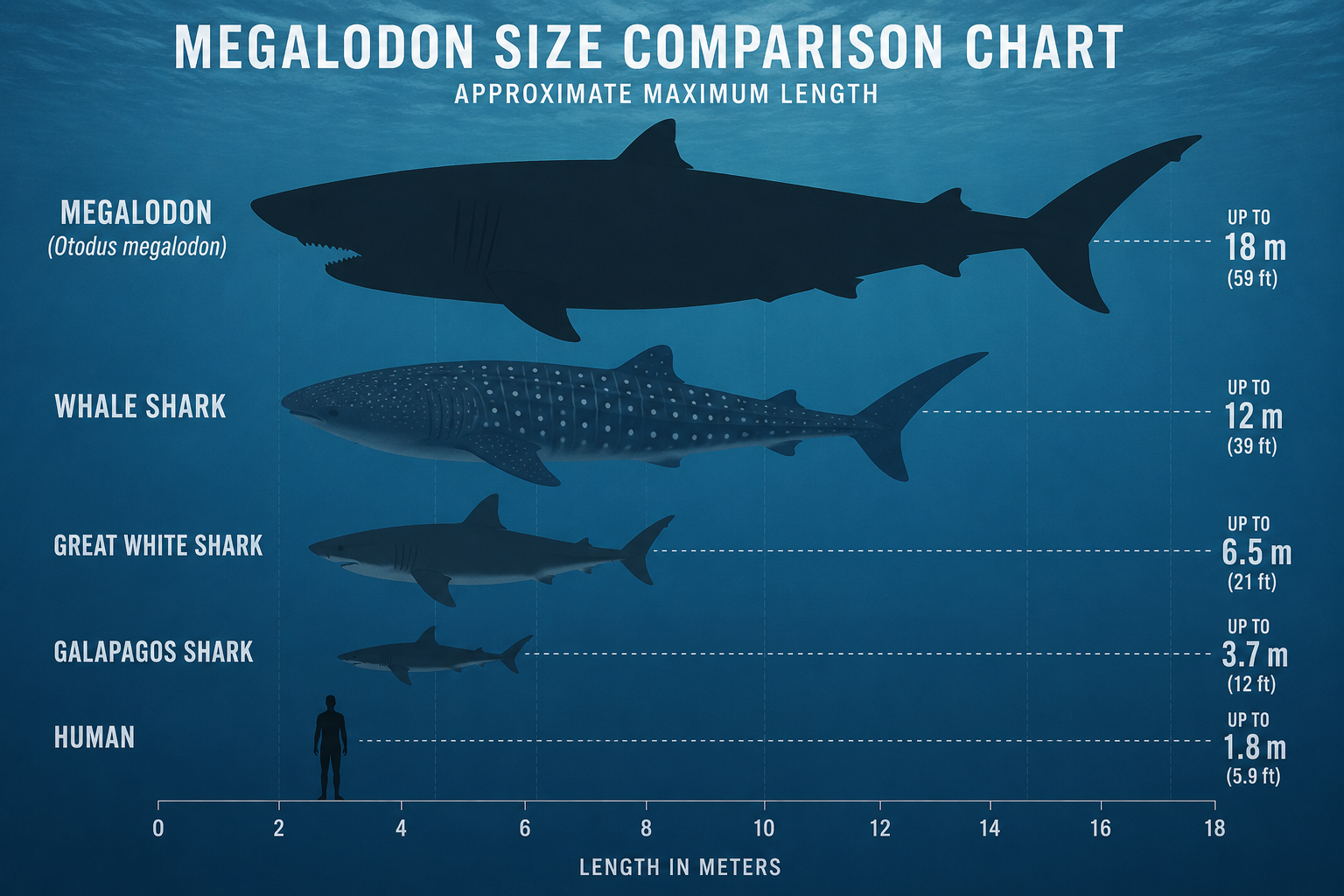
The megalodon is the largest predatory shark that has ever existed. For nearly twenty million years, from the early Miocene until the late Pliocene, Otodus megalodon patrolled warm coastal oceans on every continent except Antarctica, feeding on whales, pinnipeds, and anything else large enough to be worth the energy of a strike. It went extinct roughly 3.6 million years ago.
Despite persistent urban legends and a Hollywood film franchise, no megalodon is alive today, and the fossil record is unambiguous on that point.
This guide covers every aspect of megalodon biology, behaviour, and ecology that the fossil record will support: body size and shape, teeth and bite mechanics, hunting and prey, nursery grounds, geographic range, taxonomic controversy, and the combination of ecological pressures that drove the species to extinction.
It is a reference entry, not a summary - so expect specifics: metres, tonnes, newtons, millions of years, and the honest disagreements between palaeontologists about how to read the evidence.
Etymology and Classification
The name megalodon comes from the Greek words megas (big) and odous (tooth). It is one of the more literal names in palaeontology. The species was first described in 1843 by the Swiss-American naturalist Louis Agassiz under the name Carcharodon megalodon, placing it alongside the modern great white shark. That classification has since been revised multiple times.
Taxonomic history in brief:
- 1843: Carcharodon megalodon (Agassiz)
- Mid-20th century: Retained in Carcharodon by many authors
- Late 20th century: Moved to Carcharocles by researchers who argued megalodon's teeth descended from an ancient otodontid lineage, not from the great white's family
- 21st century: Current consensus places megalodon in Otodus, alongside its close relatives Otodus obliquus and Otodus chubutensis
The key point is that the modern great white shark (Carcharodon carcharias) is not a descendant of megalodon. The two are distantly related lamniform sharks from different families - Lamnidae for the great white, Otodontidae for megalodon - that happened to converge on some similar ecological roles.
The older idea that megalodon and great whites are ancestor and descendant is no longer supported by tooth morphology or stratigraphy. The two lineages overlap in the Pliocene fossil record, meaning juvenile great whites and adult megalodons almost certainly shared the same oceans for a time.
Full taxonomic placement:
- Kingdom: Animalia
- Phylum: Chordata
- Class: Chondrichthyes (cartilaginous fish)
- Order: Lamniformes (mackerel sharks)
- Family: Otodontidae (megatoothed sharks, extinct)
- Genus: Otodus
- Species: O. megalodon
Size and Physical Description
Megalodon is the largest shark in the fossil record and one of the largest marine predators ever. Exact size estimates, however, are a matter of ongoing debate because palaeontologists are working from teeth and vertebral centra rather than articulated skeletons.
Length estimates:
- Most commonly cited adult range: 15-18 metres
- Upper-bound estimates from some studies: up to 20 metres
- Lower-bound re-analyses: closer to 14-16 metres for typical adults
Mass estimates:
- Common range: 50-70 tonnes
- Upper estimates (2022 reconstruction): up to 100 tonnes
- 2024 re-analysis: substantially lower, arguing for a more slender body
A 2022 three-dimensional reconstruction based on scaling from modern lamniform sharks proposed a stout, sperm-whale-like body plan for megalodon, with total length around 20 metres and body mass near 100 tonnes. That reconstruction produced the widely circulated image of a massive, torpedo-like animal.
A 2024 study re-examined the vertebral and tooth evidence and argued the earlier reconstruction overestimated girth; the revised body shape is more slender, closer in proportion to a modern shortfin mako, which lowers the total mass estimate considerably. Both sides of that debate still arrive at an animal larger than any shark alive today by a wide margin.
Megalodon's jaw gape, reconstructed from tooth sockets and jaw fragments, is estimated at more than 2 metres wide. That is large enough to swallow a standing adult human in a single bite, which is an unpleasant but accurate visual for readers who want a sense of scale.
The Teeth
Megalodon is known almost entirely from its teeth. Those teeth are the reason the species was discovered, named, and endlessly debated. They are also genuinely remarkable.
Tooth characteristics:
- Size: up to 18 centimetres along the diagonal - roughly the size of a grown human hand
- Shape: triangular, symmetrical, slightly curved
- Edges: finely serrated along both cutting surfaces
- Root: thick and broad, anchoring the tooth deeply in the jaw
- Colour (fossil): black, brown, grey, or blue depending on the mineral environment where they fossilised
Megalodon teeth are the largest teeth of any shark species that has ever lived. For comparison, a mature great white shark tooth tops out around 7 centimetres. A single fully grown megalodon carried roughly 250 teeth across five functional rows, with replacement teeth developing continuously behind the active row.
Over a single individual's lifetime, the animal shed thousands of teeth into the seabed - which is why megalodon teeth are among the most commonly collected marine fossils on the planet despite the species being extinct for millions of years.
The serrations are the decisive anatomical feature. Fine serrations along the cutting edge allowed the teeth to slice through cartilage, blubber, and bone the way a steak knife cuts through tough meat. Unserrated shark teeth puncture and grip; serrated teeth shear. Megalodon's serrations, combined with the teeth's enormous size and the animal's bite force, produced a feeding apparatus capable of removing a roughly head-sized chunk of flesh in a single closing motion.
Bite Force and Hunting Mechanics
Biomechanical studies have estimated megalodon's bite force at 108,514 to 182,201 newtons. That is the strongest bite force ever calculated for any animal, extinct or alive.
Comparative bite forces:
| Animal | Estimated bite force (N) |
|---|---|
| Megalodon | 108,514-182,201 |
| Tyrannosaurus rex | ~35,000-57,000 |
| Saltwater crocodile | ~16,000 |
| Great white shark | ~18,000 |
| Spotted hyena | ~4,500 |
| Lion | ~4,000 |
| Human | ~1,100 |
A bite force an order of magnitude greater than a modern great white, delivered by jaws over two metres wide, through serrated hand-sized teeth, is a combination with no modern parallel. Fossil whale bones from Miocene and Pliocene deposits - particularly vertebrae, flipper bones, and ribs - routinely carry distinctive megalodon tooth marks. In some fossil specimens, the marks are so deep that the teeth embedded in the bone broke off and fossilised in place.
Megalodon hunting behaviour can be reconstructed from those bite marks. The pattern is consistent and striking: early bites tend to cluster around the base of the flippers and tail of cetacean prey, suggesting the shark deliberately crippled its target before moving to finishing bites on the thorax.
This matches behaviours seen in some modern large predators - and is very different from the single killing bite of a modern great white on a seal. Megalodon seems to have approached big prey like an engineer: disable mobility first, then dismantle at leisure.
Ambush from below is the most likely attack vector. Analyses of megalodon's estimated acceleration and turning capability are consistent with a fast vertical strike from the dark water below, targeting the silhouette of a whale against the sunlit surface. This is similar in principle to how modern great white sharks ambush seals, but scaled up to whale-sized targets.
Diet and Prey
Megalodon was a macropredator - an animal that fed primarily on other large animals. The fossil record gives an unusually detailed picture of its diet because tooth marks on prey bones are preserved alongside megalodon teeth themselves in many localities.
Primary prey:
- Baleen whales (Mysticeti), particularly small and medium-sized species
- Early toothed whales (Odontoceti), including ancestral sperm whales and dolphins
- Pinnipeds: early seals, sea lions, and walruses
- Sirenians: ancestors of modern manatees and dugongs
- Large bony fish
- Sea turtles
The species coexisted with a Miocene-Pliocene marine fauna that was substantially richer in large cetaceans than today's oceans. Warm coastal shelves supported dense populations of small-to-medium baleen whales that were ecologically suited to megalodon's ambush-from-below hunting style.
When those whale populations restructured during the Pliocene - with some species going extinct, others moving to cooler deep water, and others simply becoming larger and harder to kill - megalodon's food base started to collapse.
Pinnipeds were an important secondary food source, particularly for smaller, younger megalodons that had not yet reached the size needed to take on adult whales. The same fossil sites that preserve megalodon teeth often preserve the bones of early pinnipeds with characteristic bite damage, and juvenile megalodon teeth are frequently concentrated in the shallow coastal sediments where pinnipeds hauled out.
Nursery Grounds and Life History
One of the most interesting features of megalodon ecology is the existence of identifiable nursery grounds - shallow coastal environments where juvenile sharks grew up before moving to open water as adults.
Confirmed or probable nursery sites:
- Gatun Formation, Panama (Miocene, extensively studied)
- Cabo area, Baja California, Mexico
- Atlantic coastal shelves of North America (several sites)
- Western European coastal deposits
Nursery sites are identified by concentrations of small megalodon teeth - that is, teeth of juveniles rather than adults - often occurring in shallow-water sediments with abundant smaller prey species. The pattern closely parallels the nursery behaviour of modern lamniform sharks, which also use productive coastal environments as safer growth grounds before juveniles move to open water.
Life history details are sparse but internally consistent. Megalodon, like modern lamniforms, was almost certainly ovoviviparous - eggs developed inside the mother, and pups were born live. Estimated pup size at birth is large, possibly 2 metres or more, comparable to a full-grown modern great white.
Pups grew slowly in nurseries, feeding on smaller fish and marine mammals, before reaching the body size required to target adult cetaceans. Total lifespan estimates, extrapolated from vertebral growth bands in the few available megalodon vertebral centra, suggest individuals could live 50 years or more, though the data are limited.
Geographic Range and Habitat
Megalodon had a near-global distribution across warm coastal and continental shelf waters.
Range:
| Region | Evidence |
|---|---|
| Atlantic coast of N. America | Abundant teeth from South Carolina to Florida |
| Pacific coast of N. America | California, Baja Mexico |
| Central America / Caribbean | Panama (Gatun Formation), Venezuela |
| South America | Peru, Chile, Argentina |
| Mediterranean basin | Italy, Malta, Morocco |
| Western Europe | Belgium, Netherlands, UK (Pliocene sediments) |
| Africa | North, West, and South African coastal sites |
| Indo-Pacific | Japan, Philippines, Indonesia, Australia |
Megalodon is absent from polar regions. The species' preferred habitat was warm coastal and shelf waters with abundant marine mammal prey. That thermal preference is one of the central pieces of evidence in the Pliocene extinction story: as global climate cooled and warm coastal habitat shrank, megalodon had less suitable territory to operate in, and the prey species it depended on redistributed away from the coastal shelves into waters that were harder for megalodon to hunt in.
Extinction
Megalodon went extinct around 3.6 million years ago, at or near the Pliocene-Pleistocene transition. No single cause has been proven, but three linked factors are consistently identified in the palaeoecological literature.
Proposed drivers of extinction:
- Climate cooling. The Pliocene saw a global cooling trend that reduced the extent of warm coastal waters. Megalodon was thermally restricted to warm seas, and its preferred hunting grounds shrank accordingly.
- Prey decline and restructuring. Several lineages of small-to-medium baleen whales - the bread and butter of a megalodon's diet - went extinct or declined during the Pliocene. Others evolved toward larger body sizes, faster swimming speeds, and more oceanic distributions that made them harder for a coastal ambush predator to catch.
- Competition. The late Miocene and Pliocene saw the rise of faster, more agile predators including early great white sharks (Carcharodon carcharias, first clear fossils around 3-4 million years ago) and orca-like toothed whales. These predators could target the same prey species more efficiently in the restructured marine ecosystem, squeezing megalodon out of its niche.
The fossil record is unambiguous on the timing. Megalodon teeth are extremely common in Miocene and early Pliocene sediments. They vanish in the late Pliocene. No younger teeth have ever been reliably dated, despite megalodon teeth being among the most-collected marine fossils on Earth.
The 'Is Megalodon Still Alive?' Question
Claims that megalodon might still exist in the deep ocean are a recurring feature of popular culture, amplified by the 2018 film The Meg and its sequels. There is no evidence supporting those claims, and several strong lines of evidence against them.
Why megalodon is definitively extinct:
- Megalodon teeth are continuously shed and fossilise well. If the species existed today, its teeth would appear routinely in modern sediments, beach collections, and trawl catches. They do not. The most recent reliably dated megalodon teeth are roughly 3.6 million years old.
- Megalodon was a warm-water coastal predator, not a deep-sea animal. The deep ocean hypothesis invoked in conspiracy theories does not match the species' ecology.
- Megalodon fed on large marine mammals in productive coastal waters. A population large enough to be self-sustaining would leave obvious ecological evidence - whale carcasses with fresh megalodon bite marks, for instance - and none exists.
- The species went extinct during a well-documented ecological transition. The drivers of that extinction have not reversed, so there is no habitat to support a relic population.
Megalodon is as extinct as Tyrannosaurus rex. It is a remarkable animal, and it is also firmly in the past.
Why Megalodon Skeletons Are Rare
One of the most frequently asked questions about megalodon is why no complete skeleton has ever been found. The answer is basic chondrichthyan anatomy.
Sharks are cartilaginous fish. Their skeletons are made of cartilage - a softer, more flexible tissue than bone - and cartilage rarely fossilises. It lacks the hard mineralised matrix that survives millions of years of burial and diagenesis. When a shark dies, the cartilage typically decays before fossilisation begins, leaving only the hardest parts of the animal behind.
What does fossilise:
- Teeth: dentine and enamel, extremely durable
- Vertebral centra: partially calcified disks that can survive under favourable conditions
- Jaw fragments: occasionally, in exceptional preservation
What does not fossilise:
- Full skeleton
- Cartilaginous jaw structures (except as impressions)
- Soft tissues, skin, fins
Because of this, every size estimate, body shape reconstruction, and behavioural inference for megalodon is necessarily scaled from teeth and the occasional vertebral column, using modern lamniform sharks as reference. This is why size estimates vary so widely between studies. Different scaling assumptions applied to the same fossils produce different answers, and there is no complete articulated skeleton to resolve the disagreement.
Megalodon in Culture
The megalodon occupies a unique position in popular imagination. It is one of the few extinct animals most people can name, alongside Tyrannosaurus rex and the woolly mammoth. The sheer size of its teeth, combined with its relatively recent extinction (geologically speaking), makes it a persistent favourite in documentaries, fiction, and conspiracy theories.
The 2018 film The Meg, based on a novel by Steve Alten, pushed the cultural profile of megalodon into a new gear - and also amplified the conspiracy theory that the species might still exist in the deep ocean. Marine biologists have consistently pushed back on the film's premise, and most popular science coverage now treats the 'still alive' question as settled rather than open.
What remains genuinely open - and scientifically interesting - is the question of exactly how big megalodon was, what shape its body had, and how it behaved, all of which are areas of active research.
Related Reading
- Megalodon Bite Force Explained
- How Sharks Fossilise
- Prehistoric Marine Predators
- Great White Shark: Living Apex Predator
References
Relevant peer-reviewed sources consulted for this entry include Cooper et al. (2022) in Science Advances on three-dimensional megalodon body reconstruction, Sternes et al. (2024) re-analysis of megalodon body shape in Palaeontologia Electronica, Pimiento and Clements (2014) on megalodon extinction timing in PLoS ONE, Pimiento et al.
(2010) on the Gatun Formation nursery site, Wroe et al. on lamniform bite force estimation, and consolidated literature reviews published by the Florida Museum of Natural History and the Smithsonian National Museum of Natural History. Taxonomic placement follows current consensus usage of Otodus megalodon within Otodontidae.
Frequently Asked Questions
How big was the megalodon?
Megalodon (Otodus megalodon) was the largest predatory shark that has ever lived. Length estimates based on tooth dimensions and comparisons with living lamniform sharks cluster in the 15-20 metre range, with mass estimates between 50 and 100 tonnes. A 2022 three-dimensional reconstruction proposed a sperm-whale-like body plan that could reach 20 m and 100 tonnes.
A 2024 study pushed back, arguing the body was more slender - closer to a mako shark in proportions - which lowers the total mass estimate. What is not in doubt is that megalodon dwarfed any shark alive today. A mature great white tops out around 6 metres; megalodon was at least twice that long and many times heavier.
What did megalodon eat?
Megalodon was a macropredatory hypercarnivore specialised for hunting large marine mammals. Primary prey included whales (baleen whales and early toothed whales), dolphins, pinnipeds such as seals and early sea lions, sirenians, large bony fish, and sea turtles. Fossil whale bones from the Miocene and Pliocene carry distinctive serrated bite marks that match megalodon tooth morphology exactly.
Many of these marks cluster around the base of the flippers and tail, suggesting megalodon deliberately crippled prey before delivering finishing bites to the thorax. A single large whale could provide enough energy for weeks, which matches what biologists see in modern macropredators that invest huge effort per kill.
How strong was megalodon's bite?
Biomechanical modelling estimates megalodon’s bite force at 108,514 to 182,201 newtons. This is the strongest bite force ever calculated for any animal, living or extinct - roughly ten times stronger than a modern great white shark and several times stronger than the estimated bite force of Tyrannosaurus rex. The serrated triangular teeth were designed to slice through blubber, muscle, and bone in a single closing motion.
Tooth-on-bone fossil evidence confirms megalodon routinely crushed the ribcages of whales several metres long. Combined with the sheer size of the jaw (reconstructed jaw gape estimates exceed 2 metres wide), this bite was one of the most destructive feeding mechanisms ever evolved.
Where and when did megalodon live?
Megalodon lived from roughly 23 million years ago in the early Miocene to about 3.6 million years ago in the late Pliocene - a run of just under 20 million years. Its range was global but restricted to warm coastal and continental shelf waters.
Fossil teeth have been recovered from every continent except Antarctica, with major concentrations along the Atlantic coast of North America, the Pacific coast of Central America, the Mediterranean, southern Europe, Japan, and Australia. The species did not inhabit polar seas because its physiology appears to have required warmer water.
Nursery sites have been identified in shallow palaeo-coastal environments such as the Gatun Formation in Panama and Cabo, Baja California.
Why did megalodon go extinct?
Megalodon went extinct around 3.6 million years ago. No single cause has been proven, but three factors are consistently implicated. First, global climate cooling at the Pliocene boundary reduced the warm coastal waters that megalodon preferred and disrupted the productivity patterns its prey depended on.
Second, the large baleen whales that formed much of the diet were themselves in flux - some species declined, others became more mobile and oceanic, moving out of the warm coastal shelves where megalodon hunted. Third, competition with newly evolved smaller, faster predators - including the ancestors of the modern great white shark and orca-like cetaceans - likely squeezed megalodon out of its ecological niche.
The species’ extinction is unambiguous in the fossil record.
Is megalodon still alive today?
No. Megalodon has been extinct for approximately 3.6 million years. This is a scientific consensus supported by a complete absence of fossil teeth younger than the late Pliocene, despite megalodon teeth being among the most commonly collected marine fossils on Earth. If the species still existed, teeth would routinely wash up on modern beaches or be collected from seabed surveys - they do not.
Arguments that megalodon might survive in the deep ocean do not hold up because the species was a warm-water coastal predator dependent on abundant marine mammal prey, not a deep-sea animal. The 2018 film ‘The Meg’ and its sequels entertain the idea for dramatic purposes, but no peer-reviewed evidence supports the claim. Megalodon is as extinct as Tyrannosaurus rex.
Why are megalodon skeletons so rare?
Megalodon skeletons are effectively absent from the fossil record because sharks have cartilaginous skeletons rather than bony ones. Cartilage does not mineralise well and rarely survives the fossilisation process. What we have are teeth - which are composed of hard dentine and enamel and preserve exceptionally well - and occasionally vertebral centra, the partially calcified disks at the core of each vertebra.
Teeth are produced continuously throughout a shark’s life (a single megalodon shed thousands over its lifetime) and have been collected by the tens of thousands globally. Full-body reconstructions rely on scaling relationships derived from living lamniform sharks rather than on articulated skeletons.
Was megalodon related to the great white shark?
Megalodon and the great white shark are related only distantly. Both are lamniform sharks - the mackerel shark order - but they sit in separate families. The modern great white (Carcharodon carcharias) belongs to the family Lamnidae. Megalodon belongs to the family Otodontidae, a now-extinct lineage of megatoothed sharks. Earlier taxonomists placed megalodon in Carcharodon or Carcharocles, but current consensus places it in Otodus.
The two lineages coexisted during part of the Pliocene, and some researchers argue that competition with early great whites contributed to megalodon’s extinction. What is clear is that the great white did not evolve from megalodon - they are cousins on different branches, not ancestor and descendant.